


jQuery 5 – jQuery UI
By- Manish Singh
Topics in This Section
• Overview
• Installation and Setup
• Widgets
– Static tabbed panels
– Ajax tabbed panels
– Accordion panels
– Date picker
– Slider
– Progress bar
Overview
• Set of rich GUI elements and effects
– Tabbed panels, slider, etc
– Effects similar to Scripaculous
– Drag and drop API
• Pros
– Official part of jQuery
– Well tested
– Very clean design
– Many still show meaningful results if JavaScript
disabled
– Theming framework
• Cons
– No autocompleter (!)
– Not as extensive as Dojo, ext/JS, or YUI
Downloading
• Download custom bundle
– http://jqueryui.com/download
– Select widgets and effects you want
– Press “Download” to download ZIP file of result
• Unzip
– Unzip result into location of your choice
• Download additional themes
– http://jqueryui.com/download
– Deselect all widgets and options, choose different theme
• You can also interactively build a customized theme
– Unzip and copy entries in “css” folder to “css” folder of
original download
• Bookmark the documentation
– http://docs.jquery.com/UI/
Installing Files
• Load normal jQuery as before
– jQuery UI download gives an additional copy in “js”
folder, so if you are using jQuery UI, one download
from jqueryui.com is sufficient
• As discussed in previous sections, it is common to
rename jQuery-1.3.x.min.js to jQuery.js to simplify
upgrades
• Copy jQuery-ui-1.7.x.custom.min.js
– E.g., copy download_folder/js/jQuery-ui-
1.7.x.custom.min.js to WebContent/scripts
– It is common to leave detailed name for this file,
since UI capabilities change from version to version
• Copy CSS “theme” folder
– E.g., copy download_folder/css/ui-lightness to
WebContent/css/
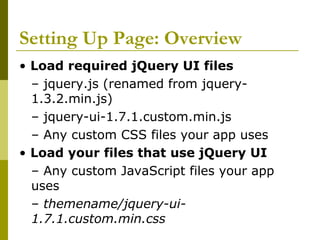
Setting Up Page: Overview
• Load required jQuery UI files
– jquery.js (renamed from jquery-
1.3.2.min.js)
– jquery-ui-1.7.1.custom.min.js
– Any custom CSS files your app uses
• Load your files that use jQuery UI
– Any custom JavaScript files your app
uses
– themename/jquery-ui-
1.7.1.custom.min.css
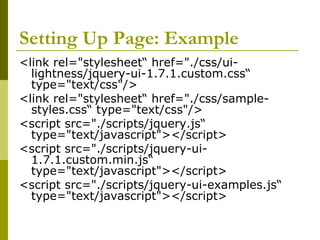
Setting Up Page: Example
<link rel="stylesheet“ href="./css/ui-
lightness/jquery-ui-1.7.1.custom.css“
type="text/css"/>
<link rel="stylesheet“ href="./css/sample-
styles.css“ type="text/css"/>
<script src="./scripts/jquery.js“
type="text/javascript"></script>
<script src="./scripts/jquery-ui-
1.7.1.custom.min.js“
type="text/javascript"></script>
<script src="./scripts/jquery-ui-examples.js“
type="text/javascript"></script>
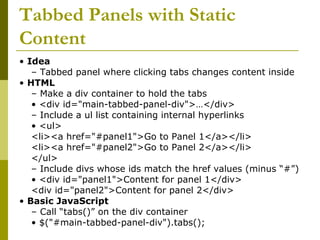
Tabbed Panels with Static
Content
• Idea
– Tabbed panel where clicking tabs changes content inside
• HTML
– Make a div container to hold the tabs
• <div id="main-tabbed-panel-div">…</div>
– Include a ul list containing internal hyperlinks
• <ul>
<li><a href="#panel1">Go to Panel 1</a></li>
<li><a href="#panel2">Go to Panel 2</a></li>
</ul>
– Include divs whose ids match the href values (minus “#”)
• <div id="panel1">Content for panel 1</div>
<div id="panel2">Content for panel 2</div>
• Basic JavaScript
– Call “tabs()” on the div container
• $("#main-tabbed-panel-div").tabs();
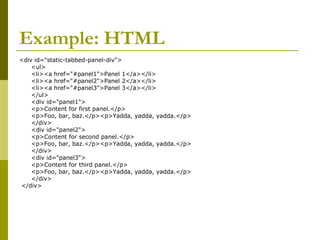
Example: HTML
<div id="static-tabbed-panel-div">
<ul>
<li><a href="#panel1">Panel 1</a></li>
<li><a href="#panel2">Panel 2</a></li>
<li><a href="#panel3">Panel 3</a></li>
</ul>
<div id="panel1">
<p>Content for first panel.</p>
<p>Foo, bar, baz.</p><p>Yadda, yadda, yadda.</p>
</div>
<div id="panel2">
<p>Content for second panel.</p>
<p>Foo, bar, baz.</p><p>Yadda, yadda, yadda.</p>
</div>
<div id="panel3">
<p>Content for third panel.</p>
<p>Foo, bar, baz.</p><p>Yadda, yadda, yadda.</p>
</div>
</div>
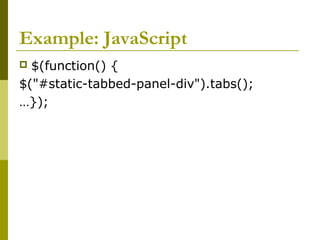
Example: JavaScript
 $(function() {
$("#static-tabbed-panel-div").tabs();
…});
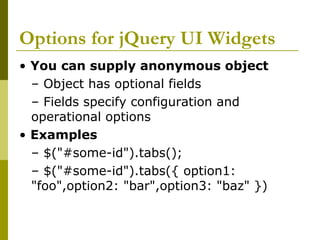
Options for jQuery UI Widgets
• You can supply anonymous object
– Object has optional fields
– Fields specify configuration and
operational options
• Examples
– $("#some-id").tabs();
– $("#some-id").tabs({ option1:
"foo",option2: "bar",option3: "baz" })
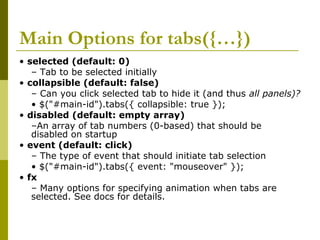
Main Options for tabs({…})
• selected (default: 0)
– Tab to be selected initially
• collapsible (default: false)
– Can you click selected tab to hide it (and thus all panels)?
• $("#main-id").tabs({ collapsible: true });
• disabled (default: empty array)
–An array of tab numbers (0-based) that should be
disabled on startup
• event (default: click)
– The type of event that should initiate tab selection
• $("#main-id").tabs({ event: "mouseover" });
• fx
– Many options for specifying animation when tabs are
selected. See docs for details.
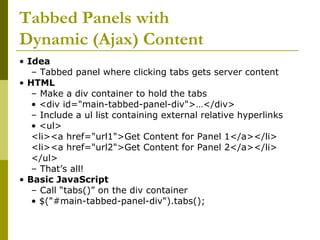
Tabbed Panels with
Dynamic (Ajax) Content
• Idea
– Tabbed panel where clicking tabs gets server content
• HTML
– Make a div container to hold the tabs
• <div id="main-tabbed-panel-div">…</div>
– Include a ul list containing external relative hyperlinks
• <ul>
<li><a href="url1">Get Content for Panel 1</a></li>
<li><a href="url2">Get Content for Panel 2</a></li>
</ul>
– That’s all!
• Basic JavaScript
– Call “tabs()” on the div container
• $("#main-tabbed-panel-div").tabs();
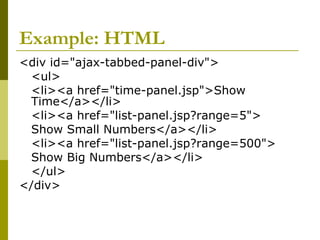
Example: HTML
<div id="ajax-tabbed-panel-div">
<ul>
<li><a href="time-panel.jsp">Show
Time</a></li>
<li><a href="list-panel.jsp?range=5">
Show Small Numbers</a></li>
<li><a href="list-panel.jsp?range=500">
Show Big Numbers</a></li>
</ul>
</div>
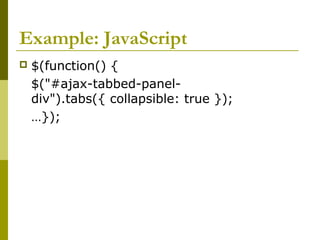
Example: JavaScript
 $(function() {
$("#ajax-tabbed-panel-
div").tabs({ collapsible: true });
…});
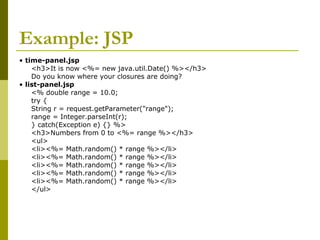
Example: JSP
• time-panel.jsp
<h3>It is now <%= new java.util.Date() %></h3>
Do you know where your closures are doing?
• list-panel.jsp
<% double range = 10.0;
try {
String r = request.getParameter("range");
range = Integer.parseInt(r);
} catch(Exception e) {} %>
<h3>Numbers from 0 to <%= range %></h3>
<ul>
<li><%= Math.random() * range %></li>
</ul>
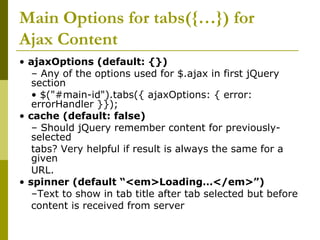
Main Options for tabs({…}) for
Ajax Content
• ajaxOptions (default: {})
– Any of the options used for $.ajax in first jQuery
section
• $("#main-id").tabs({ ajaxOptions: { error:
errorHandler }});
• cache (default: false)
– Should jQuery remember content for previously-
selected
tabs? Very helpful if result is always the same for a
given
URL.
• spinner (default “<em>Loading…</em>”)
–Text to show in tab title after tab selected but before
content is received from server
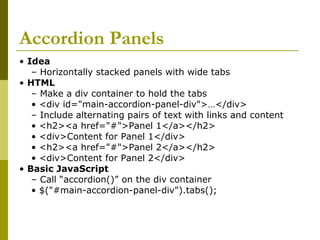
Accordion Panels
• Idea
– Horizontally stacked panels with wide tabs
• HTML
– Make a div container to hold the tabs
• <div id="main-accordion-panel-div">…</div>
– Include alternating pairs of text with links and content
• <h2><a href="#">Panel 1</a></h2>
• <div>Content for Panel 1</div>
• <h2><a href="#">Panel 2</a></h2>
• <div>Content for Panel 2</div>
• Basic JavaScript
– Call “accordion()” on the div container
• $("#main-accordion-panel-div").tabs();
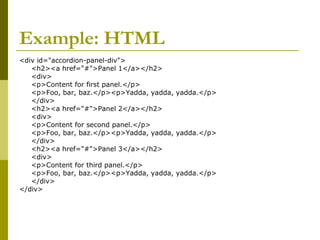
Example: HTML
<div id="accordion-panel-div">
<h2><a href="#">Panel 1</a></h2>
<div>
<p>Content for first panel.</p>
<p>Foo, bar, baz.</p><p>Yadda, yadda, yadda.</p>
</div>
<h2><a href="#">Panel 2</a></h2>
<div>
<p>Content for second panel.</p>
<p>Foo, bar, baz.</p><p>Yadda, yadda, yadda.</p>
</div>
<h2><a href="#">Panel 3</a></h2>
<div>
<p>Content for third panel.</p>
<p>Foo, bar, baz.</p><p>Yadda, yadda, yadda.</p>
</div>
</div>
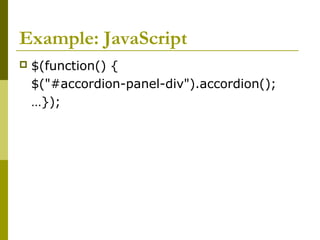
Example: JavaScript
 $(function() {
$("#accordion-panel-div").accordion();
…});
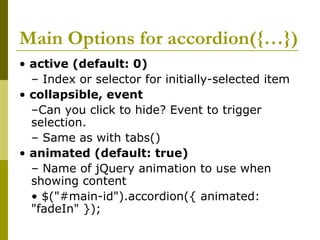
Main Options for accordion({…})
• active (default: 0)
– Index or selector for initially-selected item
• collapsible, event
–Can you click to hide? Event to trigger
selection.
– Same as with tabs()
• animated (default: true)
– Name of jQuery animation to use when
showing content
• $("#main-id").accordion({ animated:
"fadeIn" });
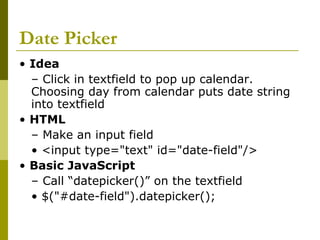
Date Picker
• Idea
– Click in textfield to pop up calendar.
Choosing day from calendar puts date string
into textfield
• HTML
– Make an input field
• <input type="text" id="date-field"/>
• Basic JavaScript
– Call “datepicker()” on the textfield
• $("#date-field").datepicker();
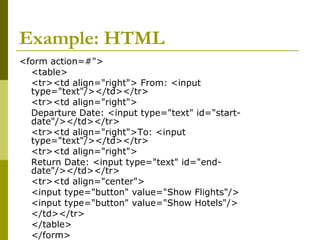
Example: HTML
<form action=#">
<table>
<tr><td align="right"> From: <input
type="text"/></td></tr>
<tr><td align="right">
Departure Date: <input type="text" id="start-
date"/></td></tr>
<tr><td align="right">To: <input
type="text"/></td></tr>
<tr><td align="right">
Return Date: <input type="text" id="end-
date"/></td></tr>
<tr><td align="center">
<input type="button" value="Show Flights"/>
<input type="button" value="Show Hotels"/>
</td></tr>
</table>
</form>
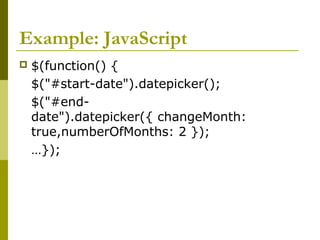
Example: JavaScript
 $(function() {
$("#start-date").datepicker();
$("#end-
date").datepicker({ changeMonth:
true,numberOfMonths: 2 });
…});
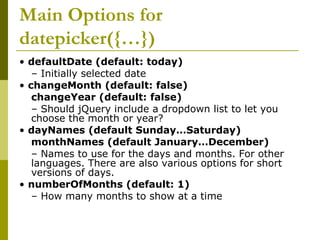
Main Options for
datepicker({…})
• defaultDate (default: today)
– Initially selected date
• changeMonth (default: false)
changeYear (default: false)
– Should jQuery include a dropdown list to let you
choose the month or year?
• dayNames (default Sunday…Saturday)
monthNames (default January…December)
– Names to use for the days and months. For other
languages. There are also various options for short
versions of days.
• numberOfMonths (default: 1)
– How many months to show at a time
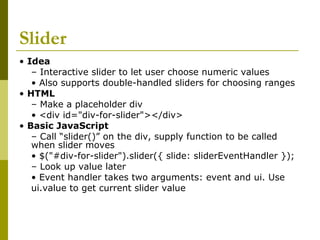
Slider
• Idea
– Interactive slider to let user choose numeric values
• Also supports double-handled sliders for choosing ranges
• HTML
– Make a placeholder div
• <div id="div-for-slider"></div>
• Basic JavaScript
– Call “slider()” on the div, supply function to be called
when slider moves
• $("#div-for-slider").slider({ slide: sliderEventHandler });
– Look up value later
• Event handler takes two arguments: event and ui. Use
ui.value to get current slider value
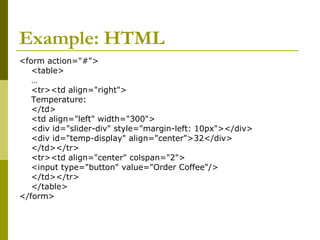
Example: HTML
<form action="#">
<table>
…
<tr><td align="right">
Temperature:
</td>
<td align="left" width="300">
<div id="slider-div" style="margin-left: 10px"></div>
<div id="temp-display" align="center">32</div>
</td></tr>
<tr><td align="center" colspan="2">
<input type="button" value="Order Coffee"/>
</td></tr>
</table>
</form>
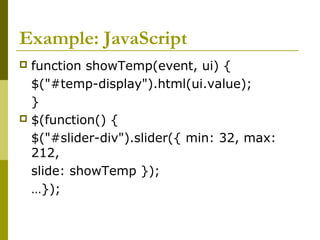
Example: JavaScript
 function showTemp(event, ui) {
$("#temp-display").html(ui.value);
}
 $(function() {
$("#slider-div").slider({ min: 32, max:
212,
slide: showTemp });
…});
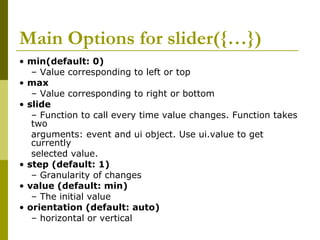
Main Options for slider({…})
• min(default: 0)
– Value corresponding to left or top
• max
– Value corresponding to right or bottom
• slide
– Function to call every time value changes. Function takes
two
arguments: event and ui object. Use ui.value to get
currently
selected value.
• step (default: 1)
– Granularity of changes
• value (default: min)
– The initial value
• orientation (default: auto)
– horizontal or vertical
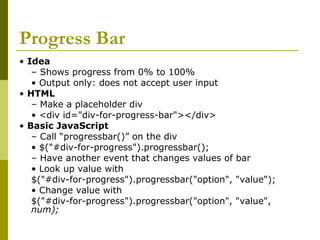
Progress Bar
• Idea
– Shows progress from 0% to 100%
• Output only: does not accept user input
• HTML
– Make a placeholder div
• <div id="div-for-progress-bar"></div>
• Basic JavaScript
– Call “progressbar()” on the div
• $("#div-for-progress").progressbar();
– Have another event that changes values of bar
• Look up value with
$("#div-for-progress").progressbar("option", "value");
• Change value with
$("#div-for-progress").progressbar("option", "value",
num);
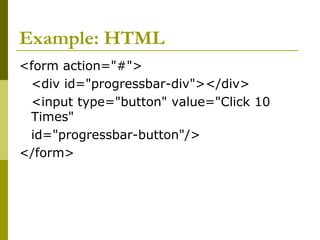
Example: HTML
<form action="#">
<div id="progressbar-div"></div>
<input type="button" value="Click 10
Times"
id="progressbar-button"/>
</form>
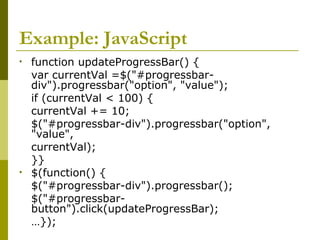
Example: JavaScript
• function updateProgressBar() {
var currentVal =$("#progressbar-
div").progressbar("option", "value");
if (currentVal < 100) {
currentVal += 10;
$("#progressbar-div").progressbar("option",
"value",
currentVal);
}}
• $(function() {
$("#progressbar-div").progressbar();
$("#progressbar-
button").click(updateProgressBar);
…});
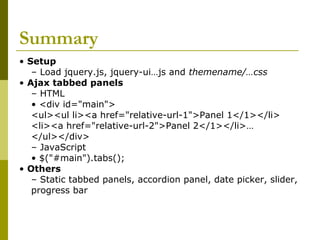
Summary
• Setup
– Load jquery.js, jquery-ui…js and themename/…css
• Ajax tabbed panels
– HTML
• <div id="main">
<ul><ul li><a href="relative-url-1">Panel 1</1></li>
<li><a href="relative-url-2">Panel 2</1></li>…
</ul></div>
– JavaScript
• $("#main").tabs();
• Others
– Static tabbed panels, accordion panel, date picker, slider,
progress bar
Questions??
Thank You
Email : immanish4u@gmail.com

Jquery 5

  • 1.
    jQuery 5 –jQuery UI By- Manish Singh
  • 2.
    Topics in ThisSection • Overview • Installation and Setup • Widgets – Static tabbed panels – Ajax tabbed panels – Accordion panels – Date picker – Slider – Progress bar
  • 3.
    Overview • Set ofrich GUI elements and effects – Tabbed panels, slider, etc – Effects similar to Scripaculous – Drag and drop API • Pros – Official part of jQuery – Well tested – Very clean design – Many still show meaningful results if JavaScript disabled – Theming framework • Cons – No autocompleter (!) – Not as extensive as Dojo, ext/JS, or YUI
  • 4.
    Downloading • Download custombundle – http://jqueryui.com/download – Select widgets and effects you want – Press “Download” to download ZIP file of result • Unzip – Unzip result into location of your choice • Download additional themes – http://jqueryui.com/download – Deselect all widgets and options, choose different theme • You can also interactively build a customized theme – Unzip and copy entries in “css” folder to “css” folder of original download • Bookmark the documentation – http://docs.jquery.com/UI/
  • 5.
    Installing Files • Loadnormal jQuery as before – jQuery UI download gives an additional copy in “js” folder, so if you are using jQuery UI, one download from jqueryui.com is sufficient • As discussed in previous sections, it is common to rename jQuery-1.3.x.min.js to jQuery.js to simplify upgrades • Copy jQuery-ui-1.7.x.custom.min.js – E.g., copy download_folder/js/jQuery-ui- 1.7.x.custom.min.js to WebContent/scripts – It is common to leave detailed name for this file, since UI capabilities change from version to version • Copy CSS “theme” folder – E.g., copy download_folder/css/ui-lightness to WebContent/css/
  • 6.
    Setting Up Page:Overview • Load required jQuery UI files – jquery.js (renamed from jquery- 1.3.2.min.js) – jquery-ui-1.7.1.custom.min.js – Any custom CSS files your app uses • Load your files that use jQuery UI – Any custom JavaScript files your app uses – themename/jquery-ui- 1.7.1.custom.min.css
  • 7.
    Setting Up Page:Example <link rel="stylesheet“ href="./css/ui- lightness/jquery-ui-1.7.1.custom.css“ type="text/css"/> <link rel="stylesheet“ href="./css/sample- styles.css“ type="text/css"/> <script src="./scripts/jquery.js“ type="text/javascript"></script> <script src="./scripts/jquery-ui- 1.7.1.custom.min.js“ type="text/javascript"></script> <script src="./scripts/jquery-ui-examples.js“ type="text/javascript"></script>
  • 8.
    Tabbed Panels withStatic Content • Idea – Tabbed panel where clicking tabs changes content inside • HTML – Make a div container to hold the tabs • <div id="main-tabbed-panel-div">…</div> – Include a ul list containing internal hyperlinks • <ul> <li><a href="#panel1">Go to Panel 1</a></li> <li><a href="#panel2">Go to Panel 2</a></li> </ul> – Include divs whose ids match the href values (minus “#”) • <div id="panel1">Content for panel 1</div> <div id="panel2">Content for panel 2</div> • Basic JavaScript – Call “tabs()” on the div container • $("#main-tabbed-panel-div").tabs();
  • 9.
    Example: HTML <div id="static-tabbed-panel-div"> <ul> <li><ahref="#panel1">Panel 1</a></li> <li><a href="#panel2">Panel 2</a></li> <li><a href="#panel3">Panel 3</a></li> </ul> <div id="panel1"> <p>Content for first panel.</p> <p>Foo, bar, baz.</p><p>Yadda, yadda, yadda.</p> </div> <div id="panel2"> <p>Content for second panel.</p> <p>Foo, bar, baz.</p><p>Yadda, yadda, yadda.</p> </div> <div id="panel3"> <p>Content for third panel.</p> <p>Foo, bar, baz.</p><p>Yadda, yadda, yadda.</p> </div> </div>
  • 10.
    Example: JavaScript  $(function(){ $("#static-tabbed-panel-div").tabs(); …});
  • 11.
    Options for jQueryUI Widgets • You can supply anonymous object – Object has optional fields – Fields specify configuration and operational options • Examples – $("#some-id").tabs(); – $("#some-id").tabs({ option1: "foo",option2: "bar",option3: "baz" })
  • 12.
    Main Options fortabs({…}) • selected (default: 0) – Tab to be selected initially • collapsible (default: false) – Can you click selected tab to hide it (and thus all panels)? • $("#main-id").tabs({ collapsible: true }); • disabled (default: empty array) –An array of tab numbers (0-based) that should be disabled on startup • event (default: click) – The type of event that should initiate tab selection • $("#main-id").tabs({ event: "mouseover" }); • fx – Many options for specifying animation when tabs are selected. See docs for details.
  • 13.
    Tabbed Panels with Dynamic(Ajax) Content • Idea – Tabbed panel where clicking tabs gets server content • HTML – Make a div container to hold the tabs • <div id="main-tabbed-panel-div">…</div> – Include a ul list containing external relative hyperlinks • <ul> <li><a href="url1">Get Content for Panel 1</a></li> <li><a href="url2">Get Content for Panel 2</a></li> </ul> – That’s all! • Basic JavaScript – Call “tabs()” on the div container • $("#main-tabbed-panel-div").tabs();
  • 14.
    Example: HTML <div id="ajax-tabbed-panel-div"> <ul> <li><ahref="time-panel.jsp">Show Time</a></li> <li><a href="list-panel.jsp?range=5"> Show Small Numbers</a></li> <li><a href="list-panel.jsp?range=500"> Show Big Numbers</a></li> </ul> </div>
  • 15.
    Example: JavaScript  $(function(){ $("#ajax-tabbed-panel- div").tabs({ collapsible: true }); …});
  • 16.
    Example: JSP • time-panel.jsp <h3>Itis now <%= new java.util.Date() %></h3> Do you know where your closures are doing? • list-panel.jsp <% double range = 10.0; try { String r = request.getParameter("range"); range = Integer.parseInt(r); } catch(Exception e) {} %> <h3>Numbers from 0 to <%= range %></h3> <ul> <li><%= Math.random() * range %></li> <li><%= Math.random() * range %></li> <li><%= Math.random() * range %></li> <li><%= Math.random() * range %></li> <li><%= Math.random() * range %></li> </ul>
  • 17.
    Main Options fortabs({…}) for Ajax Content • ajaxOptions (default: {}) – Any of the options used for $.ajax in first jQuery section • $("#main-id").tabs({ ajaxOptions: { error: errorHandler }}); • cache (default: false) – Should jQuery remember content for previously- selected tabs? Very helpful if result is always the same for a given URL. • spinner (default “<em>Loading…</em>”) –Text to show in tab title after tab selected but before content is received from server
  • 18.
    Accordion Panels • Idea –Horizontally stacked panels with wide tabs • HTML – Make a div container to hold the tabs • <div id="main-accordion-panel-div">…</div> – Include alternating pairs of text with links and content • <h2><a href="#">Panel 1</a></h2> • <div>Content for Panel 1</div> • <h2><a href="#">Panel 2</a></h2> • <div>Content for Panel 2</div> • Basic JavaScript – Call “accordion()” on the div container • $("#main-accordion-panel-div").tabs();
  • 19.
    Example: HTML <div id="accordion-panel-div"> <h2><ahref="#">Panel 1</a></h2> <div> <p>Content for first panel.</p> <p>Foo, bar, baz.</p><p>Yadda, yadda, yadda.</p> </div> <h2><a href="#">Panel 2</a></h2> <div> <p>Content for second panel.</p> <p>Foo, bar, baz.</p><p>Yadda, yadda, yadda.</p> </div> <h2><a href="#">Panel 3</a></h2> <div> <p>Content for third panel.</p> <p>Foo, bar, baz.</p><p>Yadda, yadda, yadda.</p> </div> </div>
  • 20.
    Example: JavaScript  $(function(){ $("#accordion-panel-div").accordion(); …});
  • 21.
    Main Options foraccordion({…}) • active (default: 0) – Index or selector for initially-selected item • collapsible, event –Can you click to hide? Event to trigger selection. – Same as with tabs() • animated (default: true) – Name of jQuery animation to use when showing content • $("#main-id").accordion({ animated: "fadeIn" });
  • 22.
    Date Picker • Idea –Click in textfield to pop up calendar. Choosing day from calendar puts date string into textfield • HTML – Make an input field • <input type="text" id="date-field"/> • Basic JavaScript – Call “datepicker()” on the textfield • $("#date-field").datepicker();
  • 23.
    Example: HTML <form action=#"> <table> <tr><tdalign="right"> From: <input type="text"/></td></tr> <tr><td align="right"> Departure Date: <input type="text" id="start- date"/></td></tr> <tr><td align="right">To: <input type="text"/></td></tr> <tr><td align="right"> Return Date: <input type="text" id="end- date"/></td></tr> <tr><td align="center"> <input type="button" value="Show Flights"/> <input type="button" value="Show Hotels"/> </td></tr> </table> </form>
  • 24.
    Example: JavaScript  $(function(){ $("#start-date").datepicker(); $("#end- date").datepicker({ changeMonth: true,numberOfMonths: 2 }); …});
  • 25.
    Main Options for datepicker({…}) •defaultDate (default: today) – Initially selected date • changeMonth (default: false) changeYear (default: false) – Should jQuery include a dropdown list to let you choose the month or year? • dayNames (default Sunday…Saturday) monthNames (default January…December) – Names to use for the days and months. For other languages. There are also various options for short versions of days. • numberOfMonths (default: 1) – How many months to show at a time
  • 26.
    Slider • Idea – Interactiveslider to let user choose numeric values • Also supports double-handled sliders for choosing ranges • HTML – Make a placeholder div • <div id="div-for-slider"></div> • Basic JavaScript – Call “slider()” on the div, supply function to be called when slider moves • $("#div-for-slider").slider({ slide: sliderEventHandler }); – Look up value later • Event handler takes two arguments: event and ui. Use ui.value to get current slider value
  • 27.
    Example: HTML <form action="#"> <table> … <tr><tdalign="right"> Temperature: </td> <td align="left" width="300"> <div id="slider-div" style="margin-left: 10px"></div> <div id="temp-display" align="center">32</div> </td></tr> <tr><td align="center" colspan="2"> <input type="button" value="Order Coffee"/> </td></tr> </table> </form>
  • 28.
    Example: JavaScript  functionshowTemp(event, ui) { $("#temp-display").html(ui.value); }  $(function() { $("#slider-div").slider({ min: 32, max: 212, slide: showTemp }); …});
  • 29.
    Main Options forslider({…}) • min(default: 0) – Value corresponding to left or top • max – Value corresponding to right or bottom • slide – Function to call every time value changes. Function takes two arguments: event and ui object. Use ui.value to get currently selected value. • step (default: 1) – Granularity of changes • value (default: min) – The initial value • orientation (default: auto) – horizontal or vertical
  • 30.
    Progress Bar • Idea –Shows progress from 0% to 100% • Output only: does not accept user input • HTML – Make a placeholder div • <div id="div-for-progress-bar"></div> • Basic JavaScript – Call “progressbar()” on the div • $("#div-for-progress").progressbar(); – Have another event that changes values of bar • Look up value with $("#div-for-progress").progressbar("option", "value"); • Change value with $("#div-for-progress").progressbar("option", "value", num);
  • 31.
    Example: HTML <form action="#"> <divid="progressbar-div"></div> <input type="button" value="Click 10 Times" id="progressbar-button"/> </form>
  • 32.
    Example: JavaScript • functionupdateProgressBar() { var currentVal =$("#progressbar- div").progressbar("option", "value"); if (currentVal < 100) { currentVal += 10; $("#progressbar-div").progressbar("option", "value", currentVal); }} • $(function() { $("#progressbar-div").progressbar(); $("#progressbar- button").click(updateProgressBar); …});
  • 33.
    Summary • Setup – Loadjquery.js, jquery-ui…js and themename/…css • Ajax tabbed panels – HTML • <div id="main"> <ul><ul li><a href="relative-url-1">Panel 1</1></li> <li><a href="relative-url-2">Panel 2</1></li>… </ul></div> – JavaScript • $("#main").tabs(); • Others – Static tabbed panels, accordion panel, date picker, slider, progress bar
  • 34.
  • 35.
    Thank You Email :immanish4u@gmail.com