Downloaded 40 times








![Automation should not
require programming
experience; it MUST
[RFC 2119] be easy
We all have other stuff to do, don't we?](https://image.slidesharecdn.com/jp-mens-ansible-140425052533-phpapp01/85/OSDC-2014-Jan-Piet-Mens-Configuration-Management-with-Ansible-13-320.jpg)






![Inventory
$ cat ${ANSIBLE_HOSTS:-/etc/ansible/hosts}
[local]
127.0.0.1
[webservers]
www.example.com ntp=ntp1.pool.ntp.org
web[10-23].example.com
sushi ansible_ssh_host=127.0.0.1 ansible_ssh_port=222
[devservers]
a1.ww.mens.de](https://image.slidesharecdn.com/jp-mens-ansible-140425052533-phpapp01/85/OSDC-2014-Jan-Piet-Mens-Configuration-Management-with-Ansible-25-320.jpg)


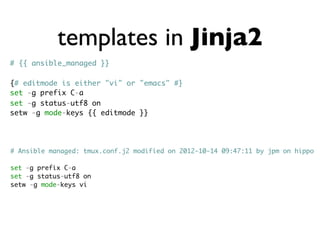
![generate /etc/hosts
{% for k,v in hostvars.iteritems() -%}
{{ v['ansible_eth0']['ipv4']['address']}} {{ k }}
{{ v['ansible_hostname'] }}
{% endfor %}
192.168.1.218 k4.ww.mens.de k4
192.168.1.194 a1.ww.mens.de a1
...](https://image.slidesharecdn.com/jp-mens-ansible-140425052533-phpapp01/85/OSDC-2014-Jan-Piet-Mens-Configuration-Management-with-Ansible-36-320.jpg)

![vault
$ ansible-vault create yy.yml
Vault password:
Confirm Vault password:
$ cat yy.yml
$ANSIBLE_VAULT;1.1;AES256
13064343538613362376132363832663335626463656265333132613932363833
[...]
3539
$ ansible-playbook yy.yml
ERROR: A vault password must be specified to decrypt data
$ ansible-playbook --ask-vault-pass yy.yml
Vault password:](https://image.slidesharecdn.com/jp-mens-ansible-140425052533-phpapp01/85/OSDC-2014-Jan-Piet-Mens-Configuration-Management-with-Ansible-42-320.jpg)
![API: task execution
#!/usr/bin/env python
import ansible.runner
import sys
res = ansible.runner.Runner(
pattern='a1*',
module_name='command',
module_args='/usr/bin/uptime'
).run()
print res
{'dark': {}, 'contacted': {'a1.ww.mens.de': {u'changed': True, u'end': u'2012-10-22
09:07:18.327568', u'stdout': u'09:07:18 up 100 days, 2:13, 3 users, load average:
0.00, 0.00, 0.00', u'cmd': [u'/usr/bin/uptime'], u'rc': 0, u'start': u'2012-10-22
09:07:18.323645', u'stderr': u'', u'delta': u'0:00:00.003923', 'invocation':
{'module_name': u'command', 'module_args': u'/usr/bin/uptime'}}}}](https://image.slidesharecdn.com/jp-mens-ansible-140425052533-phpapp01/85/OSDC-2014-Jan-Piet-Mens-Configuration-Management-with-Ansible-43-320.jpg)
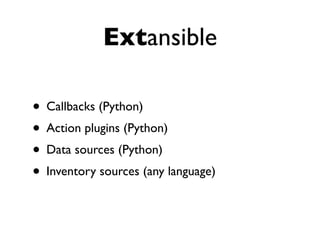
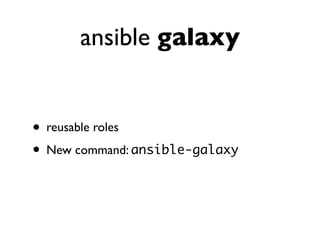



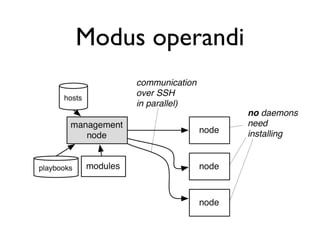
The document discusses the simplicity and efficiency of Ansible for system configuration, advocating against traditional complicated methods like shell scripts and various daemons. It provides an overview of Ansible's push-based architecture, inventory management, modules, playbooks, and the use of YAML for configuration. Key features include minimal setup requirements, easy task execution, role management, and support for various data sources and templates.


