Test-driven
Infrastructure
    Jon Topper
What is Infrastructure?
★   Physical Servers
★   Virtual / Cloud Servers
★   Switches
★   Firewalls
★   Routers
★   Load Balancers
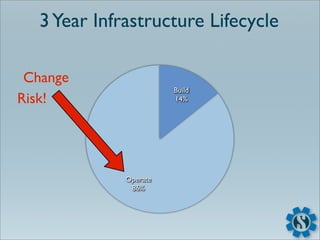
3 Year Infrastructure Lifecycle

 Change
                        Build
Risk!                   14%


              Operate
               86%
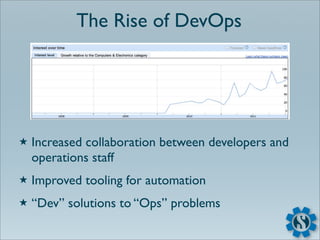
The Rise of DevOps


★   Increased collaboration between developers and
    operations staff
★   Improved tooling for automation
★   “Dev” solutions to “Ops” problems
Infrastructure as Code
Puppet
node 'webserver' {

    package { 'httpd':
        ensure => latest
    }

    file { '/etc/httpd/httpd.conf':
        require => Package['httpd'],
        owner   => root,
        mode    => 644,
        content => template('httpd.conf')
    }

    service { 'httpd':
        ensure => running,
        enable => true,
        require => File['/etc/httpd/httpd.conf']
    }

}
“Dev” Tooling
★   IDEs, text editors, refactoring tools
★   Version Control Systems
★   Automated documentation generation
★   ... Testing?
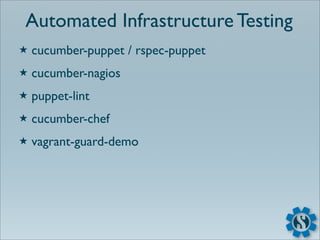
Automated Infrastructure Testing
★   cucumber-puppet / rspec-puppet
★   cucumber-nagios
★   puppet-lint
★   cucumber-chef
★   vagrant-guard-demo
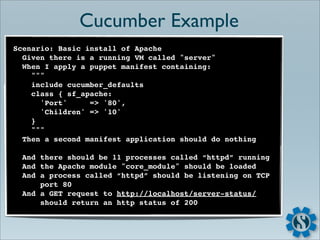
Cucumber Example
Scenario: Basic install of Apache
  Given there is a running VM called "server"
  When I apply a puppet manifest containing:
    """
    include cucumber_defaults
    class { sf_apache:
      'Port'     => '80',
      'Children' => '10'
    }
    """
  Then a second manifest application should do nothing

  And there should be 11 processes called “httpd” running
  And the Apache module "core_module" should be loaded
  And a process called “httpd” should be listening on TCP
      port 80
  And a GET request to http://localhost/server-status/
      should return an http status of 200
Given there is a running VM called "server"
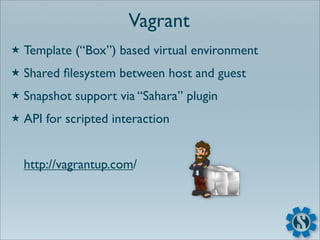
Vagrant
★   Template (“Box”) based virtual environment
★   Shared filesystem between host and guest
★   Snapshot support via “Sahara” plugin
★   API for scripted interaction


    http://vagrantup.com/
Given there is a running VM called "server"


           Given /^there is a running VM called
             "([^"]*)"$/ do |vm_name|

                 vm_platform.vm( vm_name ).start
                 vm_platform.vm( vm_name ).snapshot

           end
attr_reader :last_vm

def initialize
    @name_map      = {}
end

def vm(name)

      if @name_map.has_key?(name)
          @last_vm = @name_map[name]
          return @name_map[name]
      end

      vm = create_vm_object_by_name( name )

      @name_map[name] = vm
      @last_vm        = vm

      return vm

end

def clean_tainted
    @name_map.each { |name,vm|
        vm.rollback
        @name_map.delete(name)
    }
end
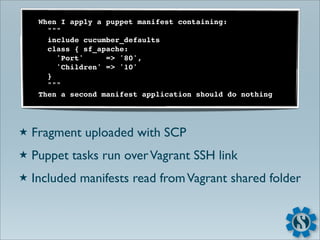
When I apply a puppet manifest containing:
       """
       include cucumber_defaults
       class { sf_apache:
         'Port'     => '80',
         'Children' => '10'
       }
       """
     Then a second manifest application should do nothing


★   Fragment uploaded with SCP
★   Puppet tasks run over Vagrant SSH link
★   Included manifests read from Vagrant shared folder
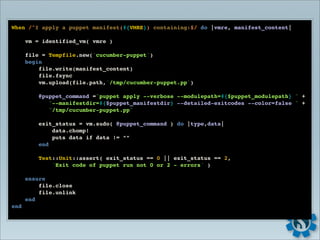
When /^I apply a puppet manifest(#{VMRE}) containing:$/ do |vmre, manifest_content|

      vm = identified_vm( vmre )

      file = Tempfile.new('cucumber-puppet')
      begin
          file.write(manifest_content)
          file.fsync
          vm.upload(file.path,'/tmp/cucumber-puppet.pp')

          @puppet_command ="puppet apply --verbose --modulepath=#{$puppet_modulepath} " +
             "--manifestdir=#{$puppet_manifestdir} --detailed-exitcodes --color=false " +
             "/tmp/cucumber-puppet.pp"

          exit_status = vm.sudo( @puppet_command ) do |type,data|
              data.chomp!
              puts data if data != “”
          end

          Test::Unit::assert( exit_status == 0 || exit_status == 2,
              'Exit code of puppet run not 0 or 2 - errors' )

      ensure
          file.close
          file.unlink
      end
end
VMRE


VMRE ||= /(?: on the last VM| on the VM(?: called|) "(?:[^"]+)"|)/

def identified_vm( str )
    case str
        when /^( on the last VM|)$/
             return vm_platform.last_vm
        when /^ on the VM(?: called|) "([^"]+)"$/
             return @vm_platform.vm( $1 )
    end
end
And a GET request to http://localhost/server-status/
          should return an http status of 200


Then /^a GET request to (.+)(#{VMRE}) should return an http status of (d+)$/
do |url,vmre,status|

      vm = identified_vm( vmre )

      response = vm.freeman.call('http.GET',url)

      assert( response['code'].to_i == status.to_i,
          "Response code 200 expected from #{url}, " +
            "received #{response['code']}" )

end


★   ‘freeman’ is an XML-RPC service
★   First call starts a new XML-RPC server in the guest
★   Code shared over Vagrant’s folder system
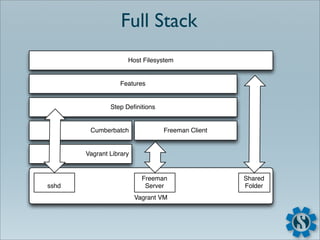
Full Stack
                     Host Filesystem


                   Features


               Step Definitions


        Cumberbatch              Freeman Client


       Vagrant Library


                           Freeman                Shared
sshd                        Server                Folder
                         Vagrant VM
Benefits
★   Cleaner interfaces
★   Improved separation of concerns
★   Increased reusability
★   Rapid troubleshooting
★   Empowering for junior engineers
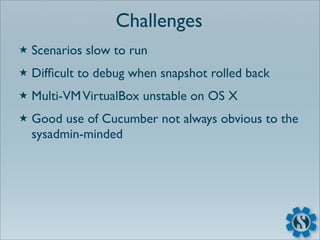
Challenges
★   Scenarios slow to run
★   Difficult to debug when snapshot rolled back
★   Multi-VM VirtualBox unstable on OS X
★   Good use of Cucumber not always obvious to the
    sysadmin-minded
Jon Topper


   jon@scalefactory.com
http://www.scalefactory.com/


     Twitter: @jtopper

Test driven infrastructure

  • 1.
  • 2.
    What is Infrastructure? ★ Physical Servers ★ Virtual / Cloud Servers ★ Switches ★ Firewalls ★ Routers ★ Load Balancers
  • 3.
    3 Year InfrastructureLifecycle Change Build Risk! 14% Operate 86%
  • 4.
    The Rise ofDevOps ★ Increased collaboration between developers and operations staff ★ Improved tooling for automation ★ “Dev” solutions to “Ops” problems
  • 5.
  • 6.
    Puppet node 'webserver' { package { 'httpd': ensure => latest } file { '/etc/httpd/httpd.conf': require => Package['httpd'], owner => root, mode => 644, content => template('httpd.conf') } service { 'httpd': ensure => running, enable => true, require => File['/etc/httpd/httpd.conf'] } }
  • 7.
    “Dev” Tooling ★ IDEs, text editors, refactoring tools ★ Version Control Systems ★ Automated documentation generation ★ ... Testing?
  • 8.
    Automated Infrastructure Testing ★ cucumber-puppet / rspec-puppet ★ cucumber-nagios ★ puppet-lint ★ cucumber-chef ★ vagrant-guard-demo
  • 9.
    Cucumber Example Scenario: Basicinstall of Apache Given there is a running VM called "server" When I apply a puppet manifest containing: """ include cucumber_defaults class { sf_apache: 'Port' => '80', 'Children' => '10' } """ Then a second manifest application should do nothing And there should be 11 processes called “httpd” running And the Apache module "core_module" should be loaded And a process called “httpd” should be listening on TCP port 80 And a GET request to http://localhost/server-status/ should return an http status of 200
  • 10.
    Given there isa running VM called "server"
  • 11.
    Vagrant ★ Template (“Box”) based virtual environment ★ Shared filesystem between host and guest ★ Snapshot support via “Sahara” plugin ★ API for scripted interaction http://vagrantup.com/
  • 12.
    Given there isa running VM called "server" Given /^there is a running VM called "([^"]*)"$/ do |vm_name| vm_platform.vm( vm_name ).start vm_platform.vm( vm_name ).snapshot end
  • 13.
    attr_reader :last_vm def initialize @name_map = {} end def vm(name) if @name_map.has_key?(name) @last_vm = @name_map[name] return @name_map[name] end vm = create_vm_object_by_name( name ) @name_map[name] = vm @last_vm = vm return vm end def clean_tainted @name_map.each { |name,vm| vm.rollback @name_map.delete(name) } end
  • 14.
    When I applya puppet manifest containing: """ include cucumber_defaults class { sf_apache: 'Port' => '80', 'Children' => '10' } """ Then a second manifest application should do nothing ★ Fragment uploaded with SCP ★ Puppet tasks run over Vagrant SSH link ★ Included manifests read from Vagrant shared folder
  • 15.
    When /^I applya puppet manifest(#{VMRE}) containing:$/ do |vmre, manifest_content| vm = identified_vm( vmre ) file = Tempfile.new('cucumber-puppet') begin file.write(manifest_content) file.fsync vm.upload(file.path,'/tmp/cucumber-puppet.pp') @puppet_command ="puppet apply --verbose --modulepath=#{$puppet_modulepath} " + "--manifestdir=#{$puppet_manifestdir} --detailed-exitcodes --color=false " + "/tmp/cucumber-puppet.pp" exit_status = vm.sudo( @puppet_command ) do |type,data| data.chomp! puts data if data != “” end Test::Unit::assert( exit_status == 0 || exit_status == 2, 'Exit code of puppet run not 0 or 2 - errors' ) ensure file.close file.unlink end end
  • 16.
    VMRE VMRE ||= /(?:on the last VM| on the VM(?: called|) "(?:[^"]+)"|)/ def identified_vm( str ) case str when /^( on the last VM|)$/ return vm_platform.last_vm when /^ on the VM(?: called|) "([^"]+)"$/ return @vm_platform.vm( $1 ) end end
  • 17.
    And a GETrequest to http://localhost/server-status/ should return an http status of 200 Then /^a GET request to (.+)(#{VMRE}) should return an http status of (d+)$/ do |url,vmre,status| vm = identified_vm( vmre ) response = vm.freeman.call('http.GET',url) assert( response['code'].to_i == status.to_i, "Response code 200 expected from #{url}, " + "received #{response['code']}" ) end ★ ‘freeman’ is an XML-RPC service ★ First call starts a new XML-RPC server in the guest ★ Code shared over Vagrant’s folder system
  • 18.
    Full Stack Host Filesystem Features Step Definitions Cumberbatch Freeman Client Vagrant Library Freeman Shared sshd Server Folder Vagrant VM
  • 19.
    Benefits ★ Cleaner interfaces ★ Improved separation of concerns ★ Increased reusability ★ Rapid troubleshooting ★ Empowering for junior engineers
  • 20.
    Challenges ★ Scenarios slow to run ★ Difficult to debug when snapshot rolled back ★ Multi-VM VirtualBox unstable on OS X ★ Good use of Cucumber not always obvious to the sysadmin-minded
  • 21.
    Jon Topper jon@scalefactory.com http://www.scalefactory.com/ Twitter: @jtopper