Introduction
to Accounting
FUNDAMENTALS OF
ACCOUNTANCY, BUSINESS,
& MANAGEMENT 1
LESSON 1
Accounting
Accounting is, broadly speaking, a system that helps business track
events that affect them. This process involves identifying the events
that affect a business, recording these events, and communicating the
summarized results of all events within a particular period of interested
parties.
The Accounting Process
• To be identified as a relevant economic event, there
should be a transfer of things with value. Normally,
for the purchase of equipment, cash or money is
exchanged for the equipment. The cash and the
equipment both have value making the purchase
relevant economic event.
1.Identification of Economic
Events Relevant to Business
The Accounting Process
• After the company identifies the relevant economic
events, it records those events which will serve as the
history of its financial activities. Recording events
should be done systematically and chronologically for
easier tracking and interpretation. Records of events
are inputted in the so-called accounting books.
1.Recording of Relevant Economic Events
The Accounting Process
• This is done after a lapse of a specific period
(usually one year). The most popular accounting
reports are the financial statements. All similar
events during the period are lumped together to
provide meaningful and presentable information.
As such, all sales transactions during the period
are added and presented as one aggregate
amount. This makes the information
understandable to other parties.
Summarizing the Recorded Events
into Accounting Reports
Nature of Accounting
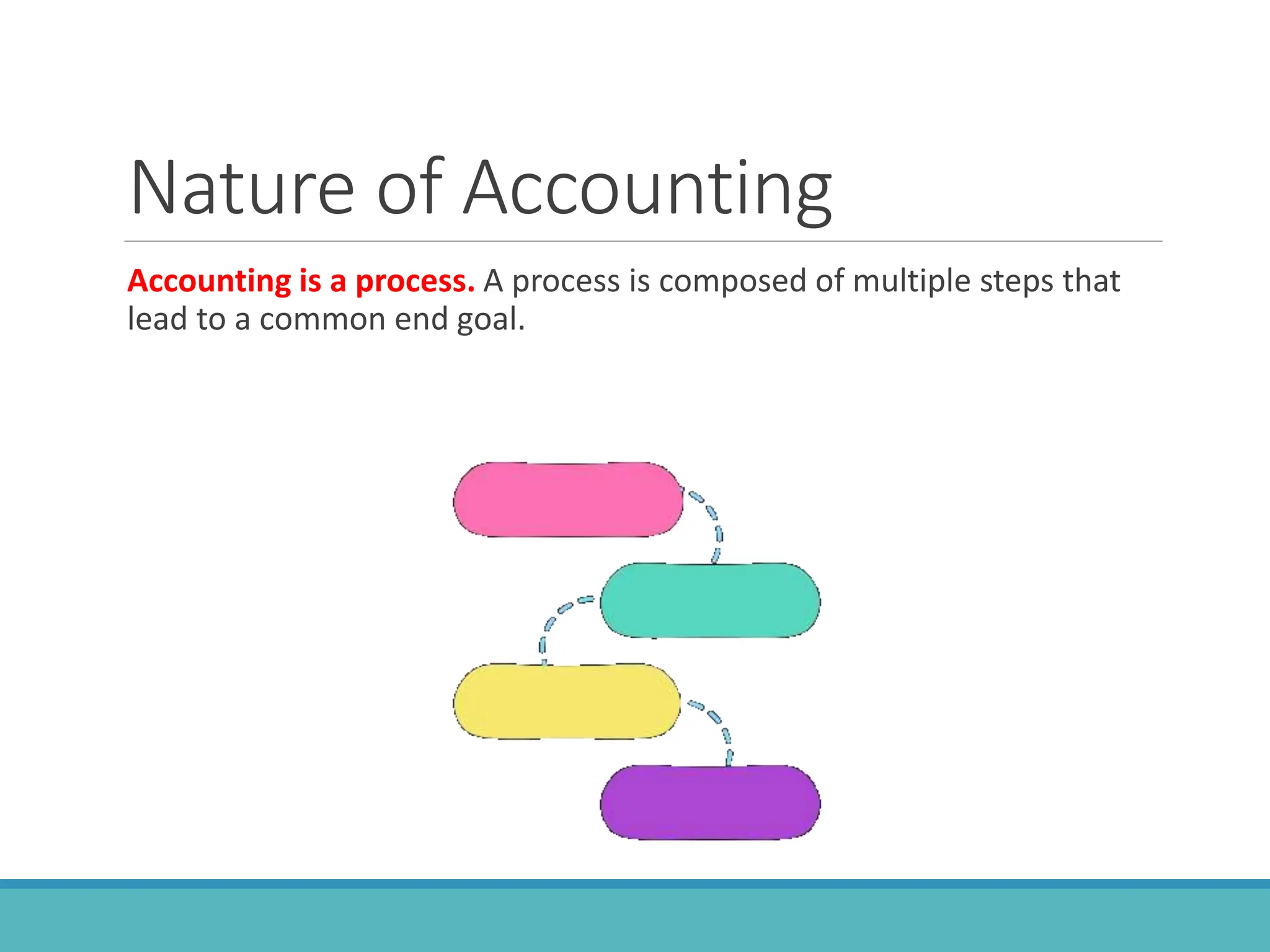
Accounting is a process. A process is composed of multiple steps that
lead to a common end goal.
Nature of Accounting
Accounting is a process because it
performs the functions of identifying,
recording, and communicating economic
events with the end goal of providing
information to internal and external
parties.
Nature of Accounting
Accounting is an art. Art refers to a way of
performing something. It entails creativity
and skills to help us attain certain
objectives. Accounting is the art of
recording, classifying, summarizing, and
finalizing financial data.
Nature of Accounting
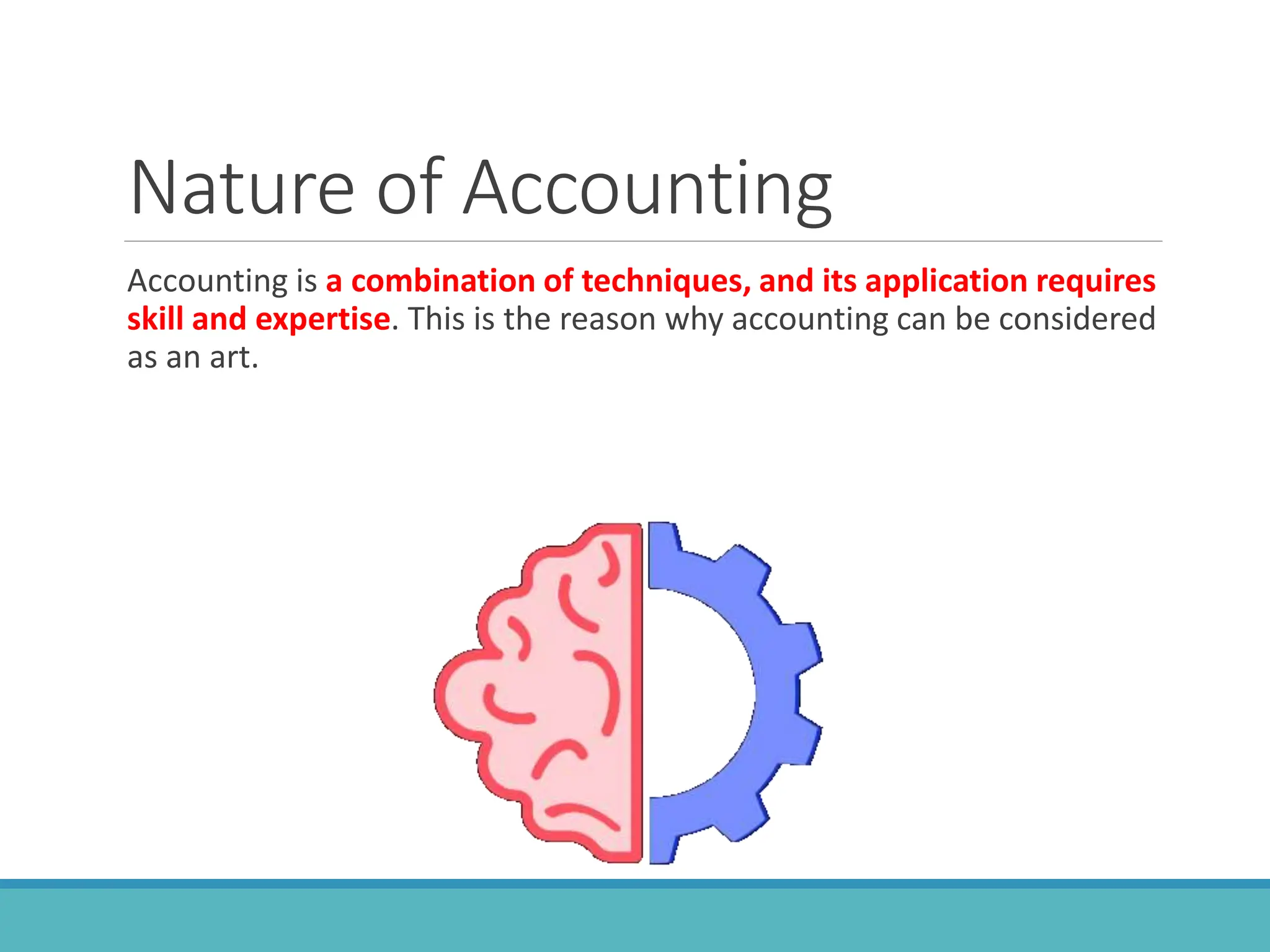
Accounting is a combination of techniques, and its application requires
skill and expertise. This is the reason why accounting can be considered
as an art.
Nature of Accounting
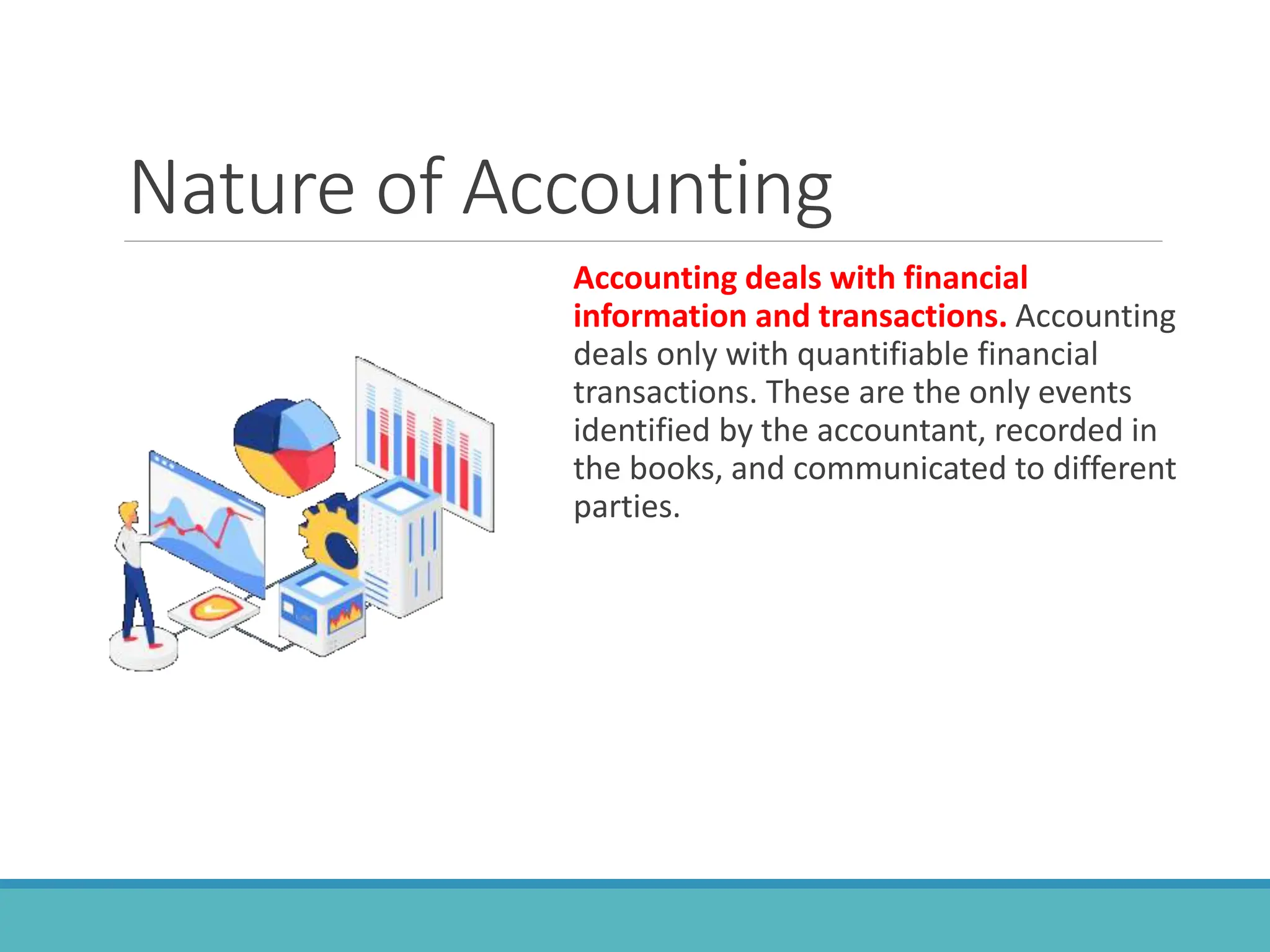
Accounting deals with financial
information and transactions. Accounting
deals only with quantifiable financial
transactions. These are the only events
identified by the accountant, recorded in
the books, and communicated to different
parties.
Nature of Accounting
Non-financial transactions are not the focus
of the accounting process. However, non-
financial data may be used to interpret and
better estimate some financial data.
Nature of Accounting
Accounting is a means and not an end. Accounting is a tool to achieve
specific objectives. It is not the objective itself.
Nature of Accounting
Accounting is an information system. Accounting is recognized and
characterized as a storehouse of information.
Nature of Accounting
As a service function, it collects processes and
communicates financial information of any
entity. This discipline of knowledge has been
evolved out to meet the need of financial
information required by different interested
groups.
Functions of Accounting
The American Accounting Association (AAA) defines accounting as “the
process of identifying, measuring, and communicating economic
information to permit informed judgments and decisions by the users
of information.”
Functions of Accounting
The American Institute of Certified Public Accountants (AICPA) defines
accounting as “the art of recording, classifying, and summarizing in a
significant manner and in terms of money, transactions and events,
which are in part at least of a financial character and interpreting the
results thereof.”
Functions of Accounting
Keeping systematic record of business transactions. Recording
transactions does not only involve entering the transactions in the
accounting books. The records should be systematic enough to enable
easy understanding of readers. No matter how comprehensive the
records are, if they are not produced systematically, then they provide
little to no value.
Functions of Accounting
Protecting the properties of the business. The accounting records serve
as the evidence that the properties of a business do exist or how much
of a particular resource does a company have. If the accounting records
show that the amount of cash should be Php1,000,000, any excess and
deficiency will be noticed immediately. Moreover, the accounting
system helps in preventing employee fraud and misappropriation of
company resources.
Functions of Accounting
Communicating results to various parties in or connected with the
business. The accounting reports produced at the end of each period
are not only used by external parties (e.g., potential investors,
government agencies), but also by the management in their decision-
making function. Communication of the results of operations of a
company is essential for all concerned parties to enable them to take
well-informed decisions.
Functions of Accounting
Meeting legal requirements. In the Philippines, the government
requires some companies (particularly those with public accountability)
to provide financial reports quarterly, semi-annually, or annually. This
procedure aims to protect the public by providing them the necessary
information to make sound decisions. The government also requires
reports from heavily regulated industries such as energy and oil
industries.
FABM1 - Lesson 1 - Introduction to Accounting.pptx

FABM1 - Lesson 1 - Introduction to Accounting.pptx

  • 1.
  • 2.
    Accounting Accounting is, broadlyspeaking, a system that helps business track events that affect them. This process involves identifying the events that affect a business, recording these events, and communicating the summarized results of all events within a particular period of interested parties.
  • 3.
    The Accounting Process •To be identified as a relevant economic event, there should be a transfer of things with value. Normally, for the purchase of equipment, cash or money is exchanged for the equipment. The cash and the equipment both have value making the purchase relevant economic event. 1.Identification of Economic Events Relevant to Business
  • 4.
    The Accounting Process •After the company identifies the relevant economic events, it records those events which will serve as the history of its financial activities. Recording events should be done systematically and chronologically for easier tracking and interpretation. Records of events are inputted in the so-called accounting books. 1.Recording of Relevant Economic Events
  • 5.
    The Accounting Process •This is done after a lapse of a specific period (usually one year). The most popular accounting reports are the financial statements. All similar events during the period are lumped together to provide meaningful and presentable information. As such, all sales transactions during the period are added and presented as one aggregate amount. This makes the information understandable to other parties. Summarizing the Recorded Events into Accounting Reports
  • 6.
    Nature of Accounting Accountingis a process. A process is composed of multiple steps that lead to a common end goal.
  • 7.
    Nature of Accounting Accountingis a process because it performs the functions of identifying, recording, and communicating economic events with the end goal of providing information to internal and external parties.
  • 8.
    Nature of Accounting Accountingis an art. Art refers to a way of performing something. It entails creativity and skills to help us attain certain objectives. Accounting is the art of recording, classifying, summarizing, and finalizing financial data.
  • 9.
    Nature of Accounting Accountingis a combination of techniques, and its application requires skill and expertise. This is the reason why accounting can be considered as an art.
  • 10.
    Nature of Accounting Accountingdeals with financial information and transactions. Accounting deals only with quantifiable financial transactions. These are the only events identified by the accountant, recorded in the books, and communicated to different parties.
  • 11.
    Nature of Accounting Non-financialtransactions are not the focus of the accounting process. However, non- financial data may be used to interpret and better estimate some financial data.
  • 12.
    Nature of Accounting Accountingis a means and not an end. Accounting is a tool to achieve specific objectives. It is not the objective itself.
  • 13.
    Nature of Accounting Accountingis an information system. Accounting is recognized and characterized as a storehouse of information.
  • 14.
    Nature of Accounting Asa service function, it collects processes and communicates financial information of any entity. This discipline of knowledge has been evolved out to meet the need of financial information required by different interested groups.
  • 15.
    Functions of Accounting TheAmerican Accounting Association (AAA) defines accounting as “the process of identifying, measuring, and communicating economic information to permit informed judgments and decisions by the users of information.”
  • 16.
    Functions of Accounting TheAmerican Institute of Certified Public Accountants (AICPA) defines accounting as “the art of recording, classifying, and summarizing in a significant manner and in terms of money, transactions and events, which are in part at least of a financial character and interpreting the results thereof.”
  • 17.
    Functions of Accounting Keepingsystematic record of business transactions. Recording transactions does not only involve entering the transactions in the accounting books. The records should be systematic enough to enable easy understanding of readers. No matter how comprehensive the records are, if they are not produced systematically, then they provide little to no value.
  • 18.
    Functions of Accounting Protectingthe properties of the business. The accounting records serve as the evidence that the properties of a business do exist or how much of a particular resource does a company have. If the accounting records show that the amount of cash should be Php1,000,000, any excess and deficiency will be noticed immediately. Moreover, the accounting system helps in preventing employee fraud and misappropriation of company resources.
  • 19.
    Functions of Accounting Communicatingresults to various parties in or connected with the business. The accounting reports produced at the end of each period are not only used by external parties (e.g., potential investors, government agencies), but also by the management in their decision- making function. Communication of the results of operations of a company is essential for all concerned parties to enable them to take well-informed decisions.
  • 20.
    Functions of Accounting Meetinglegal requirements. In the Philippines, the government requires some companies (particularly those with public accountability) to provide financial reports quarterly, semi-annually, or annually. This procedure aims to protect the public by providing them the necessary information to make sound decisions. The government also requires reports from heavily regulated industries such as energy and oil industries.