PRESENTED BY:
FATHIMA SHARIN, VISHNU.R.NAIR,
5TH YEAR PHARM.D.
“EFFICACY & SAFETY OF LACOSAMIDE IN DIABETIC
NEUROPATHIC PAIN: AN 18-WEEK DOUBLE-BLIND,
PLACEBO-CONTROLLED TRIAL OF FIXED DOSE
REGIMENS”
The article was published in “Clin J Pain”, 2009
Article was received on: June 17, 2008
Article was accepted on: November 23, 2008
1. James. P. Wymer, MD, PhD, Upstate Clinical Research, Albany, New York
2. Jeffrey Simpson, PhD, Schwarz Biosciences Inc, a member of the UCB Group,
Research Triangle Park, NC
3. David Sen, PhD, Schwarz Biosciences Inc, a member of the UCB Group,
Research Triangle Park, NC
4. Sabine Bongardt, MS, Schwarz Biosciences GmbH, a member of the UCB
Group, Monheim, Germany.
 Painful distal diabetic neuropathy is one of the most common form of chronic
neuropathic pain
 Affects approximately 30% of patients with DM
 Pain is described as a steady, aching or burning pain, & characterized by
hyperalgesia, allodynia & paresthesia
 Treatment of PDN is extremely difficult
 Lacosamide is an investigational drug, being investigated for the treatment of
neuropathic pain & epilepsy
 Lacosamide has minimal PPB, & minimal risks for drug-drug interaction, which
makes it a safer alternative for patients with neuropathic pain, on multiple
concomitant medications.
A. STUDY DESIGN: Randomized, double-blind, placebo-controlled, parallel-
group, multicenter study, done at 53 sites throughout the United States.
B. STUDY POPULATION: 370
 Men & women, with the following criteria:
1. Age : Atleast 18 years
2. Diagnosis: DM(Type 1/2), with symptoms of PDN(for at least 6 months to 5
years)
3. HbA1C level: <12%
4. Optimized diabetic control for atleast 3 months before the enrollment
5. Pain of at least moderate severity, during 7 days before randomization.
Includes:
1. Women- Pregnant, breast-feeding, of child-bearing potential & not practicing
adequate birth-control
2. Individuals, who had participated in an investigational trial, within the past 30
days
3. Presence of any other conditions, that may interfere with the assessment of
neuropathic pain
4. Major skin ulcers
5. Clinically significant ECG abnormalities
6. Significant hepatic/renal diseases(CrCl< 50 ml/min)
7. Myocardial infarction/ clinically relevant cardiac dysfunction, within the last 12
months/ any cardiac disorder, which would predispose the patient to
MI/arrhythmia.
8. QTc > 450 milliseconds(for men) , & > 470 milliseconds(in women)
9. Sitting DBP < 50 mm Hg / > 105 mm Hg
10. History of chronic alcohol/drug abuse in near history
11. Pts., expected to undergo surgery during the trial/ taking any medications for
any treatment, that might be expected to interfere with the result of the trial.
Include:
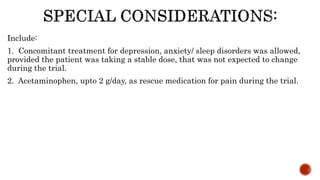
1. Concomitant treatment for depression, anxiety/ sleep disorders was allowed,
provided the patient was taking a stable dose, that was not expected to change
during the trial.
2. Acetaminophen, upto 2 g/day, as rescue medication for pain during the trial.
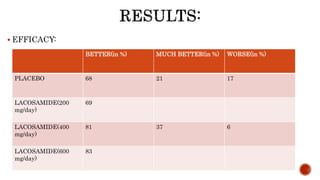
 EFFICACY:
BETTER(in %) MUCH BETTER(in %) WORSE(in %)
PLACEBO 68 21 17
LACOSAMIDE(200
mg/day)
69
LACOSAMIDE(400
mg/day)
81 37 6
LACOSAMIDE(600
mg/day)
83
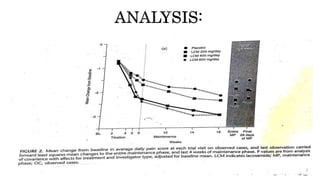
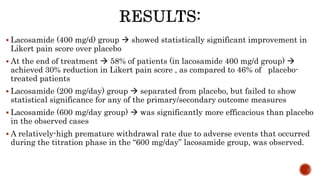
 Lacosamide (400 mg/d) group  showed statistically significant improvement in
Likert pain score over placebo
 At the end of treatment  58% of patients (in lacosamide 400 mg/d group) 
achieved 30% reduction in Likert pain score , as compared to 46% of placebo-
treated patients
 Lacosamide (200 mg/day) group  separated from placebo, but failed to show
statistical significance for any of the primary/secondary outcome measures
 Lacosamide (600 mg/day group)  was significantly more efficacious than placebo
in the observed cases
 A relatively-high premature withdrawal rate due to adverse events that occurred
during the titration phase in the “600 mg/day” lacosamide group, was observed.
 Overall  lacosamide, at daily doses of 200-400 mg  was well-tolerated, with
8% of patients discontinuing due to adverse events (in the 200 mg/day group), &
23% due to adverse events (in the 400 mg/day group), compared to the 9%
discontinuation rates in the placebo group.
 Discontinuations due to adverse events were highest in the “600 mg/day group”
 Most common adverse events include dizziness, tremor, headache & fatigue
 Somnolence, cognitive & behavioral side effects, weight change & edema were
notably low.
 According to safety & efficacy analyses  lacosamide (400 mg/day)  provided
an optimal balance between efficacy & side-effects, in patients with patient
diabetic neuropathy.
 To summarize  this study suggests that lacosamide (at 400 mg/day)  provides
an optimal balance between efficacy & side-effects in patients with painful
diabetic neuropathy
 Effectiveness of the drug, coupled with demonstrated low-potential for drug-drug
interactions & its proposed novel mechanism of action  makes lacosamide a
potentially attractive addition to the pharmacotherapeutical strategies for painful
diabetic neuropathy.
 Since the study was conducted for a short period of time  the result obtained
could not be generalized.
 In the lacosamide (600 mg/day) group  there was high withdrawal rate due to
adverse events(40%)
 Majority of the patients, who withdrew from study  did so while still being in
the titration phase.
THANK YOU!!!

Journal club presentation @ Rxvichu!!

  • 1.
    PRESENTED BY: FATHIMA SHARIN,VISHNU.R.NAIR, 5TH YEAR PHARM.D.
  • 2.
    “EFFICACY & SAFETYOF LACOSAMIDE IN DIABETIC NEUROPATHIC PAIN: AN 18-WEEK DOUBLE-BLIND, PLACEBO-CONTROLLED TRIAL OF FIXED DOSE REGIMENS”
  • 3.
    The article waspublished in “Clin J Pain”, 2009 Article was received on: June 17, 2008 Article was accepted on: November 23, 2008
  • 4.
    1. James. P.Wymer, MD, PhD, Upstate Clinical Research, Albany, New York 2. Jeffrey Simpson, PhD, Schwarz Biosciences Inc, a member of the UCB Group, Research Triangle Park, NC 3. David Sen, PhD, Schwarz Biosciences Inc, a member of the UCB Group, Research Triangle Park, NC 4. Sabine Bongardt, MS, Schwarz Biosciences GmbH, a member of the UCB Group, Monheim, Germany.
  • 5.
     Painful distaldiabetic neuropathy is one of the most common form of chronic neuropathic pain  Affects approximately 30% of patients with DM  Pain is described as a steady, aching or burning pain, & characterized by hyperalgesia, allodynia & paresthesia  Treatment of PDN is extremely difficult  Lacosamide is an investigational drug, being investigated for the treatment of neuropathic pain & epilepsy  Lacosamide has minimal PPB, & minimal risks for drug-drug interaction, which makes it a safer alternative for patients with neuropathic pain, on multiple concomitant medications.
  • 6.
    A. STUDY DESIGN:Randomized, double-blind, placebo-controlled, parallel- group, multicenter study, done at 53 sites throughout the United States. B. STUDY POPULATION: 370
  • 7.
     Men &women, with the following criteria: 1. Age : Atleast 18 years 2. Diagnosis: DM(Type 1/2), with symptoms of PDN(for at least 6 months to 5 years) 3. HbA1C level: <12% 4. Optimized diabetic control for atleast 3 months before the enrollment 5. Pain of at least moderate severity, during 7 days before randomization.
  • 8.
    Includes: 1. Women- Pregnant,breast-feeding, of child-bearing potential & not practicing adequate birth-control 2. Individuals, who had participated in an investigational trial, within the past 30 days 3. Presence of any other conditions, that may interfere with the assessment of neuropathic pain 4. Major skin ulcers 5. Clinically significant ECG abnormalities 6. Significant hepatic/renal diseases(CrCl< 50 ml/min) 7. Myocardial infarction/ clinically relevant cardiac dysfunction, within the last 12 months/ any cardiac disorder, which would predispose the patient to MI/arrhythmia.
  • 9.
    8. QTc >450 milliseconds(for men) , & > 470 milliseconds(in women) 9. Sitting DBP < 50 mm Hg / > 105 mm Hg 10. History of chronic alcohol/drug abuse in near history 11. Pts., expected to undergo surgery during the trial/ taking any medications for any treatment, that might be expected to interfere with the result of the trial.
  • 10.
    Include: 1. Concomitant treatmentfor depression, anxiety/ sleep disorders was allowed, provided the patient was taking a stable dose, that was not expected to change during the trial. 2. Acetaminophen, upto 2 g/day, as rescue medication for pain during the trial.
  • 12.
     EFFICACY: BETTER(in %)MUCH BETTER(in %) WORSE(in %) PLACEBO 68 21 17 LACOSAMIDE(200 mg/day) 69 LACOSAMIDE(400 mg/day) 81 37 6 LACOSAMIDE(600 mg/day) 83
  • 13.
     Lacosamide (400mg/d) group  showed statistically significant improvement in Likert pain score over placebo  At the end of treatment  58% of patients (in lacosamide 400 mg/d group)  achieved 30% reduction in Likert pain score , as compared to 46% of placebo- treated patients  Lacosamide (200 mg/day) group  separated from placebo, but failed to show statistical significance for any of the primary/secondary outcome measures  Lacosamide (600 mg/day group)  was significantly more efficacious than placebo in the observed cases  A relatively-high premature withdrawal rate due to adverse events that occurred during the titration phase in the “600 mg/day” lacosamide group, was observed.
  • 14.
     Overall lacosamide, at daily doses of 200-400 mg  was well-tolerated, with 8% of patients discontinuing due to adverse events (in the 200 mg/day group), & 23% due to adverse events (in the 400 mg/day group), compared to the 9% discontinuation rates in the placebo group.  Discontinuations due to adverse events were highest in the “600 mg/day group”  Most common adverse events include dizziness, tremor, headache & fatigue  Somnolence, cognitive & behavioral side effects, weight change & edema were notably low.
  • 15.
     According tosafety & efficacy analyses  lacosamide (400 mg/day)  provided an optimal balance between efficacy & side-effects, in patients with patient diabetic neuropathy.
  • 16.
     To summarize this study suggests that lacosamide (at 400 mg/day)  provides an optimal balance between efficacy & side-effects in patients with painful diabetic neuropathy  Effectiveness of the drug, coupled with demonstrated low-potential for drug-drug interactions & its proposed novel mechanism of action  makes lacosamide a potentially attractive addition to the pharmacotherapeutical strategies for painful diabetic neuropathy.
  • 17.
     Since thestudy was conducted for a short period of time  the result obtained could not be generalized.  In the lacosamide (600 mg/day) group  there was high withdrawal rate due to adverse events(40%)  Majority of the patients, who withdrew from study  did so while still being in the titration phase.
  • 18.