Theory of Information Integration in Statistical Learning ( 統計的学習における情報統合の理論 ) 情報理工学系研究科 数理情報学専攻 数理第五研究室 助教 鈴木 大慈 2011 年 4 月 25 日
博士論文のテーマ(?) 人間は様々な事物を「統合」し,多くの問題を 解決している. 情報統合  情報:機能・データ(知識) 統合:組み合わせる・まとめる・整合性を取る 機能(関数)の統合 知識(データ)の統合 異なる環境の情報統合
発表の概要 ベイズ予測分布 事前分布の選択と α ダイバージェンス 相互情報量推定 二乗損失型相互情報量 Multiple Kernel Learning L1 と L2 の狭間で
ベイズ予測分布 - 事前分布の選択と α ダイバージェンス -
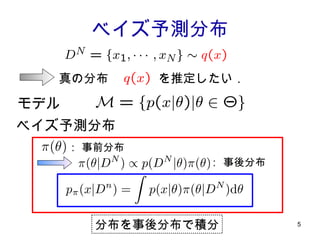
ベイズ予測分布 分布を事後分布で積分 真の分布    を推定したい. ベイズ予測分布 モデル : 事前分布 : 事後分布
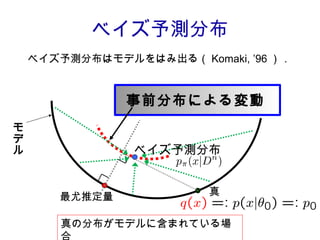
ベイズ予測分布 ベイズ予測分布はモデルをはみ出る( Komaki, ’96 ). モデル 真 最尤推定量 事前分布による変動 ベイズ予測分布 真の分布がモデルに含まれている場合
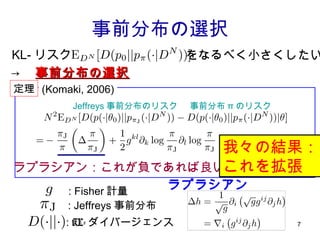
事前分布の選択 KL- リスク をなるべく小さくしたい ->   事前分布の選択 Jeffreys 事前分布のリスク 事前分布 π のリスク (Komaki, 2006) : Jeffreys 事前分布 : Fisher 計量 :  KL- ダイバージェンス ラプラシアン:これが負であれば良い ラプラシアン 我々の結果: これを拡張 定理
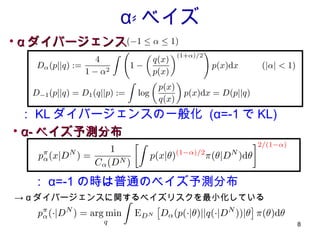
α- ベイズ α ダイバージェンス : KL ダイバージェンスの一般化  (α=-1 で KL) α- ベイズ予測分布 ->  α ダイバージェンスに関するベイズリスクを最小化している : α=-1 の時は普通のベイズ予測分布
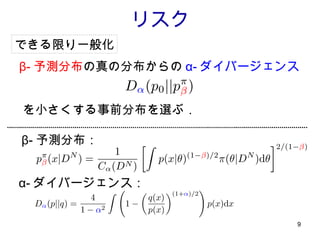
リスク β- 予測分布 の真の分布からの α- ダイバージェンス β- 予測分布: α- ダイバージェンス: を小さくする事前分布を選ぶ. できる限り一般化
結果 :   を事前分布としたときの β- ベイズ予測分布 漸近的なリスクの差  [Suzuki&Komaki,2010] 二階微分作用素 ← 補正項  (α=β で 0) A 優調和関数であれば良い α=β の時,ラプラシアンによる特徴付けが現われる A に付随した拡散過程 が存在
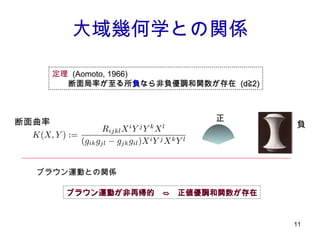
大域幾何学との関係 定理   (Aomoto, 1966)    断面局率が至る所 負 なら非負優調和関数が存在  (d≧2) 断面曲率 正 負 ブラウン運動が非再帰的 ⇔ 正値優調和関数が存在 ブラウン運動との関係
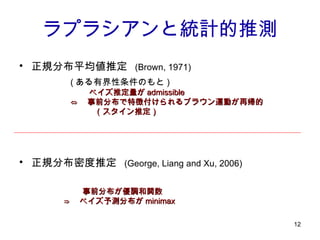
ラプラシアンと統計的推測 正規分布平均値推定   (Brown, 1971) 正規分布密度推定   (George, Liang and Xu, 2006) ( ある有界性条件のもと )     ベイズ推定量が admissible ⇔  事前分布で特徴付けられるブラウン運動が再帰的    (スタイン推定)     事前分布が優調和関数 ⇒  ベイズ予測分布が minimax
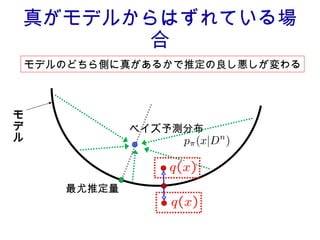
真がモデルからはずれている場合 モデル ベイズ予測分布 最尤推定量 モデルのどちら側に真があるかで推定の良し悪しが変わる
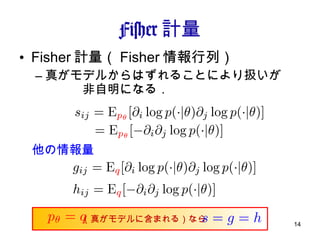
Fisher 計量 Fisher 計量( Fisher 情報行列) 真がモデルからはずれることにより扱いが    非自明になる. 他の情報量 (真がモデルに含まれる)なら
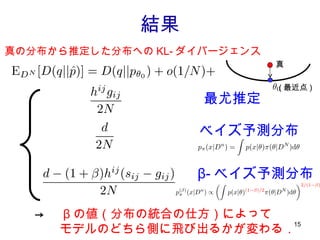
結果 最尤推定 ベイズ予測分布 β- ベイズ予測分布 真の分布から推定した分布への KL- ダイバージェンス ->   β の値(分布の統合の仕方)によって   モデルのどちら側に飛び出るかが変わる. 真 ( 最近点 )
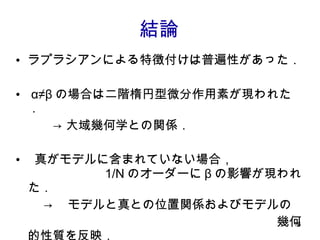
結論 ラプラシアンによる特徴付けは普遍性があった. α≠β の場合は二階楕円型微分作用素が現われた.    -> 大域幾何学との関係. 真がモデルに含まれていない場合,            1/N のオーダーに β の影響が現われた. ->  モデルと真との位置関係およびモデルの                      幾何的性質を反映.     -> (今後の課題)最適な β の決定方法.
発表の概要 ベイズ予測分布 事前分布の選択と α ダイバージェンス 相互情報量推定 二乗損失型相互情報量 Multiple Kernel Learning L1 と L2 の狭間で
相互情報量に関する研究   - 二乗損失型相互情報量 -
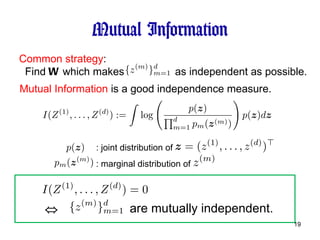
Mutual Information Common strategy : Find  W  which makes  as independent as possible. Mutual Information  is a good independence measure.  are mutually independent. ⇔ : joint distribution of  : marginal distribution of
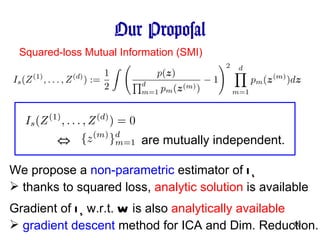
Our Proposal Squared-loss Mutual Information (SMI) are mutually independent. ⇔ We propose a  non-parametric  estimator of  I s thanks to squared loss,  analytic solution  is available Gradient of  I s  w.r.t.  W  is also  analytically available gradient descent  method for ICA and Dim. Reduction.
Estimation Method Estimate the  density ratio : (Legendre-Fenchel convex duality  [Nguyen et al. 08] ) Define , then we can write where sup is taken over  all measurable functions . the optimal function is the  density ratio
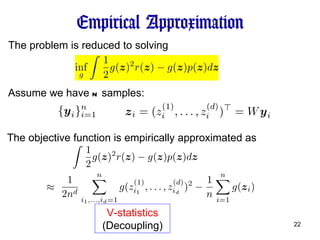
The problem is reduced to solving  Empirical Approximation The objective function is empirically approximated as V-statistics (Decoupling) Assume we have  n  samples:
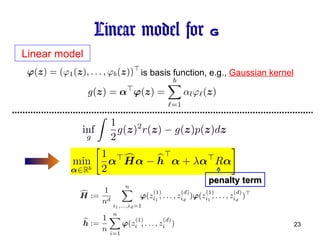
Linear model for  g   Linear model is basis function, e.g.,  Gaussian kernel penalty term
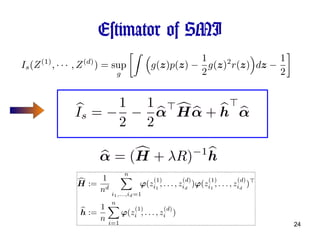
Estimator of SMI
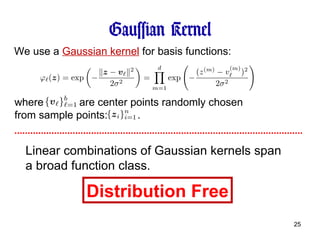
Gaussian Kernel We use a  Gaussian kernel  for basis functions: where  are center points randomly chosen  from sample points:  . Linear combinations of Gaussian kernels span  a broad function class. Distribution Free
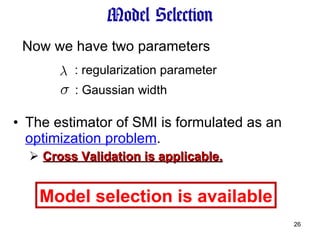
Model Selection The estimator of SMI is formulated as an  optimization problem . Cross Validation is applicable. Model selection is available Now we have two parameters  : regularization parameter : Gaussian width
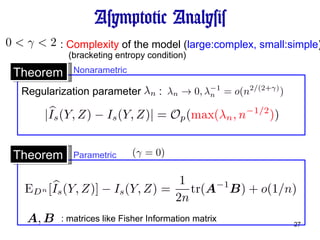
Asymptotic Analysis Regularization parameter  : Theorem :  Complexity  of the model ( large:complex, small:simple ) Theorem Nonarametric Parametric : matrices like Fisher Information matrix (bracketing entropy condition)
Applications ICA (Independent Component Analysis) [Suzuki&Sugiyama, 2011] SDR (Sufficient Dimension Reduction) [Suzuki&Sugiyama, 2010] Independence Test [Sugiyama&Suzuki, 2011] Causal Inference  [Yamada&Sugiyama, 2010]
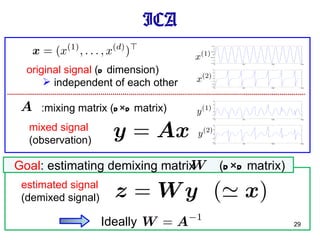
ICA mixed signal (observation) original signal  ( d   dimension) independent of each other estimated signal (demixed signal) :mixing matrix ( d × d  matrix) Goal : estimating demixing matrix  ( d × d  matrix) Ideally
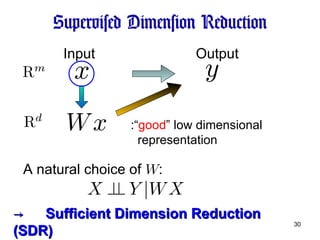
Supervised Dimension Reduction Input  Output :“ good ” low dimensional  representation ->   Sufficient Dimension Reduction (SDR)  A natural choice of  W :
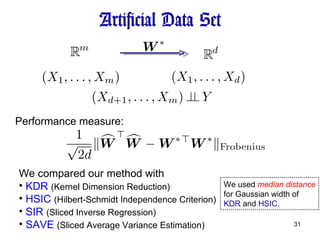
Artificial Data Set We compared our method with KDR   (Kernel Dimension Reduction) HSIC   (Hilbert-Schmidt Independence Criterion) SIR   (Sliced Inverse Regression) SAVE   (Sliced Average Variance Estimation) Performance measure: We used  median distance for Gaussian width of  KDR  and  HSIC .
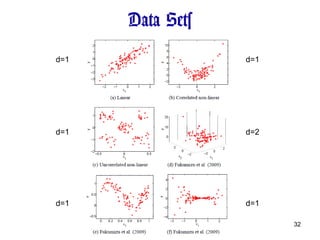
Data Sets d=1 d=1 d=1 d=1 d=1 d=2
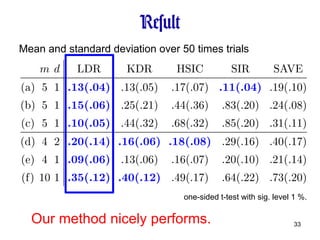
Result one-sided t-test with sig. level 1 %. Mean and standard deviation over 50 times trials Our method nicely performs.
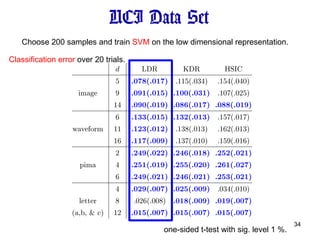
UCI Data Set one-sided t-test with sig. level 1 %. Choose 200 samples and train  SVM  on the low dimensional representation. Classification error  over 20 trials.
発表の概要 ベイズ予測分布 事前分布の選択と α ダイバージェンス 相互情報量推定 二乗損失型相互情報量 Multiple Kernel Learning L1 と L2 の狭間で
Multiple Kernel Learning
Multiple Kernel Learning (MKL) ↓ Elasticnet MKL Lp-norm MKL 汎化誤差を理論的に解析 スパース性と汎化誤差の関係 どのような正則化が好ましい?
Sparse Learning : n  samples : Convex loss ( hinge, square, logistic ) L 1 -regularization->  sparse Lasso Group Lasso I : subset of indices [Yuan&Lin:JRSS2006] [Tibshirani :JRSS1996]
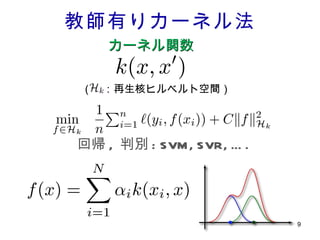
教師有りカーネル法 回帰 ,  判別 : SVM, SVR, …. カーネル関数 ( :再生核ヒルベルト空間)
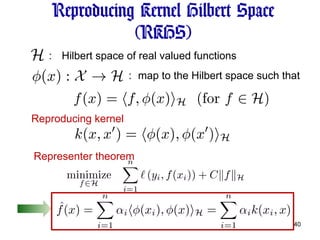
Reproducing Kernel Hilbert Space (RKHS) :  Hilbert space of real valued functions : map to the Hilbert space such that Reproducing kernel Representer theorem
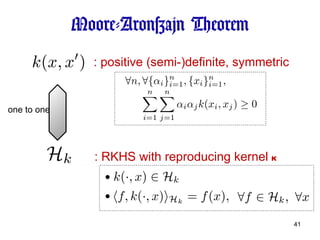
Moore-Aronszajn Theorem : positive (semi-)definite, symmetric : RKHS with reproducing kernel  k one to one
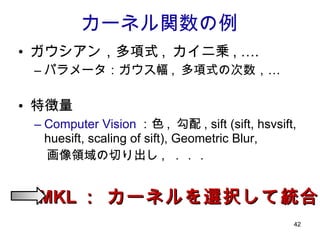
ガウシアン,多項式 ,  カイ二乗 , …. パラメータ:ガウス幅 ,  多項式の次数,… 特徴量 Computer Vision :色 ,  勾配 , sift (sift, hsvsift, huesift, scaling of sift), Geometric Blur,   画像領域の切り出し ,  ... カーネル関数の例 MKL : カーネルを選択して統合
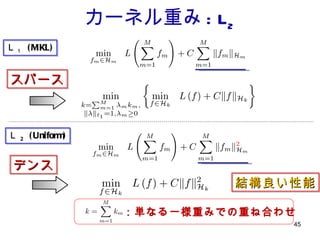
MKL: Multiple Kernel Learning :  M 個のカーネル関数 : カーネル関数 k m に付随した RKHS [ Lanckriet et al. 2004 ] L1 正則化: スパース Gourp Lasso の無限次元への拡張 [Bach, Lanchriet, Jordan:ICML 2004 ]
カーネル重みとの関係 [Micchelli & Pontil: JMLR2005] 目的関数をカーネル関数の凸結合の中で最小化 : given k は k m らの凸結合 Young の不等式
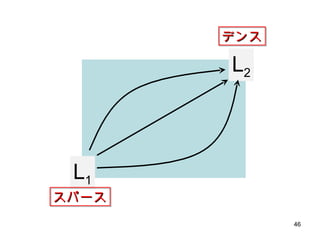
カーネル重み : L 2 L 1   (MKL) L 2  (Uniform) :単なる一様重みでの重ね合わせ スパース デンス 結構良い性能
L 1 L 2 スパース デンス
L 1 と L 2 の橋渡し Elasticnet MKL Lp-norm MKL (1≦p≦2) [Marius et al.: NIPS2009] [Shawe-Taylor: NIPS workshop 2008,  Tomioka & Suzuki: NIPS workshop 2009] cf. elastic-net: [Zou & Hastie: JRSS, 2005]
Best Medium density dense [Tomioka & Suzuki: NIPS 2009 Workshop ] Elasticnet MKL:  caltech 101 dataset L1 L2 中間的なスパースさが良い
[Cortes, Mohri, and Rostamizadeh: UAI 2009] MKL (sparse) 一様重み  (dense) 中間 (p=4/3) Lp-norm MKL # of features
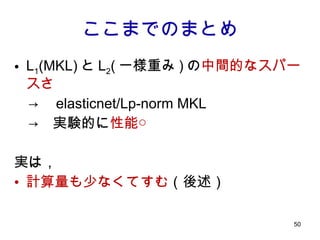
ここまでのまとめ L 1 (MKL) と L 2 ( 一様重み ) の 中間的なスパースさ  ->  elasticnet/Lp-norm MKL  -> 実験的に 性能○ 実は, 計算量も少なくてすむ (後述)
なぜ,性能が良いのか? どのような条件のとき,中間的スパースさが良いのか?    以後,主に Elasticnet MKL を扱う.
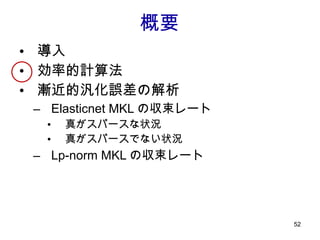
導入 効率的計算法 漸近的汎化誤差の解析 Elasticnet MKL の収束レート 真がスパースな状況 真がスパースでない状況 Lp-norm MKL の収束レート 概要
効率的計算法
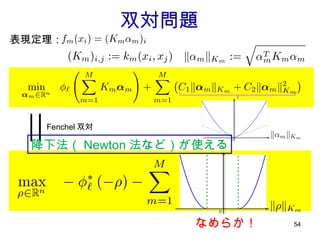
双対問題 表現定理: なめらか! 降下法( Newton 法など)が使える Fenchel 双対
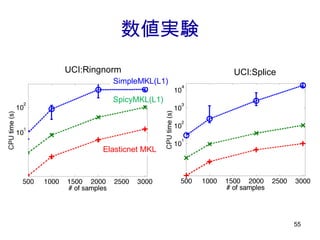
数値実験 UCI:Ringnorm UCI:Splice SimpleMKL(L1) SpicyMKL(L1) Elasticnet MKL
導入 効率的計算法 漸近的汎化誤差の解析 Elasticnet MKL の収束レート 真がスパースな状況 真がスパースでない状況 Lp-norm MKL の収束レート 概要
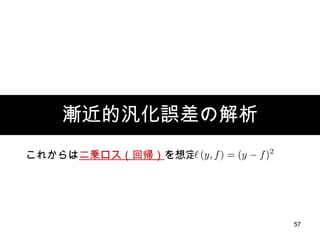
漸近的汎化誤差の解析 これからは 二乗ロス(回帰) を想定:
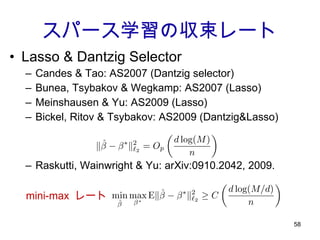
Lasso & Dantzig Selector Candes & Tao: AS2007 (Dantzig selector) Bunea, Tsybakov & Wegkamp: AS2007 (Lasso) Meinshausen & Yu: AS2009 (Lasso) Bickel, Ritov & Tsybakov: AS2009 (Dantzig&Lasso) Raskutti, Wainwright & Yu: arXiv:0910.2042, 2009. mini-max  レート スパース学習の収束レート
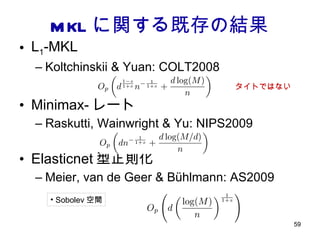
L 1 -MKL Koltchinskii & Yuan: COLT2008 Minimax- レート Raskutti, Wainwright & Yu: NIPS2009 Elasticnet 型正則化 Meier, van de Geer  & B ü hlmann: AS2009 Sobolev 空間 タイトではない MKL に関する既存の結果

Jokyokai

  • 1.
    Theory of InformationIntegration in Statistical Learning ( 統計的学習における情報統合の理論 ) 情報理工学系研究科 数理情報学専攻 数理第五研究室 助教 鈴木 大慈 2011 年 4 月 25 日
  • 2.
    博士論文のテーマ(?) 人間は様々な事物を「統合」し,多くの問題を 解決している. 情報統合 情報:機能・データ(知識) 統合:組み合わせる・まとめる・整合性を取る 機能(関数)の統合 知識(データ)の統合 異なる環境の情報統合
  • 3.
    発表の概要 ベイズ予測分布 事前分布の選択とα ダイバージェンス 相互情報量推定 二乗損失型相互情報量 Multiple Kernel Learning L1 と L2 の狭間で
  • 4.
  • 5.
    ベイズ予測分布 分布を事後分布で積分 真の分布    を推定したい.ベイズ予測分布 モデル : 事前分布 : 事後分布
  • 6.
    ベイズ予測分布 ベイズ予測分布はモデルをはみ出る( Komaki,’96 ). モデル 真 最尤推定量 事前分布による変動 ベイズ予測分布 真の分布がモデルに含まれている場合
  • 7.
    事前分布の選択 KL- リスクをなるべく小さくしたい ->   事前分布の選択 Jeffreys 事前分布のリスク 事前分布 π のリスク (Komaki, 2006) : Jeffreys 事前分布 : Fisher 計量 : KL- ダイバージェンス ラプラシアン:これが負であれば良い ラプラシアン 我々の結果: これを拡張 定理
  • 8.
    α- ベイズ αダイバージェンス : KL ダイバージェンスの一般化 (α=-1 で KL) α- ベイズ予測分布 -> α ダイバージェンスに関するベイズリスクを最小化している : α=-1 の時は普通のベイズ予測分布
  • 9.
    リスク β- 予測分布の真の分布からの α- ダイバージェンス β- 予測分布: α- ダイバージェンス: を小さくする事前分布を選ぶ. できる限り一般化
  • 10.
    結果 :   を事前分布としたときのβ- ベイズ予測分布 漸近的なリスクの差 [Suzuki&Komaki,2010] 二階微分作用素 ← 補正項 (α=β で 0) A 優調和関数であれば良い α=β の時,ラプラシアンによる特徴付けが現われる A に付随した拡散過程 が存在
  • 11.
    大域幾何学との関係 定理 (Aomoto, 1966)    断面局率が至る所 負 なら非負優調和関数が存在 (d≧2) 断面曲率 正 負 ブラウン運動が非再帰的 ⇔ 正値優調和関数が存在 ブラウン運動との関係
  • 12.
    ラプラシアンと統計的推測 正規分布平均値推定 (Brown, 1971) 正規分布密度推定 (George, Liang and Xu, 2006) ( ある有界性条件のもと )    ベイズ推定量が admissible ⇔  事前分布で特徴付けられるブラウン運動が再帰的    (スタイン推定)    事前分布が優調和関数 ⇒  ベイズ予測分布が minimax
  • 13.
    真がモデルからはずれている場合 モデル ベイズ予測分布最尤推定量 モデルのどちら側に真があるかで推定の良し悪しが変わる
  • 14.
    Fisher 計量 Fisher計量( Fisher 情報行列) 真がモデルからはずれることにより扱いが    非自明になる. 他の情報量 (真がモデルに含まれる)なら
  • 15.
    結果 最尤推定 ベイズ予測分布β- ベイズ予測分布 真の分布から推定した分布への KL- ダイバージェンス ->   β の値(分布の統合の仕方)によって   モデルのどちら側に飛び出るかが変わる. 真 ( 最近点 )
  • 16.
    結論 ラプラシアンによる特徴付けは普遍性があった. α≠βの場合は二階楕円型微分作用素が現われた.    -> 大域幾何学との関係. 真がモデルに含まれていない場合,            1/N のオーダーに β の影響が現われた. ->  モデルと真との位置関係およびモデルの                      幾何的性質を反映.     -> (今後の課題)最適な β の決定方法.
  • 17.
    発表の概要 ベイズ予測分布 事前分布の選択とα ダイバージェンス 相互情報量推定 二乗損失型相互情報量 Multiple Kernel Learning L1 と L2 の狭間で
  • 18.
    相互情報量に関する研究 - 二乗損失型相互情報量 -
  • 19.
    Mutual Information Commonstrategy : Find W which makes as independent as possible. Mutual Information is a good independence measure. are mutually independent. ⇔ : joint distribution of : marginal distribution of
  • 20.
    Our Proposal Squared-lossMutual Information (SMI) are mutually independent. ⇔ We propose a non-parametric estimator of I s thanks to squared loss, analytic solution is available Gradient of I s w.r.t. W is also analytically available gradient descent method for ICA and Dim. Reduction.
  • 21.
    Estimation Method Estimatethe density ratio : (Legendre-Fenchel convex duality [Nguyen et al. 08] ) Define , then we can write where sup is taken over all measurable functions . the optimal function is the density ratio
  • 22.
    The problem isreduced to solving Empirical Approximation The objective function is empirically approximated as V-statistics (Decoupling) Assume we have n samples:
  • 23.
    Linear model for g Linear model is basis function, e.g., Gaussian kernel penalty term
  • 24.
  • 25.
    Gaussian Kernel Weuse a Gaussian kernel for basis functions: where are center points randomly chosen from sample points: . Linear combinations of Gaussian kernels span a broad function class. Distribution Free
  • 26.
    Model Selection Theestimator of SMI is formulated as an optimization problem . Cross Validation is applicable. Model selection is available Now we have two parameters : regularization parameter : Gaussian width
  • 27.
    Asymptotic Analysis Regularizationparameter : Theorem : Complexity of the model ( large:complex, small:simple ) Theorem Nonarametric Parametric : matrices like Fisher Information matrix (bracketing entropy condition)
  • 28.
    Applications ICA (IndependentComponent Analysis) [Suzuki&Sugiyama, 2011] SDR (Sufficient Dimension Reduction) [Suzuki&Sugiyama, 2010] Independence Test [Sugiyama&Suzuki, 2011] Causal Inference [Yamada&Sugiyama, 2010]
  • 29.
    ICA mixed signal(observation) original signal ( d dimension) independent of each other estimated signal (demixed signal) :mixing matrix ( d × d matrix) Goal : estimating demixing matrix ( d × d matrix) Ideally
  • 30.
    Supervised Dimension ReductionInput Output :“ good ” low dimensional representation ->   Sufficient Dimension Reduction (SDR) A natural choice of W :
  • 31.
    Artificial Data SetWe compared our method with KDR (Kernel Dimension Reduction) HSIC (Hilbert-Schmidt Independence Criterion) SIR (Sliced Inverse Regression) SAVE (Sliced Average Variance Estimation) Performance measure: We used median distance for Gaussian width of KDR and HSIC .
  • 32.
    Data Sets d=1d=1 d=1 d=1 d=1 d=2
  • 33.
    Result one-sided t-testwith sig. level 1 %. Mean and standard deviation over 50 times trials Our method nicely performs.
  • 34.
    UCI Data Setone-sided t-test with sig. level 1 %. Choose 200 samples and train SVM on the low dimensional representation. Classification error over 20 trials.
  • 35.
    発表の概要 ベイズ予測分布 事前分布の選択とα ダイバージェンス 相互情報量推定 二乗損失型相互情報量 Multiple Kernel Learning L1 と L2 の狭間で
  • 36.
  • 37.
    Multiple Kernel Learning(MKL) ↓ Elasticnet MKL Lp-norm MKL 汎化誤差を理論的に解析 スパース性と汎化誤差の関係 どのような正則化が好ましい?
  • 38.
    Sparse Learning :n samples : Convex loss ( hinge, square, logistic ) L 1 -regularization-> sparse Lasso Group Lasso I : subset of indices [Yuan&Lin:JRSS2006] [Tibshirani :JRSS1996]
  • 39.
    教師有りカーネル法 回帰 , 判別 : SVM, SVR, …. カーネル関数 ( :再生核ヒルベルト空間)
  • 40.
    Reproducing Kernel HilbertSpace (RKHS) : Hilbert space of real valued functions : map to the Hilbert space such that Reproducing kernel Representer theorem
  • 41.
    Moore-Aronszajn Theorem :positive (semi-)definite, symmetric : RKHS with reproducing kernel k one to one
  • 42.
    ガウシアン,多項式 , カイ二乗 , …. パラメータ:ガウス幅 , 多項式の次数,… 特徴量 Computer Vision :色 , 勾配 , sift (sift, hsvsift, huesift, scaling of sift), Geometric Blur,  画像領域の切り出し , ... カーネル関数の例 MKL : カーネルを選択して統合
  • 43.
    MKL: Multiple KernelLearning : M 個のカーネル関数 : カーネル関数 k m に付随した RKHS [ Lanckriet et al. 2004 ] L1 正則化: スパース Gourp Lasso の無限次元への拡張 [Bach, Lanchriet, Jordan:ICML 2004 ]
  • 44.
    カーネル重みとの関係 [Micchelli &Pontil: JMLR2005] 目的関数をカーネル関数の凸結合の中で最小化 : given k は k m らの凸結合 Young の不等式
  • 45.
    カーネル重み : L2 L 1 (MKL) L 2 (Uniform) :単なる一様重みでの重ね合わせ スパース デンス 結構良い性能
  • 46.
    L 1 L2 スパース デンス
  • 47.
    L 1 とL 2 の橋渡し Elasticnet MKL Lp-norm MKL (1≦p≦2) [Marius et al.: NIPS2009] [Shawe-Taylor: NIPS workshop 2008, Tomioka & Suzuki: NIPS workshop 2009] cf. elastic-net: [Zou & Hastie: JRSS, 2005]
  • 48.
    Best Medium densitydense [Tomioka & Suzuki: NIPS 2009 Workshop ] Elasticnet MKL: caltech 101 dataset L1 L2 中間的なスパースさが良い
  • 49.
    [Cortes, Mohri, andRostamizadeh: UAI 2009] MKL (sparse) 一様重み (dense) 中間 (p=4/3) Lp-norm MKL # of features
  • 50.
    ここまでのまとめ L 1(MKL) と L 2 ( 一様重み ) の 中間的なスパースさ  ->  elasticnet/Lp-norm MKL  -> 実験的に 性能○ 実は, 計算量も少なくてすむ (後述)
  • 51.
  • 52.
    導入 効率的計算法 漸近的汎化誤差の解析Elasticnet MKL の収束レート 真がスパースな状況 真がスパースでない状況 Lp-norm MKL の収束レート 概要
  • 53.
  • 54.
    双対問題 表現定理: なめらか!降下法( Newton 法など)が使える Fenchel 双対
  • 55.
    数値実験 UCI:Ringnorm UCI:SpliceSimpleMKL(L1) SpicyMKL(L1) Elasticnet MKL
  • 56.
    導入 効率的計算法 漸近的汎化誤差の解析Elasticnet MKL の収束レート 真がスパースな状況 真がスパースでない状況 Lp-norm MKL の収束レート 概要
  • 57.
  • 58.
    Lasso & DantzigSelector Candes & Tao: AS2007 (Dantzig selector) Bunea, Tsybakov & Wegkamp: AS2007 (Lasso) Meinshausen & Yu: AS2009 (Lasso) Bickel, Ritov & Tsybakov: AS2009 (Dantzig&Lasso) Raskutti, Wainwright & Yu: arXiv:0910.2042, 2009. mini-max レート スパース学習の収束レート
  • 59.
    L 1 -MKLKoltchinskii & Yuan: COLT2008 Minimax- レート Raskutti, Wainwright & Yu: NIPS2009 Elasticnet 型正則化 Meier, van de Geer & B ü hlmann: AS2009 Sobolev 空間 タイトではない MKL に関する既存の結果