How Social Media Changes !
User-Centred Design

INUSE Seminar
May 16, 2013
Mikael Johnson
D.Sc. (Tech)
Aalto University, Finland
http://people.aalto.fi/mikael_johnson
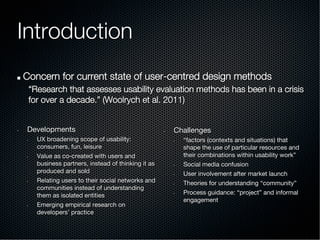
Introduction
!   Concern for current state of user-centred design methods
“Research that assesses usability evaluation methods has been in a crisis
for over a decade.” (Woolrych et al. 2011)
•  Developments
•  UX broadening scope of usability: 

consumers, fun, leisure
•  Value as co-created with users and
business partners, instead of thinking it as
produced and sold
•  Relating users to their social networks and
communities instead of understanding
them as isolated entities
•  Emerging empirical research on
developers’ practice

•  Challenges
•  “factors (contexts and situations) that
shape the use of particular resources and
their combinations within usability work”
•  Social media confusion
•  User involvement after market launch
•  Theories for understanding “community”
•  Process guidance: “project” and informal
engagement
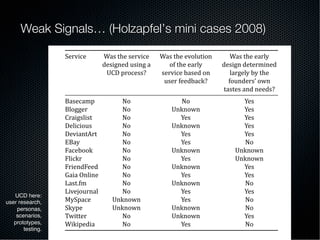
Weak Signals… (Holzapfel’s mini cases 2008)
UCD here:

user research,

personas,

scenarios,!
prototypes,!
testing.!
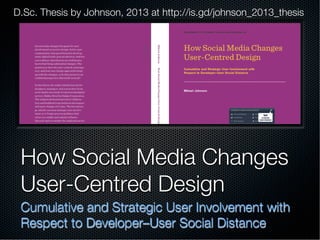
How Social Media Changes
User-Centred Design
Cumulative and Strategic User Involvement with
Respect to Developer–User Social Distance
D.Sc. Thesis by Johnson, 2013 at http://is.gd/johnson_2013_thesis
Study Setup: How Social Media
Changes User-Centred Design
•  Research questions
1.  How do users’ actions in and around a social media service shape its design?
2.  How do social media developers’ user involvement practices evolve over time?
3.  How does user categorisation change with social media?
•  Method: explorative case study
•  Real life software design, Case-based qualitative inquiry
•  Both users and developers, Long-term commitment
•  Reflective HCI: seeks means from social and behavioral sciences to address so far
unaddressed aspects of human-computer interaction
•  Here: Science and Technology Studies, Biography of Artefacts
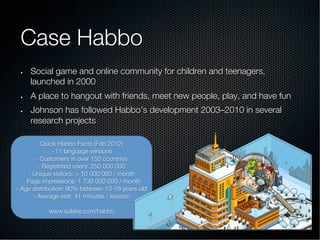
Case Habbo
•  Social game and online community for children and teenagers,
launched in 2000
•  A place to hangout with friends, meet new people, play, and have fun
•  Johnson has followed Habbo’s development 2003–2010 in several
research projects
Quick Habbo Facts (Feb 2012)
- 11 language versions
- Customers in over 150 countries
- Registered users: 250 000 000
- Unique visitors: > 10 000 000 / month
- Page impressions: 1 730 000 000 / month
- Age distribution: 90% between 13-18 years old
- Average visit: 41 minutes / session
www.sulake.com/habbo
Social Interaction in Habbo
(Ad by Sulake 2008)
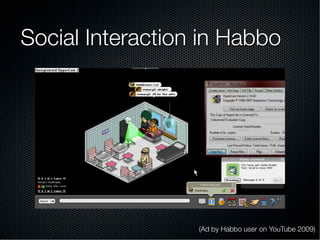
Social Interaction in Habbo
(Ad by Habbo user on YouTube 2009)
What is Social Media?
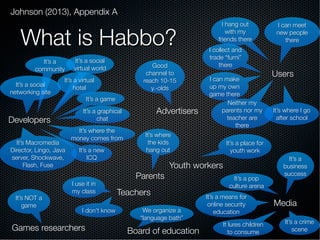
What is Habbo?
Developers
Users
Media
It’s a game
It’s a
community
It’s a graphical
chat
It’s a social
virtual world
Games researchers
It’s NOT a
game
It’s a social
networking site
I hang out
with my
friends there
I can meet
new people
there
It’s a
business
success
It’s a crime
scene
It lures children
to consume
It’s a place for
youth work
It’s a pop
culture arena
It’s a means for
online security
education
It’s Macromedia
Director, Lingo, Java
server, Shockwave,
Flash, Fuse
It’s a new
ICQ
I collect and
trade “furni”
there
I can make
up my own
game there
Neither my
parents nor my
teacher are
there
It’s where I go
after school
Parents
Teachers
I use it in
my class
I don’t know
It’s where
the kids
hang out
Youth workers
Johnson (2013), Appendix A
Board of education
We organize a
“language bath”
Advertisers
Good
channel to
reach 10-15
y.-olds
It’s where the
money comes from
It’s a virtual
hotel
Social Media is as Computerization
Movement and Design Context
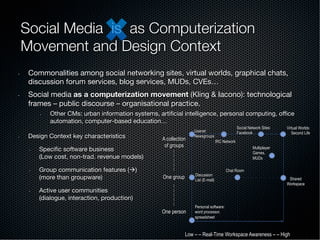
•  Commonalities among social networking sites, virtual worlds, graphical chats,
discussion forum services, blog services, MUDs, CVEs…
•  Social media as a computerization movement (Kling & Iacono): technological
frames – public discourse – organisational practice.
•  Other CMs: urban information systems, artificial intelligence, personal computing, office
automation, computer-based education…
•  Design Context key characteristics
•  Specific software business

(Low cost, non-trad. revenue models)
•  Group communication features (à)

(more than groupware)
•  Active user communities

(dialogue, interaction, production)
A collection
of groups
|
|
|
|
|
One group
|
|
|
|
|
One person
Low – – Real-Time Workspace Awareness – – High
Usenet
Newsgroups
IRC Network
Discussion
List (E-mail)
Chat Room
Personal software:
word processor,
spreadsheet
Multiplayer
Games,
MUDs
Social Network Sites:
Facebook
Virtual Worlds:
Second Life
Shared
Workspace
Research Strategy
•  Sustained search for appropriate social science research
methodologies to capture service developments and pick up
particular emerging issues
•  Co-construction of the user: Thesis Article III!
Johnson M 2007. Unscrambling the "Average User" of Habbo Hotel, Human Technology, 3 (2), 127–153.
•  Theories of consumption: Thesis Article IV!
Lehdonvirta, V, Wilska T-A, Johnson M 2009. Virtual Consumerism: Case Habbo Hotel. Information,
Communication & Society, 12 (7).
•  Subcultures: Thesis Article V!
Johnson M, Sihvonen T 2009. On the Dark Side: Gothic Play and Performance in a Virtual World, Journal of
Virtual Worlds Research, 1 (3).
•  Symbolic interactionism: Thesis Article VII!
Johnson M, Hyysalo S, Tamminen S 2010. The Virtuality of Virtual Worlds, or What We Can Learn from
Playacting Horse Girls and Marginalized Developers, 603-633. Symbolic Interaction 33 (4).
Conceptual Clarifications: User-Centred Design
•  User-centred design is here treated as a specific form of design practice
•  a particular way of designing (with the intention of putting users first), which
includes a set of interrelated ideas, guiding principles, methods, and
techniques, as well as what user-centred designers do in practice.
•  Umbrella concept (Keinonen 2010)
•  Socio-cultural-material practice bound by time and space: UCD 1986 different from UCD
1996, different regions and organisations have adopted different flavours
•  Turns
•  Design Based on Usability Evaluation
•  Turn to the Social and Contextual
•  From Evaluation to Business Process
•  A Focus on User Experience
•  Centering Design on Value(s) and Activity
•  Where to?
•  X-centred design is always protest against mainstream design
Conceptual Clarifications: User
•  Not so relevant as a question of identity: people rarely think about themselves as users
•  More interesting here: role of users in development
•  “The user is a complex idea:
•  on the one hand, it is a category used by engineers and developers to refer to those who may
eventually use their systems, on the other it can refer to a range of other individuals and institutions,
imagined and real, some of which begin to develop various kinds of engagement with a technology
over time.” (Stewart & Hyysalo 2008)
•  Cf. “person interacting with the system” (ISO standards)
•  Focus also on user representations, not only on actual people and realised computer-mediated activity
•  E.g., the abstraction processes between user categories used by developers and the everyday lives of
thousands, if not millions, of unique users
•  Relational category, not entity category
•  Object-specific: user of what? Multiple levels of granularity
•  What can one do? Pay attention to
•  different stakeholders’ capacity to act, who did what
•  categories that interviewees employ & abstractions in design talk
•  i.e. social constructionism 3.0 (borrowing from Science and Technology Studies)
Habbo in Everyday Life of Teens
—  Utopia or futile consumption?
◦  Neither
—  Brief Consumption Analysis
◦  Economic aspects
–  13% of users spend money!
ave. 10€ / month (TS 3.9.2008)
◦  Material aspects
–  Habbo characters, rooms, navigation,
communication devices, home pages, list
of friends, etc.
–  Computer, network, power, etc.
◦  Symbolic aspects
–  Habbo fashion, popularity contests,
property, groups
◦  Productive aspects
–  Room decoration, profile creation, stories
& play & games
—  Can be compared to a school yard
(for better or worse): play, games,
discussion…
—  With Habbo, teens
◦  Keep in contact with friends
◦  Get current information about what’s
going on
◦  Interact as consumers with commercial
stakeholders
—  Habbo is part of popular culture
◦  Commenting
◦  Irony
◦  Socialisation agent
Johnson M, Hyysalo S, Tamminen S 2010. The Virtuality of Virtual Worlds, or What We Can Learn from
Playacting Horse Girls and Marginalized Developers, 603-633. Symbolic Interaction 33 (4).
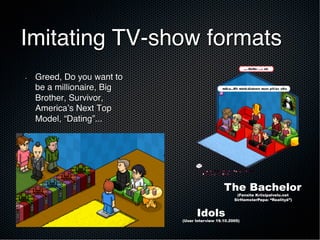
Imitating TV-show formats!
Idols
(User Interview 19.10.2005)
The Bachelor
(Fansite Kriisipalvelu.net
SirHamsterPepa: “Realityä”)
•  Greed, Do you want to
be a millionaire, Big
Brother, Survivor,
America’s Next Top
Model, “Dating”...!
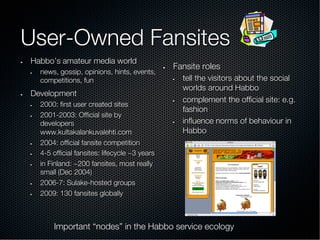
User-Owned Fansites
•  Habbo’s amateur media world
•  news, gossip, opinions, hints, events,
competitions, fun
•  Development
•  2000: first user created sites
•  2001-2003: Official site by
developers
www.kultakalankuvalehti.com
•  2004: official fansite competition
•  4-5 official fansites: lifecycle ~3 years
•  in Finland: ~200 fansites, most really
small (Dec 2004)
•  2006-7: Sulake-hosted groups
•  2009: 130 fansites globally
•  Fansite roles
•  tell the visitors about the social
worlds around Habbo
•  complement the official site: e.g.
fashion
•  influence norms of behaviour in
Habbo
Important “nodes” in the Habbo service ecology
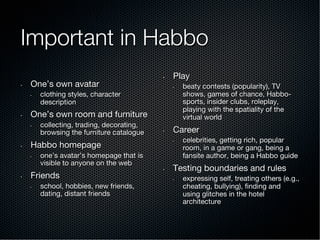
Important in Habbo
•  One’s own avatar
•  clothing styles, character
description
•  One’s own room and furniture
•  collecting, trading, decorating,
browsing the furniture catalogue
•  Habbo homepage
•  one’s avatar’s homepage that is
visible to anyone on the web
•  Friends
•  school, hobbies, new friends,
dating, distant friends
•  Play
•  beaty contests (popularity), TV
shows, games of chance, Habbo-
sports, insider clubs, roleplay,
playing with the spatiality of the
virtual world
•  Career
•  celebrities, getting rich, popular
room, in a game or gang, being a
fansite author, being a Habbo guide
•  Testing boundaries and rules
•  expressing self, treating others (e.g.,
cheating, bullying), finding and
using glitches in the hotel
architecture
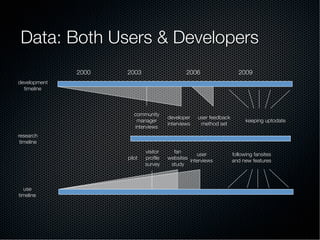
Data: Both Users & Developers
research
timeline
development
timeline
use
timeline
2000
 2003
 2006
 2009
pilot
visitor
profile
survey
fan!
websites!
study
user!
interviews
developer
interviews
user feedback!
method set
community
manager
interviews
following fansites!
and new features
keeping uptodate
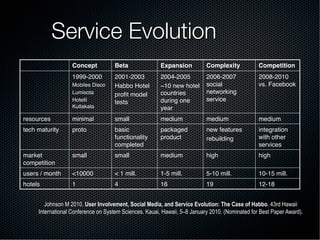
Service Evolution
Concept! Beta! Expansion! Complexity! Competition!
1999-2000!
Mobiles Disco!
Lumisota!
Hotelli
Kultakala!
2001-2003!
Habbo Hotel!
profit model
tests!
2004-2005!
~10 new hotel
countries
during one
year!
2006-2007

social
networking
service!
2008-2010

vs. Facebook!
!
resources! minimal! small! medium! medium! medium!
tech maturity! proto! basic
functionality
completed!
packaged
product!
new features!
rebuilding!
integration
with other
services!
market
competition!
small! small! medium! high! high!
users / month! <10000! < 1 mill.! 1-5 mill.! 5-10 mill.! 10-15 mill.!
hotels! 1! 4! 16! 19! 12-18!
Johnson M 2010. User Involvement, Social Media, and Service Evolution: The Case of Habbo. 43rd Hawaii
International Conference on System Sciences. Kauai, Hawaii, 5–8 January 2010. (Nominated for Best Paper Award).
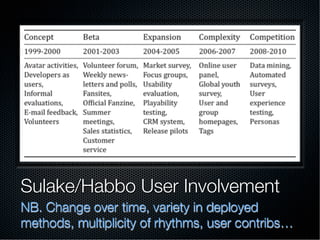
Sulake/Habbo User Involvement
NB. Change over time, variety in deployed
methods, multiplicity of rhythms, user contribs…
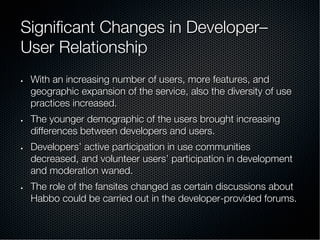
Significant Changes in Developer–
User Relationship
•  With an increasing number of users, more features, and
geographic expansion of the service, also the diversity of use
practices increased.
•  The younger demographic of the users brought increasing
differences between developers and users.
•  Developers’ active participation in use communities
decreased, and volunteer users’ participation in development
and moderation waned.
•  The role of the fansites changed as certain discussions about
Habbo could be carried out in the developer-provided forums.
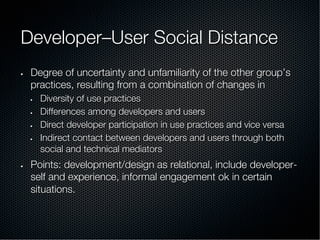
Developer–User Social Distance
•  Degree of uncertainty and unfamiliarity of the other group’s
practices, resulting from a combination of changes in
•  Diversity of use practices
•  Differences among developers and users
•  Direct developer participation in use practices and vice versa
•  Indirect contact between developers and users through both
social and technical mediators
•  Points: development/design as relational, include developer-
self and experience, informal engagement ok in certain
situations.
Shifts in Developer–User Social Distance
•  Previously: developers’ own use of a product and resulting first-hand experience
poorly considered
•  ‘Bad guys’: developers are not representative
•  ‘Heroes’: some developers know what users want, without asking
•  Missing ‘factor’ in method advice
•  Here: nuanced middle ground
•  Depends on how familiar developers are with the users and the use practices, what I call
developer–user social distance
•  Self-centred design adequate, but within limits
•  Small distance: informal engagement
•  Broad distance: more bridging activities
•  Developer–user social distance changes over time
•  Start: small or broad
•  User involvement activities (participation) modifies
•  Previously: focus on use context or development context, here more relational
Implications
!   “Start condition” for user-centred design?
!   Method advice
!   First question: not “where in the project are you”?, but find
out developer–user social distance, how familiar are the
developers with the users?
!   Diversity of user practices
!   Social, cultural, and professional differences
!   Previous direct user involvement
!   Other indirect sources of information about users?
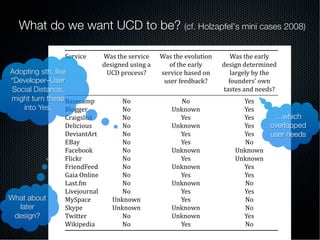
What do we want UCD to be? (cf. Holzapfel’s mini cases 2008)
Adopting sth. like
“Developer–User
Social Distance,
might turn these
into Yes.
…which
overlapped
user needs
What about
later
design?
How Social Media Changes UCD
•  Different methods repertoire => different strategic
choices
•  Consider:
•  Developer–user social distance
•  Cumulation of user knowledge
•  Key rhythms in development
•  Broader applicability to other design contexts
Thanks!
http://people.aalto.fi/mikael_johnson
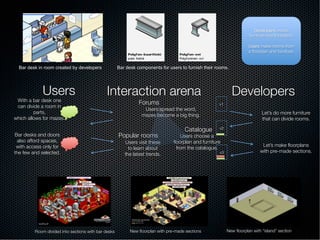
Developers
Users
Room divided into sections with bar desks
 New floorplan with pre-made sections
 New floorplan with “island” section
Developers create
furniture and floorplans.

Users make rooms from
a floorplan and furniture.
Bar desk in room created by developers Bar desk components for users to furnish their rooms.
With a bar desk one
can divide a room in
parts,
which allows for mazes.
Let’s do more furniture
that can divide rooms.
Bar desks and doors
also afford spaces,
with access only for
the few and selected.
Forums
Users spread the word, 
mazes become a big thing.
Popular rooms
Users visit these 
to learn about!
the latest trends.
Catalogue
Users choose a!
floorplan and furniture!
from the catalogue.
Interaction arena
Let’s make floorplans
with pre-made sections.
v1
v2
v3

Johnson INUSE Seminar May 16, 2013

  • 1.
    How Social MediaChanges ! User-Centred Design INUSE Seminar May 16, 2013 Mikael Johnson D.Sc. (Tech) Aalto University, Finland http://people.aalto.fi/mikael_johnson
  • 2.
    Introduction !   Concernfor current state of user-centred design methods “Research that assesses usability evaluation methods has been in a crisis for over a decade.” (Woolrych et al. 2011) •  Developments •  UX broadening scope of usability: 
 consumers, fun, leisure •  Value as co-created with users and business partners, instead of thinking it as produced and sold •  Relating users to their social networks and communities instead of understanding them as isolated entities •  Emerging empirical research on developers’ practice •  Challenges •  “factors (contexts and situations) that shape the use of particular resources and their combinations within usability work” •  Social media confusion •  User involvement after market launch •  Theories for understanding “community” •  Process guidance: “project” and informal engagement
  • 3.
    Weak Signals… (Holzapfel’smini cases 2008) UCD here:
 user research,
 personas,
 scenarios,! prototypes,! testing.!
  • 4.
    How Social MediaChanges User-Centred Design Cumulative and Strategic User Involvement with Respect to Developer–User Social Distance D.Sc. Thesis by Johnson, 2013 at http://is.gd/johnson_2013_thesis
  • 5.
    Study Setup: HowSocial Media Changes User-Centred Design •  Research questions 1.  How do users’ actions in and around a social media service shape its design? 2.  How do social media developers’ user involvement practices evolve over time? 3.  How does user categorisation change with social media? •  Method: explorative case study •  Real life software design, Case-based qualitative inquiry •  Both users and developers, Long-term commitment •  Reflective HCI: seeks means from social and behavioral sciences to address so far unaddressed aspects of human-computer interaction •  Here: Science and Technology Studies, Biography of Artefacts
  • 6.
    Case Habbo •  Socialgame and online community for children and teenagers, launched in 2000 •  A place to hangout with friends, meet new people, play, and have fun •  Johnson has followed Habbo’s development 2003–2010 in several research projects Quick Habbo Facts (Feb 2012) - 11 language versions - Customers in over 150 countries - Registered users: 250 000 000 - Unique visitors: > 10 000 000 / month - Page impressions: 1 730 000 000 / month - Age distribution: 90% between 13-18 years old - Average visit: 41 minutes / session www.sulake.com/habbo
  • 7.
    Social Interaction inHabbo (Ad by Sulake 2008)
  • 8.
    Social Interaction inHabbo (Ad by Habbo user on YouTube 2009)
  • 9.
  • 10.
    What is Habbo? Developers Users Media It’sa game It’s a community It’s a graphical chat It’s a social virtual world Games researchers It’s NOT a game It’s a social networking site I hang out with my friends there I can meet new people there It’s a business success It’s a crime scene It lures children to consume It’s a place for youth work It’s a pop culture arena It’s a means for online security education It’s Macromedia Director, Lingo, Java server, Shockwave, Flash, Fuse It’s a new ICQ I collect and trade “furni” there I can make up my own game there Neither my parents nor my teacher are there It’s where I go after school Parents Teachers I use it in my class I don’t know It’s where the kids hang out Youth workers Johnson (2013), Appendix A Board of education We organize a “language bath” Advertisers Good channel to reach 10-15 y.-olds It’s where the money comes from It’s a virtual hotel
  • 11.
    Social Media isas Computerization Movement and Design Context •  Commonalities among social networking sites, virtual worlds, graphical chats, discussion forum services, blog services, MUDs, CVEs… •  Social media as a computerization movement (Kling & Iacono): technological frames – public discourse – organisational practice. •  Other CMs: urban information systems, artificial intelligence, personal computing, office automation, computer-based education… •  Design Context key characteristics •  Specific software business
 (Low cost, non-trad. revenue models) •  Group communication features (à)
 (more than groupware) •  Active user communities
 (dialogue, interaction, production) A collection of groups | | | | | One group | | | | | One person Low – – Real-Time Workspace Awareness – – High Usenet Newsgroups IRC Network Discussion List (E-mail) Chat Room Personal software: word processor, spreadsheet Multiplayer Games, MUDs Social Network Sites: Facebook Virtual Worlds: Second Life Shared Workspace
  • 12.
    Research Strategy •  Sustainedsearch for appropriate social science research methodologies to capture service developments and pick up particular emerging issues •  Co-construction of the user: Thesis Article III! Johnson M 2007. Unscrambling the "Average User" of Habbo Hotel, Human Technology, 3 (2), 127–153. •  Theories of consumption: Thesis Article IV! Lehdonvirta, V, Wilska T-A, Johnson M 2009. Virtual Consumerism: Case Habbo Hotel. Information, Communication & Society, 12 (7). •  Subcultures: Thesis Article V! Johnson M, Sihvonen T 2009. On the Dark Side: Gothic Play and Performance in a Virtual World, Journal of Virtual Worlds Research, 1 (3). •  Symbolic interactionism: Thesis Article VII! Johnson M, Hyysalo S, Tamminen S 2010. The Virtuality of Virtual Worlds, or What We Can Learn from Playacting Horse Girls and Marginalized Developers, 603-633. Symbolic Interaction 33 (4).
  • 13.
    Conceptual Clarifications: User-CentredDesign •  User-centred design is here treated as a specific form of design practice •  a particular way of designing (with the intention of putting users first), which includes a set of interrelated ideas, guiding principles, methods, and techniques, as well as what user-centred designers do in practice. •  Umbrella concept (Keinonen 2010) •  Socio-cultural-material practice bound by time and space: UCD 1986 different from UCD 1996, different regions and organisations have adopted different flavours •  Turns •  Design Based on Usability Evaluation •  Turn to the Social and Contextual •  From Evaluation to Business Process •  A Focus on User Experience •  Centering Design on Value(s) and Activity •  Where to? •  X-centred design is always protest against mainstream design
  • 14.
    Conceptual Clarifications: User • Not so relevant as a question of identity: people rarely think about themselves as users •  More interesting here: role of users in development •  “The user is a complex idea: •  on the one hand, it is a category used by engineers and developers to refer to those who may eventually use their systems, on the other it can refer to a range of other individuals and institutions, imagined and real, some of which begin to develop various kinds of engagement with a technology over time.” (Stewart & Hyysalo 2008) •  Cf. “person interacting with the system” (ISO standards) •  Focus also on user representations, not only on actual people and realised computer-mediated activity •  E.g., the abstraction processes between user categories used by developers and the everyday lives of thousands, if not millions, of unique users •  Relational category, not entity category •  Object-specific: user of what? Multiple levels of granularity •  What can one do? Pay attention to •  different stakeholders’ capacity to act, who did what •  categories that interviewees employ & abstractions in design talk •  i.e. social constructionism 3.0 (borrowing from Science and Technology Studies)
  • 15.
    Habbo in EverydayLife of Teens —  Utopia or futile consumption? ◦  Neither —  Brief Consumption Analysis ◦  Economic aspects –  13% of users spend money! ave. 10€ / month (TS 3.9.2008) ◦  Material aspects –  Habbo characters, rooms, navigation, communication devices, home pages, list of friends, etc. –  Computer, network, power, etc. ◦  Symbolic aspects –  Habbo fashion, popularity contests, property, groups ◦  Productive aspects –  Room decoration, profile creation, stories & play & games —  Can be compared to a school yard (for better or worse): play, games, discussion… —  With Habbo, teens ◦  Keep in contact with friends ◦  Get current information about what’s going on ◦  Interact as consumers with commercial stakeholders —  Habbo is part of popular culture ◦  Commenting ◦  Irony ◦  Socialisation agent Johnson M, Hyysalo S, Tamminen S 2010. The Virtuality of Virtual Worlds, or What We Can Learn from Playacting Horse Girls and Marginalized Developers, 603-633. Symbolic Interaction 33 (4).
  • 16.
    Imitating TV-show formats! Idols (UserInterview 19.10.2005) The Bachelor (Fansite Kriisipalvelu.net SirHamsterPepa: “Realityä”) •  Greed, Do you want to be a millionaire, Big Brother, Survivor, America’s Next Top Model, “Dating”...!
  • 17.
    User-Owned Fansites •  Habbo’samateur media world •  news, gossip, opinions, hints, events, competitions, fun •  Development •  2000: first user created sites •  2001-2003: Official site by developers www.kultakalankuvalehti.com •  2004: official fansite competition •  4-5 official fansites: lifecycle ~3 years •  in Finland: ~200 fansites, most really small (Dec 2004) •  2006-7: Sulake-hosted groups •  2009: 130 fansites globally •  Fansite roles •  tell the visitors about the social worlds around Habbo •  complement the official site: e.g. fashion •  influence norms of behaviour in Habbo Important “nodes” in the Habbo service ecology
  • 18.
    Important in Habbo • One’s own avatar •  clothing styles, character description •  One’s own room and furniture •  collecting, trading, decorating, browsing the furniture catalogue •  Habbo homepage •  one’s avatar’s homepage that is visible to anyone on the web •  Friends •  school, hobbies, new friends, dating, distant friends •  Play •  beaty contests (popularity), TV shows, games of chance, Habbo- sports, insider clubs, roleplay, playing with the spatiality of the virtual world •  Career •  celebrities, getting rich, popular room, in a game or gang, being a fansite author, being a Habbo guide •  Testing boundaries and rules •  expressing self, treating others (e.g., cheating, bullying), finding and using glitches in the hotel architecture
  • 19.
    Data: Both Users& Developers research timeline development timeline use timeline 2000 2003 2006 2009 pilot visitor profile survey fan! websites! study user! interviews developer interviews user feedback! method set community manager interviews following fansites! and new features keeping uptodate
  • 20.
    Service Evolution Concept! Beta!Expansion! Complexity! Competition! 1999-2000! Mobiles Disco! Lumisota! Hotelli Kultakala! 2001-2003! Habbo Hotel! profit model tests! 2004-2005! ~10 new hotel countries during one year! 2006-2007
 social networking service! 2008-2010
 vs. Facebook! ! resources! minimal! small! medium! medium! medium! tech maturity! proto! basic functionality completed! packaged product! new features! rebuilding! integration with other services! market competition! small! small! medium! high! high! users / month! <10000! < 1 mill.! 1-5 mill.! 5-10 mill.! 10-15 mill.! hotels! 1! 4! 16! 19! 12-18! Johnson M 2010. User Involvement, Social Media, and Service Evolution: The Case of Habbo. 43rd Hawaii International Conference on System Sciences. Kauai, Hawaii, 5–8 January 2010. (Nominated for Best Paper Award).
  • 21.
    Sulake/Habbo User Involvement NB.Change over time, variety in deployed methods, multiplicity of rhythms, user contribs…
  • 22.
    Significant Changes inDeveloper– User Relationship •  With an increasing number of users, more features, and geographic expansion of the service, also the diversity of use practices increased. •  The younger demographic of the users brought increasing differences between developers and users. •  Developers’ active participation in use communities decreased, and volunteer users’ participation in development and moderation waned. •  The role of the fansites changed as certain discussions about Habbo could be carried out in the developer-provided forums.
  • 23.
    Developer–User Social Distance • Degree of uncertainty and unfamiliarity of the other group’s practices, resulting from a combination of changes in •  Diversity of use practices •  Differences among developers and users •  Direct developer participation in use practices and vice versa •  Indirect contact between developers and users through both social and technical mediators •  Points: development/design as relational, include developer- self and experience, informal engagement ok in certain situations.
  • 24.
    Shifts in Developer–UserSocial Distance •  Previously: developers’ own use of a product and resulting first-hand experience poorly considered •  ‘Bad guys’: developers are not representative •  ‘Heroes’: some developers know what users want, without asking •  Missing ‘factor’ in method advice •  Here: nuanced middle ground •  Depends on how familiar developers are with the users and the use practices, what I call developer–user social distance •  Self-centred design adequate, but within limits •  Small distance: informal engagement •  Broad distance: more bridging activities •  Developer–user social distance changes over time •  Start: small or broad •  User involvement activities (participation) modifies •  Previously: focus on use context or development context, here more relational
  • 25.
    Implications !   “Startcondition” for user-centred design? !   Method advice !   First question: not “where in the project are you”?, but find out developer–user social distance, how familiar are the developers with the users? !   Diversity of user practices !   Social, cultural, and professional differences !   Previous direct user involvement !   Other indirect sources of information about users?
  • 26.
    What do wewant UCD to be? (cf. Holzapfel’s mini cases 2008) Adopting sth. like “Developer–User Social Distance, might turn these into Yes. …which overlapped user needs What about later design?
  • 27.
    How Social MediaChanges UCD •  Different methods repertoire => different strategic choices •  Consider: •  Developer–user social distance •  Cumulation of user knowledge •  Key rhythms in development •  Broader applicability to other design contexts
  • 28.
  • 29.
    Developers Users Room divided intosections with bar desks New floorplan with pre-made sections New floorplan with “island” section Developers create furniture and floorplans. Users make rooms from a floorplan and furniture. Bar desk in room created by developers Bar desk components for users to furnish their rooms. With a bar desk one can divide a room in parts, which allows for mazes. Let’s do more furniture that can divide rooms. Bar desks and doors also afford spaces, with access only for the few and selected. Forums Users spread the word, mazes become a big thing. Popular rooms Users visit these to learn about! the latest trends. Catalogue Users choose a! floorplan and furniture! from the catalogue. Interaction arena Let’s make floorplans with pre-made sections. v1 v2 v3