








Delta Module Three Neil McMahon Delta 3 Extending practice  and English  language teaching specialisation
Session One:  Friday  August 27th 3pm – 6pm A review of key issues relevant to candidates’ specialities Learning styles and motivations Neil McMahon Delta 3
Neil McMahon Delta 3 Delta Module Three –  Choosing Your Specialism
Module Three aims to develop candidates ’  knowledge of and competence in: a chosen specialism Neil McMahon Delta 3
To achieve these aims, candidates need to: research a chosen specialism Neil McMahon Delta 3
Candidates must select  one  specialism where the candidate already has experience or one which they would like to explore for future employment Neil McMahon Delta 3
The specialism can be narrowed down from those on the official list  in order to research a specific aspect in appropriate depth. Neil McMahon Delta 3
An individual learner may be chosen as a specialist subject for this assignment. Neil McMahon Delta 3
Grasp of topic –  maximum 35 marks •  Review of the relevant literature in the topic area •  Understanding of key issues in the topic area •  Application of knowledge to practice and identification of key issues Neil McMahon Delta 3
Neil McMahon Delta 3 Delta Module Three –  Choosing Your Specialism The choices on offer
Neil McMahon Delta 3 Delta Module Three –  Choosing Your Specialism •   Business English (BE) • Teaching young learners/young adults (specified age group required with 5-year range e.g. 8–13, 14–19) (YL) • English for Special Purposes (ESP) • English for Academic Purposes (EAP) • Teaching examination classes (EX) • Teaching one-to-one (1to1) • ESOL learners with literacy needs (ESOL) • CLIL/Embedded ESOL (teaching English through subject/work-based learning) (CLIL)
Neil McMahon Delta 3 Delta Module Three –  Choosing Your Specialism   • Teaching monolingual classes (MON) • Teaching multilingual classes (MUL) • Teaching in an English-speaking environment (ESE)   • Teaching in a non-English-speaking environment. (NESE) • Teaching learners online/through distance/blended learning (DL) • Teaching English to learners with special requirements e.g. visual/hearing impairment, dyslexia, ASD (SR) • Language development for teachers (LDT) • Language support (e.g. on mainstream teaching programmes, specialist skills support, such as supporting writing needs) (LS)
Neil McMahon Delta 3 Delta Module Three –  Choosing Your Specialism   Focusing your specialism Candidates  may choose to focus the selected specialism in order to research a specific aspect in  appropriate depth
Neil McMahon Delta 3 Delta Module Three –  Choosing Your Specialism   Focusing your specialism ESP = Teaching communication skills to doctors working in a general hospital.
Neil McMahon Delta 3 Delta Module Three –  Choosing Your Specialism   Focusing your specialism Teaching Young learners =  Designing course programmes for 11-12 year old learners in Uruguay
Neil McMahon Delta 3 Delta Module Three –  Choosing Your Specialism   Focusing your specialism Teaching FCE   Or = Preparing candidates for the FCE listening test
Neil McMahon Delta 3 Delta Module Three –  Choosing Your Specialism   Focusing your specialism However, candidates should beware of choosing too narrow a focus, e.g. choosing a discrete sub-skill or area of grammar  
Guiding Questions Part 1: Introduction Why did you choose this specialism? Neil McMahon Delta 3
Guiding Questions Part 1: Introduction What theories and principles in the academic and professional literature have you found relevant, useful or challenging? Neil McMahon Delta 3
Guiding Questions Part 1: Introduction What ideas from observation and experience have you drawn on? Neil McMahon Delta 3
Guiding Questions Part 1: Introduction What have you found out from your research which is important for the design of your course? Neil McMahon Delta 3
Guiding Questions Part 2: Needs Analysis Who is your specialist group? What are their main characteristics? (e.g. age, educational and language level, nationality, learning style(s), motivations, job, etc.) Neil McMahon Delta 3
Part 1: Introduction Grasp of topic When selected suitably, Part 1 was handled well. Stronger assignments often had a section addressing issues which characterised the specialism, or showed how it differs from other kinds of teaching. Stronger assignments typically made reference to at least five or six relevant sources. Most candidates also made good reference to experience. Neil McMahon Delta 3
Part 1: Introduction Weaknesses Failing candidates tended to have common problems such as: failing to adequately focus the assignment by choosing a suitable specialism Neil McMahon Delta 3
Part 1: Introduction Weaknesses Failing candidates tended to have common problems such as: considering in Part 1 only a specific class and context rather than issues relating to the specialism in general Neil McMahon Delta 3
Part 1: Introduction Weaknesses Failing candidates tended to have common problems such as: not referring explicitly to key sources and theory Neil McMahon Delta 3
Part 1: Topic area Advice to candidates: Neil McMahon Delta 3
Part 1: Topic area Advice to candidates: It is essential that the whole assignment is clearly related to a specialism. Neil McMahon Delta 3
Part 1: Topic area Advice to candidates: Part 1 should consider general issues to be considered when teaching this type of class. In Part 2 the focus will be narrowed to a specific class of learners. Neil McMahon Delta 3
Part 1: Topic area Advice to candidates: The review of the literature should go beyond simply finding one or two sources which describe the topic area, and should show that the candidate has read and synthesised a number (5 or 6) of key sources.  It should also contain an element of criticality. Neil McMahon Delta 3
Part 1: Topic area Advice to candidates: Outline in practical terms key features of the specialism, ways in which teaching may differ from General English, and particular points which need to be considered when designing a course in this specialism. Neil McMahon Delta 3
Part 1: Topic area Examples illustrating the ways in which stronger assignments referred to background reading. Neil McMahon Delta 3
Part 1: Topic area Example 1 Although learner-centeredness has been a key concept in adult EFL for years, many teachers believe that teens are too young to have a say in what is taught. Puchta and Schratz disagree; connecting course content to students' real-life experiences "make the end goals of language learning seem nearer and more motivating" (1992:1). Neil McMahon Delta 3
Part 1: Topic area Example 2 A number of writers feel that there is a fundamental dichotomy between EAP and general English. Benson, for example, argues that with regards to listening skills, those required in an academic environment are “quantitatively and qualitatively different than those within an ESL classroom” (1989:422). From my experience in both sectors I would not go this far……. Neil McMahon Delta 3
Session One:  Friday  August 27th 3pm – 6pm A review of key issues relevant to candidates’ specialities Learning styles and motivations Neil McMahon Delta 3
Learning Styles Visual Auditory Kinaesthetic (Tactile) (Olfactory) (Gustatory) Neil McMahon Delta 3
Learning Styles Environmental Emotional Sociological Physiological Psychological Neil McMahon Delta 3
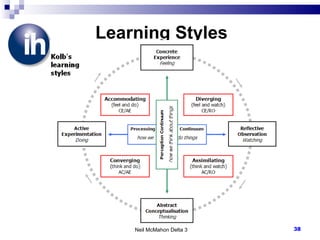
Learning Styles Neil McMahon Delta 3
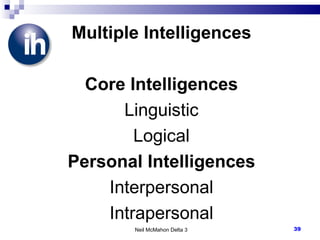
Multiple Intelligences Core Intelligences Linguistic Logical Personal Intelligences Interpersonal Intrapersonal Neil McMahon Delta 3
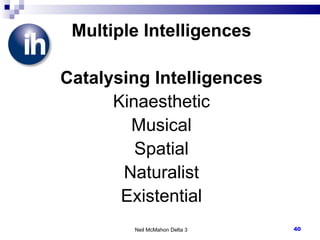
Multiple Intelligences Catalysing Intelligences Kinaesthetic Musical Spatial Naturalist Existential Neil McMahon Delta 3
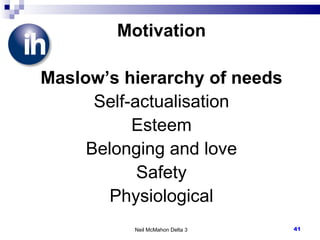
Motivation Maslow’s hierarchy of needs Self-actualisation Esteem Belonging and love Safety Physiological Neil McMahon Delta 3
Motivation Intrinsic Extrinsic Instrumental Integrative Choice  Executive Neil McMahon Delta 3

Delta 3 specialisms, learning styles, motivations

  • 1.
    Delta Module ThreeNeil McMahon Delta 3 Extending practice and English language teaching specialisation
  • 2.
    Session One: Friday August 27th 3pm – 6pm A review of key issues relevant to candidates’ specialities Learning styles and motivations Neil McMahon Delta 3
  • 3.
    Neil McMahon Delta3 Delta Module Three – Choosing Your Specialism
  • 4.
    Module Three aimsto develop candidates ’ knowledge of and competence in: a chosen specialism Neil McMahon Delta 3
  • 5.
    To achieve theseaims, candidates need to: research a chosen specialism Neil McMahon Delta 3
  • 6.
    Candidates must select one specialism where the candidate already has experience or one which they would like to explore for future employment Neil McMahon Delta 3
  • 7.
    The specialism canbe narrowed down from those on the official list in order to research a specific aspect in appropriate depth. Neil McMahon Delta 3
  • 8.
    An individual learnermay be chosen as a specialist subject for this assignment. Neil McMahon Delta 3
  • 9.
    Grasp of topic– maximum 35 marks • Review of the relevant literature in the topic area • Understanding of key issues in the topic area • Application of knowledge to practice and identification of key issues Neil McMahon Delta 3
  • 10.
    Neil McMahon Delta3 Delta Module Three – Choosing Your Specialism The choices on offer
  • 11.
    Neil McMahon Delta3 Delta Module Three – Choosing Your Specialism • Business English (BE) • Teaching young learners/young adults (specified age group required with 5-year range e.g. 8–13, 14–19) (YL) • English for Special Purposes (ESP) • English for Academic Purposes (EAP) • Teaching examination classes (EX) • Teaching one-to-one (1to1) • ESOL learners with literacy needs (ESOL) • CLIL/Embedded ESOL (teaching English through subject/work-based learning) (CLIL)
  • 12.
    Neil McMahon Delta3 Delta Module Three – Choosing Your Specialism • Teaching monolingual classes (MON) • Teaching multilingual classes (MUL) • Teaching in an English-speaking environment (ESE) • Teaching in a non-English-speaking environment. (NESE) • Teaching learners online/through distance/blended learning (DL) • Teaching English to learners with special requirements e.g. visual/hearing impairment, dyslexia, ASD (SR) • Language development for teachers (LDT) • Language support (e.g. on mainstream teaching programmes, specialist skills support, such as supporting writing needs) (LS)
  • 13.
    Neil McMahon Delta3 Delta Module Three – Choosing Your Specialism Focusing your specialism Candidates may choose to focus the selected specialism in order to research a specific aspect in appropriate depth
  • 14.
    Neil McMahon Delta3 Delta Module Three – Choosing Your Specialism Focusing your specialism ESP = Teaching communication skills to doctors working in a general hospital.
  • 15.
    Neil McMahon Delta3 Delta Module Three – Choosing Your Specialism Focusing your specialism Teaching Young learners = Designing course programmes for 11-12 year old learners in Uruguay
  • 16.
    Neil McMahon Delta3 Delta Module Three – Choosing Your Specialism Focusing your specialism Teaching FCE  Or = Preparing candidates for the FCE listening test
  • 17.
    Neil McMahon Delta3 Delta Module Three – Choosing Your Specialism Focusing your specialism However, candidates should beware of choosing too narrow a focus, e.g. choosing a discrete sub-skill or area of grammar 
  • 18.
    Guiding Questions Part1: Introduction Why did you choose this specialism? Neil McMahon Delta 3
  • 19.
    Guiding Questions Part1: Introduction What theories and principles in the academic and professional literature have you found relevant, useful or challenging? Neil McMahon Delta 3
  • 20.
    Guiding Questions Part1: Introduction What ideas from observation and experience have you drawn on? Neil McMahon Delta 3
  • 21.
    Guiding Questions Part1: Introduction What have you found out from your research which is important for the design of your course? Neil McMahon Delta 3
  • 22.
    Guiding Questions Part2: Needs Analysis Who is your specialist group? What are their main characteristics? (e.g. age, educational and language level, nationality, learning style(s), motivations, job, etc.) Neil McMahon Delta 3
  • 23.
    Part 1: IntroductionGrasp of topic When selected suitably, Part 1 was handled well. Stronger assignments often had a section addressing issues which characterised the specialism, or showed how it differs from other kinds of teaching. Stronger assignments typically made reference to at least five or six relevant sources. Most candidates also made good reference to experience. Neil McMahon Delta 3
  • 24.
    Part 1: IntroductionWeaknesses Failing candidates tended to have common problems such as: failing to adequately focus the assignment by choosing a suitable specialism Neil McMahon Delta 3
  • 25.
    Part 1: IntroductionWeaknesses Failing candidates tended to have common problems such as: considering in Part 1 only a specific class and context rather than issues relating to the specialism in general Neil McMahon Delta 3
  • 26.
    Part 1: IntroductionWeaknesses Failing candidates tended to have common problems such as: not referring explicitly to key sources and theory Neil McMahon Delta 3
  • 27.
    Part 1: Topicarea Advice to candidates: Neil McMahon Delta 3
  • 28.
    Part 1: Topicarea Advice to candidates: It is essential that the whole assignment is clearly related to a specialism. Neil McMahon Delta 3
  • 29.
    Part 1: Topicarea Advice to candidates: Part 1 should consider general issues to be considered when teaching this type of class. In Part 2 the focus will be narrowed to a specific class of learners. Neil McMahon Delta 3
  • 30.
    Part 1: Topicarea Advice to candidates: The review of the literature should go beyond simply finding one or two sources which describe the topic area, and should show that the candidate has read and synthesised a number (5 or 6) of key sources. It should also contain an element of criticality. Neil McMahon Delta 3
  • 31.
    Part 1: Topicarea Advice to candidates: Outline in practical terms key features of the specialism, ways in which teaching may differ from General English, and particular points which need to be considered when designing a course in this specialism. Neil McMahon Delta 3
  • 32.
    Part 1: Topicarea Examples illustrating the ways in which stronger assignments referred to background reading. Neil McMahon Delta 3
  • 33.
    Part 1: Topicarea Example 1 Although learner-centeredness has been a key concept in adult EFL for years, many teachers believe that teens are too young to have a say in what is taught. Puchta and Schratz disagree; connecting course content to students' real-life experiences "make the end goals of language learning seem nearer and more motivating" (1992:1). Neil McMahon Delta 3
  • 34.
    Part 1: Topicarea Example 2 A number of writers feel that there is a fundamental dichotomy between EAP and general English. Benson, for example, argues that with regards to listening skills, those required in an academic environment are “quantitatively and qualitatively different than those within an ESL classroom” (1989:422). From my experience in both sectors I would not go this far……. Neil McMahon Delta 3
  • 35.
    Session One: Friday August 27th 3pm – 6pm A review of key issues relevant to candidates’ specialities Learning styles and motivations Neil McMahon Delta 3
  • 36.
    Learning Styles VisualAuditory Kinaesthetic (Tactile) (Olfactory) (Gustatory) Neil McMahon Delta 3
  • 37.
    Learning Styles EnvironmentalEmotional Sociological Physiological Psychological Neil McMahon Delta 3
  • 38.
    Learning Styles NeilMcMahon Delta 3
  • 39.
    Multiple Intelligences CoreIntelligences Linguistic Logical Personal Intelligences Interpersonal Intrapersonal Neil McMahon Delta 3
  • 40.
    Multiple Intelligences CatalysingIntelligences Kinaesthetic Musical Spatial Naturalist Existential Neil McMahon Delta 3
  • 41.
    Motivation Maslow’s hierarchyof needs Self-actualisation Esteem Belonging and love Safety Physiological Neil McMahon Delta 3
  • 42.
    Motivation Intrinsic ExtrinsicInstrumental Integrative Choice Executive Neil McMahon Delta 3