HENOK N SHIHEPOPO COLLECTIONS
Literary Criticism
Neoclassical Criticism: John Dryden
John Dryden as the Father of English Criticism
 Dr Johnson declare Dryden as the father of English Criticism due to the fact that he is the first writer
who taught English people to determine the merit of compositions upon principles.
 According to the new critics , Dryden created the new fashion of criticizing , just like Shakespeare
who established the new fashion of dramatizing, the fashion that aimed at delighting, at truth, at
justice, at nature, at poetry and do away with the rules.
 He was a writer and a critic, thus he had a dogmatic bend.
 His criticism ideology is derived from the classical and modern criticism and from literature,
especially on drama.
 Dryden in his dialogue “ the dramatic Poesy “, he commented on the three unities of drama
 In essence Dryden liberated the English criticism from the classical criticism in his first original
criticism, his liberal criticism, historical criticism, his comparative and theoretical criticism
Neoclassical Criticism
John Dryden: First original critic
 Dryden been the father of English criticism does not mean that he is the
first English critic, there wee many critics before him, e.g. Ben Johnson
and Sir Phillip Sydney. However;
 Their criticism was a blind imitation of the ancients, meaning hat they
followed the Plato’s and Aristotle’s criticism.
 Their criticism was merely by chances, meaning that their critical works
were merely by chances utterances on the critical arts.
 Sydney defend poetry against the puritan attacks
 Johnson’s critical utterances wee in the form of noting down what
interest him
 In essence, Johnson’s criticism was sketchy, ruthless, limited, while
Dryden’s criticism was tolerant, urbane in his critical range, hence
Dryden with his diverse literary tradition and much greater critical output
made him the father of English criticism.
Neoclassical Criticism
John Dryden: Liberal Criticism
 Literary criticism than was magisterial and dogmatic, but Dryden was
sceptical
 Hence he did not make rules but he discovered them for his guidance
for writing his plays and judging those written by others.
 Dryden was in agreement with Aristotle’s definition of poetry as a
process of imitation, however he added some qualifiers, hence
according to him poetry have to do with the close imitation of facts
present or past. In essence, he gave more reliability and flexibilities to
poetry.
Neoclassical Criticism
John Dryden: Liberal Criticism cont…..
 In terms of criticism, drama, in tragedy he made a case of double lagged
imitation.
 According to him, a poet is free to imitate things as they are said or thought
to be.
 Hence he gave the poet the right to imitate what could be, might be, or
ought to be.
 Dryden brushed away all the arbitrary bans against freedom of compositions
and freedom of thoughts.
 He see no reason of prohibiting the tragi-comedy for it mingles mirth with a
serious plot.
Neoclassical Criticism
John Dryden: Descriptive Criticism
 Dryden is the first Englishman that attempted the extended
descriptive criticism.
 The English criticism before Dryden was either theoretical or
legislative.
 It is found in his criticism that literary analysis , the dominant concer
n of modern critic emerges for the first time.
Neoclassical Criticism
John Dryden: historical criticism
 He recognised that the genius and temperament differ from ages
to ages, hence the literature in different periods of history is bound
to be different.
 Dryden traced the decay of literature of the pre-restoration era to
historical causes and its revival, thus he discovered that the
Elizabethan and restoration drama are governed by different literary
conventions.
Neoclassical Criticism
John Dryden: Comparative criticism
 Dryden add a new dimension comparative analysis in literary criticism
by his.
 His methods of criticism shifts according to the work of literature he
criticized or discussing.
 Hence he was intelligent and sensitive enough as a critic to realised
that different kind of work need different critical approaches.
 That what made his criticism unique, individualised and free from
rigidity or dogmatic!
Neoclassical Criticism
John Dryden: Theoretical Criticism
 In this field he modified the ancient’s doctrine rather than creating
new theories.
 He test every accepted critical canon of the ancients in the light of
modernity and exploded some of their outmoded concepts.
 He also recognise the fundamental truth that the climate, the age,
the disposition of people to which poets write might be different.
Neoclassical criticism
Dryden’s Views on the Function of Poetry
 he believe that the function of poetry is to delight and transport, and not to
teach or instruct like Plato says.
 According to Plato a poet is not a teacher nor an imitator, but a poet is a
creator, who creates new things act of life and nature.
Neoclassical Criticism
Dryden’s views on Drama
 According to Dryden, Drama is just and lively image of human.it represent the
passion and the humour , the changing of fortune to which it’s subject to
delight and instruction
 He agree with Plato and Aristotle that dram is the poetry including drama, is
the imitation, but according to Dryden, drama is not a mere imitation of an
imitation because it adds creative aspects and it has a close imitation of
present and past.
 Dryden enhance the way we look at poetry. This refers to the aesthetic
nature of dram the rhyme, meter, symbols, for poetry they goes beyond
imitation
Neoclassical Criticism
Dryden and the violation of the three unities
 He was more tolerant toward the change
 As the father of English criticism, he explored more and according to him, critic
s may feel limited by the prescription of these unities, therefor he defend their
violation as he compared the French and the English literature.
 He felt that introducing sub-plot wont do any harm, due to the fact that they
bring the in the variety of richness and livens the play.
 according to him , b y doing so , the play will present the just and lively
picture than the narrow and compare play.
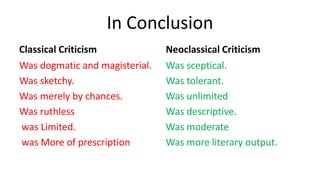
In Conclusion
Classical Criticism
Was dogmatic and magisterial.
Was sketchy.
Was merely by chances.
Was ruthless
was Limited.
was More of prescription
Neoclassical Criticism
Was sceptical.
Was tolerant.
Was unlimited
Was descriptive.
Was moderate
Was more literary output.

Neoclassical criticism

  • 1.
    HENOK N SHIHEPOPOCOLLECTIONS Literary Criticism Neoclassical Criticism: John Dryden
  • 2.
    John Dryden asthe Father of English Criticism  Dr Johnson declare Dryden as the father of English Criticism due to the fact that he is the first writer who taught English people to determine the merit of compositions upon principles.  According to the new critics , Dryden created the new fashion of criticizing , just like Shakespeare who established the new fashion of dramatizing, the fashion that aimed at delighting, at truth, at justice, at nature, at poetry and do away with the rules.  He was a writer and a critic, thus he had a dogmatic bend.  His criticism ideology is derived from the classical and modern criticism and from literature, especially on drama.  Dryden in his dialogue “ the dramatic Poesy “, he commented on the three unities of drama  In essence Dryden liberated the English criticism from the classical criticism in his first original criticism, his liberal criticism, historical criticism, his comparative and theoretical criticism Neoclassical Criticism
  • 3.
    Neoclassical Criticism John Dryden:First original critic  Dryden been the father of English criticism does not mean that he is the first English critic, there wee many critics before him, e.g. Ben Johnson and Sir Phillip Sydney. However;  Their criticism was a blind imitation of the ancients, meaning hat they followed the Plato’s and Aristotle’s criticism.  Their criticism was merely by chances, meaning that their critical works were merely by chances utterances on the critical arts.  Sydney defend poetry against the puritan attacks  Johnson’s critical utterances wee in the form of noting down what interest him  In essence, Johnson’s criticism was sketchy, ruthless, limited, while Dryden’s criticism was tolerant, urbane in his critical range, hence Dryden with his diverse literary tradition and much greater critical output made him the father of English criticism.
  • 4.
    Neoclassical Criticism John Dryden:Liberal Criticism  Literary criticism than was magisterial and dogmatic, but Dryden was sceptical  Hence he did not make rules but he discovered them for his guidance for writing his plays and judging those written by others.  Dryden was in agreement with Aristotle’s definition of poetry as a process of imitation, however he added some qualifiers, hence according to him poetry have to do with the close imitation of facts present or past. In essence, he gave more reliability and flexibilities to poetry.
  • 5.
    Neoclassical Criticism John Dryden:Liberal Criticism cont…..  In terms of criticism, drama, in tragedy he made a case of double lagged imitation.  According to him, a poet is free to imitate things as they are said or thought to be.  Hence he gave the poet the right to imitate what could be, might be, or ought to be.  Dryden brushed away all the arbitrary bans against freedom of compositions and freedom of thoughts.  He see no reason of prohibiting the tragi-comedy for it mingles mirth with a serious plot.
  • 6.
    Neoclassical Criticism John Dryden:Descriptive Criticism  Dryden is the first Englishman that attempted the extended descriptive criticism.  The English criticism before Dryden was either theoretical or legislative.  It is found in his criticism that literary analysis , the dominant concer n of modern critic emerges for the first time.
  • 7.
    Neoclassical Criticism John Dryden:historical criticism  He recognised that the genius and temperament differ from ages to ages, hence the literature in different periods of history is bound to be different.  Dryden traced the decay of literature of the pre-restoration era to historical causes and its revival, thus he discovered that the Elizabethan and restoration drama are governed by different literary conventions.
  • 8.
    Neoclassical Criticism John Dryden:Comparative criticism  Dryden add a new dimension comparative analysis in literary criticism by his.  His methods of criticism shifts according to the work of literature he criticized or discussing.  Hence he was intelligent and sensitive enough as a critic to realised that different kind of work need different critical approaches.  That what made his criticism unique, individualised and free from rigidity or dogmatic!
  • 9.
    Neoclassical Criticism John Dryden:Theoretical Criticism  In this field he modified the ancient’s doctrine rather than creating new theories.  He test every accepted critical canon of the ancients in the light of modernity and exploded some of their outmoded concepts.  He also recognise the fundamental truth that the climate, the age, the disposition of people to which poets write might be different.
  • 10.
    Neoclassical criticism Dryden’s Viewson the Function of Poetry  he believe that the function of poetry is to delight and transport, and not to teach or instruct like Plato says.  According to Plato a poet is not a teacher nor an imitator, but a poet is a creator, who creates new things act of life and nature.
  • 11.
    Neoclassical Criticism Dryden’s viewson Drama  According to Dryden, Drama is just and lively image of human.it represent the passion and the humour , the changing of fortune to which it’s subject to delight and instruction  He agree with Plato and Aristotle that dram is the poetry including drama, is the imitation, but according to Dryden, drama is not a mere imitation of an imitation because it adds creative aspects and it has a close imitation of present and past.  Dryden enhance the way we look at poetry. This refers to the aesthetic nature of dram the rhyme, meter, symbols, for poetry they goes beyond imitation
  • 12.
    Neoclassical Criticism Dryden andthe violation of the three unities  He was more tolerant toward the change  As the father of English criticism, he explored more and according to him, critic s may feel limited by the prescription of these unities, therefor he defend their violation as he compared the French and the English literature.  He felt that introducing sub-plot wont do any harm, due to the fact that they bring the in the variety of richness and livens the play.  according to him , b y doing so , the play will present the just and lively picture than the narrow and compare play.
  • 13.
    In Conclusion Classical Criticism Wasdogmatic and magisterial. Was sketchy. Was merely by chances. Was ruthless was Limited. was More of prescription Neoclassical Criticism Was sceptical. Was tolerant. Was unlimited Was descriptive. Was moderate Was more literary output.