KEY ELEMENTS OF SUCCESS
FOR NEW TESTING AND
ASSESSMENT APPROACHES
IN REGULATORY CONTEXT
Helsinki Chemicals Forum,
7-8 June 2017
Panel 4
Anne Gourmelon
ENV/EHS - OECD
New approaches discussed at OECD
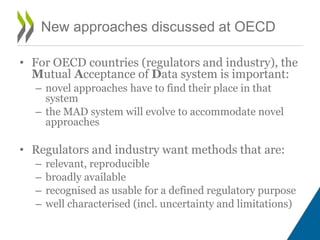
• For OECD countries (regulators and industry), the
Mutual Acceptance of Data system is important:
– novel approaches have to find their place in that
system
– the MAD system will evolve to accommodate novel
approaches
• Regulators and industry want methods that are:
– relevant, reproducible
– broadly available
– recognised as usable for a defined regulatory purpose
– well characterised (incl. uncertainty and limitations)
Key elements of success for acceptance
• Having methods that are recognised as valid is a must
for their acceptance and use
• For novel approaches: demonstration of their
application in case studies greatly facilitate their uptake
– Learn and develop together the good practice
– Learn together what works and what does not
• Not oppose systematically the novel approaches to the
traditional ones, but see them initially as
complementary
– This will allow more data and better comparison over time
Key elements of success for acceptance
• Building a strategy of how these novel approaches
fit together
– Problem formulation/scope of use
– Define the approach: which methods, data
interpretation, combination of methods and
prediction models)
– Clarity on overall predictive capacity and uncertainty
• Accept that technology will develop faster, but that
your goal is to have good enough approaches that
stay applicable for some time, and get upgraded
– moving together is more important than moving
faster
Foreseeable challenges
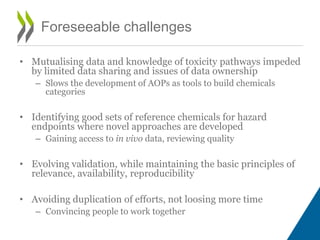
• Mutualising data and knowledge of toxicity pathways impeded
by limited data sharing and issues of data ownership
– Slows the development of AOPs as tools to build chemicals
categories
• Identifying good sets of reference chemicals for hazard
endpoints where novel approaches are developed
– Gaining access to in vivo data, reviewing quality
• Evolving validation, while maintaining the basic principles of
relevance, availability, reproducibility
• Avoiding duplication of efforts, not loosing more time
– Convincing people to work together

June 9 2017 Panel 4 Anne Gourmelon

  • 1.
    KEY ELEMENTS OFSUCCESS FOR NEW TESTING AND ASSESSMENT APPROACHES IN REGULATORY CONTEXT Helsinki Chemicals Forum, 7-8 June 2017 Panel 4 Anne Gourmelon ENV/EHS - OECD
  • 2.
    New approaches discussedat OECD • For OECD countries (regulators and industry), the Mutual Acceptance of Data system is important: – novel approaches have to find their place in that system – the MAD system will evolve to accommodate novel approaches • Regulators and industry want methods that are: – relevant, reproducible – broadly available – recognised as usable for a defined regulatory purpose – well characterised (incl. uncertainty and limitations)
  • 3.
    Key elements ofsuccess for acceptance • Having methods that are recognised as valid is a must for their acceptance and use • For novel approaches: demonstration of their application in case studies greatly facilitate their uptake – Learn and develop together the good practice – Learn together what works and what does not • Not oppose systematically the novel approaches to the traditional ones, but see them initially as complementary – This will allow more data and better comparison over time
  • 4.
    Key elements ofsuccess for acceptance • Building a strategy of how these novel approaches fit together – Problem formulation/scope of use – Define the approach: which methods, data interpretation, combination of methods and prediction models) – Clarity on overall predictive capacity and uncertainty • Accept that technology will develop faster, but that your goal is to have good enough approaches that stay applicable for some time, and get upgraded – moving together is more important than moving faster
  • 5.
    Foreseeable challenges • Mutualisingdata and knowledge of toxicity pathways impeded by limited data sharing and issues of data ownership – Slows the development of AOPs as tools to build chemicals categories • Identifying good sets of reference chemicals for hazard endpoints where novel approaches are developed – Gaining access to in vivo data, reviewing quality • Evolving validation, while maintaining the basic principles of relevance, availability, reproducibility • Avoiding duplication of efforts, not loosing more time – Convincing people to work together