Benchmarking
What is Benchmarking ?
• A method for identifying and importing best
practices in order to improve performance.
• The process of learning, adapting and measuring
outstanding practices and processes from any
organization to improve performance.
Why Benchmark ?
• Identify opportunities to improve performance
• Learn from others’ experiences
• Set realistic but ambitious targets
• Uncover strengths in one’s own organization
• Better prioritize and allocate resources
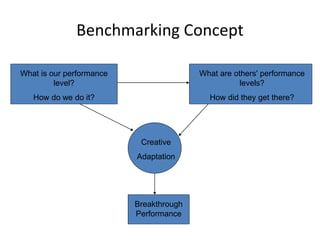
Benchmarking Concept
Creative
Adaptation
Breakthrough
Performance
What is our performance
level?
How do we do it?
What are others' performance
levels?
How did they get there?
Types of Benchmarking: 1
• Strategic Benchmarking
How public, private and nonprofit organizations
compare with each other. It moves across
industries and cities to determine what are the
best strategic outcomes.
Types of Benchmarking: 2
• Performance Benchmarking
How public, private and nonprofit
organizations compare themselves with each
other in terms of product and service. It
focuses on elements of cost, technical
quality, service features, speed, reliability,
and other performance comparisons.
Types of Benchmarking: 3
• Process Benchmarking
How public, private and nonprofit
organizations compare through the
identification of the most effective operating
practices from many organizations that
perform similar work processes.
When not to Benchmark ?
• Target is not critical to the core business
functions
• Customer’s requirement is not clear
• Key stakeholders are not involved
• Inadequate resources to carry through
• No plan for implementing findings
• Fear of sharing information with other
organizations
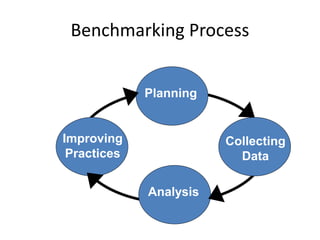
Benchmarking Process
Planning
Collecting
Data
Analysis
Improving
Practices
1. Planning
• Determine the purpose and scope of the
project
• Select the process to be benchmarked
• Choose the team
• Define the scope
• Develop a flow chart for the process
• Establish process measures
• Identify benchmarking partners
2. Collecting Data
• Conduct background research to gain
thorough understanding on the process and
partnering organizations
• Use questionnaires to gather information
necessary for benchmarking
• Conduct site visits if additional information is
needed
• Conduct interviews if more detail
information is needed
3. Analysis
• Analyze quantitative data of partnering
organizations and your organization
• Analyze qualitative data of partnering
organizations and your organization
• Determine the performance gap
4. Improving Practices
• Report findings and brief management
• Develop an improvement implementation plan
• Implement process improvements
• Monitor performance measurements and track
progress
• Recalibrate the process as needed
Pitfalls & Criticisms
• Idea of copying others
– How can an organization be superior if it does not
innovate to get ahead? How can an organization
even survive if it loses track of its external
environment?
• Not a strategy or business philosophy
– It is an improvement tool
• Not a substitute for innovation
– It is a source of ideas from outside
Pitfalls & Criticisms
• Avoid –
– Benchmarking for the sake of it
– Focusing entirely on comparisons of performance
measures rather than the processes and activities
that enable the achievement of good practice
– Expecting that benchmarking will be quick or easy
Base Salary, Structures and
Benchmarking
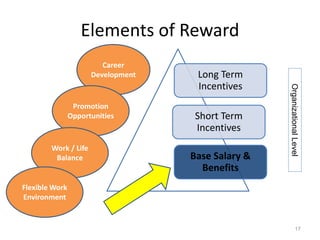
Elements of Reward
Long Term
Incentives
Short Term
Incentives
Base Salary &
Benefits
Organizational
Level
Career
Development
Promotion
Opportunities
Work / Life
Balance
Flexible Work
Environment
17
Objectives of a
Base Salary Structure
Before delving into the details of how actually to pay people, there are many
factors that impact a base salary program that an organization must consider.
In general, every organization's base salary program has certain objectives.
The principal ones are as follows:
• internal equity
• external equity (or competitiveness),
• individual equity,
• process equity,
• performance or productivity incentives,
• maximum use of financial resources,
• compliance with laws and regulations, and
• administrative efficiency.
18
Objectives of a
Base Salary Structure
Management needs to ask itself:
19
Is this point
important to this
organization? If so,
how important?
What are the
implications of
this point to the
current or desired
practices?
Internal & External Equity
Internal equity deals with the perceived worth of a job relative to other jobs
in the organization. All employees compare their jobs to other jobs within the
organization. Generally, they consider skill, effort, responsibility and working
conditions in this comparison in order to determine the value of their jobs
relative to other jobs. Likewise, management must often determine the
"worth" or "value" of one job in relation other jobs for the purpose of salary
programs. Maintaining appropriate salary relative to value or worth is
achieving internal equity.
External equity deals with the issue of market rates for jobs. An employer's
goal should be to pay what is necessary to attract, retain and motivate a
sufficient number of qualified employees. This requires a base salary program
that pays competitively. Among others, internal data such as turnover rates
and exit interviews can be helpful in determining the competitiveness of pay
rates.
20
Individual & Process Equity
Individual equity deals with how individuals perceive how they are being paid
relative to other individuals within the organization and perhaps within the
same position. This focus of individual equity is on the merits of the person
filling a job, as opposed to the job itself. In simple terms, employees want to
feel that the rewards they receive for how they do their work are comparable
to the rewards received by others for the same amount of effort or output, all
other factors being equal. How merit rewards or increases are given strongly
impacts perceptions of individual equity.
Process equity deals with how employees perceive the fairness or equity in
the administration of the compensation system is process equity. Process
equity, in the perceptions of employees, is strongly influenced by the
openness of the system, communication of the system to employees,
participation in design or administration of the system and a grievance appeal
procedure.
21
Performance Incentives &
Use of Resources
Performance Incentives - A significant element of a base pay program is to
encourage higher or increased levels of employee performance. Pay systems
need to be designed to improve organizational performance.
Maximum Use of Financial Resources - Since an organization does not have
unlimited financial resources, the base pay program needs to be designed to
maximize the value to the organization with minimum use of these limited
resources. In order to accomplish this, salary programs have a variety of tools
such as salary range maximums, pay increase budgets, authorization
procedures, compensation committees or various internal auditing
procedures available to help accomplish this objective.
22
Compliance & Administration
Compliance with Laws and Regulations - While not the primary objective of a
salary program, one of the objectives needs to be to keep the organization in
compliance with various state and federal laws and regulations.
Administrative Efficiency - Due to the limited financial resources in an
organization, one of the objectives should be to have a salary program that is
easy to administer, flexible, and cost-effective.
23
Developing a Salary
Structure
The basis for most salary programs is a salary structure - a hierarchy of jobs
with salary ranges and/or rates assigned.
Salary structures are designed so that the greater the worth of a job (as
determined by internal or external equity), the higher the salary grade and
range.
Developing a salary structure is a process with a series of steps:
1. Job analysis and documentation
2. Development of a job evaluation methodology
3. Establishment of Salary Ranges
4. Benchmarking Data Collection
24
Job Analysis &
Documentation
Job Analysis - This involves collecting and evaluating relevant information
about jobs. Any data collected should clarify the nature of the work being
performed (principal or essential tasks, duties and responsibilities), the level
of the work being performed, the extent and types of knowledge, skill, mental
and physical effort and requirements, and responsibility required for the work
being performed.
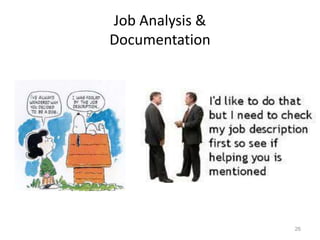
Job Documentation - There needs to be a formalized way to document job
content. In most organizations, a job description is the means used to
accomplish this. Job documentation is used to evaluate job content, provide
objective criteria for making pay comparisons, ensure that jobs are classified
according to content as opposed to individual personalities, effectively
communicate the job duties to both supervisors and employees, and help the
organization defend itself against charges of discrimination.
25
Job Analysis &
Documentation
26
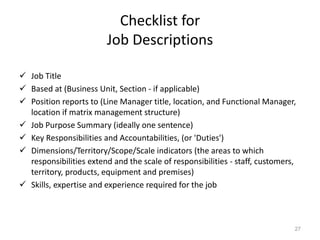
Checklist for
Job Descriptions
 Job Title
 Based at (Business Unit, Section - if applicable)
 Position reports to (Line Manager title, location, and Functional Manager,
location if matrix management structure)
 Job Purpose Summary (ideally one sentence)
 Key Responsibilities and Accountabilities, (or 'Duties')
 Dimensions/Territory/Scope/Scale indicators (the areas to which
responsibilities extend and the scale of responsibilities - staff, customers,
territory, products, equipment and premises)
 Skills, expertise and experience required for the job
27
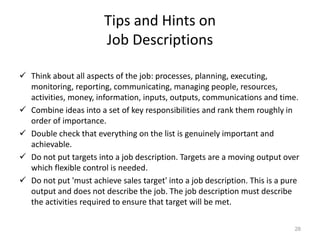
Tips and Hints on
Job Descriptions
 Think about all aspects of the job: processes, planning, executing,
monitoring, reporting, communicating, managing people, resources,
activities, money, information, inputs, outputs, communications and time.
 Combine ideas into a set of key responsibilities and rank them roughly in
order of importance.
 Double check that everything on the list is genuinely important and
achievable.
 Do not put targets into a job description. Targets are a moving output over
which flexible control is needed.
 Do not put 'must achieve sales target' into a job description. This is a pure
output and does not describe the job. The job description must describe
the activities required to ensure that target will be met.
28
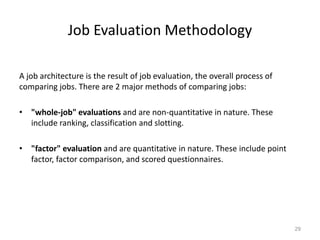
Job Evaluation Methodology
A job architecture is the result of job evaluation, the overall process of
comparing jobs. There are 2 major methods of comparing jobs:
• "whole-job" evaluations and are non-quantitative in nature. These
include ranking, classification and slotting.
• "factor" evaluation and are quantitative in nature. These include point
factor, factor comparison, and scored questionnaires.
29
Job Evaluation Methodology
30
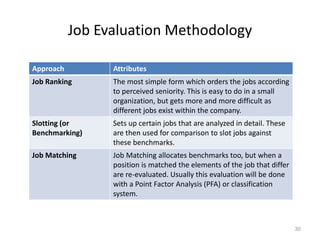
Approach Attributes
Job Ranking The most simple form which orders the jobs according
to perceived seniority. This is easy to do in a small
organization, but gets more and more difficult as
different jobs exist within the company.
Slotting (or
Benchmarking)
Sets up certain jobs that are analyzed in detail. These
are then used for comparison to slot jobs against
these benchmarks.
Job Matching Job Matching allocates benchmarks too, but when a
position is matched the elements of the job that differ
are re-evaluated. Usually this evaluation will be done
with a Point Factor Analysis (PFA) or classification
system.
Job Evaluation Methodology
31
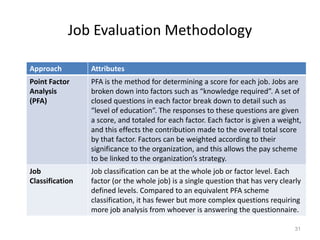
Approach Attributes
Point Factor
Analysis
(PFA)
PFA is the method for determining a score for each job. Jobs are
broken down into factors such as “knowledge required”. A set of
closed questions in each factor break down to detail such as
“level of education”. The responses to these questions are given
a score, and totaled for each factor. Each factor is given a weight,
and this effects the contribution made to the overall total score
by that factor. Factors can be weighted according to their
significance to the organization, and this allows the pay scheme
to be linked to the organization’s strategy.
Job
Classification
Job classification can be at the whole job or factor level. Each
factor (or the whole job) is a single question that has very clearly
defined levels. Compared to an equivalent PFA scheme
classification, it has fewer but more complex questions requiring
more job analysis from whoever is answering the questionnaire.
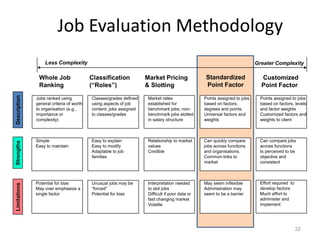
Job Evaluation Methodology
Less Complexity Greater Complexity
Whole Job
Ranking
Classification
(“Roles”)
Market Pricing
& Slotting
Standardized
Point Factor
Customized
Point Factor
Description
Strengths
Limitations
Jobs ranked using
general criteria of worth
to organisation (e.g.,
importance or
complexity)
Simple
Easy to maintain
Potential for bias
May over emphasize a
single factor
Classes/grades defined
using aspects of job
content; jobs assigned
to classes/grades
Market rates
established for
benchmark jobs; non-
benchmark jobs slotted
in salary structure
Points assigned to jobs
based on factors,
degrees and points.
Universal factors and
weights
Points assigned to jobs
based on factors, levels
and factor weights
Customized factors and
weights to client
Easy to explain
Easy to modify
Adaptable to job
families
Relationship to market
values
Credible
Can quickly compare
jobs across functions
and organisations.
Common links to
market
Can compare jobs
across functions
Is perceived to be
objective and
consistent
Unusual jobs may be
“forced”
Potential for bias
Interpretation needed
to slot jobs
Difficult if poor data or
fast changing market
Volatile
May seem inflexible
Administration may
seem to be a barrier
Effort required to
develop factors
Much effort to
administer and
implement
32
The Five Factors
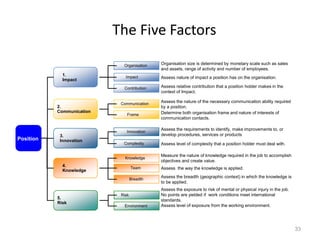
Organisation size is determined by monetary scale such as sales
and assets, range of activity and number of employees.
Assess nature of impact a position has on the organisation.
Assess relative contribution that a position holder makes in the
context of Impact.
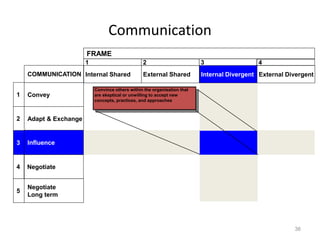
Assess the nature of the necessary communication ability required
by a position.
Determine both organisation frame and nature of interests of
communication contacts.
Assess the exposure to risk of mental or physical injury in the job.
No points are yielded if work conditions meet international
standards.
Assess level of exposure from the working environment.
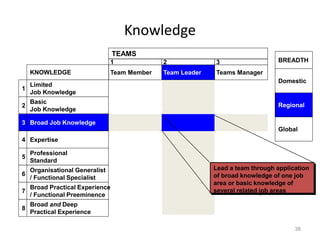
Measure the nature of knowledge required in the job to accomplish
objectives and create value.
Assess the way the knowledge is applied.
Assess the breadth (geographic context) in which the knowledge is
to be applied.
Organisation
Impact
Contribution
Communication
Frame
Innovation
Complexity
Knowledge
Team
Breadth
Position
1.
Impact
2.
Communication
3.
Innovation
4.
Knowledge
Risk
Environment
5.
Risk
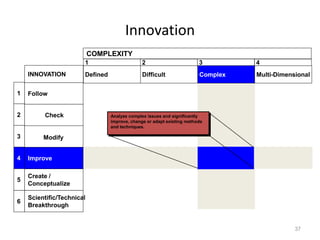
Assess the requirements to identify, make improvements to, or
develop procedures, services or products
Assess level of complexity that a position holder must deal with.
33
Organisation Sizing
Basic
R&D
Engineer
Procure
Logistics
Applied
R&D
Produce Apply
Assembl
e
Market Sales
Distri-
bution
Service
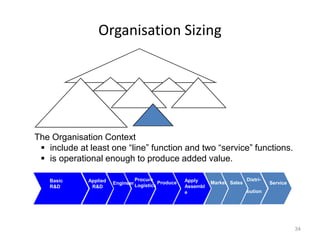
The Organisation Context
 include at least one “line” function and two “service” functions.
 is operational enough to produce added value.
34
Impact
3
2
1 4 5
NATURE OF
IMPACT
Delivery
Operational
Tactical
Strategic
Visionary
1
2
3
4
5
Some
Limited Significant
Direct Major
Level of Contribution
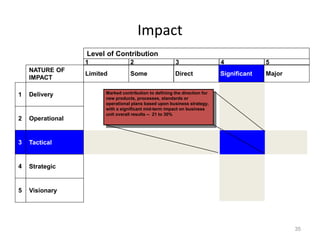
Marked contribution to defining the direction for
new products, processes, standards or
operational plans based upon business strategy,
with a significant mid-term impact on business
unit overall results -- 21 to 30%
35
Communication
Convince others within the organisation that
are skeptical or unwilling to accept new
concepts, practices, and approaches
External Shared
Internal Shared
FRAME
External Divergent
Internal Divergent
COMMUNICATION
Convey
Adapt & Exchange
Influence
Negotiate
Negotiate
Long term
3
2
1 4
1
2
3
4
5
36
Innovation
Difficult
Defined
COMPLEXITY
Multi-Dimensional
Analyze complex issues and significantly
improve, change or adapt existing methods
and techniques.
1
2
3
4
5
6
3
2
1 4
INNOVATION
Follow
Improve
Create /
Conceptualize
Scientific/Technical
Breakthrough
Modify
Check
Complex
37
Knowledge
KNOWLEDGE
Limited
Job Knowledge
Basic
Job Knowledge
Broad Job Knowledge
Expertise
Professional
Standard
Organisational Generalist
/ Functional Specialist
Broad Practical Experience
/ Functional Preeminence
Broad and Deep
Practical Experience
Lead a team through application
of broad knowledge of one job
area or basic knowledge of
several related job areas
Teams Manager
Team Leader
Team Member
TEAMS
BREADTH
Domestic
Regional
Global
1
2
3
4
5
6
7
8
3
2
1
38
Risk
Disability
Injury
Mental
1
2
3
3
2
1
Risk
Environment
0
High
Exposure
Low
Exposure
Moderate
Exposure
Normal
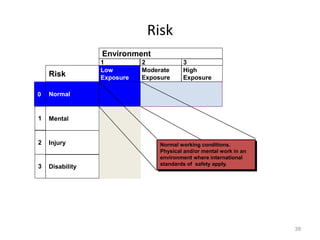
Normal working conditions.
Physical and/or mental work in an
environment where international
standards of safety apply.
39
Major applications
• A clear ranking of positions that is internally consistent
• A first analysis of the organisational effectiveness
• A global comparison of relations between positions
• A starting point to establish position / competency profiles
• A database to support career planning and succession
• An objective reference to solve title issues
• A reliable base for an equitable salary structure
• A tool that facilitates market benchmarking
40
Purpose of Salary Ranges
 To accomplish the organization's objectives with regards to a salary
program,
 To reflect the organization's philosophy on how it wishes to relate its
salary program to the market,
 To demonstrate the internal job values of positions,
 To support how the organization wishes to mix base pay, benefits and
incentives.
41
Establishing Salary Ranges
• How should the organization's pay level relate to the external market?
• Should the organization be a pay leader, match the market or pay less than
market?
• What is the organization willing to pay for: job content, seniority,
performance, skills, cost of labor, or some combination of all of these?
• How does the organization pay its employees:
– based on a single rate structure (all employees in the same job receive the same pay),
– based on seniority,
– based on merit,
– based on productivity (piece work),
– based on new skills (skill-based pay),
– or based on some combination of these factors?
• Are short term or long term incentives provided?
42
Establishing Salary Ranges
Number of Salary Ranges
The number of salary ranges will depend on the number of different levels of
relative job value that are recognized by the organization and the difference
in pay between the highest and lowest paid jobs in the pay structure.
Creating a Range around a mid point
The focal point of a salary range is the mid-point as this is generally the
"going" rate for jobs assigned to that range. The range minimum is the usually
the lowest pay rate for any job in that range and is usually the pay rate given
to people hired in that range who meet minimal qualifications only. The
maximum of a range is the highest rate an employer is willing to pay for jobs
in that pay range. Other important range issues include the range width and
the degree of overlap between ranges.
43
Managing Salary Rates
and Increases
An organization must also decide how to administer their salary structure:
• How to pay new employees?
• How and when to give employees increases?
• How to move existing employees from the minimum to the maximum of
their assigned salary range?
• How to determine the pay increase for an employee being promoted from
one job to another?
• What influence, if any, cost of labor increases will have on the
determination of pay increases for employees?
In addition, an organization must develop policies and procedures that will
implement the results of these decisions in a consistent manner.
44
Managing Salary Rates
and Increases
Starting Pay for New Employees
In order to avoid paying new employees the same as more experienced
employees, most employers choose to start new employees closer to the
minimum of the salary range. In general, an employee with minimum
qualifications should be paid the minimum of the range. This general rule is
not true when a new hire has skills which are in great demand or has skills or
other expertise substantially above the minimum.
Employee Increases
There are several different types of base pay increases: general (across-the-
board) increases, cost-of-living/labor increases, promotion increases, step
increases (based on longevity), and merit increases.
45
Managing Salary Rates
and Increases
General increases
These are diminishing in popularity because they are not consistent with the
idea of pay for performance. With a general increase, employees in a certain
group based on established requirements are eligible for a certain monetary
or percent increase to their base salary.
A cost-of-living increase
This is a type of general increase given to all eligible employees. This type of
increase may happen as a result of union contract negotiation. Some
companies choose to track benchmark positions over a period of time and
modify other positions based on changes in the ranges of benchmark
positions.
46
Managing Salary Rates
and Increases
Promotion increases
These are given when an employee is moved from one job to another with a
higher pay grade and range. The size of the increase will be influenced by the
difference between the old and new pay ranges, and the pay of the newly
promoted person's peers, superiors and subordinates, if any.
Merit increases
These are also known as pay for performance. To be successful, an
organization must be able to measure differences in job performance and
these differences must be significant enough to merit the time and effort
required to measure them and pay accordingly. Managers require training in
performance planning and appraisal, and control mechanisms must be in
place to successfully administer a merit increase program.
47
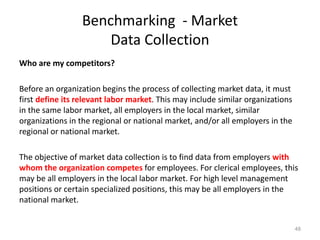
Benchmarking - Market
Data Collection
Who are my competitors?
Before an organization begins the process of collecting market data, it must
first define its relevant labor market. This may include similar organizations
in the same labor market, all employers in the local market, similar
organizations in the regional or national market, and/or all employers in the
regional or national market.
The objective of market data collection is to find data from employers with
whom the organization competes for employees. For clerical employees, this
may be all employers in the local labor market. For high level management
positions or certain specialized positions, this may be all employers in the
national market.
48
Activities
Creating a Job Description
50
Create a Job
Description for the
Head of the
Business School
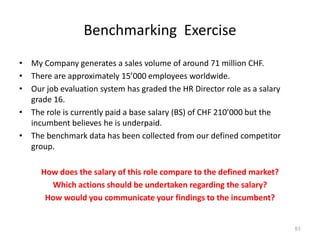
Benchmarking Exercise
• My Company generates a sales volume of around 71 million CHF.
• There are approximately 15’000 employees worldwide.
• Our job evaluation system has graded the HR Director role as a salary
grade 16.
• The role is currently paid a base salary (BS) of CHF 210’000 but the
incumbent believes he is underpaid.
• The benchmark data has been collected from our defined competitor
group.
How does the salary of this role compare to the defined market?
Which actions should be undertaken regarding the salary?
How would you communicate your findings to the incumbent?
51

Compensation benchmarking

  • 1.
  • 2.
    What is Benchmarking? • A method for identifying and importing best practices in order to improve performance. • The process of learning, adapting and measuring outstanding practices and processes from any organization to improve performance.
  • 3.
    Why Benchmark ? •Identify opportunities to improve performance • Learn from others’ experiences • Set realistic but ambitious targets • Uncover strengths in one’s own organization • Better prioritize and allocate resources
  • 4.
    Benchmarking Concept Creative Adaptation Breakthrough Performance What isour performance level? How do we do it? What are others' performance levels? How did they get there?
  • 5.
    Types of Benchmarking:1 • Strategic Benchmarking How public, private and nonprofit organizations compare with each other. It moves across industries and cities to determine what are the best strategic outcomes.
  • 6.
    Types of Benchmarking:2 • Performance Benchmarking How public, private and nonprofit organizations compare themselves with each other in terms of product and service. It focuses on elements of cost, technical quality, service features, speed, reliability, and other performance comparisons.
  • 7.
    Types of Benchmarking:3 • Process Benchmarking How public, private and nonprofit organizations compare through the identification of the most effective operating practices from many organizations that perform similar work processes.
  • 8.
    When not toBenchmark ? • Target is not critical to the core business functions • Customer’s requirement is not clear • Key stakeholders are not involved • Inadequate resources to carry through • No plan for implementing findings • Fear of sharing information with other organizations
  • 9.
  • 10.
    1. Planning • Determinethe purpose and scope of the project • Select the process to be benchmarked • Choose the team • Define the scope • Develop a flow chart for the process • Establish process measures • Identify benchmarking partners
  • 11.
    2. Collecting Data •Conduct background research to gain thorough understanding on the process and partnering organizations • Use questionnaires to gather information necessary for benchmarking • Conduct site visits if additional information is needed • Conduct interviews if more detail information is needed
  • 12.
    3. Analysis • Analyzequantitative data of partnering organizations and your organization • Analyze qualitative data of partnering organizations and your organization • Determine the performance gap
  • 13.
    4. Improving Practices •Report findings and brief management • Develop an improvement implementation plan • Implement process improvements • Monitor performance measurements and track progress • Recalibrate the process as needed
  • 14.
    Pitfalls & Criticisms •Idea of copying others – How can an organization be superior if it does not innovate to get ahead? How can an organization even survive if it loses track of its external environment? • Not a strategy or business philosophy – It is an improvement tool • Not a substitute for innovation – It is a source of ideas from outside
  • 15.
    Pitfalls & Criticisms •Avoid – – Benchmarking for the sake of it – Focusing entirely on comparisons of performance measures rather than the processes and activities that enable the achievement of good practice – Expecting that benchmarking will be quick or easy
  • 16.
    Base Salary, Structuresand Benchmarking
  • 17.
    Elements of Reward LongTerm Incentives Short Term Incentives Base Salary & Benefits Organizational Level Career Development Promotion Opportunities Work / Life Balance Flexible Work Environment 17
  • 18.
    Objectives of a BaseSalary Structure Before delving into the details of how actually to pay people, there are many factors that impact a base salary program that an organization must consider. In general, every organization's base salary program has certain objectives. The principal ones are as follows: • internal equity • external equity (or competitiveness), • individual equity, • process equity, • performance or productivity incentives, • maximum use of financial resources, • compliance with laws and regulations, and • administrative efficiency. 18
  • 19.
    Objectives of a BaseSalary Structure Management needs to ask itself: 19 Is this point important to this organization? If so, how important? What are the implications of this point to the current or desired practices?
  • 20.
    Internal & ExternalEquity Internal equity deals with the perceived worth of a job relative to other jobs in the organization. All employees compare their jobs to other jobs within the organization. Generally, they consider skill, effort, responsibility and working conditions in this comparison in order to determine the value of their jobs relative to other jobs. Likewise, management must often determine the "worth" or "value" of one job in relation other jobs for the purpose of salary programs. Maintaining appropriate salary relative to value or worth is achieving internal equity. External equity deals with the issue of market rates for jobs. An employer's goal should be to pay what is necessary to attract, retain and motivate a sufficient number of qualified employees. This requires a base salary program that pays competitively. Among others, internal data such as turnover rates and exit interviews can be helpful in determining the competitiveness of pay rates. 20
  • 21.
    Individual & ProcessEquity Individual equity deals with how individuals perceive how they are being paid relative to other individuals within the organization and perhaps within the same position. This focus of individual equity is on the merits of the person filling a job, as opposed to the job itself. In simple terms, employees want to feel that the rewards they receive for how they do their work are comparable to the rewards received by others for the same amount of effort or output, all other factors being equal. How merit rewards or increases are given strongly impacts perceptions of individual equity. Process equity deals with how employees perceive the fairness or equity in the administration of the compensation system is process equity. Process equity, in the perceptions of employees, is strongly influenced by the openness of the system, communication of the system to employees, participation in design or administration of the system and a grievance appeal procedure. 21
  • 22.
    Performance Incentives & Useof Resources Performance Incentives - A significant element of a base pay program is to encourage higher or increased levels of employee performance. Pay systems need to be designed to improve organizational performance. Maximum Use of Financial Resources - Since an organization does not have unlimited financial resources, the base pay program needs to be designed to maximize the value to the organization with minimum use of these limited resources. In order to accomplish this, salary programs have a variety of tools such as salary range maximums, pay increase budgets, authorization procedures, compensation committees or various internal auditing procedures available to help accomplish this objective. 22
  • 23.
    Compliance & Administration Compliancewith Laws and Regulations - While not the primary objective of a salary program, one of the objectives needs to be to keep the organization in compliance with various state and federal laws and regulations. Administrative Efficiency - Due to the limited financial resources in an organization, one of the objectives should be to have a salary program that is easy to administer, flexible, and cost-effective. 23
  • 24.
    Developing a Salary Structure Thebasis for most salary programs is a salary structure - a hierarchy of jobs with salary ranges and/or rates assigned. Salary structures are designed so that the greater the worth of a job (as determined by internal or external equity), the higher the salary grade and range. Developing a salary structure is a process with a series of steps: 1. Job analysis and documentation 2. Development of a job evaluation methodology 3. Establishment of Salary Ranges 4. Benchmarking Data Collection 24
  • 25.
    Job Analysis & Documentation JobAnalysis - This involves collecting and evaluating relevant information about jobs. Any data collected should clarify the nature of the work being performed (principal or essential tasks, duties and responsibilities), the level of the work being performed, the extent and types of knowledge, skill, mental and physical effort and requirements, and responsibility required for the work being performed. Job Documentation - There needs to be a formalized way to document job content. In most organizations, a job description is the means used to accomplish this. Job documentation is used to evaluate job content, provide objective criteria for making pay comparisons, ensure that jobs are classified according to content as opposed to individual personalities, effectively communicate the job duties to both supervisors and employees, and help the organization defend itself against charges of discrimination. 25
  • 26.
  • 27.
    Checklist for Job Descriptions Job Title  Based at (Business Unit, Section - if applicable)  Position reports to (Line Manager title, location, and Functional Manager, location if matrix management structure)  Job Purpose Summary (ideally one sentence)  Key Responsibilities and Accountabilities, (or 'Duties')  Dimensions/Territory/Scope/Scale indicators (the areas to which responsibilities extend and the scale of responsibilities - staff, customers, territory, products, equipment and premises)  Skills, expertise and experience required for the job 27
  • 28.
    Tips and Hintson Job Descriptions  Think about all aspects of the job: processes, planning, executing, monitoring, reporting, communicating, managing people, resources, activities, money, information, inputs, outputs, communications and time.  Combine ideas into a set of key responsibilities and rank them roughly in order of importance.  Double check that everything on the list is genuinely important and achievable.  Do not put targets into a job description. Targets are a moving output over which flexible control is needed.  Do not put 'must achieve sales target' into a job description. This is a pure output and does not describe the job. The job description must describe the activities required to ensure that target will be met. 28
  • 29.
    Job Evaluation Methodology Ajob architecture is the result of job evaluation, the overall process of comparing jobs. There are 2 major methods of comparing jobs: • "whole-job" evaluations and are non-quantitative in nature. These include ranking, classification and slotting. • "factor" evaluation and are quantitative in nature. These include point factor, factor comparison, and scored questionnaires. 29
  • 30.
    Job Evaluation Methodology 30 ApproachAttributes Job Ranking The most simple form which orders the jobs according to perceived seniority. This is easy to do in a small organization, but gets more and more difficult as different jobs exist within the company. Slotting (or Benchmarking) Sets up certain jobs that are analyzed in detail. These are then used for comparison to slot jobs against these benchmarks. Job Matching Job Matching allocates benchmarks too, but when a position is matched the elements of the job that differ are re-evaluated. Usually this evaluation will be done with a Point Factor Analysis (PFA) or classification system.
  • 31.
    Job Evaluation Methodology 31 ApproachAttributes Point Factor Analysis (PFA) PFA is the method for determining a score for each job. Jobs are broken down into factors such as “knowledge required”. A set of closed questions in each factor break down to detail such as “level of education”. The responses to these questions are given a score, and totaled for each factor. Each factor is given a weight, and this effects the contribution made to the overall total score by that factor. Factors can be weighted according to their significance to the organization, and this allows the pay scheme to be linked to the organization’s strategy. Job Classification Job classification can be at the whole job or factor level. Each factor (or the whole job) is a single question that has very clearly defined levels. Compared to an equivalent PFA scheme classification, it has fewer but more complex questions requiring more job analysis from whoever is answering the questionnaire.
  • 32.
    Job Evaluation Methodology LessComplexity Greater Complexity Whole Job Ranking Classification (“Roles”) Market Pricing & Slotting Standardized Point Factor Customized Point Factor Description Strengths Limitations Jobs ranked using general criteria of worth to organisation (e.g., importance or complexity) Simple Easy to maintain Potential for bias May over emphasize a single factor Classes/grades defined using aspects of job content; jobs assigned to classes/grades Market rates established for benchmark jobs; non- benchmark jobs slotted in salary structure Points assigned to jobs based on factors, degrees and points. Universal factors and weights Points assigned to jobs based on factors, levels and factor weights Customized factors and weights to client Easy to explain Easy to modify Adaptable to job families Relationship to market values Credible Can quickly compare jobs across functions and organisations. Common links to market Can compare jobs across functions Is perceived to be objective and consistent Unusual jobs may be “forced” Potential for bias Interpretation needed to slot jobs Difficult if poor data or fast changing market Volatile May seem inflexible Administration may seem to be a barrier Effort required to develop factors Much effort to administer and implement 32
  • 33.
    The Five Factors Organisationsize is determined by monetary scale such as sales and assets, range of activity and number of employees. Assess nature of impact a position has on the organisation. Assess relative contribution that a position holder makes in the context of Impact. Assess the nature of the necessary communication ability required by a position. Determine both organisation frame and nature of interests of communication contacts. Assess the exposure to risk of mental or physical injury in the job. No points are yielded if work conditions meet international standards. Assess level of exposure from the working environment. Measure the nature of knowledge required in the job to accomplish objectives and create value. Assess the way the knowledge is applied. Assess the breadth (geographic context) in which the knowledge is to be applied. Organisation Impact Contribution Communication Frame Innovation Complexity Knowledge Team Breadth Position 1. Impact 2. Communication 3. Innovation 4. Knowledge Risk Environment 5. Risk Assess the requirements to identify, make improvements to, or develop procedures, services or products Assess level of complexity that a position holder must deal with. 33
  • 34.
    Organisation Sizing Basic R&D Engineer Procure Logistics Applied R&D Produce Apply Assembl e MarketSales Distri- bution Service The Organisation Context  include at least one “line” function and two “service” functions.  is operational enough to produce added value. 34
  • 35.
    Impact 3 2 1 4 5 NATUREOF IMPACT Delivery Operational Tactical Strategic Visionary 1 2 3 4 5 Some Limited Significant Direct Major Level of Contribution Marked contribution to defining the direction for new products, processes, standards or operational plans based upon business strategy, with a significant mid-term impact on business unit overall results -- 21 to 30% 35
  • 36.
    Communication Convince others withinthe organisation that are skeptical or unwilling to accept new concepts, practices, and approaches External Shared Internal Shared FRAME External Divergent Internal Divergent COMMUNICATION Convey Adapt & Exchange Influence Negotiate Negotiate Long term 3 2 1 4 1 2 3 4 5 36
  • 37.
    Innovation Difficult Defined COMPLEXITY Multi-Dimensional Analyze complex issuesand significantly improve, change or adapt existing methods and techniques. 1 2 3 4 5 6 3 2 1 4 INNOVATION Follow Improve Create / Conceptualize Scientific/Technical Breakthrough Modify Check Complex 37
  • 38.
    Knowledge KNOWLEDGE Limited Job Knowledge Basic Job Knowledge BroadJob Knowledge Expertise Professional Standard Organisational Generalist / Functional Specialist Broad Practical Experience / Functional Preeminence Broad and Deep Practical Experience Lead a team through application of broad knowledge of one job area or basic knowledge of several related job areas Teams Manager Team Leader Team Member TEAMS BREADTH Domestic Regional Global 1 2 3 4 5 6 7 8 3 2 1 38
  • 39.
  • 40.
    Major applications • Aclear ranking of positions that is internally consistent • A first analysis of the organisational effectiveness • A global comparison of relations between positions • A starting point to establish position / competency profiles • A database to support career planning and succession • An objective reference to solve title issues • A reliable base for an equitable salary structure • A tool that facilitates market benchmarking 40
  • 41.
    Purpose of SalaryRanges  To accomplish the organization's objectives with regards to a salary program,  To reflect the organization's philosophy on how it wishes to relate its salary program to the market,  To demonstrate the internal job values of positions,  To support how the organization wishes to mix base pay, benefits and incentives. 41
  • 42.
    Establishing Salary Ranges •How should the organization's pay level relate to the external market? • Should the organization be a pay leader, match the market or pay less than market? • What is the organization willing to pay for: job content, seniority, performance, skills, cost of labor, or some combination of all of these? • How does the organization pay its employees: – based on a single rate structure (all employees in the same job receive the same pay), – based on seniority, – based on merit, – based on productivity (piece work), – based on new skills (skill-based pay), – or based on some combination of these factors? • Are short term or long term incentives provided? 42
  • 43.
    Establishing Salary Ranges Numberof Salary Ranges The number of salary ranges will depend on the number of different levels of relative job value that are recognized by the organization and the difference in pay between the highest and lowest paid jobs in the pay structure. Creating a Range around a mid point The focal point of a salary range is the mid-point as this is generally the "going" rate for jobs assigned to that range. The range minimum is the usually the lowest pay rate for any job in that range and is usually the pay rate given to people hired in that range who meet minimal qualifications only. The maximum of a range is the highest rate an employer is willing to pay for jobs in that pay range. Other important range issues include the range width and the degree of overlap between ranges. 43
  • 44.
    Managing Salary Rates andIncreases An organization must also decide how to administer their salary structure: • How to pay new employees? • How and when to give employees increases? • How to move existing employees from the minimum to the maximum of their assigned salary range? • How to determine the pay increase for an employee being promoted from one job to another? • What influence, if any, cost of labor increases will have on the determination of pay increases for employees? In addition, an organization must develop policies and procedures that will implement the results of these decisions in a consistent manner. 44
  • 45.
    Managing Salary Rates andIncreases Starting Pay for New Employees In order to avoid paying new employees the same as more experienced employees, most employers choose to start new employees closer to the minimum of the salary range. In general, an employee with minimum qualifications should be paid the minimum of the range. This general rule is not true when a new hire has skills which are in great demand or has skills or other expertise substantially above the minimum. Employee Increases There are several different types of base pay increases: general (across-the- board) increases, cost-of-living/labor increases, promotion increases, step increases (based on longevity), and merit increases. 45
  • 46.
    Managing Salary Rates andIncreases General increases These are diminishing in popularity because they are not consistent with the idea of pay for performance. With a general increase, employees in a certain group based on established requirements are eligible for a certain monetary or percent increase to their base salary. A cost-of-living increase This is a type of general increase given to all eligible employees. This type of increase may happen as a result of union contract negotiation. Some companies choose to track benchmark positions over a period of time and modify other positions based on changes in the ranges of benchmark positions. 46
  • 47.
    Managing Salary Rates andIncreases Promotion increases These are given when an employee is moved from one job to another with a higher pay grade and range. The size of the increase will be influenced by the difference between the old and new pay ranges, and the pay of the newly promoted person's peers, superiors and subordinates, if any. Merit increases These are also known as pay for performance. To be successful, an organization must be able to measure differences in job performance and these differences must be significant enough to merit the time and effort required to measure them and pay accordingly. Managers require training in performance planning and appraisal, and control mechanisms must be in place to successfully administer a merit increase program. 47
  • 48.
    Benchmarking - Market DataCollection Who are my competitors? Before an organization begins the process of collecting market data, it must first define its relevant labor market. This may include similar organizations in the same labor market, all employers in the local market, similar organizations in the regional or national market, and/or all employers in the regional or national market. The objective of market data collection is to find data from employers with whom the organization competes for employees. For clerical employees, this may be all employers in the local labor market. For high level management positions or certain specialized positions, this may be all employers in the national market. 48
  • 49.
  • 50.
    Creating a JobDescription 50 Create a Job Description for the Head of the Business School
  • 51.
    Benchmarking Exercise • MyCompany generates a sales volume of around 71 million CHF. • There are approximately 15’000 employees worldwide. • Our job evaluation system has graded the HR Director role as a salary grade 16. • The role is currently paid a base salary (BS) of CHF 210’000 but the incumbent believes he is underpaid. • The benchmark data has been collected from our defined competitor group. How does the salary of this role compare to the defined market? Which actions should be undertaken regarding the salary? How would you communicate your findings to the incumbent? 51