Succession Planning
Succession Planning
•Succession Planning is the process of training &
preparing employees in an organization so that there
will always be someone to replace an employee who
leaves.
•“ A defined program that an organization systemized
to ensure leadership continuity for all key positions by
developing activities that will build personnel talent
from within.”
Feature Of SUCCESSION PLANNING
• Identification of key job vacancies.
• Consideration of internal candidates for fill those
vacancies.
• Assessing job requirements and skills of existing
employees.
• Fill the gaps between needs and skills through training and
development.
• Identify future leader.
WHY TO DO IT?
• Ensuring the organization is prepared with a support
plan when key people leave.
• Saves the time and money incurred in hiring new
people.
• Gives the bird eye view on the talent present in the
organization.
Succession Planning Process
1.IDENTIFY CRITICAL POSITIONS
• Critical positions are the focus of succession planning efforts.
• Without these roles, the department or agency would be unable to
effectively meet its business objectives.
• It allows organization to target talent investments to ensure leadership
continuity
• Reduce risk from leadership attrition.
2. Construct Sucess profile.
• Work, experience
• Technical and professional knowldge
• Personality and leadership skills
3.ASSESS THE STAFF
Interested staff Whose skills and competencies could be
developed.
4.Create Development plans
5.Develop sucessors
6.sucessiors ready
7.Review and adapt
JOB ANALYSIS
Objectives & Uses
COURSE: HUMAN RESOURCES PLANNING ( HR MINOR)
SUBMITTED BY,
ASHIK JOSE
S3,MBA
REG.NO: 122016
CONTENTS
⮚ INTRODUCTION
⮚ JOB ANALYSIS
⮚ OBJECTIVES OF JOB ANALYSIS
⮚ USES OF JOB ANALYSIS
⮚ CONCLUSION
INTRODUCTION
▪ Job analysis most basic building block of HR management.
▪ It is a systematic way to gather and analyse information about the content, context, and
human requirement of job.
▪ Job design and job analysis are different.
▪Job design – develops jobs that fit effectively into the flow of organisational work that
needs to be done.
▪Job analysis – gather data in a formal and systematic way about what people do in their
jobs.
JOB ANALYSIS
▪ It is a combination of two words - job and analysis.
▪ Job – Combination of all works, duties and responsibilities assigned to an employee.
▪ Analysis – Process of deep examination.
▪ Definition
According to Edwin B. Flippo – “Job analysis is the process of studying and collecting
information relating to the operations and responsibilities of a specific job”.
▪ The immediate products of this analysis are job descriptions and job specifications.
JOB ANALYSIS
METHODS SOURCES OF
DATA
CONDUCTED BY
• Questionnaires
• Interviews
• Observation
• Record
• Employees
• Supervisors
• Managers
• Job analysts
• Job analyst
• Outside consultant
• Supervisor/manager
Job Descriptions Job Specifications
Used for Used for
OBJECTIVES OF JOB ANALYSIS
▪Job Evaluation
Job analysis provides required information which is necessary for evaluating the worthiness of jobs. After
the preparation of job description and job specification statements, it assists for the evaluation of actual
performance against the predetermined standard.
▪Job Description
A job description is a job profile which describes the contents, environment, and condition of jobs. It is
prepared on the basis of data collected through job analysis.
▪Job Specification
Job analysis provides the information related to the job and this data can be used to make the process or job
simple. Job specification is another notable objective of job analysis.
OBJECTIVES OF JOB ANALYSIS
▪Arranging suitable working conditions
Job analysis can help the management to provide suitable working environment and physical facilities
favourable to employees.
▪ Industrial relations
Job analysis helps to find out right person for doing the job . It ensures adequate health, safety and
welfare of employees.
▪ Job designing
Job elements are studied in detail under job analysis and these elements are properly organised to
facilitate the completion of the job.
USES OF JOB ANALYSIS
▪ Manpower Planning
It facilitates the division of work into different jobs.
▪ Helpful in Vocational Selection
It helps in determining how many and what kinds of workers are required for different jobs, and
qualifications required for them.
▪ Helpful in Wages and Salaries Administration
Differentiation of job leads to decide the salaries and wages of all the workers and the employees.
▪ Recruitment, Selection And Placement
It is very essential to know the requirements of the job and the qualities of the individual who will
perform the job.
USES OF JOB ANALYSIS
▪Performance Appraisal
The performance of employees can be appraised objectively with the standard of job performance so
established.
▪Training and Development
It helps in administering the training and development programmes.
▪ Job Evaluation
Job evaluation aims at determining the relative worth of the job which in turn helps in determining
the compensation of job.
▪ Discipline
It studies the failure of the workman to meet the required standard of performance, corrective
measures may be taken in time to avoid the untoward situations.
USES OF JOB ANALYSIS
▪Safety and Health
Job analysis process uncovers the hazardous and unhealthy environmental factors such as heat,
noise, fumes, dust etc.
▪ Job designing
Industrial engineers may use the job analysis information in designing the job by making the
comprehensive study of the job elements.
CONCLUSION
▪ Job analysis provides information to organizations that helps them determine which
employees are best fit for specific jobs.
▪ Helps individuals develop their careers, and also for helping organizations develop their
employees in order to maximize talent.
▪ Information about a job as it presently exists may be used to develop programs to recruit,
select, train, and appraise people for the job as it will exist in the future.
THANK YOU…
JOB
ANALYSIS-
PROCESS
SUBMITTED BY
ASWATHI O S
JOB ANALYSIS- INTRODUCTION
Job analysis refers to a systematic process of collecting all
information about a specific job, including skill requirements, roles,
responsibilities and processes in order to create a valid job
description. Job analysis also gives an overview of the physical,
emotional & related human qualities required to execute the job
successfully.
Definition:
According to Edwin B. Flippo, “Job Analysis is the process
of studying and collecting information relating to the
operation and responsibilities of a specific job.”
1.Defining objectives
• Redesign the job description
• Revise the compensation program
• Change the organization structure
• Redesign the job in a particular department. Once the objective is selected, it
should be well communicated to the top management because with its support
only, the changes can be made in the organization.
2.Preparing the job Analysis:
▪ The kind of jobs that are to be analyzed are selected
▪ The members who are included in the analysis and the methods to be used are
identified.
▪ The complete review of the existing job description is done to have a fair insight
of the duties, responsibilities, organization chart, working conditions, hazards,
etc.
3.Performing the Job Analysis
▪ The sufficient time should be allotted for collecting the job details from the
employees.
▪ The information from the employees can be collected through questionnaires,
interviews, or through an observation method.
▪ It needs to be sorted on the basis of its nature, division, department.
4.Designing Job Descriptions and Job
Specifications
▪The job analyst prepares a draft of the job description and the specifications.
▪ After sorting of the information, the changes that need to be made in the jobs is
identified and is written on paper.
▪ Once the draft gets prepared, it is circulated to the managers, supervisors, and
the employees.
5.Control Job Descriptions and Job Specifications
This is the last step in the process of job analysis wherein the job descriptions,
and the specifications are timely checked and modified according to the changing
needs of the organization.
CONCLUTION
The main purpose of job analysis is thus to collect the data and then to analyses
the data related to the job. A job can be analyses only after it has been designed
and someone is already performing it. the most important thing is job description
and job specialization are two product of job analysis play as a major role.
JOB DESCRIPTION
ASWIN C.M
S3 MBA
REG 122019
WHAT IS A JOB DESCRIPTION
• A job description is a document intended to provide job applicants with an outline
of the main duties and responsibilities of the role for which they are applying.
• The description is usually drawn up by the individual in the organization
responsible for overseeing the selection process for the role, often with the help of
the company’s HR department and/or an external recruiter.
• It also includes the job title and to whom the person holding that job has to report.
It is only possible to do a job description, however, after carrying out a job
analysis.
THE MAIN OBJECTIVES OF A JOB DESCRIPTION
1. Primary Objectives:
The primary objectives of a job description include:
• Safety of the workforce.
• Development of a superior workforce.
• Development of the Human resources department.
• Development of an employee-oriented company culture that emphasized quality, continuous
improvement, and high performance.
• Personal ongoing development.
2. Secondary Objectives:
The secondary objectives of job descriptions include:
• To help managers articulate the most important outcomes they need from an
employee performing a particular job.
• To assist as a communication tool to tell coworkers where their job leaves off and
the job another employee starts.
• To tell an employee where their job fits within the overall department and the
overall company.
• To help employees from other departments, who must work with the person
hired, understand the boundaries of the person’s responsibilities.
• Finally, develop job descriptions performs as an integral piece of the performance
development planning process.
COMPONENTS OF JOB DESCRIPITION
STEPS TO WRITE A JOB DESCRIPINTION
1.JOB TITLE
2.ROLE SUMMARY
3.DUTIES
4.QUALIFICATION
5.ROLE EXPECTATION
6.REPORTING
7.VERIFICATION
ADVANTAGES OF JOB DESCRIPTION
1. Helps companies understand the type of candidate they should search for based
on title, position and location
2. Employees are well aware about their job roles & duties
3. Job description helps in understanding the workplace environment, benefits etc
for a prospective employee
4. Helps in better recruitment & selection
5. Job description clearly highlights all the requirements, objectives & goals that it
wants an employee to perform
DISADVANTAGES OF JOB DESCRIPTION
1. They are time bound and can change with organization structure, industry
policies, company requirements etc.
2. It can only highlight the macro criteria of a job but cannot fully explain the
obstacles, emotional requirements etc. related to the job
3. Incomplete job description lacking quality information can misguide both the HR
manager as well as the employee
JOB DESCRIPTION EXAMPLE
CONCLUSION
• A job description is an essential part of the job application process as, with the
right information, it should help applicants to determine whether the role is in line
with their skill set and whether it is a job they actually want to do.
• From the organization's perspective, the job description is vital in ensuring that the
applications received for the position closely match the needs of the role itself.
• It helps HR departments and external recruiters to streamline the selection process
and attract a higher number of suitable candidates for interview or further
selection.
• A job description helps to streamline the selection process.
JOB
SPECIFICATION
PRESENTED BY – ATHIRA Y
WHAT IS JOB
SPECIFICATION ?
• Job specification specifies information about the skills or qualities
required for doing the job.
• Job specification helps in hiring an appropriate person for an appropriate
position.
• Job specification is defined as a statement about qualification and
characteristics of employee required to perform the job task in a
satisfactory manner.
Objectives of Job
Specification
• To highlight the specific details essential to perform the task at its best
• To provide a framework to HR manager to identity the best prospects
• To help the recruitment team in screening the resumes of the applicant
• To verify the performance of the employee during appraisal and promotion
PURPOSE
• Job specification helps candidates analyze whether are eligible to apply for a
particular job vacancy or not.
• It helps recruiting team of an organization understand what level of
qualifications, qualities and set of characteristics should be present in a
candidate to make him or her eligible for the job opening.
• Job Specification gives detailed information about any job including job
responsibilities, desired technical and physical skills, conversational ability
and much more.
• It helps in selecting the most appropriate candidate for a particular job.
COMPONENTS
●Educational Qualifications
●Experience
●Skills and Knowledge
●Personal Traits and characteristics
Job Specification
Example
Here is a sample job specification, which is prepared for a marketing manager in a telecom company.
Education Must be an engineer and MBA in marketing for a reputed MBA institute
Work experience Must have prior work experience in marketing & sales (preferably telecom or
FMCG)
Skills & Knowledge 1. Must be a good communicator and must be able to lead a team.
2. Prior experience in handling ATL-BTL activities and managing promotional
events.
3. Must be able to handle social media like Facebook, Twitter and help build online
brand
4. Experience in managing PR and media
5. Strong analytical skills and problem solving skills
6. Must understand business, come up with innovative products and launch them
Personality Traits & Characteristics 1. Must be presentable and a good orator
2. Should be calm in complex situations and show leadership skills in managing
multiple teams
3. Should be emotionally strong and should give timely deliverables
ADVANTAG
ES
• Highlight specific duties
• Help in screening of resumes
• Management
• Benchmark to evaluate employees
• Performance appraisal
Disadvantages
• Time consuming
• Time bound
• Complex issues
• Bias
Conclusion
• The job specification list the knowledge skill and abilities of
individual to perform job satisfactorily
• Without proper job analysis by the human resources department it is
difficult for any organization to remain competitive and be able to
attract and retain talent
LABOUR TURNOVER
AND ATTRITION
Presented by,
Alexmon
Joseph
Reg No: 122006
INTRODUCTION
• Attrition and turnover decreases the number of employees on staff, but
attrition is voluntary or retirement.
• Labour turnover includes employees who leave of their own decisions. It
also refers to employees who are involuntarily terminated or discharged.
LABOUR TURNOVER
• It is also called as staffing turnover, refers to the ratio of a number of
employees who leave a company through dismissal or resignation to the
total number of employees on the payroll in that period.
• Turnover rate = (Total departures / Average headcount)*100
TYPES OF TURNOVER
• Voluntary
• Involuntary
• Functional
• Dysfunctional
LABOUR ATTRITION
• It is defined as the natural process which employees leaves the work
force
• In attrition an employee will not fill the vacancy left by the deporting
employee.
TYPES OF ATTRITION
• Attrition due to retirement
• Voluntary attrition
• Involuntary attrition
• Internal attrition
• Demographic specific attrition
LABOUR TURNOVER VS ATTRITION
Labour turnover
• Organization will fill the vacant place
suddenly.
• Function of stable workforce.
• Planned
Attrition
• Companies do not seek to replace.
• Function of decreasing workforce.
• Unplanned
CONCLUSION
• Employee turnover and attrition both occur when an employee leaves
the company.
• Both attrition and turnover decrease the number of employees.
• In turnover, the company makes efforts to replace the lost employee but
in attrition cases the vacancy remains unfilled.
THANK YOU
REDEPLOYMENT,
RETRENCHMENT &
VOLUNTARY RETIREMENT
PRESENTED BY
AMEERKHAN M
INTRODUCTION
❑Topics:Redeployment , Retrenchment and Voluntary retirement
❑Redelpoyment is reassignment of employees to other departments or job
❑Retrenchment is one of the ways company use to terminate employment
❑Voluntary retirement is termination or retirement of employee voluntarily
before retirement date
REDEPLOYMENT
❑Redeployment in the workplace is the moving of an employee from
one job or role to another.
❑The new job or role does not necessarily need to be similar to the
original
❑Employees are moved from area within organisation
Advantages of Redeployment
❑Lowers Costs
• Save time and money spend on recruitment
❑Solidifies Employer-employee Relations
• Career growth that don’t involve a loss of income
❑Strengthens Corporate Image
• Employees are placed in another job within the organisation
❑Improves Talent retention
• Prevent termination of talented employees
RETRENCHMENT (DEFINITION)
❑Retrenchment means termination of service by an employer,of a
workman,for any reason whatsever other than;
• As punishment inflicted by way of diciplinary action
• Retirement on reaching the age of superannuation
• Voluntary retirement
• Non renewal of contract and
• Continued ill health (Indusrial Dispute Act 1947)
RETRENCHMENT
❑Retrenchment means terminating an employee due to the surplus of
labor or incapacity of employees to match the performance standards
of the company.
❑It is a form of downsizing
❑Reason: Business recession,Shortage of material,Introduction of new
machinery etc..
Benefits of Retrenchment
❑Reduced labour costs
• It reduce the size of its workforce.
❑Improves Performance of the company
• employees would start performing better.
VOLUNTARY RETIREMENT
❑Also known as a voluntary retirement scheme
❑Voluntary Retirement means voluntary termination of employment
❑Is not a kind of forced retirement.
❑Voluntary retirement is an early retirement incentive that is offered to
eligible staff members who meet certain criteria.
❑Occurs before date of retirement
VOLUNTARY RETIREMENT (CONT.)
❑Reduce surplus staff.
❑This scheme is also known as a golden handshake
❑Not allowed to apply in another firm that belongs to the same
company
❑No recruitement against vacancies
Benefits of VRS
❑No legal obstacle
• it is lawful and voluntary.
❑Attractive benefits to employees
• Gratuity ,provident fund ,rehabilitation ,advice on manging of funds
❑Flexibility
• can be applied to certain divsions and departments
❑Reduce employee costs
• it reduce the size of its workforce.
CONCLUSION
❑Redeployment helps to retain top talents,protect corporate
image,lower cost
❑Retreanchment helps in improved performace and Reduced labour
costs
❑VRS is the most human technique to provide overall reduction in the
existing strength of the employees
THANK
YOU
DEMAND FORECASTING
TECHNIQUES
SUBMITTED BY, AMINA BIJILY
� predictive analytics
� predict customer demand to optimize supply
decisions
� two major categories, qualitative and
quantitative methods.
Qualitative assessment
� Unaided judgment
� Prediction market
� Delphi technique
� Game theory
� Judgmental bootstrapping
Quantitative assessment
� Discrete event simulation
� Extrapolation
� Group method of data handling (GMDH)
� Reference class≈ forecasting
Calculating demand forecast
accuracy
� accuracy of forecasts made regarding customer
demand for a product.
� . Understanding and predicting customer demand is
vital to manufacturers and distributors to avoid stock-
outs and maintain adequate inventory levels.
Calculating the accuracy of supply
chain forecasts
� Forecast accuracy in the supply chain is typically
measured using the Mean Absolute Percent Error or
MAPE.
� Statistically MAPE is defined as the average of
percentage errors.
Calculating forecast error
� The forecast error needs to be calculated using actual
sales as a base.
� Tracking Signal and Forecast Bias.
THANK YOU
SUPPLY FORECASTING
TECHNIQUES
AMRITA SUNILKUMAR
S3 MBA
INTRODUCTION
� Process of projecting the organization’s future HR needs and how it will
meet those needs under a given set of assumptions about the
organization's policies and the environmental conditions in which it
operates.
� Purpose: determine the number of employees required for each job and
their knowledge, skills, abilities.
� Assess the disparity between supply and demand .
� Essential in determining the characteristics of hiring sources within the
predetermined planning horizon.
SUPPLY FORECASTING TECHNIQUES
� TREND ANALYSIS
� COMPETENCY MODEL
� REPLACEMENT CHARTS
� STAFFING TABLE
� SUCCESSION PLANNING
� MARKOV ANALYSIS
TREND ANALYSIS
� Simplest methods of forecasting future HR supply.
� Examining trends of past
� Predict the effect of the same activity on the future of the
organization.
� Assumes : past trends and ratios in employee movement
are stable and indicative of future trends.
Example
� An organization reviewing historical data may realize that,
every year approximately five percent of their staff retire,
six percent resign and three percent dismissed.
� Using a simple trend analysis future HR supply forecasts
can be established by assuming an average reduction in
internal HR supply of 14 percent per year.
COMPETENCY MODEL
� Activity of determining the specific competencies that are
characteristic of high performance and success in a given
job.
� Future oriented model
� Focus on matching the right skills or competencies needed
for each job with skills available within the organization
REPLACEMENT CHART
� Information regarding possible replacements for vertical
or horizontal movement.
� Estimate vacancies in higher level jobs - identify how
potential HR supply can fill these vacancies via internal
movements from lower levels jobs.
� Include: information about employees performance,
readiness to fill the position and education.
STAFFING TABLE
� Graphical representations of all organizational jobs, along
with the numbers of employees currently occupying those
jobs and future employment requirements, which can be
derived from demand forecasts.
SUCCESSION PLANNING
� Longer term process of grooming a successor ( selected fro a pool of
candidates on the basis of perceived competency) for management
or critical positions.
� Determining the internal labor supply calls.
� Planner modifies analysis to reflect changes expected in the near
future.
MARKOV ANALYSIS
� Predict internal employee movement from one year to
another .
� Allows for the development of a transition matrix to
forecast internal labor supply.
� Statistical technique - forecasting future behavior of
variable or system.
� Named : Russian mathematician Andrei Andreyevich
Markov
CONCLUSION
�Human resource forecasting is all about
estimating the future demand and supply of
human resources in an organization.
�Estimating availability of human resource
which is followed by demand forecasting.
PLACEMENT
ANJANA V KUMAR
S3 MBA
Register No. : 122014
TABLE OF CONTENTS
INTRODUCTION
IMPORTANCE
ASSESSMENT-
CLASSIFICATION
MODEL
BENEFITS OF PLACEMENT
CONCLUSION
INTRODUCTION
❑Placement is the process of assigning a specific job to
each of the selected candidates.
❑Includes initial assignment of new employees &
promotion, transfer or demotion of present employees.
❑Job description & job specification plays an important
role.
❑Jobs can be classified into 3 categories based on the
type of placement :
i) Independent
ii) Sequential
iii) Pooled
⮚Helps to avoid misfit between the job & the candidate.
⮚Helps to reduce cost per hire and time to hire.
⮚Helps candidate to work as per the predetermined
objectives of the organization.
IMPORTANCE
Collect details about the employee
Construct his or her profile
Which subgroup profile does the
individual’s profile best fit?
Compare subgroup profile to job
family profiles
ASSESSMENT-CLASSIFICATION MODEL & EMPLOYEE
PLACEMENT
Which job family profile does
subgroup profile best fit?
Assign the individual to job family
Assign the individual to specific job
after further counselling &
assessment
⮚ After placement, employee is put on probation period
ranging from one to two years.
⮚ During this period his work would be observed .
⮚ If the employees performance is good, then their job
position will be confirmed.
⮚ If it is not satisfactory no confirmation order would be
given or in some cases he/she may be asked to quit.
⮚Improves Employee Morale.
⮚Reduces Employee Attrition
And Turnover.
⮚Reduces Absenteeism.
⮚Enhances Job Satisfaction.
⮚Enhances Labour Productivity.
BENEFITS OF PLACEMENT
Placement is the actual posting of an employee to a
particular job for which he has been chosen. The
purpose of a placement is usually to give the worker an
opportunity to learn something from a new work
environment or for them to contribute something to
that environment for a set period of time.
CONCLUSION
HRP- CONCEPT AND OBJECTIVES
Presented By:
Acsah Sara Sam
S3 MBA
INTRODUCTION
• Human resource is an important corporate asset
• Human resources signifies potentials, abilities, capacities and skills
• Optimum utilisation of human resources determines the success of any
organization
• Organisational productivity, growth of company and economic development
depends on human capacities
• To realise company objectives- human resource plan
• Planning – Decides in advance what to do in the future
• System of matching the supply of people with the requirements of the
organisation
HRP Concept
• HRP is the systematic process of matching the internal and external supply of
people with job openings anticipated in the organization over a specified
period of time.
• The process of systematically reviewing HR requirements to ensure that the
required number of employees with the required skills is available when they
are needed
❑Right number and kinds of people
❑Right place
❑Right time
• A subsystem in the total organisational planning
• Tries to assess the human resource requirements in advance
• Getting right no. of qualified people at the right time
• Helps the management in meeting the future demand of human resource
• Continuous process
Features of HRP
⮚Well defined objectives
• On the basis of company goals
• Developing human resources, career planning , ensuring better commitment etc.
⮚Determining human resource needs
• Has to be done in advance
• For that- recruiting, selecting, training
❖Keeping manpower inventory
❖Adjusting demand and supply
• Advanced planning
❖Creating proper work environment
• Proper working conditions, job satisfaction
OBJECTIVES OF HRP
1. Forecast personnel requirements
• To determine the future manpower needs
2. Cope with changes
• Changes in market conditions, technology, products and government
regulations
3. Use existing manpower productively
• Keeping an inventory- on the basis of skills, experience, training etc.
4. Promote employees in a systematic manner
CONCLUSION
• Ensures right number of people at right place and at right time
• Continuous process of developing and determining objectives
• Determining the future manpower needs
• Effective HRP reduces the pressure on the management and employees
THANK YOU..
HRP
PROCESSES
Presentation by,
AISWARIYA S KUTTICHIRA
122002
Index
► Human Resource Planning Definition
► HRP Processes
► Determining the objectives of HRP
► Analyzing Current Manpower Inventory
► Forecasting Demand
► Analyzing the Manpower Gaps
► Employment Plan / Action Plan
► Training and Development
► Appraisal of Manpower Planning
Human Resource Planning (HRP)
► Human Resource Planning (HRP) is the most important
asset of an organization. Human Resource Planning are the
important managerial function. It ensures the right type of
people, in the right number, at the right time and place,
who are trained and motivated to do the right kind of work
at the right time, there is generally a shortage of suitable
persons.
HRP Processes
► Planning Processes contains 7 steps. Those are;
1. Determining the objectives of Human Resource Planning
2. Analyzing Current Manpower Inventory
3. Forecasting Demand and Supply of Human Resources
4. Analyzing the Manpower Gaps
5. Employment Plan/ Action Plan
6. Training and Development
7. Appraisal of Manpower Planning
Determining the objectives of Human Resource
Planning:
► The foremost step in every process is the determination of
the objectives for which the process is to be carried on.
The objective for which the manpower planning is to be
done should be defined precisely, so as to ensure that a
right number of people for the right kind of job are
selected.
► The objective can vary across the several departments in
the organisation such as the personnel demand may differ
in marketing, finance, production, HR department, based
on their roles or functions.
ANALYZING CURRENT
MANPOWER INVENTORY
► The next step is to analyze the current manpower supply in
the organization through the stored information about the
employees in terms of their experience, proficiency, skills,
etc. required to perform a particular job.
► Also, the future vacancies can be estimated, so as to plan for
the manpower from both the internal (within the current
employees) and the external (hiring candidates from outside
) sources. Thus, it is to be ensured that reservoir of talent is
maintained to meet any vacancy arising in the near future.
FORECASTING DEMAND AND SUPPLY
► Once the inventory of talented manpower is maintained; the next step
is to match the demand for the manpower arising in the future with the
supply or available resources with the organization.
► Here, the required skills of personnel for a particular job are matched
with the job description and specification.
ANALYZING THE MANPOWER GAPS
► After forecasting the demand and supply, the manpower gaps can be
easily evaluated. In case the demand is more than the supply of
human resources, that means there is deficit, and thus, new
candidates are to be hired.
► Whereas, if the demand is less than supply, there arises a surplus in
the human resources, and hence, the employees have to be removed
either in the form of termination, retirement, layoff, transfer, rtc.
EMPLOYMENT PLAN / ACTION PLAN
► Once the manpower gaps are evaluated, the action plan is to
be formulated accordingly. In a case of a deficit, the firm may
go either for recruitment, training, interdepartmental transfer
plans whereas in the case of surplus, the voluntary retirement
schemes, redeloyment, transfer, layoff, could be followed.
TRAINING AND DEVELOPMENT
► The training is not only for the new joinees but also for the
existing employees who are required to update thair skills from
time to time.
► After the employment plan, the training programmes are
conducted to equip the new employees as well as the ones with
requisite skills to be performed on a particular job.
APPRAISAL OF MANPOWER
PLANNING:
► Finally, the effectiveness of the manpower planning
process is to be evaluated. Here the human resource plan
is compared with its actual implementation to ensure of
employees for several jobs.
► At this stage, the firm has to decide the success of the
plan and control the deficiencies, if any.
CONCLUSION
► Human Resource Planning is a continuous process that
begins with the objectives of Human Resource Planning
and ends with the appraisal or feedback and control of
the planning process.
THANK YOU
IMPORTANCE OF
HUMAN RESOURCE
PLANNING
SUBMITTED BY
AKARSH S SASI
REG:NO :122003
HUMAN RESOURCE PLANNING
The systematic process of planning HR requirements for the organisation.
1. Future personnel needs
• Future availability of manpower.
2. creating highly talented personnel
• Recruit and select most capable personnel
• Dealing with problem of skilled manpower shortage
IMPORTANCE OF HRP
3. foundation for personnel functions
• Recruitment, selection training and development.
• Personnel movements like promotion transfer and layoffs.
4. coping with change
• Changes in business environment
5. Succession planning
• Prepare people for future challenges
6. Part of strategic planning
• Integral part of strategic planning
• HRP Provides inputs in strategy formulation process.
7. Reservoir of talent
• Reservoir of talent at any point of time
CONCLUSION
Human resource planning is essential to any company it helps
companies to address employee deficit or challenges before such
problem emerge and with a good understanding of the process
firm can implement the right strategy to put the best workforce
together.
THANK YOU
FACTORS AFFECTING HUMAN
RESOURCE PLANNING
SUBMITTED BY
AKSHAY KRISHNAN V
ROLL No. 04
S3,MBA
HUMAN RESOURCE PLANNING
• Human resource planning (HRP) is the continuous process of systematic planning
ahead to achieve optimum use of an organization's most valuable asset—quality
employees.
• Having a good HRP strategy in place can mean productivity and profitability for a
company.
FACTORS AFFECTING HUMAN RESOURCE PLANNING
• TYPE AND STRATEGY OF ORGANIZATION
The type of organization is an important consideration because it determines the
production processes involved, number and type of staff needed, and the supervisory
and managerial personnel required.
• ORGANISATIONAL GROWTH CYCLES AND PLANNING
The stage of an organization’s growth can have considerable influence on human
resource planning.
• ENVIRONMENTAL UNCERTAINTIES
HR departments deal with environmental uncertainties by carefully formulating
recruitment, selection, and training and development policies and programmes.
• TIME HORIZONS
A plan cannot be for too long on a time horizon as the operating environment itself
may undergo charges.
• TYPE AND QULAITY OF INFORMATIONS
The information used to forecast personnel needs originates from a multitude of
sources. HR department must maintain accurate and timely data.
• LABOUR MARKET
Labor market comprises people with skills and abilities that can be tapped as and
when the need arises.
• OUTSOURCING
Organizations outsource many things to reduce either cost or time or efforts or all
together.
• NATURE OF JOBS BEING FILLED
The demand and supply, alternative employees and turnover ratio varies from job to
job.
CONCLUSION
Human resources are a key element in the success or failure of monitoring
programmed to meet their objectives. There are so many factors which affect the
working of a firm directly and indirectly. So these factors are changing dynamically
day by day so they must be closely governed and maintained to ensure the smooth
flow of Human Resource Planning. Thus a Human Resource Planning is said to be
efficient when these factors are successfully watched.
THANK YOU…
HRP Absenteeism
Presentation
Presented By
AKSHAY SURESH
CONTENTS
MEANING AND DEFINITION
CONSEQUENCES OF ABSENTEEISM
MEASURES TO CONTROL ABSENTEEISM
CONCLUSION
TYPES OF ABSENTEEISM
CAUSES OF ABSENTEEISM
FORMULA FOR MEASURING ABSENTEEISM
MEANING
When an employee is scheduled to work fails to report on duty it is called
absenteeism It is defined as unauthorised absence from work
*Means absence at regular work without prior permission , notice or sanction
DEFINITION OF ‘ABSENTEEISM’
Absenteeism” is a practice or a habit of being an “absence” and an
“absentee” is one who habitually stays away.
- WEBSTER’S DICTIONARY
FORMULA FOR MEASURING ABSENTEEISM
• Authorized Absenteeism
• Unauthorized Absenteeism
• Willful Absenteeism
• Absenteeism caused by circumstances beyond ones
control
TYPES OF ABSENTEEISM
1. Individual 2. Co workers
• Loss of pay
• Disciplinary action
• Work life conflict
CONSEQUENCES OF ABSENTEEISM
• Increased workload
• Decreases morale of employees
• Undesired overtime
• Conflict with absent employees
3. Organisation 4. Family
• Decreased productivity
• Increased cost due to replacement, training
• More grievances
• Backlogs, arrears in work
CONSEQUENCES OF ABSENTEEISM (cont.)
• Less earnings
• Physical and mental problems
CAUSES OF ABSENTEEISM
• Illness and accident
• Lack of job satisfaction
• Boredom on the job
• Poor Working Condition
• Poor supervision and inadequate leadership
• Personal problems
• Work load and stress
MEASURES TO CONTROL
• Proper selection
• Proper orientation
• Better working conditions
• Provision of transport and housing facilities
• Incentives to regular employees
• Disciplinary action
• Effective supervision
• Employee counseling
Thank you
• Absenteeism refers to the habitual non presence of an employee at
their job.
• Absenteeism if not properly managed fails the organisation
• Should focus on the reasons and consequences of absenteeism
• Possible causes of over-absenteeism include job dissatisfaction, ongoing
personal issues, and chronic medical problems.
HUMAN RESOURCES
MANAGEMENT
PRESENTATION
TOPIC : JOB BURN OUT
PRESENTED BY,
GOVIND G
REG NO: 122027
SUBMITTED TO,
DR SANTHOSH THAMPY SIR
INTRODUCTION
• JOB BURNOUT IS THE SOCIAL TYPE OF WORK RELATED
• STRESS STATES OF PHYSICAL OR EMOTIONAL EXHAUSTION
THAT ALSO INVOLVES A SENSE OF REDUCED
ACCOMPLISHMENT AND LOSS OF OF PERSONAL IDENTIFY
“BURN OUT “ IS N’T A MEDICAL DIAGONISIS SOME EXPERTS
THINK THAT OTHER CONDITIONSSUCH AS DEPRESSION
STAGES OF BURNOUT
❑HONEY MOON PHASE
❑ONSET OF STRESS
❑CHRONIC STRESS
❑BURNOUT HABITUAL BURN OUT
STAGES
• ONSET OF STRESS
It began with the awareness of some days beings m0re difficulties than others optimisms
wanning as well as notices common stress symptoms .
• CHRONIC STRESS
In this phase a marked changes your stress levels going from motivation to experiencing
stress on increase frequient basis you my also experience
• BURN OUT HABITUAL BURN OUT
Entering the stage is habitual burn out itself where symptoms becomes critical continuing
as normal is often possible this stages as it becomes increasingly.
SYMP TOMS OF JOB BURN OUTBURNOUT
❖IRRITABLE
❖LOW IMMUNE SYSTEM
❖DEPRESSED
❖HARD TO FOCUS
❖PAINFULLY BORED
❖FEEL UNDER APPRICATED AT WORK
❖WANT TO BE ALONE
❖DREAM ABIOUT A VACCATION
POSSIBLE CAUSES OF JOB BURN OUTBURNOUT
⮚ LacAn inability to your job, such as your schedule, assignments or workload could
lead to job burnout.
⮚ Unclear job expectations.
If you're unclear about the degree of authority you have or what your supervisor or others
expect from you.
⮚ Lack of social support
If you feel isolated at work and in your personal life, you might feel more stressed.
⮚ Work-life imbalance.
If your work takes up so much of your time and effort that you don't have the energy to spend
time with your family and friends, you might burn out quickly.
CONCLUSION
The results of this study show that workplace support is an
important job resource. People who experience burnout can
have a negative impact on interactions with colleagues,
superiors users, which reduces the support in the workplace.
Despite this, the presence of such support reduces the effect of
burnout.
THANK YOU
JOB
EVALUATION
JISHNU SURENDRAN
S3, MBA
HUMAN RESOURCE PLANNING
JOB EVALUATION
• Job evaluation is an orderly and systematic process of
determining the worth of a job in relation to other jobs. It is a
process of rewarding the job after it has been analyzed. Each
job should be paid according to its real value i.e., a high value
job should receive higher compensation and low value job
should receive lower compensation..
WHAT ?
DEFINITIONS
• “Job evaluation is a process of determining the relative worth
of the various jobs within the organization, so that differential
wages may be paid to jobs of different worth”. - Wendell
French.
• “Job evaluation represents an effort to determine the relative
value of every job in a plant to determine what the fair basic
wage for such a job should be.” - Kimball and Kimball.
• “Job evaluation is the process of analysis and assessment of job
to ascertain reliably their relative importance using the
assessment as a basis for balanced wage structure”.
-The British Institute of Management.
WHY ?
IMPORTANCE OF JOB EVALUATION
• To rank the jobs in the order of importance based on the job
duties, responsibilities and other relevant factors.
• To have external and internal consistency in wage structure. The
aim is to provide equal pay for jobs of equal value. The salary
should be proportional to the job difficulty and the responsibility
associated with it.
• The systematic evaluation of jobs and fixation of wages on that
basis helps in solving wage controversies. It removes
subjectiveness and simplifies union management negotiations on
wages.
WHY ?
• It aims at conducting wage surveys and comparing wage
systems of different organizations/firms. Its aim is to fix
minimum and maximum wages throughout the organization
for each position.
• It is helpful and it provides a basis for recruitment, selection,
training, promotion and transfer of an employee. It has been
considered as a good instrument to ‘promote good relationship
between employer and employee.
• To minimize wage discrimination based on sex, age, caste,
region, religion etc.
HOW ?
JOB EVALUATION PROCESS
1. Identification of jobs to be evaluated.
2. Gathering relevant information about the jobs.
3. Determination of job ranking.
4. Selection of benchmark jobs.
5. Wage and salary surveys
6. Periodic review and feedback
PRINCIPLES ?
• Rate the job but not the employee. Rate the elements on the
basis of the job demands.
• The elements selected for rating should be easily understood.
• The elements should be defined clearly and properly selected.
• Employees concerned and the supervisors should be
educated and convinced about the program
• Supervisors should be encouraged to participate in rating the
jobs.
• Secure employee cooperation by encouraging them to
participate in the rating program.
• Discuss with the supervisors and employees about rating but
not about assigning money values to the points.
CONCLUSION
In short,, job evaluation is a process of analyzing and assessing
the various jobs systematically in order to ascertain their relative
worth in an organization. Jobs are mostly evaluated on the basis
of their content and are placed in order of their importance.
A job evaluation scheme should be chosen cautiously. It should
be devised and administered on the basis of employment
market, demand for labor, bargaining power of the parties & job
conditions.
THANK YOU.
ACQUI HIRING AND
APPLICATION BLANK
BY SAJITH SREEDHAR K
What is acqui hiring
• Acqui hiring is when a company purchases another
company in order to recruit and acquire its employees.
• Acqui Hiring is the combination off Acquisition and Hiring.
• Company acquired is shutdown after the purchase
Advantages of acquihiring
• FROM THE PERSPECTIVE OF ACQUI HIRING
COMPANY
1. Saves time & effort in finding new talent
2. Provides unique skillset to the buying company
3. Acqui hiring increases earning potential
• FROM THE PERSPECTIVE OF THE TARGET COMPANY
1. Provides safe exit strategy
2. Assist in future growth
3. Avoids bankruptcy
Disadvantages of acquihiring
• FROM THE PERSPECTIVE OF ACQUI HIRING COMPANY
1. No guarantee
2. Dissatisfaction among current workers
3. Chances of setback
• FROM THE PERSPECTIVE OF TARGET COMPANY
1. Problems of relocation
2. Ignorance from investors
WHAT IS APPLICATION
BLANK?
• It is the form made by the organisation which is to be filled
by the candidate who clear preliminary interview.
• It is highly structured form,in which questions are
standardised and determined in advance.
• It is useful in providing the organisation with various
insights about the candidate.
BENEFITS OF APPLICATION
BLANK
• It helps organisation reject unqualified candidates
• It helps the organization to formulate questions to be asked
in the future interview
• It can be stored for future reference
• It also test the writing ability of the candidate
DISADVANTAGES OF APPLICATION
BLANK
• Applicants can exaggerate their abilities.
• Chances of error in evaluation.
• Difficult process.
Types of data collected
• Personal data
• Marital Data
• Physical data
• Employment data
• Educational data
• Extra curricular data
• References
THANK
YOU
BACKGROUND CHECK
PRESENTED BY
RINTU RAJESH
S3 MBA
Introduction
❖ It is the process of authenticating the information supplied to a
potential employer by a job applicant in his or her application
❖ The HR Manager has the responsibility for selecting and using a
reputable external background checking company.
❖ Background checks will only be carried out when a candidate has been
offered a role and will not be used as part of the final selection
process.
185
Objectives
⮚ Job competencies
⮚ Workplace safety
⮚ Organisational Reputation
⮚ Data Verification
186
187
Benefits of reference checks
• To verify the truthfulness of the information.
• To check if the applicant has any criminal background or history.
• To check if the applicant has the right skill set for the job.
• To identify patterns of behavior of the applicant.
Types of Background Check
Background checks will include:
❖ Social Security Verification
❖ Prior Employment Verification
❖ Personal and Professional References
188
❖ Educational Verification
❖ Criminal History
❖ Motor Vehicle Records
❖ Credit History
189
BC Procedures
1. Candidates are asked to give approval for;
• Collection of 2 References
• Identity, financial and criminal checks.
2. Candidates supply two previous employers and their contact details.
3. HR uses the information to access the background checking services and
input the information supplied. HR also make payment to the background
checking company.
190
4. HR contacts the referees and asks for employment verification (role, dates,
confirmation of employment)
5. If the reviews are positive the company continues process, and negative
the company holds for discussions and makes a decision to continue with the
offer or withdraw it.
6. If reference checks came back positive, the company continues with the
recruitment process and induction.
191
Conclusion
Employee background check helps to understand the authenticity of the
records. Places right candidate to the right job and reduces the problem by
verifying the accuracy and completeness of information provided by the
applicant.
192
THANK YOU
Career Planning
and
Development
Presented by,
Nethanya Baiju
Definitions
▪ Career - General course that a person chooses to pursue
throughout his or her working life
▪ Career planning - Ongoing process whereby an individual
sets career goals and identifies the means to achieve
them
▪ Career development - Formal approach used by the
organization to help people acquire the skills and
experiences needed to perform current and future jobs
Career
Planning
Objectives
▪ Effective development of available talent
▪ Self-appraisal opportunities for employees
▪ Career paths developed cutting across divisions and
geographic locations
▪ Demonstrates commitment to EEO and affirmative action
▪ Satisfies employees’ specific development needs
▪ Improves performance
▪ Increases employee loyalty and motivation
▪ Determines training and development needs
Career
Planning
Self
Explore
Explore
Careers
Make
Decisions
Set Goals
Take
Action
Career
Planning
Process
Objectives of
career
Development
▪ To attract and retain persons in an organization
▪ To utilize human resources optimally
▪ To improve morale and motivation level of employees
▪ To reduce employee turnover
▪ To practice a balanced ‘promotion from within’ policy
▪ To make employees adaptable to changes
▪ To maintain harmonious industrial relation
▪ To increase employee’s loyalty commitment to the
organization
▪ To inculcate equitable employment practices providing
equal career progression opportunities to women and
minorities
Different
Stages of
Career
Development
▪ Exploratory stage
▪ Establishment stage
▪ Maintenance stage
▪ Stage of decline
Exploratory
stage
▪ Ensure the availability of accurate information about the
various occupations existing in the organization to the
new employee
▪ Create opportunities to enable new employees to get
information with the organizational careers through job
rotation, internship, visit different units, seminars, etc.
▪ Sponsor educational and training programmes for
ensuring supply of potential talent in future.
Establishme
nt stage
▪ Identification of the best possible talent for the
organization
▪ Communicating the correct and positive of the
organization to the employee
▪ Maximum learning and favorable attitudes of the
employees towards the organization
▪ Assigning challenging jobs to employees to enable them
test their abilities and skills/
▪ Designing of development plan ,identification of
development needs, deciding career steps, etc
Maintenance
stage
▪ Strategies motivate employees, so that they can be
productivity utilized even without promotion
▪ Adequate oppertunities for transition from specialist
cadres to generalist position at higher levels of the
organization
▪ Help employees to adjust to their changing role s their
career shifts from active position to advisory position
▪ Help employees to prepare for retirement
Decline
Stage
▪ Manage retirement without destroying the employee’s
sense of self-worth
▪ Invent new creative part-time roles for which can use
their knowledge, experience and wisdom
Advantages of
Career
Development
▪ It reduces employee turnover by providing promotional
avenues
▪ It improves morale and motivation
▪ It enables organizations to man promotional vacancies
internally
▪ It ensures better utilization of employee’s skills and
provides increased work satisfaction to employees
▪ It makes employees adaptable to the changing
requirement of the organization
▪ It reduces industrial disputes related to promotional
matters and thereby provides opportunity to the
organization to maintain hard industrial relations
▪ Career development programs ensure equitable
promotional decisions for every human in an organization
Conclusion
A Career Development Plan is a personal action plan that
can use to create a roadmap for the career. The
personalized development plan will help to identify specific,
achievable career goals and then design and implement
strategies to reach the goal.
THANK
YOU….
EMPLOYEE RETENTION
PRESENTED BY AMAL KRISHNA CHANDRAN
Meaning
► Employee retention is a phenomenon where employees choose to stay
on with their current company and don’t actively seek other job
prospects.
► The opposite of retention is turnover, where employees leave the
company for a variety of reasons.
► Retention is defined as the process by which a company ensures that its
employees don’t quit their jobs.
EMPLOYEE RETENTION STRATEGIES
► Retention strategies for Top Performers
► Retention strategies for Average Performers
► Retention strategies for Poor Performers
Retention Strategies for Top Performers
► high performers are likely to be 400% more productive than their
average-performing counterparts. it’s definitely worth paying special
attention to retention strategies for this group.
1. Giving them challenging work
2. Train them in cross-disciplinary skills
3. Define and Implement a succession plan
Retention Strategies for Average
Performers
► Average performers form the majority of the workforce in most
companies. As a result, they are also responsible for a large portion of
your productivity. That's why retention strategies for this segment are
equally important.
1. Offer personalized benefits and perks
2. Ensure they are working under the right manager
3. Adopt a social recognition system to recognize them
Retention strategies for Poor
Performers
► Low-performing employees might have hidden potential that is not being
utilized correctly. They could be working in the wrong department, while
their aptitude lies elsewhere. Or they simply might require additional
training. A wave of turnover among poor performers can negatively
impact your culture, not to mention lead to high rehiring costs.
1. Identify the cause of poor performance
2. Address skill gaps immediately
3. Write accurate job descriptions to hire the right people
Causes of Employee Turnover
► Personal Reasons
► Work Life-Balance
► Lack of Opportunity
► Financial Reasons
Benefits of ER
► Cost Reduction
► Recruitment and Training Efficiency
► Increased Productivity
► Improved employee morale
► Better Customer Experience
Conclusion
► Employee retention is the organizational goal of keeping talented
employees and reducing turnover by fostering a positive work
atmosphere to promote engagement, showing appreciation to
employees, and providing competitive pay and benefits and healthy
work-life balance.
THANK YOU
RESMIMOL VIKRAMAN
122046
RECRUITMENT
❑Recruitment is the process of attracting potential
employees to the organization or company.
❑ It is a systematic means of finding and inducing
available candidates to apply to the company or
enterprise for employment.
E-RECRUITMENT
E-Recruitment includes the entire process of finding the
prospective candidates, assessing, interviewing and hiring them,
as per the job requirement. Through this, the recruitment is done
more effectively and efficiently.
Generally, the job vacancies are advertised on the world wide
web (www), where the applicants attach their CV or resume, to
get recognized by the potential recruiters or the employers.
BENEFITS
Faster than traditional mode
Lower cost per hire
Convenience and easy accessibility (free of time& place
constraint) draws even passive job seekers.
Clearer job description
No middlemen. Selecting an applicant or not completely
depends on the HR Manager of the Company.
Serves a s a means for advertising and brand building for
corporate.
DEMERITS
Limited reach of the medium in some parts of the country.
In order to make their profile attractive, many applicants give
fake referrals with some times fake service certificates which
again takes more time for the HR managers to select a genuine
candidates.
As some job portals are coming out with a standardized
format for filling the profile, the applicant cannot highlight his
/her skill set
REASONS FOR E-RECRUITMENT
❑ Access to worldwide web opportunities
❑ Convenient. A click away from a job industry
❑ Efficient in terms of Accuracy
❑ Cost & Time Effective
Thank you
INDUCTION
SUBMITTED BY,
ANJALY SABU
ROLL NO. 122013
INTRODUCTION
• An induction is the process a new recruit goes through to be
introduced to the company and their new role.
• After the selection of employees,the first step is to orient them to
organizational life.
• In large organisations, there may be a more lengthy process,
involving off-site or centrally-based training and perhaps a series of
meetings and presentations from various parts of the organisation.
IMPORTANCE OF INDUCTION
• A sense of belongingness is created in the mind of the new employee.
• It given favourable impression about the organization.
• It given chances of increasing loyalty towards the organization and reduction
in the rate of labour turnover.
• It helps in removal of anxiety, bias and confusion about the organizational
details.
TO BE CONTINUED
• Adjustment with peers, seniors and the work assigned becomes easy.
• It leads to the development of the good and favorable public image of the
company.
• It leads to regular and honest participation and timely completion of the task
by the employee
OBJECTIVES
• To introduce new employees with the organizational environment, exposing them to
the mission, history and traditions of the organizations.
• To create a positive attitude in the minds of the new employees.
• To create proper awareness in the new employees enabling them to understand the
business of the organization.
• To provide opportunity to interact with other fellow employees and also with other
managerial employees of the organization.
STEPS IN INDUCTION PROGRAM
• General Orientation
• Specific Orientation
• Follow-up Orientation
INDUCTION TRAINING
Induction training can, however be more elaborate, especially if the training program is
meant for supervisory or could ne through movies or documentaries showing the
company’s activities or through lecture demonstration.
CONCLUSION
• Induction is the process of introducing a new employee to the company culture and
process with the aim of bringing them up to speed as quickly as possible as well as
making them feel socially comfortable and aware of their professional responsibilities.
THANK YOU
JOB DESIGN,
REDESIGN
BY MELVIN BABY
INTRODUCTION
• Job Design is important for an organization to perform the organizational activities
in the most effective and efficient manner.
• Job Redesign tailors employee positions to an organization current functions and
needs, During the time of change Job redesign ensures that organizational needs
are filled by proficient employees.
• . The main purpose of job design, or redesign, is to coordinate and optimise
work processes to create value and maximise performance
JOB DESIGN
• The Job Design means outlining the task, duties, responsibilities, qualifications,
methods and relationships required to perform the given set of a job.
• The objective of a job design is to arrange the work in such a manner so as to
reduce the boredom and dissatisfaction among the employees, arising due to the
repetitive nature of the task.
CHARACTERISTICS
• Skill Variety
• Task Identity
• Task Significance
• Autonomy
• Job Feedback
METHODS AND TECHNIQUES
1. Job Simplification
2. Job Rotation
3. Job Enrichment
4. Job Enlargement
BENEFITS
• Employee Input
• Employee Training
• Work/ Rest schedules
• Adjustments
JOB REDESIGN
• Job redesign is an effort where job responsibilities and tasks are reviewed, and
possibly re-allocated among staff, to improve output.
• Restructuring the elements including tasks, duties and responsibilities of a specific
job in order to make it more encouraging and inspiring for the employees or
workers is known as job redesigning.
PROCESS
• Revising the Job Content.
• Analyzing the Job Related Information.
• Altering the Job Elements.
• Reformation of Job Description and Specification.
• Reshuffling Job Related Tasks and Duties.
BENEFITS
• Enchances the Quality of Work Life.
• Increases organizations and Employees Productivity.
• Brings The Sense of Belongingness in Employees.
• Creates a Right Person – Job Fit.
CONCLUSION
• Job design is a continuous and ever evolving process that is aimed at helping
employees make adjustments with the changes in the workplace.
• Therefore, the purpose of job redesigning is to identify the task significance and
skill variety available in the organization and reallocating the job-related tasks and
responsibilities according to the specific skills possessed by an employee.
THANK YOU…..
JOB OWNERSHIP
Presented by:
Minnu Maria Suresh
S3 MBA
SPIRAL MODEL
APPLICATION
• OWNERSHIP
• JOB OWNERSHIP
• KEY COMPONENTS
• IMPORTANCE
• WAYS TO TAKE
• BENEFITS
CONTENTS
OWNERSHIP
◼ Ownership is a power relationship in which a person - the
"owner" exercises dominion and control over an object, object
may be physical, abstract, animal, or person.
◼ It is an umbrella term for a series of rights and responsibilities
JOB OWNERSHIP
❖ Job Ownership is a culture imbibed within an employee to possess the freedom in
making an appropriate decision and willingness to accept the outcome of his/her action.
❖ It is about being responsible for your work and learn to accept your mistakes.
❖ It is expected to be demonstrated from every single seat
KEY COMPONENTS
IMPORTANCE OF JOB OWNERSHIP
◼ Provides a constant source of motivation for your work: Taking ownership of your work helps with
motivation in your job role, as it empowers you to ask questions, develop ideas and get feedback on your efforts
instead of waiting to receive answers from your superiors.
◼ Ensures you align your projects or job duties with company goals: When taking ownership of your
work, you maintain good communication with your direct superior and ask questions about the reasoning behind
new assignments or job tasks. This helps you direct your work activities toward accomplishing company goals.
IMPORTANCE OF JOB OWNERSHIP (CONTINUED…)
◼ Helps you foster positive workplace relationships: Because work ownership encourages accountability and
communication with your superiors, it helps you complete your work while thinking of how it affects others and
ensures you speak with your superior to learn more about their expectations.
◼ Encourages career growth: Work ownership encourages you to expand your skill set, take on additional
responsibilities and pursue new job roles, which can help you take proactive steps in your career.
WAYS TO TAKE OWNERSHIP
◼ Remind yourself why you chose your job
◼ Balance expressing your ideas with supporting others' ideas
◼ Communicate with your employer about your career goals
◼ Offer solutions to problems
◼ Take advantage of learning opportunities
◼ Set professional goals for yourself
BENEFITS OF TAKING OWNERSHIP
❑ Provides a constant source of motivation for your work
❑ Ensures you align your projects or job duties with company goals
❑ Helps you foster positive workplace relationships
❑ Encourages career growth
THANK
YOU
Methods
of Job
Evaluation
Presented by :
Lakshmi M S
Job Evaluation
The systematic process of determining the relative value
of different jobs in an organization.
It is an accepted tool in the hands of the personnel
management for avoiding any inconsistency in job rates
and for achieving uniformity in the entire wage structure.
Methods of job evaluation
Two categories :
1. Non Quantitative Methods
a) Ranking or Job Comparison
b) Grading or Job Classification
2. Quantitative Methods
a) Point Rating
b) Factor Comparison
Ranking Method
• Simplest form of job evaluation
• The method involves ranking each job relative
to all other jobs.
• Jobs are ranked from simplest to hardest
• The importance of order of job is judged in terms of duties,
responsibilities and demands on the job holder
Merit :
• Appropriate for small-size organisation
• Less time consuming
• It is quite economical to put it into effect
Demerit :
• No definite standard of judgements
• Unmanageability when there are large number of jobs
Grading Method
• Also known as Classification method
• Jobs are classified and grouped according to predetermined grades
• On the basis of information derived from job analysis
• The example of job grades may include, depending on the type of
jobs the organization offers, skilled, unskilled, account clerk, steno-
typist, office superintendent, laboratory assistant and so on
Merit
• This method is easy to understand and simple to operate.
• It is economical and , therefore suitable for small organizations .
Demerit
• Cannot deal with complex jobs.
• Suffers from personal bias.
Point rating
• Most widely used method
• Determines the relative worth of a job on the basis of points allotted to
each specific factor of a job
• The sum total to these points allotted to various job factors is the worth
of the job.
• This total is compared with that of other jobs and relative worth of
various jobs is determined.
Merits
•It is the most comprehensive and accurate method of job evaluation.
• Prejudice and human judgement are minimised.
•Jobs can be easily placed in distinct categories
Demerits
• It is both time-consuming and expensive method
• It is difficult to understand for an average worker.
• A lot of clerical work is involved in recording rating scales.
Factor comparison Method
• Combination of both ranking and points methods
• Job is ranked according to series of factors
• Commonly used factors are :
Mental and physical requirements, skill, working conditions and
responsibility
• Pay will be assigned by comparing the weights of the factors
required for each job
Merits
• It is more objective method of job evaluation.
• The use of limited number of factors (usually five) ensures less
chances of overlapping and over-weighting of factors.
Demerits
• It is expensive and time consuming method
• Using the same five factors for evaluating jobs may not always
be appropriate because jobs differ across and within
organization.
• It is difficult to understand and operate.
CONCLUSION
Job evaluation has assumed greater significance in organizations currently
due to its multifaceted usefulness in human resource management.
It establishes worth of a job in comparison to other jobs and indicates
hierarch of jobs in organization.
THANK
YOU
Psychological Test
SUBMITTED BY
SETHULAKSHMI MANOJ
S3 MBA
Psychological test
A psychological test is a standardized measure of a sample of a
persons behavior that is used to measure the individual difference
that exist among people.
A standardized psychological test is a scientific tool that measures
different characteristics of a person: cognitive abilities, aptitutes,
personality, motivation etc.
Types of psychological tests
Psychological test divided into two,
▪Ability test
It measures achievement, aptitude, intelligence etc.
▪Personality test
it measures personality dimention.
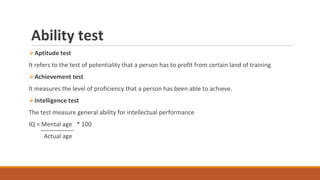
Ability test
⮚Aptitude test
It refers to the test of potentiality that a person has to profit from certain land of training
⮚Achievement test
It measures the level of proficiency that a person has been able to achieve.
⮚Intelligence test
The test measure general ability for intellectual performance
IQ = Mental age * 100
Actual age
Personality test
⮚Interest test
It consist of three forms, it measures vocational interest, interest in personal areas and interest to particular
occupation
⮚Personality inventories
It measures characteristics way of reacting a variety of situation
⮚Projective tests
It consist of pictures or incomplete items. A task is asked to narrate what he sees in picture or complete it
⮚Attitudes and values
Attitudes are tendencies to act favourable and values is concept of desirability a number of attitudes and
values tests are developed
Uses
⮚Prediction
It useful for selection, promotion and displacement
⮚Diagnosis
It deals with identifying the causative factors leading to a practical
behaviour
⮚Research
It helps to create a proper situation for describing behavior are
research test
Challenges
⮚Use of test
⮚Lack of professional approach
⮚Maintenance of ethical standard
⮚Test anxiety v’s test wiseness
⮚Test validity
Conclusion
The psychological tests have general tendency to use tests have
been found to be good predictors at either another level or in
another organization. The selection of psychological test is based on
the nature and objective of organization. Psychological test mostly
use in selection and recruitment.
Reliability and validity of
selection tools
Done by :
Walidahmad Alam
Introduction
• Reliability and validity are concepts used to evaluate the quality of
research. They indicate how well a method, technique or test measures
something. Reliability is about the consistency of a measure, and validity
is about the accuracy of a measure.
• It’s important to consider reliability and validity when you are creating
your research design, planning your methods, and writing up your results,
especially in quantitative research.
• Reliability and validity are closely related, but they mean different things.
A measurement can be reliable without being valid. However, if a
measurement is valid, it is usually also reliable.
SELECTION
• Selection is the process of identifying an individual from a pool of job
applicants with the requisite qualifications and competencies to fill jobs
in the organization.
• This is an HR process that helps differentiate between qualified and
unqualified applicants by applying various techniques.
• The term ‘selection’ comes with the connotation of placing the right
person in the right job.
• Some activities include:
Screening
Eliminating unsuitable candidates
Conducting an examination (tests).
Interviews
Checking references
Medical tests
SELECTION TEST Types
• Aptitude Test : Learning capacity
• Intelligence Tests : Reasoning, verbal , number, memory
• Achievement Tests : Theoretical and practical knowledge
• Situational Tests : Situational problems
• Interest Tests : Likes and dislikes of candidates
• Personality Tests : Relationship, Talkative, Reliability, Self-confident
• Honesty Tests : The “Polygraph” is a lie detector mechanical device that
measure honesty of the candidate. Reduce losses and Employee theft
RELIABILITY
• A necessary condition in order for a selection method to be valid is that it first be reliable.
• Reliability concerns the consistency of measurement. This consistency applies to the
scores that derive from selection method. These scores can come from a paper-and pencil
test, a job interview, a performance appraisal, or any other method that is used to make
decisions about people.
• A reliable test is one that yields consistent scores when a person takes two alternative
forms of the test or when he or she takes the same test on two or more different
occasions.
• Reliability refers to the consistency or stability of response on a test, for example a group
takes a cognitive ability test on this week and achieves a mean score of 100. The same test
is repeated after a week and the groups reported mean score of 62. Then we have to
conclude that something is wrong with the test. We would describe the test as unreliable
because it yields inconsistence measurements.
• No selection test achieves perfect reliability, but the goal is to reduce error in
measurement as much as possible.
Methods of reliability
The most important methods of assessing reliability for HR specialists are (test-retest,
inter-rater, and internal consistency) reliability. all of these methods must not be used
in every situation, and in some instances a particular method may be totally
inappropriate.
Different methods of reliability :
1- Test-retest reliability
This method examines the consistency of a test over time. A single group of people
take a test (time 1), later the same people take the same test again (time 2), the
correlation (called the coefficient of stability) is computed between the time 1 scores
and the time 2 scores. Test-retest reliability measures the consistency of results when
you repeat the same test on the same sample at a different point in time. we use it
when you are measuring something that you expect to stay constant in your sample.
2- Inter-rater reliability
• Inter-rater reliability (also called inter observer reliability) measures the degree
of agreement between different people observing or assessing the same thing.
we use it when data is collected by researchers assigning ratings, scores or
categories to one or more variables.
Suppose a job applicant is interviewed by several different interviewers, the
interviewers rate the applicant separately on several dimensions. In this case each
interviewer can be viewed as a form of “interview test”. It is therefore important to
know how one interviewer ‘s rating of the candidate correlates with the other
interviewers ratings of the same candidate.
• This method involves administering a test twice to the same group of people.
Then correlation is done to determine the correspondence between the two set
of scores. The correlation coefficient called reliability coefficient.
❖ Having reliable measures is critical. Reliability information can be
obtained from several sources:
1- Reliability studies conducted by the organization that will use the tests.
2- Reliability information provided by commercial test publishers that sell
the tests.
3- data from other companies that have used the same tests in their
selection systems.
4- data from individuals who have used the tests in research studies.
Reliability serves as the foundation for the validity of a test. If a test cannot
measure people consistently, it cannot possibly be valid.
3- Internal consistency
The third method of assessing reliability is internal consistency. This type of
reliability assesses whether all the items on a test measure the same trait or ability
that is, whether the test’s content is internally consistent.
In the most common way of assessing internal consistency, a group of people are
given a test. A coefficient is computed that represents the average correlation of
each item on the test with each other item.
Internal consistency assesses the correlation between multiple items in a test that
are intended to measure the same construct.
You can calculate internal consistency without repeating the test or involving other
researchers, so it’s a good way of assessing reliability when you only have one data
set.
VALIDITY
• The term validity refers to whether or not a test measures what it
intends to measure. On a test with high validity the items will be closely
linked to the test’s intended focus. For many certification and licensure
tests this means that the items will be highly related to a specific job or
occupation.
• The validity of a selection procedure refers to the extent to which there
is empirical evidence or data that accurate inferences can be made
from the score for a particular employment selection purpose.
• Validity often refers to evidence that the test is job related.
• There are three major types of validity:
(1) content validity. (2) construct validity. (3) criterion-related validity.
1- CONTENT VALIDITY
• A test has content validity, if it reflects an actual sample of the work done on
the job. The test should measure tasks and skills actually needed for the job.
• The basic procedure is to identify job tasks and behaviors that are critical to
performance and then randomly select a sample of these tasks and behaviors to
be tested.
• A selection procedure has content validity if it representatively samples
significant parts of a job, such as a filing test for a file clerk or a test of cash
register operation for a grocery checker. Selection tests that approximate
significant aspects of a job are called job sample tests.
• The basic procedure here is to identify job tasks and behaviors that are critical
to performance, and then randomly select a sample of those tasks and
behaviors to be tested.
2- CONSTRUCT VALIDITY
• Construct Validity is used to ensure that the measure, actually measures what it
is intended to measure and not other variables.
• Instead of directly testing or using other information to predict job
success, some selection methods seek to measure the degree to which
an applicant possesses psychological traits called constructs. Constructs
include intelligence, leadership ability, verbal ability, mechanical ability,
manual dexterity, etc.
• The collection of evidence used to test hypotheses about relationships between
measures and their constructs. Examines the extent to which a selection tool
measures a theoretical construct or trait. Difficult validation method - have to
prove that your test really measures the concept you say it measure show do
you know your intelligence test measures intelligence? How would you go
about proving this is a valid inference?
3- CRITERION VALIDITY
• Demonstrating Criterion validity means demonstrating that those who
do well on the test also do well on the job and that those who do poorly
on the test do poorly on the job. Thus, the test has validity to the extent
that the people with higher test scores perform better on the job. In
psychological measurement, a predictor is the measurement (in this
case, the test score) that you are trying to relate to a criterion, like
performance on the job. The term criterion validity reflects that
terminology.
• Criterion validity is a type of validity based on showing that scores on
the test (predictors) are related to job performance(criterion).
Selection a best suitable candidates for a job is an essential function of HR
department. And, the effective selection is depends to a large degree on the
basic testing concepts of validity and reliability.
Reliability: It is a test’s first major requirement and refers to its consistency.
A test is said to be reliable only when the result an outcome is consistent on
identical test obtained form same person at two different occasion.
Validity (legal acceptance): It measures to prove that something is true or
correct. In other words, validity tells us whether the test is measuring what
we think it’s supposed to be measuring.
Conclusion
Thank you…
BY RESHMA M S
SOCIAL
RECRUITMENT
SOCIAL RECRUITMENT- MEANING
• Social recruitment is concerned with sourcing candidates for jobs via social media channels and
social media networks. Social recruitment takes two different paths. The first is increasing reach
by spreading jobs and relying on the power of peoples’ social networks. The second is actively
searching for potential candidates via publicly-available information on social networks.
BENEFITS OF SOCIAL RECRUITING
1. Reach passive candidates.
2. Get more referrals.
3. Target your perfect candidates.
4. Showcase your company culture.
5. Save money.
6. Establish a more personal connection with potential candidates
Recruitment marketing software makes social
recruiting simpler, easier and more
streamlined. It helps companies showcase
their Employer Brands and build strong
relationships with candidates.
Social Recruiting with
Recruitment Marketing Software
HOW DOES SOCIAL RECRUITING WORK?
∙ Identifying potential candidates.
∙ Sending a potential applicant a direct message.
∙ Tweet links to available positions, and include relevant hashtags to build long-
term cohesion.
∙ Post employee photos on your organization’s Instagram account with a message
encouraging others to join your team, apply for open positions (with links), or add their
resume to your recruiting pool.
∙ Creating videos to share on YouTube, Facebook, or Instagram pages that
highlight and outline your organization’s culture.
RETRAINING
Submitted by,
SUMITHA S
INTRODUCTION
Retraining is all about renovate and update the employees to the time to time
changing and developing working environment,managerial skills, modern
technology etc.. To facilitate a better performance in a highly competitive
management era.
NEED FOR RETRAINING
❖ Future Training
❖ Manpower changes
❖ Obsolescence
❖ Poor Efficiency
❖ Cost Factor
❖ Mechanization
❖ Thechnological Development
❖ Macro-Level changes
PROCESS OF RETRAINING
► Identification of change of environment
► Identification of changes required in skill set
► Defining retraining objectives
► Identification of retraining methods
► Imparting retraining
► Post retraining evaluation
RETRAINING METHODS
❑ On – the- job method
❖ Orientation
❖ Instruction
❖ Internship
❖ Coaching
❖ Committee Assignments
RETRAINING METHODS
❑ Off – the – training
❖ Case study method
❖ Conferences
❖ Management Education
❖ Simulation
❖ Lectures
❖ Business Games
❖ In – basket method
ADVANTAGES OF RETRAINING
❑ Moving along with time ,changing environment
❑ Survival, Growing and competition
❑ Qualitative, cost effective and efficient
❑ Newer technology and decreases fear of obsolete
❑ Moral, feel elavated
CONCLUTION
Retraining is nothing but “Training again” the employees with newer skills for
performing the job
THANK YOU
► ……..
A presentation on
Job Evaluation
-Objectives & Uses
Submitted by,
Jerin Jacob
SMBS MBA S3
MG University
Reg. No: 122029
•In simple words, job evaluation is the
rating of jobs in an organization.
•Job evaluation is defined as the systematic
process of assessing the value of each job in
relation to other jobs in an organisation.
Definition – Job Evaluation
•According to Edwin B Flippo, “Job
Evaluation is a systematic and orderly
process of determining the worth of a job in
relation to other jobs.”
Objectives – Job Evaluation
• Determine hierarchy and place the worth of each
job
• Ensure fair and equitable wage structure
• Determine standard for performance appraisal
• Fixing incentives and bonus
Objectives – Job Evaluation
• Provide information for work organization
• Provide framework for periodic review and
justification of wage structure
• To ensure the competitiveness in the labor
market
• To identify ladder of progression
Uses – Job Evaluation
•Align our performance with the company’s need
•Measure our worth to the company
•Discuss our career
•Communicating our performance
•Basis for training need identification
Reference
• Mayhew, R. (2019, February 11). How to Comment on Your
Performance Review. Bizfluent. HTTPS://bizfluent.com/how-
6179046-comment-performance-review.html
• N, D. (2019, August 16). Objectives of Job Evaluation: 11 Objectives of
Job Evaluation. Economics Discussion.
https://www.economicsdiscussion.net/human-resource-
management/job-evaluation/objectives-of-job-evaluation/31791
• Poels, F. (2004). Handbook of Job Evaluation and Remuneration
Strategies. Penguin Random House.
HRP (3).pptx

HRP (3).pptx

  • 1.
  • 2.
    Succession Planning •Succession Planningis the process of training & preparing employees in an organization so that there will always be someone to replace an employee who leaves. •“ A defined program that an organization systemized to ensure leadership continuity for all key positions by developing activities that will build personnel talent from within.”
  • 3.
    Feature Of SUCCESSIONPLANNING • Identification of key job vacancies. • Consideration of internal candidates for fill those vacancies. • Assessing job requirements and skills of existing employees. • Fill the gaps between needs and skills through training and development. • Identify future leader.
  • 4.
    WHY TO DOIT? • Ensuring the organization is prepared with a support plan when key people leave. • Saves the time and money incurred in hiring new people. • Gives the bird eye view on the talent present in the organization.
  • 5.
  • 6.
    1.IDENTIFY CRITICAL POSITIONS •Critical positions are the focus of succession planning efforts. • Without these roles, the department or agency would be unable to effectively meet its business objectives. • It allows organization to target talent investments to ensure leadership continuity • Reduce risk from leadership attrition.
  • 7.
    2. Construct Sucessprofile. • Work, experience • Technical and professional knowldge • Personality and leadership skills 3.ASSESS THE STAFF Interested staff Whose skills and competencies could be developed. 4.Create Development plans
  • 8.
  • 10.
    JOB ANALYSIS Objectives &Uses COURSE: HUMAN RESOURCES PLANNING ( HR MINOR) SUBMITTED BY, ASHIK JOSE S3,MBA REG.NO: 122016
  • 11.
    CONTENTS ⮚ INTRODUCTION ⮚ JOBANALYSIS ⮚ OBJECTIVES OF JOB ANALYSIS ⮚ USES OF JOB ANALYSIS ⮚ CONCLUSION
  • 12.
    INTRODUCTION ▪ Job analysismost basic building block of HR management. ▪ It is a systematic way to gather and analyse information about the content, context, and human requirement of job. ▪ Job design and job analysis are different. ▪Job design – develops jobs that fit effectively into the flow of organisational work that needs to be done. ▪Job analysis – gather data in a formal and systematic way about what people do in their jobs.
  • 13.
    JOB ANALYSIS ▪ Itis a combination of two words - job and analysis. ▪ Job – Combination of all works, duties and responsibilities assigned to an employee. ▪ Analysis – Process of deep examination. ▪ Definition According to Edwin B. Flippo – “Job analysis is the process of studying and collecting information relating to the operations and responsibilities of a specific job”. ▪ The immediate products of this analysis are job descriptions and job specifications.
  • 14.
    JOB ANALYSIS METHODS SOURCESOF DATA CONDUCTED BY • Questionnaires • Interviews • Observation • Record • Employees • Supervisors • Managers • Job analysts • Job analyst • Outside consultant • Supervisor/manager Job Descriptions Job Specifications Used for Used for
  • 15.
    OBJECTIVES OF JOBANALYSIS ▪Job Evaluation Job analysis provides required information which is necessary for evaluating the worthiness of jobs. After the preparation of job description and job specification statements, it assists for the evaluation of actual performance against the predetermined standard. ▪Job Description A job description is a job profile which describes the contents, environment, and condition of jobs. It is prepared on the basis of data collected through job analysis. ▪Job Specification Job analysis provides the information related to the job and this data can be used to make the process or job simple. Job specification is another notable objective of job analysis.
  • 16.
    OBJECTIVES OF JOBANALYSIS ▪Arranging suitable working conditions Job analysis can help the management to provide suitable working environment and physical facilities favourable to employees. ▪ Industrial relations Job analysis helps to find out right person for doing the job . It ensures adequate health, safety and welfare of employees. ▪ Job designing Job elements are studied in detail under job analysis and these elements are properly organised to facilitate the completion of the job.
  • 17.
    USES OF JOBANALYSIS ▪ Manpower Planning It facilitates the division of work into different jobs. ▪ Helpful in Vocational Selection It helps in determining how many and what kinds of workers are required for different jobs, and qualifications required for them. ▪ Helpful in Wages and Salaries Administration Differentiation of job leads to decide the salaries and wages of all the workers and the employees. ▪ Recruitment, Selection And Placement It is very essential to know the requirements of the job and the qualities of the individual who will perform the job.
  • 18.
    USES OF JOBANALYSIS ▪Performance Appraisal The performance of employees can be appraised objectively with the standard of job performance so established. ▪Training and Development It helps in administering the training and development programmes. ▪ Job Evaluation Job evaluation aims at determining the relative worth of the job which in turn helps in determining the compensation of job. ▪ Discipline It studies the failure of the workman to meet the required standard of performance, corrective measures may be taken in time to avoid the untoward situations.
  • 19.
    USES OF JOBANALYSIS ▪Safety and Health Job analysis process uncovers the hazardous and unhealthy environmental factors such as heat, noise, fumes, dust etc. ▪ Job designing Industrial engineers may use the job analysis information in designing the job by making the comprehensive study of the job elements.
  • 20.
    CONCLUSION ▪ Job analysisprovides information to organizations that helps them determine which employees are best fit for specific jobs. ▪ Helps individuals develop their careers, and also for helping organizations develop their employees in order to maximize talent. ▪ Information about a job as it presently exists may be used to develop programs to recruit, select, train, and appraise people for the job as it will exist in the future.
  • 21.
  • 22.
  • 23.
    JOB ANALYSIS- INTRODUCTION Jobanalysis refers to a systematic process of collecting all information about a specific job, including skill requirements, roles, responsibilities and processes in order to create a valid job description. Job analysis also gives an overview of the physical, emotional & related human qualities required to execute the job successfully.
  • 24.
    Definition: According to EdwinB. Flippo, “Job Analysis is the process of studying and collecting information relating to the operation and responsibilities of a specific job.”
  • 26.
    1.Defining objectives • Redesignthe job description • Revise the compensation program • Change the organization structure • Redesign the job in a particular department. Once the objective is selected, it should be well communicated to the top management because with its support only, the changes can be made in the organization.
  • 27.
    2.Preparing the jobAnalysis: ▪ The kind of jobs that are to be analyzed are selected ▪ The members who are included in the analysis and the methods to be used are identified. ▪ The complete review of the existing job description is done to have a fair insight of the duties, responsibilities, organization chart, working conditions, hazards, etc.
  • 28.
    3.Performing the JobAnalysis ▪ The sufficient time should be allotted for collecting the job details from the employees. ▪ The information from the employees can be collected through questionnaires, interviews, or through an observation method. ▪ It needs to be sorted on the basis of its nature, division, department.
  • 29.
    4.Designing Job Descriptionsand Job Specifications ▪The job analyst prepares a draft of the job description and the specifications. ▪ After sorting of the information, the changes that need to be made in the jobs is identified and is written on paper. ▪ Once the draft gets prepared, it is circulated to the managers, supervisors, and the employees.
  • 31.
    5.Control Job Descriptionsand Job Specifications This is the last step in the process of job analysis wherein the job descriptions, and the specifications are timely checked and modified according to the changing needs of the organization.
  • 32.
    CONCLUTION The main purposeof job analysis is thus to collect the data and then to analyses the data related to the job. A job can be analyses only after it has been designed and someone is already performing it. the most important thing is job description and job specialization are two product of job analysis play as a major role.
  • 34.
  • 35.
    WHAT IS AJOB DESCRIPTION • A job description is a document intended to provide job applicants with an outline of the main duties and responsibilities of the role for which they are applying. • The description is usually drawn up by the individual in the organization responsible for overseeing the selection process for the role, often with the help of the company’s HR department and/or an external recruiter. • It also includes the job title and to whom the person holding that job has to report. It is only possible to do a job description, however, after carrying out a job analysis.
  • 36.
    THE MAIN OBJECTIVESOF A JOB DESCRIPTION 1. Primary Objectives: The primary objectives of a job description include: • Safety of the workforce. • Development of a superior workforce. • Development of the Human resources department. • Development of an employee-oriented company culture that emphasized quality, continuous improvement, and high performance. • Personal ongoing development.
  • 37.
    2. Secondary Objectives: Thesecondary objectives of job descriptions include: • To help managers articulate the most important outcomes they need from an employee performing a particular job. • To assist as a communication tool to tell coworkers where their job leaves off and the job another employee starts. • To tell an employee where their job fits within the overall department and the overall company. • To help employees from other departments, who must work with the person hired, understand the boundaries of the person’s responsibilities. • Finally, develop job descriptions performs as an integral piece of the performance development planning process.
  • 38.
    COMPONENTS OF JOBDESCRIPITION
  • 39.
    STEPS TO WRITEA JOB DESCRIPINTION 1.JOB TITLE 2.ROLE SUMMARY 3.DUTIES 4.QUALIFICATION 5.ROLE EXPECTATION 6.REPORTING 7.VERIFICATION
  • 40.
    ADVANTAGES OF JOBDESCRIPTION 1. Helps companies understand the type of candidate they should search for based on title, position and location 2. Employees are well aware about their job roles & duties 3. Job description helps in understanding the workplace environment, benefits etc for a prospective employee 4. Helps in better recruitment & selection 5. Job description clearly highlights all the requirements, objectives & goals that it wants an employee to perform
  • 41.
    DISADVANTAGES OF JOBDESCRIPTION 1. They are time bound and can change with organization structure, industry policies, company requirements etc. 2. It can only highlight the macro criteria of a job but cannot fully explain the obstacles, emotional requirements etc. related to the job 3. Incomplete job description lacking quality information can misguide both the HR manager as well as the employee
  • 42.
  • 43.
    CONCLUSION • A jobdescription is an essential part of the job application process as, with the right information, it should help applicants to determine whether the role is in line with their skill set and whether it is a job they actually want to do. • From the organization's perspective, the job description is vital in ensuring that the applications received for the position closely match the needs of the role itself. • It helps HR departments and external recruiters to streamline the selection process and attract a higher number of suitable candidates for interview or further selection. • A job description helps to streamline the selection process.
  • 44.
  • 45.
    WHAT IS JOB SPECIFICATION? • Job specification specifies information about the skills or qualities required for doing the job. • Job specification helps in hiring an appropriate person for an appropriate position. • Job specification is defined as a statement about qualification and characteristics of employee required to perform the job task in a satisfactory manner.
  • 46.
    Objectives of Job Specification •To highlight the specific details essential to perform the task at its best • To provide a framework to HR manager to identity the best prospects • To help the recruitment team in screening the resumes of the applicant • To verify the performance of the employee during appraisal and promotion
  • 47.
    PURPOSE • Job specificationhelps candidates analyze whether are eligible to apply for a particular job vacancy or not. • It helps recruiting team of an organization understand what level of qualifications, qualities and set of characteristics should be present in a candidate to make him or her eligible for the job opening. • Job Specification gives detailed information about any job including job responsibilities, desired technical and physical skills, conversational ability and much more. • It helps in selecting the most appropriate candidate for a particular job.
  • 48.
    COMPONENTS ●Educational Qualifications ●Experience ●Skills andKnowledge ●Personal Traits and characteristics
  • 49.
    Job Specification Example Here isa sample job specification, which is prepared for a marketing manager in a telecom company. Education Must be an engineer and MBA in marketing for a reputed MBA institute Work experience Must have prior work experience in marketing & sales (preferably telecom or FMCG) Skills & Knowledge 1. Must be a good communicator and must be able to lead a team. 2. Prior experience in handling ATL-BTL activities and managing promotional events. 3. Must be able to handle social media like Facebook, Twitter and help build online brand 4. Experience in managing PR and media 5. Strong analytical skills and problem solving skills 6. Must understand business, come up with innovative products and launch them Personality Traits & Characteristics 1. Must be presentable and a good orator 2. Should be calm in complex situations and show leadership skills in managing multiple teams 3. Should be emotionally strong and should give timely deliverables
  • 50.
    ADVANTAG ES • Highlight specificduties • Help in screening of resumes • Management • Benchmark to evaluate employees • Performance appraisal
  • 51.
    Disadvantages • Time consuming •Time bound • Complex issues • Bias
  • 52.
    Conclusion • The jobspecification list the knowledge skill and abilities of individual to perform job satisfactorily • Without proper job analysis by the human resources department it is difficult for any organization to remain competitive and be able to attract and retain talent
  • 54.
    LABOUR TURNOVER AND ATTRITION Presentedby, Alexmon Joseph Reg No: 122006
  • 55.
    INTRODUCTION • Attrition andturnover decreases the number of employees on staff, but attrition is voluntary or retirement. • Labour turnover includes employees who leave of their own decisions. It also refers to employees who are involuntarily terminated or discharged.
  • 56.
    LABOUR TURNOVER • Itis also called as staffing turnover, refers to the ratio of a number of employees who leave a company through dismissal or resignation to the total number of employees on the payroll in that period. • Turnover rate = (Total departures / Average headcount)*100
  • 57.
    TYPES OF TURNOVER •Voluntary • Involuntary • Functional • Dysfunctional
  • 58.
    LABOUR ATTRITION • Itis defined as the natural process which employees leaves the work force • In attrition an employee will not fill the vacancy left by the deporting employee.
  • 59.
    TYPES OF ATTRITION •Attrition due to retirement • Voluntary attrition • Involuntary attrition • Internal attrition • Demographic specific attrition
  • 60.
    LABOUR TURNOVER VSATTRITION Labour turnover • Organization will fill the vacant place suddenly. • Function of stable workforce. • Planned Attrition • Companies do not seek to replace. • Function of decreasing workforce. • Unplanned
  • 61.
    CONCLUSION • Employee turnoverand attrition both occur when an employee leaves the company. • Both attrition and turnover decrease the number of employees. • In turnover, the company makes efforts to replace the lost employee but in attrition cases the vacancy remains unfilled.
  • 62.
  • 63.
  • 64.
    INTRODUCTION ❑Topics:Redeployment , Retrenchmentand Voluntary retirement ❑Redelpoyment is reassignment of employees to other departments or job ❑Retrenchment is one of the ways company use to terminate employment ❑Voluntary retirement is termination or retirement of employee voluntarily before retirement date
  • 65.
    REDEPLOYMENT ❑Redeployment in theworkplace is the moving of an employee from one job or role to another. ❑The new job or role does not necessarily need to be similar to the original ❑Employees are moved from area within organisation
  • 66.
    Advantages of Redeployment ❑LowersCosts • Save time and money spend on recruitment ❑Solidifies Employer-employee Relations • Career growth that don’t involve a loss of income ❑Strengthens Corporate Image • Employees are placed in another job within the organisation ❑Improves Talent retention • Prevent termination of talented employees
  • 67.
    RETRENCHMENT (DEFINITION) ❑Retrenchment meanstermination of service by an employer,of a workman,for any reason whatsever other than; • As punishment inflicted by way of diciplinary action • Retirement on reaching the age of superannuation • Voluntary retirement • Non renewal of contract and • Continued ill health (Indusrial Dispute Act 1947)
  • 68.
    RETRENCHMENT ❑Retrenchment means terminatingan employee due to the surplus of labor or incapacity of employees to match the performance standards of the company. ❑It is a form of downsizing ❑Reason: Business recession,Shortage of material,Introduction of new machinery etc..
  • 69.
    Benefits of Retrenchment ❑Reducedlabour costs • It reduce the size of its workforce. ❑Improves Performance of the company • employees would start performing better.
  • 70.
    VOLUNTARY RETIREMENT ❑Also knownas a voluntary retirement scheme ❑Voluntary Retirement means voluntary termination of employment ❑Is not a kind of forced retirement. ❑Voluntary retirement is an early retirement incentive that is offered to eligible staff members who meet certain criteria. ❑Occurs before date of retirement
  • 71.
    VOLUNTARY RETIREMENT (CONT.) ❑Reducesurplus staff. ❑This scheme is also known as a golden handshake ❑Not allowed to apply in another firm that belongs to the same company ❑No recruitement against vacancies
  • 72.
    Benefits of VRS ❑Nolegal obstacle • it is lawful and voluntary. ❑Attractive benefits to employees • Gratuity ,provident fund ,rehabilitation ,advice on manging of funds ❑Flexibility • can be applied to certain divsions and departments ❑Reduce employee costs • it reduce the size of its workforce.
  • 73.
    CONCLUSION ❑Redeployment helps toretain top talents,protect corporate image,lower cost ❑Retreanchment helps in improved performace and Reduced labour costs ❑VRS is the most human technique to provide overall reduction in the existing strength of the employees
  • 74.
  • 75.
  • 76.
    � predictive analytics �predict customer demand to optimize supply decisions � two major categories, qualitative and quantitative methods.
  • 77.
    Qualitative assessment � Unaidedjudgment � Prediction market � Delphi technique � Game theory � Judgmental bootstrapping
  • 78.
    Quantitative assessment � Discreteevent simulation � Extrapolation � Group method of data handling (GMDH) � Reference class≈ forecasting
  • 79.
    Calculating demand forecast accuracy �accuracy of forecasts made regarding customer demand for a product. � . Understanding and predicting customer demand is vital to manufacturers and distributors to avoid stock- outs and maintain adequate inventory levels.
  • 80.
    Calculating the accuracyof supply chain forecasts � Forecast accuracy in the supply chain is typically measured using the Mean Absolute Percent Error or MAPE. � Statistically MAPE is defined as the average of percentage errors.
  • 81.
    Calculating forecast error �The forecast error needs to be calculated using actual sales as a base. � Tracking Signal and Forecast Bias.
  • 82.
  • 83.
  • 84.
    INTRODUCTION � Process ofprojecting the organization’s future HR needs and how it will meet those needs under a given set of assumptions about the organization's policies and the environmental conditions in which it operates. � Purpose: determine the number of employees required for each job and their knowledge, skills, abilities. � Assess the disparity between supply and demand . � Essential in determining the characteristics of hiring sources within the predetermined planning horizon.
  • 85.
    SUPPLY FORECASTING TECHNIQUES �TREND ANALYSIS � COMPETENCY MODEL � REPLACEMENT CHARTS � STAFFING TABLE � SUCCESSION PLANNING � MARKOV ANALYSIS
  • 86.
    TREND ANALYSIS � Simplestmethods of forecasting future HR supply. � Examining trends of past � Predict the effect of the same activity on the future of the organization. � Assumes : past trends and ratios in employee movement are stable and indicative of future trends.
  • 87.
    Example � An organizationreviewing historical data may realize that, every year approximately five percent of their staff retire, six percent resign and three percent dismissed. � Using a simple trend analysis future HR supply forecasts can be established by assuming an average reduction in internal HR supply of 14 percent per year.
  • 88.
    COMPETENCY MODEL � Activityof determining the specific competencies that are characteristic of high performance and success in a given job. � Future oriented model � Focus on matching the right skills or competencies needed for each job with skills available within the organization
  • 90.
    REPLACEMENT CHART � Informationregarding possible replacements for vertical or horizontal movement. � Estimate vacancies in higher level jobs - identify how potential HR supply can fill these vacancies via internal movements from lower levels jobs. � Include: information about employees performance, readiness to fill the position and education.
  • 92.
    STAFFING TABLE � Graphicalrepresentations of all organizational jobs, along with the numbers of employees currently occupying those jobs and future employment requirements, which can be derived from demand forecasts.
  • 94.
    SUCCESSION PLANNING � Longerterm process of grooming a successor ( selected fro a pool of candidates on the basis of perceived competency) for management or critical positions. � Determining the internal labor supply calls. � Planner modifies analysis to reflect changes expected in the near future.
  • 96.
    MARKOV ANALYSIS � Predictinternal employee movement from one year to another . � Allows for the development of a transition matrix to forecast internal labor supply. � Statistical technique - forecasting future behavior of variable or system. � Named : Russian mathematician Andrei Andreyevich Markov
  • 98.
    CONCLUSION �Human resource forecastingis all about estimating the future demand and supply of human resources in an organization. �Estimating availability of human resource which is followed by demand forecasting.
  • 99.
    PLACEMENT ANJANA V KUMAR S3MBA Register No. : 122014
  • 100.
  • 101.
    INTRODUCTION ❑Placement is theprocess of assigning a specific job to each of the selected candidates. ❑Includes initial assignment of new employees & promotion, transfer or demotion of present employees. ❑Job description & job specification plays an important role.
  • 102.
    ❑Jobs can beclassified into 3 categories based on the type of placement : i) Independent ii) Sequential iii) Pooled
  • 103.
    ⮚Helps to avoidmisfit between the job & the candidate. ⮚Helps to reduce cost per hire and time to hire. ⮚Helps candidate to work as per the predetermined objectives of the organization. IMPORTANCE
  • 104.
    Collect details aboutthe employee Construct his or her profile Which subgroup profile does the individual’s profile best fit? Compare subgroup profile to job family profiles ASSESSMENT-CLASSIFICATION MODEL & EMPLOYEE PLACEMENT
  • 105.
    Which job familyprofile does subgroup profile best fit? Assign the individual to job family Assign the individual to specific job after further counselling & assessment
  • 106.
    ⮚ After placement,employee is put on probation period ranging from one to two years. ⮚ During this period his work would be observed . ⮚ If the employees performance is good, then their job position will be confirmed. ⮚ If it is not satisfactory no confirmation order would be given or in some cases he/she may be asked to quit.
  • 107.
    ⮚Improves Employee Morale. ⮚ReducesEmployee Attrition And Turnover. ⮚Reduces Absenteeism. ⮚Enhances Job Satisfaction. ⮚Enhances Labour Productivity. BENEFITS OF PLACEMENT
  • 108.
    Placement is theactual posting of an employee to a particular job for which he has been chosen. The purpose of a placement is usually to give the worker an opportunity to learn something from a new work environment or for them to contribute something to that environment for a set period of time. CONCLUSION
  • 109.
    HRP- CONCEPT ANDOBJECTIVES Presented By: Acsah Sara Sam S3 MBA
  • 110.
    INTRODUCTION • Human resourceis an important corporate asset • Human resources signifies potentials, abilities, capacities and skills • Optimum utilisation of human resources determines the success of any organization • Organisational productivity, growth of company and economic development depends on human capacities • To realise company objectives- human resource plan
  • 111.
    • Planning –Decides in advance what to do in the future • System of matching the supply of people with the requirements of the organisation
  • 112.
    HRP Concept • HRPis the systematic process of matching the internal and external supply of people with job openings anticipated in the organization over a specified period of time. • The process of systematically reviewing HR requirements to ensure that the required number of employees with the required skills is available when they are needed ❑Right number and kinds of people ❑Right place ❑Right time
  • 113.
    • A subsystemin the total organisational planning • Tries to assess the human resource requirements in advance • Getting right no. of qualified people at the right time • Helps the management in meeting the future demand of human resource • Continuous process
  • 114.
    Features of HRP ⮚Welldefined objectives • On the basis of company goals • Developing human resources, career planning , ensuring better commitment etc. ⮚Determining human resource needs • Has to be done in advance • For that- recruiting, selecting, training
  • 115.
    ❖Keeping manpower inventory ❖Adjustingdemand and supply • Advanced planning ❖Creating proper work environment • Proper working conditions, job satisfaction
  • 116.
    OBJECTIVES OF HRP 1.Forecast personnel requirements • To determine the future manpower needs 2. Cope with changes • Changes in market conditions, technology, products and government regulations 3. Use existing manpower productively • Keeping an inventory- on the basis of skills, experience, training etc. 4. Promote employees in a systematic manner
  • 117.
    CONCLUSION • Ensures rightnumber of people at right place and at right time • Continuous process of developing and determining objectives • Determining the future manpower needs • Effective HRP reduces the pressure on the management and employees
  • 118.
  • 119.
  • 120.
    Index ► Human ResourcePlanning Definition ► HRP Processes ► Determining the objectives of HRP ► Analyzing Current Manpower Inventory ► Forecasting Demand ► Analyzing the Manpower Gaps ► Employment Plan / Action Plan ► Training and Development ► Appraisal of Manpower Planning
  • 121.
    Human Resource Planning(HRP) ► Human Resource Planning (HRP) is the most important asset of an organization. Human Resource Planning are the important managerial function. It ensures the right type of people, in the right number, at the right time and place, who are trained and motivated to do the right kind of work at the right time, there is generally a shortage of suitable persons.
  • 122.
    HRP Processes ► PlanningProcesses contains 7 steps. Those are; 1. Determining the objectives of Human Resource Planning 2. Analyzing Current Manpower Inventory 3. Forecasting Demand and Supply of Human Resources 4. Analyzing the Manpower Gaps 5. Employment Plan/ Action Plan 6. Training and Development 7. Appraisal of Manpower Planning
  • 123.
    Determining the objectivesof Human Resource Planning: ► The foremost step in every process is the determination of the objectives for which the process is to be carried on. The objective for which the manpower planning is to be done should be defined precisely, so as to ensure that a right number of people for the right kind of job are selected. ► The objective can vary across the several departments in the organisation such as the personnel demand may differ in marketing, finance, production, HR department, based on their roles or functions.
  • 124.
    ANALYZING CURRENT MANPOWER INVENTORY ►The next step is to analyze the current manpower supply in the organization through the stored information about the employees in terms of their experience, proficiency, skills, etc. required to perform a particular job. ► Also, the future vacancies can be estimated, so as to plan for the manpower from both the internal (within the current employees) and the external (hiring candidates from outside ) sources. Thus, it is to be ensured that reservoir of talent is maintained to meet any vacancy arising in the near future.
  • 125.
    FORECASTING DEMAND ANDSUPPLY ► Once the inventory of talented manpower is maintained; the next step is to match the demand for the manpower arising in the future with the supply or available resources with the organization. ► Here, the required skills of personnel for a particular job are matched with the job description and specification.
  • 126.
    ANALYZING THE MANPOWERGAPS ► After forecasting the demand and supply, the manpower gaps can be easily evaluated. In case the demand is more than the supply of human resources, that means there is deficit, and thus, new candidates are to be hired. ► Whereas, if the demand is less than supply, there arises a surplus in the human resources, and hence, the employees have to be removed either in the form of termination, retirement, layoff, transfer, rtc.
  • 127.
    EMPLOYMENT PLAN /ACTION PLAN ► Once the manpower gaps are evaluated, the action plan is to be formulated accordingly. In a case of a deficit, the firm may go either for recruitment, training, interdepartmental transfer plans whereas in the case of surplus, the voluntary retirement schemes, redeloyment, transfer, layoff, could be followed.
  • 128.
    TRAINING AND DEVELOPMENT ►The training is not only for the new joinees but also for the existing employees who are required to update thair skills from time to time. ► After the employment plan, the training programmes are conducted to equip the new employees as well as the ones with requisite skills to be performed on a particular job.
  • 129.
    APPRAISAL OF MANPOWER PLANNING: ►Finally, the effectiveness of the manpower planning process is to be evaluated. Here the human resource plan is compared with its actual implementation to ensure of employees for several jobs. ► At this stage, the firm has to decide the success of the plan and control the deficiencies, if any.
  • 130.
    CONCLUSION ► Human ResourcePlanning is a continuous process that begins with the objectives of Human Resource Planning and ends with the appraisal or feedback and control of the planning process.
  • 131.
  • 132.
    IMPORTANCE OF HUMAN RESOURCE PLANNING SUBMITTEDBY AKARSH S SASI REG:NO :122003
  • 133.
    HUMAN RESOURCE PLANNING Thesystematic process of planning HR requirements for the organisation.
  • 134.
    1. Future personnelneeds • Future availability of manpower. 2. creating highly talented personnel • Recruit and select most capable personnel • Dealing with problem of skilled manpower shortage IMPORTANCE OF HRP
  • 135.
    3. foundation forpersonnel functions • Recruitment, selection training and development. • Personnel movements like promotion transfer and layoffs. 4. coping with change • Changes in business environment 5. Succession planning • Prepare people for future challenges
  • 136.
    6. Part ofstrategic planning • Integral part of strategic planning • HRP Provides inputs in strategy formulation process. 7. Reservoir of talent • Reservoir of talent at any point of time
  • 137.
    CONCLUSION Human resource planningis essential to any company it helps companies to address employee deficit or challenges before such problem emerge and with a good understanding of the process firm can implement the right strategy to put the best workforce together.
  • 138.
  • 139.
    FACTORS AFFECTING HUMAN RESOURCEPLANNING SUBMITTED BY AKSHAY KRISHNAN V ROLL No. 04 S3,MBA
  • 140.
    HUMAN RESOURCE PLANNING •Human resource planning (HRP) is the continuous process of systematic planning ahead to achieve optimum use of an organization's most valuable asset—quality employees. • Having a good HRP strategy in place can mean productivity and profitability for a company.
  • 141.
    FACTORS AFFECTING HUMANRESOURCE PLANNING • TYPE AND STRATEGY OF ORGANIZATION The type of organization is an important consideration because it determines the production processes involved, number and type of staff needed, and the supervisory and managerial personnel required. • ORGANISATIONAL GROWTH CYCLES AND PLANNING The stage of an organization’s growth can have considerable influence on human resource planning.
  • 142.
    • ENVIRONMENTAL UNCERTAINTIES HRdepartments deal with environmental uncertainties by carefully formulating recruitment, selection, and training and development policies and programmes. • TIME HORIZONS A plan cannot be for too long on a time horizon as the operating environment itself may undergo charges. • TYPE AND QULAITY OF INFORMATIONS The information used to forecast personnel needs originates from a multitude of sources. HR department must maintain accurate and timely data.
  • 143.
    • LABOUR MARKET Labormarket comprises people with skills and abilities that can be tapped as and when the need arises. • OUTSOURCING Organizations outsource many things to reduce either cost or time or efforts or all together. • NATURE OF JOBS BEING FILLED The demand and supply, alternative employees and turnover ratio varies from job to job.
  • 144.
    CONCLUSION Human resources area key element in the success or failure of monitoring programmed to meet their objectives. There are so many factors which affect the working of a firm directly and indirectly. So these factors are changing dynamically day by day so they must be closely governed and maintained to ensure the smooth flow of Human Resource Planning. Thus a Human Resource Planning is said to be efficient when these factors are successfully watched.
  • 145.
  • 146.
  • 147.
    CONTENTS MEANING AND DEFINITION CONSEQUENCESOF ABSENTEEISM MEASURES TO CONTROL ABSENTEEISM CONCLUSION TYPES OF ABSENTEEISM CAUSES OF ABSENTEEISM FORMULA FOR MEASURING ABSENTEEISM
  • 148.
    MEANING When an employeeis scheduled to work fails to report on duty it is called absenteeism It is defined as unauthorised absence from work *Means absence at regular work without prior permission , notice or sanction DEFINITION OF ‘ABSENTEEISM’ Absenteeism” is a practice or a habit of being an “absence” and an “absentee” is one who habitually stays away. - WEBSTER’S DICTIONARY
  • 149.
  • 150.
    • Authorized Absenteeism •Unauthorized Absenteeism • Willful Absenteeism • Absenteeism caused by circumstances beyond ones control TYPES OF ABSENTEEISM
  • 151.
    1. Individual 2.Co workers • Loss of pay • Disciplinary action • Work life conflict CONSEQUENCES OF ABSENTEEISM • Increased workload • Decreases morale of employees • Undesired overtime • Conflict with absent employees
  • 152.
    3. Organisation 4.Family • Decreased productivity • Increased cost due to replacement, training • More grievances • Backlogs, arrears in work CONSEQUENCES OF ABSENTEEISM (cont.) • Less earnings • Physical and mental problems
  • 153.
    CAUSES OF ABSENTEEISM •Illness and accident • Lack of job satisfaction • Boredom on the job • Poor Working Condition • Poor supervision and inadequate leadership • Personal problems • Work load and stress
  • 154.
    MEASURES TO CONTROL •Proper selection • Proper orientation • Better working conditions • Provision of transport and housing facilities • Incentives to regular employees • Disciplinary action • Effective supervision • Employee counseling
  • 155.
  • 156.
    • Absenteeism refersto the habitual non presence of an employee at their job. • Absenteeism if not properly managed fails the organisation • Should focus on the reasons and consequences of absenteeism • Possible causes of over-absenteeism include job dissatisfaction, ongoing personal issues, and chronic medical problems.
  • 157.
    HUMAN RESOURCES MANAGEMENT PRESENTATION TOPIC :JOB BURN OUT PRESENTED BY, GOVIND G REG NO: 122027 SUBMITTED TO, DR SANTHOSH THAMPY SIR
  • 158.
    INTRODUCTION • JOB BURNOUTIS THE SOCIAL TYPE OF WORK RELATED • STRESS STATES OF PHYSICAL OR EMOTIONAL EXHAUSTION THAT ALSO INVOLVES A SENSE OF REDUCED ACCOMPLISHMENT AND LOSS OF OF PERSONAL IDENTIFY “BURN OUT “ IS N’T A MEDICAL DIAGONISIS SOME EXPERTS THINK THAT OTHER CONDITIONSSUCH AS DEPRESSION
  • 159.
    STAGES OF BURNOUT ❑HONEYMOON PHASE ❑ONSET OF STRESS ❑CHRONIC STRESS ❑BURNOUT HABITUAL BURN OUT
  • 160.
    STAGES • ONSET OFSTRESS It began with the awareness of some days beings m0re difficulties than others optimisms wanning as well as notices common stress symptoms . • CHRONIC STRESS In this phase a marked changes your stress levels going from motivation to experiencing stress on increase frequient basis you my also experience • BURN OUT HABITUAL BURN OUT Entering the stage is habitual burn out itself where symptoms becomes critical continuing as normal is often possible this stages as it becomes increasingly.
  • 161.
    SYMP TOMS OFJOB BURN OUTBURNOUT ❖IRRITABLE ❖LOW IMMUNE SYSTEM ❖DEPRESSED ❖HARD TO FOCUS ❖PAINFULLY BORED ❖FEEL UNDER APPRICATED AT WORK ❖WANT TO BE ALONE ❖DREAM ABIOUT A VACCATION
  • 162.
    POSSIBLE CAUSES OFJOB BURN OUTBURNOUT ⮚ LacAn inability to your job, such as your schedule, assignments or workload could lead to job burnout. ⮚ Unclear job expectations. If you're unclear about the degree of authority you have or what your supervisor or others expect from you. ⮚ Lack of social support If you feel isolated at work and in your personal life, you might feel more stressed. ⮚ Work-life imbalance. If your work takes up so much of your time and effort that you don't have the energy to spend time with your family and friends, you might burn out quickly.
  • 163.
    CONCLUSION The results ofthis study show that workplace support is an important job resource. People who experience burnout can have a negative impact on interactions with colleagues, superiors users, which reduces the support in the workplace. Despite this, the presence of such support reduces the effect of burnout.
  • 164.
  • 165.
  • 166.
    JOB EVALUATION • Jobevaluation is an orderly and systematic process of determining the worth of a job in relation to other jobs. It is a process of rewarding the job after it has been analyzed. Each job should be paid according to its real value i.e., a high value job should receive higher compensation and low value job should receive lower compensation..
  • 167.
    WHAT ? DEFINITIONS • “Jobevaluation is a process of determining the relative worth of the various jobs within the organization, so that differential wages may be paid to jobs of different worth”. - Wendell French. • “Job evaluation represents an effort to determine the relative value of every job in a plant to determine what the fair basic wage for such a job should be.” - Kimball and Kimball. • “Job evaluation is the process of analysis and assessment of job to ascertain reliably their relative importance using the assessment as a basis for balanced wage structure”. -The British Institute of Management.
  • 168.
    WHY ? IMPORTANCE OFJOB EVALUATION • To rank the jobs in the order of importance based on the job duties, responsibilities and other relevant factors. • To have external and internal consistency in wage structure. The aim is to provide equal pay for jobs of equal value. The salary should be proportional to the job difficulty and the responsibility associated with it. • The systematic evaluation of jobs and fixation of wages on that basis helps in solving wage controversies. It removes subjectiveness and simplifies union management negotiations on wages.
  • 169.
    WHY ? • Itaims at conducting wage surveys and comparing wage systems of different organizations/firms. Its aim is to fix minimum and maximum wages throughout the organization for each position. • It is helpful and it provides a basis for recruitment, selection, training, promotion and transfer of an employee. It has been considered as a good instrument to ‘promote good relationship between employer and employee. • To minimize wage discrimination based on sex, age, caste, region, religion etc.
  • 170.
    HOW ? JOB EVALUATIONPROCESS 1. Identification of jobs to be evaluated. 2. Gathering relevant information about the jobs. 3. Determination of job ranking. 4. Selection of benchmark jobs. 5. Wage and salary surveys 6. Periodic review and feedback
  • 171.
    PRINCIPLES ? • Ratethe job but not the employee. Rate the elements on the basis of the job demands. • The elements selected for rating should be easily understood. • The elements should be defined clearly and properly selected. • Employees concerned and the supervisors should be educated and convinced about the program • Supervisors should be encouraged to participate in rating the jobs. • Secure employee cooperation by encouraging them to participate in the rating program. • Discuss with the supervisors and employees about rating but not about assigning money values to the points.
  • 172.
    CONCLUSION In short,, jobevaluation is a process of analyzing and assessing the various jobs systematically in order to ascertain their relative worth in an organization. Jobs are mostly evaluated on the basis of their content and are placed in order of their importance. A job evaluation scheme should be chosen cautiously. It should be devised and administered on the basis of employment market, demand for labor, bargaining power of the parties & job conditions.
  • 173.
  • 174.
    ACQUI HIRING AND APPLICATIONBLANK BY SAJITH SREEDHAR K
  • 175.
    What is acquihiring • Acqui hiring is when a company purchases another company in order to recruit and acquire its employees. • Acqui Hiring is the combination off Acquisition and Hiring. • Company acquired is shutdown after the purchase
  • 176.
    Advantages of acquihiring •FROM THE PERSPECTIVE OF ACQUI HIRING COMPANY 1. Saves time & effort in finding new talent 2. Provides unique skillset to the buying company 3. Acqui hiring increases earning potential • FROM THE PERSPECTIVE OF THE TARGET COMPANY 1. Provides safe exit strategy 2. Assist in future growth 3. Avoids bankruptcy
  • 177.
    Disadvantages of acquihiring •FROM THE PERSPECTIVE OF ACQUI HIRING COMPANY 1. No guarantee 2. Dissatisfaction among current workers 3. Chances of setback • FROM THE PERSPECTIVE OF TARGET COMPANY 1. Problems of relocation 2. Ignorance from investors
  • 178.
    WHAT IS APPLICATION BLANK? •It is the form made by the organisation which is to be filled by the candidate who clear preliminary interview. • It is highly structured form,in which questions are standardised and determined in advance. • It is useful in providing the organisation with various insights about the candidate.
  • 179.
    BENEFITS OF APPLICATION BLANK •It helps organisation reject unqualified candidates • It helps the organization to formulate questions to be asked in the future interview • It can be stored for future reference • It also test the writing ability of the candidate
  • 180.
    DISADVANTAGES OF APPLICATION BLANK •Applicants can exaggerate their abilities. • Chances of error in evaluation. • Difficult process.
  • 181.
    Types of datacollected • Personal data • Marital Data • Physical data • Employment data • Educational data • Extra curricular data • References
  • 182.
  • 183.
  • 184.
    Introduction ❖ It isthe process of authenticating the information supplied to a potential employer by a job applicant in his or her application ❖ The HR Manager has the responsibility for selecting and using a reputable external background checking company. ❖ Background checks will only be carried out when a candidate has been offered a role and will not be used as part of the final selection process. 185
  • 185.
    Objectives ⮚ Job competencies ⮚Workplace safety ⮚ Organisational Reputation ⮚ Data Verification 186
  • 186.
    187 Benefits of referencechecks • To verify the truthfulness of the information. • To check if the applicant has any criminal background or history. • To check if the applicant has the right skill set for the job. • To identify patterns of behavior of the applicant.
  • 187.
    Types of BackgroundCheck Background checks will include: ❖ Social Security Verification ❖ Prior Employment Verification ❖ Personal and Professional References 188
  • 188.
    ❖ Educational Verification ❖Criminal History ❖ Motor Vehicle Records ❖ Credit History 189
  • 189.
    BC Procedures 1. Candidatesare asked to give approval for; • Collection of 2 References • Identity, financial and criminal checks. 2. Candidates supply two previous employers and their contact details. 3. HR uses the information to access the background checking services and input the information supplied. HR also make payment to the background checking company. 190
  • 190.
    4. HR contactsthe referees and asks for employment verification (role, dates, confirmation of employment) 5. If the reviews are positive the company continues process, and negative the company holds for discussions and makes a decision to continue with the offer or withdraw it. 6. If reference checks came back positive, the company continues with the recruitment process and induction. 191
  • 191.
    Conclusion Employee background checkhelps to understand the authenticity of the records. Places right candidate to the right job and reduces the problem by verifying the accuracy and completeness of information provided by the applicant. 192
  • 192.
  • 193.
  • 194.
    Definitions ▪ Career -General course that a person chooses to pursue throughout his or her working life ▪ Career planning - Ongoing process whereby an individual sets career goals and identifies the means to achieve them ▪ Career development - Formal approach used by the organization to help people acquire the skills and experiences needed to perform current and future jobs
  • 195.
    Career Planning Objectives ▪ Effective developmentof available talent ▪ Self-appraisal opportunities for employees ▪ Career paths developed cutting across divisions and geographic locations ▪ Demonstrates commitment to EEO and affirmative action ▪ Satisfies employees’ specific development needs ▪ Improves performance ▪ Increases employee loyalty and motivation ▪ Determines training and development needs
  • 196.
  • 197.
    Objectives of career Development ▪ Toattract and retain persons in an organization ▪ To utilize human resources optimally ▪ To improve morale and motivation level of employees ▪ To reduce employee turnover ▪ To practice a balanced ‘promotion from within’ policy ▪ To make employees adaptable to changes ▪ To maintain harmonious industrial relation ▪ To increase employee’s loyalty commitment to the organization ▪ To inculcate equitable employment practices providing equal career progression opportunities to women and minorities
  • 198.
    Different Stages of Career Development ▪ Exploratorystage ▪ Establishment stage ▪ Maintenance stage ▪ Stage of decline
  • 199.
    Exploratory stage ▪ Ensure theavailability of accurate information about the various occupations existing in the organization to the new employee ▪ Create opportunities to enable new employees to get information with the organizational careers through job rotation, internship, visit different units, seminars, etc. ▪ Sponsor educational and training programmes for ensuring supply of potential talent in future.
  • 200.
    Establishme nt stage ▪ Identificationof the best possible talent for the organization ▪ Communicating the correct and positive of the organization to the employee ▪ Maximum learning and favorable attitudes of the employees towards the organization ▪ Assigning challenging jobs to employees to enable them test their abilities and skills/ ▪ Designing of development plan ,identification of development needs, deciding career steps, etc
  • 201.
    Maintenance stage ▪ Strategies motivateemployees, so that they can be productivity utilized even without promotion ▪ Adequate oppertunities for transition from specialist cadres to generalist position at higher levels of the organization ▪ Help employees to adjust to their changing role s their career shifts from active position to advisory position ▪ Help employees to prepare for retirement
  • 202.
    Decline Stage ▪ Manage retirementwithout destroying the employee’s sense of self-worth ▪ Invent new creative part-time roles for which can use their knowledge, experience and wisdom
  • 203.
    Advantages of Career Development ▪ Itreduces employee turnover by providing promotional avenues ▪ It improves morale and motivation ▪ It enables organizations to man promotional vacancies internally ▪ It ensures better utilization of employee’s skills and provides increased work satisfaction to employees ▪ It makes employees adaptable to the changing requirement of the organization ▪ It reduces industrial disputes related to promotional matters and thereby provides opportunity to the organization to maintain hard industrial relations ▪ Career development programs ensure equitable promotional decisions for every human in an organization
  • 204.
    Conclusion A Career DevelopmentPlan is a personal action plan that can use to create a roadmap for the career. The personalized development plan will help to identify specific, achievable career goals and then design and implement strategies to reach the goal.
  • 205.
  • 206.
    EMPLOYEE RETENTION PRESENTED BYAMAL KRISHNA CHANDRAN
  • 207.
    Meaning ► Employee retentionis a phenomenon where employees choose to stay on with their current company and don’t actively seek other job prospects. ► The opposite of retention is turnover, where employees leave the company for a variety of reasons. ► Retention is defined as the process by which a company ensures that its employees don’t quit their jobs.
  • 208.
    EMPLOYEE RETENTION STRATEGIES ►Retention strategies for Top Performers ► Retention strategies for Average Performers ► Retention strategies for Poor Performers
  • 209.
    Retention Strategies forTop Performers ► high performers are likely to be 400% more productive than their average-performing counterparts. it’s definitely worth paying special attention to retention strategies for this group. 1. Giving them challenging work 2. Train them in cross-disciplinary skills 3. Define and Implement a succession plan
  • 210.
    Retention Strategies forAverage Performers ► Average performers form the majority of the workforce in most companies. As a result, they are also responsible for a large portion of your productivity. That's why retention strategies for this segment are equally important. 1. Offer personalized benefits and perks 2. Ensure they are working under the right manager 3. Adopt a social recognition system to recognize them
  • 211.
    Retention strategies forPoor Performers ► Low-performing employees might have hidden potential that is not being utilized correctly. They could be working in the wrong department, while their aptitude lies elsewhere. Or they simply might require additional training. A wave of turnover among poor performers can negatively impact your culture, not to mention lead to high rehiring costs. 1. Identify the cause of poor performance 2. Address skill gaps immediately 3. Write accurate job descriptions to hire the right people
  • 212.
    Causes of EmployeeTurnover ► Personal Reasons ► Work Life-Balance ► Lack of Opportunity ► Financial Reasons
  • 213.
    Benefits of ER ►Cost Reduction ► Recruitment and Training Efficiency ► Increased Productivity ► Improved employee morale ► Better Customer Experience
  • 214.
    Conclusion ► Employee retentionis the organizational goal of keeping talented employees and reducing turnover by fostering a positive work atmosphere to promote engagement, showing appreciation to employees, and providing competitive pay and benefits and healthy work-life balance.
  • 215.
  • 216.
  • 217.
    RECRUITMENT ❑Recruitment is theprocess of attracting potential employees to the organization or company. ❑ It is a systematic means of finding and inducing available candidates to apply to the company or enterprise for employment.
  • 218.
    E-RECRUITMENT E-Recruitment includes theentire process of finding the prospective candidates, assessing, interviewing and hiring them, as per the job requirement. Through this, the recruitment is done more effectively and efficiently. Generally, the job vacancies are advertised on the world wide web (www), where the applicants attach their CV or resume, to get recognized by the potential recruiters or the employers.
  • 221.
    BENEFITS Faster than traditionalmode Lower cost per hire Convenience and easy accessibility (free of time& place constraint) draws even passive job seekers. Clearer job description No middlemen. Selecting an applicant or not completely depends on the HR Manager of the Company. Serves a s a means for advertising and brand building for corporate.
  • 222.
    DEMERITS Limited reach ofthe medium in some parts of the country. In order to make their profile attractive, many applicants give fake referrals with some times fake service certificates which again takes more time for the HR managers to select a genuine candidates. As some job portals are coming out with a standardized format for filling the profile, the applicant cannot highlight his /her skill set
  • 223.
    REASONS FOR E-RECRUITMENT ❑Access to worldwide web opportunities ❑ Convenient. A click away from a job industry ❑ Efficient in terms of Accuracy ❑ Cost & Time Effective
  • 224.
  • 225.
  • 226.
    INTRODUCTION • An inductionis the process a new recruit goes through to be introduced to the company and their new role. • After the selection of employees,the first step is to orient them to organizational life. • In large organisations, there may be a more lengthy process, involving off-site or centrally-based training and perhaps a series of meetings and presentations from various parts of the organisation.
  • 227.
    IMPORTANCE OF INDUCTION •A sense of belongingness is created in the mind of the new employee. • It given favourable impression about the organization. • It given chances of increasing loyalty towards the organization and reduction in the rate of labour turnover. • It helps in removal of anxiety, bias and confusion about the organizational details.
  • 228.
    TO BE CONTINUED •Adjustment with peers, seniors and the work assigned becomes easy. • It leads to the development of the good and favorable public image of the company. • It leads to regular and honest participation and timely completion of the task by the employee
  • 229.
    OBJECTIVES • To introducenew employees with the organizational environment, exposing them to the mission, history and traditions of the organizations. • To create a positive attitude in the minds of the new employees. • To create proper awareness in the new employees enabling them to understand the business of the organization. • To provide opportunity to interact with other fellow employees and also with other managerial employees of the organization.
  • 230.
    STEPS IN INDUCTIONPROGRAM • General Orientation • Specific Orientation • Follow-up Orientation INDUCTION TRAINING Induction training can, however be more elaborate, especially if the training program is meant for supervisory or could ne through movies or documentaries showing the company’s activities or through lecture demonstration.
  • 231.
    CONCLUSION • Induction isthe process of introducing a new employee to the company culture and process with the aim of bringing them up to speed as quickly as possible as well as making them feel socially comfortable and aware of their professional responsibilities.
  • 232.
  • 233.
  • 234.
    INTRODUCTION • Job Designis important for an organization to perform the organizational activities in the most effective and efficient manner. • Job Redesign tailors employee positions to an organization current functions and needs, During the time of change Job redesign ensures that organizational needs are filled by proficient employees. • . The main purpose of job design, or redesign, is to coordinate and optimise work processes to create value and maximise performance
  • 235.
    JOB DESIGN • TheJob Design means outlining the task, duties, responsibilities, qualifications, methods and relationships required to perform the given set of a job. • The objective of a job design is to arrange the work in such a manner so as to reduce the boredom and dissatisfaction among the employees, arising due to the repetitive nature of the task.
  • 236.
    CHARACTERISTICS • Skill Variety •Task Identity • Task Significance • Autonomy • Job Feedback
  • 237.
    METHODS AND TECHNIQUES 1.Job Simplification 2. Job Rotation 3. Job Enrichment 4. Job Enlargement
  • 238.
    BENEFITS • Employee Input •Employee Training • Work/ Rest schedules • Adjustments
  • 239.
    JOB REDESIGN • Jobredesign is an effort where job responsibilities and tasks are reviewed, and possibly re-allocated among staff, to improve output. • Restructuring the elements including tasks, duties and responsibilities of a specific job in order to make it more encouraging and inspiring for the employees or workers is known as job redesigning.
  • 240.
    PROCESS • Revising theJob Content. • Analyzing the Job Related Information. • Altering the Job Elements. • Reformation of Job Description and Specification. • Reshuffling Job Related Tasks and Duties.
  • 241.
    BENEFITS • Enchances theQuality of Work Life. • Increases organizations and Employees Productivity. • Brings The Sense of Belongingness in Employees. • Creates a Right Person – Job Fit.
  • 242.
    CONCLUSION • Job designis a continuous and ever evolving process that is aimed at helping employees make adjustments with the changes in the workplace. • Therefore, the purpose of job redesigning is to identify the task significance and skill variety available in the organization and reallocating the job-related tasks and responsibilities according to the specific skills possessed by an employee.
  • 243.
  • 244.
  • 245.
    SPIRAL MODEL APPLICATION • OWNERSHIP •JOB OWNERSHIP • KEY COMPONENTS • IMPORTANCE • WAYS TO TAKE • BENEFITS CONTENTS
  • 246.
    OWNERSHIP ◼ Ownership isa power relationship in which a person - the "owner" exercises dominion and control over an object, object may be physical, abstract, animal, or person. ◼ It is an umbrella term for a series of rights and responsibilities
  • 247.
    JOB OWNERSHIP ❖ JobOwnership is a culture imbibed within an employee to possess the freedom in making an appropriate decision and willingness to accept the outcome of his/her action. ❖ It is about being responsible for your work and learn to accept your mistakes. ❖ It is expected to be demonstrated from every single seat
  • 248.
  • 249.
    IMPORTANCE OF JOBOWNERSHIP ◼ Provides a constant source of motivation for your work: Taking ownership of your work helps with motivation in your job role, as it empowers you to ask questions, develop ideas and get feedback on your efforts instead of waiting to receive answers from your superiors. ◼ Ensures you align your projects or job duties with company goals: When taking ownership of your work, you maintain good communication with your direct superior and ask questions about the reasoning behind new assignments or job tasks. This helps you direct your work activities toward accomplishing company goals.
  • 250.
    IMPORTANCE OF JOBOWNERSHIP (CONTINUED…) ◼ Helps you foster positive workplace relationships: Because work ownership encourages accountability and communication with your superiors, it helps you complete your work while thinking of how it affects others and ensures you speak with your superior to learn more about their expectations. ◼ Encourages career growth: Work ownership encourages you to expand your skill set, take on additional responsibilities and pursue new job roles, which can help you take proactive steps in your career.
  • 251.
    WAYS TO TAKEOWNERSHIP ◼ Remind yourself why you chose your job ◼ Balance expressing your ideas with supporting others' ideas ◼ Communicate with your employer about your career goals ◼ Offer solutions to problems ◼ Take advantage of learning opportunities ◼ Set professional goals for yourself
  • 252.
    BENEFITS OF TAKINGOWNERSHIP ❑ Provides a constant source of motivation for your work ❑ Ensures you align your projects or job duties with company goals ❑ Helps you foster positive workplace relationships ❑ Encourages career growth
  • 253.
  • 254.
  • 255.
    Job Evaluation The systematicprocess of determining the relative value of different jobs in an organization. It is an accepted tool in the hands of the personnel management for avoiding any inconsistency in job rates and for achieving uniformity in the entire wage structure.
  • 256.
    Methods of jobevaluation Two categories : 1. Non Quantitative Methods a) Ranking or Job Comparison b) Grading or Job Classification 2. Quantitative Methods a) Point Rating b) Factor Comparison
  • 257.
    Ranking Method • Simplestform of job evaluation • The method involves ranking each job relative to all other jobs. • Jobs are ranked from simplest to hardest • The importance of order of job is judged in terms of duties, responsibilities and demands on the job holder
  • 258.
    Merit : • Appropriatefor small-size organisation • Less time consuming • It is quite economical to put it into effect Demerit : • No definite standard of judgements • Unmanageability when there are large number of jobs
  • 259.
    Grading Method • Alsoknown as Classification method • Jobs are classified and grouped according to predetermined grades • On the basis of information derived from job analysis • The example of job grades may include, depending on the type of jobs the organization offers, skilled, unskilled, account clerk, steno- typist, office superintendent, laboratory assistant and so on
  • 260.
    Merit • This methodis easy to understand and simple to operate. • It is economical and , therefore suitable for small organizations . Demerit • Cannot deal with complex jobs. • Suffers from personal bias.
  • 261.
    Point rating • Mostwidely used method • Determines the relative worth of a job on the basis of points allotted to each specific factor of a job • The sum total to these points allotted to various job factors is the worth of the job. • This total is compared with that of other jobs and relative worth of various jobs is determined.
  • 262.
    Merits •It is themost comprehensive and accurate method of job evaluation. • Prejudice and human judgement are minimised. •Jobs can be easily placed in distinct categories Demerits • It is both time-consuming and expensive method • It is difficult to understand for an average worker. • A lot of clerical work is involved in recording rating scales.
  • 263.
    Factor comparison Method •Combination of both ranking and points methods • Job is ranked according to series of factors • Commonly used factors are : Mental and physical requirements, skill, working conditions and responsibility • Pay will be assigned by comparing the weights of the factors required for each job
  • 264.
    Merits • It ismore objective method of job evaluation. • The use of limited number of factors (usually five) ensures less chances of overlapping and over-weighting of factors. Demerits • It is expensive and time consuming method • Using the same five factors for evaluating jobs may not always be appropriate because jobs differ across and within organization. • It is difficult to understand and operate.
  • 265.
    CONCLUSION Job evaluation hasassumed greater significance in organizations currently due to its multifaceted usefulness in human resource management. It establishes worth of a job in comparison to other jobs and indicates hierarch of jobs in organization.
  • 266.
  • 267.
  • 268.
    Psychological test A psychologicaltest is a standardized measure of a sample of a persons behavior that is used to measure the individual difference that exist among people. A standardized psychological test is a scientific tool that measures different characteristics of a person: cognitive abilities, aptitutes, personality, motivation etc.
  • 269.
    Types of psychologicaltests Psychological test divided into two, ▪Ability test It measures achievement, aptitude, intelligence etc. ▪Personality test it measures personality dimention.
  • 270.
    Ability test ⮚Aptitude test Itrefers to the test of potentiality that a person has to profit from certain land of training ⮚Achievement test It measures the level of proficiency that a person has been able to achieve. ⮚Intelligence test The test measure general ability for intellectual performance IQ = Mental age * 100 Actual age
  • 271.
    Personality test ⮚Interest test Itconsist of three forms, it measures vocational interest, interest in personal areas and interest to particular occupation ⮚Personality inventories It measures characteristics way of reacting a variety of situation ⮚Projective tests It consist of pictures or incomplete items. A task is asked to narrate what he sees in picture or complete it ⮚Attitudes and values Attitudes are tendencies to act favourable and values is concept of desirability a number of attitudes and values tests are developed
  • 272.
    Uses ⮚Prediction It useful forselection, promotion and displacement ⮚Diagnosis It deals with identifying the causative factors leading to a practical behaviour ⮚Research It helps to create a proper situation for describing behavior are research test
  • 273.
    Challenges ⮚Use of test ⮚Lackof professional approach ⮚Maintenance of ethical standard ⮚Test anxiety v’s test wiseness ⮚Test validity
  • 274.
    Conclusion The psychological testshave general tendency to use tests have been found to be good predictors at either another level or in another organization. The selection of psychological test is based on the nature and objective of organization. Psychological test mostly use in selection and recruitment.
  • 275.
    Reliability and validityof selection tools Done by : Walidahmad Alam
  • 276.
    Introduction • Reliability andvalidity are concepts used to evaluate the quality of research. They indicate how well a method, technique or test measures something. Reliability is about the consistency of a measure, and validity is about the accuracy of a measure. • It’s important to consider reliability and validity when you are creating your research design, planning your methods, and writing up your results, especially in quantitative research. • Reliability and validity are closely related, but they mean different things. A measurement can be reliable without being valid. However, if a measurement is valid, it is usually also reliable.
  • 277.
    SELECTION • Selection isthe process of identifying an individual from a pool of job applicants with the requisite qualifications and competencies to fill jobs in the organization. • This is an HR process that helps differentiate between qualified and unqualified applicants by applying various techniques. • The term ‘selection’ comes with the connotation of placing the right person in the right job. • Some activities include: Screening Eliminating unsuitable candidates Conducting an examination (tests). Interviews Checking references Medical tests
  • 278.
    SELECTION TEST Types •Aptitude Test : Learning capacity • Intelligence Tests : Reasoning, verbal , number, memory • Achievement Tests : Theoretical and practical knowledge • Situational Tests : Situational problems • Interest Tests : Likes and dislikes of candidates • Personality Tests : Relationship, Talkative, Reliability, Self-confident • Honesty Tests : The “Polygraph” is a lie detector mechanical device that measure honesty of the candidate. Reduce losses and Employee theft
  • 279.
    RELIABILITY • A necessarycondition in order for a selection method to be valid is that it first be reliable. • Reliability concerns the consistency of measurement. This consistency applies to the scores that derive from selection method. These scores can come from a paper-and pencil test, a job interview, a performance appraisal, or any other method that is used to make decisions about people. • A reliable test is one that yields consistent scores when a person takes two alternative forms of the test or when he or she takes the same test on two or more different occasions. • Reliability refers to the consistency or stability of response on a test, for example a group takes a cognitive ability test on this week and achieves a mean score of 100. The same test is repeated after a week and the groups reported mean score of 62. Then we have to conclude that something is wrong with the test. We would describe the test as unreliable because it yields inconsistence measurements. • No selection test achieves perfect reliability, but the goal is to reduce error in measurement as much as possible.
  • 280.
    Methods of reliability Themost important methods of assessing reliability for HR specialists are (test-retest, inter-rater, and internal consistency) reliability. all of these methods must not be used in every situation, and in some instances a particular method may be totally inappropriate. Different methods of reliability : 1- Test-retest reliability This method examines the consistency of a test over time. A single group of people take a test (time 1), later the same people take the same test again (time 2), the correlation (called the coefficient of stability) is computed between the time 1 scores and the time 2 scores. Test-retest reliability measures the consistency of results when you repeat the same test on the same sample at a different point in time. we use it when you are measuring something that you expect to stay constant in your sample.
  • 281.
    2- Inter-rater reliability •Inter-rater reliability (also called inter observer reliability) measures the degree of agreement between different people observing or assessing the same thing. we use it when data is collected by researchers assigning ratings, scores or categories to one or more variables. Suppose a job applicant is interviewed by several different interviewers, the interviewers rate the applicant separately on several dimensions. In this case each interviewer can be viewed as a form of “interview test”. It is therefore important to know how one interviewer ‘s rating of the candidate correlates with the other interviewers ratings of the same candidate. • This method involves administering a test twice to the same group of people. Then correlation is done to determine the correspondence between the two set of scores. The correlation coefficient called reliability coefficient.
  • 282.
    ❖ Having reliablemeasures is critical. Reliability information can be obtained from several sources: 1- Reliability studies conducted by the organization that will use the tests. 2- Reliability information provided by commercial test publishers that sell the tests. 3- data from other companies that have used the same tests in their selection systems. 4- data from individuals who have used the tests in research studies. Reliability serves as the foundation for the validity of a test. If a test cannot measure people consistently, it cannot possibly be valid.
  • 283.
    3- Internal consistency Thethird method of assessing reliability is internal consistency. This type of reliability assesses whether all the items on a test measure the same trait or ability that is, whether the test’s content is internally consistent. In the most common way of assessing internal consistency, a group of people are given a test. A coefficient is computed that represents the average correlation of each item on the test with each other item. Internal consistency assesses the correlation between multiple items in a test that are intended to measure the same construct. You can calculate internal consistency without repeating the test or involving other researchers, so it’s a good way of assessing reliability when you only have one data set.
  • 284.
    VALIDITY • The termvalidity refers to whether or not a test measures what it intends to measure. On a test with high validity the items will be closely linked to the test’s intended focus. For many certification and licensure tests this means that the items will be highly related to a specific job or occupation. • The validity of a selection procedure refers to the extent to which there is empirical evidence or data that accurate inferences can be made from the score for a particular employment selection purpose. • Validity often refers to evidence that the test is job related. • There are three major types of validity: (1) content validity. (2) construct validity. (3) criterion-related validity.
  • 285.
    1- CONTENT VALIDITY •A test has content validity, if it reflects an actual sample of the work done on the job. The test should measure tasks and skills actually needed for the job. • The basic procedure is to identify job tasks and behaviors that are critical to performance and then randomly select a sample of these tasks and behaviors to be tested. • A selection procedure has content validity if it representatively samples significant parts of a job, such as a filing test for a file clerk or a test of cash register operation for a grocery checker. Selection tests that approximate significant aspects of a job are called job sample tests. • The basic procedure here is to identify job tasks and behaviors that are critical to performance, and then randomly select a sample of those tasks and behaviors to be tested.
  • 286.
    2- CONSTRUCT VALIDITY •Construct Validity is used to ensure that the measure, actually measures what it is intended to measure and not other variables. • Instead of directly testing or using other information to predict job success, some selection methods seek to measure the degree to which an applicant possesses psychological traits called constructs. Constructs include intelligence, leadership ability, verbal ability, mechanical ability, manual dexterity, etc. • The collection of evidence used to test hypotheses about relationships between measures and their constructs. Examines the extent to which a selection tool measures a theoretical construct or trait. Difficult validation method - have to prove that your test really measures the concept you say it measure show do you know your intelligence test measures intelligence? How would you go about proving this is a valid inference?
  • 287.
    3- CRITERION VALIDITY •Demonstrating Criterion validity means demonstrating that those who do well on the test also do well on the job and that those who do poorly on the test do poorly on the job. Thus, the test has validity to the extent that the people with higher test scores perform better on the job. In psychological measurement, a predictor is the measurement (in this case, the test score) that you are trying to relate to a criterion, like performance on the job. The term criterion validity reflects that terminology. • Criterion validity is a type of validity based on showing that scores on the test (predictors) are related to job performance(criterion).
  • 288.
    Selection a bestsuitable candidates for a job is an essential function of HR department. And, the effective selection is depends to a large degree on the basic testing concepts of validity and reliability. Reliability: It is a test’s first major requirement and refers to its consistency. A test is said to be reliable only when the result an outcome is consistent on identical test obtained form same person at two different occasion. Validity (legal acceptance): It measures to prove that something is true or correct. In other words, validity tells us whether the test is measuring what we think it’s supposed to be measuring. Conclusion
  • 289.
  • 290.
    BY RESHMA MS SOCIAL RECRUITMENT
  • 291.
    SOCIAL RECRUITMENT- MEANING •Social recruitment is concerned with sourcing candidates for jobs via social media channels and social media networks. Social recruitment takes two different paths. The first is increasing reach by spreading jobs and relying on the power of peoples’ social networks. The second is actively searching for potential candidates via publicly-available information on social networks.
  • 292.
    BENEFITS OF SOCIALRECRUITING 1. Reach passive candidates. 2. Get more referrals. 3. Target your perfect candidates. 4. Showcase your company culture. 5. Save money. 6. Establish a more personal connection with potential candidates
  • 293.
    Recruitment marketing softwaremakes social recruiting simpler, easier and more streamlined. It helps companies showcase their Employer Brands and build strong relationships with candidates. Social Recruiting with Recruitment Marketing Software
  • 294.
    HOW DOES SOCIALRECRUITING WORK? ∙ Identifying potential candidates. ∙ Sending a potential applicant a direct message. ∙ Tweet links to available positions, and include relevant hashtags to build long- term cohesion. ∙ Post employee photos on your organization’s Instagram account with a message encouraging others to join your team, apply for open positions (with links), or add their resume to your recruiting pool. ∙ Creating videos to share on YouTube, Facebook, or Instagram pages that highlight and outline your organization’s culture.
  • 296.
  • 297.
    INTRODUCTION Retraining is allabout renovate and update the employees to the time to time changing and developing working environment,managerial skills, modern technology etc.. To facilitate a better performance in a highly competitive management era.
  • 298.
    NEED FOR RETRAINING ❖Future Training ❖ Manpower changes ❖ Obsolescence ❖ Poor Efficiency ❖ Cost Factor ❖ Mechanization ❖ Thechnological Development ❖ Macro-Level changes
  • 299.
    PROCESS OF RETRAINING ►Identification of change of environment ► Identification of changes required in skill set ► Defining retraining objectives ► Identification of retraining methods ► Imparting retraining ► Post retraining evaluation
  • 300.
    RETRAINING METHODS ❑ On– the- job method ❖ Orientation ❖ Instruction ❖ Internship ❖ Coaching ❖ Committee Assignments
  • 301.
    RETRAINING METHODS ❑ Off– the – training ❖ Case study method ❖ Conferences ❖ Management Education ❖ Simulation ❖ Lectures ❖ Business Games ❖ In – basket method
  • 302.
    ADVANTAGES OF RETRAINING ❑Moving along with time ,changing environment ❑ Survival, Growing and competition ❑ Qualitative, cost effective and efficient ❑ Newer technology and decreases fear of obsolete ❑ Moral, feel elavated
  • 303.
    CONCLUTION Retraining is nothingbut “Training again” the employees with newer skills for performing the job
  • 304.
  • 305.
    A presentation on JobEvaluation -Objectives & Uses Submitted by, Jerin Jacob SMBS MBA S3 MG University Reg. No: 122029
  • 306.
    •In simple words,job evaluation is the rating of jobs in an organization. •Job evaluation is defined as the systematic process of assessing the value of each job in relation to other jobs in an organisation.
  • 307.
    Definition – JobEvaluation •According to Edwin B Flippo, “Job Evaluation is a systematic and orderly process of determining the worth of a job in relation to other jobs.”
  • 308.
    Objectives – JobEvaluation • Determine hierarchy and place the worth of each job • Ensure fair and equitable wage structure • Determine standard for performance appraisal • Fixing incentives and bonus
  • 309.
    Objectives – JobEvaluation • Provide information for work organization • Provide framework for periodic review and justification of wage structure • To ensure the competitiveness in the labor market • To identify ladder of progression
  • 310.
    Uses – JobEvaluation •Align our performance with the company’s need •Measure our worth to the company •Discuss our career •Communicating our performance •Basis for training need identification
  • 311.
    Reference • Mayhew, R.(2019, February 11). How to Comment on Your Performance Review. Bizfluent. HTTPS://bizfluent.com/how- 6179046-comment-performance-review.html • N, D. (2019, August 16). Objectives of Job Evaluation: 11 Objectives of Job Evaluation. Economics Discussion. https://www.economicsdiscussion.net/human-resource- management/job-evaluation/objectives-of-job-evaluation/31791 • Poels, F. (2004). Handbook of Job Evaluation and Remuneration Strategies. Penguin Random House.