JK Cement Ltd ,India
SAP Implementation
A snapshot……..Indian Cement Industry
 Growing demand requires capacity
expansion from current level of 190
Million tons per annum
 Market spread throughout country with
market leadership in each region by the
leaders
 Government indirectly regulates price
and capacity….hence control of fixed
costs key to success
 Increasing Power cost and shortage of
power poses threat to production to meet
the demands. Prices have spiraled in the
past 24 months due to increase in inputs
costs of fuels.
 Due to large geographical spread in the
country, managing transportation cost is a
major key components for success
About JK Cement
 Second largest White Cement producer in India
with 0.3 millions tons per annum
 Sixth Largest Grey Cement producer in India since
1975 with 7.5 million tons per annum
 Sell cement and cement derivatives like wall filler
 Sales of $ 425 million backed by strong brands
 Well developed distribution net work…..23 offices,
60 warehouses, 4000 retailers , 1500 industrial
customers
 Five manufacturing plants with five captive Power
plants
 More than 3000 employees with excellent labour
relations and a professional management
 ISO Certified process framework and product ranges
Current Environment
Factory - NimbaheraFactory - MangrolFactory - Gotan
Depots Marketing OfficeCorporate Office
Systems
-Varied legacy systems:
Oracle
Fox Pro
Excel
-Heavy usage of manual
procedures
-- Key calculations like cost
are manual
Organization
-Not able to integrate various
functions
-End users do not get a
holistic picture of business
-Operational control is restricted
-Key business activities like
fund flow/cash flow
management run on
approximations
Information/Processes
-Information is not available
online
- Business analytics are very
limited
-Processes are not
standard for many functions
across the organization
Overview of the Technical Scope
• Implementation of SAP ERP (FI, CO,
PS, SD, MM, PP-PI, QM and PM) for all
existing manufacturing facilities / auxiliary
plants / offices / branches / depots of JK
Cement Limited
• PS, FI-CO and MM for erection and
commissioning of green field project of
new cement plant in Karnataka
• HR, Payroll and ESS Implementation for
all the organizational elements
• Business Warehouse for strategic
reporting and analysis
• Enterprise portal for Management
Dashboard and alerts
• Solution Manager for project
management, knowledge repository
• ABAP development for custom objects
Organizational Scope
• Companies:
• JK Cement Limited and other four legal entities
for sales and distribution
• Manufacturing Plants:
• Five Cement Plants
• Greenfield implementation
• Jaykaycem Limited,,Karnataka Plant –
• Project System Implementation for mapping of
erection and commissioning of green-field project
of Cement plant.
• Captive Power plants - 5
• Registered Office - Kanpur
• Corporate Office – Kanpur
• Central Marketing Office for Gray and White - Delhi
• All Regional Offices – 23
• Depots – 60 Numbers (Depots and RO – 83)
About The Project
 Project commencement : May 2008
 Project Completion date: Feb 2009
 Total Efforts : 240 man months
 Team size : Regular 18; Peak 32
 Custom Objects : 150
 Approach : Big Bang for all modules in scope
Key Business Drivers
Market Focused
 Accelerate Revenue growth
 Increase market share with timely availability products at market
 Facilitate Order capture and order fulfillment by integrating all depots . Sales staff to
have information anytime, anywhere
Organization Focused
 Improved financial management with timely information for management decisions
 Improve operating margin with optimized procurement, production and distribution costs
with focus on power, transport and delivery costs
 Reduce idle inventory through efficient distribution
 Enhance controls with unified process across the organization
 Improve Efficiency of Asset management through improved Inventory turns, Accounts
Receivable turnover and working capital optimization
Key Challenges
• Change management transforming organizational processes in to an integrated
environment
• Fast growth through acquisitions and expansions to be provided for
• Capturing the complex business processes which have developed over a period of
time
• Consignments use all modes of transport namely Road/Rail/Ship and reallocation/
rerouting become complex
• Implementing best practices without losing local flavor
• Enabling end users to participate in the project generally perceived as an IT project
• Cement prices are market driven and volatile. Retrospective changes including
Transporter Billing
• Market share is highly dependent upon Price and hence, “Cost control” in
Production as well as Logistics is very important
Our Approach
Revenue
Growth
Acquire New
Customers
Retain & Grow
Existing Customers
COGS
SG&A
Operating
Margin
Value Potential
Inventory, Assets
Receivables
Asset
Efficiency
• Reduction in selling expenses due to better /
updated information with sales team, more
efficient and integrated processes
• Back Office Shared Services / Centralization
• 5% reduction in selling
expenses
• Benefits arising from Shared
Services / Centralization
• Reduction in Freight costs due to better
delivery / schedule planning (resulting from
enhanced data visibility / availability)
• Improved operational processes (planning.
Scheduling, production, etc.)
• Freight costs reduced by
0.2% (from19.69% to 19.5%)
• Increased recoverability of disputed debts
due to billing process efficiency
• Interest on cash collected earlier - data
visibility for collections follow up
• 5% reduction in disputed
debts 33% of disputed debts
are recovered
• 10% reduction in overdue
debts – (8% interest rate; 30
days additional interest
earned)
• Reduced inventory carrying costs due to
increased turns. SAP provides updated
information on current inventory levels (RM, WIP,
FG) – potential for consolidation
• Reduction in plant & machinery maintenance
costs due to automation / availability of data
regarding planned / unplanned downtime etc
• Current marketing strategy is to target high
value / potential customers in various
territories. SAP enables this through data
visibility & insights into customer behavior and
buying patterns
• Increase in sale of white cement due to
improved sales processes. Capacity utilization
would increase in this case.
• 2% additional realization for
5% of the sales due to better
pricing
• 1% increase in sale of white
cement
Improvement Lever Assumption
• 10% reduction in inventory
turnover (in days) for white
cement (from 96.9 to 87.3 days)
• 1% reduction in plant &
maintenance costs
We follow a Value potential approach aimed to realize benefits as
depicted below
Project Phases & milestones
May08 Feb09
• SAP’s ASAP methodology followed throughout the project
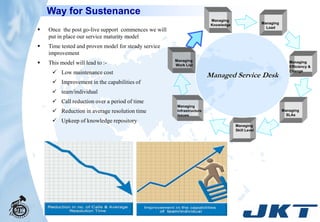
Way for Sustenance
 Once the post go-live support commences we will
put in place our service maturity model
 Time tested and proven model for steady service
improvement
 This model will lead to :-
 Low maintenance cost
 Improvement in the capabilities of
 team/individual
 Call reduction over a period of time
 Reduction in average resolution time
 Upkeep of knowledge repository
Managed Service Desk
Thank you
for your time &
interest

Jk cements case study

  • 1.
    JK Cement Ltd,India SAP Implementation
  • 2.
    A snapshot……..Indian CementIndustry  Growing demand requires capacity expansion from current level of 190 Million tons per annum  Market spread throughout country with market leadership in each region by the leaders  Government indirectly regulates price and capacity….hence control of fixed costs key to success  Increasing Power cost and shortage of power poses threat to production to meet the demands. Prices have spiraled in the past 24 months due to increase in inputs costs of fuels.  Due to large geographical spread in the country, managing transportation cost is a major key components for success
  • 3.
    About JK Cement Second largest White Cement producer in India with 0.3 millions tons per annum  Sixth Largest Grey Cement producer in India since 1975 with 7.5 million tons per annum  Sell cement and cement derivatives like wall filler  Sales of $ 425 million backed by strong brands  Well developed distribution net work…..23 offices, 60 warehouses, 4000 retailers , 1500 industrial customers  Five manufacturing plants with five captive Power plants  More than 3000 employees with excellent labour relations and a professional management  ISO Certified process framework and product ranges
  • 4.
    Current Environment Factory -NimbaheraFactory - MangrolFactory - Gotan Depots Marketing OfficeCorporate Office Systems -Varied legacy systems: Oracle Fox Pro Excel -Heavy usage of manual procedures -- Key calculations like cost are manual Organization -Not able to integrate various functions -End users do not get a holistic picture of business -Operational control is restricted -Key business activities like fund flow/cash flow management run on approximations Information/Processes -Information is not available online - Business analytics are very limited -Processes are not standard for many functions across the organization
  • 5.
    Overview of theTechnical Scope • Implementation of SAP ERP (FI, CO, PS, SD, MM, PP-PI, QM and PM) for all existing manufacturing facilities / auxiliary plants / offices / branches / depots of JK Cement Limited • PS, FI-CO and MM for erection and commissioning of green field project of new cement plant in Karnataka • HR, Payroll and ESS Implementation for all the organizational elements • Business Warehouse for strategic reporting and analysis • Enterprise portal for Management Dashboard and alerts • Solution Manager for project management, knowledge repository • ABAP development for custom objects Organizational Scope • Companies: • JK Cement Limited and other four legal entities for sales and distribution • Manufacturing Plants: • Five Cement Plants • Greenfield implementation • Jaykaycem Limited,,Karnataka Plant – • Project System Implementation for mapping of erection and commissioning of green-field project of Cement plant. • Captive Power plants - 5 • Registered Office - Kanpur • Corporate Office – Kanpur • Central Marketing Office for Gray and White - Delhi • All Regional Offices – 23 • Depots – 60 Numbers (Depots and RO – 83) About The Project  Project commencement : May 2008  Project Completion date: Feb 2009  Total Efforts : 240 man months  Team size : Regular 18; Peak 32  Custom Objects : 150  Approach : Big Bang for all modules in scope
  • 6.
    Key Business Drivers MarketFocused  Accelerate Revenue growth  Increase market share with timely availability products at market  Facilitate Order capture and order fulfillment by integrating all depots . Sales staff to have information anytime, anywhere Organization Focused  Improved financial management with timely information for management decisions  Improve operating margin with optimized procurement, production and distribution costs with focus on power, transport and delivery costs  Reduce idle inventory through efficient distribution  Enhance controls with unified process across the organization  Improve Efficiency of Asset management through improved Inventory turns, Accounts Receivable turnover and working capital optimization
  • 7.
    Key Challenges • Changemanagement transforming organizational processes in to an integrated environment • Fast growth through acquisitions and expansions to be provided for • Capturing the complex business processes which have developed over a period of time • Consignments use all modes of transport namely Road/Rail/Ship and reallocation/ rerouting become complex • Implementing best practices without losing local flavor • Enabling end users to participate in the project generally perceived as an IT project • Cement prices are market driven and volatile. Retrospective changes including Transporter Billing • Market share is highly dependent upon Price and hence, “Cost control” in Production as well as Logistics is very important
  • 8.
    Our Approach Revenue Growth Acquire New Customers Retain& Grow Existing Customers COGS SG&A Operating Margin Value Potential Inventory, Assets Receivables Asset Efficiency • Reduction in selling expenses due to better / updated information with sales team, more efficient and integrated processes • Back Office Shared Services / Centralization • 5% reduction in selling expenses • Benefits arising from Shared Services / Centralization • Reduction in Freight costs due to better delivery / schedule planning (resulting from enhanced data visibility / availability) • Improved operational processes (planning. Scheduling, production, etc.) • Freight costs reduced by 0.2% (from19.69% to 19.5%) • Increased recoverability of disputed debts due to billing process efficiency • Interest on cash collected earlier - data visibility for collections follow up • 5% reduction in disputed debts 33% of disputed debts are recovered • 10% reduction in overdue debts – (8% interest rate; 30 days additional interest earned) • Reduced inventory carrying costs due to increased turns. SAP provides updated information on current inventory levels (RM, WIP, FG) – potential for consolidation • Reduction in plant & machinery maintenance costs due to automation / availability of data regarding planned / unplanned downtime etc • Current marketing strategy is to target high value / potential customers in various territories. SAP enables this through data visibility & insights into customer behavior and buying patterns • Increase in sale of white cement due to improved sales processes. Capacity utilization would increase in this case. • 2% additional realization for 5% of the sales due to better pricing • 1% increase in sale of white cement Improvement Lever Assumption • 10% reduction in inventory turnover (in days) for white cement (from 96.9 to 87.3 days) • 1% reduction in plant & maintenance costs We follow a Value potential approach aimed to realize benefits as depicted below
  • 9.
    Project Phases &milestones May08 Feb09 • SAP’s ASAP methodology followed throughout the project
  • 10.
    Way for Sustenance Once the post go-live support commences we will put in place our service maturity model  Time tested and proven model for steady service improvement  This model will lead to :-  Low maintenance cost  Improvement in the capabilities of  team/individual  Call reduction over a period of time  Reduction in average resolution time  Upkeep of knowledge repository Managed Service Desk
  • 11.
    Thank you for yourtime & interest