NE Z T Het VCS verhaal Peter Kopeczek 09-12-10
Doelstellingen Creeren van een virtuele platform = neZt… … waar onderwijs, creatieve en bedrijven elkaar kunnen vinden… … voor het met elkaar werken aan sociale of andere levensvatbare innovaties. 09-12-10
Doelstellingen specifiek Hangar36 Samenwerking verhogen tussen diverse initiatieven van Hangar36 en creatieve HBO opleidingen Pilot-demo van een virtueel platform als tool om vast te stellen wat er nodig is om via virtualiteit de creatieve en innovatieve business te stimuleren 09-12-10
Activiteiten Een inventarisatie van behoeftes en ervaringen van Hangarparticipanten.  Een inventarisatie van behoeftes en ervaringen van studenten van creatieve opleidingen in Den Haag. Maken van een Pilot-demo: eerst inventariseren en het verwerken van de inventarisatie. Wat is er al op virtueel gebied. Daarnaast ook de kenmerken inventariseren. Het presenteren van de bevindingen van 1 en 2 aan de opleiders en stagebegeleiders en andere potentieel belanghebbenden, zoals bv de gemeente. Dit doen we door een (creatief en onderscheidend) Seminar te organiseren (er is een mooie ruimte in de Hangar).Dit seminar heeft tot doel: concrete kenmerken te inventariseren waaraan een eerste demo moet voldoen.  Aanbevelingen en conclusie. 09-12-10
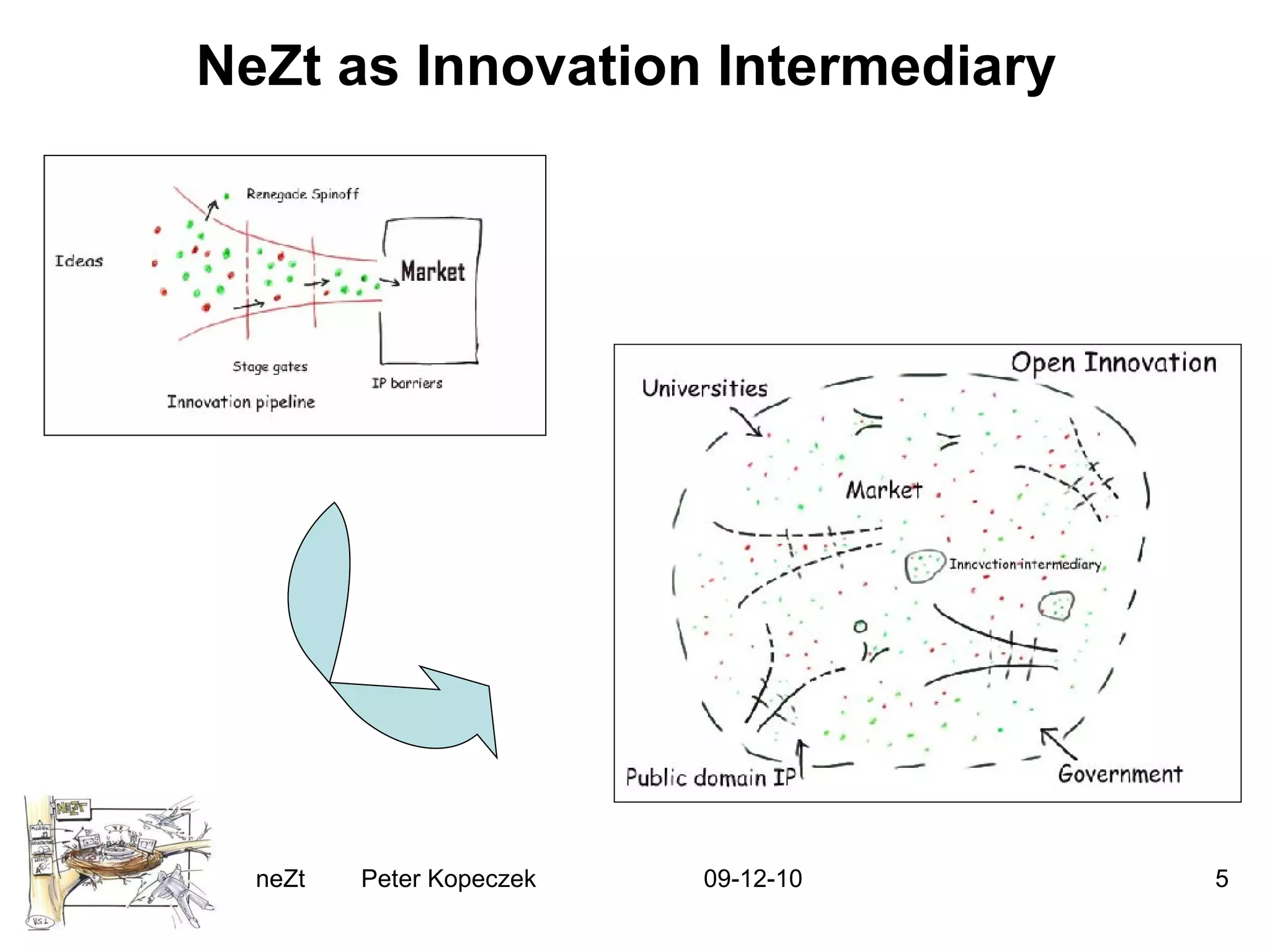
NeZt as Innovation Intermediary 09-12-10 neZt  Peter Kopeczek
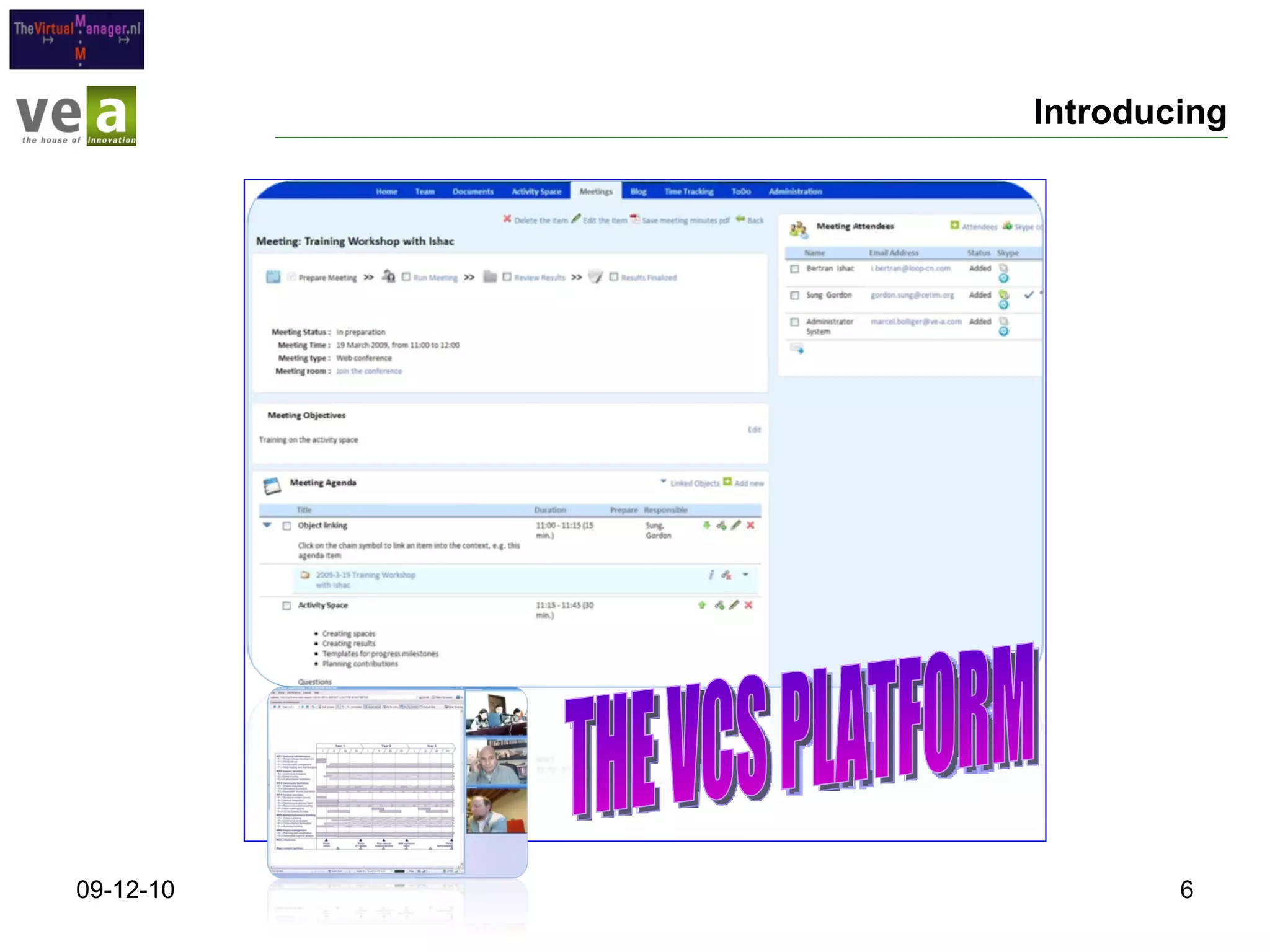
Introducing 09-12-10 THE VCS PLATFORM
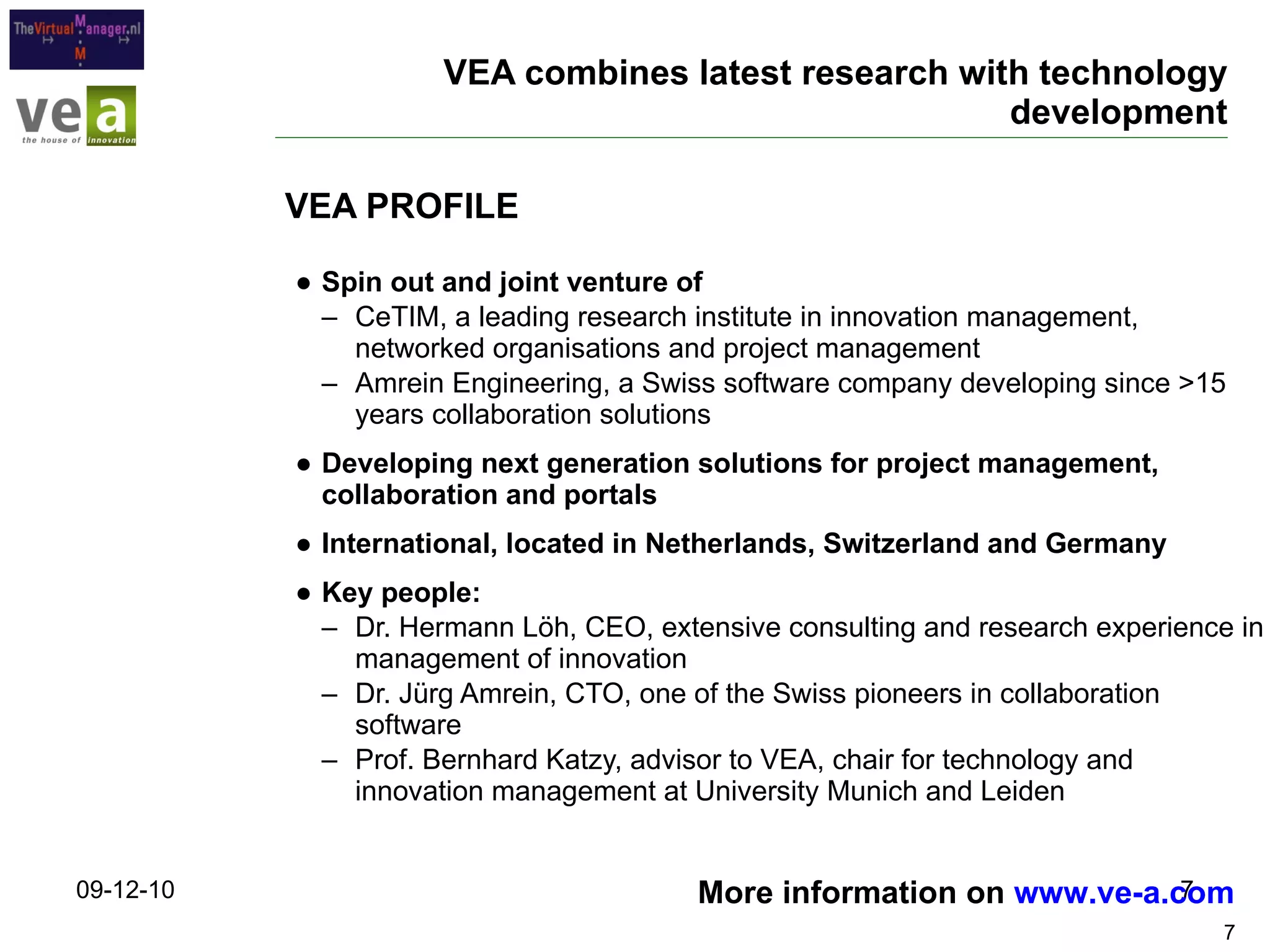
VEA combines latest research with technology development Spin out and joint venture of  CeTIM, a leading research institute in innovation management, networked organisations and project management Amrein Engineering, a Swiss software company developing since >15 years collaboration solutions Developing next generation solutions for project management, collaboration and portals International, located in Netherlands, Switzerland and Germany Key people: Dr. Hermann Löh, CEO, extensive consulting and research experience in management of innovation Dr. Jürg Amrein, CTO, one of the Swiss pioneers in collaboration software Prof. Bernhard Katzy, advisor to VEA, chair for technology and innovation management at University Munich and Leiden VEA PROFILE 09-12-10 More information on  www.ve-a.com
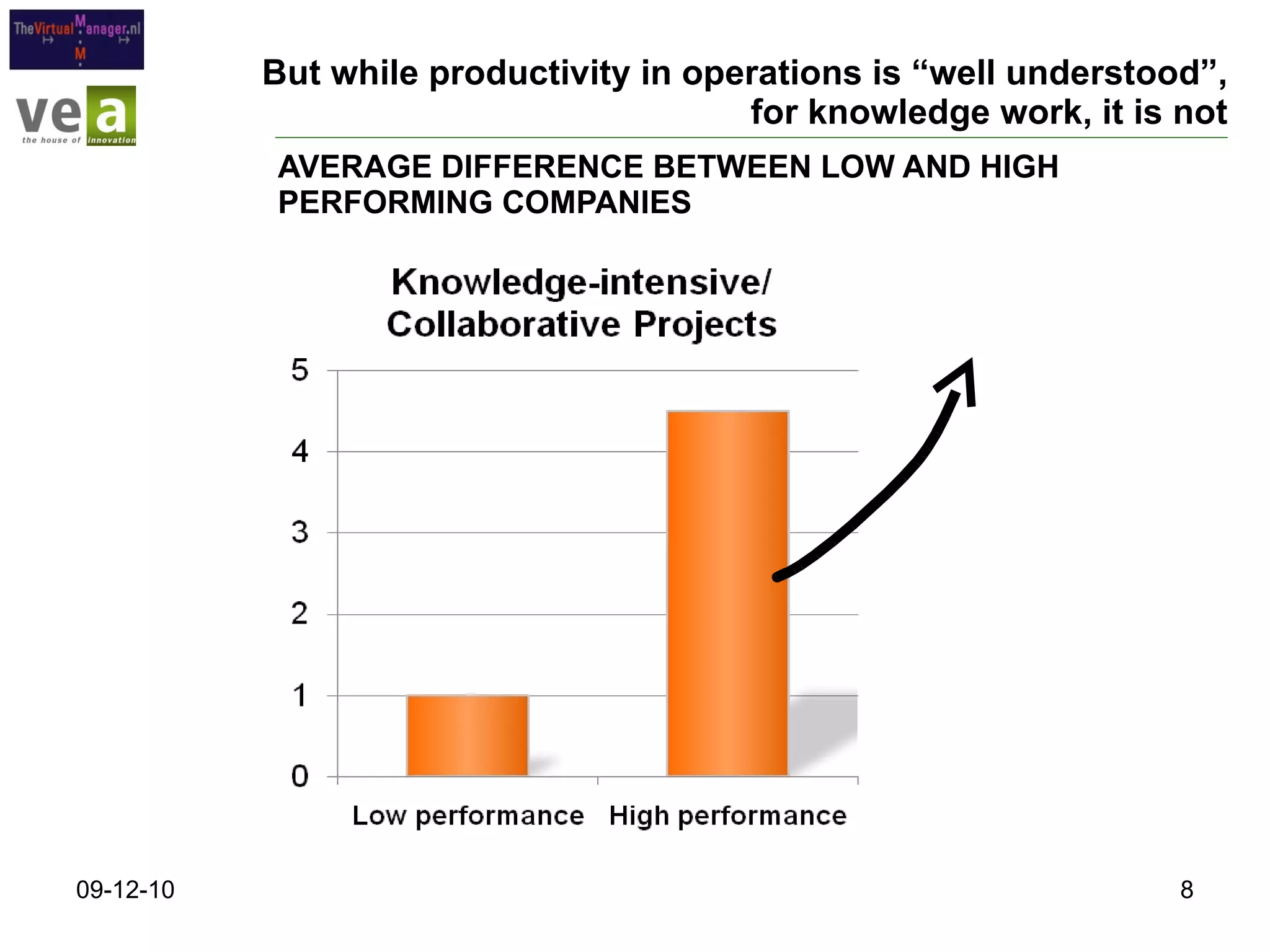
But while productivity in operations is “well understood”, for knowledge work, it is not AVERAGE DIFFERENCE BETWEEN LOW AND HIGH PERFORMING COMPANIES  09-12-10
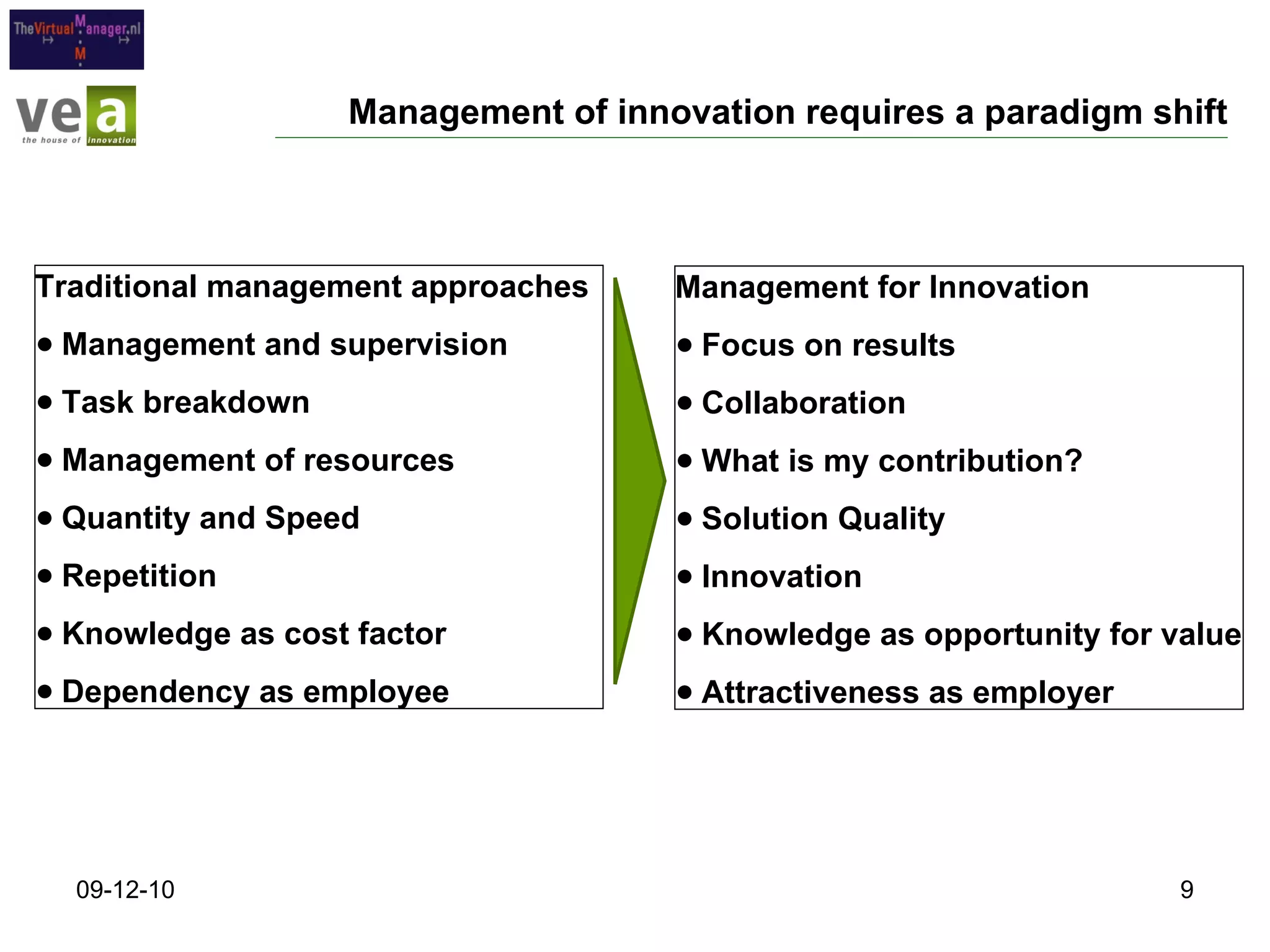
Management of innovation requires a paradigm shift 09-12-10 Management for Innovation Focus on results Collaboration What is my contribution? Solution Quality Innovation Knowledge as opportunity for value Attractiveness as employer Traditional management approaches Management and supervision Task breakdown Management of resources Quantity and Speed Repetition Knowledge as cost factor Dependency as employee
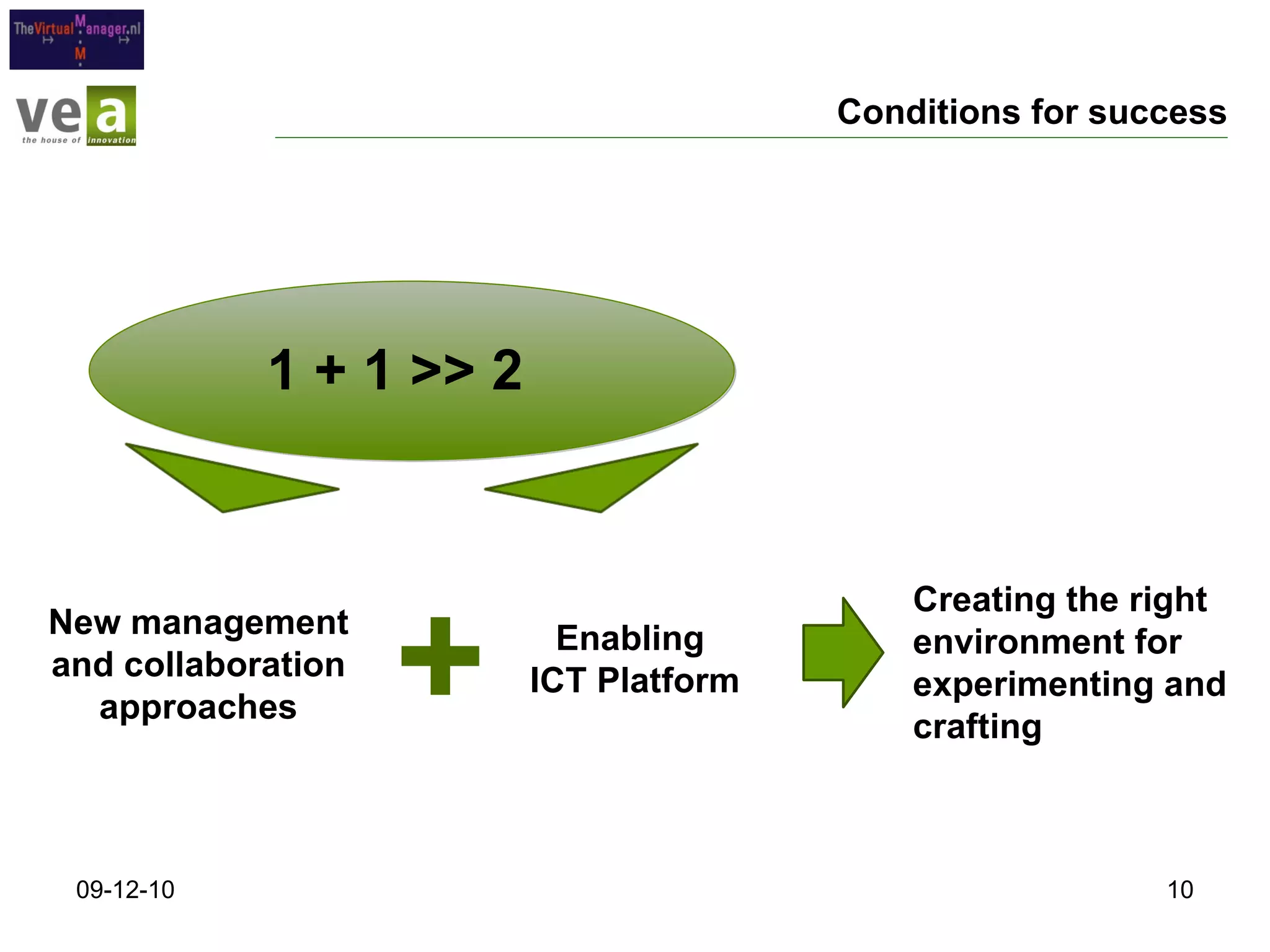
Conditions for success 1 + 1 >> 2  09-12-10 New management and collaboration approaches Creating the right environment for experimenting and crafting Enabling  ICT Platform +
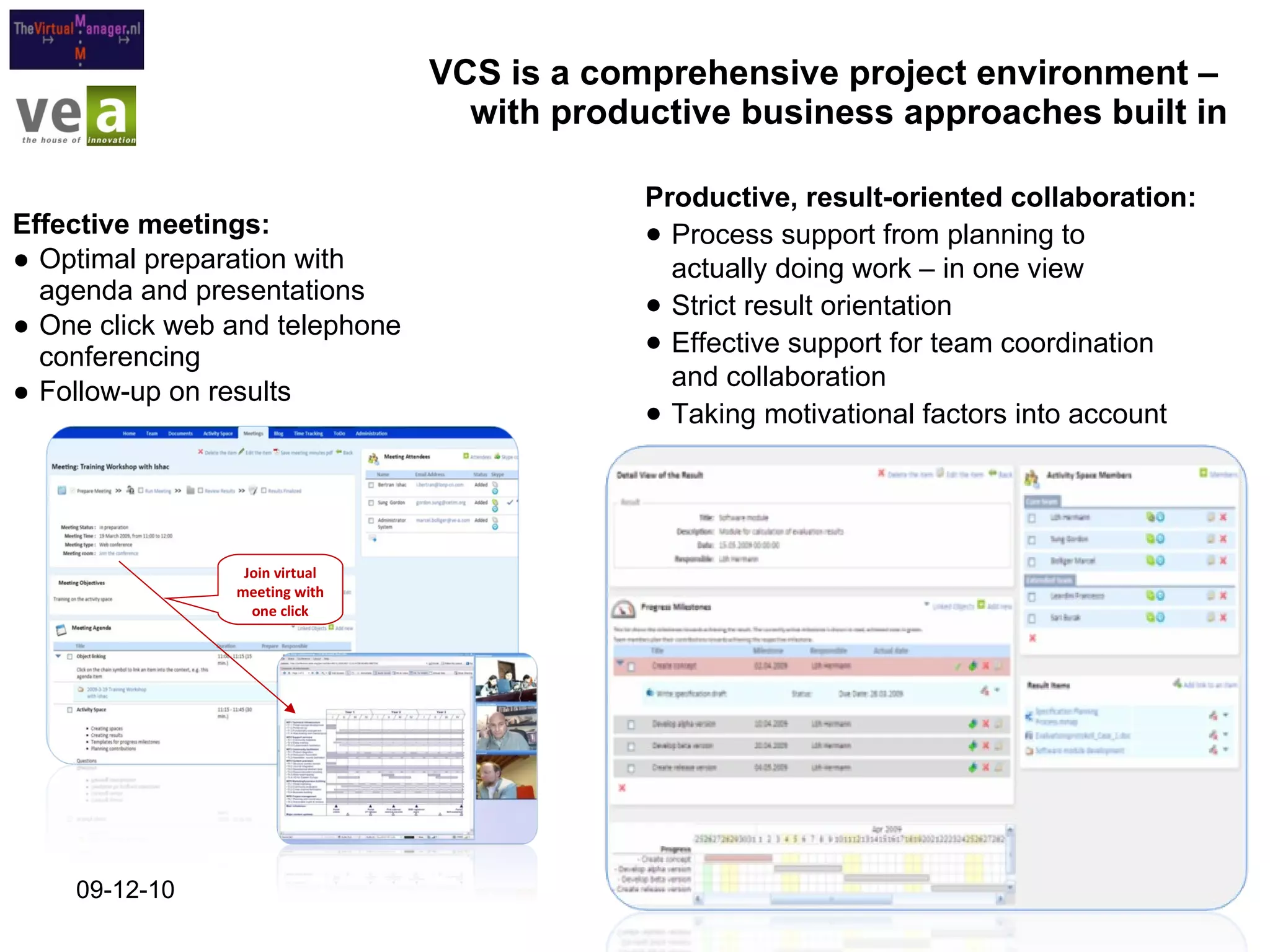
VCS is a comprehensive project environment –  with productive business approaches built in Effective meetings: Optimal preparation with agenda and presentations One click web and telephone conferencing Follow-up on results 09-12-10 Join virtual meeting with one click Productive, result-oriented collaboration: Process support from planning to  actually doing work – in one view Strict result orientation Effective support for team coordination  and collaboration Taking motivational factors into account
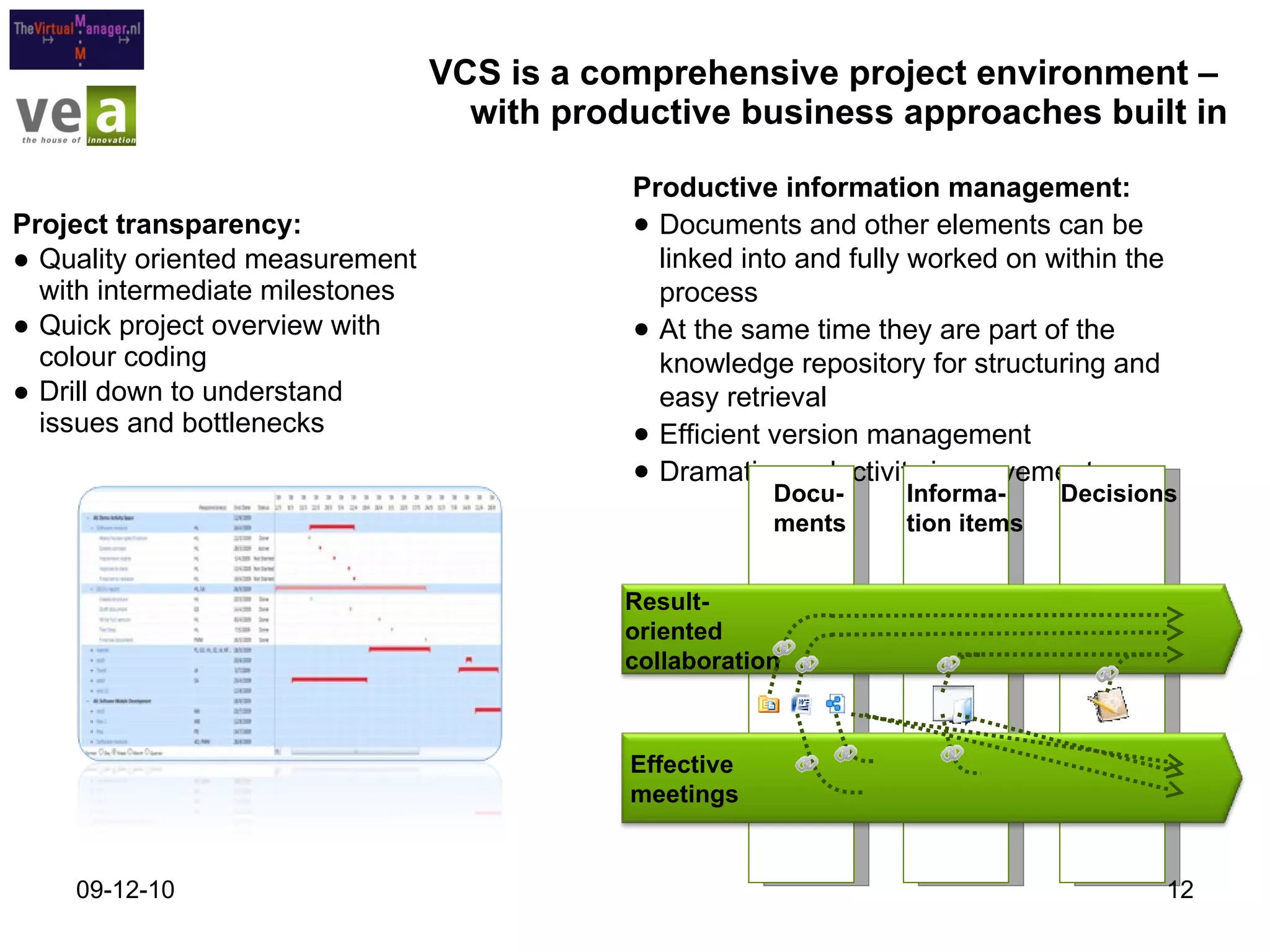
VCS is a comprehensive project environment –  with productive business approaches built in Project transparency: Quality oriented measurement with intermediate milestones Quick project overview with colour coding  Drill down to understand issues and bottlenecks 09-12-10 Productive information management: Documents and other elements can be linked into and fully worked on within the process At the same time they are part of the knowledge repository for structuring and easy retrieval Efficient version management Dramatic productivity improvement Docu- ments Informa- tion items Decisions Result- oriented  collaboration Effective  meetings
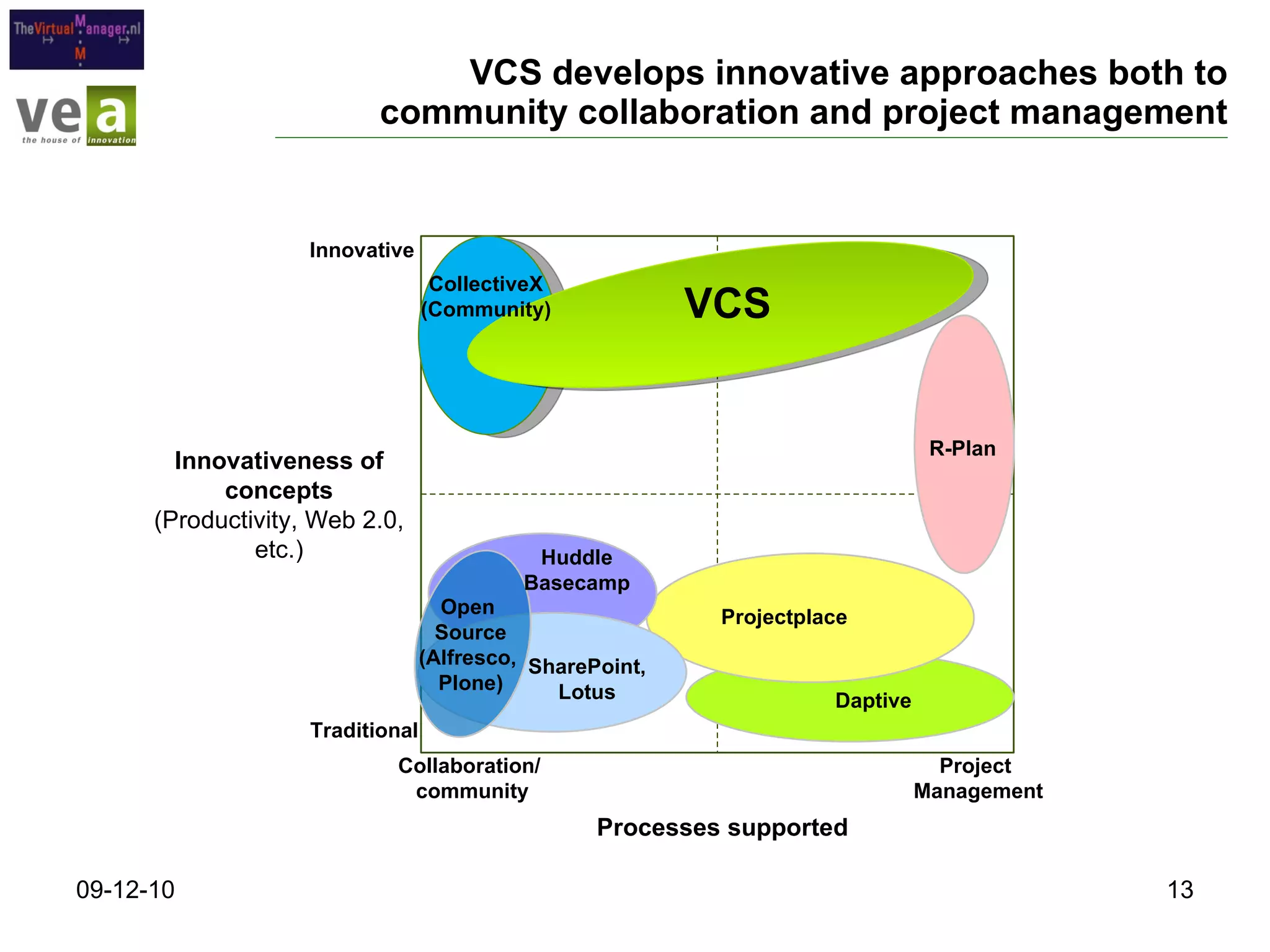
VCS develops innovative approaches both to community collaboration and project management 09-12-10 Processes supported Innovativeness of concepts (Productivity, Web 2.0, etc.) Collaboration/  community Project  Management Traditional Innovative CollectiveX (Community) VCS Daptive Projectplace R-Plan SharePoint, Lotus Open  Source (Alfresco,  Plone) Huddle Basecamp
Especially for Hangar 36 09-12-10
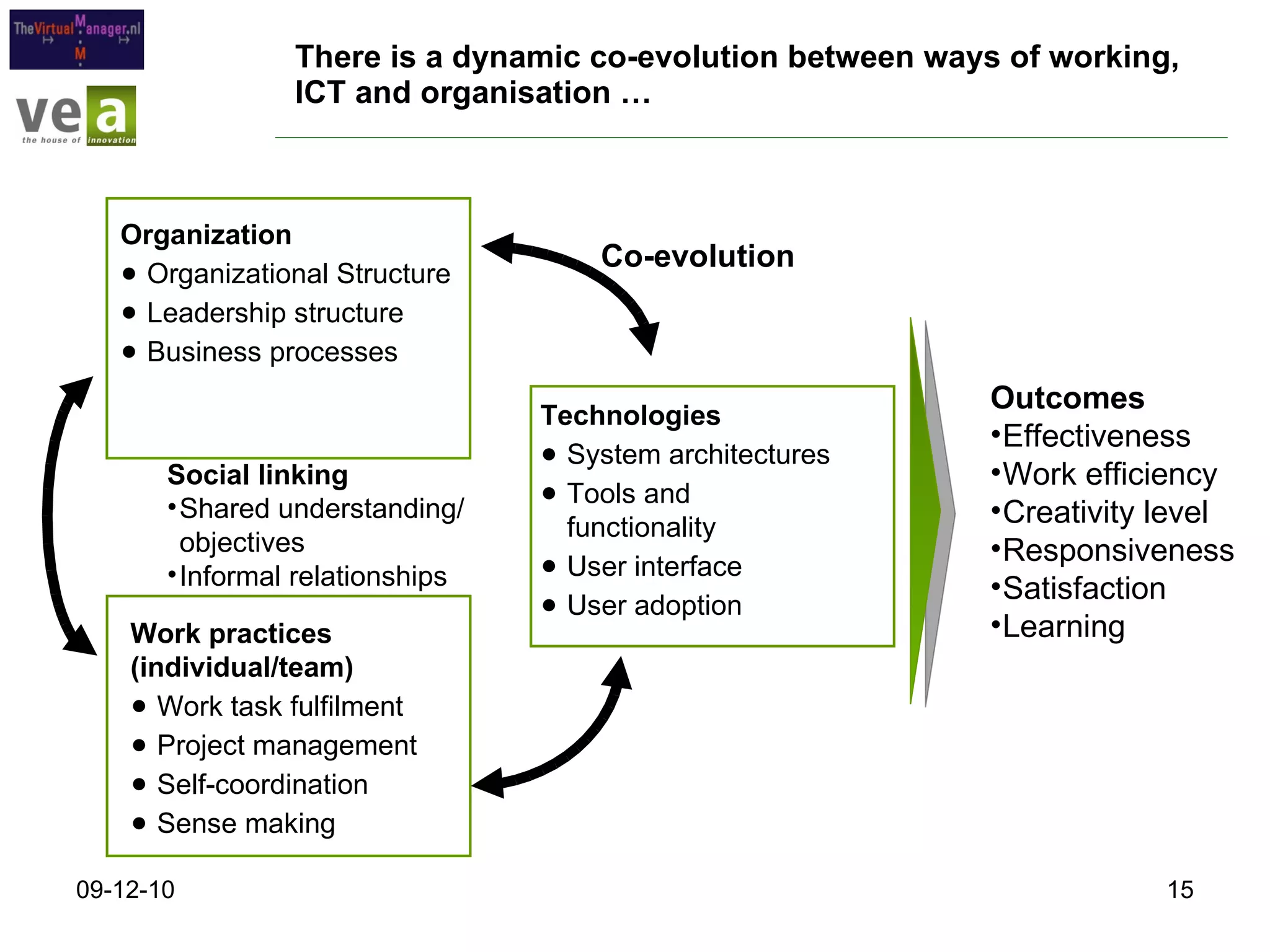
There is a dynamic co-evolution between ways of working, ICT and organisation …  09-12-10 Work practices (individual/team) Work task fulfilment Project management Self-coordination Sense making Organization Organizational Structure Leadership structure Business processes Technologies System architectures Tools and  functionality User interface User adoption Social linking Shared understanding/  objectives Informal relationships Co-evolution Outcomes Effectiveness Work efficiency Creativity level Responsiveness Satisfaction Learning
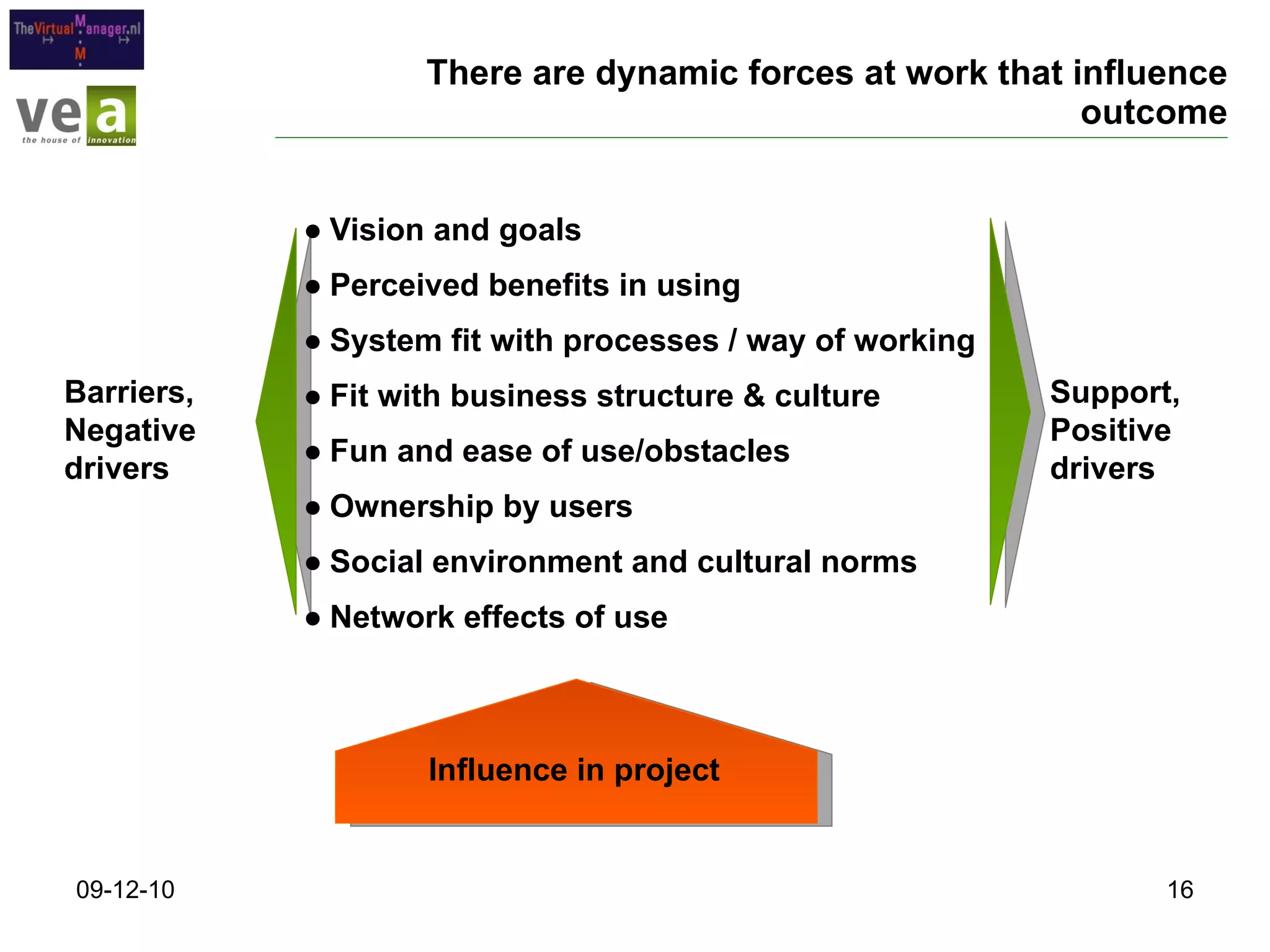
There are dynamic forces at work that influence outcome Vision and goals Perceived benefits in using System fit with processes / way of working Fit with business structure & culture Fun and ease of use/obstacles Ownership by users Social environment and cultural norms Network effects of use 09-12-10 Support, Positive  drivers Barriers, Negative  drivers Influence in project
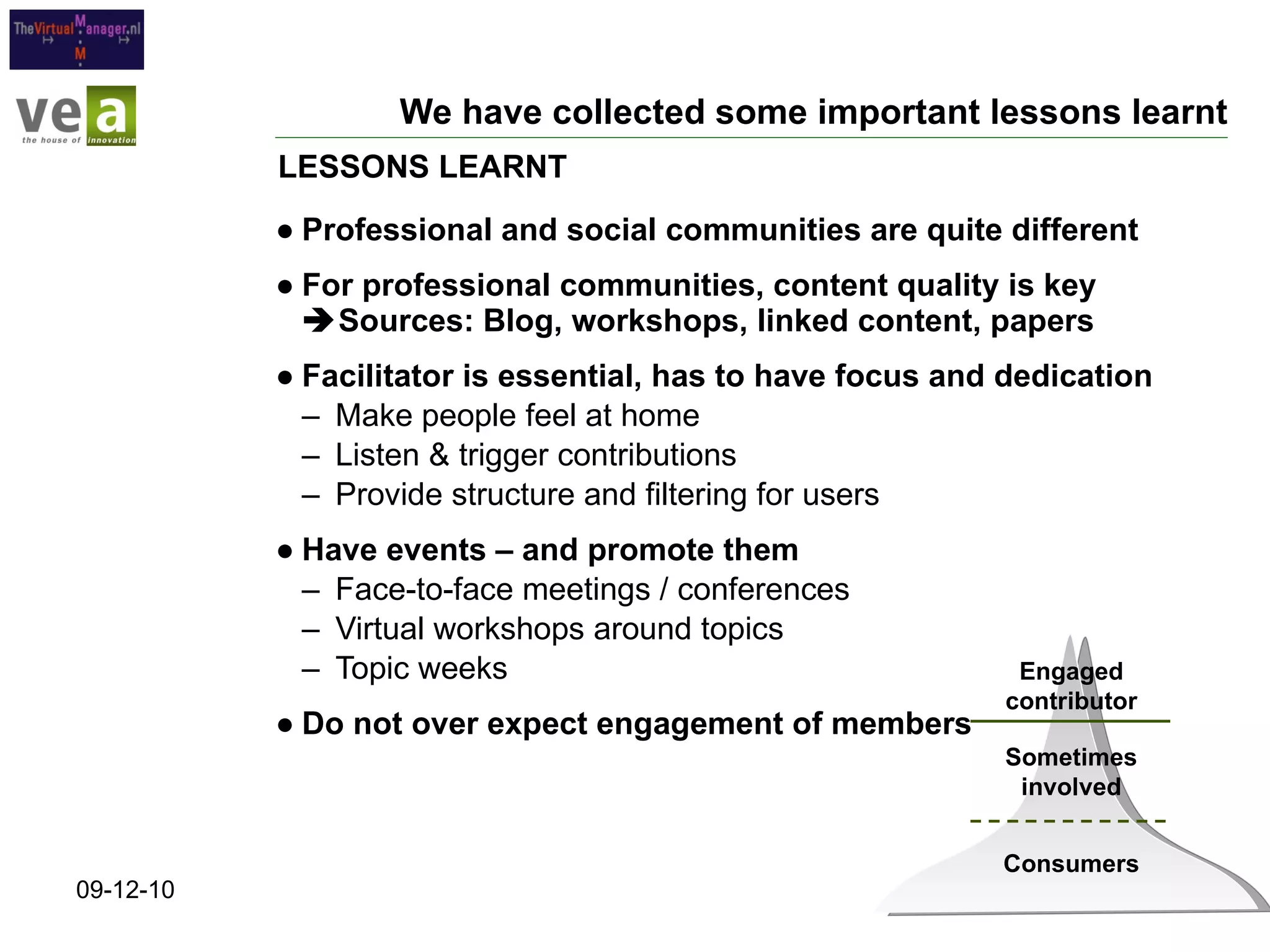
We have collected some important lessons learnt Professional and social communities are quite different For professional communities, content quality is key   Sources: Blog, workshops, linked content, papers Facilitator is essential, has to have focus and dedication Make people feel at home Listen & trigger contributions Provide structure and filtering for users Have events – and promote them Face-to-face meetings / conferences Virtual workshops around topics Topic weeks Do not over expect engagement of members LESSONS LEARNT 09-12-10 Engaged contributor Sometimes involved Consumers
Before starting there should be some questions answered to achieve success What is the value proposition for the participants? What is the value proposition for the facilitator(s)? Where does the content come from? What are ways of engaging and contributing more content? Who facilitates – are there enough resources, skill and dedication for this? What is the business model – who pays for what – and why? KEY QUESTIONS FOR CREATING A PROFESSIONAL COMMUNITY 09-12-10
The productivity differences are largely due to different coordination models 09-12-10 DIFFERENTIATION IN COORDINATION MODELS [Source: Lühring, 2006; Löh and Katzy, 2008; Sari et al., 2007] Backup Formal project management Ad-hoc coordination Heedful interrelating Scope definition  Management sets exact scope before project approval; Changes only with formal approval process  Nobody defines scope clearly, can change quickly on request  Team defines and negotiates scope jointly. Changes on member request with joint approval  Team selection  Management/PM on long-term resource planning  Short-term resource availability  Competence and commitment of people  Task planning & assignment  Formal WBS and detailed task planning by PM, scheduling ac-cording to resource availability  Short-term task identification and assignment according to availability – usually by PM  Identification of required results and negotiation/sign-up of people to deliver  Progress tracking  Reporting task progress or completion  Typically PM keeps track of central Todo-List  Updating maturity status of results  Problem solving  Risk management and detailed planning tries to identify problems early, solving through hierarchical decision making Problem solving discussions as they arise  Visibility and concern by everybody identifies problems, which are solved by those affected  Result/ knowledge integration  Through planning clear task break down and specifications with minimal interfaces  Largely through project manager Shared responsibility and collaboration for results, e.g. iterating drafts between team
The productivity differences are largely due to different coordination models 09-12-10 DIFFERENTIATION IN COORDINATION MODELS Backup [Source: Lühring, 2006; Löh and Katzy, 2008; Sari et al., 2007] Formal project management Ad-hoc coordination Heedful interrelating Scope definition  Management sets exact scope before project approval; Changes only with formal approval process  Nobody defines scope clearly, can change quickly on request  Team defines and negotiates scope jointly. Changes on member request with joint approval  Team selection  Management/PM on long-term resource planning  Short-term resource availability  Competence and commitment of people  Task planning & assignment  Formal WBS and detailed task planning by PM, scheduling ac-cording to resource availability  Short-term task identification and assignment according to availability – usually by PM  Identification of required results and negotiation/sign-up of people to deliver  Progress tracking  Reporting task progress or completion  Typically PM keeps track of central Todo-List  Updating maturity status of results  Problem solving  Risk management and detailed planning tries to identify problems early, solving through hierarchical decision making Problem solving discussions as they arise  Visibility and concern by everybody identifies problems, which are solved by those affected  Result/ knowledge integration  Through planning clear task break down and specifications with minimal interfaces  Largely through project manager Shared responsibility and collaboration for results, e.g. iterating drafts between team Guiding principles: Reducing uncertainty by detailed planning and control Formal project manager, supported by plans and procedures Team members are resources to be used efficiently Break-down of responsi-bility to individuals, however little integration Guiding principles: Flexible reaction to external/internal changes Little planning, short-term assignment of tasks Little formal documen-tation (outdating quickly) Project manager keeps track and communicates Team members have limited visibility and thus little chance to support integration Guiding principles: Enabling team members to make contributions to goals according to own competences Joint planning and commitments towards achievements High visibility of status and contributions Lateral communication and problem solving Fast, high quality, lowest effort, fosters  innovation Flexible, but error prone, high stress levels Efficient in short  term, but often rework, low innovation

Vcs platform verhaal final

  • 1.
    NE Z THet VCS verhaal Peter Kopeczek 09-12-10
  • 2.
    Doelstellingen Creeren vaneen virtuele platform = neZt… … waar onderwijs, creatieve en bedrijven elkaar kunnen vinden… … voor het met elkaar werken aan sociale of andere levensvatbare innovaties. 09-12-10
  • 3.
    Doelstellingen specifiek Hangar36Samenwerking verhogen tussen diverse initiatieven van Hangar36 en creatieve HBO opleidingen Pilot-demo van een virtueel platform als tool om vast te stellen wat er nodig is om via virtualiteit de creatieve en innovatieve business te stimuleren 09-12-10
  • 4.
    Activiteiten Een inventarisatievan behoeftes en ervaringen van Hangarparticipanten. Een inventarisatie van behoeftes en ervaringen van studenten van creatieve opleidingen in Den Haag. Maken van een Pilot-demo: eerst inventariseren en het verwerken van de inventarisatie. Wat is er al op virtueel gebied. Daarnaast ook de kenmerken inventariseren. Het presenteren van de bevindingen van 1 en 2 aan de opleiders en stagebegeleiders en andere potentieel belanghebbenden, zoals bv de gemeente. Dit doen we door een (creatief en onderscheidend) Seminar te organiseren (er is een mooie ruimte in de Hangar).Dit seminar heeft tot doel: concrete kenmerken te inventariseren waaraan een eerste demo moet voldoen. Aanbevelingen en conclusie. 09-12-10
  • 5.
    NeZt as InnovationIntermediary 09-12-10 neZt Peter Kopeczek
  • 6.
  • 7.
    VEA combines latestresearch with technology development Spin out and joint venture of CeTIM, a leading research institute in innovation management, networked organisations and project management Amrein Engineering, a Swiss software company developing since >15 years collaboration solutions Developing next generation solutions for project management, collaboration and portals International, located in Netherlands, Switzerland and Germany Key people: Dr. Hermann Löh, CEO, extensive consulting and research experience in management of innovation Dr. Jürg Amrein, CTO, one of the Swiss pioneers in collaboration software Prof. Bernhard Katzy, advisor to VEA, chair for technology and innovation management at University Munich and Leiden VEA PROFILE 09-12-10 More information on www.ve-a.com
  • 8.
    But while productivityin operations is “well understood”, for knowledge work, it is not AVERAGE DIFFERENCE BETWEEN LOW AND HIGH PERFORMING COMPANIES 09-12-10
  • 9.
    Management of innovationrequires a paradigm shift 09-12-10 Management for Innovation Focus on results Collaboration What is my contribution? Solution Quality Innovation Knowledge as opportunity for value Attractiveness as employer Traditional management approaches Management and supervision Task breakdown Management of resources Quantity and Speed Repetition Knowledge as cost factor Dependency as employee
  • 10.
    Conditions for success1 + 1 >> 2 09-12-10 New management and collaboration approaches Creating the right environment for experimenting and crafting Enabling ICT Platform +
  • 11.
    VCS is acomprehensive project environment – with productive business approaches built in Effective meetings: Optimal preparation with agenda and presentations One click web and telephone conferencing Follow-up on results 09-12-10 Join virtual meeting with one click Productive, result-oriented collaboration: Process support from planning to actually doing work – in one view Strict result orientation Effective support for team coordination and collaboration Taking motivational factors into account
  • 12.
    VCS is acomprehensive project environment – with productive business approaches built in Project transparency: Quality oriented measurement with intermediate milestones Quick project overview with colour coding Drill down to understand issues and bottlenecks 09-12-10 Productive information management: Documents and other elements can be linked into and fully worked on within the process At the same time they are part of the knowledge repository for structuring and easy retrieval Efficient version management Dramatic productivity improvement Docu- ments Informa- tion items Decisions Result- oriented collaboration Effective meetings
  • 13.
    VCS develops innovativeapproaches both to community collaboration and project management 09-12-10 Processes supported Innovativeness of concepts (Productivity, Web 2.0, etc.) Collaboration/ community Project Management Traditional Innovative CollectiveX (Community) VCS Daptive Projectplace R-Plan SharePoint, Lotus Open Source (Alfresco, Plone) Huddle Basecamp
  • 14.
  • 15.
    There is adynamic co-evolution between ways of working, ICT and organisation … 09-12-10 Work practices (individual/team) Work task fulfilment Project management Self-coordination Sense making Organization Organizational Structure Leadership structure Business processes Technologies System architectures Tools and functionality User interface User adoption Social linking Shared understanding/ objectives Informal relationships Co-evolution Outcomes Effectiveness Work efficiency Creativity level Responsiveness Satisfaction Learning
  • 16.
    There are dynamicforces at work that influence outcome Vision and goals Perceived benefits in using System fit with processes / way of working Fit with business structure & culture Fun and ease of use/obstacles Ownership by users Social environment and cultural norms Network effects of use 09-12-10 Support, Positive drivers Barriers, Negative drivers Influence in project
  • 17.
    We have collectedsome important lessons learnt Professional and social communities are quite different For professional communities, content quality is key  Sources: Blog, workshops, linked content, papers Facilitator is essential, has to have focus and dedication Make people feel at home Listen & trigger contributions Provide structure and filtering for users Have events – and promote them Face-to-face meetings / conferences Virtual workshops around topics Topic weeks Do not over expect engagement of members LESSONS LEARNT 09-12-10 Engaged contributor Sometimes involved Consumers
  • 18.
    Before starting thereshould be some questions answered to achieve success What is the value proposition for the participants? What is the value proposition for the facilitator(s)? Where does the content come from? What are ways of engaging and contributing more content? Who facilitates – are there enough resources, skill and dedication for this? What is the business model – who pays for what – and why? KEY QUESTIONS FOR CREATING A PROFESSIONAL COMMUNITY 09-12-10
  • 19.
    The productivity differencesare largely due to different coordination models 09-12-10 DIFFERENTIATION IN COORDINATION MODELS [Source: Lühring, 2006; Löh and Katzy, 2008; Sari et al., 2007] Backup Formal project management Ad-hoc coordination Heedful interrelating Scope definition Management sets exact scope before project approval; Changes only with formal approval process Nobody defines scope clearly, can change quickly on request Team defines and negotiates scope jointly. Changes on member request with joint approval Team selection Management/PM on long-term resource planning Short-term resource availability Competence and commitment of people Task planning & assignment Formal WBS and detailed task planning by PM, scheduling ac-cording to resource availability Short-term task identification and assignment according to availability – usually by PM Identification of required results and negotiation/sign-up of people to deliver Progress tracking Reporting task progress or completion Typically PM keeps track of central Todo-List Updating maturity status of results Problem solving Risk management and detailed planning tries to identify problems early, solving through hierarchical decision making Problem solving discussions as they arise Visibility and concern by everybody identifies problems, which are solved by those affected Result/ knowledge integration Through planning clear task break down and specifications with minimal interfaces Largely through project manager Shared responsibility and collaboration for results, e.g. iterating drafts between team
  • 20.
    The productivity differencesare largely due to different coordination models 09-12-10 DIFFERENTIATION IN COORDINATION MODELS Backup [Source: Lühring, 2006; Löh and Katzy, 2008; Sari et al., 2007] Formal project management Ad-hoc coordination Heedful interrelating Scope definition Management sets exact scope before project approval; Changes only with formal approval process Nobody defines scope clearly, can change quickly on request Team defines and negotiates scope jointly. Changes on member request with joint approval Team selection Management/PM on long-term resource planning Short-term resource availability Competence and commitment of people Task planning & assignment Formal WBS and detailed task planning by PM, scheduling ac-cording to resource availability Short-term task identification and assignment according to availability – usually by PM Identification of required results and negotiation/sign-up of people to deliver Progress tracking Reporting task progress or completion Typically PM keeps track of central Todo-List Updating maturity status of results Problem solving Risk management and detailed planning tries to identify problems early, solving through hierarchical decision making Problem solving discussions as they arise Visibility and concern by everybody identifies problems, which are solved by those affected Result/ knowledge integration Through planning clear task break down and specifications with minimal interfaces Largely through project manager Shared responsibility and collaboration for results, e.g. iterating drafts between team Guiding principles: Reducing uncertainty by detailed planning and control Formal project manager, supported by plans and procedures Team members are resources to be used efficiently Break-down of responsi-bility to individuals, however little integration Guiding principles: Flexible reaction to external/internal changes Little planning, short-term assignment of tasks Little formal documen-tation (outdating quickly) Project manager keeps track and communicates Team members have limited visibility and thus little chance to support integration Guiding principles: Enabling team members to make contributions to goals according to own competences Joint planning and commitments towards achievements High visibility of status and contributions Lateral communication and problem solving Fast, high quality, lowest effort, fosters innovation Flexible, but error prone, high stress levels Efficient in short term, but often rework, low innovation

Editor's Notes