
Knowledge Capture Initiative Snapshot  KMRM Consulting, LLC
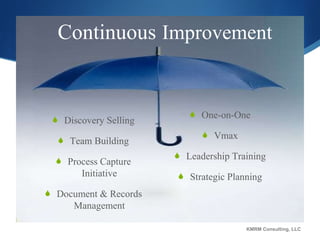
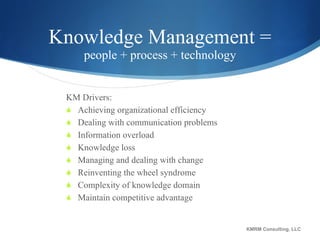
Discovery Selling Team Building Process Capture Initiative Document & Records Management KMRM Consulting, LLC Continuous   Improvement One-on-One Vmax Leadership Training Strategic Planning Discovery Selling Team Building Process Capture Initiative Document & Records Management
Process Capture Initiative Identify existing documented policies and processes to get a snapshot of where the Company is now The “snapshot” is an intrinsic piece of Continuous Improvement. How can you enter into a path of improvements unless you know where you are and what needs to be improved? KMRM Consulting, LLC
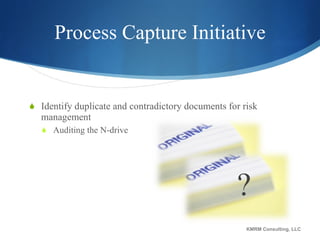
Process Capture Initiative Identify duplicate and contradictory documents for risk management Auditing the N-drive KMRM Consulting, LLC ?
Process Capture Initiative Identify processes and documentation of processes that need to be updated, revised or deleted Emergency Action Plan Quality Control Manual Quality Assurance Manual Process Flow Chart KMRM Consulting, LLC
Process Capture Initiative Heighten awareness of job processes and responsibilities for the purpose of better job accountability toward each other Who does what… when and how Kickoff Meeting Agenda and project information Process Flow Diagram project KMRM Consulting, LLC
Process Capture Initiative Format existing and newly generated policies and processes into templates for standardization Use KMRM templates Consistent information  Identical layout People know where/how to find what they need KMRM Consulting, LLC
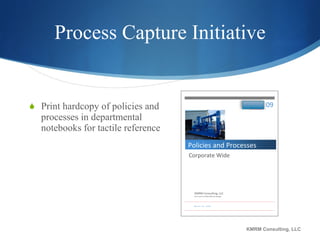
Process Capture Initiative Print hardcopy of policies and processes in departmental notebooks for tactile reference KMRM Consulting, LLC
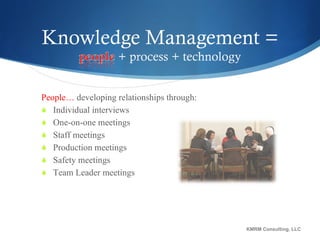
Process Capture Initiative Establish an electronic deliverable (Wiki) to provide universal access Findability Usability Searchability Intellectual Asset KMRM Consulting, LLC
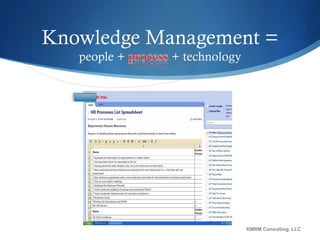
Knowledge Management = people + process + technology KM Drivers: Achieving organizational efficiency  Dealing with communication problems  Information overload  Knowledge loss  Managing and dealing with change  Reinventing the wheel syndrome Complexity of knowledge domain Maintain competitive advantage  KMRM Consulting, LLC
People…  developing relationships through: Individual interviews One-on-one meetings Staff meetings Production meetings Safety meetings Team Leader meetings KMRM Consulting, LLC
Process…  the five phases of process management: The Reactive Phase:  realizing the need for process improvement Documentation Phase:  collecting data Stability Phase:  make unstable processes stable, then stable into better Corrective Action Phase:  tweaking the process design in a cycle of continuous improvement Preventive Action Phase:  preventing defects and errors before they occur KMRM Consulting, LLC
KMRM Consulting, LLC
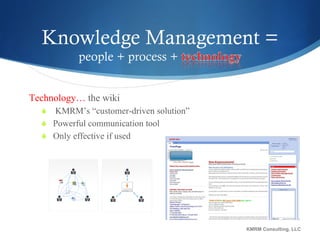
Technology…  the wiki KMRM’s “customer-driven solution” Powerful communication tool Only effective if used KMRM Consulting, LLC
Q & A Short Break Return Hand out and go over notebooks KMRM Consulting, LLC
Department Notebooks KMRM Consulting, LLC
Contents Letter from KMRM Department abbreviations for Wiki and N-drive Wiki style sheet Using links Definitions of Terms used Blank copies of both Policy & Process Templates CW Process for Writing Policies and Processes KMRM Consulting, LLC
Department Specific Printed copy of individual process pages found on the wiki The ones for which your department is responsible Edited for standardization Supporting documents and forms are not in your binder;  these reside in the uploaded documents and files folder KMRM Consulting, LLC
Appendix Guide to writing policies and processes Why document policies and processes? Policies and processes diagram KMRM Consulting, LLC
Wiki Reminders KMRM Consulting, LLC
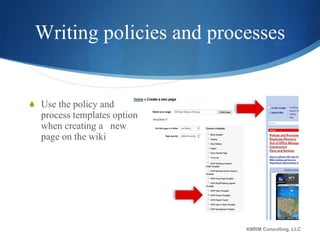
Writing policies and processes Use the policy and process templates option when creating a  new page on the wiki KMRM Consulting, LLC
Writing policies and processes When selecting a name for  your policy or process page, begin with your department abbreviation; for syspro processes, type “SYS” immediately following your department abbreviation Example:  “ACT SYS Supplier Query” KMRM Consulting, LLC
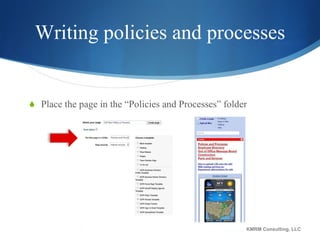
Writing policies and processes Place the page in the “Policies and Processes” folder KMRM Consulting, LLC
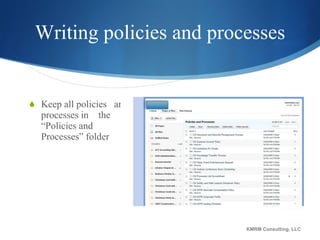
Writing policies and processes Keep all policies  and processes in  the “Policies and Processes” folder KMRM Consulting, LLC
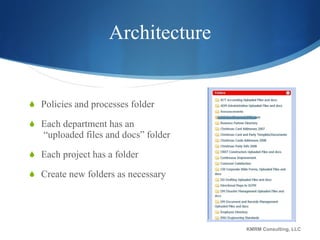
Architecture Policies and processes folder Each department has an  “uploaded files and docs” folder Each project has a folder Create new folders as necessary KMRM Consulting, LLC
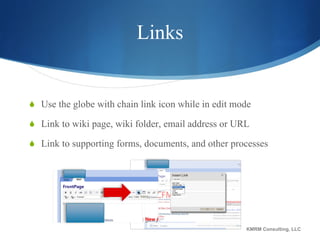
Links Use the globe with chain link icon while in edit mode Link to wiki page, wiki folder, email address or URL Link to supporting forms, documents, and other processes KMRM Consulting, LLC
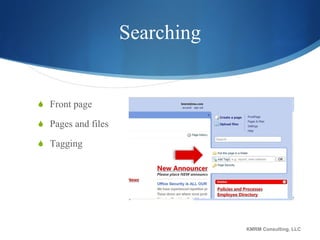
Searching Front page Pages and files Tagging KMRM Consulting, LLC
Working Collaboratively Create a page; fill in the process information Have users read and edit the page Use the comments box for discussion Change from “work in progress” to “original” when finalized KMRM Consulting, LLC
Appreciation Luncheon KMRM Consulting, LLC
KMRM.com KMRM Consulting, LLC

Knowledge Capture Initiative Summary Report

  • 1.
    Knowledge Capture InitiativeSnapshot KMRM Consulting, LLC
  • 2.
    Discovery Selling TeamBuilding Process Capture Initiative Document & Records Management KMRM Consulting, LLC Continuous Improvement One-on-One Vmax Leadership Training Strategic Planning Discovery Selling Team Building Process Capture Initiative Document & Records Management
  • 3.
    Process Capture InitiativeIdentify existing documented policies and processes to get a snapshot of where the Company is now The “snapshot” is an intrinsic piece of Continuous Improvement. How can you enter into a path of improvements unless you know where you are and what needs to be improved? KMRM Consulting, LLC
  • 4.
    Process Capture InitiativeIdentify duplicate and contradictory documents for risk management Auditing the N-drive KMRM Consulting, LLC ?
  • 5.
    Process Capture InitiativeIdentify processes and documentation of processes that need to be updated, revised or deleted Emergency Action Plan Quality Control Manual Quality Assurance Manual Process Flow Chart KMRM Consulting, LLC
  • 6.
    Process Capture InitiativeHeighten awareness of job processes and responsibilities for the purpose of better job accountability toward each other Who does what… when and how Kickoff Meeting Agenda and project information Process Flow Diagram project KMRM Consulting, LLC
  • 7.
    Process Capture InitiativeFormat existing and newly generated policies and processes into templates for standardization Use KMRM templates Consistent information Identical layout People know where/how to find what they need KMRM Consulting, LLC
  • 8.
    Process Capture InitiativePrint hardcopy of policies and processes in departmental notebooks for tactile reference KMRM Consulting, LLC
  • 9.
    Process Capture InitiativeEstablish an electronic deliverable (Wiki) to provide universal access Findability Usability Searchability Intellectual Asset KMRM Consulting, LLC
  • 10.
    Knowledge Management =people + process + technology KM Drivers: Achieving organizational efficiency Dealing with communication problems Information overload Knowledge loss Managing and dealing with change Reinventing the wheel syndrome Complexity of knowledge domain Maintain competitive advantage KMRM Consulting, LLC
  • 11.
    People… developingrelationships through: Individual interviews One-on-one meetings Staff meetings Production meetings Safety meetings Team Leader meetings KMRM Consulting, LLC
  • 12.
    Process… thefive phases of process management: The Reactive Phase: realizing the need for process improvement Documentation Phase: collecting data Stability Phase: make unstable processes stable, then stable into better Corrective Action Phase: tweaking the process design in a cycle of continuous improvement Preventive Action Phase: preventing defects and errors before they occur KMRM Consulting, LLC
  • 13.
  • 14.
    Technology… thewiki KMRM’s “customer-driven solution” Powerful communication tool Only effective if used KMRM Consulting, LLC
  • 15.
    Q & AShort Break Return Hand out and go over notebooks KMRM Consulting, LLC
  • 16.
  • 17.
    Contents Letter fromKMRM Department abbreviations for Wiki and N-drive Wiki style sheet Using links Definitions of Terms used Blank copies of both Policy & Process Templates CW Process for Writing Policies and Processes KMRM Consulting, LLC
  • 18.
    Department Specific Printedcopy of individual process pages found on the wiki The ones for which your department is responsible Edited for standardization Supporting documents and forms are not in your binder; these reside in the uploaded documents and files folder KMRM Consulting, LLC
  • 19.
    Appendix Guide towriting policies and processes Why document policies and processes? Policies and processes diagram KMRM Consulting, LLC
  • 20.
    Wiki Reminders KMRMConsulting, LLC
  • 21.
    Writing policies andprocesses Use the policy and process templates option when creating a new page on the wiki KMRM Consulting, LLC
  • 22.
    Writing policies andprocesses When selecting a name for your policy or process page, begin with your department abbreviation; for syspro processes, type “SYS” immediately following your department abbreviation Example: “ACT SYS Supplier Query” KMRM Consulting, LLC
  • 23.
    Writing policies andprocesses Place the page in the “Policies and Processes” folder KMRM Consulting, LLC
  • 24.
    Writing policies andprocesses Keep all policies and processes in the “Policies and Processes” folder KMRM Consulting, LLC
  • 25.
    Architecture Policies andprocesses folder Each department has an “uploaded files and docs” folder Each project has a folder Create new folders as necessary KMRM Consulting, LLC
  • 26.
    Links Use theglobe with chain link icon while in edit mode Link to wiki page, wiki folder, email address or URL Link to supporting forms, documents, and other processes KMRM Consulting, LLC
  • 27.
    Searching Front pagePages and files Tagging KMRM Consulting, LLC
  • 28.
    Working Collaboratively Createa page; fill in the process information Have users read and edit the page Use the comments box for discussion Change from “work in progress” to “original” when finalized KMRM Consulting, LLC
  • 29.
  • 30.

Editor's Notes

  • #2 Welcome. Thanks. Masters degree program “Death by powerpoint.” We’ll try not to kill you by powerpoint this morning.
  • #3 Graphic shows umbrella of continuous improvement at SCFM. Showing a few of these. Concern over too many initiatives. OUR perspective is that these are all part of a continuous improvement program.
  • #4 We were hired for the process capture initiative. Graphic of camera supports Bob’s desire for a snapshot of SCFM. Hard to develop map of where you want to go without knowing where you’re starting from.
  • #5 Heard over and over about deleting duplicate and contradictory documents. N-drive audit is important because it is the form of information management you use at SCFM. Looking through it gives us a good snapshot of company. This is a good first step toward Document and Records Management.
  • #6 Third objective… Examples are Emergency Action Plan, etc… We’ve worked with each one of you on one of these types of documents. Worked on which are current, which are outdated, which need to be revised. Not exhaustive list, these are just examples.
  • #7 As we’ve participated in the various meetings, we heard over and over again people express frustration over the uncertainty of job descriptions and responsibilities. Specifically, as a project moves through the organization, there is often confusion about who is responsible for what, when and how an aspect of the project takes place. There is a need to better identify job roles and responsibilities. Ball gets dropped when people are not clear about who’s responsible for what. Have tried to address some of these concerns by drilling into the kickoff meeting agenda and process flow diagram. Doing this helps us find more clarity in determining the who, what, when and how of each step in selling, designing, manufacturing, and delivering a project.
  • #8 Important to format. Not too long ago SCFM was small enough for people to pitch in and help or just talk across the desk if they needed to know something. The increase in numbers and separation by physical space requires a formal way of transferring information between departments and people. With standardization, people know what to expect and where they will find the information they are looking for.
  • #9 Might seem that we’re stating the obvious. Masters program debate of paperless. We’re not there yet. We think it is important to have a hard copy. We found it easier to reference several documents at once; also it is a concrete visual of the processes your department is on for. Later in presentation, we are going to deliver into your hands those notebooks.
  • #10 Brings us to the electronic deliverable. Affectionately known as SCFM Wiki. We’ll spend mend time later talking specifically about the wiki. Our hope that all within SCFM will use it for access to policies and processes and that it will be useful for findability, usability, etc… We also encourage you to use the wiki as an intranet or for internal communication.
  • #11 When Bob hired us for the process capture initiative we approached the project with a particular framework in mind. We wanted to spend just a few moments now helping you understand that framework. In broad terms it’s called Knowledge Management. More bang for your buck. KM new discipline. Academic term; tremendous value for organizations. KM is basically people + process + technology. Michelle to describe each.
  • #12 We began the project by focusing on people. This was to get a sense of where everyone was culturally, within the organization. It was important to us to identify the joys and frustrations in order to get flavor and sense of how people within organization feel about organization. The last thing you want is for a consultant to come up with a solution that doesn’t fit the organization. This is the component of Knowledge Management that is the least tangible part of what we did in terms of ROI. It is, however, intrinsic to the end product. People are always an organization’s most valuable asset.
  • #13 The 2 nd part of KM is the process people do day in and day out to conduct the everyday business of the organization. In order to help you better understand processes and the way they evolve within an organization, we’ve used the model of the five phases of process management. An article titled: “Scaling the Maturity Levels of Process Management” is a good piece of literature that describes these phases. It can be found by using the search box on the main page of the wiki. Use your own department to see where SCFM falls in these processes. Read through all five. It is important to understand that movement through these phases for an organization is typically NOT linear. We have been primarily focusing on the first three phases. We think this is a helpful tool to help you get your minds get around process management and how it fits into the overall continuous improvement program.
  • #14 We’ve been trying to help managers identify the processes for which they are responsible. Processes we’ve identified and that you’ve identified as important. We see processes that occur, but haven’t been formalized. We challenge you to look carefully at the suggested processes that have yet to be formalized (written). Although you may be resistive toward us telling you what processes you still need to write, or how to do things, we ask that you consider how our suggestions will help your department and the way in which your department interacts with other departments. We ask you to continue to identify and refine processes with a vision toward getting out of the reactive phase described in the previous slide and move steadily toward the stable and preventive phases of process management. Again, an intrinsic aspect of Knowledge Management is to facilitate communication between people so that you can better understand one another’s roles and what you can expect from one another. Michelle, Critical to transfer emails that contain agreed-upon policies and processes into a wiki page. This can be part of your continued document and records management efforts.
  • #15 Technology never stands alone. The way it is implemented is to first get a sense of where people are, then study processes, and only then to look at possible technological solutions. We didn’t begin our time at SCFM knowing we wanted to implement a wiki. It was simply the best solution to the communications and information findability issues unique to SCFM. In the end it’s only a tool. Ken’s story of brick, board and kitchen pan used as tools.
  • #16 Ready for a short break, but first answer any questions. Come back and hand out departmental notebooks and go through them.
  • #19 Spreadsheet not printed on purpose. Meant to be a live, working document. On wiki. Your process may not look like the last time you saw it because in the last few weeks, we’ve been spending a lot of time editing for standardization. Explain “work in progress.” This is on style sheet. Look at the process and see what is missing. When complete, replace work in progress with “original.” If you review a process and make change to an “original,” change to the current date, so you always quickly know the last time a process has been revised.
  • #23 Mention new word to wiki converter.