Technical Seminar - 2004 
JINI: New Technology FFoorr aa NNeettwwoorrkkeedd WWoorrlldd 
Under the guidance of 
Miss Ipshita Mishra 
Presented By 
Purnendu Mishra 
Roll no-CS200119100 
Presented By:- Purnendu Mishra(CS200119100)
Introduction 
Technical Seminar - 2004 
• Jini technology, announced by Sun Microsystems in January 1999, represents a 
fundamental shift in the way we do distributed computing. 
• Jini is a set of APIs and network protocols that can help you build and deploy 
distributed systems that are organized as federations of services. 
• Jini's architecture helps to raise the level of abstraction in distributed systems 
programming, effectively turning network programming into object-oriented 
programming. 
• Jini technology helps developers address the fundamental difficulties of distributed 
computing. 
• Jini technology is built on top of the Java 2 platform application environment. It 
uses core Java platform functionality to provide a reliable, portable, and ultimately 
simple-to-use distributed computing model. 
• Jini is an attempt to rethink computer architecture, given the rising importance of 
the network and the proliferation of processors in devices that have no disk drive. 
Presented By:- Purnendu Mishra(CS200119100)
Components of Jini 
Technical Seminar - 2004 
• CORBA & DCOM are the languages used in JINI technology. 
• EJB is used to build the business logic servers. 
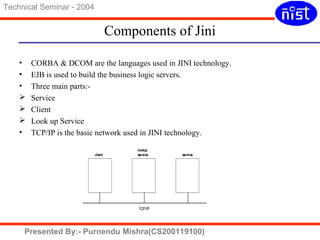
• Three main parts:- 
 Service 
 Client 
 Look up Service 
• TCP/IP is the basic network used in JINI technology. 
Presented By:- Purnendu Mishra(CS200119100)
Technical Seminar - 2004 
The Discovery Process 
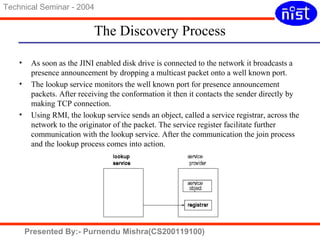
• As soon as the JINI enabled disk drive is connected to the network it broadcasts a 
presence announcement by dropping a multicast packet onto a well known port. 
• The lookup service monitors the well known port for presence announcement 
packets. After receiving the conformation it then it contacts the sender directly by 
making TCP connection. 
• Using RMI, the lookup service sends an object, called a service registrar, across the 
network to the originator of the packet. The service register facilitate further 
communication with the lookup service. After the communication the join process 
and the lookup process comes into action. 
Presented By:- Purnendu Mishra(CS200119100)
The Join process 
Technical Seminar - 2004 
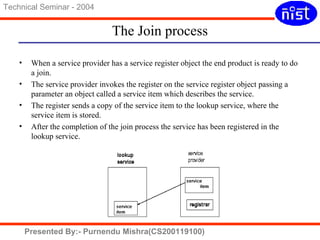
• When a service provider has a service register object the end product is ready to do 
a join. 
• The service provider invokes the register on the service register object passing a 
parameter an object called a service item which describes the service. 
• The register sends a copy of the service item to the lookup service, where the 
service item is stored. 
• After the completion of the join process the service has been registered in the 
lookup service. 
Presented By:- Purnendu Mishra(CS200119100)
The Lookup Process 
Technical Seminar - 2004 
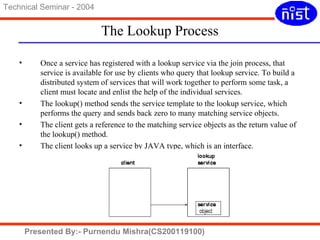
• Once a service has registered with a lookup service via the join process, that 
service is available for use by clients who query that lookup service. To build a 
distributed system of services that will work together to perform some task, a 
client must locate and enlist the help of the individual services. 
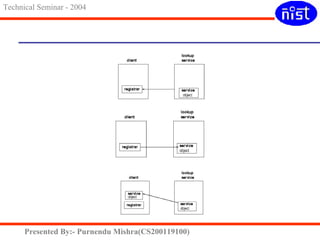
• The lookup() method sends the service template to the lookup service, which 
performs the query and sends back zero to many matching service objects. 
• The client gets a reference to the matching service objects as the return value of 
the lookup() method. 
• The client looks up a service by JAVA type, which is an interface. 
Presented By:- Purnendu Mishra(CS200119100)
Technical Seminar - 2004 
Presented By:- Purnendu Mishra(CS200119100)
Technical Seminar - 2004 
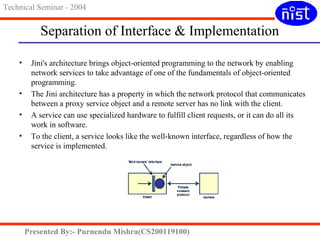
Separation of Interface & Implementation 
• Jini's architecture brings object-oriented programming to the network by enabling 
network services to take advantage of one of the fundamentals of object-oriented 
programming. 
• The Jini architecture has a property in which the network protocol that communicates 
between a proxy service object and a remote server has no link with the client. 
• A service can use specialized hardware to fulfill client requests, or it can do all its 
work in software. 
• To the client, a service looks like the well-known interface, regardless of how the 
service is implemented. 
Presented By:- Purnendu Mishra(CS200119100)
Support Services 
Technical Seminar - 2004 
• The three components of a Jini system are clients, services and service locators, 
which may run anywhere on the network. 
• These will be implemented using Java code running in Java Virtual Machines 
(JVM). 
• The ability to move objects across the network from one JVM to another, 
particular implementations must make use of support services such as RMI 
daemons and HTTP services. 
 A Java object running as a service has a proxy component exported to the service 
locators and then onto a client. It passes through one JVM in ``passive'' form and is 
activated ( brought to life) in the client's JVM. 
 The JAVA REMOTE METHOD INVOCATION system has two types: 
 The original UnicastRemoteObject. 
 The newer Activable class. 
Presented By:- Purnendu Mishra(CS200119100)
JINI at a Glance 
Technical Seminar - 2004 
• The different uses of Jini technology are:- 
 A printer can be connected to the network and the user can access the printer from 
another system without having it configured. 
 To reduce the maintenance cost the file on one system is made into the network so 
that all the clients can access it. 
 New capabilities extending existing ones can be added to a running system without 
disrupting existing services. 
• The different unique qualities are:- 
 Code mobility. 
 Protocol agonistic. 
 Leasing. 
Presented By:- Purnendu Mishra(CS200119100)
Technical Seminar - 2004 
Real World Example of Jini Technology 
• Jini technology gives real-world ease-of-use a boost for many types of 
networked devices. 
• As for an example let us consider to install and configure a new VCR. 
 The consumer plugs in the VCR. 
 The VCR announces its presence to the Jini network. 
 The TV automatically requests the VCR's interface and configures its channels 
accordingly. 
 The VCR automatically requests the clock interface provided by the home 
miniserver and sets its time. 
• Jini can automate a number of enterprise system administration duties, freeing 
sysadmins to do more interesting work. 
Presented By:- Purnendu Mishra(CS200119100)
Conclusion 
Technical Seminar - 2004 
• Jini technology is built on top of the Java 2 platform application environment and 
makes use of the core Java platform functionality to provide a distributed 
computing model that's reliable, portable, and easy to use. 
• The JavaOne conference offers a number of valuable opportunities to educate you 
on the ins and outs of Jini technology. 
• Jini technology will succeed to the extent that this new technology, combined with 
the now-in-progress community model of development, succeeds. 
Presented By:- Purnendu Mishra(CS200119100)
THANK U!!! 
Technical Seminar - 2004 
Presented By:- Purnendu Mishra(CS200119100)

Jini new technology for a networked world

  • 1.
    Technical Seminar -2004 JINI: New Technology FFoorr aa NNeettwwoorrkkeedd WWoorrlldd Under the guidance of Miss Ipshita Mishra Presented By Purnendu Mishra Roll no-CS200119100 Presented By:- Purnendu Mishra(CS200119100)
  • 2.
    Introduction Technical Seminar- 2004 • Jini technology, announced by Sun Microsystems in January 1999, represents a fundamental shift in the way we do distributed computing. • Jini is a set of APIs and network protocols that can help you build and deploy distributed systems that are organized as federations of services. • Jini's architecture helps to raise the level of abstraction in distributed systems programming, effectively turning network programming into object-oriented programming. • Jini technology helps developers address the fundamental difficulties of distributed computing. • Jini technology is built on top of the Java 2 platform application environment. It uses core Java platform functionality to provide a reliable, portable, and ultimately simple-to-use distributed computing model. • Jini is an attempt to rethink computer architecture, given the rising importance of the network and the proliferation of processors in devices that have no disk drive. Presented By:- Purnendu Mishra(CS200119100)
  • 3.
    Components of Jini Technical Seminar - 2004 • CORBA & DCOM are the languages used in JINI technology. • EJB is used to build the business logic servers. • Three main parts:-  Service  Client  Look up Service • TCP/IP is the basic network used in JINI technology. Presented By:- Purnendu Mishra(CS200119100)
  • 4.
    Technical Seminar -2004 The Discovery Process • As soon as the JINI enabled disk drive is connected to the network it broadcasts a presence announcement by dropping a multicast packet onto a well known port. • The lookup service monitors the well known port for presence announcement packets. After receiving the conformation it then it contacts the sender directly by making TCP connection. • Using RMI, the lookup service sends an object, called a service registrar, across the network to the originator of the packet. The service register facilitate further communication with the lookup service. After the communication the join process and the lookup process comes into action. Presented By:- Purnendu Mishra(CS200119100)
  • 5.
    The Join process Technical Seminar - 2004 • When a service provider has a service register object the end product is ready to do a join. • The service provider invokes the register on the service register object passing a parameter an object called a service item which describes the service. • The register sends a copy of the service item to the lookup service, where the service item is stored. • After the completion of the join process the service has been registered in the lookup service. Presented By:- Purnendu Mishra(CS200119100)
  • 6.
    The Lookup Process Technical Seminar - 2004 • Once a service has registered with a lookup service via the join process, that service is available for use by clients who query that lookup service. To build a distributed system of services that will work together to perform some task, a client must locate and enlist the help of the individual services. • The lookup() method sends the service template to the lookup service, which performs the query and sends back zero to many matching service objects. • The client gets a reference to the matching service objects as the return value of the lookup() method. • The client looks up a service by JAVA type, which is an interface. Presented By:- Purnendu Mishra(CS200119100)
  • 7.
    Technical Seminar -2004 Presented By:- Purnendu Mishra(CS200119100)
  • 8.
    Technical Seminar -2004 Separation of Interface & Implementation • Jini's architecture brings object-oriented programming to the network by enabling network services to take advantage of one of the fundamentals of object-oriented programming. • The Jini architecture has a property in which the network protocol that communicates between a proxy service object and a remote server has no link with the client. • A service can use specialized hardware to fulfill client requests, or it can do all its work in software. • To the client, a service looks like the well-known interface, regardless of how the service is implemented. Presented By:- Purnendu Mishra(CS200119100)
  • 9.
    Support Services TechnicalSeminar - 2004 • The three components of a Jini system are clients, services and service locators, which may run anywhere on the network. • These will be implemented using Java code running in Java Virtual Machines (JVM). • The ability to move objects across the network from one JVM to another, particular implementations must make use of support services such as RMI daemons and HTTP services.  A Java object running as a service has a proxy component exported to the service locators and then onto a client. It passes through one JVM in ``passive'' form and is activated ( brought to life) in the client's JVM.  The JAVA REMOTE METHOD INVOCATION system has two types:  The original UnicastRemoteObject.  The newer Activable class. Presented By:- Purnendu Mishra(CS200119100)
  • 10.
    JINI at aGlance Technical Seminar - 2004 • The different uses of Jini technology are:-  A printer can be connected to the network and the user can access the printer from another system without having it configured.  To reduce the maintenance cost the file on one system is made into the network so that all the clients can access it.  New capabilities extending existing ones can be added to a running system without disrupting existing services. • The different unique qualities are:-  Code mobility.  Protocol agonistic.  Leasing. Presented By:- Purnendu Mishra(CS200119100)
  • 11.
    Technical Seminar -2004 Real World Example of Jini Technology • Jini technology gives real-world ease-of-use a boost for many types of networked devices. • As for an example let us consider to install and configure a new VCR.  The consumer plugs in the VCR.  The VCR announces its presence to the Jini network.  The TV automatically requests the VCR's interface and configures its channels accordingly.  The VCR automatically requests the clock interface provided by the home miniserver and sets its time. • Jini can automate a number of enterprise system administration duties, freeing sysadmins to do more interesting work. Presented By:- Purnendu Mishra(CS200119100)
  • 12.
    Conclusion Technical Seminar- 2004 • Jini technology is built on top of the Java 2 platform application environment and makes use of the core Java platform functionality to provide a distributed computing model that's reliable, portable, and easy to use. • The JavaOne conference offers a number of valuable opportunities to educate you on the ins and outs of Jini technology. • Jini technology will succeed to the extent that this new technology, combined with the now-in-progress community model of development, succeeds. Presented By:- Purnendu Mishra(CS200119100)
  • 13.
    THANK U!!! TechnicalSeminar - 2004 Presented By:- Purnendu Mishra(CS200119100)