Computing the Image of the
City

    Bin Jiang
    University of Gävle, Sweden
    http://fromto.hig.se/~bjg/
Outline of the talk
   The image of the city
   How the city looks like?
       Gaussian way of thinking
       Scaling way of thinking
   Head/tail division rule
   Head/tail breaks
   How to compute the image of the city?
   Conclusion


                                            2
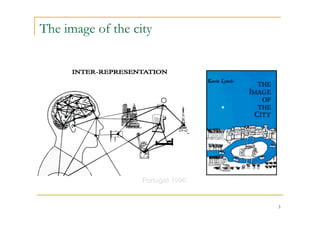
The image of the city


                   Portugali 1996


                                    3
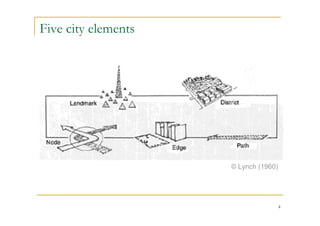
Five city elements


                     © Lynch (1960)


                                      4
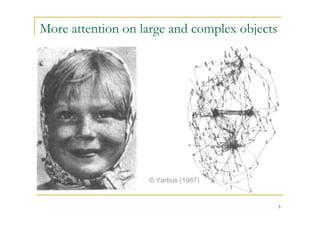
More attention on large and complex objects


                   © Yarbus (1967)


                                              5
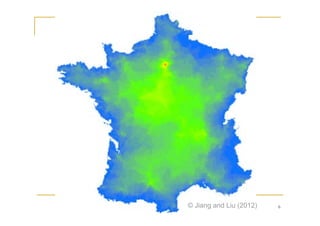
© Jiang and Liu (2012)   6
Two key concepts of the image of the city
   Legibility refers to a particular (visual) quality or
    (apparent) clarity that makes the city’s layout or
    structure recognizable, identifiable, and eventually
    imageable in the human minds.
   Imageability is a quality of a city artifact that gives on
    an observer a strong vivid image.
   Gibson’s affordance: A city or city artifacts due to
    their distinguished properties (geometric, visual,
    topological or semantic) affords remembering to
    shape a mental map in the human minds.


                                                             7
How to obtain the image of the city?
   It is obtained through interviewing city
    residents
       by map drawing,
       comparing with photographs, and
       walking in the physical spaces in the city.
   Qualitative approach in essence.
   Herewith I propose a quantitative approach:
    computing the image of the city


                                                      8
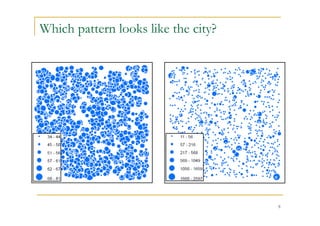
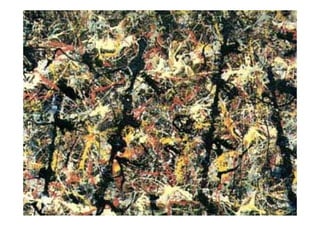
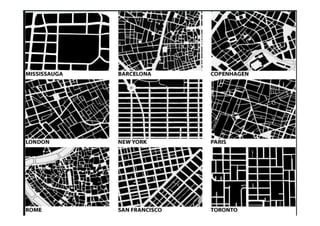
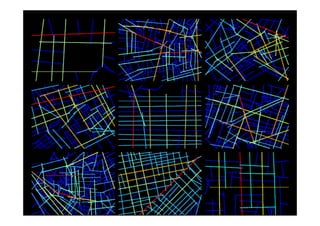
Which pattern looks like the city?


                                     9
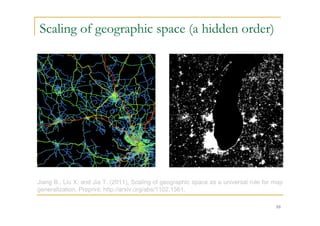
Scaling of geographic space (a hidden order)


Jiang B., Liu X. and Jia T. (2011), Scaling of geographic space as a universal rule for map
generalization, Preprint: http://arxiv.org/abs/1102.1561.

                                                                                        10
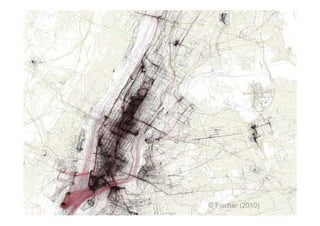
© Fischer (2010)   11
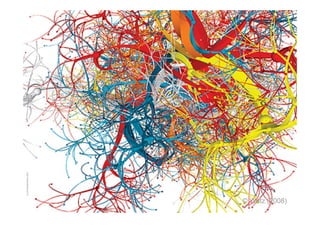
© Watz (2008)
         12
13
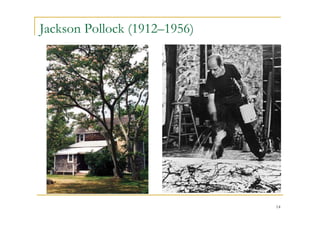
Jackson Pollock (1912–1956)


                              14
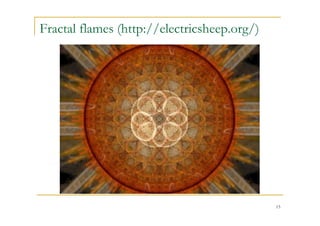
Fractal flames (http://electricsheep.org/)


                                             15
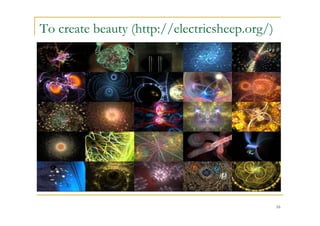
To create beauty (http://electricsheep.org/)


                                               16
17
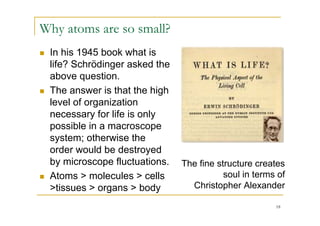
Why atoms are so small?
   In his 1945 book what is
    life? Schrödinger asked the
    above question.
   The answer is that the high
    level of organization
    necessary for life is only
    possible in a macroscope
    system; otherwise the
    order would be destroyed
    by microscope fluctuations.   The fine structure creates
   Atoms > molecules > cells                soul in terms of
    >tissues > organs > body        Christopher Alexander

                                                          18
Geometric order vs structural order


                                      19
20
21
22
23
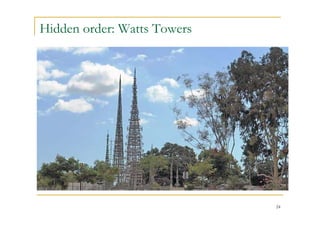
Hidden order: Watts Towers


                             24
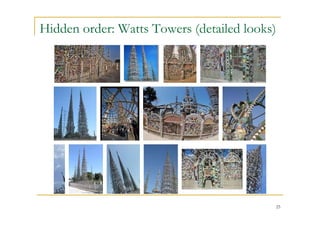
Hidden order: Watts Towers (detailed looks)


                                          25
26
27
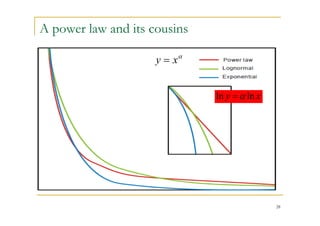
A power law and its cousins

                     y  x


                              ln y   ln x


                                              28
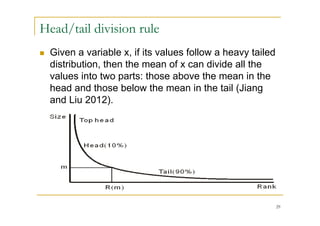
Head/tail division rule
   Given a variable x, if its values follow a heavy tailed
    distribution, then the mean of x can divide all the
    values into two parts: those above the mean in the
    head and those below the mean in the tail (Jiang
    and Liu 2012).


                                                              29
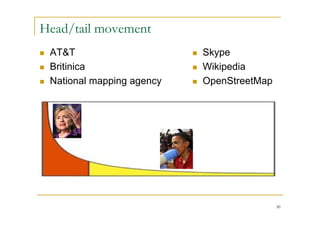
Head/tail movement
   AT&T                         Skype
   Britinica                    Wikipedia
   National mapping agency      OpenStreetMap


                                                  30
Head/tail breaks
   Iteratively apply the head/tail division rule to
    dataset with a heavy tailed distribution, untill the
    data in head is no longer heavy tailed
    distributed, or specifically, the number in the
    head is no longer a minority (e.g., < 40%).
   Both the number of classes and class intervals
    are automatically or naturally determined.
   For example, four classes: [min, m1), [m1, m2),
    [m2, m3), [m3, max].
   Head/tail breaks is more natural than natural
    breaks.
                                                           31
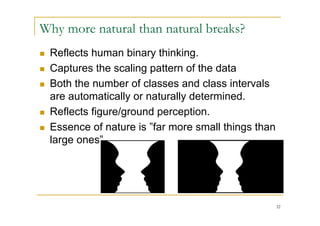
Why more natural than natural breaks?
   Reflects human binary thinking.
   Captures the scaling pattern of the data
   Both the number of classes and class intervals
    are automatically or naturally determined.
   Reflects figure/ground perception.
   Essence of nature is ”far more small things than
    large ones”.


                                                       32
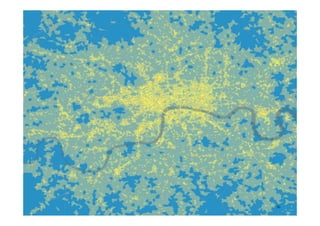
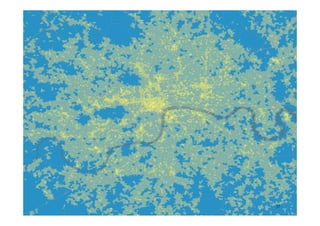
Computing the image of the city
   Step 1: organize all city artifacts layer by layer
   Step 2: all the city artifacts must be organized in
    terms of city artifacts rather than geometric
    primitives such as points, lines and polygons
   Step 3: rank the city artifacts of the same type from
    the largest to the smallest
   Step 4: partition all the artifacts into two categories:
    those below the mean (in the tail) and those above
    the mean (in the head)
   Step 5: continue step 4 until the artifacts in the head
    are non longer heavy tailed

                                                           33
34
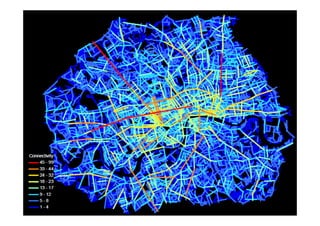
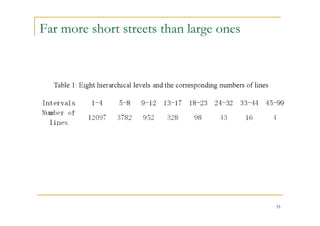
Far more short streets than large ones


                                         35
36
37
Conclusion
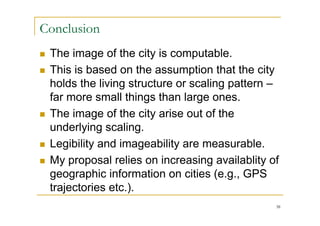
   The image of the city is computable.
   This is based on the assumption that the city
    holds the living structure or scaling pattern –
    far more small things than large ones.
   The image of the city arise out of the
    underlying scaling.
   Legibility and imageability are measurable.
   My proposal relies on increasing availablity of
    geographic information on cities (e.g., GPS
    trajectories etc.).
                                                  38
Thank you very much!!!

   Questions and comments?


                              39

Jiang - INPUT2012

  • 1.
    Computing the Imageof the City Bin Jiang University of Gävle, Sweden http://fromto.hig.se/~bjg/
  • 2.
    Outline of thetalk  The image of the city  How the city looks like?  Gaussian way of thinking  Scaling way of thinking  Head/tail division rule  Head/tail breaks  How to compute the image of the city?  Conclusion 2
  • 3.
    The image ofthe city Portugali 1996 3
  • 4.
    Five city elements © Lynch (1960) 4
  • 5.
    More attention onlarge and complex objects © Yarbus (1967) 5
  • 6.
    © Jiang andLiu (2012) 6
  • 7.
    Two key conceptsof the image of the city  Legibility refers to a particular (visual) quality or (apparent) clarity that makes the city’s layout or structure recognizable, identifiable, and eventually imageable in the human minds.  Imageability is a quality of a city artifact that gives on an observer a strong vivid image.  Gibson’s affordance: A city or city artifacts due to their distinguished properties (geometric, visual, topological or semantic) affords remembering to shape a mental map in the human minds. 7
  • 8.
    How to obtainthe image of the city?  It is obtained through interviewing city residents  by map drawing,  comparing with photographs, and  walking in the physical spaces in the city.  Qualitative approach in essence.  Herewith I propose a quantitative approach: computing the image of the city 8
  • 9.
    Which pattern lookslike the city? 9
  • 10.
    Scaling of geographicspace (a hidden order) Jiang B., Liu X. and Jia T. (2011), Scaling of geographic space as a universal rule for map generalization, Preprint: http://arxiv.org/abs/1102.1561. 10
  • 11.
  • 12.
  • 13.
  • 14.
  • 15.
  • 16.
    To create beauty(http://electricsheep.org/) 16
  • 17.
  • 18.
    Why atoms areso small?  In his 1945 book what is life? Schrödinger asked the above question.  The answer is that the high level of organization necessary for life is only possible in a macroscope system; otherwise the order would be destroyed by microscope fluctuations. The fine structure creates  Atoms > molecules > cells soul in terms of >tissues > organs > body Christopher Alexander 18
  • 19.
    Geometric order vsstructural order 19
  • 20.
  • 21.
  • 22.
  • 23.
  • 24.
  • 25.
    Hidden order: WattsTowers (detailed looks) 25
  • 26.
  • 27.
  • 28.
    A power lawand its cousins y  x ln y   ln x 28
  • 29.
    Head/tail division rule  Given a variable x, if its values follow a heavy tailed distribution, then the mean of x can divide all the values into two parts: those above the mean in the head and those below the mean in the tail (Jiang and Liu 2012). 29
  • 30.
    Head/tail movement  AT&T  Skype  Britinica  Wikipedia  National mapping agency  OpenStreetMap 30
  • 31.
    Head/tail breaks  Iteratively apply the head/tail division rule to dataset with a heavy tailed distribution, untill the data in head is no longer heavy tailed distributed, or specifically, the number in the head is no longer a minority (e.g., < 40%).  Both the number of classes and class intervals are automatically or naturally determined.  For example, four classes: [min, m1), [m1, m2), [m2, m3), [m3, max].  Head/tail breaks is more natural than natural breaks. 31
  • 32.
    Why more naturalthan natural breaks?  Reflects human binary thinking.  Captures the scaling pattern of the data  Both the number of classes and class intervals are automatically or naturally determined.  Reflects figure/ground perception.  Essence of nature is ”far more small things than large ones”. 32
  • 33.
    Computing the imageof the city  Step 1: organize all city artifacts layer by layer  Step 2: all the city artifacts must be organized in terms of city artifacts rather than geometric primitives such as points, lines and polygons  Step 3: rank the city artifacts of the same type from the largest to the smallest  Step 4: partition all the artifacts into two categories: those below the mean (in the tail) and those above the mean (in the head)  Step 5: continue step 4 until the artifacts in the head are non longer heavy tailed 33
  • 34.
  • 35.
    Far more shortstreets than large ones 35
  • 36.
  • 37.
  • 38.
    Conclusion  The image of the city is computable.  This is based on the assumption that the city holds the living structure or scaling pattern – far more small things than large ones.  The image of the city arise out of the underlying scaling.  Legibility and imageability are measurable.  My proposal relies on increasing availablity of geographic information on cities (e.g., GPS trajectories etc.). 38
  • 39.
    Thank you verymuch!!!  Questions and comments? 39