
by F. Maltinti, D. Melis, F. Annunziata


Seventh International Conference on Informatics and Urban and Regional
             Planning, University of Cagliari 10-12 May 2012
Introduction
Aim
Describing methodology
Case study
Conclusion and Further studies.


               input 2012, F. Maltinti "Gis applications for vulnerability assessment of a road network"
Transport infrastructures guarantee accessibility

Importance of accessibility during emergency
situations

Knowledge of road network vulnerability is
fundamental to manage risks

               input 2012, F. Maltinti "Gis applications for vulnerability assessment of a road network"
Studying a new methodology for assessing road
network vulnerability to:
   Identify a vulnerability index correlated to
   design and geometric characteristics of roads
   Identify critical links of a road network to define
   improvements priorities
   Guarantee     accessibility                         during                    emergency
   situations    input 2012, F. Maltinti "Gis applications for vulnerability assessment of a road network"
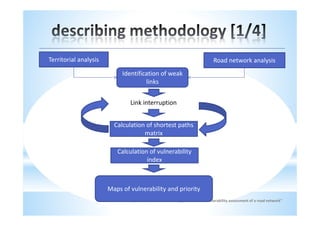
Territorial analysis                                                           Road network analysis
                            Identification of weak
                                     links


                               Link interruption


                         Calculation of shortest paths
                                    matrix

                          Calculation of vulnerability
                                     index


                       Maps of vulnerability and priority
                               input 2012, F. Maltinti "Gis applications for vulnerability assessment of a road network"
The proposed Total vulnerability index is expressed by:

                   vulnerktot=vulnerkglob-norm+vulnerkO/Dresc-norm+vulnerkshorth-path-norm

      where:
                                              is the normalized indicator for vulnerability assessment
1)   vulnerkglob-norm=f[ΣiΣj   (tkij-t0ij)]   connected to the whole network
                                                      [i, j =urban nodes, k=weak links]

                                              is the normalized indicator for the vulnerability
2) vulnerkO/Dresc-norm=f[ΣiΣj (tkij-t0ij)]    assessment connected to the rescue operation
                                              [i, =relief operation centres, j= urban nodes destination
                                              of relief]

3) vulnerkshorth-path-norm=f[ΣiΣj (nkij)]
                                              is the normalized indicator for the vulnerability
            1 if ∆tkij>0                      assessment connected to the number of shortest paths
nkij=                                         involved in a link closure
            0 if ∆tkij<0                       input 2012, F. Maltinti "Gis applications for vulnerability assessment of a road network"
The index to assess municipality exposure is:
                               exposurei=f[(ΣkΣj(tkij–t0ij)]

 To consider population the function can be rewrite as follows:

                           exposureweii=f[Pi/Ptot,ΣkΣj(tkij–t0ij)]

 We used:
 • ArcView GIS, to record georeference and process data, and finally to realize the
   network vulnerability map;
 • ArcGis Network Analyst extension to calculate the matrix of the shortest paths,
   and also to construct the matrix of road distances.

 We have obtained travel time by dividing the length by the travel speed of the road
 link and travel speed by the design characteristics of the horizontal alignment of the
 road to which the link belongs
                                input 2012, F. Maltinti "Gis applications for vulnerability assessment of a road network"
Hypotheses (coming from Italian Geometric Design Standards of Roads):

• the vehicle is isolated: its speed is not affected by traffic conditions;
• the road gradient does not influence vehicle speed;
• on tangents the vehicle follows the equations of uniformly accelerated linear
  motion until it reaches the designed speed limit;
• on curves vehicle speed depends on the radius of the curves and on the road
  category.


The first one is not easily verified, but it appears valid for roads located in sparsely
populated areas with low traffic volume.


                                 input 2012, F. Maltinti "Gis applications for vulnerability assessment of a road network"
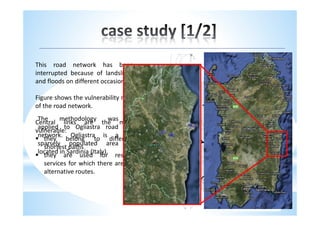
This road network has been
interrupted because of landslides
and floods on different occasions.

Figure shows the vulnerability map
of the road network.
 The     methodology         was
Central links are the most
 applied to Ogliastra road
vulnerable:
 network. Ogliastra is a
   they belong to different
 sparsely populated area
   shortest paths
 located in Sardinia (Italy).
   they are used for rescue
   services for which there are no
   alternative routes.
These figures show municipality exposure to the event:
The figure on the left shows that more vulnerable municipalities are localized in central-
southern area of the region characterized by low population density.

                                     The       situation        is
                                     completely        different
                                     (see the figure on the
                                     right) using function
                                     considering            local
                                     population:           more
                                     vulnerable
                                     municipalities           are
                                     localized     in     north-
                                     eastern and south-
                                     eastern area of the
                                     region because they are
                                     more populated than
                                     central-southern area

     exposurei=f[(ΣkΣj(tkij–t0ij)]                                   exposureweii=f[Pi/Ptot,ΣkΣj(tkij–t0ij)]
The proposed methodology:
• expresses vulnerability of a road network considering geometric and design
  characteristics of the elements of road.
• attaches more importance to peripheral links which are particularly critical because
  they have not alternative paths and their closure can completely isolate an area.


   The methodology is specifically effective in areas of low population density and
                               where traffic flow is poor.
    It could represent a new tool for roads administrators to define improvement
                   priorities and to manage emergency situations.

The study is going on including other road design characteristics (e.g. road gradient),
identifying combinations of link failures and considering different hazards in the
definition of the index.
                                input 2012, F. Maltinti "Gis applications for vulnerability assessment of a road network"
F. Maltinti "Gis applications for vulnerability assessment of a road network"


       Seventh International Conference on Informatics and Urban and Regional
                    Planning, University of Cagliari 10-12 May 2012

Maltinti, Melis and Annunziata - input2012

  • 1.
    by F. Maltinti,D. Melis, F. Annunziata Seventh International Conference on Informatics and Urban and Regional Planning, University of Cagliari 10-12 May 2012
  • 2.
    Introduction Aim Describing methodology Case study Conclusionand Further studies. input 2012, F. Maltinti "Gis applications for vulnerability assessment of a road network"
  • 3.
    Transport infrastructures guaranteeaccessibility Importance of accessibility during emergency situations Knowledge of road network vulnerability is fundamental to manage risks input 2012, F. Maltinti "Gis applications for vulnerability assessment of a road network"
  • 4.
    Studying a newmethodology for assessing road network vulnerability to: Identify a vulnerability index correlated to design and geometric characteristics of roads Identify critical links of a road network to define improvements priorities Guarantee accessibility during emergency situations input 2012, F. Maltinti "Gis applications for vulnerability assessment of a road network"
  • 5.
    Territorial analysis Road network analysis Identification of weak links Link interruption Calculation of shortest paths matrix Calculation of vulnerability index Maps of vulnerability and priority input 2012, F. Maltinti "Gis applications for vulnerability assessment of a road network"
  • 6.
    The proposed Totalvulnerability index is expressed by: vulnerktot=vulnerkglob-norm+vulnerkO/Dresc-norm+vulnerkshorth-path-norm where: is the normalized indicator for vulnerability assessment 1) vulnerkglob-norm=f[ΣiΣj (tkij-t0ij)] connected to the whole network [i, j =urban nodes, k=weak links] is the normalized indicator for the vulnerability 2) vulnerkO/Dresc-norm=f[ΣiΣj (tkij-t0ij)] assessment connected to the rescue operation [i, =relief operation centres, j= urban nodes destination of relief] 3) vulnerkshorth-path-norm=f[ΣiΣj (nkij)] is the normalized indicator for the vulnerability 1 if ∆tkij>0 assessment connected to the number of shortest paths nkij= involved in a link closure 0 if ∆tkij<0 input 2012, F. Maltinti "Gis applications for vulnerability assessment of a road network"
  • 7.
    The index toassess municipality exposure is: exposurei=f[(ΣkΣj(tkij–t0ij)] To consider population the function can be rewrite as follows: exposureweii=f[Pi/Ptot,ΣkΣj(tkij–t0ij)] We used: • ArcView GIS, to record georeference and process data, and finally to realize the network vulnerability map; • ArcGis Network Analyst extension to calculate the matrix of the shortest paths, and also to construct the matrix of road distances. We have obtained travel time by dividing the length by the travel speed of the road link and travel speed by the design characteristics of the horizontal alignment of the road to which the link belongs input 2012, F. Maltinti "Gis applications for vulnerability assessment of a road network"
  • 8.
    Hypotheses (coming fromItalian Geometric Design Standards of Roads): • the vehicle is isolated: its speed is not affected by traffic conditions; • the road gradient does not influence vehicle speed; • on tangents the vehicle follows the equations of uniformly accelerated linear motion until it reaches the designed speed limit; • on curves vehicle speed depends on the radius of the curves and on the road category. The first one is not easily verified, but it appears valid for roads located in sparsely populated areas with low traffic volume. input 2012, F. Maltinti "Gis applications for vulnerability assessment of a road network"
  • 9.
    This road networkhas been interrupted because of landslides and floods on different occasions. Figure shows the vulnerability map of the road network. The methodology was Central links are the most applied to Ogliastra road vulnerable: network. Ogliastra is a they belong to different sparsely populated area shortest paths located in Sardinia (Italy). they are used for rescue services for which there are no alternative routes.
  • 10.
    These figures showmunicipality exposure to the event: The figure on the left shows that more vulnerable municipalities are localized in central- southern area of the region characterized by low population density. The situation is completely different (see the figure on the right) using function considering local population: more vulnerable municipalities are localized in north- eastern and south- eastern area of the region because they are more populated than central-southern area exposurei=f[(ΣkΣj(tkij–t0ij)] exposureweii=f[Pi/Ptot,ΣkΣj(tkij–t0ij)]
  • 11.
    The proposed methodology: •expresses vulnerability of a road network considering geometric and design characteristics of the elements of road. • attaches more importance to peripheral links which are particularly critical because they have not alternative paths and their closure can completely isolate an area. The methodology is specifically effective in areas of low population density and where traffic flow is poor. It could represent a new tool for roads administrators to define improvement priorities and to manage emergency situations. The study is going on including other road design characteristics (e.g. road gradient), identifying combinations of link failures and considering different hazards in the definition of the index. input 2012, F. Maltinti "Gis applications for vulnerability assessment of a road network"
  • 12.
    F. Maltinti "Gisapplications for vulnerability assessment of a road network" Seventh International Conference on Informatics and Urban and Regional Planning, University of Cagliari 10-12 May 2012