Laboratorio URB&COM
                                                                 Urbanistica e Commercio
                                                                 DiAP - Politecnico di Milano


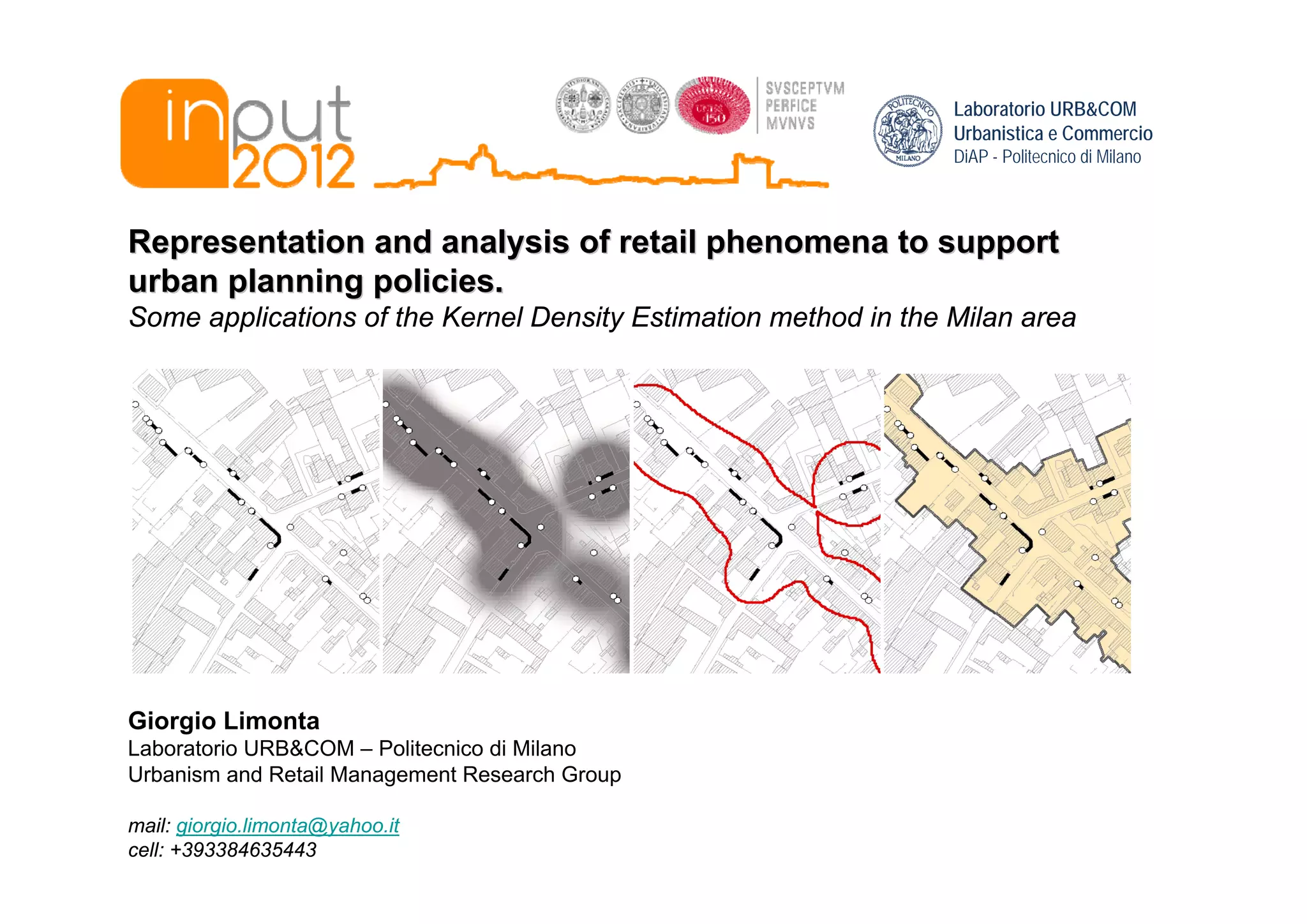
Representation and analysis of retail phenomena to support
urban planning policies.
Some applications of the Kernel Density Estimation method in the Milan area


Giorgio Limonta
Laboratorio URB&COM – Politecnico di Milano
Urbanism and Retail Management Research Group

mail: giorgio.limonta@yahoo.it
cell: +393384635443
Summary

Retail planning and urban planning;

Representation of the retail phenomenon;

The Kernel Density Estimation (KDE);

Phases of the analysis’ process;

Analysis and general urban plan

Conclusion

 Laboratorio URB&COM            Representation and analysis of retail phenomena to support urban planning policies
 DiAP - Politecnico di Milano   Some applications of the Kernel Density Estimation method in the Milan area
 Giorgio Limonta                Session: Spatial Data Analysis
Retail planning and urban planning
National deregulation (principal acts):
-   Legislative Decree no. 114/1998 (liberalization of the retail businnes);
-   Legislative Decree no. 59/2010 (implementation of the European Directive ‘Bolkestein’);


Led retail planning policies into a gradual transition from a “quantitative need” to a “qualitative
   need”;

Led the management of retailing structure’ allocation within urban planning policies (especially
    at the municipal level);


      Laboratorio URB&COM                    Representation and analysis of retail phenomena to support urban planning policies
      DiAP - Politecnico di Milano           Some applications of the Kernel Density Estimation method in the Milan area
      Giorgio Limonta                        Session: Spatial Data Analysis
Representation of the retail phenomenon
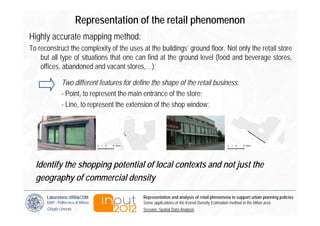
Highly accurate mapping method:
To reconstruct the complexity of the uses at the buildings’ ground floor. Not only the retail store
    but all type of situations that one can find at the ground level (food and beverage stores,
    offices, abandoned and vacant stores,…);

               Two different features for define the shape of the retail business:
               - Point, to represent the main entrance of the store;
               - Line, to represent the extension of the shop window;


  Identify the shopping potential of local contexts and not just the
  geography of commercial density

      Laboratorio URB&COM                    Representation and analysis of retail phenomena to support urban planning policies
      DiAP - Politecnico di Milano           Some applications of the Kernel Density Estimation method in the Milan area
      Giorgio Limonta                        Session: Spatial Data Analysis
The Kernel Density Estimation (KDE)

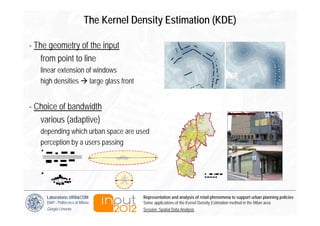
- The geometry of the input
    from point to line
   linear extension of windows
   high densities large glass front


- Choice of bandwidth
   various (adaptive)
   depending which urban space are used
   perception by a users passing


     Laboratorio URB&COM                  Representation and analysis of retail phenomena to support urban planning policies
     DiAP - Politecnico di Milano         Some applications of the Kernel Density Estimation method in the Milan area
     Giorgio Limonta                      Session: Spatial Data Analysis
Phases of the analysis’ process
                             Retail and services Clustering Area (RCAs)
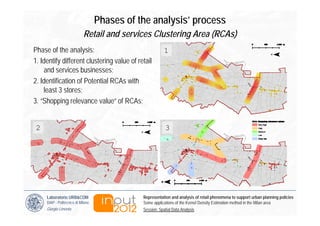
Phase of the analysis:                                    1
1. Identify different clustering value of retail
    and services businesses;
2. Identification of Potential RCAs with
    least 3 stores;
3. “Shopping relevance value” of RCAs;


2                                                         3


     Laboratorio URB&COM                       Representation and analysis of retail phenomena to support urban planning policies
     DiAP - Politecnico di Milano              Some applications of the Kernel Density Estimation method in the Milan area
     Giorgio Limonta                           Session: Spatial Data Analysis
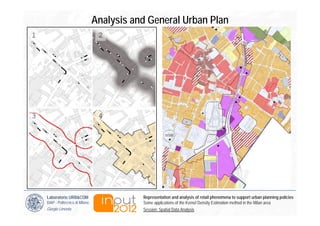
Analysis and General Urban Plan
Piano di Governo del Territorio (General Urban Plan)

   Documento di Piano (Strategic plan)
    Identify strengths and weakness of the RCAs                    define the strategic guidelines for
    development the urban sales activities;

   Piano delle Regole (Regulation plan)
    The KDE’ result was a basic references areas for identify specific prescription zones
    (differentiate the dimension for the new medium size store);

   Piano dei Servizi (Services Plan)
    Value the “shopping effect” of the different part of the city able to qualify in terms of
    sociability and livability define public strategies for retail and services;


   Laboratorio URB&COM                       Representation and analysis of retail phenomena to support urban planning policies
   DiAP - Politecnico di Milano              Some applications of the Kernel Density Estimation method in the Milan area
   Giorgio Limonta                           Session: Spatial Data Analysis
Analysis and General Urban Plan
1                                   2


3                                   4


    Laboratorio URB&COM                       Representation and analysis of retail phenomena to support urban planning policies
    DiAP - Politecnico di Milano              Some applications of the Kernel Density Estimation method in the Milan area
    Giorgio Limonta                           Session: Spatial Data Analysis
Conclusions
•   It’s necessary to define some methodologies for representation and analysis the retail and
    services dynamics for best interact with the General Urban Plan;

•   KDE method could be a good tool for the analysis and the interpretation of the retail
    phenomena (well-know method, implemented in some GIS software);

•   Could be a good way to support the public retail strategies: helpful to define and describe the
    RCAs; give an objective evaluation of the retail and services densities (compromise between
    subjective depiction and geo-statistical analysis);

•   Make the interpretation objective and transparent: easy to explain the input variables choice
    (bandwidth);

•   Could be also used to define the perimeters of the retail planning and regulation zones within
    the General Urban Plan (strictly connected to the mapping detail of the input);


    Laboratorio URB&COM                     Representation and analysis of retail phenomena to support urban planning policies
    DiAP - Politecnico di Milano            Some applications of the Kernel Density Estimation method in the Milan area
    Giorgio Limonta                         Session: Spatial Data Analysis

Limonta - Input2012

  • 1.
    Laboratorio URB&COM Urbanistica e Commercio DiAP - Politecnico di Milano Representation and analysis of retail phenomena to support urban planning policies. Some applications of the Kernel Density Estimation method in the Milan area Giorgio Limonta Laboratorio URB&COM – Politecnico di Milano Urbanism and Retail Management Research Group mail: giorgio.limonta@yahoo.it cell: +393384635443
  • 2.
    Summary Retail planning andurban planning; Representation of the retail phenomenon; The Kernel Density Estimation (KDE); Phases of the analysis’ process; Analysis and general urban plan Conclusion Laboratorio URB&COM Representation and analysis of retail phenomena to support urban planning policies DiAP - Politecnico di Milano Some applications of the Kernel Density Estimation method in the Milan area Giorgio Limonta Session: Spatial Data Analysis
  • 3.
    Retail planning andurban planning National deregulation (principal acts): - Legislative Decree no. 114/1998 (liberalization of the retail businnes); - Legislative Decree no. 59/2010 (implementation of the European Directive ‘Bolkestein’); Led retail planning policies into a gradual transition from a “quantitative need” to a “qualitative need”; Led the management of retailing structure’ allocation within urban planning policies (especially at the municipal level); Laboratorio URB&COM Representation and analysis of retail phenomena to support urban planning policies DiAP - Politecnico di Milano Some applications of the Kernel Density Estimation method in the Milan area Giorgio Limonta Session: Spatial Data Analysis
  • 4.
    Representation of theretail phenomenon Highly accurate mapping method: To reconstruct the complexity of the uses at the buildings’ ground floor. Not only the retail store but all type of situations that one can find at the ground level (food and beverage stores, offices, abandoned and vacant stores,…); Two different features for define the shape of the retail business: - Point, to represent the main entrance of the store; - Line, to represent the extension of the shop window; Identify the shopping potential of local contexts and not just the geography of commercial density Laboratorio URB&COM Representation and analysis of retail phenomena to support urban planning policies DiAP - Politecnico di Milano Some applications of the Kernel Density Estimation method in the Milan area Giorgio Limonta Session: Spatial Data Analysis
  • 5.
    The Kernel DensityEstimation (KDE) - The geometry of the input from point to line linear extension of windows high densities large glass front - Choice of bandwidth various (adaptive) depending which urban space are used perception by a users passing Laboratorio URB&COM Representation and analysis of retail phenomena to support urban planning policies DiAP - Politecnico di Milano Some applications of the Kernel Density Estimation method in the Milan area Giorgio Limonta Session: Spatial Data Analysis
  • 6.
    Phases of theanalysis’ process Retail and services Clustering Area (RCAs) Phase of the analysis: 1 1. Identify different clustering value of retail and services businesses; 2. Identification of Potential RCAs with least 3 stores; 3. “Shopping relevance value” of RCAs; 2 3 Laboratorio URB&COM Representation and analysis of retail phenomena to support urban planning policies DiAP - Politecnico di Milano Some applications of the Kernel Density Estimation method in the Milan area Giorgio Limonta Session: Spatial Data Analysis
  • 7.
    Analysis and GeneralUrban Plan Piano di Governo del Territorio (General Urban Plan) Documento di Piano (Strategic plan) Identify strengths and weakness of the RCAs define the strategic guidelines for development the urban sales activities; Piano delle Regole (Regulation plan) The KDE’ result was a basic references areas for identify specific prescription zones (differentiate the dimension for the new medium size store); Piano dei Servizi (Services Plan) Value the “shopping effect” of the different part of the city able to qualify in terms of sociability and livability define public strategies for retail and services; Laboratorio URB&COM Representation and analysis of retail phenomena to support urban planning policies DiAP - Politecnico di Milano Some applications of the Kernel Density Estimation method in the Milan area Giorgio Limonta Session: Spatial Data Analysis
  • 8.
    Analysis and GeneralUrban Plan 1 2 3 4 Laboratorio URB&COM Representation and analysis of retail phenomena to support urban planning policies DiAP - Politecnico di Milano Some applications of the Kernel Density Estimation method in the Milan area Giorgio Limonta Session: Spatial Data Analysis
  • 9.
    Conclusions • It’s necessary to define some methodologies for representation and analysis the retail and services dynamics for best interact with the General Urban Plan; • KDE method could be a good tool for the analysis and the interpretation of the retail phenomena (well-know method, implemented in some GIS software); • Could be a good way to support the public retail strategies: helpful to define and describe the RCAs; give an objective evaluation of the retail and services densities (compromise between subjective depiction and geo-statistical analysis); • Make the interpretation objective and transparent: easy to explain the input variables choice (bandwidth); • Could be also used to define the perimeters of the retail planning and regulation zones within the General Urban Plan (strictly connected to the mapping detail of the input); Laboratorio URB&COM Representation and analysis of retail phenomena to support urban planning policies DiAP - Politecnico di Milano Some applications of the Kernel Density Estimation method in the Milan area Giorgio Limonta Session: Spatial Data Analysis