Input 2012
                            Cagliari, 10th-12th May 2012


        Regional development
         strategies: the role of
infrastructures and transport.
The case of the Friuli Venezia Giulia region in the
         wider Northeastern Italian macroregion


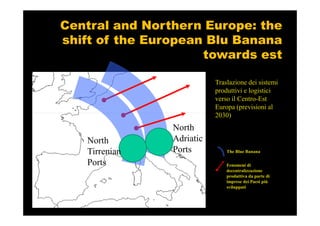
       Prof. Sandro Fabbro - Ing. Marco Dean
       Department of Civil Engineering and Architecture
       University of Udine
Paper contents and objectives
The paper analyzes the transport infrastructure planning,
       in the FVG region, in the context of the North
       Adriatic logistic system.
Starting from the situation of this small but nodal region,
       the paper argues the necessity, for Italy, to radically
       restructure its policies in this sector.
For achieving this aim, it seems necessary, first of all, to
       rethink the national planning. In particular the
       National Logistcs Plan (2006 and 2010) and the
       Strategic National Framework (2007-2013) are two
       frameworks which seem not anymore adequate to
       relaunch Italy in the context of the TEN-T networks.
Towards a new Normal?

In the World:
   Prosecution of growth in the BRICS countries;
   More attention regarding the search for better models of
   production, consumption, transportation, redistribution.


In Europe:
   Prosecution of the economic and financial crisis;
   Decline of demand and production if not recession
   Less public resources for big investment programs
   Serious difficulties in the carrying on of the European
   construction model.
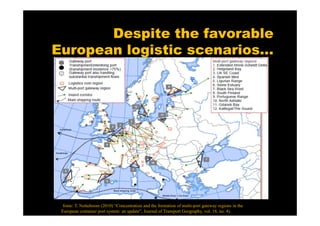
Despite the favorable
European logistic scenarios…


 (fonte: T. Notteboom (2010) “Concentration and the formation of multi-port gateway regions in the
 European container port system: an update”, Journal of Transport Geography, vol. 18, no. 4).
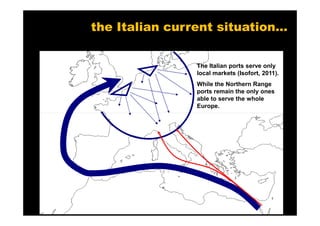
the Italian current situation…


                The Italian ports serve only
                local markets (Isofort, 2011).
                While the Northern Range
                ports remain the only ones
                able to serve the whole
                Europe.
seems not adequate to relaunch
                the national economy

During the last decade, in spite of the remarkable
developement of the maritime trade in the Mediterranean, the
freight traffic in the Italian ports Sea, is increased slightly.
This has been caused by:
    stagnation of the national economy;
    “bottlenecks” and several other transport problems;
    lack of coordination among the too many ports and freight
    villages;
    inadequacy of the national planning instruments (NL,
    84/94, NLP 2006, SNF 2007-2013 ecc.) to be selective
    concerning the identification of few priority areas and
    nodes on which to focus investment and allow, to the most
    competitive companies, to manage the logistic services.
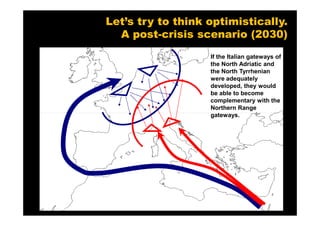
Let’s try to think optimistically.
  A post-crisis scenario (2030)
                   If the Italian gateways of
                   the North Adriatic and
                   the North Tyrrhenian
                   were adequately
                   developed, they would
                   be able to become
                   complementary with the
                   Northern Range
                   gateways.
Central and Northern Europe: the
shift of the European Blu Banana
                     towards est

                           Traslazione dei sistemi
                           produttivi e logistici
                           verso il Centro-Est
                           Europa (previsioni al
                           2030)
                North
   North        Adriatic
   Tirrenian    Ports          The Blue Banana

   Ports                       Fenomeni di
                               decentralizzazione
                               produttiva da parte di
                               imprese dei Paesi più
                               sviluppati
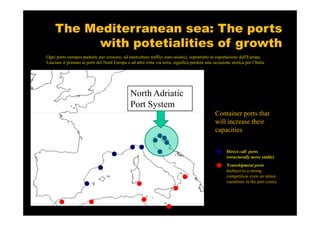
The Mediterranean sea: The ports
          with potetialities of growth
Ogni porto europeo punterà, per crescere, ad intercettare traffici euro-asiatici, soprattutto in esportazione dall'Europa.
Lasciare il primato ai porti del Nord Europa o ad altre rotte via terra, significa perdere una occasione storica per l’Italia


                                                North Adriatic
                                                Port System
                                                                                                Container ports that
                                                                                                will increase their
                                                                                                capacities


                                                                                                       Direct call ports
                                                                                                       (structurally more stable)
                                                                                                       Transhipment ports
                                                                                                       (subject to a strong
                                                                                                       competition even on minor
                                                                                                       variations in the port costs)
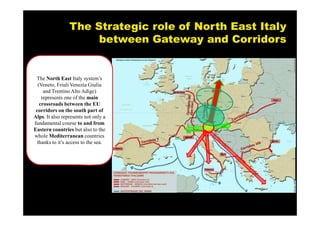
The Strategic role of North East Italy
                      between Gateway and Corridors


 The North East Italy system’s
  (Veneto, Friuli Venezia Giulia
     and Trentino Alto Adige)
    represents one of the main
   crossroads between the EU
 corridors on the south part of
Alps. It also represents not only a
fundamental course to and from
Eastern countries but also to the
whole Mediterranean countries
 thanks to it’s access to the sea.
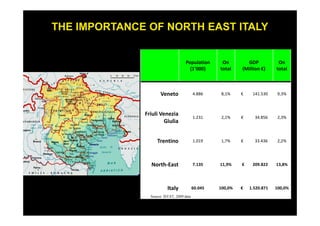
THE IMPORTANCE OF NORTH EAST ITALY


                                    Population       On        GDP            On
                                      (1’000)       total    (Million €)     total


                     Veneto                4.886     8,1%    €    141.530     9,3%


              Friuli Venezia
                                           1.231     2,1%    €     34.856     2,3%
                       Giulia


                   Trentino                1.019     1,7%    €     33.436     2,2%


                North-East                 7.135    11,9%    €    209.822    13,8%


                          Italy            60.045   100,0%   €   1.520.871   100,0%
                Source: ISTAT, 2009 data
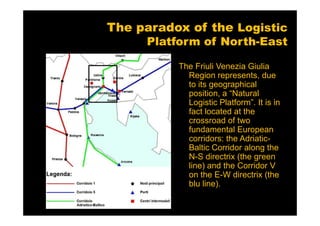
The paradox of the Logistic
     Platform of North-East

          The Friuli Venezia Giulia
            Region represents, due
            to its geographical
            position, a “Natural
            Logistic Platform”. It is in
            fact located at the
            crossroad of two
            fundamental European
            corridors: the Adriatic-
            Baltic Corridor along the
            N-S directrix (the green
            line) and the Corridor V
            on the E-W directrix (the
            blu line).
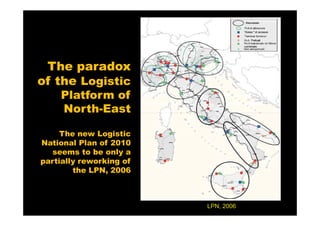
The paradox
of the Logistic
    Platform of
    North-East

     The new Logistic
National Plan of 2010
   seems to be only a
partially reworking of
        the LPN, 2006


                         LPN, 2006
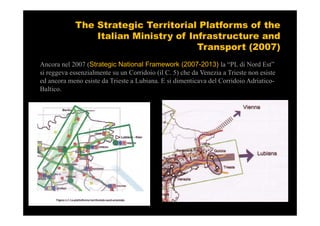
The Strategic Territorial Platforms of the
                 Italian Ministry of Infrastructure and
                                       Transport (2007)
Ancora nel 2007 (Strategic National Framework (2007-2013) la “PL di Nord Est”
si reggeva essenzialmente su un Corridoio (il C. 5) che da Venezia a Trieste non esiste
ed ancora meno esiste da Trieste a Lubiana. E si dimenticava del Corridoio Adriatico-
Baltico.
.
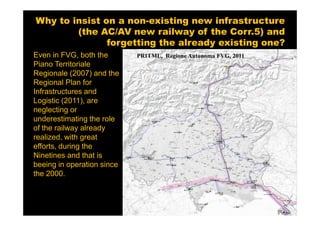
Why to insist on a non-existing new infrastructure
        (the AC/AV new railway of the Corr.5) and
               forgetting the already existing one?
Even in FVG, both the       PRITML, Regione Autonoma FVG, 2011
Piano Territoriale
Regionale (2007) and the
Regional Plan for
Infrastructures and
Logistic (2011), are
neglecting or
underestimating the role
of the railway already
realized, with great
efforts, during the
Ninetines and that is
beeing in operation since
the 2000.
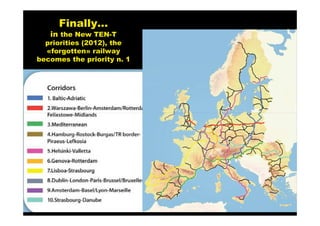
Finally…
   in the New TEN-T
  priorities (2012), the
  «forgotten» railway
becomes the priority n. 1
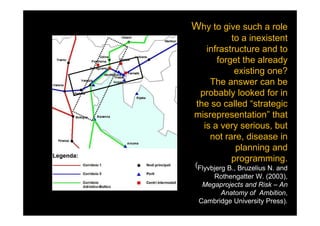
Why to give such a role
          to a inexistent
   infrastructure and to
      forget the already
           existing one?
    The answer can be
 probably looked for in
the so called “strategic
misrepresentation” that
  is a very serious, but
    not rare, disease in
           planning and
          programming.
(Flyvbjerg B., Bruzelius N. and
     Rothengatter W. (2003),
  Megaprojects and Risk – An
       Anatomy of Ambition,
 Cambridge University Press).
                       were?
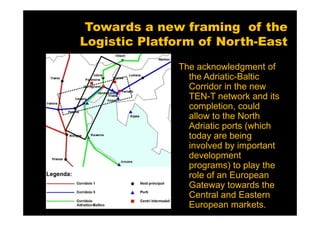
Towards a new framing of the
Logistic Platform of North-East
              The acknowledgment of
                the Adriatic-Baltic
                Corridor in the new
                TEN-T network and its
                completion, could
                allow to the North
                Adriatic ports (which
                today are being
                involved by important
                development
                programs) to play the
                role of an European
                Gateway towards the
                Central and Eastern
                European markets.
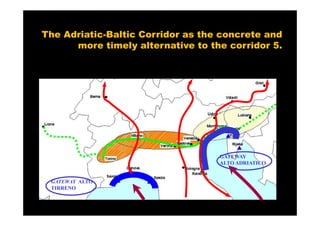
The Adriatic-Baltic Corridor as the concrete and
      more timely alternative to the corridor 5.


                                   GATEWAY
                                   ALTO ADRIATICO


 GATEWAY ALTO
 TIRRENO
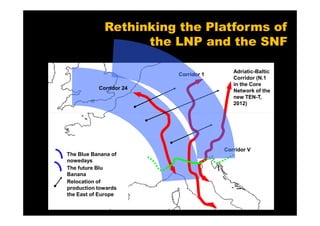
Rethinking the Platforms of
                   the LNP and the SNF

                                         Adriatic-Baltic
                         Corridor 1
                                         Corridor (N.1
                                         in the Core
           Corridor 24                   Network of the
                                         new TEN-T,
                                         2012)


                                      Corridor V
The Blue Banana of
nowedays
The future Blu
Banana
Relocation of
production towards
the East of Europe
Conclusion on the Case Study


Direct observations and implications:
  According to this case study, the national logistics
  planning and programming has, in the last decade,
  neglected important existing infrastructures. On the
  contrary, the post-crisis programming needs a deep
  change prioritizing the corridor sections which are
  actually able to produce, in a shorter term,
  economic benefits (as the Adriatic-Baltic corridor).
Conclusions
Direct but more general implications:
This case obliges to rethink the infrastructure and logistic
  strategies at the regional as well as at the National level.
         National as well as regional Plans have to be revised
         introducing the «European Gateway ports” category;
         Infrastructural priorities are to be reconsidered in
         accordance with this macro-objective.
         Before the provision of new infrastructures, priority has
         to be given to: a. the optimization of the existing
         transport infrastructures; b. the elimination of the
         bottleneks; c. the connection of the already existing
         corridors with the secondary regional networks;
         Finally, in the transport and logistic sector, a real open
         market has to be guaranteed in order to give, to the
         most competitive companies, the possibility to manage
         ports and networks and consequently to reduce the
         costs.
Thank you
for your attention!

Fabbro & Dean - input2012

  • 1.
    Input 2012 Cagliari, 10th-12th May 2012 Regional development strategies: the role of infrastructures and transport. The case of the Friuli Venezia Giulia region in the wider Northeastern Italian macroregion Prof. Sandro Fabbro - Ing. Marco Dean Department of Civil Engineering and Architecture University of Udine
  • 2.
    Paper contents andobjectives The paper analyzes the transport infrastructure planning, in the FVG region, in the context of the North Adriatic logistic system. Starting from the situation of this small but nodal region, the paper argues the necessity, for Italy, to radically restructure its policies in this sector. For achieving this aim, it seems necessary, first of all, to rethink the national planning. In particular the National Logistcs Plan (2006 and 2010) and the Strategic National Framework (2007-2013) are two frameworks which seem not anymore adequate to relaunch Italy in the context of the TEN-T networks.
  • 3.
    Towards a newNormal? In the World: Prosecution of growth in the BRICS countries; More attention regarding the search for better models of production, consumption, transportation, redistribution. In Europe: Prosecution of the economic and financial crisis; Decline of demand and production if not recession Less public resources for big investment programs Serious difficulties in the carrying on of the European construction model.
  • 4.
    Despite the favorable Europeanlogistic scenarios… (fonte: T. Notteboom (2010) “Concentration and the formation of multi-port gateway regions in the European container port system: an update”, Journal of Transport Geography, vol. 18, no. 4).
  • 5.
    the Italian currentsituation… The Italian ports serve only local markets (Isofort, 2011). While the Northern Range ports remain the only ones able to serve the whole Europe.
  • 6.
    seems not adequateto relaunch the national economy During the last decade, in spite of the remarkable developement of the maritime trade in the Mediterranean, the freight traffic in the Italian ports Sea, is increased slightly. This has been caused by: stagnation of the national economy; “bottlenecks” and several other transport problems; lack of coordination among the too many ports and freight villages; inadequacy of the national planning instruments (NL, 84/94, NLP 2006, SNF 2007-2013 ecc.) to be selective concerning the identification of few priority areas and nodes on which to focus investment and allow, to the most competitive companies, to manage the logistic services.
  • 7.
    Let’s try tothink optimistically. A post-crisis scenario (2030) If the Italian gateways of the North Adriatic and the North Tyrrhenian were adequately developed, they would be able to become complementary with the Northern Range gateways.
  • 8.
    Central and NorthernEurope: the shift of the European Blu Banana towards est Traslazione dei sistemi produttivi e logistici verso il Centro-Est Europa (previsioni al 2030) North North Adriatic Tirrenian Ports The Blue Banana Ports Fenomeni di decentralizzazione produttiva da parte di imprese dei Paesi più sviluppati
  • 9.
    The Mediterranean sea:The ports with potetialities of growth Ogni porto europeo punterà, per crescere, ad intercettare traffici euro-asiatici, soprattutto in esportazione dall'Europa. Lasciare il primato ai porti del Nord Europa o ad altre rotte via terra, significa perdere una occasione storica per l’Italia North Adriatic Port System Container ports that will increase their capacities Direct call ports (structurally more stable) Transhipment ports (subject to a strong competition even on minor variations in the port costs)
  • 10.
    The Strategic roleof North East Italy between Gateway and Corridors The North East Italy system’s (Veneto, Friuli Venezia Giulia and Trentino Alto Adige) represents one of the main crossroads between the EU corridors on the south part of Alps. It also represents not only a fundamental course to and from Eastern countries but also to the whole Mediterranean countries thanks to it’s access to the sea.
  • 11.
    THE IMPORTANCE OFNORTH EAST ITALY Population On GDP On (1’000) total (Million €) total Veneto 4.886 8,1% € 141.530 9,3% Friuli Venezia 1.231 2,1% € 34.856 2,3% Giulia Trentino 1.019 1,7% € 33.436 2,2% North-East 7.135 11,9% € 209.822 13,8% Italy 60.045 100,0% € 1.520.871 100,0% Source: ISTAT, 2009 data
  • 12.
    The paradox ofthe Logistic Platform of North-East The Friuli Venezia Giulia Region represents, due to its geographical position, a “Natural Logistic Platform”. It is in fact located at the crossroad of two fundamental European corridors: the Adriatic- Baltic Corridor along the N-S directrix (the green line) and the Corridor V on the E-W directrix (the blu line).
  • 13.
    The paradox of theLogistic Platform of North-East The new Logistic National Plan of 2010 seems to be only a partially reworking of the LPN, 2006 LPN, 2006
  • 14.
    The Strategic TerritorialPlatforms of the Italian Ministry of Infrastructure and Transport (2007) Ancora nel 2007 (Strategic National Framework (2007-2013) la “PL di Nord Est” si reggeva essenzialmente su un Corridoio (il C. 5) che da Venezia a Trieste non esiste ed ancora meno esiste da Trieste a Lubiana. E si dimenticava del Corridoio Adriatico- Baltico. .
  • 15.
    Why to insiston a non-existing new infrastructure (the AC/AV new railway of the Corr.5) and forgetting the already existing one? Even in FVG, both the PRITML, Regione Autonoma FVG, 2011 Piano Territoriale Regionale (2007) and the Regional Plan for Infrastructures and Logistic (2011), are neglecting or underestimating the role of the railway already realized, with great efforts, during the Ninetines and that is beeing in operation since the 2000.
  • 16.
    Finally… in the New TEN-T priorities (2012), the «forgotten» railway becomes the priority n. 1
  • 17.
    Why to givesuch a role to a inexistent infrastructure and to forget the already existing one? The answer can be probably looked for in the so called “strategic misrepresentation” that is a very serious, but not rare, disease in planning and programming. (Flyvbjerg B., Bruzelius N. and Rothengatter W. (2003), Megaprojects and Risk – An Anatomy of Ambition, Cambridge University Press). were?
  • 18.
    Towards a newframing of the Logistic Platform of North-East The acknowledgment of the Adriatic-Baltic Corridor in the new TEN-T network and its completion, could allow to the North Adriatic ports (which today are being involved by important development programs) to play the role of an European Gateway towards the Central and Eastern European markets.
  • 19.
    The Adriatic-Baltic Corridoras the concrete and more timely alternative to the corridor 5. GATEWAY ALTO ADRIATICO GATEWAY ALTO TIRRENO
  • 20.
    Rethinking the Platformsof the LNP and the SNF Adriatic-Baltic Corridor 1 Corridor (N.1 in the Core Corridor 24 Network of the new TEN-T, 2012) Corridor V The Blue Banana of nowedays The future Blu Banana Relocation of production towards the East of Europe
  • 21.
    Conclusion on theCase Study Direct observations and implications: According to this case study, the national logistics planning and programming has, in the last decade, neglected important existing infrastructures. On the contrary, the post-crisis programming needs a deep change prioritizing the corridor sections which are actually able to produce, in a shorter term, economic benefits (as the Adriatic-Baltic corridor).
  • 22.
    Conclusions Direct but moregeneral implications: This case obliges to rethink the infrastructure and logistic strategies at the regional as well as at the National level. National as well as regional Plans have to be revised introducing the «European Gateway ports” category; Infrastructural priorities are to be reconsidered in accordance with this macro-objective. Before the provision of new infrastructures, priority has to be given to: a. the optimization of the existing transport infrastructures; b. the elimination of the bottleneks; c. the connection of the already existing corridors with the secondary regional networks; Finally, in the transport and logistic sector, a real open market has to be guaranteed in order to give, to the most competitive companies, the possibility to manage ports and networks and consequently to reduce the costs.
  • 23.