JUVENILE IDIOPATHIC
ARTHRITIS
Dr Ritasman Baisya
Assistant Professor, Rheumatology
NIMS , Hyderabad
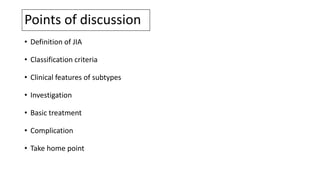
Points of discussion
• Definition of JIA
• Classification criteria
• Clinical features of subtypes
• Investigation
• Basic treatment
• Complication
• Take home point
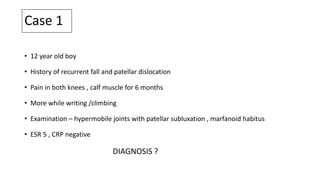
Case 1
• 12 year old boy
• History of recurrent fall and patellar dislocation
• Pain in both knees , calf muscle for 6 months
• More while writing /climbing
• Examination – hypermobile joints with patellar subluxation , marfanoid habitus
• ESR 5 , CRP negative
DIAGNOSIS ?
Case 2
• 9 year old girl
• Pain in both knees for 6 months with swelling
• History of fever , weight loss
• Exam- cervical lymphadenopathy , sternal tenderness , active knee synovitis
• CBP- 10/45000/ 1.5 , Blast 80%
Diagnosis ?
Case 3
• 6 year old boy
• Pain in both knees with swelling , EMS- 30 min for 6 months
• Relieved with NSAIDs, feverish at hike of joint pain
• Exam- both knee active synovitis with flexion deformity
• ESR -45 , CRP -24 , CBP-10/10000/5.6 , RF-negative
DIAGNOSIS ?
All of them have knee pain , but -
• First case – Mechanical pain , due to hypermobility + Growing pain
• Second case - Leukemia causing knee arthritis
• Third case – No specific cause is identified – Juvenile idiopathic
arthritis
Definition of JIA
• Onset before the age of 16 years
• Cause of arthritis is unknown
• Swelling within a joint / limitation in the range of movement with joint
pain or tenderness, which persists for at least 6 weeks, is observed by a
physician
• Not primarily caused by mechanical disorders / other identifiable causes
(e.g., infection, CTD , metabolic , genetic disorders )
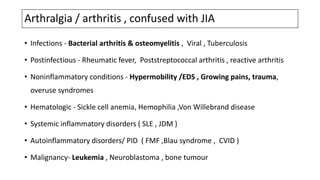
Arthralgia / arthritis , confused with JIA
• Infections - Bacterial arthritis & osteomyelitis , Viral , Tuberculosis
• Postinfectious - Rheumatic fever, Poststreptococcal arthritis , reactive arthritis
• Noninflammatory conditions - Hypermobility /EDS , Growing pains, trauma,
overuse syndromes
• Hematologic - Sickle cell anemia, Hemophilia ,Von Willebrand disease
• Systemic inflammatory disorders ( SLE , JDM )
• Autoinflammatory disorders/ PID ( FMF ,Blau syndrome , CVID )
• Malignancy- Leukemia , Neuroblastoma , bone tumour
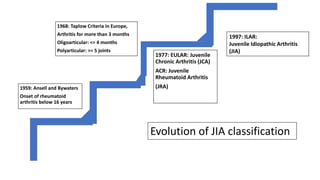
1959: Ansell and Bywaters
Onset of rheumatoid
arthritis below 16 years
1968: Taplow Criteria in Europe,
Arthritis for more than 3 months
Oligoarticular: <= 4 months
Polyarticular: >= 5 joints
1977: EULAR: Juvenile
Chronic Arthritis (JCA)
ACR: Juvenile
Rheumatoid Arthritis
(JRA)
1997: ILAR:
Juvenile Idiopathic Arthritis
(JIA)
Evolution of JIA classification
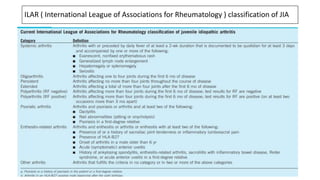
ILAR ( International League of Associations for Rheumatology ) classification of JIA
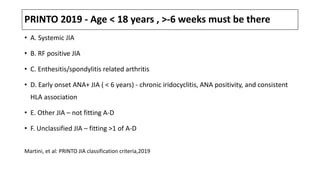
PRINTO 2019 - Age < 18 years , >-6 weeks must be there
• A. Systemic JIA
• B. RF positive JIA
• C. Enthesitis/spondylitis related arthritis
• D. Early onset ANA+ JIA ( < 6 years) - chronic iridocyclitis, ANA positivity, and consistent
HLA association
• E. Other JIA – not fitting A-D
• F. Unclassified JIA – fitting >1 of A-D
Martini, et al: PRINTO JIA classification criteria,2019
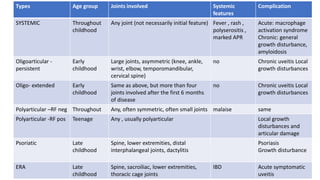
Types Age group Joints involved Systemic
features
Complication
SYSTEMIC Throughout
childhood
Any joint (not necessarily initial feature) Fever , rash ,
polyserositis ,
marked APR
Acute: macrophage
activation syndrome
Chronic: general
growth disturbance,
amyloidosis
Oligoarticular -
persistent
Early
childhood
Large joints, asymmetric (knee, ankle,
wrist, elbow, temporomandibular,
cervical spine)
no Chronic uveitis Local
growth disturbances
Oligo- extended Early
childhood
Same as above, but more than four
joints involved after the first 6 months
of disease
no Chronic uveitis Local
growth disturbances
Polyarticular –RF neg Throughout Any, often symmetric, often small joints malaise same
Polyarticular -RF pos Teenage Any , usually polyarticular Local growth
disturbances and
articular damage
Psoriatic Late
childhood
Spine, lower extremities, distal
interphalangeal joints, dactylitis
Psoriasis
Growth disturbance
ERA Late
childhood
Spine, sacroiliac, lower extremities,
thoracic cage joints
IBD Acute symptomatic
uveitis
Clinical features
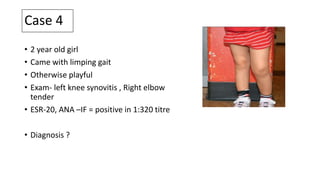
Case 4
• 2 year old girl
• Came with limping gait
• Otherwise playful
• Exam- left knee synovitis , Right elbow
tender
• ESR-20, ANA –IF = positive in 1:320 titre
• Diagnosis ?
ANA positive oligoarticular JIA
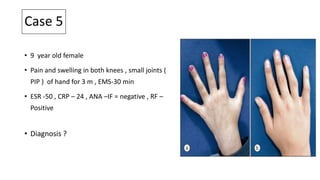
Case 5
• 9 year old female
• Pain and swelling in both knees , small joints (
PIP ) of hand for 3 m , EMS-30 min
• ESR -50 , CRP – 24 , ANA –IF = negative , RF –
Positive
• Diagnosis ?
RF positive Polyarticular JIA , ANA negative
Oligoarticular
• Less than 5 joints
• If > 5 joint after 6m- extended oligoarticular
• younger than 5 years , peak age 1-3 yr , F>M
• Limp – MC , pain less frequent , no constitutional features
• Knee –MC , Hip- rarest ( exclude other diagnosis )
• ESR ,CRP –near normal
• 40-85% ANA positive
• ANA , female – increased chance of chronic asymptomatic uveitis
Polyarticular
• RF negative-
• knee , ankle , elbow , MCP ,PIP , cervical spine ( torticollis )
• Flexor tenosynovitis , mild systemic features
• RF positive-
• Symmetric , unremitting polyarthritis ,behaves like adult RA
• Early erosion , nodules
• Poor outcome with deformity
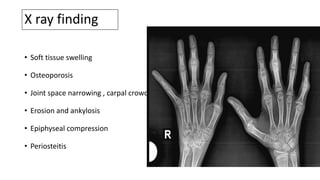
X ray finding
• Soft tissue swelling
• Osteoporosis
• Joint space narrowing , carpal crowding
• Erosion and ankylosis
• Epiphyseal compression
• Periosteitis
Case 6
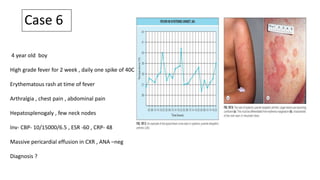
4 year old boy
High grade fever for 2 week , daily one spike of 40C
Erythematous rash at time of fever
Arthralgia , chest pain , abdominal pain
Hepatosplenogaly , few neck nodes
Inv- CBP- 10/15000/6.5 , ESR -60 , CRP- 48
Massive pericardial effusion in CXR , ANA –neg
Diagnosis ?
Systemic onset JIA
SOJIA
• 90% cases - evanescent salmon-colored maculopapular rash over trunk, thighs,
upper arms, most commonly when the fever is present
• Koebner + , occasionally pruritic
• Polyarthritis followed by fever ( 3-12 weeks )
• Generalized lymphadenopathy , hepatosplenomegaly - 50% - 75%
• Polyserositis , pericardial effusion , tamponade , myocarditis ( rare )
• Pulmonary – pneumonitis , pleural effusion , pulmonary fibrosis
• CNS – coma , meningitis
Investigation
• CBP- leukocytosis , thrombocytosis
• LFT – mild elevated liver enzymes
• High ESR , CRP
• Xray joints – soft tissue swelling , osteoporosis , periostitis , epiphyseal collapse
• Chest x ray , 2D echo , US –abdomen
Case 7
• 10 year old male
• Pain at both heel and sole for 2 years , more in early morning while starts walking
, improved with walking slowly
• Father has IBP , diagnosed as AS
• He had also history of right eye uveitis 6 month back
• Diagnosis ?
Enthesitis related arthritis
ERA
• Enthesitis- related arthritis affects boys more than girls and presents most
commonly after the age of 9 years.
• Entheseal tenderness ( heel , plantar fascia , rib cage )
• Knee , ankle , hip
• Inflammatory back pain
• HLA B27 association , family history , IBD ,
• Acute symptomatic iritis – 10-15%
Juvenile PsA
• Dactylitis, nail pitting, distal interphalangeal arthritis, and asymmetric
RF negative peripheral arthritis
• IBP common
• Heterogenous category
• Needs revision in criteria
Management
Case 4 Rx
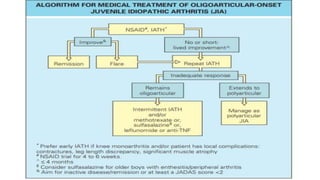
• Diagnosed as oligoarticuar JIA
• Started NSAIDs for 4 weeks and intraarticular triamcinolone hexaacetnide in
knee
• She was fine for 3 months
• Then right knee , right ankle, right elbow arthritis after 6m
• Started Methotrexate 10mg/m2 – she is fine
Case 5 Rx
• Diagnosed as polyarticular JIA
• Started low dose steroid for 4 weeks with oral methotrexate 10mg/m2
• After 2 month Mtx hiked to sc 15 mg/m2 – inadequate response
• Started inj. adalimumab s.c . every 2 week with methotrexate – achieves
remission
Case 6 Rx
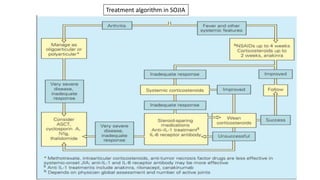
• Diagnosed as SOJIA
• Started steroid for 2 weeks – inadequate response
• Planned for IL6 receptor antagonist tocilizumab with low dose steroid
• He was improved and fine
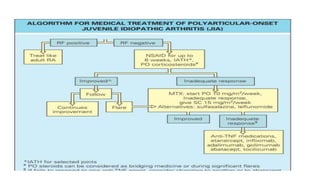
Treatment algorithm in SOJIA
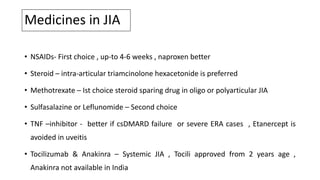
Medicines in JIA
• NSAIDs- First choice , up-to 4-6 weeks , naproxen better
• Steroid – intra-articular triamcinolone hexacetonide is preferred
• Methotrexate – Ist choice steroid sparing drug in oligo or polyarticular JIA
• Sulfasalazine or Leflunomide – Second choice
• TNF –inhibitor - better if csDMARD failure or severe ERA cases , Etanercept is
avoided in uveitis
• Tocilizumab & Anakinra – Systemic JIA , Tocili approved from 2 years age ,
Anakinra not available in India
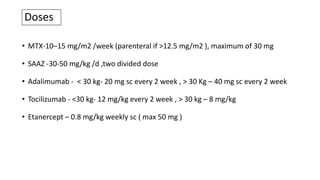
Doses
• MTX-10–15 mg/m2 /week (parenteral if >12.5 mg/m2 ), maximum of 30 mg
• SAAZ -30-50 mg/kg /d ,two divided dose
• Adalimumab - < 30 kg- 20 mg sc every 2 week , > 30 Kg – 40 mg sc every 2 week
• Tocilizumab - <30 kg- 12 mg/kg every 2 week , > 30 kg – 8 mg/kg
• Etanercept – 0.8 mg/kg weekly sc ( max 50 mg )
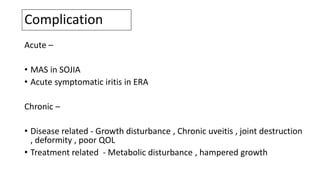
Complication
Acute –
• MAS in SOJIA
• Acute symptomatic iritis in ERA
Chronic –
• Disease related - Growth disturbance , Chronic uveitis , joint destruction
, deformity , poor QOL
• Treatment related - Metabolic disturbance , hampered growth
Case 6 readmitted
• 4 year boy who diagnosed as SOJIA ( case -6)
• Was fine with low dose steroid and tocilizumab for 6 months
• Stopped Tocilizumab due to financial constraints and other medicines due to fear
of side effects
• Presented with continuous high grade fever for 7 days ,never touched baseline
• Active arthritis , serositis , skin rash
• Exam- toxic , tachycardia , tachypnea , altered mental status
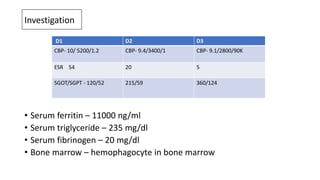
Investigation
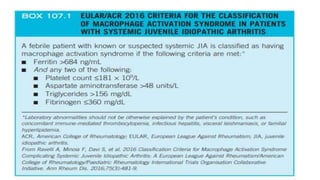
• Serum ferritin – 11000 ng/ml
• Serum triglyceride – 235 mg/dl
• Serum fibrinogen – 20 mg/dl
• Bone marrow – hemophagocyte in bone marrow
D1 D2 D3
CBP- 10/ 5200/1.2 CBP- 9.4/3400/1 CBP- 9.1/2800/90K
ESR 54 20 5
SGOT/SGPT - 120/52 215/59 360/124
MAS
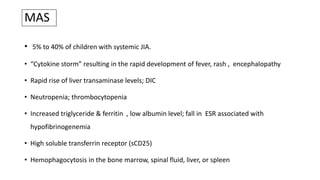
• 5% to 40% of children with systemic JIA.
• “Cytokine storm” resulting in the rapid development of fever, rash , encephalopathy
• Rapid rise of liver transaminase levels; DIC
• Neutropenia; thrombocytopenia
• Increased triglyceride & ferritin , low albumin level; fall in ESR associated with
hypofibrinogenemia
• High soluble transferrin receptor (sCD25)
• Hemophagocytosis in the bone marrow, spinal fluid, liver, or spleen
Therapy
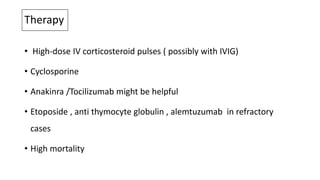
• High-dose IV corticosteroid pulses ( possibly with IVIG)
• Cyclosporine
• Anakinra /Tocilizumab might be helpful
• Etoposide , anti thymocyte globulin , alemtuzumab in refractory
cases
• High mortality
Uveitis
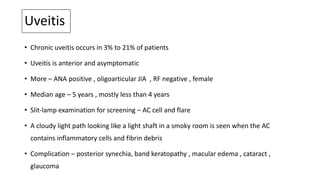
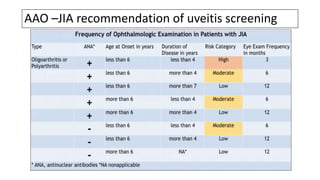
• Chronic uveitis occurs in 3% to 21% of patients
• Uveitis is anterior and asymptomatic
• More – ANA positive , oligoarticular JIA , RF negative , female
• Median age – 5 years , mostly less than 4 years
• Slit-lamp examination for screening – AC cell and flare
• A cloudy light path looking like a light shaft in a smoky room is seen when the AC
contains inflammatory cells and fibrin debris
• Complication – posterior synechia, band keratopathy , macular edema , cataract ,
glaucoma
AAO –JIA recommendation of uveitis screening
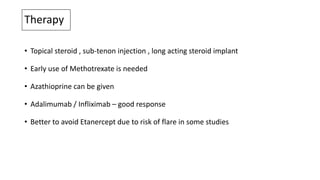
Therapy
• Topical steroid , sub-tenon injection , long acting steroid implant
• Early use of Methotrexate is needed
• Azathioprine can be given
• Adalimumab / Infliximab – good response
• Better to avoid Etanercept due to risk of flare in some studies
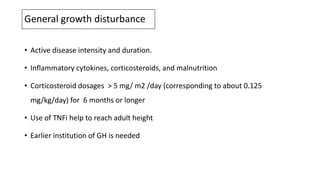
General growth disturbance
• Active disease intensity and duration.
• Inflammatory cytokines, corticosteroids, and malnutrition
• Corticosteroid dosages > 5 mg/ m2 /day (corresponding to about 0.125
mg/kg/day) for 6 months or longer
• Use of TNFi help to reach adult height
• Earlier institution of GH is needed
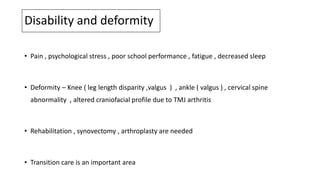
Disability and deformity
• Pain , psychological stress , poor school performance , fatigue , decreased sleep
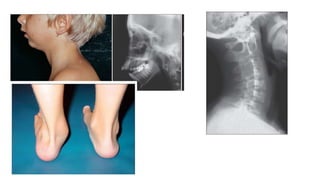
• Deformity – Knee ( leg length disparity ,valgus ) , ankle ( valgus ) , cervical spine
abnormality , altered craniofacial profile due to TMJ arthritis
• Rehabilitation , synovectomy , arthroplasty are needed
• Transition care is an important area
Learning point
• JIA - diagnosis of exclusion , age < 16 years , duration > 6 week
• ILAR 1997 classification – Oligoarticular , Polyarticular , Systemic , ERA , juvenile PsA ,undifferentiated
• PRINTO based on ANA positivity , RF positivity ( latest )
• Oligoarticular < 5 – up-to 6 m ( persistent ) , > 5 after 6m - extended
• Polyarticular – RF positive/Negative
• SOJIA – fever , rash , systemic features , can lead to MAS
• NSAIDs , steroid , methotrexate , TNF inhibitor in articular JIA
• Tocilizumab , anakinra in SOJIA
• Chronic uveitis in JIA is asymptomatic , needs screening frequently for ANA positive oligoarticular
female cases
Thank you
You can read for more details -
• Hochberg Rheumatology
• Kelley Rheumatology
• Zaripova, L.N., Midgley, A., Christmas, S.E. et al. Juvenile idiopathic arthritis: from aetiopathogenesis to
therapeutic approaches. Pediatr Rheumatol 19, 135 (2021).

JIA1.ppt a basic approach to know about JIA

  • 1.
    JUVENILE IDIOPATHIC ARTHRITIS Dr RitasmanBaisya Assistant Professor, Rheumatology NIMS , Hyderabad
  • 2.
    Points of discussion •Definition of JIA • Classification criteria • Clinical features of subtypes • Investigation • Basic treatment • Complication • Take home point
  • 3.
    Case 1 • 12year old boy • History of recurrent fall and patellar dislocation • Pain in both knees , calf muscle for 6 months • More while writing /climbing • Examination – hypermobile joints with patellar subluxation , marfanoid habitus • ESR 5 , CRP negative DIAGNOSIS ?
  • 4.
    Case 2 • 9year old girl • Pain in both knees for 6 months with swelling • History of fever , weight loss • Exam- cervical lymphadenopathy , sternal tenderness , active knee synovitis • CBP- 10/45000/ 1.5 , Blast 80% Diagnosis ?
  • 5.
    Case 3 • 6year old boy • Pain in both knees with swelling , EMS- 30 min for 6 months • Relieved with NSAIDs, feverish at hike of joint pain • Exam- both knee active synovitis with flexion deformity • ESR -45 , CRP -24 , CBP-10/10000/5.6 , RF-negative DIAGNOSIS ?
  • 6.
    All of themhave knee pain , but - • First case – Mechanical pain , due to hypermobility + Growing pain • Second case - Leukemia causing knee arthritis • Third case – No specific cause is identified – Juvenile idiopathic arthritis
  • 7.
    Definition of JIA •Onset before the age of 16 years • Cause of arthritis is unknown • Swelling within a joint / limitation in the range of movement with joint pain or tenderness, which persists for at least 6 weeks, is observed by a physician • Not primarily caused by mechanical disorders / other identifiable causes (e.g., infection, CTD , metabolic , genetic disorders )
  • 8.
    Arthralgia / arthritis, confused with JIA • Infections - Bacterial arthritis & osteomyelitis , Viral , Tuberculosis • Postinfectious - Rheumatic fever, Poststreptococcal arthritis , reactive arthritis • Noninflammatory conditions - Hypermobility /EDS , Growing pains, trauma, overuse syndromes • Hematologic - Sickle cell anemia, Hemophilia ,Von Willebrand disease • Systemic inflammatory disorders ( SLE , JDM ) • Autoinflammatory disorders/ PID ( FMF ,Blau syndrome , CVID ) • Malignancy- Leukemia , Neuroblastoma , bone tumour
  • 9.
    1959: Ansell andBywaters Onset of rheumatoid arthritis below 16 years 1968: Taplow Criteria in Europe, Arthritis for more than 3 months Oligoarticular: <= 4 months Polyarticular: >= 5 joints 1977: EULAR: Juvenile Chronic Arthritis (JCA) ACR: Juvenile Rheumatoid Arthritis (JRA) 1997: ILAR: Juvenile Idiopathic Arthritis (JIA) Evolution of JIA classification
  • 10.
    ILAR ( InternationalLeague of Associations for Rheumatology ) classification of JIA
  • 11.
    PRINTO 2019 -Age < 18 years , >-6 weeks must be there • A. Systemic JIA • B. RF positive JIA • C. Enthesitis/spondylitis related arthritis • D. Early onset ANA+ JIA ( < 6 years) - chronic iridocyclitis, ANA positivity, and consistent HLA association • E. Other JIA – not fitting A-D • F. Unclassified JIA – fitting >1 of A-D Martini, et al: PRINTO JIA classification criteria,2019
  • 12.
    Types Age groupJoints involved Systemic features Complication SYSTEMIC Throughout childhood Any joint (not necessarily initial feature) Fever , rash , polyserositis , marked APR Acute: macrophage activation syndrome Chronic: general growth disturbance, amyloidosis Oligoarticular - persistent Early childhood Large joints, asymmetric (knee, ankle, wrist, elbow, temporomandibular, cervical spine) no Chronic uveitis Local growth disturbances Oligo- extended Early childhood Same as above, but more than four joints involved after the first 6 months of disease no Chronic uveitis Local growth disturbances Polyarticular –RF neg Throughout Any, often symmetric, often small joints malaise same Polyarticular -RF pos Teenage Any , usually polyarticular Local growth disturbances and articular damage Psoriatic Late childhood Spine, lower extremities, distal interphalangeal joints, dactylitis Psoriasis Growth disturbance ERA Late childhood Spine, sacroiliac, lower extremities, thoracic cage joints IBD Acute symptomatic uveitis
  • 13.
  • 14.
    Case 4 • 2year old girl • Came with limping gait • Otherwise playful • Exam- left knee synovitis , Right elbow tender • ESR-20, ANA –IF = positive in 1:320 titre • Diagnosis ?
  • 15.
  • 16.
    Case 5 • 9year old female • Pain and swelling in both knees , small joints ( PIP ) of hand for 3 m , EMS-30 min • ESR -50 , CRP – 24 , ANA –IF = negative , RF – Positive • Diagnosis ?
  • 17.
    RF positive PolyarticularJIA , ANA negative
  • 18.
    Oligoarticular • Less than5 joints • If > 5 joint after 6m- extended oligoarticular • younger than 5 years , peak age 1-3 yr , F>M • Limp – MC , pain less frequent , no constitutional features • Knee –MC , Hip- rarest ( exclude other diagnosis ) • ESR ,CRP –near normal • 40-85% ANA positive • ANA , female – increased chance of chronic asymptomatic uveitis
  • 19.
    Polyarticular • RF negative- •knee , ankle , elbow , MCP ,PIP , cervical spine ( torticollis ) • Flexor tenosynovitis , mild systemic features • RF positive- • Symmetric , unremitting polyarthritis ,behaves like adult RA • Early erosion , nodules • Poor outcome with deformity
  • 20.
    X ray finding •Soft tissue swelling • Osteoporosis • Joint space narrowing , carpal crowding • Erosion and ankylosis • Epiphyseal compression • Periosteitis
  • 21.
    Case 6 4 yearold boy High grade fever for 2 week , daily one spike of 40C Erythematous rash at time of fever Arthralgia , chest pain , abdominal pain Hepatosplenogaly , few neck nodes Inv- CBP- 10/15000/6.5 , ESR -60 , CRP- 48 Massive pericardial effusion in CXR , ANA –neg Diagnosis ?
  • 22.
  • 23.
    SOJIA • 90% cases- evanescent salmon-colored maculopapular rash over trunk, thighs, upper arms, most commonly when the fever is present • Koebner + , occasionally pruritic • Polyarthritis followed by fever ( 3-12 weeks ) • Generalized lymphadenopathy , hepatosplenomegaly - 50% - 75% • Polyserositis , pericardial effusion , tamponade , myocarditis ( rare ) • Pulmonary – pneumonitis , pleural effusion , pulmonary fibrosis • CNS – coma , meningitis
  • 24.
    Investigation • CBP- leukocytosis, thrombocytosis • LFT – mild elevated liver enzymes • High ESR , CRP • Xray joints – soft tissue swelling , osteoporosis , periostitis , epiphyseal collapse • Chest x ray , 2D echo , US –abdomen
  • 25.
    Case 7 • 10year old male • Pain at both heel and sole for 2 years , more in early morning while starts walking , improved with walking slowly • Father has IBP , diagnosed as AS • He had also history of right eye uveitis 6 month back • Diagnosis ?
  • 26.
  • 27.
    ERA • Enthesitis- relatedarthritis affects boys more than girls and presents most commonly after the age of 9 years. • Entheseal tenderness ( heel , plantar fascia , rib cage ) • Knee , ankle , hip • Inflammatory back pain • HLA B27 association , family history , IBD , • Acute symptomatic iritis – 10-15%
  • 28.
    Juvenile PsA • Dactylitis,nail pitting, distal interphalangeal arthritis, and asymmetric RF negative peripheral arthritis • IBP common • Heterogenous category • Needs revision in criteria
  • 29.
  • 30.
    Case 4 Rx •Diagnosed as oligoarticuar JIA • Started NSAIDs for 4 weeks and intraarticular triamcinolone hexaacetnide in knee • She was fine for 3 months • Then right knee , right ankle, right elbow arthritis after 6m • Started Methotrexate 10mg/m2 – she is fine
  • 32.
    Case 5 Rx •Diagnosed as polyarticular JIA • Started low dose steroid for 4 weeks with oral methotrexate 10mg/m2 • After 2 month Mtx hiked to sc 15 mg/m2 – inadequate response • Started inj. adalimumab s.c . every 2 week with methotrexate – achieves remission
  • 34.
    Case 6 Rx •Diagnosed as SOJIA • Started steroid for 2 weeks – inadequate response • Planned for IL6 receptor antagonist tocilizumab with low dose steroid • He was improved and fine
  • 35.
  • 36.
    Medicines in JIA •NSAIDs- First choice , up-to 4-6 weeks , naproxen better • Steroid – intra-articular triamcinolone hexacetonide is preferred • Methotrexate – Ist choice steroid sparing drug in oligo or polyarticular JIA • Sulfasalazine or Leflunomide – Second choice • TNF –inhibitor - better if csDMARD failure or severe ERA cases , Etanercept is avoided in uveitis • Tocilizumab & Anakinra – Systemic JIA , Tocili approved from 2 years age , Anakinra not available in India
  • 37.
    Doses • MTX-10–15 mg/m2/week (parenteral if >12.5 mg/m2 ), maximum of 30 mg • SAAZ -30-50 mg/kg /d ,two divided dose • Adalimumab - < 30 kg- 20 mg sc every 2 week , > 30 Kg – 40 mg sc every 2 week • Tocilizumab - <30 kg- 12 mg/kg every 2 week , > 30 kg – 8 mg/kg • Etanercept – 0.8 mg/kg weekly sc ( max 50 mg )
  • 38.
    Complication Acute – • MASin SOJIA • Acute symptomatic iritis in ERA Chronic – • Disease related - Growth disturbance , Chronic uveitis , joint destruction , deformity , poor QOL • Treatment related - Metabolic disturbance , hampered growth
  • 39.
    Case 6 readmitted •4 year boy who diagnosed as SOJIA ( case -6) • Was fine with low dose steroid and tocilizumab for 6 months • Stopped Tocilizumab due to financial constraints and other medicines due to fear of side effects • Presented with continuous high grade fever for 7 days ,never touched baseline • Active arthritis , serositis , skin rash • Exam- toxic , tachycardia , tachypnea , altered mental status
  • 40.
    Investigation • Serum ferritin– 11000 ng/ml • Serum triglyceride – 235 mg/dl • Serum fibrinogen – 20 mg/dl • Bone marrow – hemophagocyte in bone marrow D1 D2 D3 CBP- 10/ 5200/1.2 CBP- 9.4/3400/1 CBP- 9.1/2800/90K ESR 54 20 5 SGOT/SGPT - 120/52 215/59 360/124
  • 41.
    MAS • 5% to40% of children with systemic JIA. • “Cytokine storm” resulting in the rapid development of fever, rash , encephalopathy • Rapid rise of liver transaminase levels; DIC • Neutropenia; thrombocytopenia • Increased triglyceride & ferritin , low albumin level; fall in ESR associated with hypofibrinogenemia • High soluble transferrin receptor (sCD25) • Hemophagocytosis in the bone marrow, spinal fluid, liver, or spleen
  • 43.
    Therapy • High-dose IVcorticosteroid pulses ( possibly with IVIG) • Cyclosporine • Anakinra /Tocilizumab might be helpful • Etoposide , anti thymocyte globulin , alemtuzumab in refractory cases • High mortality
  • 44.
    Uveitis • Chronic uveitisoccurs in 3% to 21% of patients • Uveitis is anterior and asymptomatic • More – ANA positive , oligoarticular JIA , RF negative , female • Median age – 5 years , mostly less than 4 years • Slit-lamp examination for screening – AC cell and flare • A cloudy light path looking like a light shaft in a smoky room is seen when the AC contains inflammatory cells and fibrin debris • Complication – posterior synechia, band keratopathy , macular edema , cataract , glaucoma
  • 45.
    AAO –JIA recommendationof uveitis screening
  • 46.
    Therapy • Topical steroid, sub-tenon injection , long acting steroid implant • Early use of Methotrexate is needed • Azathioprine can be given • Adalimumab / Infliximab – good response • Better to avoid Etanercept due to risk of flare in some studies
  • 47.
    General growth disturbance •Active disease intensity and duration. • Inflammatory cytokines, corticosteroids, and malnutrition • Corticosteroid dosages > 5 mg/ m2 /day (corresponding to about 0.125 mg/kg/day) for 6 months or longer • Use of TNFi help to reach adult height • Earlier institution of GH is needed
  • 48.
    Disability and deformity •Pain , psychological stress , poor school performance , fatigue , decreased sleep • Deformity – Knee ( leg length disparity ,valgus ) , ankle ( valgus ) , cervical spine abnormality , altered craniofacial profile due to TMJ arthritis • Rehabilitation , synovectomy , arthroplasty are needed • Transition care is an important area
  • 50.
    Learning point • JIA- diagnosis of exclusion , age < 16 years , duration > 6 week • ILAR 1997 classification – Oligoarticular , Polyarticular , Systemic , ERA , juvenile PsA ,undifferentiated • PRINTO based on ANA positivity , RF positivity ( latest ) • Oligoarticular < 5 – up-to 6 m ( persistent ) , > 5 after 6m - extended • Polyarticular – RF positive/Negative • SOJIA – fever , rash , systemic features , can lead to MAS • NSAIDs , steroid , methotrexate , TNF inhibitor in articular JIA • Tocilizumab , anakinra in SOJIA • Chronic uveitis in JIA is asymptomatic , needs screening frequently for ANA positive oligoarticular female cases
  • 51.
    Thank you You canread for more details - • Hochberg Rheumatology • Kelley Rheumatology • Zaripova, L.N., Midgley, A., Christmas, S.E. et al. Juvenile idiopathic arthritis: from aetiopathogenesis to therapeutic approaches. Pediatr Rheumatol 19, 135 (2021).