There is no singular test for diagnosing rheumatoid
arthritis.
Instead, rheumatoid arthritis is diagnosed based
on :history & physical examination & investigations

The Importance of Early Diagnosis
RA is progressive, not benign.
Structural damage/disability occurs
within first 2 to 3 years of disease.
Slower progression of disease linked
to early treatment
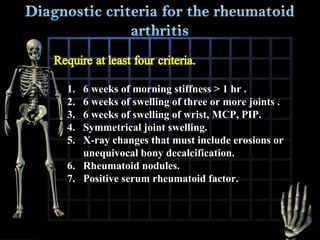
1.
2.
3.
4.
5.

6 weeks of morning stiffness > 1 hr .
6 weeks of swelling of three or more joints .
6 weeks of swelling of wrist, MCP, PIP.
Symmetrical joint swelling.
X-ray changes that must include erosions or
unequivocal bony decalcification.
6. Rheumatoid nodules.
7. Positive serum rheumatoid factor.
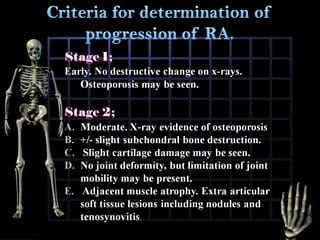
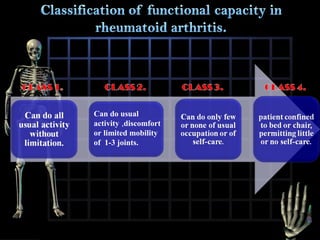
Can do usual
activity ,discomfort
or limited mobility
of 1-3 joints.
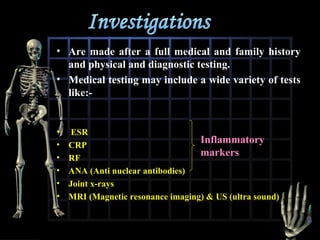
• Are made after a full medical and family history
and physical and diagnostic testing.
• Medical testing may include a wide variety of tests
like:-

•
•
•
•
•
•

ESR
Inflammatory
CRP
markers
RF
ANA (Anti nuclear antibodies)
Joint x-rays
MRI (Magnetic resonance imaging) & US (ultra sound)
CONTD….
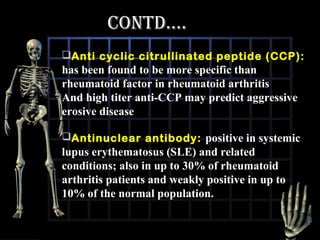
Anti cyclic citrullinated peptide (CCP):

has been found to be more specific than
rheumatoid factor in rheumatoid arthritis
And high titer anti-CCP may predict aggressive
erosive disease
Antinuclear antibody: positive in systemic

lupus erythematosus (SLE) and related
conditions; also in up to 30% of rheumatoid
arthritis patients and weakly positive in up to
10% of the normal population.
• C-Reactive protein
– Correlates with disease activity and radiologic
progression
– One of the most responsive acute phase reactants
– Can be elevated in many non-RA related
diseases

• Erythrocyte sedimentation rate
– Influenced by non-acute phase response factors
– Can be elevated in many non-RA related
diseases
Is an autoantibody that is present in the blood
of most people with RA (75-80%)
 Directed against host immunoglobulin
(is positive in no more than 5 percent of patients
without rheumatoid arthritis).
Repeat

negative

6-12 months following disease onset if
Liver function tests… mild elevation of alkaline
phosphatase and .Low serum albumin .
CBC…normochromic normocytic or Microcytic anemia .
Hemoglobin slightly decreased; hemoglobin averages
around 10 g/dL .Platelets & WBCs Usually increased.

Urinalysis … Microscopic hematuria or proteinuria
may be present, indicat connective tissue diseases.

Joint fluid … to rule out other diseases; 5,000 to
25,000 WBC with polymorphonuclear leukocytes .
cultures are negative, there are no crystals, and fluid
glucose level typically is low.
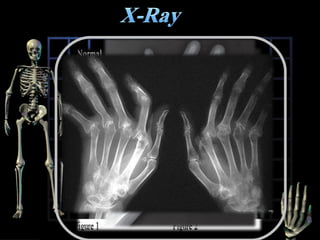
X-Ray of both hands and wrists and feet for
suspected RA.
MRI it is more sensitive to detect RA change.

 X-ray change
•
•
•
•
•

Loss of joint space
Soft tissue swelling
Bony decalcification
Erosions
Peri-articular osteoporosis
• Social factors
– Low socioeconomic status
– Less education
– Psychosocial stress
– female sex
• Physical factors
– Extra-articular manifestations
– Elevated CRP and ESR
– High titers of RF
– early Erosions on x-ray
– Duration of disease
•
•
•
•
•

Goals of Treatment
Relieve pain
Reduce inflammation
Slow down or stop joint damage
Maintaining the ability to function in daily
activities, improving the quality of life.
• Current Treatment
• Non - pharmacological
• pharmacological
• Surgery
• Routine monitoring and ongoing care.
• Physiotherapy is a vital part of treating RA may be
useful in decreasing the symptoms of RA.

• program of exercise strengthens joints & minimize
deformity and increase the range of movement and
functions.

• Natural treatments include using massage with
herbs, magneto therapy etc..

• Occupational therapy can give advice to do every
day activities with less pain or advice on how to use
splints, skills training.

• Weight loss & Smoking cessation
• Analgesics
used only for pain relief
E.g.:- Oral
Paracetamol
Topical
Capsaicin
Diclofenac
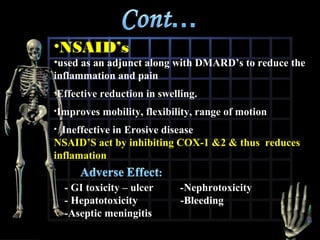
•NSAID’s

•used as an adjunct along with DMARD’s to reduce the
inflammation and pain
•Effective

reduction in swelling.

•Improves

mobility, flexibility, range of motion

Ineffective in Erosive disease
NSAID’S act by inhibiting COX-1 &2 & thus reduces
inflamation
•

- GI toxicity – ulcer
- Hepatotoxicity
-Aseptic meningitis

-Nephrotoxicity
-Bleeding
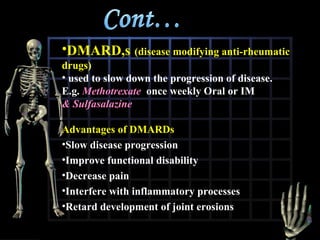
•DMARD,s (disease modifying anti-rheumatic
drugs)
• used to slow down the progression of disease.
E.g. Methotrexate once weekly Oral or IM
& Sulfasalazine
Advantages of DMARDs
•Slow disease progression
•Improve functional disability
•Decrease pain
•Interfere with inflammatory processes
•Retard development of joint erosions
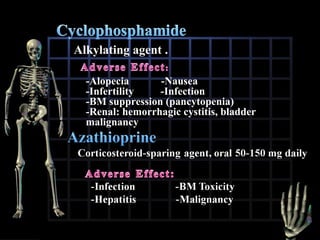
Alkylating agent .
-Alopecia
-Nausea
-Infertility
-Infection
-BM suppression (pancytopenia)
-Renal: hemorrhagic cystitis, bladder
malignancy
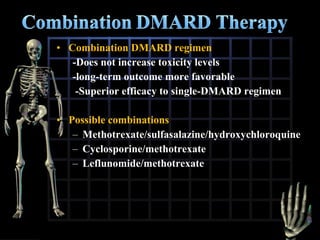
• Combination DMARD regimen
-Does not increase toxicity levels
-long-term outcome more favorable
-Superior efficacy to single-DMARD regimen
• Possible combinations
– Methotrexate/sulfasalazine/hydroxychloroquine
– Cyclosporine/methotrexate
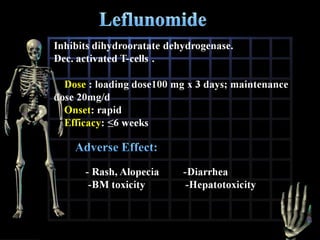
– Leflunomide/methotrexate
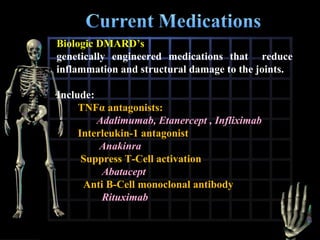
Biologic DMARD’s
genetically engineered medications that reduce
inflammation and structural damage to the joints.
Include:
TNFα antagonists:
Adalimumab, Etanercept , Infliximab
Interleukin-1 antagonist
Anakinra
Suppress T-Cell activation
Abatacept
Anti B-Cell monoclonal antibody
Rituximab
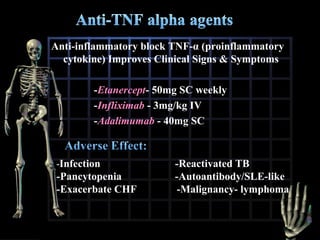
Anti-inflammatory block TNF-α (proinflammatory
cytokine) Improves Clinical Signs & Symptoms
-Etanercept- 50mg SC weekly
-Infliximab - 3mg/kg IV
-Adalimumab - 40mg SC

-Infection

-Pancytopenia
-Exacerbate CHF

-Reactivated TB
-Autoantibody/SLE-like
-Malignancy- lymphoma


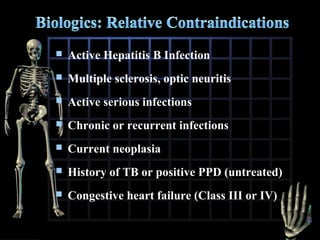
Active Hepatitis B Infection



Multiple sclerosis, optic neuritis



Active serious infections



Chronic or recurrent infections



Current neoplasia



History of TB or positive PPD (untreated)



Congestive heart failure (Class III or IV)
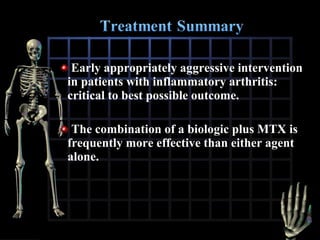
Early appropriately aggressive intervention
in patients with inflammatory arthritis:
critical to best possible outcome.
The combination of a biologic plus MTX is
frequently more effective than either agent
alone.
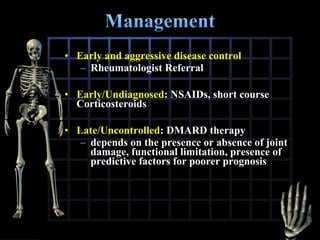
• Early and aggressive disease control
– Rheumatologist Referral
• Early/Undiagnosed: NSAIDs, short course
Corticosteroids
• Late/Uncontrolled: DMARD therapy
– depends on the presence or absence of joint
damage, functional limitation, presence of
predictive factors for poorer prognosis
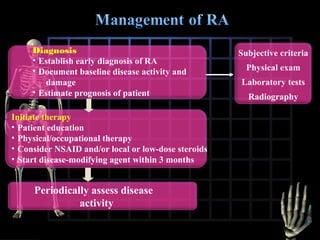
Diagnosis
• Establish early diagnosis of RA
• Document baseline disease activity and
damage
• Estimate prognosis of patient
Initiate therapy
• Patient education
• Physical/occupational therapy
• Consider NSAID and/or local or low-dose steroids
• Start disease-modifying agent within 3 months

Periodically assess disease
activity

Subjective criteria
Physical exam
Laboratory tests
Radiography
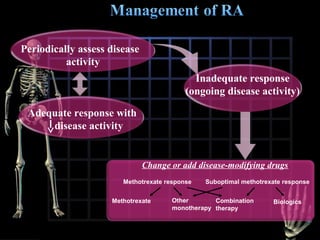
Periodically assess disease
activity
Inadequate response
(ongoing disease activity)
Adequate response with
disease activity

Change or add disease-modifying drugs
Methotrexate response
Methotrexate

Suboptimal methotrexate response

Other
Combination
monotherapy therapy

Biologics
Rheumatoid arthritis diagnosis

Rheumatoid arthritis diagnosis

  • 3.
    There is nosingular test for diagnosing rheumatoid arthritis. Instead, rheumatoid arthritis is diagnosed based on :history & physical examination & investigations The Importance of Early Diagnosis RA is progressive, not benign. Structural damage/disability occurs within first 2 to 3 years of disease. Slower progression of disease linked to early treatment
  • 4.
    1. 2. 3. 4. 5. 6 weeks ofmorning stiffness > 1 hr . 6 weeks of swelling of three or more joints . 6 weeks of swelling of wrist, MCP, PIP. Symmetrical joint swelling. X-ray changes that must include erosions or unequivocal bony decalcification. 6. Rheumatoid nodules. 7. Positive serum rheumatoid factor.
  • 7.
    Can do usual activity,discomfort or limited mobility of 1-3 joints.
  • 8.
    • Are madeafter a full medical and family history and physical and diagnostic testing. • Medical testing may include a wide variety of tests like:- • • • • • • ESR Inflammatory CRP markers RF ANA (Anti nuclear antibodies) Joint x-rays MRI (Magnetic resonance imaging) & US (ultra sound)
  • 9.
    CONTD…. Anti cyclic citrullinatedpeptide (CCP): has been found to be more specific than rheumatoid factor in rheumatoid arthritis And high titer anti-CCP may predict aggressive erosive disease Antinuclear antibody: positive in systemic lupus erythematosus (SLE) and related conditions; also in up to 30% of rheumatoid arthritis patients and weakly positive in up to 10% of the normal population.
  • 10.
    • C-Reactive protein –Correlates with disease activity and radiologic progression – One of the most responsive acute phase reactants – Can be elevated in many non-RA related diseases • Erythrocyte sedimentation rate – Influenced by non-acute phase response factors – Can be elevated in many non-RA related diseases
  • 11.
    Is an autoantibodythat is present in the blood of most people with RA (75-80%)  Directed against host immunoglobulin (is positive in no more than 5 percent of patients without rheumatoid arthritis). Repeat negative 6-12 months following disease onset if
  • 12.
    Liver function tests…mild elevation of alkaline phosphatase and .Low serum albumin . CBC…normochromic normocytic or Microcytic anemia . Hemoglobin slightly decreased; hemoglobin averages around 10 g/dL .Platelets & WBCs Usually increased. Urinalysis … Microscopic hematuria or proteinuria may be present, indicat connective tissue diseases. Joint fluid … to rule out other diseases; 5,000 to 25,000 WBC with polymorphonuclear leukocytes . cultures are negative, there are no crystals, and fluid glucose level typically is low.
  • 13.
    X-Ray of bothhands and wrists and feet for suspected RA. MRI it is more sensitive to detect RA change.  X-ray change • • • • • Loss of joint space Soft tissue swelling Bony decalcification Erosions Peri-articular osteoporosis
  • 15.
    • Social factors –Low socioeconomic status – Less education – Psychosocial stress – female sex • Physical factors – Extra-articular manifestations – Elevated CRP and ESR – High titers of RF – early Erosions on x-ray – Duration of disease
  • 16.
    • • • • • Goals of Treatment Relievepain Reduce inflammation Slow down or stop joint damage Maintaining the ability to function in daily activities, improving the quality of life. • Current Treatment • Non - pharmacological • pharmacological • Surgery • Routine monitoring and ongoing care.
  • 17.
    • Physiotherapy isa vital part of treating RA may be useful in decreasing the symptoms of RA. • program of exercise strengthens joints & minimize deformity and increase the range of movement and functions. • Natural treatments include using massage with herbs, magneto therapy etc.. • Occupational therapy can give advice to do every day activities with less pain or advice on how to use splints, skills training. • Weight loss & Smoking cessation
  • 18.
    • Analgesics used onlyfor pain relief E.g.:- Oral Paracetamol Topical Capsaicin Diclofenac
  • 19.
    •NSAID’s •used as anadjunct along with DMARD’s to reduce the inflammation and pain •Effective reduction in swelling. •Improves mobility, flexibility, range of motion Ineffective in Erosive disease NSAID’S act by inhibiting COX-1 &2 & thus reduces inflamation • - GI toxicity – ulcer - Hepatotoxicity -Aseptic meningitis -Nephrotoxicity -Bleeding
  • 21.
    •DMARD,s (disease modifyinganti-rheumatic drugs) • used to slow down the progression of disease. E.g. Methotrexate once weekly Oral or IM & Sulfasalazine Advantages of DMARDs •Slow disease progression •Improve functional disability •Decrease pain •Interfere with inflammatory processes •Retard development of joint erosions
  • 24.
    Alkylating agent . -Alopecia -Nausea -Infertility -Infection -BMsuppression (pancytopenia) -Renal: hemorrhagic cystitis, bladder malignancy
  • 25.
    • Combination DMARDregimen -Does not increase toxicity levels -long-term outcome more favorable -Superior efficacy to single-DMARD regimen • Possible combinations – Methotrexate/sulfasalazine/hydroxychloroquine – Cyclosporine/methotrexate – Leflunomide/methotrexate
  • 26.
    Biologic DMARD’s genetically engineeredmedications that reduce inflammation and structural damage to the joints. Include: TNFα antagonists: Adalimumab, Etanercept , Infliximab Interleukin-1 antagonist Anakinra Suppress T-Cell activation Abatacept Anti B-Cell monoclonal antibody Rituximab
  • 27.
    Anti-inflammatory block TNF-α(proinflammatory cytokine) Improves Clinical Signs & Symptoms -Etanercept- 50mg SC weekly -Infliximab - 3mg/kg IV -Adalimumab - 40mg SC -Infection -Pancytopenia -Exacerbate CHF -Reactivated TB -Autoantibody/SLE-like -Malignancy- lymphoma
  • 28.
     Active Hepatitis BInfection  Multiple sclerosis, optic neuritis  Active serious infections  Chronic or recurrent infections  Current neoplasia  History of TB or positive PPD (untreated)  Congestive heart failure (Class III or IV)
  • 29.
    Early appropriately aggressiveintervention in patients with inflammatory arthritis: critical to best possible outcome. The combination of a biologic plus MTX is frequently more effective than either agent alone.
  • 30.
    • Early andaggressive disease control – Rheumatologist Referral • Early/Undiagnosed: NSAIDs, short course Corticosteroids • Late/Uncontrolled: DMARD therapy – depends on the presence or absence of joint damage, functional limitation, presence of predictive factors for poorer prognosis
  • 31.
    Diagnosis • Establish earlydiagnosis of RA • Document baseline disease activity and damage • Estimate prognosis of patient Initiate therapy • Patient education • Physical/occupational therapy • Consider NSAID and/or local or low-dose steroids • Start disease-modifying agent within 3 months Periodically assess disease activity Subjective criteria Physical exam Laboratory tests Radiography
  • 32.
    Periodically assess disease activity Inadequateresponse (ongoing disease activity) Adequate response with disease activity Change or add disease-modifying drugs Methotrexate response Methotrexate Suboptimal methotrexate response Other Combination monotherapy therapy Biologics