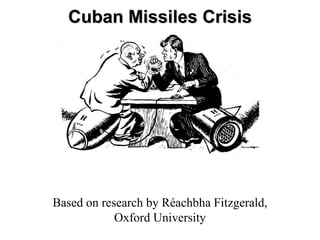
Cuban Missiles Crisis Based on research by Réachbha Fitzgerald, Oxford University
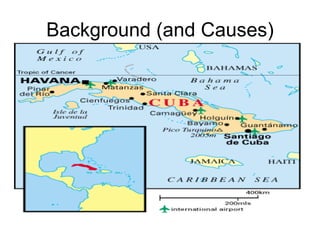
Background (and Causes)
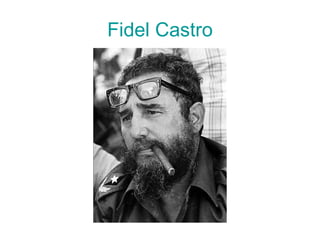
Fidel Castro
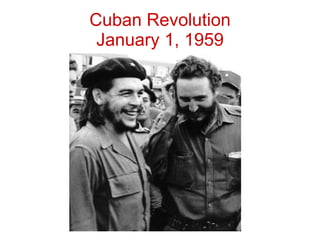
Cuban Revolution January 1, 1959
Bay of Pigs Cuban who had been forced into exile by Castro or those who fled in fear of communism ended up in Florida, USA They formed an organization intended on forcing Castro from power. US President Kennedy supported them. In April of 1961, 14,000 Cuban exiles landed and were quickly surrounded and taken prisoner by 20,000 Cuban Communist troops. Results: Castro asked the USSR for support against another possible US attack. Kennedy humiliated due to the failure of the invasion.
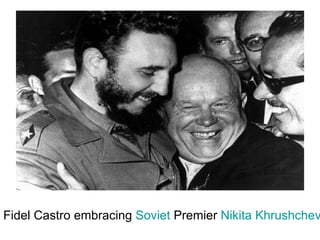
.  Fidel Castro embracing  Soviet  Premier  Nikita Khrushchev
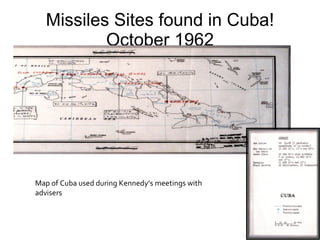
Missiles Sites found in Cuba! October 1962 Map of Cuba used during Kennedy’s meetings with advisers
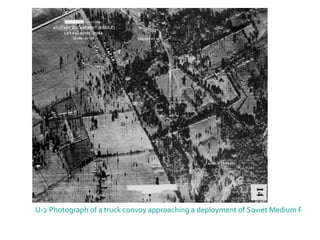
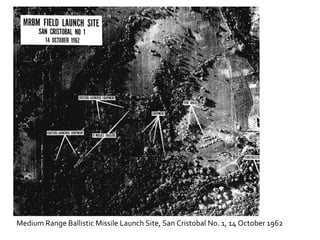
U-2 Photograph of a truck convoy approaching a deployment of Soviet Medium Range Ballistic Missiles near Los Palacios at San Cristobal 

Medium Range Ballistic Missile Launch Site, San Cristobal No. 1, 14 October 1962
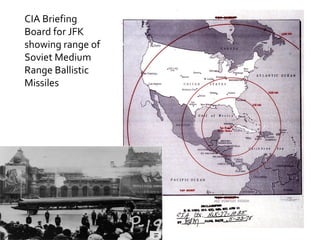
CIA Briefing Board for JFK showing range of Soviet Medium Range Ballistic Missiles
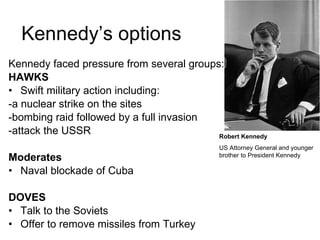
Kennedy’s options Kennedy faced pressure from several groups: HAWKS Swift military action including: -a nuclear strike on the sites -bombing raid followed by a full invasion -attack the USSR Moderates Naval blockade of Cuba DOVES Talk to the Soviets Offer to remove missiles from Turkey Robert Kennedy US Attorney General and younger brother to President Kennedy
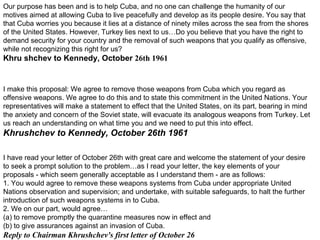
Our purpose has been and is to help Cuba, and no one can challenge the humanity of our motives aimed at allowing Cuba to live peacefully and develop as its people desire. You say that that Cuba worries you because it lies at a distance of ninety miles across the sea from the shores of the United States. However, Turkey lies next to us…Do you believe that you have the right to demand security for your country and the removal of such weapons that you qualify as offensive, while not recognizing this right for us? Khru   shchev to Kennedy, October  26th   1961 I make this proposal: We agree to remove those weapons from Cuba which you regard as offensive weapons. We agree to do this and to state this commitment in the United Nations. Your representatives will make a statement to effect that the United States, on its part, bearing in mind the anxiety and concern of the Soviet state, will evacuate its analogous weapons from Turkey. Let us reach an understanding on what time you and we need to put this into effect. Khrushchev to Kennedy, October  26th   1961 I have read your letter of October 26th with great care and welcome the statement of your desire to seek a prompt solution to the problem…as I read your letter, the key elements of your proposals - which seem generally acceptable as I understand them - are as follows: 1. You would agree to remove these weapons systems from Cuba under appropriate United Nations observation and supervision; and undertake, with suitable safeguards, to halt the further introduction of such weapons systems in to Cuba. 2. We on our part, would agree… (a) to remove promptly the quarantine measures now in effect and (b) to give assurances against an invasion of Cuba. Reply to Chairman Khrushchev's first letter of October  26
Consequences Both  sides realised how close they had come to world nuclear holocaust. •  The Cold War did not end, but they carefully avoided direct conflict. (a) A ‘hot-line’ was installed between Moscow and Washington to improve communications; (b) A Limited Test Ban Treaty was signed in 1963, which restricted nuclear tests to underground locations. USSR :  •  Internationally : Khrushchev was credited with being diplomatic and reasonable; •  Domestically : Khrushchev was widely seen to have backed down completely (Kennedy’s agreement to remove missiles from Turkey was kept secret). •  He was overthrown in 1964 . and died in  1971 . USA :  •  Short term : Kennedy’s reputation was greatly enhanced by his handling of the crisis. •  Long term : Historians have criticised him for (a) Creating the crisis by appearing both aggressive and yet weak in the Bay of Pigs disaster; (b) Not calling Khrushchev’s bluff by mounting a full-scale invasion of Cuba and overthrowing Castro CHINA: Chairman Mao was unimpressed with Khrushchev’s handling of the crisis and pursued a more independent course
Work Cited Essential World History , Steven Waugh, Nelson Thomas, 2001 www.activehistory.co.uk  , Russell Tarr www.wikipedia.org/Fidel_Castro

Cuban missile crisis

  • 1.
    Cuban Missiles CrisisBased on research by Réachbha Fitzgerald, Oxford University
  • 2.
  • 3.
  • 4.
  • 5.
    Bay of PigsCuban who had been forced into exile by Castro or those who fled in fear of communism ended up in Florida, USA They formed an organization intended on forcing Castro from power. US President Kennedy supported them. In April of 1961, 14,000 Cuban exiles landed and were quickly surrounded and taken prisoner by 20,000 Cuban Communist troops. Results: Castro asked the USSR for support against another possible US attack. Kennedy humiliated due to the failure of the invasion.
  • 6.
    . FidelCastro embracing Soviet Premier Nikita Khrushchev
  • 7.
    Missiles Sites foundin Cuba! October 1962 Map of Cuba used during Kennedy’s meetings with advisers
  • 8.
    U-2 Photograph ofa truck convoy approaching a deployment of Soviet Medium Range Ballistic Missiles near Los Palacios at San Cristobal 

  • 9.
    Medium Range BallisticMissile Launch Site, San Cristobal No. 1, 14 October 1962
  • 10.
    CIA Briefing Boardfor JFK showing range of Soviet Medium Range Ballistic Missiles
  • 11.
    Kennedy’s options Kennedyfaced pressure from several groups: HAWKS Swift military action including: -a nuclear strike on the sites -bombing raid followed by a full invasion -attack the USSR Moderates Naval blockade of Cuba DOVES Talk to the Soviets Offer to remove missiles from Turkey Robert Kennedy US Attorney General and younger brother to President Kennedy
  • 12.
    Our purpose hasbeen and is to help Cuba, and no one can challenge the humanity of our motives aimed at allowing Cuba to live peacefully and develop as its people desire. You say that that Cuba worries you because it lies at a distance of ninety miles across the sea from the shores of the United States. However, Turkey lies next to us…Do you believe that you have the right to demand security for your country and the removal of such weapons that you qualify as offensive, while not recognizing this right for us? Khru shchev to Kennedy, October 26th 1961 I make this proposal: We agree to remove those weapons from Cuba which you regard as offensive weapons. We agree to do this and to state this commitment in the United Nations. Your representatives will make a statement to effect that the United States, on its part, bearing in mind the anxiety and concern of the Soviet state, will evacuate its analogous weapons from Turkey. Let us reach an understanding on what time you and we need to put this into effect. Khrushchev to Kennedy, October 26th 1961 I have read your letter of October 26th with great care and welcome the statement of your desire to seek a prompt solution to the problem…as I read your letter, the key elements of your proposals - which seem generally acceptable as I understand them - are as follows: 1. You would agree to remove these weapons systems from Cuba under appropriate United Nations observation and supervision; and undertake, with suitable safeguards, to halt the further introduction of such weapons systems in to Cuba. 2. We on our part, would agree… (a) to remove promptly the quarantine measures now in effect and (b) to give assurances against an invasion of Cuba. Reply to Chairman Khrushchev's first letter of October 26
  • 13.
    Consequences Both sides realised how close they had come to world nuclear holocaust. • The Cold War did not end, but they carefully avoided direct conflict. (a) A ‘hot-line’ was installed between Moscow and Washington to improve communications; (b) A Limited Test Ban Treaty was signed in 1963, which restricted nuclear tests to underground locations. USSR : • Internationally : Khrushchev was credited with being diplomatic and reasonable; • Domestically : Khrushchev was widely seen to have backed down completely (Kennedy’s agreement to remove missiles from Turkey was kept secret). • He was overthrown in 1964 . and died in 1971 . USA : • Short term : Kennedy’s reputation was greatly enhanced by his handling of the crisis. • Long term : Historians have criticised him for (a) Creating the crisis by appearing both aggressive and yet weak in the Bay of Pigs disaster; (b) Not calling Khrushchev’s bluff by mounting a full-scale invasion of Cuba and overthrowing Castro CHINA: Chairman Mao was unimpressed with Khrushchev’s handling of the crisis and pursued a more independent course
  • 14.
    Work Cited EssentialWorld History , Steven Waugh, Nelson Thomas, 2001 www.activehistory.co.uk , Russell Tarr www.wikipedia.org/Fidel_Castro