October 25
Problems with operant conditioning
Reward traps
Punishment Pitfalls
Supernanny to the Rescue
Monday: No classes; Thursday: TEST (No
FR); Friday: End of 9 Weeks
Grades will be updated throughout the
weekend
Consider a time in your life when
“rewards” worked. And didn’t work.
Consider a time when punishment
worked. And didn’t work.
Operant Behavior Gone Bad
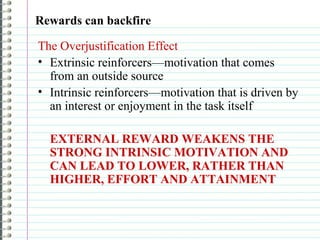
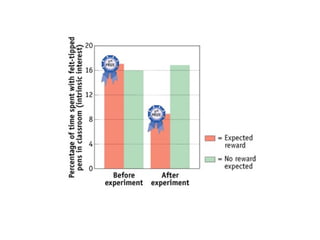
Rewards can backfire
The Overjustification Effect
• Extrinsic reinforcers—motivation that comes
from an outside source
• Intrinsic reinforcers—motivation that is driven by
an interest or enjoyment in the task itself
EXTERNAL REWARD WEAKENS THE
STRONG INTRINSIC MOTIVATION AND
CAN LEAD TO LOWER, RATHER THAN
HIGHER, EFFORT AND ATTAINMENT
Punishment Pitfalls
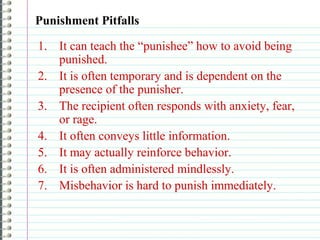
Punishment Pitfalls
1. It can teach the “punishee” how to avoid being
punished.
2. It is often temporary and is dependent on the
presence of the punisher.
3. The recipient often responds with anxiety, fear,
or rage.
4. It often conveys little information.
5. It may actually reinforce behavior.
6. It is often administered mindlessly.
7. Misbehavior is hard to punish immediately.
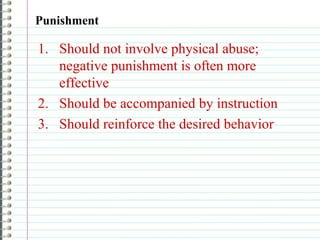
Punishment

1. Should not involve physical abuse;
negative punishment is often more
effective
2. Should be accompanied by instruction
3. Should reinforce the desired behavior
Meet the Bowersock Family…
Meet Supernanny…

43.2013

  • 2.
    October 25 Problems withoperant conditioning Reward traps Punishment Pitfalls Supernanny to the Rescue Monday: No classes; Thursday: TEST (No FR); Friday: End of 9 Weeks Grades will be updated throughout the weekend
  • 3.
    Consider a timein your life when “rewards” worked. And didn’t work. Consider a time when punishment worked. And didn’t work.
  • 4.
  • 5.
    Rewards can backfire TheOverjustification Effect • Extrinsic reinforcers—motivation that comes from an outside source • Intrinsic reinforcers—motivation that is driven by an interest or enjoyment in the task itself EXTERNAL REWARD WEAKENS THE STRONG INTRINSIC MOTIVATION AND CAN LEAD TO LOWER, RATHER THAN HIGHER, EFFORT AND ATTAINMENT
  • 7.
  • 8.
    Punishment Pitfalls 1. Itcan teach the “punishee” how to avoid being punished. 2. It is often temporary and is dependent on the presence of the punisher. 3. The recipient often responds with anxiety, fear, or rage. 4. It often conveys little information. 5. It may actually reinforce behavior. 6. It is often administered mindlessly. 7. Misbehavior is hard to punish immediately.
  • 9.
    Punishment 1. Should notinvolve physical abuse; negative punishment is often more effective 2. Should be accompanied by instruction 3. Should reinforce the desired behavior
  • 10.
  • 11.

Editor's Notes