Foreign Policy in the
Early 1960s
Chapter 22.3
Pp. 751-759
22.3:
Foreign Policy in the 60s
• Notes
• *Complete Chart on p. 751
• Answer
• 1. What were the goals of the Alliance for Progress &
the Peace Corps?
• 2. What can you infer about the Soviet Union’s foreign
policy goals from its actions in the Cold War crises of
the 60s?
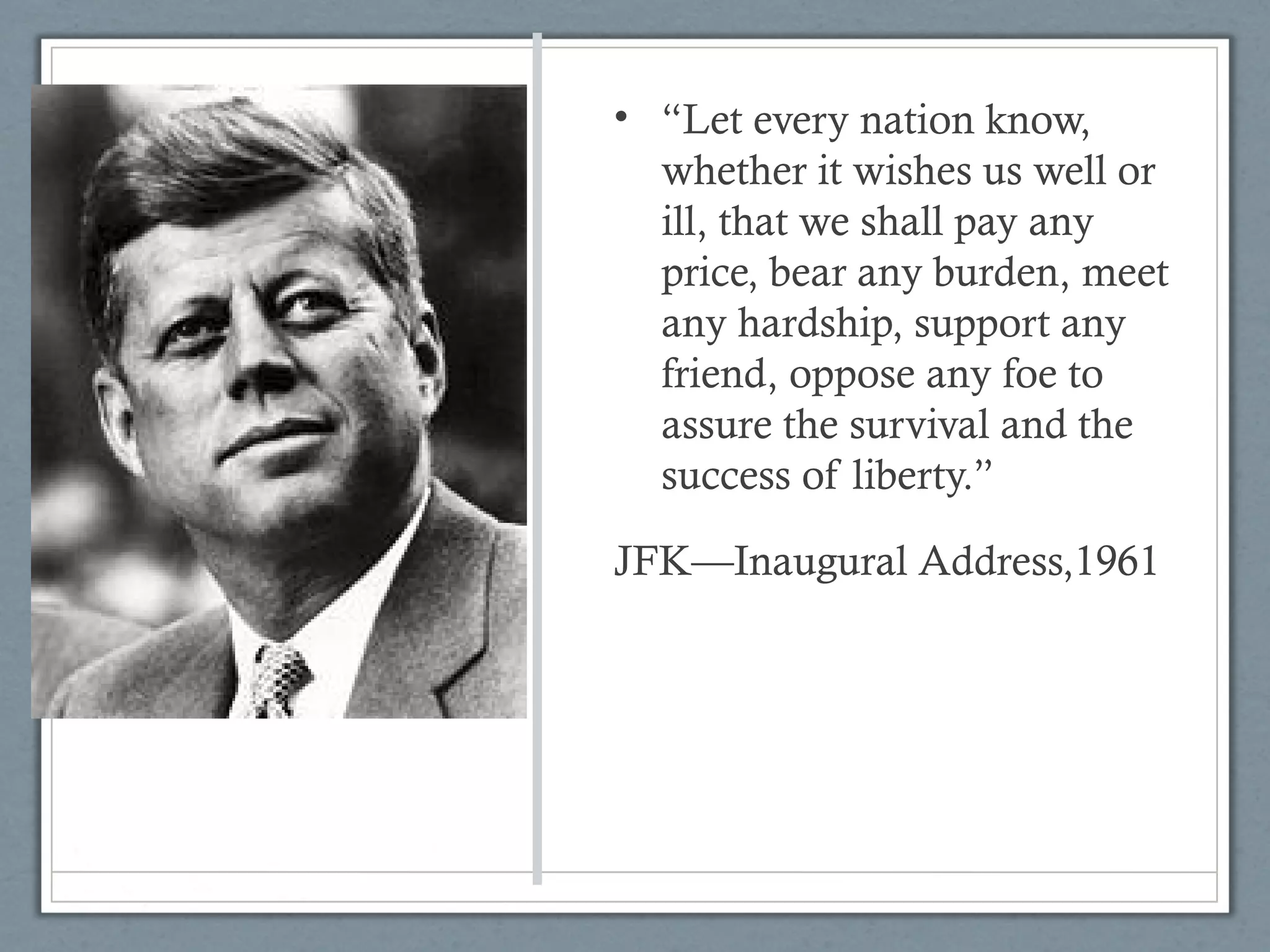
• “Let every nation know,
whether it wishes us well or
ill, that we shall pay any
price, bear any burden, meet
any hardship, support any
friend, oppose any foe to
assure the survival and the
success of liberty.”
JFK—Inaugural Address,1961
The Bay of Pigs Invasion
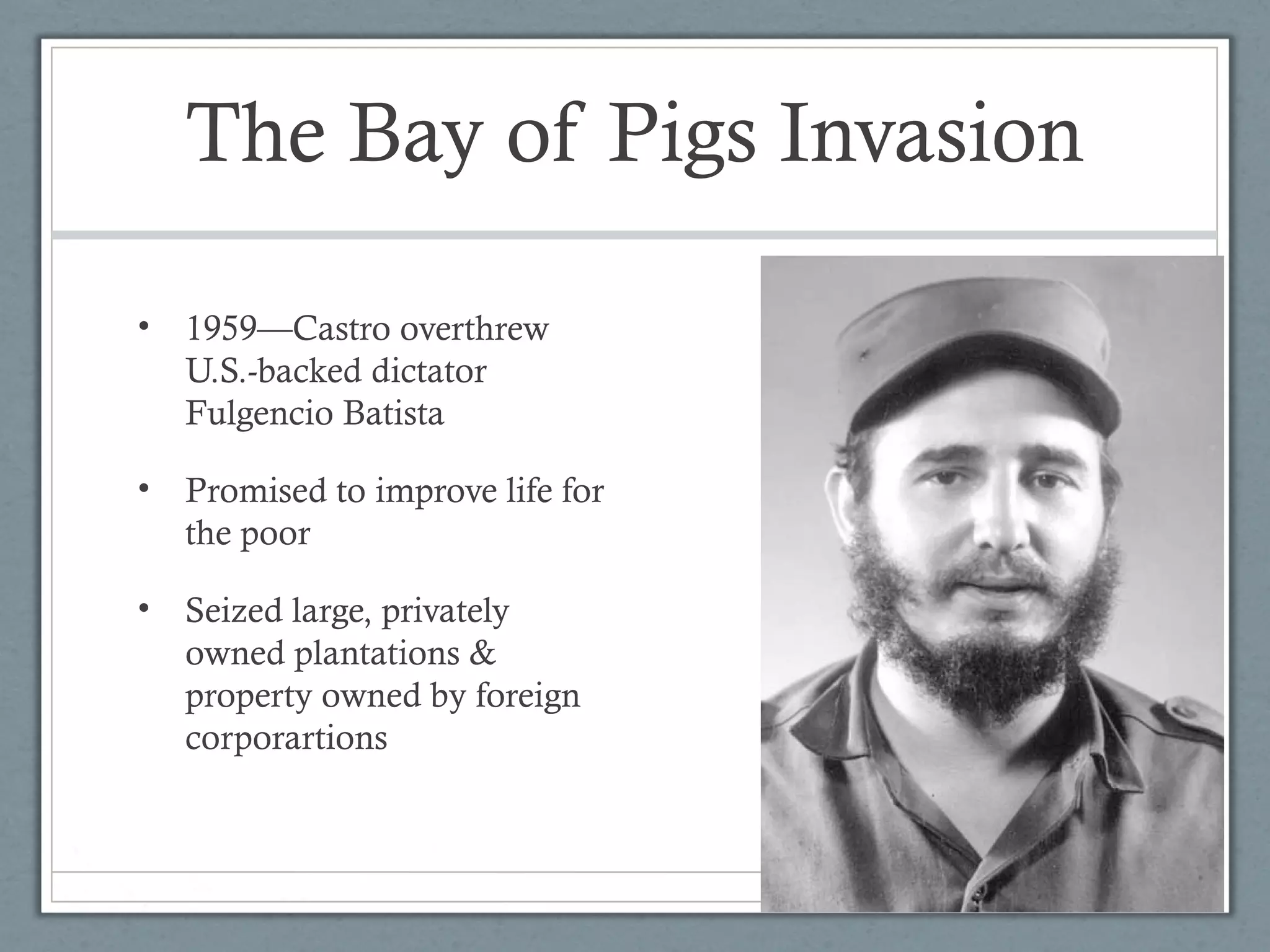
• 1959—Castro overthrew
U.S.-backed dictator
Fulgencio Batista
• Promised to improve life for
the poor
• Seized large, privately
owned plantations &
property owned by foreign
corporartions
The Bay of Pigs Invasion
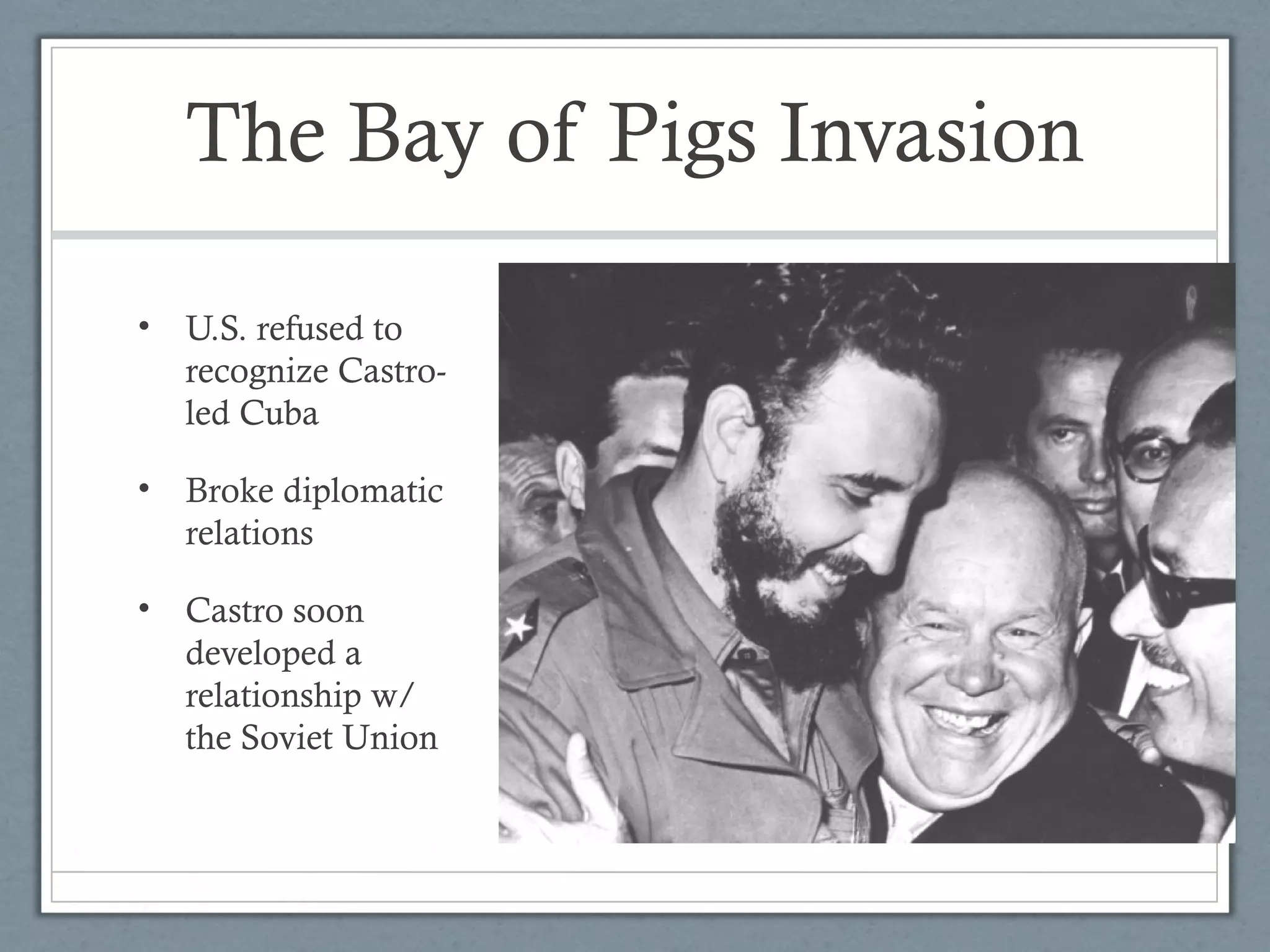
• U.S. refused to
recognize Castro-
led Cuba
• Broke diplomatic
relations
• Castro soon
developed a
relationship w/
the Soviet Union
Bay of Pigs Invasion
• Plan est. by Eisenhower in ‘60
• CIA was training Cubans to
overthrow Castro
• Training in nearby Guatemala
• Cuban people were expected to
help revolution
• Resistance to plan was prevalent
• **See map on p. 752
• “To give this activity…support
is of a piece with the hypocrisy
& cynicism for which the
United States is constantly
denouncing the Soviet Union in
the United Nations & elsewhere.
This point will not be lost on the
rest of the world—nor on our
own consciences…The Castro
regime is a thorn in the flesh;
but it is not a dagger in the
heart.”
• Senator William J. Fulbright, in
a memo to President Kennedy,
1961
Bay of Pigs Invasion
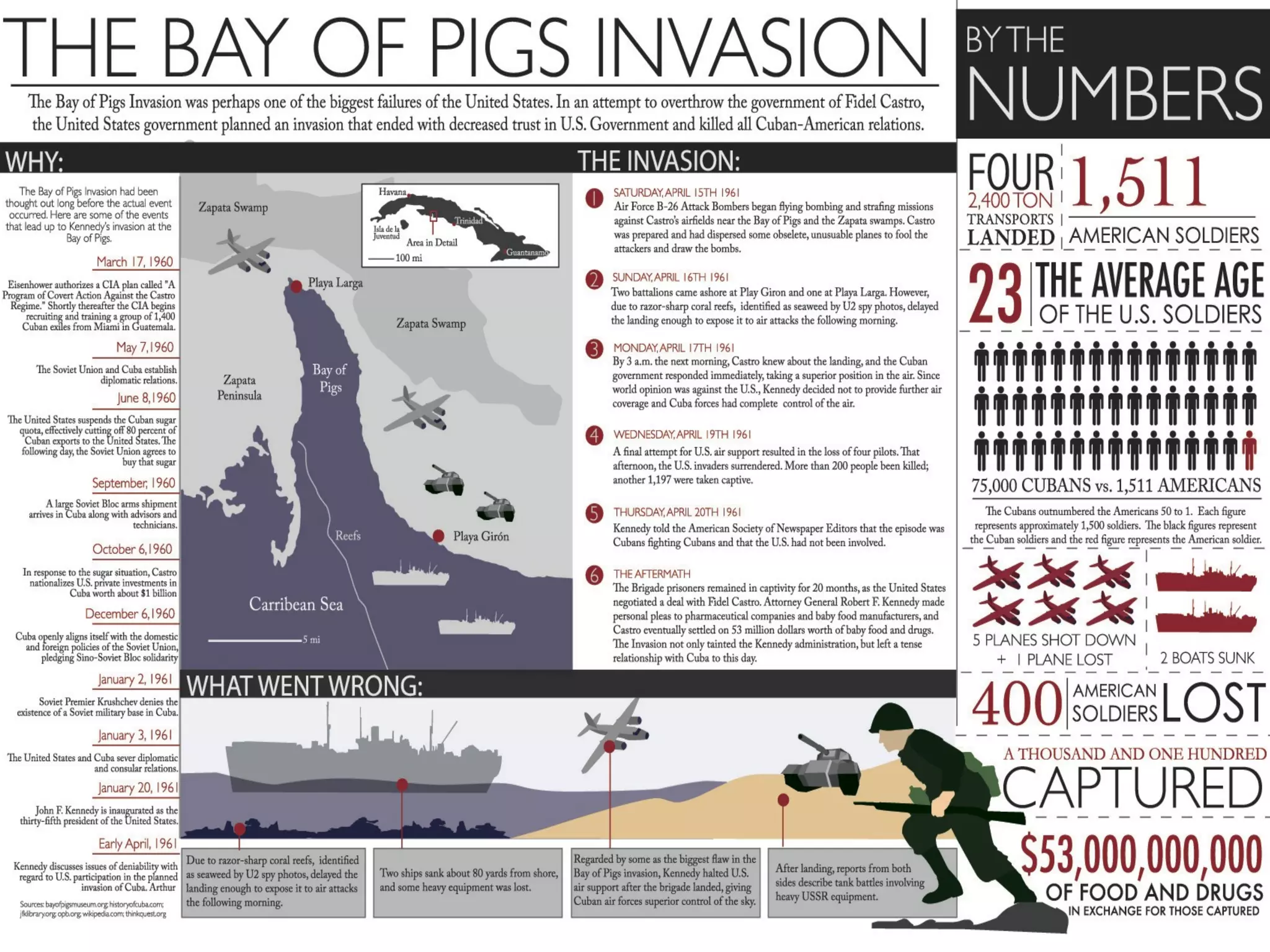
• Kennedy carried on w/ plan
• Invasion on April 17, 1961
• Total disaster
• Air strike failed to ruin Cuba’s air force
• Cuban troops outmatched 1,500 American soldiers
• Kennedy accepted the defeat, rather than increasing
efforts
• Bay of Pigs video
Bay of Pigs Invasion
• Plan was incompetent & clumsy
• Embarrassment for U.S.
• Foreign leaders questioned Kennedy’s abilities to
lead U.S.
• Seen as hypocritical
The Berlin Crisis
The Berlin Crisis
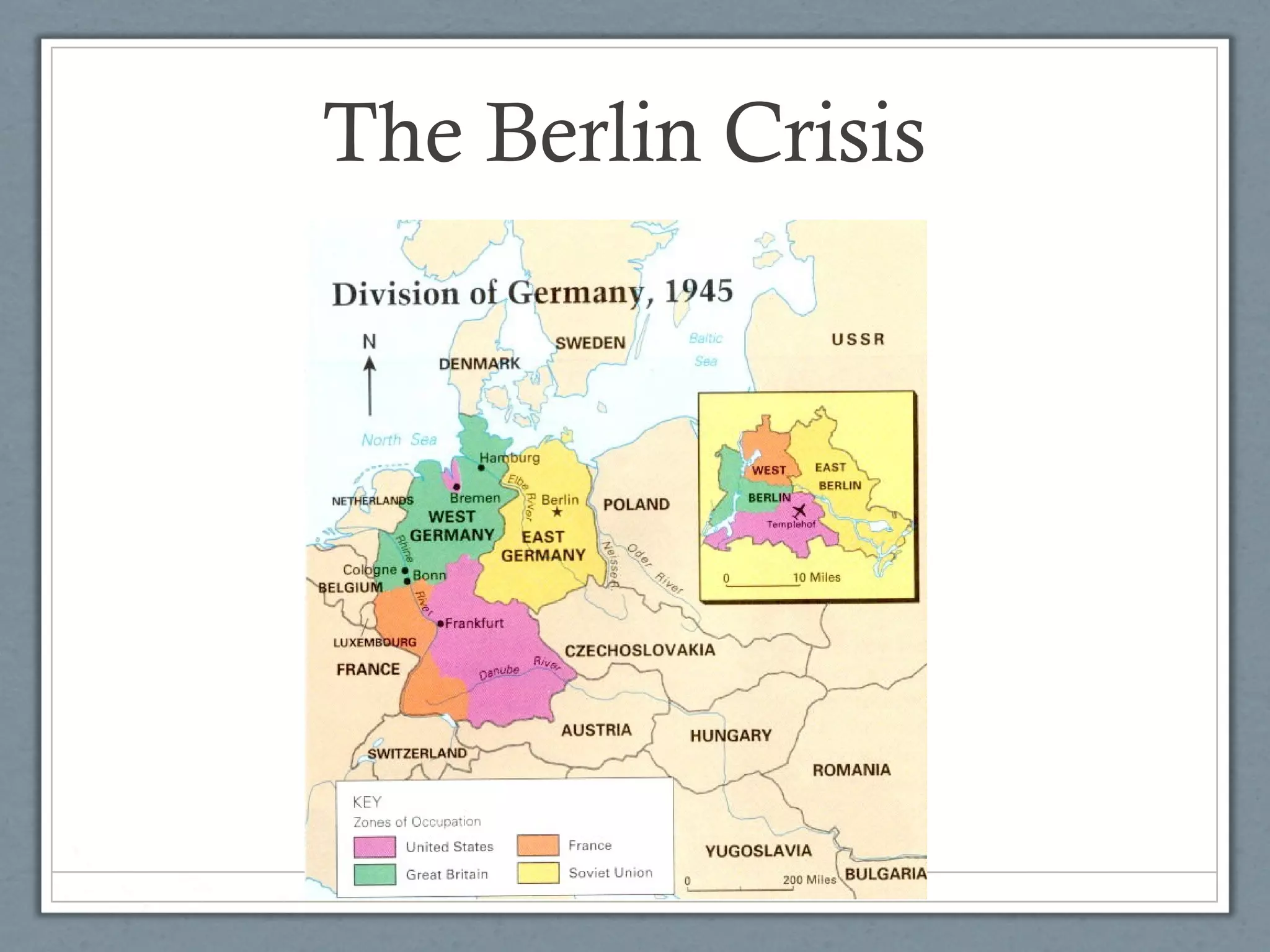
• Western regions combined to form West Germany
• Soviet-controlled East Germany
• Split Berlin w/in East Germany
• 1948—Berlin Airlift was a success
• Soviet Union hoped to make the split of Berlin
permanent
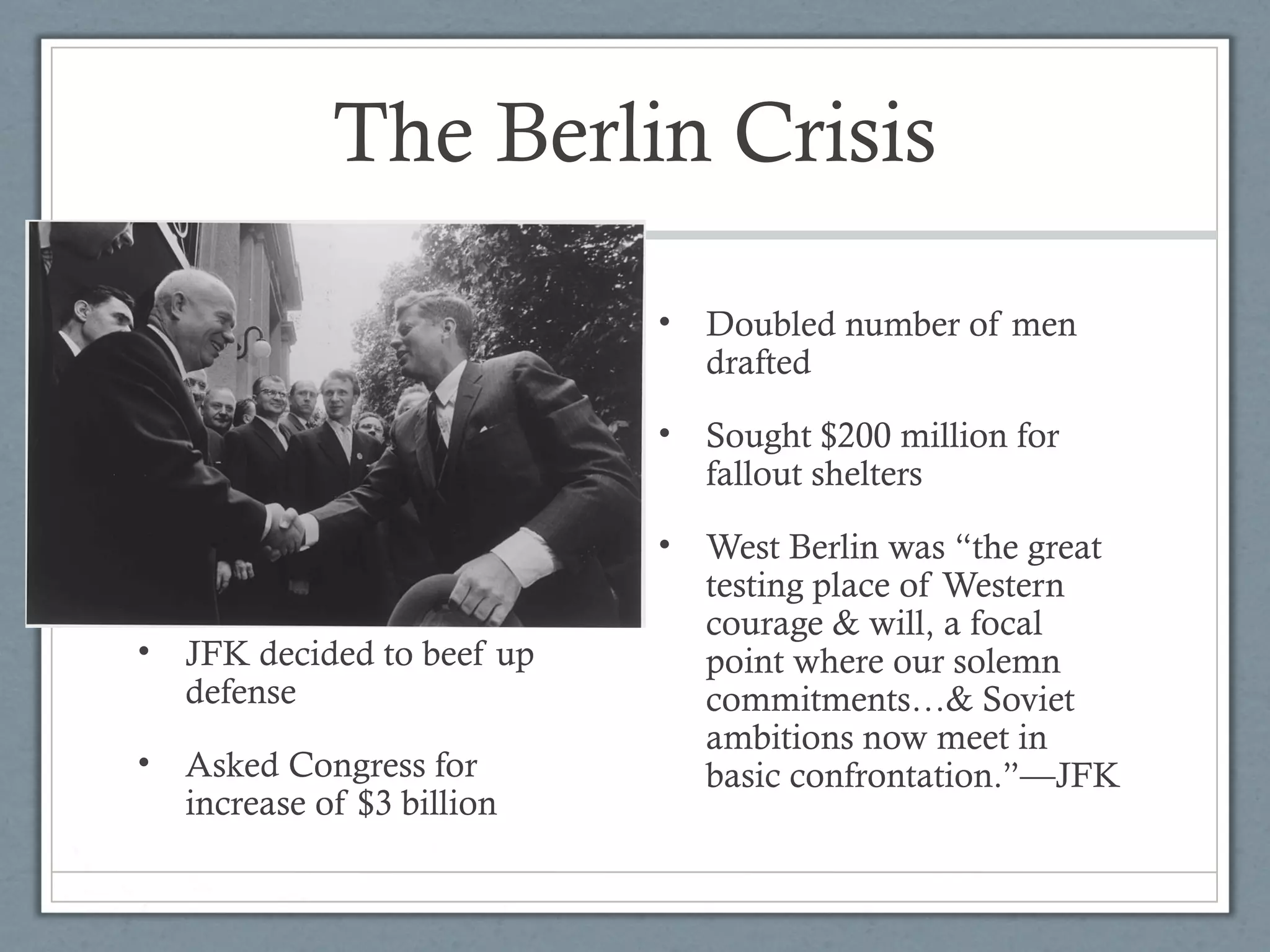
• First meeting between JFK & Khruschev (1961) went
poorly
• JFK felt bullied
The Berlin Crisis
• JFK decided to beef up
defense
• Asked Congress for
increase of $3 billion
• Doubled number of men
drafted
• Sought $200 million for
fallout shelters
• West Berlin was “the great
testing place of Western
courage & will, a focal
point where our solemn
commitments…& Soviet
ambitions now meet in
basic confrontation.”—JFK
The Berlin Crisis
• Soviet response=building of
the Berlin Wall
• Symbol of the Cold War
• Construction started in
1961
• Stopped flow of East
Germans to the West
• The U.S. “will its cities to
defend yours b/c we need
your freedom to protect
ours.”—JFK—1963
• “Ich bin ein Berliner” or “I
am a Berliner”—JFK—
1963
• **See diagram of Berlin
Wall on p. 753
The Cuban Missile Crisis
• S.U. pledged to support
Castro
• S.U. was unhappy w/ Bay
of Pigs Invasion
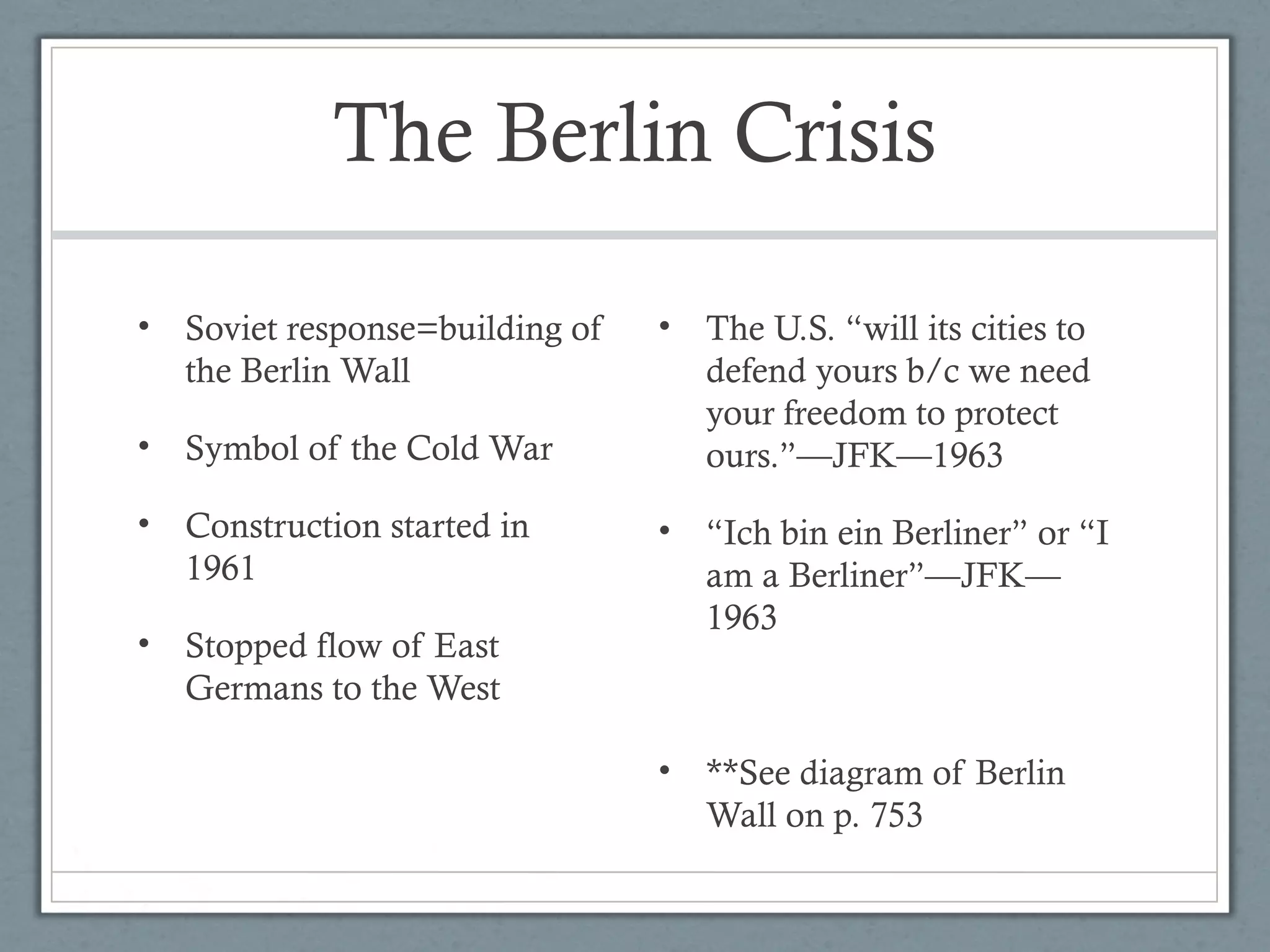
• Oct. 16, 1962—photo taken
by spy plane revealed
Soviets were building
missile bases in Cuba
• Only 90 miles from U.S. soil
• Tough decision for
Kennedy
The Cuban Missile Crisis
• Possible responses
• 1. Engage in more negotiations w/ Khruschev
• Might make JFK look weak/hesitant
• 2. Invade Cuba
• Risked all-out nuclear war w/ S.U.; but chance to oust Castro
• 3. Blockade Cuba
• How would Khruschev respond?
• 4. Bomb the missile sites
• Would Soviet launch a counterstrike?
The Cuban Missile Crisis
• Kennedy ordered U.S. on full alert
• U.S. bombers were armed w/ nuclear missiles
• Army, Marines, Navy were all ready to invade Cuba
• On Monday, Oct. 22 Kennedy went on TV to
confirm that missiles were present in Cuba
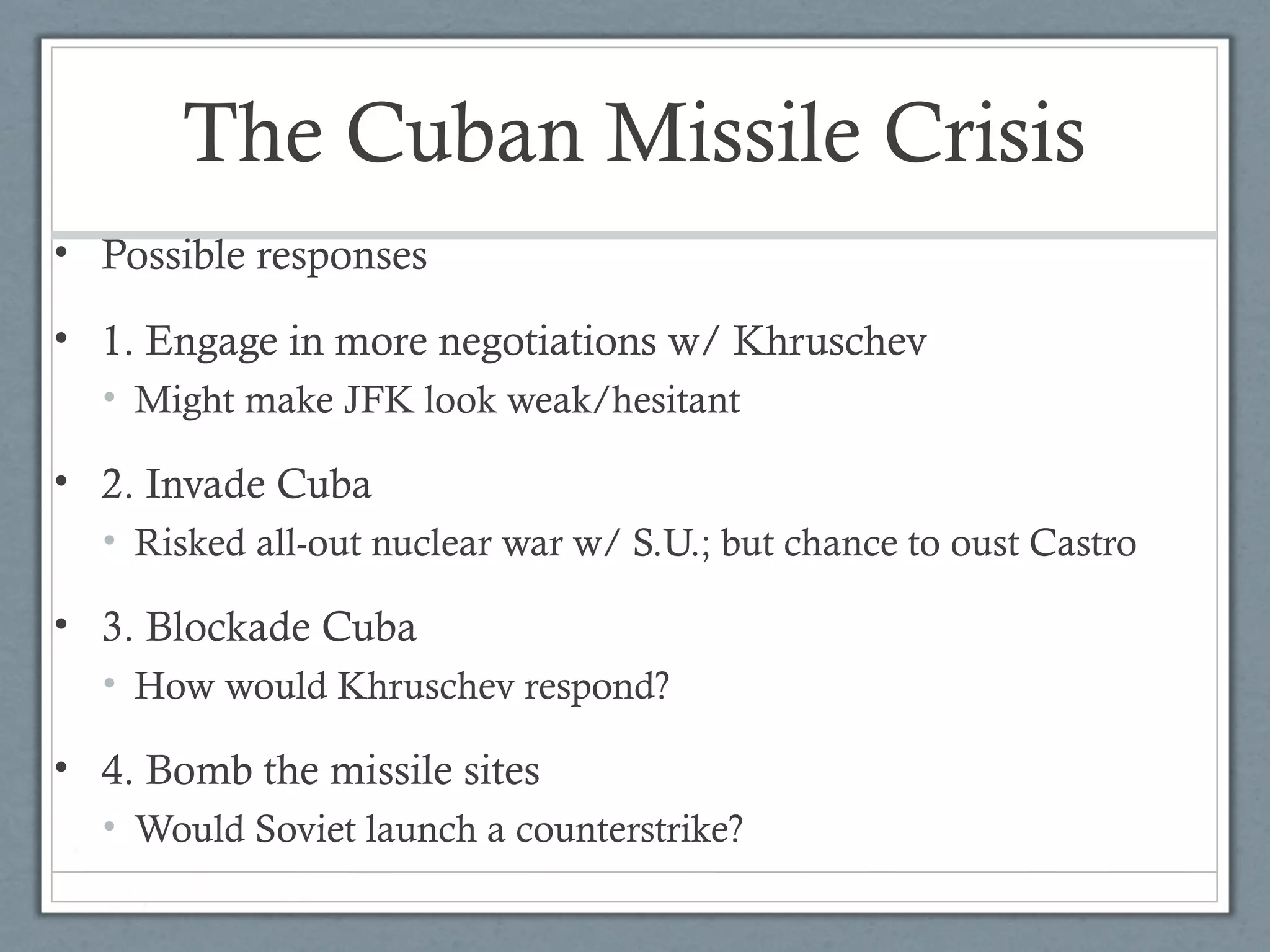
• He then ordered a “quarantine” of Cuba, careful not
to use the word “blockade”
• Blockade was considered an act of war
Cuban Missile Crisis
• U.S. would not shrink from aggression, but did not
desire confrontation
• “The cost of freedom is always high—and
Americans have always paid it. And one path we
shall never choose, and that is the path of surrender
or submission.” –Kennedy, TV/radio address,
10/22/62
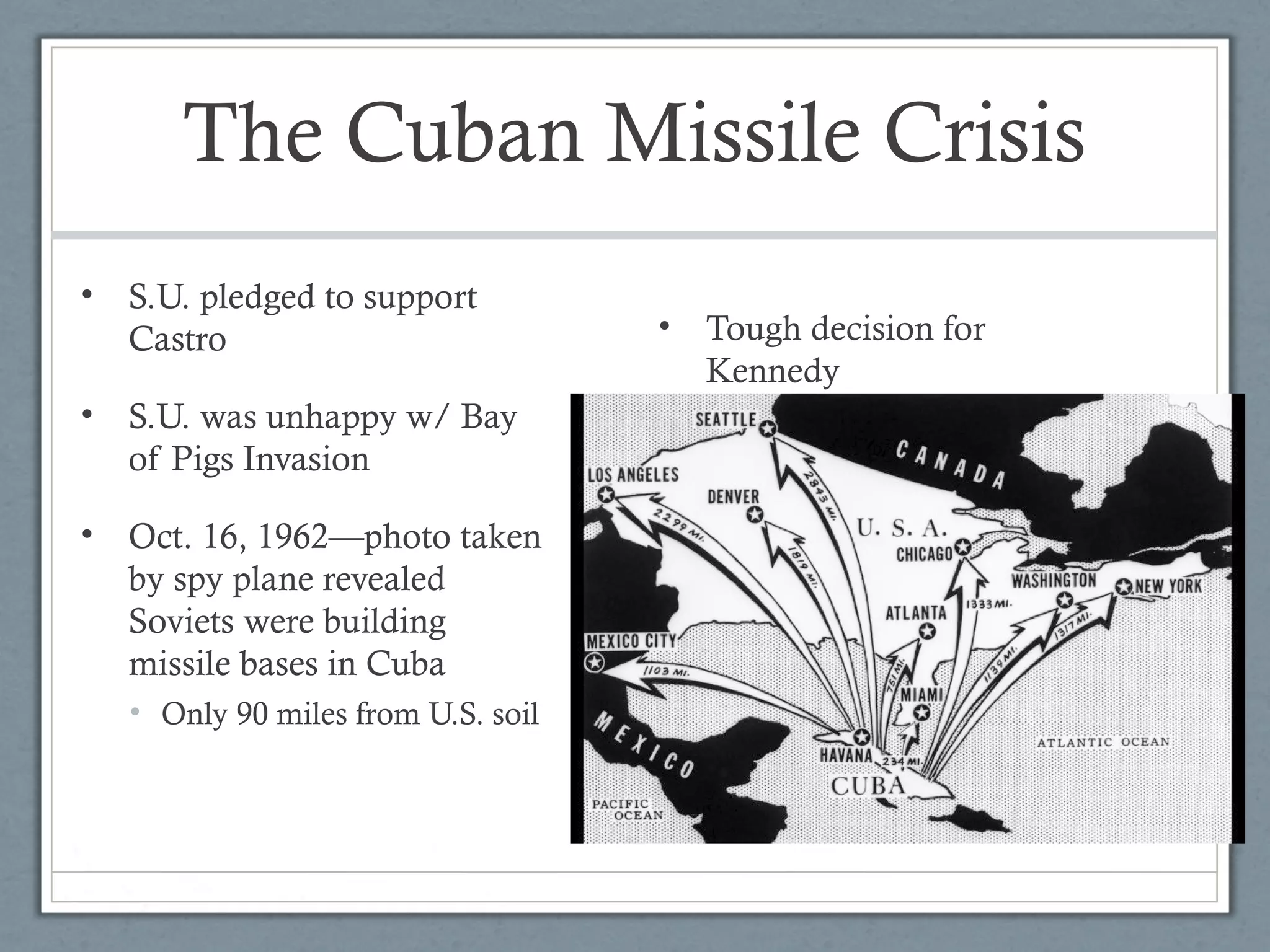
• Some people huddled in their bomb shelters waiting
for the worst
• **See bomb shelter diagram on p. 756
Cuban Missile Crisis
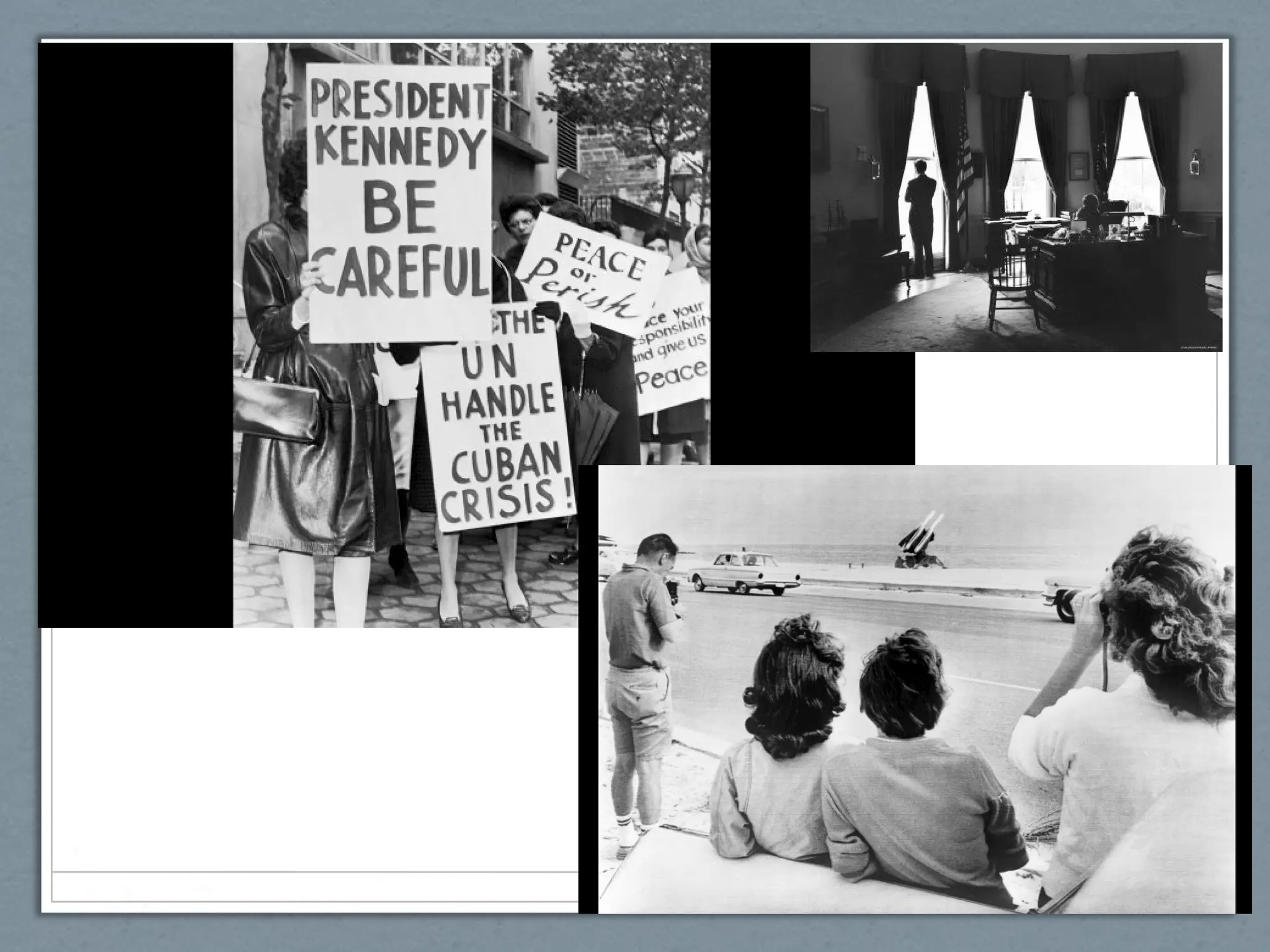
• Quarantine went into effect on 10/24
• Soviet ship stopped by navy on 10/25; it was carrying oil & allowed to
proceed
• Later a dozen ships neared the quarantine line before turning around
• In Cuba, construction on missile sites continued
• On 10/26 Khrushchev sent Kennedy a long letter
• He promised to remove missiles if quarantine was ended
• 2nd
letter on 10/27 demanded U.S. remove missiles from Turkey in
exchange for withdrawal of missiles from Cuba
• Kennedy publicly accepted terms of 1st
note
• Secretly he negotiated terms of the 2nd
note
Cuban Missile Crisis
• Standoff was over
• Sec. of State Dean Rusk “We have won a considerable
victory. You and are still alive.”
• World was closer than ever to nuclear war
• Kennedy emerged as a hero
• Khrushchev & Kennedy est. a “hot line”
• Limited Test Ban Treaty signed in 1963
• Banned nuclear testing above the ground
• Arms race continued however
Alliance for Progress
• Soviet Union & US were competing for allies in
developing countries of Latin America, Asia, &
Africa
• Kennedy tried to promote “peaceful revolution”
• Building stable, democratic governments & meeting
the needs of the people
• In 1961 JFK called on the West Hemisphere to join
in a new Alliance for Progress
Alliance for Progress
• Administration pledged $20 billion over 10 years to
promote economic development and social reform
and to prevent revolution
• “Land for the landless, and education for those who
are denied education”
• “A right to social justice”
• Never lived up to JFK’s expectations due to
widespread doubts
The Peace Corps
• Est. in 1961
• Volunteers sent abroad as
educators, health workers &
technicians
• Better standard of living in
developing countries
• **See p. 758 to learn about the
Peace Corps today
Johnson’s Foreign Policy
• Focused on containing communism
• Sent 22K marines to Dominican Republic to put down
rebellion
• Rebellion stopped
• Gov’t backed by U.S. implemented
• 16K military advisors in Vietnam by 1963
• Opposed further involvement in ‘64 campaign
• But faced increasing prospects of a Communist takeover of
S. Vietnam
22.3:
Foreign Policy in the 60s
• Notes
• *Complete Chart on p. 751
• Answer
• 1. What were the goals of the Alliance for Progress &
the Peace Corps?
• 2. What can you infer about the Soviet Union’s foreign
policy goals from its actions in the Cold War crises of
the 60s?

Foreign Policy in the 1960s

  • 1.
    Foreign Policy inthe Early 1960s Chapter 22.3 Pp. 751-759
  • 2.
    22.3: Foreign Policy inthe 60s • Notes • *Complete Chart on p. 751 • Answer • 1. What were the goals of the Alliance for Progress & the Peace Corps? • 2. What can you infer about the Soviet Union’s foreign policy goals from its actions in the Cold War crises of the 60s?
  • 3.
    • “Let everynation know, whether it wishes us well or ill, that we shall pay any price, bear any burden, meet any hardship, support any friend, oppose any foe to assure the survival and the success of liberty.” JFK—Inaugural Address,1961
  • 4.
    The Bay ofPigs Invasion • 1959—Castro overthrew U.S.-backed dictator Fulgencio Batista • Promised to improve life for the poor • Seized large, privately owned plantations & property owned by foreign corporartions
  • 5.
    The Bay ofPigs Invasion • U.S. refused to recognize Castro- led Cuba • Broke diplomatic relations • Castro soon developed a relationship w/ the Soviet Union
  • 6.
    Bay of PigsInvasion • Plan est. by Eisenhower in ‘60 • CIA was training Cubans to overthrow Castro • Training in nearby Guatemala • Cuban people were expected to help revolution • Resistance to plan was prevalent • **See map on p. 752 • “To give this activity…support is of a piece with the hypocrisy & cynicism for which the United States is constantly denouncing the Soviet Union in the United Nations & elsewhere. This point will not be lost on the rest of the world—nor on our own consciences…The Castro regime is a thorn in the flesh; but it is not a dagger in the heart.” • Senator William J. Fulbright, in a memo to President Kennedy, 1961
  • 7.
    Bay of PigsInvasion • Kennedy carried on w/ plan • Invasion on April 17, 1961 • Total disaster • Air strike failed to ruin Cuba’s air force • Cuban troops outmatched 1,500 American soldiers • Kennedy accepted the defeat, rather than increasing efforts • Bay of Pigs video
  • 9.
    Bay of PigsInvasion • Plan was incompetent & clumsy • Embarrassment for U.S. • Foreign leaders questioned Kennedy’s abilities to lead U.S. • Seen as hypocritical
  • 10.
  • 11.
    The Berlin Crisis •Western regions combined to form West Germany • Soviet-controlled East Germany • Split Berlin w/in East Germany • 1948—Berlin Airlift was a success • Soviet Union hoped to make the split of Berlin permanent • First meeting between JFK & Khruschev (1961) went poorly • JFK felt bullied
  • 12.
    The Berlin Crisis •JFK decided to beef up defense • Asked Congress for increase of $3 billion • Doubled number of men drafted • Sought $200 million for fallout shelters • West Berlin was “the great testing place of Western courage & will, a focal point where our solemn commitments…& Soviet ambitions now meet in basic confrontation.”—JFK
  • 13.
    The Berlin Crisis •Soviet response=building of the Berlin Wall • Symbol of the Cold War • Construction started in 1961 • Stopped flow of East Germans to the West • The U.S. “will its cities to defend yours b/c we need your freedom to protect ours.”—JFK—1963 • “Ich bin ein Berliner” or “I am a Berliner”—JFK— 1963 • **See diagram of Berlin Wall on p. 753
  • 14.
    The Cuban MissileCrisis • S.U. pledged to support Castro • S.U. was unhappy w/ Bay of Pigs Invasion • Oct. 16, 1962—photo taken by spy plane revealed Soviets were building missile bases in Cuba • Only 90 miles from U.S. soil • Tough decision for Kennedy
  • 15.
    The Cuban MissileCrisis • Possible responses • 1. Engage in more negotiations w/ Khruschev • Might make JFK look weak/hesitant • 2. Invade Cuba • Risked all-out nuclear war w/ S.U.; but chance to oust Castro • 3. Blockade Cuba • How would Khruschev respond? • 4. Bomb the missile sites • Would Soviet launch a counterstrike?
  • 17.
    The Cuban MissileCrisis • Kennedy ordered U.S. on full alert • U.S. bombers were armed w/ nuclear missiles • Army, Marines, Navy were all ready to invade Cuba • On Monday, Oct. 22 Kennedy went on TV to confirm that missiles were present in Cuba • He then ordered a “quarantine” of Cuba, careful not to use the word “blockade” • Blockade was considered an act of war
  • 18.
    Cuban Missile Crisis •U.S. would not shrink from aggression, but did not desire confrontation • “The cost of freedom is always high—and Americans have always paid it. And one path we shall never choose, and that is the path of surrender or submission.” –Kennedy, TV/radio address, 10/22/62 • Some people huddled in their bomb shelters waiting for the worst • **See bomb shelter diagram on p. 756
  • 19.
    Cuban Missile Crisis •Quarantine went into effect on 10/24 • Soviet ship stopped by navy on 10/25; it was carrying oil & allowed to proceed • Later a dozen ships neared the quarantine line before turning around • In Cuba, construction on missile sites continued • On 10/26 Khrushchev sent Kennedy a long letter • He promised to remove missiles if quarantine was ended • 2nd letter on 10/27 demanded U.S. remove missiles from Turkey in exchange for withdrawal of missiles from Cuba • Kennedy publicly accepted terms of 1st note • Secretly he negotiated terms of the 2nd note
  • 20.
    Cuban Missile Crisis •Standoff was over • Sec. of State Dean Rusk “We have won a considerable victory. You and are still alive.” • World was closer than ever to nuclear war • Kennedy emerged as a hero • Khrushchev & Kennedy est. a “hot line” • Limited Test Ban Treaty signed in 1963 • Banned nuclear testing above the ground • Arms race continued however
  • 21.
    Alliance for Progress •Soviet Union & US were competing for allies in developing countries of Latin America, Asia, & Africa • Kennedy tried to promote “peaceful revolution” • Building stable, democratic governments & meeting the needs of the people • In 1961 JFK called on the West Hemisphere to join in a new Alliance for Progress
  • 22.
    Alliance for Progress •Administration pledged $20 billion over 10 years to promote economic development and social reform and to prevent revolution • “Land for the landless, and education for those who are denied education” • “A right to social justice” • Never lived up to JFK’s expectations due to widespread doubts
  • 24.
    The Peace Corps •Est. in 1961 • Volunteers sent abroad as educators, health workers & technicians • Better standard of living in developing countries • **See p. 758 to learn about the Peace Corps today
  • 25.
    Johnson’s Foreign Policy •Focused on containing communism • Sent 22K marines to Dominican Republic to put down rebellion • Rebellion stopped • Gov’t backed by U.S. implemented • 16K military advisors in Vietnam by 1963 • Opposed further involvement in ‘64 campaign • But faced increasing prospects of a Communist takeover of S. Vietnam
  • 26.
    22.3: Foreign Policy inthe 60s • Notes • *Complete Chart on p. 751 • Answer • 1. What were the goals of the Alliance for Progress & the Peace Corps? • 2. What can you infer about the Soviet Union’s foreign policy goals from its actions in the Cold War crises of the 60s?