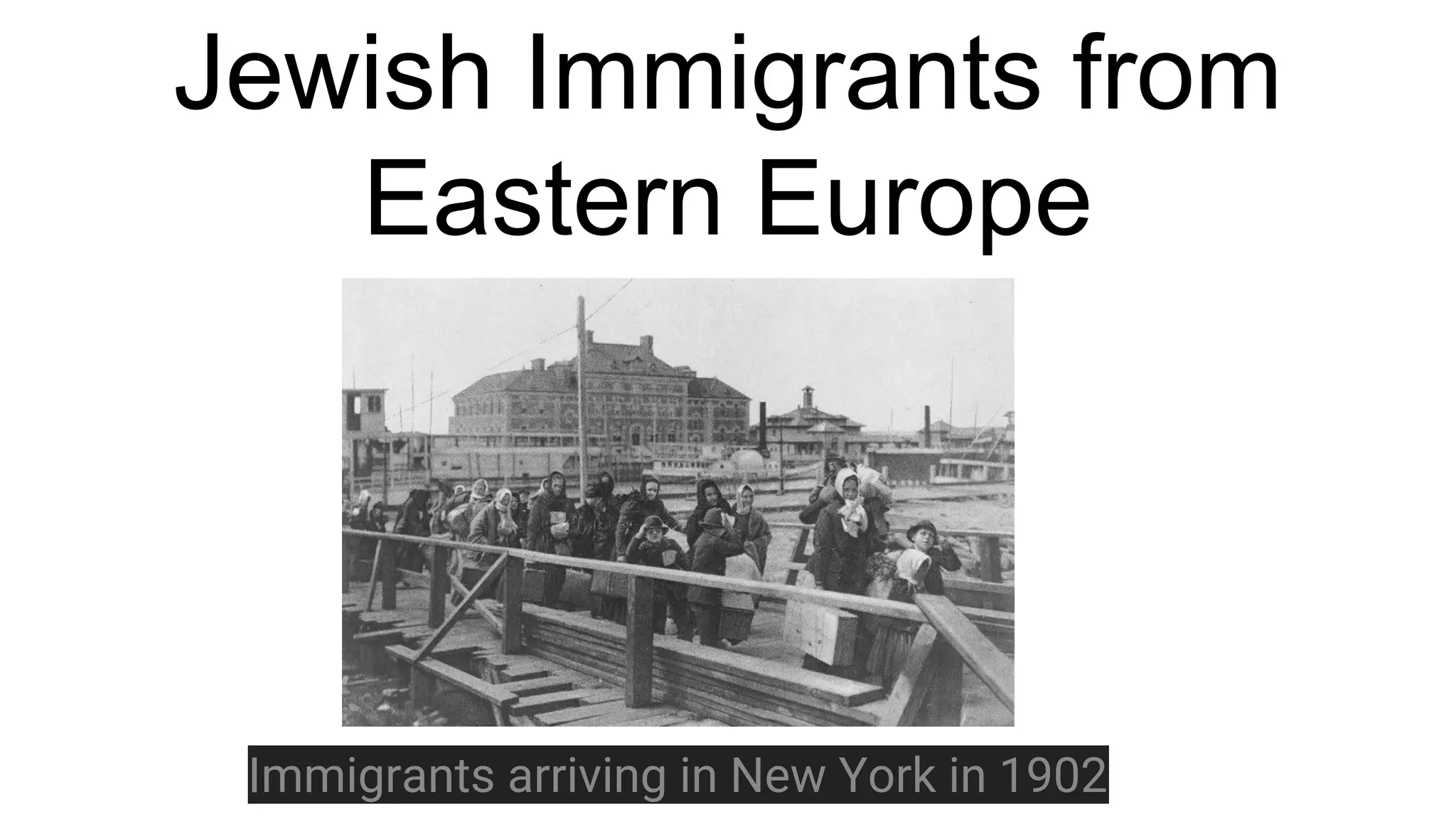
Jewish Immigrants from
Eastern Europe
Immigrants arriving in New York in 1902
Maryusha Antonovksy was no more. In her place stood Mary Antin, the
same immigrant Jewish girl but with a new, American, name. Mary had
also bought real American machine-made clothing to replace her hateful
homemade European-style clothes. “I long to forget,”she said. “It is painful
to be conscious of two worlds.”
This is Mary Antin
Fleeing Persecution
Mary Antin‘s first world had been a Jewish village in Russia. For centuries,
Russians had resented Jews, who dressed, worshiped, and ate differently from
their Christian neighbors. By the 1800s, Russia had hundreds of anti-Jewish laws.
Jews could live only in certain areas. They couldn‘t live in big cities or own land.
These are Jewish
refugees who escaped
Russia and when to
England.
In 1881, assassins
killed the Russian
monarch Czar
(emperor or leader)
Alexander II. Nervous
government leaders
blamed Jews for his
murder, even though
the assassin wasn‘t
Jewish. Angry
Russians raged
through Jewish
villages, burning,
looting, and killing.
These attacks, called
pogroms, happened
repeatedly for more
than 30 years.
Many Jews fled these terrors, hoping to find refuge
in America. Between 1881 and 1924,
some 2.4 million Jews came to the United States
from Russia and other countries in eastern
Europe. Mary Antin‘s father was one of them.
Mary‘s father left for America in 1891,
hoping to earn enough money to send for
his family. In his first letter home, Mary
sensed “An elation [joy], a hint of
triumph…. My father was inspired by a
vision. He saw something—he promised
us something. It was this America.”
When Antin sent a steamship ticket for his
family to join him, the people in Mary‘s
village gathered, filled with longing. They
wanted to know where we were going.
This is what a ticket for a
steamship ride might look
like...
After long rides in overcrowded trains and weeks of delay, Mary‘s family
finally boarded a ship in Hamburg, Germany. Although richer immigrants
enjoyed comfortable cabins, the Antins were crowded together with
hundreds of other passengers deep down in the ship. When immigrants
arrived at Ellis Island, they faced the dreaded medical inspection. Those
judged to be in poor health had to stay on Ellis Island until they were well.
Those who never improved were sent home.
Jewish Life in America
From Ellis Island, Jews headed for New York City‘s Lower East Side
neighborhood. There they established shops, newspapers, religious schools,
and synagogues (community centers and places of worship). The Lower East
Side became the most densely populated neighborhood in the city. People
lived packed into cheap tenements, often sleeping three or four to a room.
Some Jews worked as street vendors, using a pushcart to sell everything
from coal to second-hand clothes. Pushcart vendors saved their money to
buy horse-drawn carts and then little stores. Although most Jews were
poor, they arrived in America with a wide range of skills. Jews worked as
cobblers, butchers, carpenters, and watchmakers. Almost half found jobs
in the city‘s garment factories.
Jewish immigrants did whatever they could to keep their
children in school. In Europe, Jews had honored educated
people, but schooling had cost money. As a result, many Jews
had never learned to read and write. In America, Mary Antin
wrote, “Education was free…. It was the one thing that my
father was able to promise us when he sent for us: surer, safer
than bread or shelter.”
Parents who made a little money often sent
their sons, and sometimes their daughters, to
the city‘s inexpensive public colleges. By
1910, more Jewish youths over 16 were still in
school than were young people of any other
ethnic group.
Like other immigrant groups, Jews faced prejudice and discrimination.
Most private schools and clubs refused to accept Jews.
Hospitals would not hire Jewish doctors; the New York Bar Association
would not admit Jews as lawyers.
Many ads for jobs stated simply, ―Christians only.-- Still, eastern
European Jews were grateful to be in their new country.
One immigrant recalled, “There were markets groaning with food and clothes….
There was no military on horseback and no whips.”

Jewish Immigrants from Eastern Europe

  • 1.
    Jewish Immigrants from EasternEurope Immigrants arriving in New York in 1902
  • 2.
    Maryusha Antonovksy wasno more. In her place stood Mary Antin, the same immigrant Jewish girl but with a new, American, name. Mary had also bought real American machine-made clothing to replace her hateful homemade European-style clothes. “I long to forget,”she said. “It is painful to be conscious of two worlds.” This is Mary Antin
  • 3.
    Fleeing Persecution Mary Antin‘sfirst world had been a Jewish village in Russia. For centuries, Russians had resented Jews, who dressed, worshiped, and ate differently from their Christian neighbors. By the 1800s, Russia had hundreds of anti-Jewish laws. Jews could live only in certain areas. They couldn‘t live in big cities or own land. These are Jewish refugees who escaped Russia and when to England.
  • 4.
    In 1881, assassins killedthe Russian monarch Czar (emperor or leader) Alexander II. Nervous government leaders blamed Jews for his murder, even though the assassin wasn‘t Jewish. Angry Russians raged through Jewish villages, burning, looting, and killing. These attacks, called pogroms, happened repeatedly for more than 30 years.
  • 5.
    Many Jews fledthese terrors, hoping to find refuge in America. Between 1881 and 1924, some 2.4 million Jews came to the United States from Russia and other countries in eastern Europe. Mary Antin‘s father was one of them.
  • 6.
    Mary‘s father leftfor America in 1891, hoping to earn enough money to send for his family. In his first letter home, Mary sensed “An elation [joy], a hint of triumph…. My father was inspired by a vision. He saw something—he promised us something. It was this America.” When Antin sent a steamship ticket for his family to join him, the people in Mary‘s village gathered, filled with longing. They wanted to know where we were going. This is what a ticket for a steamship ride might look like...
  • 7.
    After long ridesin overcrowded trains and weeks of delay, Mary‘s family finally boarded a ship in Hamburg, Germany. Although richer immigrants enjoyed comfortable cabins, the Antins were crowded together with hundreds of other passengers deep down in the ship. When immigrants arrived at Ellis Island, they faced the dreaded medical inspection. Those judged to be in poor health had to stay on Ellis Island until they were well. Those who never improved were sent home.
  • 8.
    Jewish Life inAmerica From Ellis Island, Jews headed for New York City‘s Lower East Side neighborhood. There they established shops, newspapers, religious schools, and synagogues (community centers and places of worship). The Lower East Side became the most densely populated neighborhood in the city. People lived packed into cheap tenements, often sleeping three or four to a room.
  • 9.
    Some Jews workedas street vendors, using a pushcart to sell everything from coal to second-hand clothes. Pushcart vendors saved their money to buy horse-drawn carts and then little stores. Although most Jews were poor, they arrived in America with a wide range of skills. Jews worked as cobblers, butchers, carpenters, and watchmakers. Almost half found jobs in the city‘s garment factories.
  • 10.
    Jewish immigrants didwhatever they could to keep their children in school. In Europe, Jews had honored educated people, but schooling had cost money. As a result, many Jews had never learned to read and write. In America, Mary Antin wrote, “Education was free…. It was the one thing that my father was able to promise us when he sent for us: surer, safer than bread or shelter.”
  • 11.
    Parents who madea little money often sent their sons, and sometimes their daughters, to the city‘s inexpensive public colleges. By 1910, more Jewish youths over 16 were still in school than were young people of any other ethnic group.
  • 12.
    Like other immigrantgroups, Jews faced prejudice and discrimination. Most private schools and clubs refused to accept Jews. Hospitals would not hire Jewish doctors; the New York Bar Association would not admit Jews as lawyers. Many ads for jobs stated simply, ―Christians only.-- Still, eastern European Jews were grateful to be in their new country. One immigrant recalled, “There were markets groaning with food and clothes…. There was no military on horseback and no whips.”