1
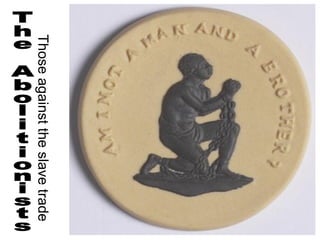
Those against the slave trade
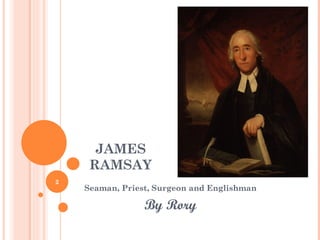
JAMES
     RAMSAY
2
    Seaman, Priest, Surgeon and Englishman

                 By Rory
LIFE BEFORE ABOLITIONISM
   Born in Fraser burgh, Scotland, to William Ramsay and
    Margaret Ogilvie.
   Educated at King’s College in Aberdeen.
   Before he became a fierce Abolitionist, James Ramsay was
    a Sailor in the Navy. When his Ship intercepted a Slaver,
    and found over a hundred slaves living in inhumane
    conditions, Ramsay was effected for life.
   Later, he suffered a fracture to his thigh bone while
    working at sea, and retired from the Navy, remaining lame
    for the rest of his life.
   Afterwards, he took up Priesthood, and journeyed to the
    Caribbean Isle of St Christopher.
                                                                3
ABOLITIONISM
   There, his Abolitionist work would begin. He made considerable
    efforts to better the lives of the Slaves there, leading to him being
    the subject of much antagonism by the local Slavers, due to his
    apparent ‘Disruption’ of the Work.
   Afterwards, when he left St Christopher, he published a novel
    about the horrors of Slavery he had witnessed, entitled: An Essay
    on the Treatment and Conversion of African Slaves in the British
    Sugar Colonies and joined an anti-Slaving group of influential
    politicians, philanthropists and clergy, based out of Teston.
   After the publishing of his book, he was repeatedly the victim of
    slander, with many accusations from threatened Slavers being
    thrown against him.
   He met with the Prime Minister, William Pitt the Younger, on
    several occasions.
   He did not live to see Slave Trade abolished, as he died in 1789,
    and was buried at Teston. However, his Legacy lives on in the         4
    common belief that he attributed to the eventual abolition more
    than any other one person.
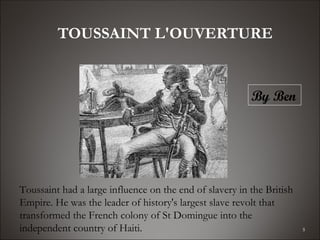
TOUSSAINT L'OUVERTURE


                                                         By Ben


Toussaint had a large influence on the end of slavery in the British
Empire. He was the leader of history's largest slave revolt that
transformed the French colony of St Domingue into the
independent country of Haiti.                                          5
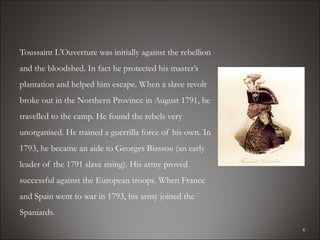
Toussaint L'Ouverture was initially against the rebellion
and the bloodshed. In fact he protected his master’s
plantation and helped him escape. When a slave revolt
broke out in the Northern Province in August 1791, he
travelled to the camp. He found the rebels very
unorganised. He trained a guerrilla force of his own. In
1793, he became an aide to Georges Biassou (an early
leader of the 1791 slave rising). His army proved
successful against the European troops. When France
and Spain went to war in 1793, his army joined the
Spaniards.
                                                            6
THE SLAVE TRADE
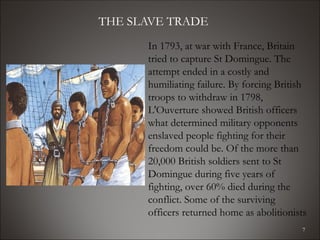
      In 1793, at war with France, Britain
      tried to capture St Domingue. The
      attempt ended in a costly and
      humiliating failure. By forcing British
      troops to withdraw in 1798,
      L'Ouverture showed British officers
      what determined military opponents
      enslaved people fighting for their
      freedom could be. Of the more than
      20,000 British soldiers sent to St
      Domingue during five years of
      fighting, over 60% died during the
      conflict. Some of the surviving
      officers returned home as abolitionists
                                            7
TOUSSAINT
         L’OUVERTURE

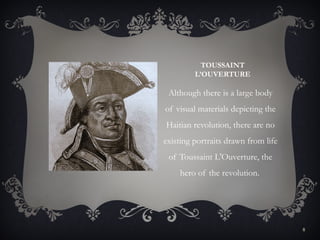
 Although there is a large body
of visual materials depicting the
Haitian revolution, there are no
existing portraits drawn from life
 of Toussaint L'Ouverture, the
    hero of the revolution.


                                     8
James Stephan by Ali
James Stephan is a politician who was born in the year 1758, 30th of June.
James Stephan started out as a reporter on parliamentary proceedings.
He then visited Barbados and witnessed the trial of 4 black slaves for murder, the men
were sentenced to death by burning. James Stephan thought this was wrong, and he
swore to himself that he will never keep a slave. He then allied with the abolitionist
movement.
Stephan was a skilled lawyer whose specialty was the laws governing Great Britain's
foreign trade. He defended the mercantilist system. In October 1805, his book
appeared It called for the abolition of neutral nations' carrying trade, meaning
America's carrying trade, between France’s Caribbean islands and Europe, including
Great Britain. Stephen's arguments two years later became the basis of Great Britain's
orders in council, which placed restrictions on American vessels. The enforcement of
this law by British warships eventually led to the war in 1812, even though the Orders
were repealed in the same month that America declared war.
James’s second wife was called Sarah, and because of this marriage, he became
acquainted with many of the figures in the anti slavery movement. Several of his
friendships were made in Clapham, he also had a few other connections in the village
of Stoke Newington, a few miles north of London.
James Stephan became the chief architect of the slave trade act 1807, providing
William Wilberforce with the legal mastermind he needed for drafting.               9
• Mary Prince (c. 1788-c. 1833) was a woman who was put into the slave
  trade and wrote a book during and about her experience. It came out in
  1831, two years before her death.
• No images exist of her, but many illustrations of other subjects are in her
  book.
• She was born to slaves in Bermuda, and was first the property of Charles
  Myners, then, when he died, Captain Williams.
• She worked domestically and in fields.
• Mary quotes: “To strip me naked - to hang me up by the wrists and lay my
  flesh open with the cow-skin, was an ordinary punishment for even a slight
  offence.”
• She was then sold to John Wood for $300, and attended meetings at the
  Moravian Church: “The Moravian ladies (Mrs. Richter, Mrs. Olufsen, and
  Mrs. Sauter) taught me to read in the class; and I got on very fast. ”
• She then escaped, worked under Thomas Pringle, and became a leading
  activist for the anti-slave trade movement.
• Little is known about how she died, and all that is known of her life is
  contained in that little book.
                                                                                10
                                                         By Billy
Elizabeth Heyrick (1789-1831): The Radical
             Campaigner by Courtney
•   Elizabeth Heyrick was born Elizabeth Coltman, in 1789, in Leicester. She married
    a Methodist, John Heyrick, who died eight years later. Elizabeth became a
    member of the Society of Friends and devoted herself to social reform.
•   As well as becoming a prison visitor, she wrote political pamphlets about a range
    of issues, from the Corn Laws to the harsh treatment of vagrants. However, her
    overriding interest was in the abolition of slavery in the British colonies. Heyrick
    began campaigning for a new sugar boycott in Leicester, with the help of Lucy
    Townsend, Mary Lloyd, Sarah Wedgwood and Sophia Sturge.
•   She visited all of the city's grocers to urge them not to stock slave-grown goods.
    Her message was clear cut. She described the West India planters as being like
    thieves and those who bought their produce, like
             receivers of stolen goods. She asked, why petition
                                         Parliament when we can take swifter action
    ourselves?                                             She wanted all slavery ended
    forever. She criticized the                                                mainstream
    anti-slavery figures for being slow, cautious
                         and accommodating.
•   In 1824, she published her pamphlet 'Immediate not
                     Gradual Abolition'. This differed from the official policy
                                                   of gradual abolition and William
    Wilberforce gave out                                       instructions for leaders of
    the movement not to speak at                                              women's
    anti-slavery societies, most of which supported                                   11
    Heyrick.
Elizabeth Heyrick (1789-1831): The Radical
             Campaigner by Courtney
•   However, her pamphlet was distributed and discussed at meetings all over the country. In
    1830, the Female Society for Birmingham submitted a motion to the National Conference of
    the Anti-Slavery Society calling for it to campaign for an immediate end to slavery in the
    British colonies. Below are some extracts from her 1824 pamphlet:
•   "The perpetuation of slavery in our West India colonies is not an abstract question, to be
    settled between the government and the planters; it is one in which we are all implicated,
    we are all guilty of supporting and perpetuating slavery. The West Indian planter and the
    people of this country stand in the same moral relation to each other as the thief and
    receiver of stolen goods."
•   "The West Indian planters have occupied much too prominent a place in the discussion of
    this great question. The abolitionists have shown a great deal too much politeness and
    accommodation towards these gentlemen. "Why petition Parliament at all, to do that for us,
    which we can do more speedily and effectually for ourselves?"
•   Elizabeth suggested that the women's associations should withdraw their funding for the
    Anti-Slavery Society, if it did not support this resolution. As the Female Society for
    Birmingham was one of the largest donors to central funds, it was influential across the
    whole network of ladies' associations, which supplied over a fifth of all donations.
•   At the conference in May 1830, the Anti-Slavery Society agreed to drop the words "gradual
    abolition" from its title and support the Female Society's plan for a new campaign calling for
    the immediate end to slavery. Elizabeth Heyrick died in 1831 and therefore did not live to
    see the passing of the 1833 Abolition of Slavery Act.


                                                                                           12
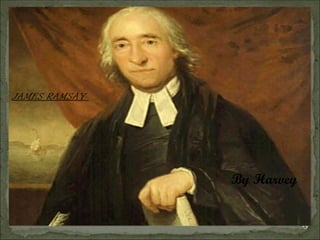
JAMES RAMSAY


               By Harvey


                           13
As well as bringing to public notice the debate about the slave
trade. He contributed several further publications to the
campaign, including An Inquiry into the Effects of Putting a
Stop to the African Slave Trade, published 1784
Ramsay became part of the group of influential politicians,
philanthropists and churchmen based at Teston, and was
persuaded by Lady Middleton, the wife of Charles Middleton
and others to publish his account of the horrors of the slave
trade. They met at Barham Court. This was the first time that
the British public had read an anti-slavery work by a
mainstream Anglican writer who had personally witnessed
the suffering of the slaves on the West-Indian plantations.
                                                                  14
Quobna Ottobah Cugoano by Guilhem
•   Ottobah was born in 1757 in Ghana and captured in 1770 to become a
    slave. He was taken to the West Indies and spent a nearly a year in
    Grenada as a slave. In 1772 he was bought by an English merchant and
    taken to England. Here, he changed his name and became free. In 1784,
    he was employed as a servant by artist Richard Cosway. It was here that
    he began to learn about British politics and abolitionists.
•   He joined the Sons of Africa abolitionist group and worked with Olaudah
    Equiano and other Africans to stop slavery. In 1786 he was involved with
    the Henry Denme case, a black man who had been kidnapped and being
    sent to the West Indies. Ottobah managed to stop the ship from
    departing at the very last minute.
•   In 1787, Ottobah published his book. He was the first African to write a
    critique about slavery. It demanded that slavery was to be completely
    destroyed and slaves should be freed. It said that Africans also had their
    right to resist against slavery.
•   Still no one listened to him and slavery continued. In 1791, he wrote a
    smaller book that told the idea of Britain building schools just for Africans
    and other ideas against slavery.
•   People do not know what happened to him after the release of his
    second book…
                                                                           15
Anthony Benezet (1713-1784) by Will
•   From the 1750s, Benezet became an avid opponent of slavery, He
    insisted on the equality of all people and pointed out the high level of
    culture, intelligence and industry of the native Africans. He wrote:
•   "To live in ease and plenty by the toil of those whom violence and cruelty
    have put in our power, is neither consistent with Christianity nor common
    justice..."
•   "I can with truth and sincerity declare, that I have found amongst the
    negroes as great a variety of talents as amongst a like number of whites;
    and I am bold to assert, that the notion entertained by some, that the
    blacks are inferior in their capacities, is a vulgar prejudice, founded on
    the pride of ignorance of their lordly masters, who have kept their slaves
    at such a distance, as to be unable to form a right judgment of them."
•   In 1754, he left the Friends' English School to set up the first public girls'
    school in America. He was motivated by a genuine concern to do the
    best for all his pupils. In an age intolerant of disabilities, Benezet was
    compassionate enough to devise a special programme for one deaf and
    dumb girl enrolled in his school, so she could share in the fellowship of
    the school. He continued to teach black children from home until1770
    when, with the support of the Society of Friends, he set up a school for
    them at Philadelphia.
                                                                            16
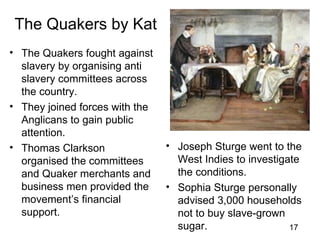
The Quakers by Kat
• The Quakers fought against
  slavery by organising anti
  slavery committees across
  the country.
• They joined forces with the
  Anglicans to gain public
  attention.
• Thomas Clarkson               • Joseph Sturge went to the
  organised the committees        West Indies to investigate
  and Quaker merchants and        the conditions.
  business men provided the     • Sophia Sturge personally
  movement’s financial            advised 3,000 households
  support.                        not to buy slave-grown
                                  sugar.                  17
Thomas Clarkson by Lauryn
•   Thomas Clarkson was a abolitionist and a leading campaigner against
    the slave trade in the British Empire. In his later years Clarkson
    campaigned for the abolition of slavery worldwide. In 1840, he was the
    key speaker at the Anti-Slave society (today known as Anti-Slavery
    International) conference in London, which campaigned to end slavery in
    other countries.

•   Thomas Clarkson was absolutely central to the anti-slavery movement.
    He helped organise the first meeting of the abolition committee in
    London in 1787 and worked more than half a century after that against
    the slave trade and slavery.

•   He travelled and shared the news about slavery and told lots of people
    about the situation. As he saw people he would give them a book or
    would talk to them when he travelling around countries. He did this
    because he didn't agree with slavery. He was against it . He organised a
    campaign. He wanted slavery to stop.


                                                                       18
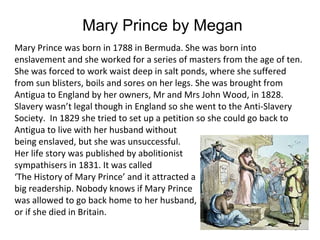
Mary Prince by Megan
Mary Prince was born in 1788 in Bermuda. She was born into
enslavement and she worked for a series of masters from the age of ten.
She was forced to work waist deep in salt ponds, where she suffered
from sun blisters, boils and sores on her legs. She was brought from
Antigua to England by her owners, Mr and Mrs John Wood, in 1828.
Slavery wasn’t legal though in England so she went to the Anti-Slavery
Society. In 1829 she tried to set up a petition so she could go back to
Antigua to live with her husband without
being enslaved, but she was unsuccessful.
Her life story was published by abolitionist
sympathisers in 1831. It was called
‘The History of Mary Prince’ and it attracted a
big readership. Nobody knows if Mary Prince
was allowed to go back home to her husband,
or if she died in Britain.
                                                                   19
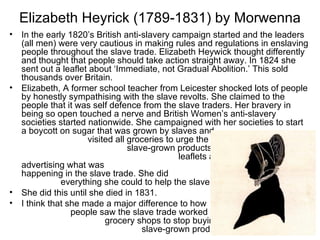
Elizabeth Heyrick (1789-1831) by Morwenna
•   In the early 1820’s British anti-slavery campaign started and the leaders
    (all men) were very cautious in making rules and regulations in enslaving
    people throughout the slave trade. Elizabeth Heywick thought differently
    and thought that people should take action straight away. In 1824 she
    sent out a leaflet about ‘Immediate, not Gradual Abolition.’ This sold
    thousands over Britain.
•   Elizabeth, A former school teacher from Leicester shocked lots of people
    by honestly sympathising with the slave revolts. She claimed to the
    people that it was self defence from the slave traders. Her bravery in
    being so open touched a nerve and British Women’s anti-slavery
    societies started nationwide. She campaigned with her societies to start
    a boycott on sugar that was grown by slaves and
                      visited all groceries to urge the not to stock
                                  slave-grown products. She wrote even more
                                                leaflets and pamphlets’
    advertising what was
    happening in the slave trade. She did
               everything she could to help the slave trade.
•   She did this until she died in 1831.
•   I think that she made a major difference to how
                  people saw the slave trade worked and stopped
                           grocery shops to stop buying and selling
                                      slave-grown products.                20
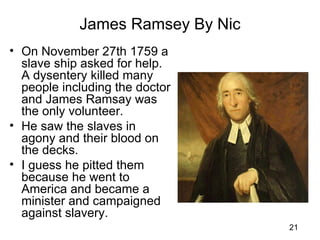
James Ramsey By Nic
• On November 27th 1759 a
  slave ship asked for help.
  A dysentery killed many
  people including the doctor
  and James Ramsay was
  the only volunteer.
• He saw the slaves in
  agony and their blood on
  the decks.
• I guess he pitted them
  because he went to
  America and became a
  minister and campaigned
  against slavery.
                                  21

Y8 h30 abolitionists

  • 1.
  • 2.
    JAMES RAMSAY 2 Seaman, Priest, Surgeon and Englishman By Rory
  • 3.
    LIFE BEFORE ABOLITIONISM  Born in Fraser burgh, Scotland, to William Ramsay and Margaret Ogilvie.  Educated at King’s College in Aberdeen.  Before he became a fierce Abolitionist, James Ramsay was a Sailor in the Navy. When his Ship intercepted a Slaver, and found over a hundred slaves living in inhumane conditions, Ramsay was effected for life.  Later, he suffered a fracture to his thigh bone while working at sea, and retired from the Navy, remaining lame for the rest of his life.  Afterwards, he took up Priesthood, and journeyed to the Caribbean Isle of St Christopher. 3
  • 4.
    ABOLITIONISM  There, his Abolitionist work would begin. He made considerable efforts to better the lives of the Slaves there, leading to him being the subject of much antagonism by the local Slavers, due to his apparent ‘Disruption’ of the Work.  Afterwards, when he left St Christopher, he published a novel about the horrors of Slavery he had witnessed, entitled: An Essay on the Treatment and Conversion of African Slaves in the British Sugar Colonies and joined an anti-Slaving group of influential politicians, philanthropists and clergy, based out of Teston.  After the publishing of his book, he was repeatedly the victim of slander, with many accusations from threatened Slavers being thrown against him.  He met with the Prime Minister, William Pitt the Younger, on several occasions.  He did not live to see Slave Trade abolished, as he died in 1789, and was buried at Teston. However, his Legacy lives on in the 4 common belief that he attributed to the eventual abolition more than any other one person.
  • 5.
    TOUSSAINT L'OUVERTURE By Ben Toussaint had a large influence on the end of slavery in the British Empire. He was the leader of history's largest slave revolt that transformed the French colony of St Domingue into the independent country of Haiti. 5
  • 6.
    Toussaint L'Ouverture wasinitially against the rebellion and the bloodshed. In fact he protected his master’s plantation and helped him escape. When a slave revolt broke out in the Northern Province in August 1791, he travelled to the camp. He found the rebels very unorganised. He trained a guerrilla force of his own. In 1793, he became an aide to Georges Biassou (an early leader of the 1791 slave rising). His army proved successful against the European troops. When France and Spain went to war in 1793, his army joined the Spaniards. 6
  • 7.
    THE SLAVE TRADE In 1793, at war with France, Britain tried to capture St Domingue. The attempt ended in a costly and humiliating failure. By forcing British troops to withdraw in 1798, L'Ouverture showed British officers what determined military opponents enslaved people fighting for their freedom could be. Of the more than 20,000 British soldiers sent to St Domingue during five years of fighting, over 60% died during the conflict. Some of the surviving officers returned home as abolitionists 7
  • 8.
    TOUSSAINT L’OUVERTURE Although there is a large body of visual materials depicting the Haitian revolution, there are no existing portraits drawn from life of Toussaint L'Ouverture, the hero of the revolution. 8
  • 9.
    James Stephan byAli James Stephan is a politician who was born in the year 1758, 30th of June. James Stephan started out as a reporter on parliamentary proceedings. He then visited Barbados and witnessed the trial of 4 black slaves for murder, the men were sentenced to death by burning. James Stephan thought this was wrong, and he swore to himself that he will never keep a slave. He then allied with the abolitionist movement. Stephan was a skilled lawyer whose specialty was the laws governing Great Britain's foreign trade. He defended the mercantilist system. In October 1805, his book appeared It called for the abolition of neutral nations' carrying trade, meaning America's carrying trade, between France’s Caribbean islands and Europe, including Great Britain. Stephen's arguments two years later became the basis of Great Britain's orders in council, which placed restrictions on American vessels. The enforcement of this law by British warships eventually led to the war in 1812, even though the Orders were repealed in the same month that America declared war. James’s second wife was called Sarah, and because of this marriage, he became acquainted with many of the figures in the anti slavery movement. Several of his friendships were made in Clapham, he also had a few other connections in the village of Stoke Newington, a few miles north of London. James Stephan became the chief architect of the slave trade act 1807, providing William Wilberforce with the legal mastermind he needed for drafting. 9
  • 10.
    • Mary Prince(c. 1788-c. 1833) was a woman who was put into the slave trade and wrote a book during and about her experience. It came out in 1831, two years before her death. • No images exist of her, but many illustrations of other subjects are in her book. • She was born to slaves in Bermuda, and was first the property of Charles Myners, then, when he died, Captain Williams. • She worked domestically and in fields. • Mary quotes: “To strip me naked - to hang me up by the wrists and lay my flesh open with the cow-skin, was an ordinary punishment for even a slight offence.” • She was then sold to John Wood for $300, and attended meetings at the Moravian Church: “The Moravian ladies (Mrs. Richter, Mrs. Olufsen, and Mrs. Sauter) taught me to read in the class; and I got on very fast. ” • She then escaped, worked under Thomas Pringle, and became a leading activist for the anti-slave trade movement. • Little is known about how she died, and all that is known of her life is contained in that little book. 10 By Billy
  • 11.
    Elizabeth Heyrick (1789-1831):The Radical Campaigner by Courtney • Elizabeth Heyrick was born Elizabeth Coltman, in 1789, in Leicester. She married a Methodist, John Heyrick, who died eight years later. Elizabeth became a member of the Society of Friends and devoted herself to social reform. • As well as becoming a prison visitor, she wrote political pamphlets about a range of issues, from the Corn Laws to the harsh treatment of vagrants. However, her overriding interest was in the abolition of slavery in the British colonies. Heyrick began campaigning for a new sugar boycott in Leicester, with the help of Lucy Townsend, Mary Lloyd, Sarah Wedgwood and Sophia Sturge. • She visited all of the city's grocers to urge them not to stock slave-grown goods. Her message was clear cut. She described the West India planters as being like thieves and those who bought their produce, like receivers of stolen goods. She asked, why petition Parliament when we can take swifter action ourselves? She wanted all slavery ended forever. She criticized the mainstream anti-slavery figures for being slow, cautious and accommodating. • In 1824, she published her pamphlet 'Immediate not Gradual Abolition'. This differed from the official policy of gradual abolition and William Wilberforce gave out instructions for leaders of the movement not to speak at women's anti-slavery societies, most of which supported 11 Heyrick.
  • 12.
    Elizabeth Heyrick (1789-1831):The Radical Campaigner by Courtney • However, her pamphlet was distributed and discussed at meetings all over the country. In 1830, the Female Society for Birmingham submitted a motion to the National Conference of the Anti-Slavery Society calling for it to campaign for an immediate end to slavery in the British colonies. Below are some extracts from her 1824 pamphlet: • "The perpetuation of slavery in our West India colonies is not an abstract question, to be settled between the government and the planters; it is one in which we are all implicated, we are all guilty of supporting and perpetuating slavery. The West Indian planter and the people of this country stand in the same moral relation to each other as the thief and receiver of stolen goods." • "The West Indian planters have occupied much too prominent a place in the discussion of this great question. The abolitionists have shown a great deal too much politeness and accommodation towards these gentlemen. "Why petition Parliament at all, to do that for us, which we can do more speedily and effectually for ourselves?" • Elizabeth suggested that the women's associations should withdraw their funding for the Anti-Slavery Society, if it did not support this resolution. As the Female Society for Birmingham was one of the largest donors to central funds, it was influential across the whole network of ladies' associations, which supplied over a fifth of all donations. • At the conference in May 1830, the Anti-Slavery Society agreed to drop the words "gradual abolition" from its title and support the Female Society's plan for a new campaign calling for the immediate end to slavery. Elizabeth Heyrick died in 1831 and therefore did not live to see the passing of the 1833 Abolition of Slavery Act. 12
  • 13.
    JAMES RAMSAY By Harvey 13
  • 14.
    As well asbringing to public notice the debate about the slave trade. He contributed several further publications to the campaign, including An Inquiry into the Effects of Putting a Stop to the African Slave Trade, published 1784 Ramsay became part of the group of influential politicians, philanthropists and churchmen based at Teston, and was persuaded by Lady Middleton, the wife of Charles Middleton and others to publish his account of the horrors of the slave trade. They met at Barham Court. This was the first time that the British public had read an anti-slavery work by a mainstream Anglican writer who had personally witnessed the suffering of the slaves on the West-Indian plantations. 14
  • 15.
    Quobna Ottobah Cugoanoby Guilhem • Ottobah was born in 1757 in Ghana and captured in 1770 to become a slave. He was taken to the West Indies and spent a nearly a year in Grenada as a slave. In 1772 he was bought by an English merchant and taken to England. Here, he changed his name and became free. In 1784, he was employed as a servant by artist Richard Cosway. It was here that he began to learn about British politics and abolitionists. • He joined the Sons of Africa abolitionist group and worked with Olaudah Equiano and other Africans to stop slavery. In 1786 he was involved with the Henry Denme case, a black man who had been kidnapped and being sent to the West Indies. Ottobah managed to stop the ship from departing at the very last minute. • In 1787, Ottobah published his book. He was the first African to write a critique about slavery. It demanded that slavery was to be completely destroyed and slaves should be freed. It said that Africans also had their right to resist against slavery. • Still no one listened to him and slavery continued. In 1791, he wrote a smaller book that told the idea of Britain building schools just for Africans and other ideas against slavery. • People do not know what happened to him after the release of his second book… 15
  • 16.
    Anthony Benezet (1713-1784)by Will • From the 1750s, Benezet became an avid opponent of slavery, He insisted on the equality of all people and pointed out the high level of culture, intelligence and industry of the native Africans. He wrote: • "To live in ease and plenty by the toil of those whom violence and cruelty have put in our power, is neither consistent with Christianity nor common justice..." • "I can with truth and sincerity declare, that I have found amongst the negroes as great a variety of talents as amongst a like number of whites; and I am bold to assert, that the notion entertained by some, that the blacks are inferior in their capacities, is a vulgar prejudice, founded on the pride of ignorance of their lordly masters, who have kept their slaves at such a distance, as to be unable to form a right judgment of them." • In 1754, he left the Friends' English School to set up the first public girls' school in America. He was motivated by a genuine concern to do the best for all his pupils. In an age intolerant of disabilities, Benezet was compassionate enough to devise a special programme for one deaf and dumb girl enrolled in his school, so she could share in the fellowship of the school. He continued to teach black children from home until1770 when, with the support of the Society of Friends, he set up a school for them at Philadelphia. 16
  • 17.
    The Quakers byKat • The Quakers fought against slavery by organising anti slavery committees across the country. • They joined forces with the Anglicans to gain public attention. • Thomas Clarkson • Joseph Sturge went to the organised the committees West Indies to investigate and Quaker merchants and the conditions. business men provided the • Sophia Sturge personally movement’s financial advised 3,000 households support. not to buy slave-grown sugar. 17
  • 18.
    Thomas Clarkson byLauryn • Thomas Clarkson was a abolitionist and a leading campaigner against the slave trade in the British Empire. In his later years Clarkson campaigned for the abolition of slavery worldwide. In 1840, he was the key speaker at the Anti-Slave society (today known as Anti-Slavery International) conference in London, which campaigned to end slavery in other countries. • Thomas Clarkson was absolutely central to the anti-slavery movement. He helped organise the first meeting of the abolition committee in London in 1787 and worked more than half a century after that against the slave trade and slavery. • He travelled and shared the news about slavery and told lots of people about the situation. As he saw people he would give them a book or would talk to them when he travelling around countries. He did this because he didn't agree with slavery. He was against it . He organised a campaign. He wanted slavery to stop. 18
  • 19.
    Mary Prince byMegan Mary Prince was born in 1788 in Bermuda. She was born into enslavement and she worked for a series of masters from the age of ten. She was forced to work waist deep in salt ponds, where she suffered from sun blisters, boils and sores on her legs. She was brought from Antigua to England by her owners, Mr and Mrs John Wood, in 1828. Slavery wasn’t legal though in England so she went to the Anti-Slavery Society. In 1829 she tried to set up a petition so she could go back to Antigua to live with her husband without being enslaved, but she was unsuccessful. Her life story was published by abolitionist sympathisers in 1831. It was called ‘The History of Mary Prince’ and it attracted a big readership. Nobody knows if Mary Prince was allowed to go back home to her husband, or if she died in Britain. 19
  • 20.
    Elizabeth Heyrick (1789-1831)by Morwenna • In the early 1820’s British anti-slavery campaign started and the leaders (all men) were very cautious in making rules and regulations in enslaving people throughout the slave trade. Elizabeth Heywick thought differently and thought that people should take action straight away. In 1824 she sent out a leaflet about ‘Immediate, not Gradual Abolition.’ This sold thousands over Britain. • Elizabeth, A former school teacher from Leicester shocked lots of people by honestly sympathising with the slave revolts. She claimed to the people that it was self defence from the slave traders. Her bravery in being so open touched a nerve and British Women’s anti-slavery societies started nationwide. She campaigned with her societies to start a boycott on sugar that was grown by slaves and visited all groceries to urge the not to stock slave-grown products. She wrote even more leaflets and pamphlets’ advertising what was happening in the slave trade. She did everything she could to help the slave trade. • She did this until she died in 1831. • I think that she made a major difference to how people saw the slave trade worked and stopped grocery shops to stop buying and selling slave-grown products. 20
  • 21.
    James Ramsey ByNic • On November 27th 1759 a slave ship asked for help. A dysentery killed many people including the doctor and James Ramsay was the only volunteer. • He saw the slaves in agony and their blood on the decks. • I guess he pitted them because he went to America and became a minister and campaigned against slavery. 21