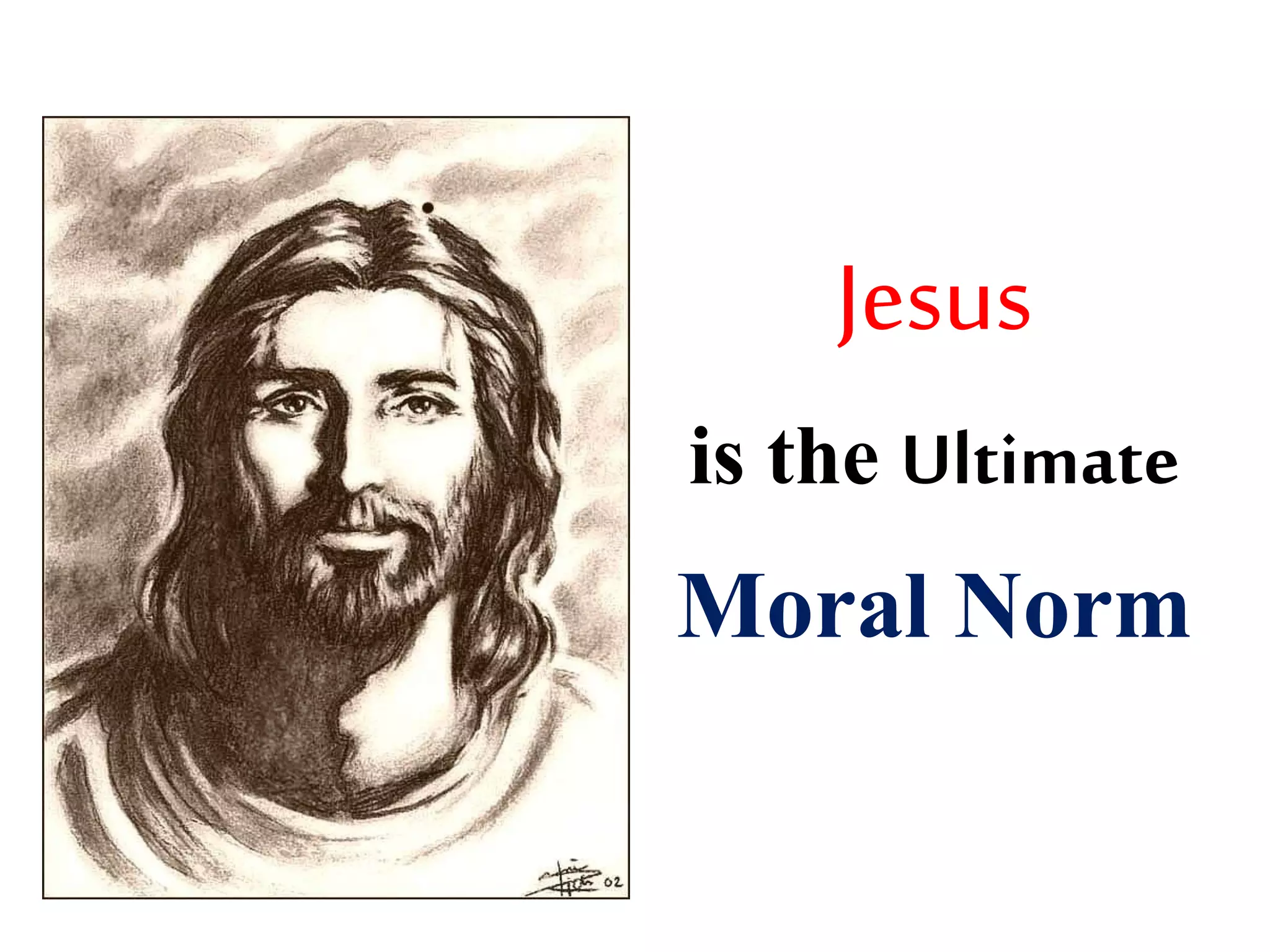
Jesus
is the Ultimate
Moral Norm
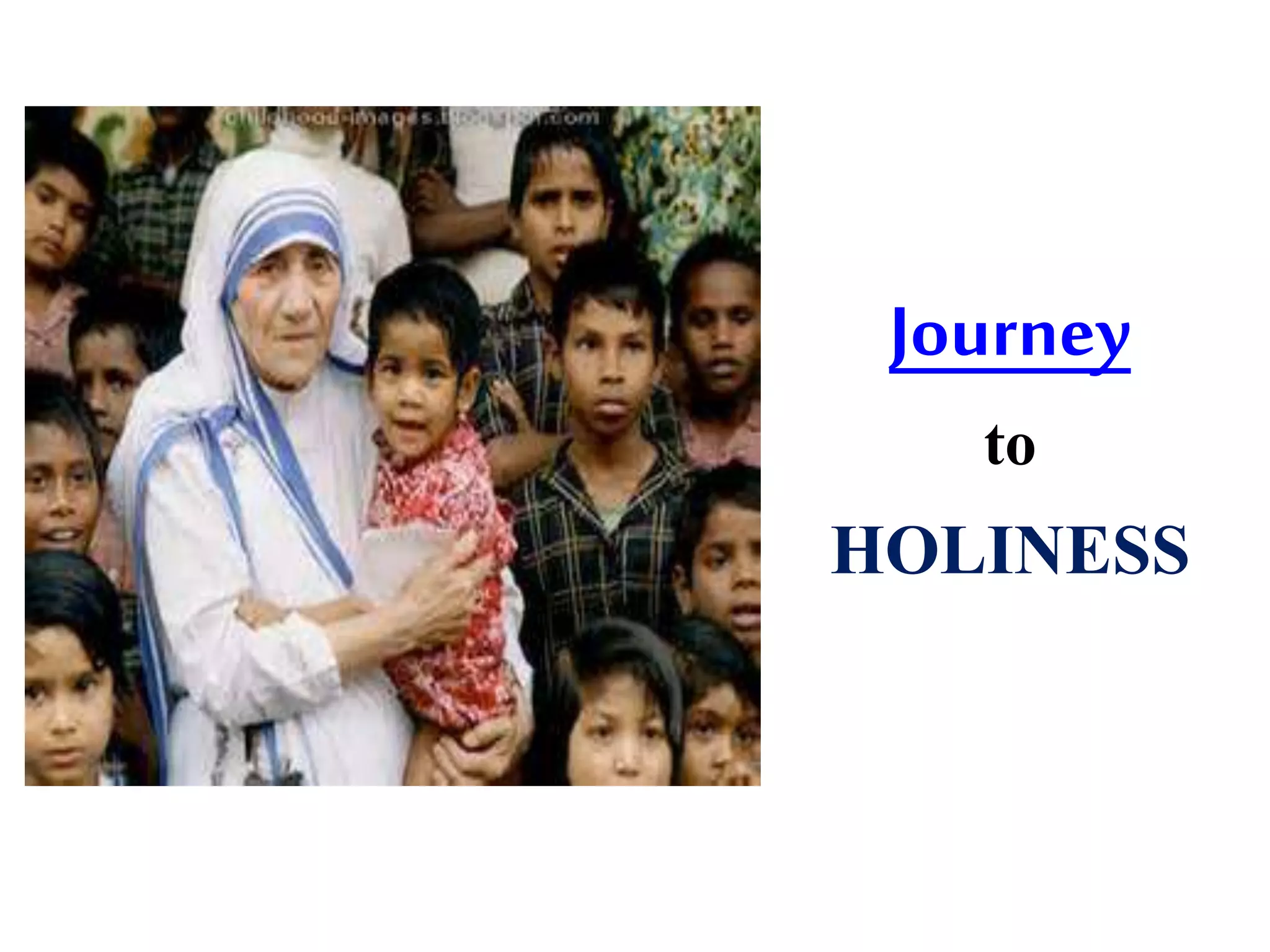
Journey
to
HOLINESS
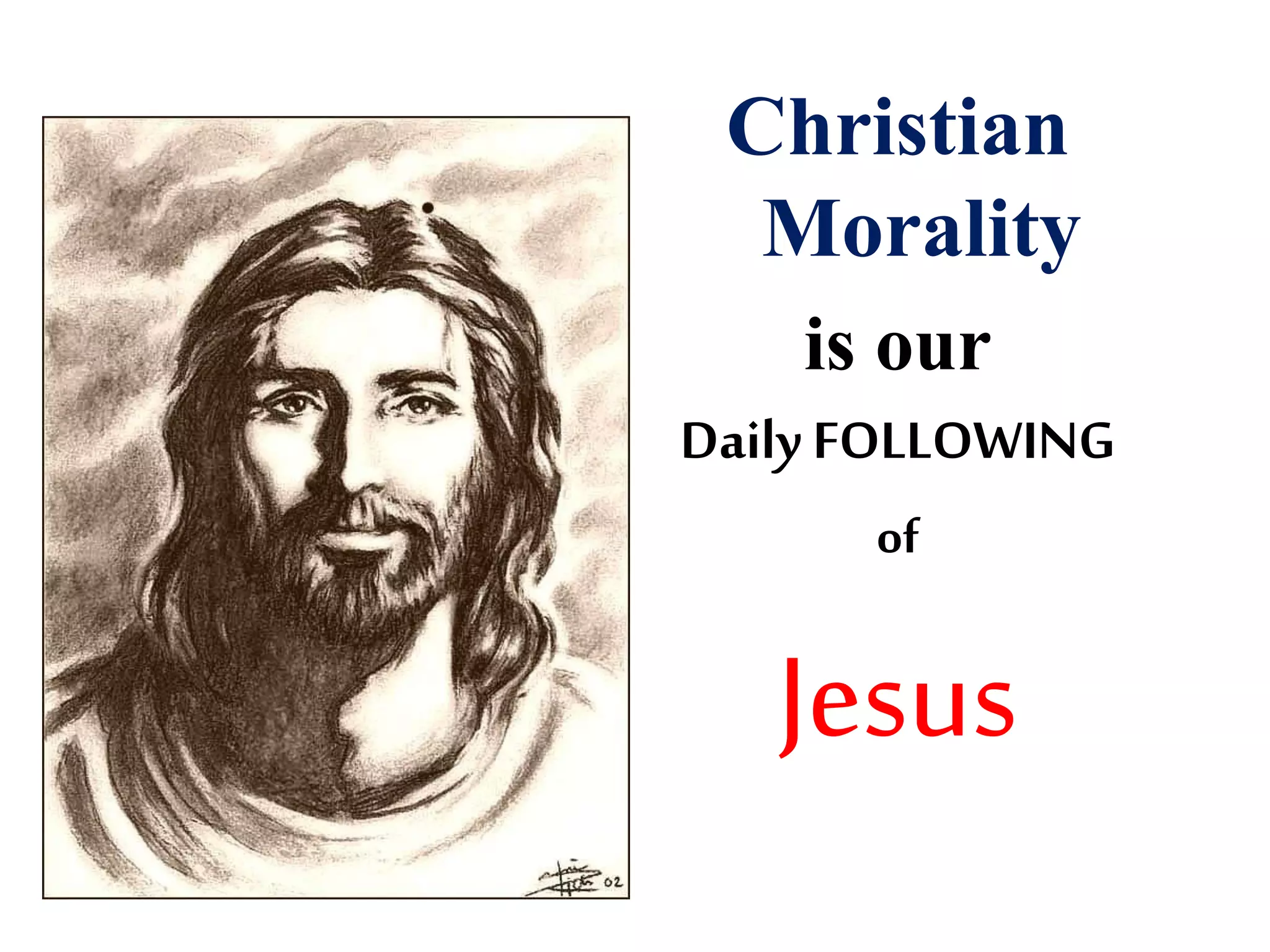
Christian
Morality
is our
Daily FOLLOWING
of
Jesus
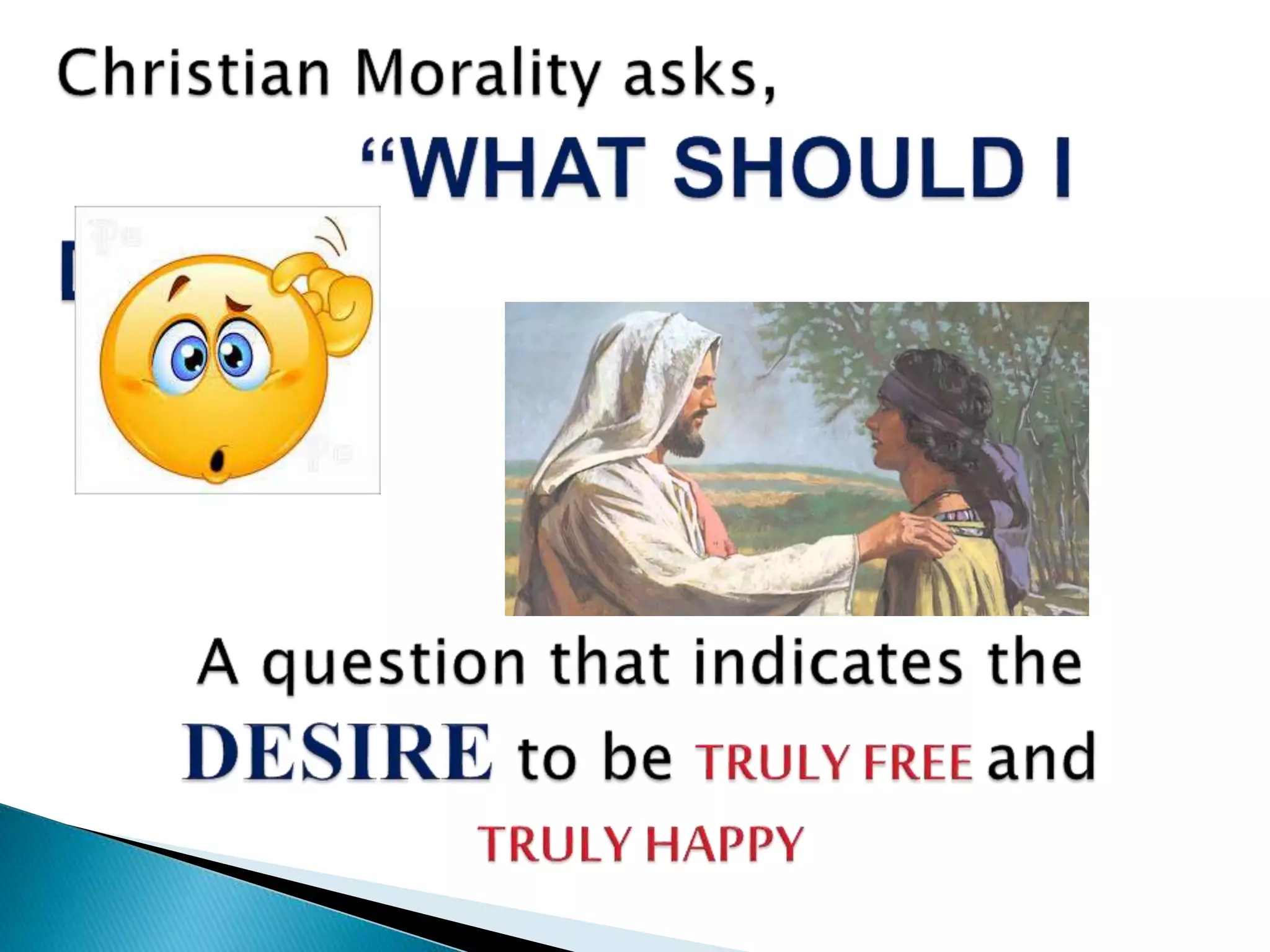
What is Christian Morality?
The RICH YOUNG
MAN
Matthew 19:16-21
The RICH YOUNG MAN
What was the question ofthe richyoung man
to Jesus?
What good must I do to gain eternal life?
We have the innate YEARNINGto do what
is REALLY GOOD!
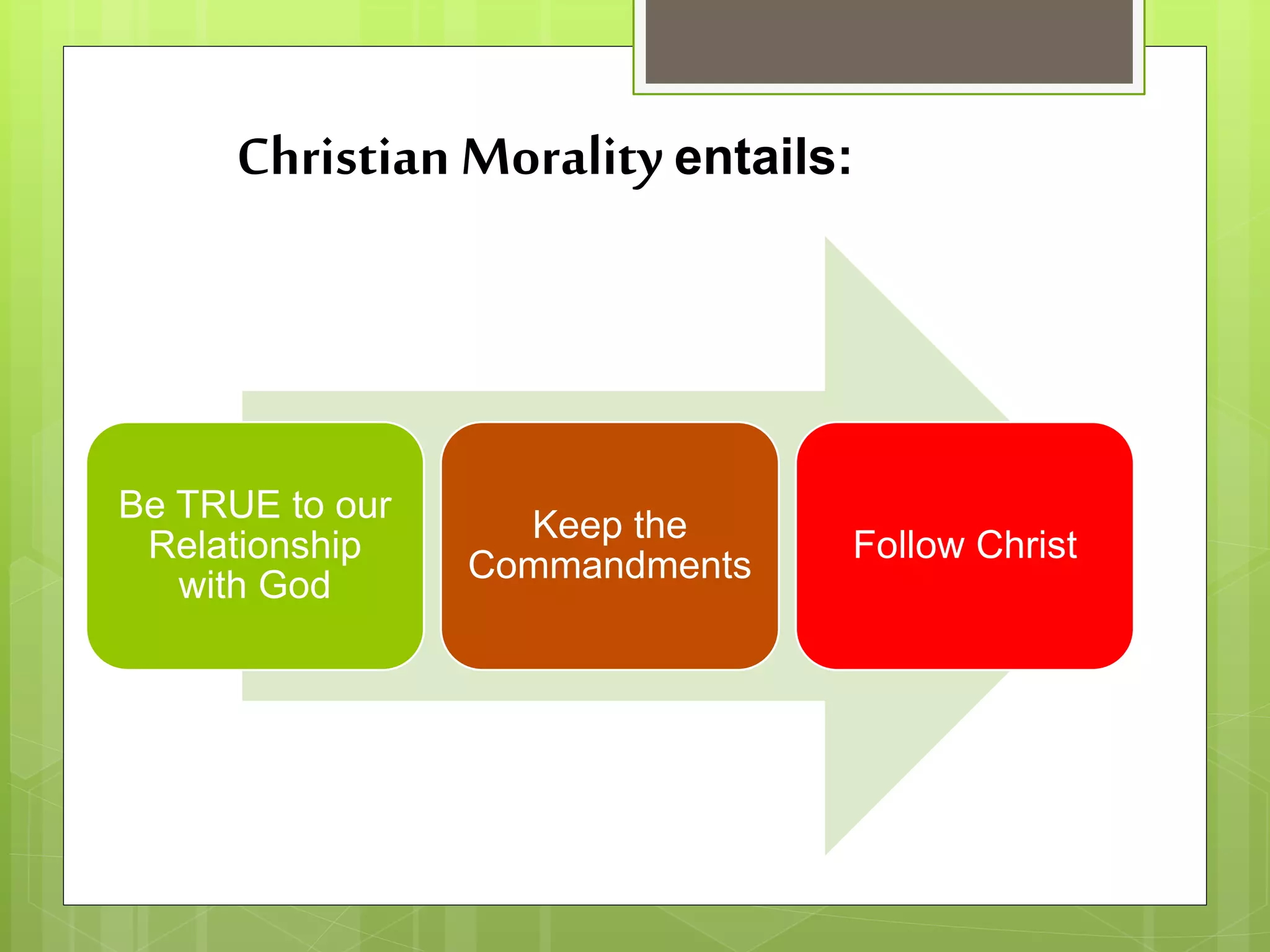
Christian Morality entails:
Be TRUE to our
Relationship
with God
Keep the
Commandments
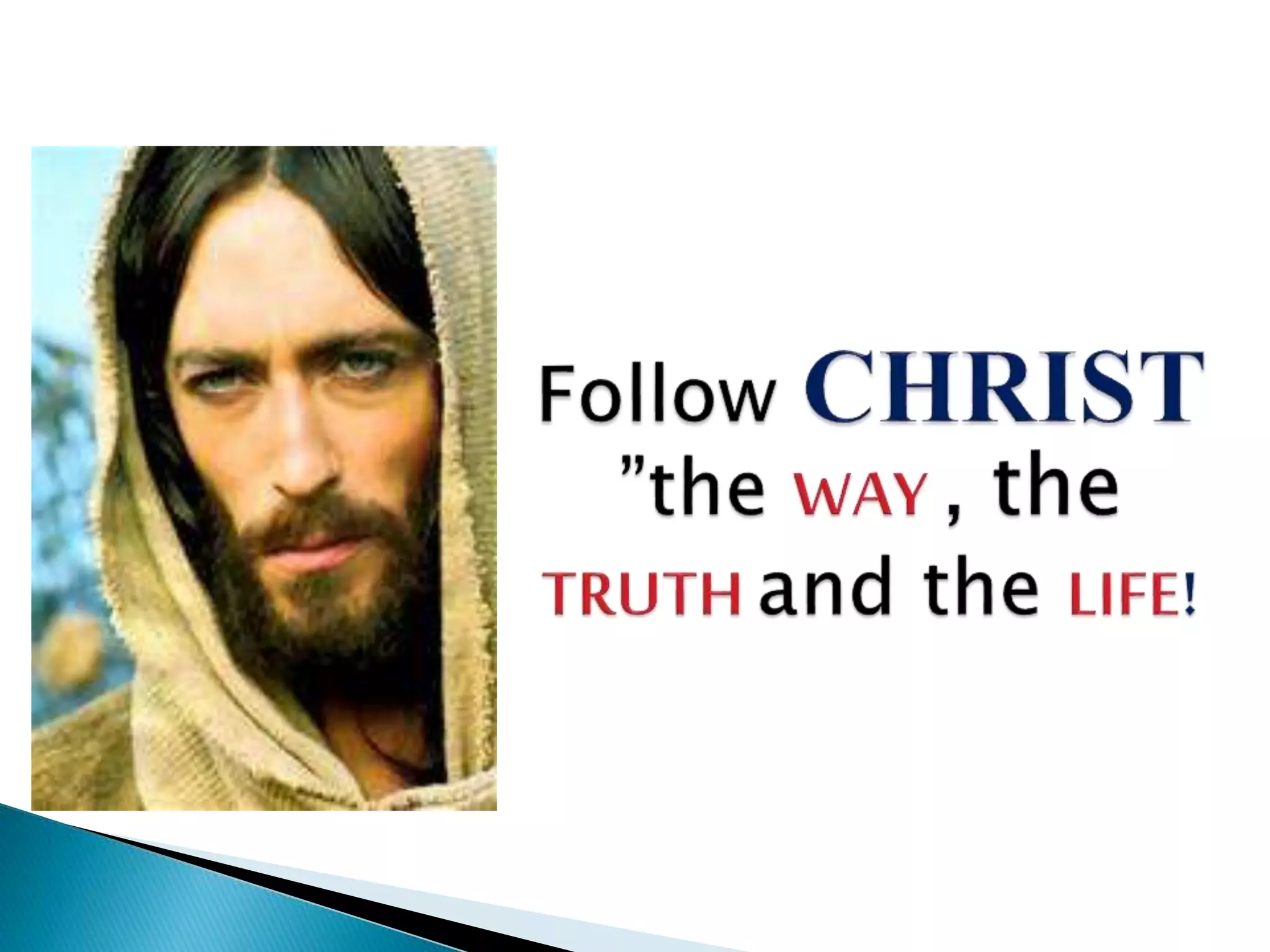
Follow Christ
Jesus during His time, did not
measure up the norms of his
society.
Christian Morality
is the IMITATION of
CHRIST
Jesus taught that our basic dignity as human
persons depends Not Only On Measurable
World Standard, but rather ON GOD WHO
LOVES US AND CALLS US TO LOVE IN RETURN.
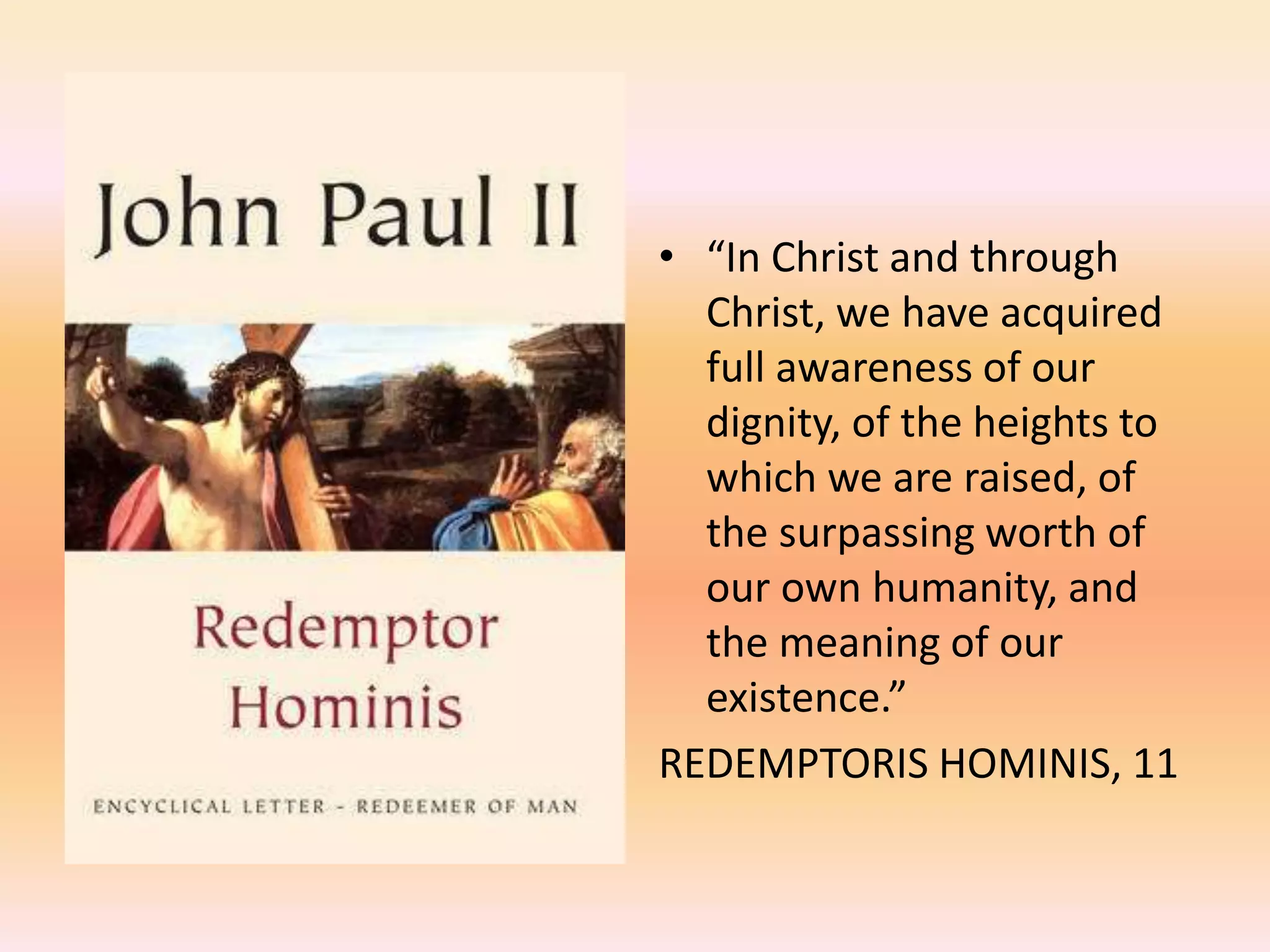
• “In Christ and through
Christ, we have acquired
full awareness of our
dignity, of the heights to
which we are raised, of
the surpassing worth of
our own humanity, and
the meaning of our
existence.”
REDEMPTORIS HOMINIS, 11
 Christian morality is
based on the teachings of Jesus
and hisChurch.
 SACRED SCRIPTURE
 TRADITION OF THE
CHURCH
The essence of
Jesus’ teaching is
LOVE.
 Refers to the sense of
rightness or wrongness of an
act.
From the Greek word MORES -
meaning: behavior
“a special kind of knowing --- a
‘knowing’ of WHAT OUGHT TO BE
DONE”
(Michael Pennock, 2001)
It is more than knowing the
principles, but acting upon it
“is either good or bad, right or
wrong based on some NORMS
that are either inherent in the act
or are observed due to some
individual or social conventional
acceptance”
 --- Manlangit
 Morality has to do with THE
WAY WE LIVE OUR LIVES.
Morality helps us TO JUDGE the difference
between right and wrong.
Once we know the difference between the
two, WE CAN DO WHAT IS RIGHT AND AVOID
WHAT IS WRONG.
 The ABILITY TO KNOW
right from wrong.
good from evil.
The ABILITY TO DISTINGUISH
what is appropriate from what is inappropriate.
The COMMITMENT
to do what is right.
To be a person is TO BE WITH
OTHERS.
 In March 1993, photographer Kevin Carter
made a trip to southern Sudan, where he
took now iconic photo of a vulture preying
upon an emaciated Sudanese toddler near
the village of Ayod.

Journalists in the Sudan were told not to
touch the famine victims, because of the risk
of transmitting disease, but Carter came
under criticism for not helping the girl.

 “The man adjusting his lens to take just the
right frame of her suffering might just as
well be a predator, another vulture on the
scene,” read one editorial.
 Carter eventually won the Pulitzer Prize for
this photo, but he couldn’t enjoy it. “I’m
really, really sorry I didn’t pick the child up,”
he confided in a friend.
 Haunted by the questions as to the little
girl’s fate, he committed suicide three
months later.
Nasaan ka sa larawang ito?
Can a human person be held
responsible for his/her
actions? Why?
WE ARE HUMAN BEINGS
• We possess intellect and will.
• We can think and choose
deliberately.
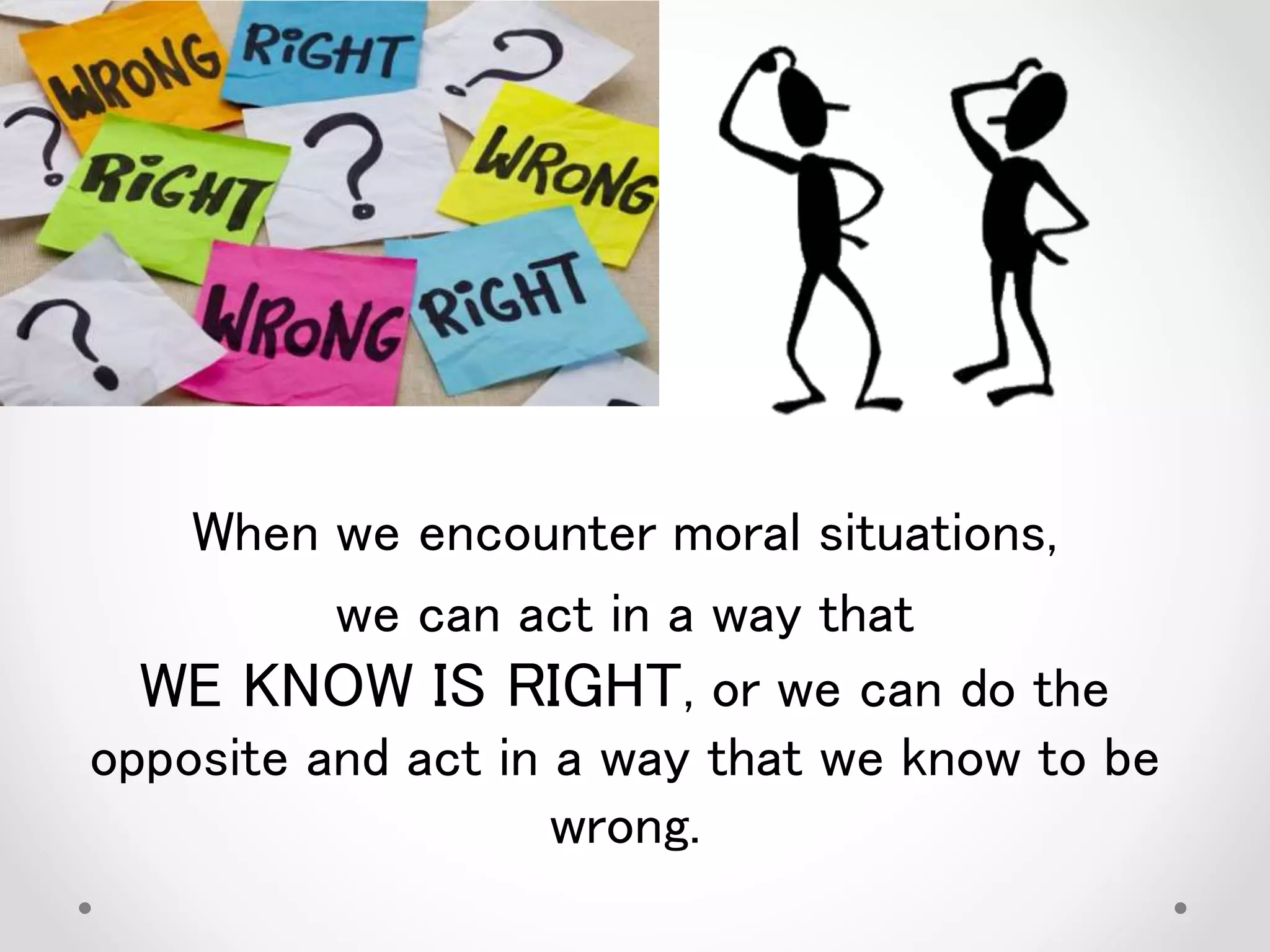
When we encounter moral situations,
we can act in a way that
WE KNOW IS RIGHT, or we can do the
opposite and act in a way that we know to be
wrong.
Which Action is subjected to
morality?
Human Acts? Acts of Man?
• Actions beyond one’s consciousness; not
dependent on the intellect & the will
• ESSENTIAL QUALITIES of Acts of Man
– Done with out knowledge
– Without consent
– Involuntary
• Ex: unconscious, involuntary, semi-deliberate,
spontaneous actions
• Acts of man can become human acts when he
employs his intellect & will in performing the act.
ACTS OF MAN (actus hominis)
• An act is not moral (amoral) when it is
accomplished without knowledge or
deliberation.
• These are the acts of a human.
“A moral person
knows the
difference between
right and wrong
and chooses to do
what is right.”
“An amoral
person has no
regard for any
standards of
right or wrong,
and just does
what he/she
likes.”
“An immoral
person knows the
difference
between right and
wrong and
chooses to do
what is wrong.”
HUMAN ACTS (actus humanus)
• Actions done CONSCIOUSLY and FREELY
by the agent/or by human person
• ESSENTIAL QUALITIES/ Constituent Elements
of Human Acts
1. Knowledge of the act
2. Freedom
3. Voluntariness
• Human person into responsibility of these
actions
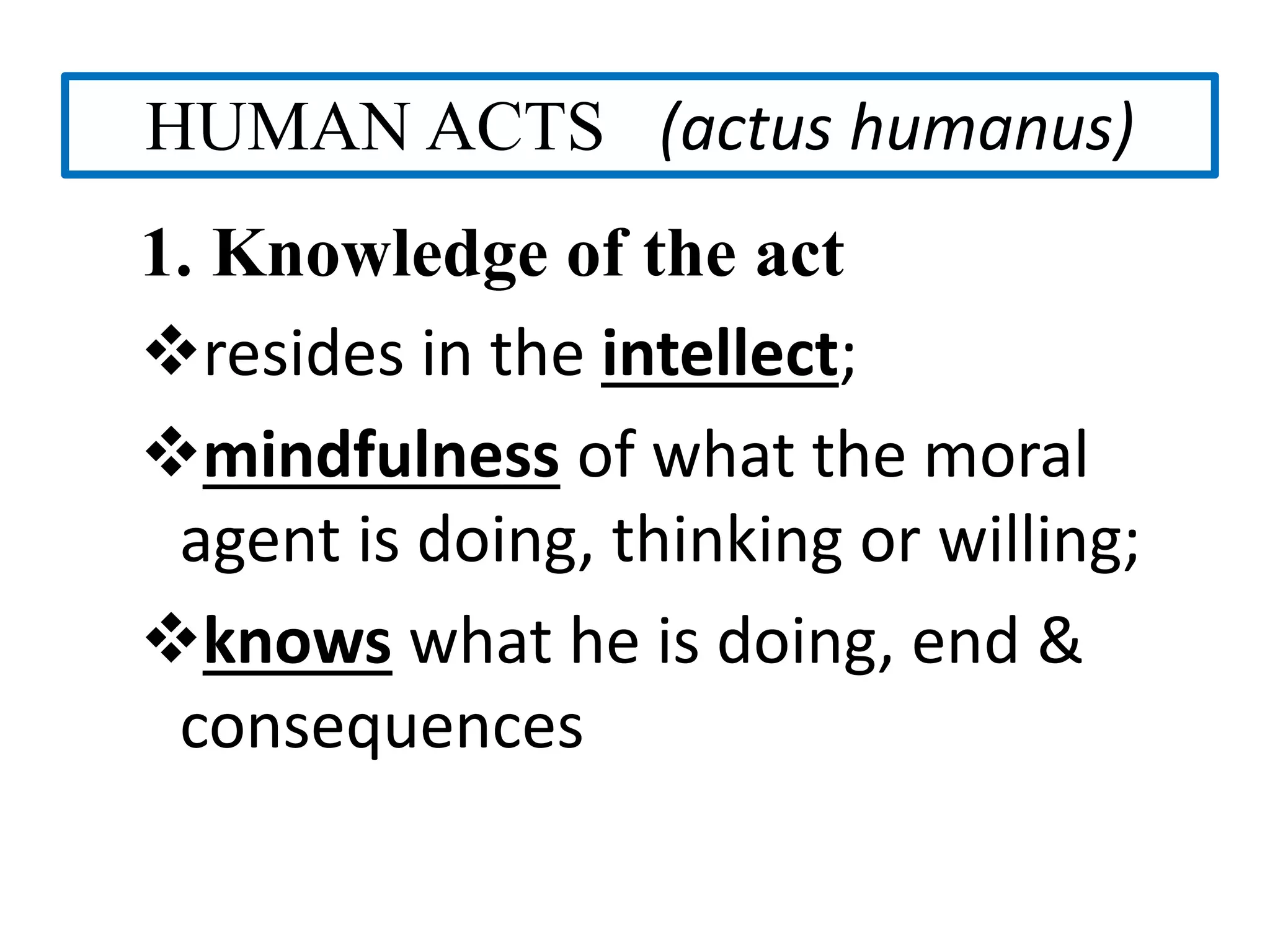
HUMAN ACTS (actus humanus)
1. Knowledge of the act
resides in the intellect;
mindfulness of what the moral
agent is doing, thinking or willing;
knows what he is doing, end &
consequences
HUMAN ACTS (actus humanus)
2. Freedom
quality of the freewill by which
one is able to choose between two
alternatives
*lack of freedom – under
pressure/forced,
HUMAN ACTS (actus humanus)
3. Voluntariness
quality of human act where any
commission or omission of the act
is a result of the knowledge which
an agent has of the end
 requires full consciousness of the
nature of act & consequence
“Human acts (actus humanus) are actions
that proceed from insight into the nature
and purpose of one’s doing and from the
consent of free will.”
(Karl H. Peschke, Christian Ethics)
 An act carries with it MORAL
CONSEQUENCES when the agent exercises
his INTELLECT and WILL in performing the
act.
 These are human acts.
Human Act or Act of Man?
 Looking
 Seeing
 Dreaming
 Day dreaming
 Hearing
 Listening
 Walking
 Sleepwalking
ALL HUMAN ACT are
subjected to morality.
Human acts are different from
animal act because man by
nature ACTS TOWARDS AN
END.
His life has a purpose.
ACTS not morally accountable
• Acts of persons asleep or under hypnosis.
• Reflex actions where the will has no time to
intervene.
• Acts of performed under serious physical
violence
• e.g. a hostage obliged to do an evil action.
• Since the will is constrained, then it is not a
moral act which could be evaluated.
“Freedom makes man a moral subject.
When he acts deliberately, man is, so to
speak, the father of his acts. Human acts,
that is, acts that are freely chosen in
consequence of a judgment of
conscience, can be morally evaluated.
They are either good or evil.”
(Catechism of the Catholic Church 1749)
What makes
something
wrong?
What makes
something
right?
Because we have free
will and reason,
we are responsible for
our acts
and our failures to act.
(sin of omission)
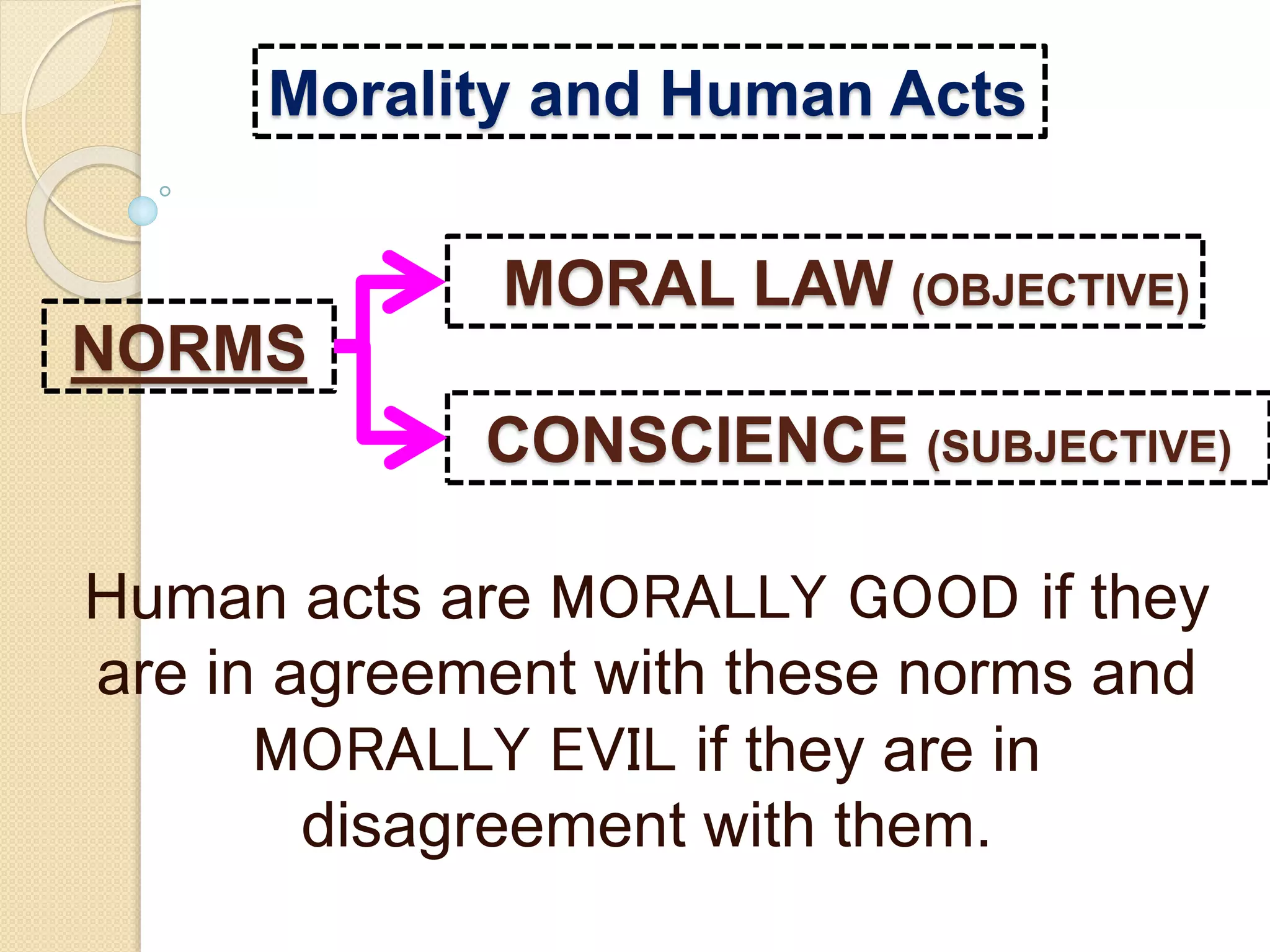
Morality and Human Acts
Human acts are MORALLY GOOD if they
are in agreement with these norms and
MORALLY EVIL if they are in
disagreement with them.
NORMS
MORAL LAW (OBJECTIVE)
CONSCIENCE (SUBJECTIVE)
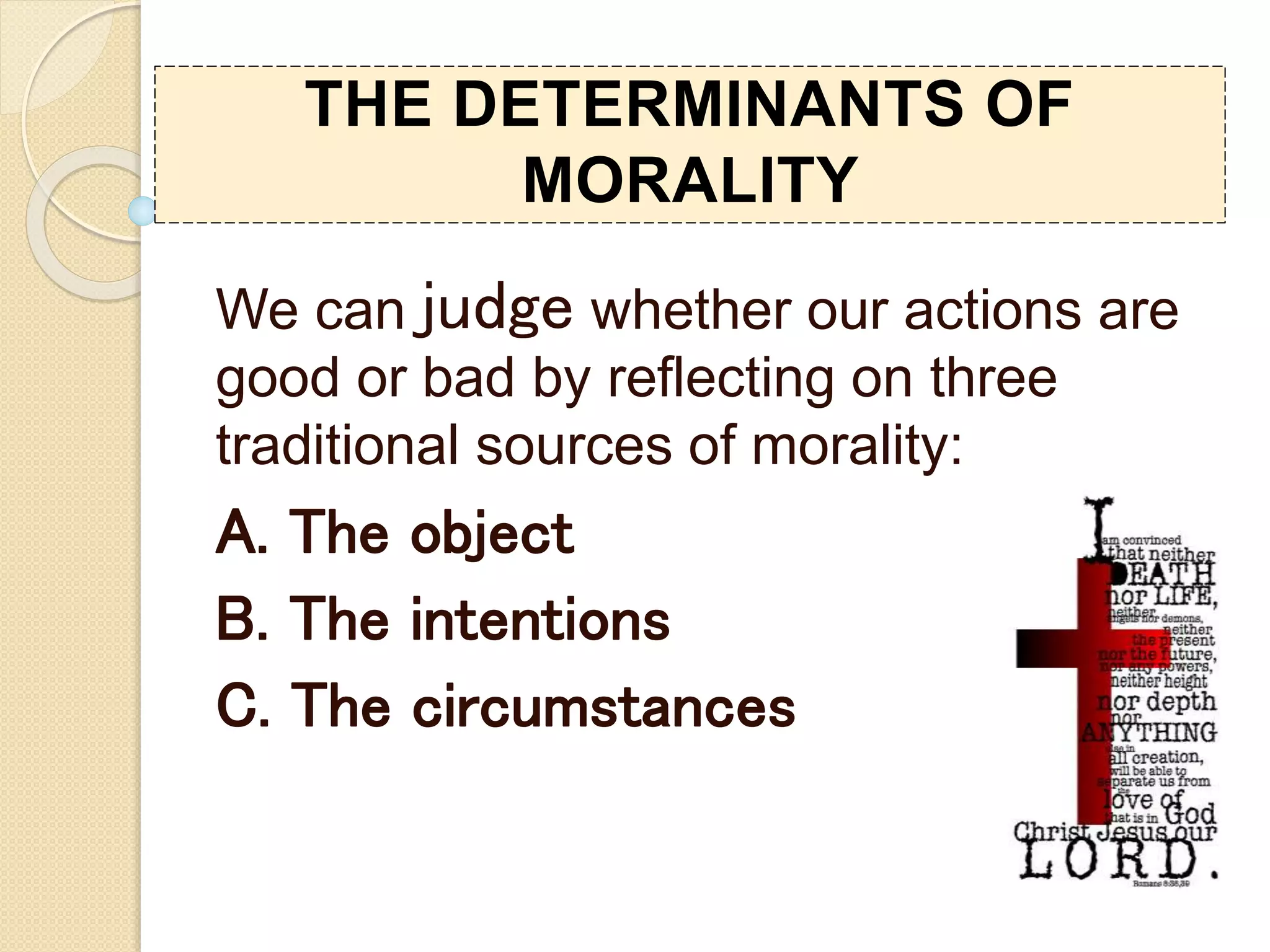
We can judge whether our actions are
good or bad by reflecting on three
traditional sources of morality:
A. The object
B. The intentions
C. The circumstances
THE DETERMINANTS OF
MORALITY
A moral act depends on
whether or not there is
consent by the will.
HUMAN
ACTS
They
include…
1) Thought
2) Speech
3) Action
A human ACT IS GOOD if these three
elements are IN HARMONY with the
moral norm.
A human ACT IS MORALLY EVIL if
only one of these elements OFFENDS
the norm of morality.
 A. The OBJECT Chosen
(What I choose to do).
 B. The INTENTION
(Why I choose to do something).
 C. The CIRCUMSTANCES
(The what, where, when,
how of my actions).
THE DETERMINANTS OF
MORALITY
What is the Object Chosen?
 The object of the act is
that effect which an
action primarily and
directly causes (finis
operis)
What is the Object Chosen?
 In morality the Object
chosen is what we
choose to do, the act
itself.
 The act can have good
matter, bad matter, or
just be neutral.
 An example of a good
act could be tutoring a
classmate in math.
What is the Object Chosen?
What are the objects of
the following actions?
Theft
Abortion
Adultery
Almsgiving
Healing
Worship
Questions?
 What is one thing
you would consider
bad in itself?
 What is one thing
you would consider
good in itself?
JUDGING THE MORALITY OF HUMAN ACTS
The moral object can either be
good (e.g. praying)
bad (e.g. stealing)
indifferent (e.g. eating)
The intention can be either good or bad.
What is “evil”?
Is the absence of GOOD
There are some acts that, of their very
nature, are “intrinsically evil”
 ‘incapable of being ordered’ to
God,
 because they radically
contradict the good of the
person made in his image.
GAUDIUM ET SPES, under the section “Respect
for the Human Person”, cites many examples of
human acts that are intrinsically evil due to the fact
that its object is evil:
ALL OFFENSES AGAINST LIFE
 murder,
 genocide,
 abortion,
 euthanasia, and
 willful suicide;
 There are some actions that are evil
by their very nature.
(e.g. murder, adultery).
 These are never morally allowable,
even if the intention and the
circumstances are good.
JUDGING THE MORALITY OF HUMAN
ACTS
human acts that are intrinsically evil due to the
fact that its object is evil:
ALL VIOLATIONS OF THE INTEGRITY OF
THE HUMAN PERSON
 mutilation,
 physical and mental torture,
 undue psychological pressures;
human acts that are intrinsically evil due to the fact
that its object is evil:
 subhuman living conditions,
 arbitrary imprisonment,
 slavery, prostitution,
 the selling of women and children,
 degrading working conditions where men are
treated as mere tools for profit rather than free and
responsible persons.
 ALL OFFENSES AGAINST HUMAN DIGNITY
THE INTENTION
What is the intention?
 A. The motive
 B. The purpose
 C. The end for
which we choose to
do something.
 Our intentions
answer why we
acted in a certain
way.
 the motive for
which a person
commits a good or
evil act
 Intentions
determine whether
our acts are
morally right or
wrong.
Intentions
 PRINCIPLES of Catholic morality :
An ACT which is GOOD in itself and is
done for a GOOD END is doubly GOOD.
Intentions
 An example of a good
intention:
 You tutor a friend
because you want him
or her to do well on the
upcoming test.
 In this example, what
you choose to do, the
Object, and why you
choose to do it are both
good.
 THE ACT IS GOOD.
 Our intentions may
also be mixed.
 Example: You can give
money to a charity for
two reasons:
 First, you wish to help the
poor.
 Second, you want to be
praised for your
generosity.
Intentions
 PRINCIPLES of Catholic morality :
An ACT which is BAD in itself and is
done for a BAD END is doubly BAD.
Intentions
 A key principle of Catholic morality :
A good intention can never make an
intrinsically evil action good.
The end does not justify the means.
 Robbing a bank
in order to help
the poor.
 Cheating to get
higher grades
so you can get
into Senior High
School.
Intentions
 PRINCIPLES of Catholic morality :
An ACT which is GOOD in itself and is
done for a BAD INTENTION
becomes BAD.
 Example:
complementing
someone just to
get a letter of
recommendation.
 In this case, one is
insincere and
deceitful using a
person to get
something you
want or need.
CIRCUMSTANCE
S
 Circumstances
are the how, who,
when, and where
of an act.
 It includes the
act’s
consequences. Circumstances can
lessen or increase
our responsibility
for an act.
 how – the manner in which the
act
is done
 who – the person acting
 when – the timing of an act
 where – the place where the act
occurs
 PRINCIPLES of Catholic morality :
Circumstance of Person
(DOER/AGENT)
An act of giving aid to orphans is good.
If the act is done by a Metro Aide (who is poor
himself/herself)
If it is done by a big-time businessman who earn
millions of pesos a week.
 PRINCIPLES of Catholic morality :
Circumstance of Person
(DOER/AGENT)
Stealing is bad.
It is worse if one steals from a beggar.
Than if he/she steals from a rich person.
 PRINCIPLES of Catholic morality :
Circumstance of Place
Creating scandal is bad.
It is worse when it is done inside the church
Than if it is done outside the church.
 PRINCIPLES of Catholic morality :
Circumstance of Time
Fasting is order to mortify oneself is good.
But it is better if one fasts during the designated
time or day.
 PRINCIPLES of Catholic morality :
Circumstance of Manner
A young man manages to have a sexual
relationship with a young woman who is not his
wife by making her believe in his false promise of
marriage.
 PRINCIPLES of Catholic morality :
Circumstance of Agent
Failure to attend Sunday Mass is bad in
itself.
But if a person is invincibly ignorant that it is
Sunday and fails to attend Mass, there is no sin
committed.
 PRINCIPLES of Catholic morality :
Circumstance of Thing
The money stolen is one million pesos
The object stolen is a relic (like the crown of St.
NIÑO)
Or the place desecrated is the church altar
 PRINCIPLES of Catholic morality :
Circumstance of Means
A person rob a bank
The robber is helped by the bank’s security
personnel
The robber is helped by an outsider.
1. An act is morally good if the object of the
act itself, the intention, and the
circumstances are good.
2. If an act itself is intrinsically evil (evil by its
very nature), the act is never morally
allowable regardless of intention or
circumstances.
3. If the object of the act is itself morally good
(or at least neutral), its morality will
be judged by the purpose or the circumstances.
5. If all three moral elements (the object of the act
itself, the intention, and the circumstances) are
good, the act is good.
If any one element is evil, the act is evil.
4. Circumstances may create, mitigate, or
aggravate sin.
 A.The Catholic Faith
teaches that “wrong is
wrong, even if
everyone is doing it.”
 B. And that “right is
right, even though no
one else is doing it.”
 God is going to judge
us:
on our COURAGE
to choose what is
good in ALL
circumstances.

Jesusis the Ultimate Moral Norm

  • 1.
  • 2.
  • 4.
  • 5.
    What is ChristianMorality? The RICH YOUNG MAN Matthew 19:16-21
  • 6.
    The RICH YOUNGMAN What was the question ofthe richyoung man to Jesus?
  • 7.
    What good mustI do to gain eternal life?
  • 9.
    We have theinnate YEARNINGto do what is REALLY GOOD!
  • 10.
    Christian Morality entails: BeTRUE to our Relationship with God Keep the Commandments Follow Christ
  • 11.
    Jesus during Histime, did not measure up the norms of his society.
  • 12.
    Christian Morality is theIMITATION of CHRIST Jesus taught that our basic dignity as human persons depends Not Only On Measurable World Standard, but rather ON GOD WHO LOVES US AND CALLS US TO LOVE IN RETURN.
  • 13.
    • “In Christand through Christ, we have acquired full awareness of our dignity, of the heights to which we are raised, of the surpassing worth of our own humanity, and the meaning of our existence.” REDEMPTORIS HOMINIS, 11
  • 14.
     Christian moralityis based on the teachings of Jesus and hisChurch.  SACRED SCRIPTURE  TRADITION OF THE CHURCH The essence of Jesus’ teaching is LOVE.
  • 16.
     Refers tothe sense of rightness or wrongness of an act. From the Greek word MORES - meaning: behavior
  • 17.
    “a special kindof knowing --- a ‘knowing’ of WHAT OUGHT TO BE DONE” (Michael Pennock, 2001) It is more than knowing the principles, but acting upon it
  • 18.
    “is either goodor bad, right or wrong based on some NORMS that are either inherent in the act or are observed due to some individual or social conventional acceptance”  --- Manlangit
  • 19.
     Morality hasto do with THE WAY WE LIVE OUR LIVES. Morality helps us TO JUDGE the difference between right and wrong. Once we know the difference between the two, WE CAN DO WHAT IS RIGHT AND AVOID WHAT IS WRONG.
  • 20.
     The ABILITYTO KNOW right from wrong. good from evil. The ABILITY TO DISTINGUISH what is appropriate from what is inappropriate. The COMMITMENT to do what is right.
  • 21.
    To be aperson is TO BE WITH OTHERS.
  • 25.
     In March1993, photographer Kevin Carter made a trip to southern Sudan, where he took now iconic photo of a vulture preying upon an emaciated Sudanese toddler near the village of Ayod.  Journalists in the Sudan were told not to touch the famine victims, because of the risk of transmitting disease, but Carter came under criticism for not helping the girl. 
  • 26.
     “The manadjusting his lens to take just the right frame of her suffering might just as well be a predator, another vulture on the scene,” read one editorial.  Carter eventually won the Pulitzer Prize for this photo, but he couldn’t enjoy it. “I’m really, really sorry I didn’t pick the child up,” he confided in a friend.  Haunted by the questions as to the little girl’s fate, he committed suicide three months later.
  • 27.
    Nasaan ka salarawang ito?
  • 28.
    Can a humanperson be held responsible for his/her actions? Why?
  • 29.
    WE ARE HUMANBEINGS • We possess intellect and will. • We can think and choose deliberately.
  • 30.
    When we encountermoral situations, we can act in a way that WE KNOW IS RIGHT, or we can do the opposite and act in a way that we know to be wrong.
  • 31.
    Which Action issubjected to morality?
  • 32.
  • 33.
    • Actions beyondone’s consciousness; not dependent on the intellect & the will • ESSENTIAL QUALITIES of Acts of Man – Done with out knowledge – Without consent – Involuntary • Ex: unconscious, involuntary, semi-deliberate, spontaneous actions • Acts of man can become human acts when he employs his intellect & will in performing the act. ACTS OF MAN (actus hominis)
  • 34.
    • An actis not moral (amoral) when it is accomplished without knowledge or deliberation. • These are the acts of a human.
  • 35.
    “A moral person knowsthe difference between right and wrong and chooses to do what is right.” “An amoral person has no regard for any standards of right or wrong, and just does what he/she likes.” “An immoral person knows the difference between right and wrong and chooses to do what is wrong.”
  • 36.
    HUMAN ACTS (actushumanus) • Actions done CONSCIOUSLY and FREELY by the agent/or by human person • ESSENTIAL QUALITIES/ Constituent Elements of Human Acts 1. Knowledge of the act 2. Freedom 3. Voluntariness • Human person into responsibility of these actions
  • 37.
    HUMAN ACTS (actushumanus) 1. Knowledge of the act resides in the intellect; mindfulness of what the moral agent is doing, thinking or willing; knows what he is doing, end & consequences
  • 38.
    HUMAN ACTS (actushumanus) 2. Freedom quality of the freewill by which one is able to choose between two alternatives *lack of freedom – under pressure/forced,
  • 39.
    HUMAN ACTS (actushumanus) 3. Voluntariness quality of human act where any commission or omission of the act is a result of the knowledge which an agent has of the end  requires full consciousness of the nature of act & consequence
  • 40.
    “Human acts (actushumanus) are actions that proceed from insight into the nature and purpose of one’s doing and from the consent of free will.” (Karl H. Peschke, Christian Ethics)
  • 41.
     An actcarries with it MORAL CONSEQUENCES when the agent exercises his INTELLECT and WILL in performing the act.  These are human acts.
  • 42.
    Human Act orAct of Man?  Looking  Seeing  Dreaming  Day dreaming  Hearing  Listening  Walking  Sleepwalking
  • 43.
    ALL HUMAN ACTare subjected to morality. Human acts are different from animal act because man by nature ACTS TOWARDS AN END. His life has a purpose.
  • 44.
    ACTS not morallyaccountable • Acts of persons asleep or under hypnosis. • Reflex actions where the will has no time to intervene. • Acts of performed under serious physical violence • e.g. a hostage obliged to do an evil action. • Since the will is constrained, then it is not a moral act which could be evaluated.
  • 45.
    “Freedom makes mana moral subject. When he acts deliberately, man is, so to speak, the father of his acts. Human acts, that is, acts that are freely chosen in consequence of a judgment of conscience, can be morally evaluated. They are either good or evil.” (Catechism of the Catholic Church 1749)
  • 46.
  • 47.
    Because we havefree will and reason, we are responsible for our acts and our failures to act. (sin of omission)
  • 48.
    Morality and HumanActs Human acts are MORALLY GOOD if they are in agreement with these norms and MORALLY EVIL if they are in disagreement with them. NORMS MORAL LAW (OBJECTIVE) CONSCIENCE (SUBJECTIVE)
  • 49.
    We can judgewhether our actions are good or bad by reflecting on three traditional sources of morality: A. The object B. The intentions C. The circumstances THE DETERMINANTS OF MORALITY
  • 50.
    A moral actdepends on whether or not there is consent by the will. HUMAN ACTS They include… 1) Thought 2) Speech 3) Action
  • 51.
    A human ACTIS GOOD if these three elements are IN HARMONY with the moral norm. A human ACT IS MORALLY EVIL if only one of these elements OFFENDS the norm of morality.
  • 52.
     A. TheOBJECT Chosen (What I choose to do).  B. The INTENTION (Why I choose to do something).  C. The CIRCUMSTANCES (The what, where, when, how of my actions). THE DETERMINANTS OF MORALITY
  • 53.
    What is theObject Chosen?  The object of the act is that effect which an action primarily and directly causes (finis operis)
  • 54.
    What is theObject Chosen?  In morality the Object chosen is what we choose to do, the act itself.  The act can have good matter, bad matter, or just be neutral.  An example of a good act could be tutoring a classmate in math.
  • 55.
    What is theObject Chosen? What are the objects of the following actions? Theft Abortion Adultery Almsgiving Healing Worship
  • 56.
    Questions?  What isone thing you would consider bad in itself?  What is one thing you would consider good in itself?
  • 57.
    JUDGING THE MORALITYOF HUMAN ACTS The moral object can either be good (e.g. praying) bad (e.g. stealing) indifferent (e.g. eating) The intention can be either good or bad.
  • 58.
    What is “evil”? Isthe absence of GOOD
  • 59.
    There are someacts that, of their very nature, are “intrinsically evil”  ‘incapable of being ordered’ to God,  because they radically contradict the good of the person made in his image.
  • 60.
    GAUDIUM ET SPES,under the section “Respect for the Human Person”, cites many examples of human acts that are intrinsically evil due to the fact that its object is evil: ALL OFFENSES AGAINST LIFE  murder,  genocide,  abortion,  euthanasia, and  willful suicide;
  • 61.
     There aresome actions that are evil by their very nature. (e.g. murder, adultery).  These are never morally allowable, even if the intention and the circumstances are good. JUDGING THE MORALITY OF HUMAN ACTS
  • 62.
    human acts thatare intrinsically evil due to the fact that its object is evil: ALL VIOLATIONS OF THE INTEGRITY OF THE HUMAN PERSON  mutilation,  physical and mental torture,  undue psychological pressures;
  • 63.
    human acts thatare intrinsically evil due to the fact that its object is evil:  subhuman living conditions,  arbitrary imprisonment,  slavery, prostitution,  the selling of women and children,  degrading working conditions where men are treated as mere tools for profit rather than free and responsible persons.  ALL OFFENSES AGAINST HUMAN DIGNITY
  • 64.
    THE INTENTION What isthe intention?  A. The motive  B. The purpose  C. The end for which we choose to do something.
  • 65.
     Our intentions answerwhy we acted in a certain way.  the motive for which a person commits a good or evil act  Intentions determine whether our acts are morally right or wrong.
  • 66.
    Intentions  PRINCIPLES ofCatholic morality : An ACT which is GOOD in itself and is done for a GOOD END is doubly GOOD.
  • 67.
    Intentions  An exampleof a good intention:  You tutor a friend because you want him or her to do well on the upcoming test.  In this example, what you choose to do, the Object, and why you choose to do it are both good.  THE ACT IS GOOD.
  • 68.
     Our intentionsmay also be mixed.  Example: You can give money to a charity for two reasons:  First, you wish to help the poor.  Second, you want to be praised for your generosity.
  • 69.
    Intentions  PRINCIPLES ofCatholic morality : An ACT which is BAD in itself and is done for a BAD END is doubly BAD.
  • 70.
    Intentions  A keyprinciple of Catholic morality : A good intention can never make an intrinsically evil action good. The end does not justify the means.
  • 71.
     Robbing abank in order to help the poor.  Cheating to get higher grades so you can get into Senior High School.
  • 72.
    Intentions  PRINCIPLES ofCatholic morality : An ACT which is GOOD in itself and is done for a BAD INTENTION becomes BAD.
  • 73.
     Example: complementing someone justto get a letter of recommendation.  In this case, one is insincere and deceitful using a person to get something you want or need.
  • 74.
    CIRCUMSTANCE S  Circumstances are thehow, who, when, and where of an act.  It includes the act’s consequences. Circumstances can lessen or increase our responsibility for an act.
  • 75.
     how –the manner in which the act is done  who – the person acting  when – the timing of an act  where – the place where the act occurs
  • 76.
     PRINCIPLES ofCatholic morality : Circumstance of Person (DOER/AGENT) An act of giving aid to orphans is good. If the act is done by a Metro Aide (who is poor himself/herself) If it is done by a big-time businessman who earn millions of pesos a week.
  • 77.
     PRINCIPLES ofCatholic morality : Circumstance of Person (DOER/AGENT) Stealing is bad. It is worse if one steals from a beggar. Than if he/she steals from a rich person.
  • 78.
     PRINCIPLES ofCatholic morality : Circumstance of Place Creating scandal is bad. It is worse when it is done inside the church Than if it is done outside the church.
  • 79.
     PRINCIPLES ofCatholic morality : Circumstance of Time Fasting is order to mortify oneself is good. But it is better if one fasts during the designated time or day.
  • 80.
     PRINCIPLES ofCatholic morality : Circumstance of Manner A young man manages to have a sexual relationship with a young woman who is not his wife by making her believe in his false promise of marriage.
  • 81.
     PRINCIPLES ofCatholic morality : Circumstance of Agent Failure to attend Sunday Mass is bad in itself. But if a person is invincibly ignorant that it is Sunday and fails to attend Mass, there is no sin committed.
  • 82.
     PRINCIPLES ofCatholic morality : Circumstance of Thing The money stolen is one million pesos The object stolen is a relic (like the crown of St. NIÑO) Or the place desecrated is the church altar
  • 83.
     PRINCIPLES ofCatholic morality : Circumstance of Means A person rob a bank The robber is helped by the bank’s security personnel The robber is helped by an outsider.
  • 84.
    1. An actis morally good if the object of the act itself, the intention, and the circumstances are good. 2. If an act itself is intrinsically evil (evil by its very nature), the act is never morally allowable regardless of intention or circumstances.
  • 85.
    3. If theobject of the act is itself morally good (or at least neutral), its morality will be judged by the purpose or the circumstances.
  • 86.
    5. If allthree moral elements (the object of the act itself, the intention, and the circumstances) are good, the act is good. If any one element is evil, the act is evil. 4. Circumstances may create, mitigate, or aggravate sin.
  • 87.
     A.The CatholicFaith teaches that “wrong is wrong, even if everyone is doing it.”  B. And that “right is right, even though no one else is doing it.”
  • 88.
     God isgoing to judge us: on our COURAGE to choose what is good in ALL circumstances.

Editor's Notes

  • #6 2. Act is moral because with reference to moral standard, it is
  • #7 2. Act is moral because with reference to moral standard, it is
  • #8 2. Act is moral because with reference to moral standard, it is
  • #11 2. Act is moral because with reference to moral standard, it is
  • #17 2. Act is moral because with reference to moral standard, it is
  • #18 2. Act is moral because with reference to moral standard, it is
  • #19 2. Act is moral because with reference to moral standard, it is
  • #22 2. Act is moral because with reference to moral standard, it is
  • #32 Happiness – gets it once he acts in such a way that he reaches a unity with the truth & goodness Imperfect man perfects himself when he acts on order to do good. Acting to evil is sin Because man was created for the good, hw is actually going against his nature whenever he rebels or acts in evil way or against God's will.
  • #33 Happiness – gets it once he acts in such a way that he reaches a unity with the truth & goodness Imperfect man perfects himself when he acts on order to do good. Acting to evil is sin Because man was created for the good, hw is actually going against his nature whenever he rebels or acts in evil way or against God's will.
  • #34 Unconscious (breath, heartbeat); involuntary (sneezing, stepping on something by mistake); semi-deliberate (done asleep/delirium); spontaneous (reflex) Acts becoming human acts: seeing billboard & hearing
  • #37 * Take necessary steps for the action to happen Action need not to be obvious, it can be voluntary in thought Knowledge – resides in the intellect; mindfulness of what the moral agent is doing, thinking or willing; knows what he is doing, end & consequences Freedom – quality of the freewill by w/c 1 is able to choose bet 2 alt. *** lack of freedom – underpressure/forced, do not agree Voluntariness – quality of human act where whereby any commission or omission of the act is a result of the knowledge w/c an agent has of the end – requires full consciousness of the nature of act & coensqence
  • #38 * Take necessary steps for the action to happen Action need not to be obvious, it can be voluntary in thought Knowledge – resides in the intellect; mindfulness of what the moral agent is doing, thinking or willing; knows what he is doing, end & consequences Freedom – quality of the freewill by w/c 1 is able to choose bet 2 alt. *** lack of freedom – underpressure/forced, do not agree Voluntariness – quality of human act where whereby any commission or omission of the act is a result of the knowledge w/c an agent has of the end – requires full consciousness of the nature of act & coensqence
  • #39 * Take necessary steps for the action to happen Action need not to be obvious, it can be voluntary in thought Knowledge – resides in the intellect; mindfulness of what the moral agent is doing, thinking or willing; knows what he is doing, end & consequences Freedom – quality of the freewill by w/c 1 is able to choose bet 2 alt. *** lack of freedom – underpressure/forced, do not agree Voluntariness – quality of human act where whereby any commission or omission of the act is a result of the knowledge w/c an agent has of the end – requires full consciousness of the nature of act & coensqence
  • #40 * Take necessary steps for the action to happen Action need not to be obvious, it can be voluntary in thought Knowledge – resides in the intellect; mindfulness of what the moral agent is doing, thinking or willing; knows what he is doing, end & consequences Freedom – quality of the freewill by w/c 1 is able to choose bet 2 alt. *** lack of freedom – underpressure/forced, do not agree Voluntariness – quality of human act where whereby any commission or omission of the act is a result of the knowledge w/c an agent has of the end – requires full consciousness of the nature of act & coensqence
  • #44 Happiness – gets it once he acts in such a way that he reaches a unity with the truth & goodness Imperfect man perfects himself when he acts on order to do good. Acting to evil is sin Because man was created for the good, hw is actually going against his nature whenever he rebels or acts in evil way or against God's will.