



Virtues
and Vices
What are Virtues?
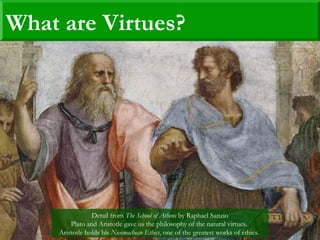
Detail from The School of Athens by Raphael Sanzio
Plato and Aristotle gave us the philosophy of the natural virtues.
Aristotle holds his Nicomachean Ethics, one of the greatest works of ethics.
What are Virtues?
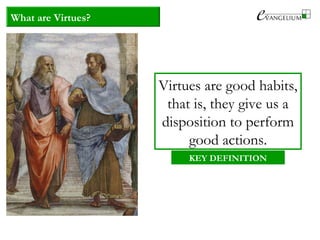
Virtues are good habits,
that is, they give us a
disposition to perform
good actions.
KEY DEFINITION
What are Virtues?
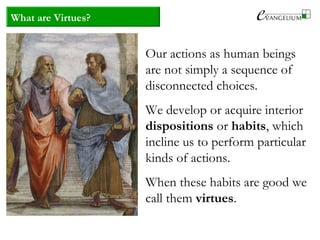
Our actions as human beings
are not simply a sequence of
disconnected choices.
We develop or acquire interior
dispositions or habits, which
incline us to perform particular
kinds of actions.
When these habits are good we
call them virtues.
What are the principal virtues?
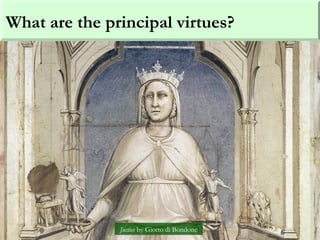
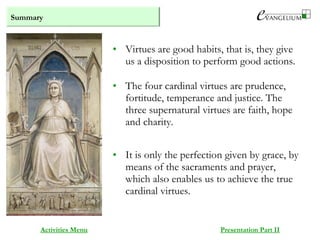
Justice by Giotto di Bondone
What are the principal virtues?
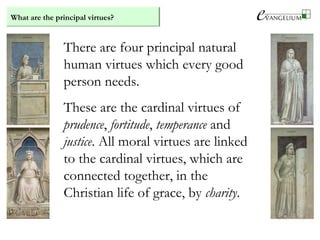
There are four principal natural
human virtues which every good
person needs.
These are the cardinal virtues of
prudence, fortitude, temperance and
justice. All moral virtues are linked
to the cardinal virtues, which are
connected together, in the
Christian life of grace, by charity.
What are the principal virtues?
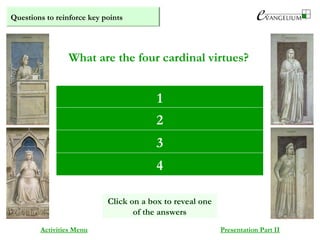
Prudence
looks in her mirror, showing that
self-knowledge is needed to
deliberate well.
Prudence
The virtue of deliberating well about what
actions we should do.
Prudence or practical wisdom
directs us about what we should do
in particular, practical situations.
Since moral laws do not determine
every possible action we might take,
we also need prudence to direct our
choice of actions well.
What are the principal virtues?
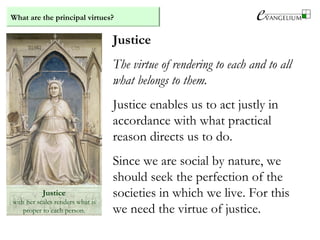
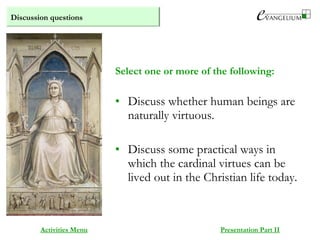
Justice
with her scales renders what is
proper to each person.
Justice
The virtue of rendering to each and to all
what belongs to them.
Justice enables us to act justly in
accordance with what practical
reason directs us to do.
Since we are social by nature, we
should seek the perfection of the
societies in which we live. For this
we need the virtue of justice.
What are the principal virtues?
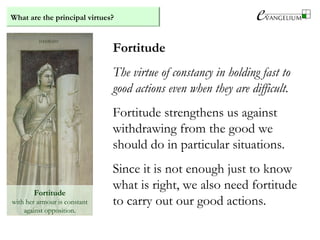
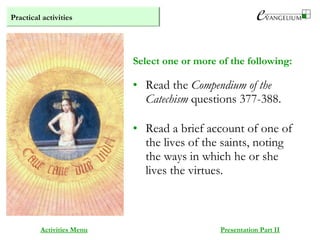
Fortitude
with her armour is constant
against opposition.
Fortitude
The virtue of constancy in holding fast to
good actions even when they are difficult.
Fortitude strengthens us against
withdrawing from the good we
should do in particular situations.
Since it is not enough just to know
what is right, we also need fortitude
to carry out our good actions.
What are the principal virtues?
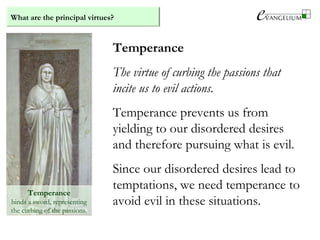
Temperance
binds a sword, representing
the curbing of the passions.
Temperance
The virtue of curbing the passions that
incite us to evil actions.
Temperance prevents us from
yielding to our disordered desires
and therefore pursuing what is evil.
Since our disordered desires lead to
temptations, we need temperance to
avoid evil in these situations.
What are the principal virtues?
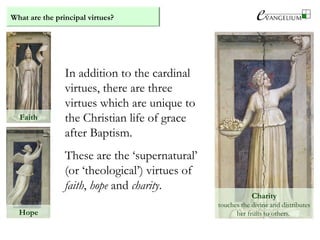
Faith
Hope
Charity
touches the divine and distributes
her fruits to others.
In addition to the cardinal
virtues, there are three
virtues which are unique to
the Christian life of grace
after Baptism.
These are the ‘supernatural’
(or ‘theological’) virtues of
faith, hope and charity.
What are the principal virtues?
Faith
Hope
Charity
touches the divine and distributes
her fruits to others.
Charity is lost if grace is
lost through mortal sin. It is
restored by means of
Confession.
Charity is the supernatural
virtue of heaven, “So faith,
hope, love abide, these three; but
the greatest of these is love.”
1 Cor 13:13
How do we achieve the virtues?
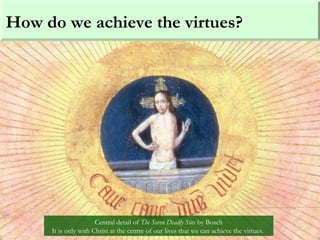
Central detail of The Seven Deadly Sins by Bosch
It is only with Christ at the centre of our lives that we can achieve the virtues.
How do we achieve the virtues?
To some extent, a person can
acquire the natural virtues
through the personal discipline
of repeated good actions and a
well-ordered life.
How do we achieve the virtues?
In our fallen condition,
however, it is not possible to
achieve complete human
perfection by our own efforts.
It is only the perfection given
by grace, by means of the
sacraments and prayer, which
also enables us to achieve the
true cardinal virtues.
Summary
Questions
to reinforce
key points
Discussion
questions
Practical
activities
Presentation Part II
Summary Activities I
Please select an activity or go immediately
to part II of the presentation
Summary
Activities Menu Presentation Part II
• Virtues are good habits, that is, they give
us a disposition to perform good actions.
• The four cardinal virtues are prudence,
fortitude, temperance and justice. The
three supernatural virtues are faith, hope
and charity.
• It is only the perfection given by grace, by
means of the sacraments and prayer,
which also enables us to achieve the true
cardinal virtues.
Questions to reinforce key points
Prudence
Justice
Fortitude
Temperance
What are the four cardinal virtues?
Activities Menu Presentation Part II
1
2
3
Click on a box to reveal one
of the answers
4
Discussion questions
Activities Menu Presentation Part II
• Discuss whether human beings are
naturally virtuous.
• Discuss some practical ways in
which the cardinal virtues can be
lived out in the Christian life today.
Select one or more of the following:
Practical activities
Activities Menu Presentation Part II
• Read the Compendium of the
Catechism questions 377-388.
• Read a brief account of one of
the lives of the saints, noting
the ways in which he or she
lives the virtues.
Select one or more of the following:
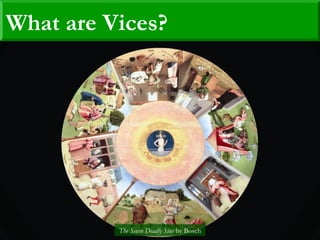
What are Vices?
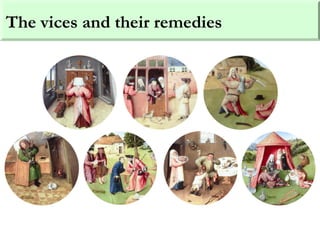
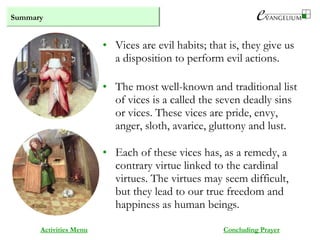
The Seven Deadly Sins by Bosch
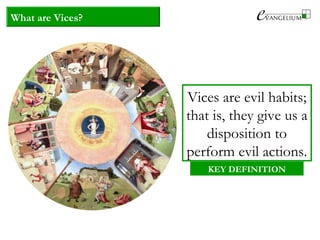
What are Vices?
Vices are evil habits;
that is, they give us a
disposition to
perform evil actions.
KEY DEFINITION
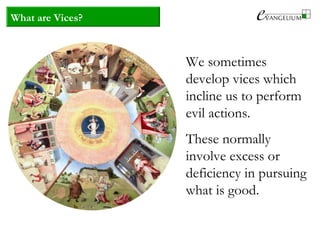
What are Vices?
We sometimes
develop vices which
incline us to perform
evil actions.
These normally
involve excess or
deficiency in pursuing
what is good.
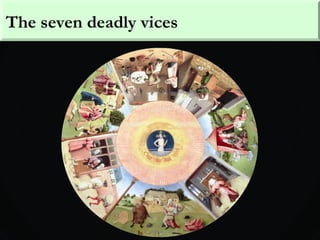
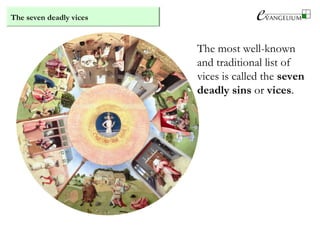
The seven deadly vices
The most well-known
and traditional list of
vices is called the seven
deadly sins or vices.
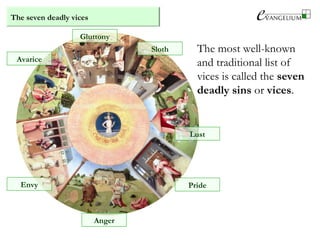
The seven deadly vices
The most well-known
and traditional list of
vices is called the seven
deadly sins or vices.
The seven deadly vices
Envy
Anger
Pride
Lust
Sloth
Avarice
Gluttony
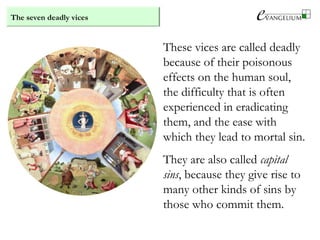
The seven deadly vices
These vices are called deadly
because of their poisonous
effects on the human soul,
the difficulty that is often
experienced in eradicating
them, and the ease with
which they lead to mortal sin.
They are also called capital
sins, because they give rise to
many other kinds of sins by
those who commit them.
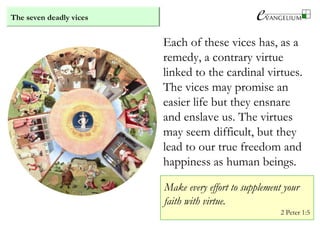
The seven deadly vices
Each of these vices has, as a
remedy, a contrary virtue
linked to the cardinal virtues.
The vices may promise an
easier life but they ensnare
and enslave us. The virtues
may seem difficult, but they
lead to our true freedom and
happiness as human beings.
Make every effort to supplement your
faith with virtue.
2 Peter 1:5
The vices and their remedies
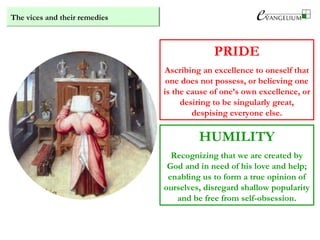
PRIDE
Ascribing an excellence to oneself that
one does not possess, or believing one
is the cause of one’s own excellence, or
desiring to be singularly great,
despising everyone else.
HUMILITY
Recognizing that we are created by
God and in need of his love and help;
enabling us to form a true opinion of
ourselves, disregard shallow popularity
and be free from self-obsession.
The vices and their remedies
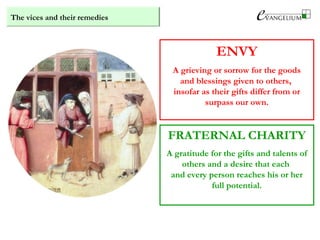
ENVY
A grieving or sorrow for the goods
and blessings given to others,
insofar as their gifts differ from or
surpass our own.
FRATERNAL CHARITY
A gratitude for the gifts and talents of
others and a desire that each
and every person reaches his or her
full potential.
The vices and their remedies
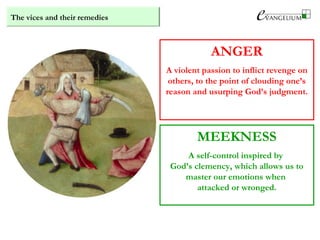
ANGER
A violent passion to inflict revenge on
others, to the point of clouding one’s
reason and usurping God’s judgment.
MEEKNESS
A self-control inspired by
God’s clemency, which allows us to
master our emotions when
attacked or wronged.
The vices and their remedies
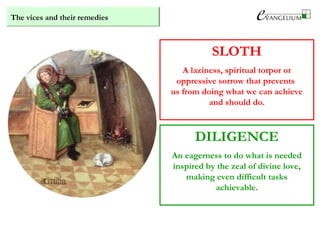
SLOTH
A laziness, spiritual torpor or
oppressive sorrow that prevents
us from doing what we can achieve
and should do.
DILIGENCE
An eagerness to do what is needed
inspired by the zeal of divine love,
making even difficult tasks
achievable.
The vices and their remedies
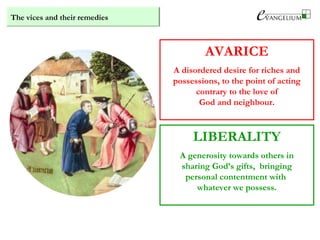
AVARICE
A disordered desire for riches and
possessions, to the point of acting
contrary to the love of
God and neighbour.
LIBERALITY
A generosity towards others in
sharing God’s gifts, bringing
personal contentment with
whatever we possess.
The vices and their remedies
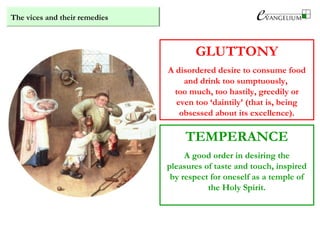
GLUTTONY
A disordered desire to consume food
and drink too sumptuously,
too much, too hastily, greedily or
even too ‘daintily’ (that is, being
obsessed about its excellence).
TEMPERANCE
A good order in desiring the
pleasures of taste and touch, inspired
by respect for oneself as a temple of
the Holy Spirit.
The vices and their remedies
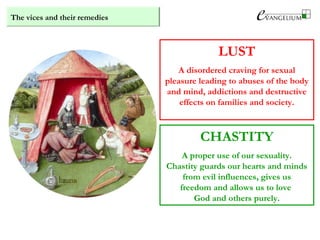
LUST
A disordered craving for sexual
pleasure leading to abuses of the body
and mind, addictions and destructive
effects on families and society.
CHASTITY
A proper use of our sexuality.
Chastity guards our hearts and minds
from evil influences, gives us
freedom and allows us to love
God and others purely.
Summary
Questions
to reinforce
key points
Discussion
questions
Practical
activities
Summary Activities II
Please select an activity or go immediately
to the concluding prayer
Concluding Prayer
Summary
Activities Menu
• Vices are evil habits; that is, they give us
a disposition to perform evil actions.
• The most well-known and traditional list
of vices is a called the seven deadly sins
or vices. These vices are pride, envy,
anger, sloth, avarice, gluttony and lust.
• Each of these vices has, as a remedy, a
contrary virtue linked to the cardinal
virtues. The virtues may seem difficult,
but they lead to our true freedom and
happiness as human beings.
Concluding Prayer
Questions to reinforce key points
Pride
Envy
Avarice
Anger
Sloth
Gluttony
Lust
What are the seven deadly vices?
Activities Menu Concluding Prayer
1
Click on a box to reveal one
of the answers
2
3
4
5
6
7
Discussion questions
Activities Menu
• Discuss some ways in
which people today
manifest the seven
deadly vices.
• Discuss some of the
ways in which we can
avoid vice.
Select one or more of the following:
Concluding Prayer
Practical activities
Activities Menu
Select one or more of the following:
• Read some articles from recent
newspapers and magazines.
Note any instances of actions
or ideas which reveal any of
the seven deadly vices.
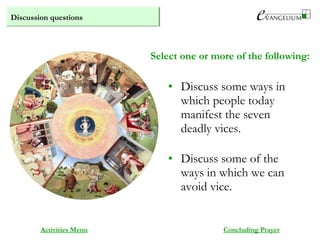
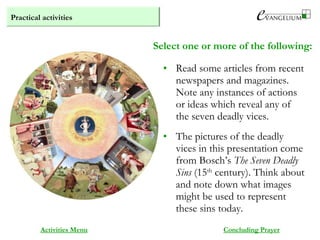
• The pictures of the deadly
vices in this presentation come
from Bosch’s The Seven Deadly
Sins (15th
century). Think about
and note down what images
might be used to represent
these sins today.
Concluding Prayer
Final Prayer
A Prayer of St Richard of Chichester
Thanks be to you, my Lord Jesus Christ, for all the benefits
which you have given me, for all the pains and insults which
you have borne for me. Most merciful Redeemer, Friend and
Brother, may I know you more clearly, love you more
dearly, and follow you more nearly, day by day.
Amen.

virtues and vices

  • 1.
  • 2.
    What are Virtues? Detailfrom The School of Athens by Raphael Sanzio Plato and Aristotle gave us the philosophy of the natural virtues. Aristotle holds his Nicomachean Ethics, one of the greatest works of ethics.
  • 3.
    What are Virtues? Virtuesare good habits, that is, they give us a disposition to perform good actions. KEY DEFINITION
  • 4.
    What are Virtues? Ouractions as human beings are not simply a sequence of disconnected choices. We develop or acquire interior dispositions or habits, which incline us to perform particular kinds of actions. When these habits are good we call them virtues.
  • 5.
    What are theprincipal virtues? Justice by Giotto di Bondone
  • 6.
    What are theprincipal virtues? There are four principal natural human virtues which every good person needs. These are the cardinal virtues of prudence, fortitude, temperance and justice. All moral virtues are linked to the cardinal virtues, which are connected together, in the Christian life of grace, by charity.
  • 7.
    What are theprincipal virtues? Prudence looks in her mirror, showing that self-knowledge is needed to deliberate well. Prudence The virtue of deliberating well about what actions we should do. Prudence or practical wisdom directs us about what we should do in particular, practical situations. Since moral laws do not determine every possible action we might take, we also need prudence to direct our choice of actions well.
  • 8.
    What are theprincipal virtues? Justice with her scales renders what is proper to each person. Justice The virtue of rendering to each and to all what belongs to them. Justice enables us to act justly in accordance with what practical reason directs us to do. Since we are social by nature, we should seek the perfection of the societies in which we live. For this we need the virtue of justice.
  • 9.
    What are theprincipal virtues? Fortitude with her armour is constant against opposition. Fortitude The virtue of constancy in holding fast to good actions even when they are difficult. Fortitude strengthens us against withdrawing from the good we should do in particular situations. Since it is not enough just to know what is right, we also need fortitude to carry out our good actions.
  • 10.
    What are theprincipal virtues? Temperance binds a sword, representing the curbing of the passions. Temperance The virtue of curbing the passions that incite us to evil actions. Temperance prevents us from yielding to our disordered desires and therefore pursuing what is evil. Since our disordered desires lead to temptations, we need temperance to avoid evil in these situations.
  • 11.
    What are theprincipal virtues? Faith Hope Charity touches the divine and distributes her fruits to others. In addition to the cardinal virtues, there are three virtues which are unique to the Christian life of grace after Baptism. These are the ‘supernatural’ (or ‘theological’) virtues of faith, hope and charity.
  • 12.
    What are theprincipal virtues? Faith Hope Charity touches the divine and distributes her fruits to others. Charity is lost if grace is lost through mortal sin. It is restored by means of Confession. Charity is the supernatural virtue of heaven, “So faith, hope, love abide, these three; but the greatest of these is love.” 1 Cor 13:13
  • 13.
    How do weachieve the virtues? Central detail of The Seven Deadly Sins by Bosch It is only with Christ at the centre of our lives that we can achieve the virtues.
  • 14.
    How do weachieve the virtues? To some extent, a person can acquire the natural virtues through the personal discipline of repeated good actions and a well-ordered life.
  • 15.
    How do weachieve the virtues? In our fallen condition, however, it is not possible to achieve complete human perfection by our own efforts. It is only the perfection given by grace, by means of the sacraments and prayer, which also enables us to achieve the true cardinal virtues.
  • 16.
    Summary Questions to reinforce key points Discussion questions Practical activities PresentationPart II Summary Activities I Please select an activity or go immediately to part II of the presentation
  • 17.
    Summary Activities Menu PresentationPart II • Virtues are good habits, that is, they give us a disposition to perform good actions. • The four cardinal virtues are prudence, fortitude, temperance and justice. The three supernatural virtues are faith, hope and charity. • It is only the perfection given by grace, by means of the sacraments and prayer, which also enables us to achieve the true cardinal virtues.
  • 18.
    Questions to reinforcekey points Prudence Justice Fortitude Temperance What are the four cardinal virtues? Activities Menu Presentation Part II 1 2 3 Click on a box to reveal one of the answers 4
  • 19.
    Discussion questions Activities MenuPresentation Part II • Discuss whether human beings are naturally virtuous. • Discuss some practical ways in which the cardinal virtues can be lived out in the Christian life today. Select one or more of the following:
  • 20.
    Practical activities Activities MenuPresentation Part II • Read the Compendium of the Catechism questions 377-388. • Read a brief account of one of the lives of the saints, noting the ways in which he or she lives the virtues. Select one or more of the following:
  • 21.
    What are Vices? TheSeven Deadly Sins by Bosch
  • 22.
    What are Vices? Vicesare evil habits; that is, they give us a disposition to perform evil actions. KEY DEFINITION
  • 23.
    What are Vices? Wesometimes develop vices which incline us to perform evil actions. These normally involve excess or deficiency in pursuing what is good.
  • 24.
  • 25.
    The most well-known andtraditional list of vices is called the seven deadly sins or vices. The seven deadly vices
  • 26.
    The most well-known andtraditional list of vices is called the seven deadly sins or vices. The seven deadly vices Envy Anger Pride Lust Sloth Avarice Gluttony
  • 27.
    The seven deadlyvices These vices are called deadly because of their poisonous effects on the human soul, the difficulty that is often experienced in eradicating them, and the ease with which they lead to mortal sin. They are also called capital sins, because they give rise to many other kinds of sins by those who commit them.
  • 28.
    The seven deadlyvices Each of these vices has, as a remedy, a contrary virtue linked to the cardinal virtues. The vices may promise an easier life but they ensnare and enslave us. The virtues may seem difficult, but they lead to our true freedom and happiness as human beings. Make every effort to supplement your faith with virtue. 2 Peter 1:5
  • 29.
    The vices andtheir remedies
  • 30.
    The vices andtheir remedies PRIDE Ascribing an excellence to oneself that one does not possess, or believing one is the cause of one’s own excellence, or desiring to be singularly great, despising everyone else. HUMILITY Recognizing that we are created by God and in need of his love and help; enabling us to form a true opinion of ourselves, disregard shallow popularity and be free from self-obsession.
  • 31.
    The vices andtheir remedies ENVY A grieving or sorrow for the goods and blessings given to others, insofar as their gifts differ from or surpass our own. FRATERNAL CHARITY A gratitude for the gifts and talents of others and a desire that each and every person reaches his or her full potential.
  • 32.
    The vices andtheir remedies ANGER A violent passion to inflict revenge on others, to the point of clouding one’s reason and usurping God’s judgment. MEEKNESS A self-control inspired by God’s clemency, which allows us to master our emotions when attacked or wronged.
  • 33.
    The vices andtheir remedies SLOTH A laziness, spiritual torpor or oppressive sorrow that prevents us from doing what we can achieve and should do. DILIGENCE An eagerness to do what is needed inspired by the zeal of divine love, making even difficult tasks achievable.
  • 34.
    The vices andtheir remedies AVARICE A disordered desire for riches and possessions, to the point of acting contrary to the love of God and neighbour. LIBERALITY A generosity towards others in sharing God’s gifts, bringing personal contentment with whatever we possess.
  • 35.
    The vices andtheir remedies GLUTTONY A disordered desire to consume food and drink too sumptuously, too much, too hastily, greedily or even too ‘daintily’ (that is, being obsessed about its excellence). TEMPERANCE A good order in desiring the pleasures of taste and touch, inspired by respect for oneself as a temple of the Holy Spirit.
  • 36.
    The vices andtheir remedies LUST A disordered craving for sexual pleasure leading to abuses of the body and mind, addictions and destructive effects on families and society. CHASTITY A proper use of our sexuality. Chastity guards our hearts and minds from evil influences, gives us freedom and allows us to love God and others purely.
  • 37.
    Summary Questions to reinforce key points Discussion questions Practical activities SummaryActivities II Please select an activity or go immediately to the concluding prayer Concluding Prayer
  • 38.
    Summary Activities Menu • Vicesare evil habits; that is, they give us a disposition to perform evil actions. • The most well-known and traditional list of vices is a called the seven deadly sins or vices. These vices are pride, envy, anger, sloth, avarice, gluttony and lust. • Each of these vices has, as a remedy, a contrary virtue linked to the cardinal virtues. The virtues may seem difficult, but they lead to our true freedom and happiness as human beings. Concluding Prayer
  • 39.
    Questions to reinforcekey points Pride Envy Avarice Anger Sloth Gluttony Lust What are the seven deadly vices? Activities Menu Concluding Prayer 1 Click on a box to reveal one of the answers 2 3 4 5 6 7
  • 40.
    Discussion questions Activities Menu •Discuss some ways in which people today manifest the seven deadly vices. • Discuss some of the ways in which we can avoid vice. Select one or more of the following: Concluding Prayer
  • 41.
    Practical activities Activities Menu Selectone or more of the following: • Read some articles from recent newspapers and magazines. Note any instances of actions or ideas which reveal any of the seven deadly vices. • The pictures of the deadly vices in this presentation come from Bosch’s The Seven Deadly Sins (15th century). Think about and note down what images might be used to represent these sins today. Concluding Prayer
  • 42.
    Final Prayer A Prayerof St Richard of Chichester Thanks be to you, my Lord Jesus Christ, for all the benefits which you have given me, for all the pains and insults which you have borne for me. Most merciful Redeemer, Friend and Brother, may I know you more clearly, love you more dearly, and follow you more nearly, day by day. Amen.