Christian Morality in Our Times
INSTRUCTOR: ROMNICK AGUSTIN DANAO
Basic Concepts in Morality
A. Definition of Morality
There are two definitions of morality namely: descriptive and normative. Let us try to look at
their meanings and their applications within the society as a whole. Looking at their meanings and
applications, we can recognize their differences as well so as to think what meanings of morality is more
valid in our tribes, families, or societies as a whole.
A.1. Descriptive morality
There is an existing code of conduct being practice by a specific society. That code of conduct
becomes their guidelines living within the society where they belong. An example of this code of
conduct is the Kalinga bodong system where in every ikalingas has to abide with the pagta/laws in order
to maintain peace and orderliness in every tribe.
However, this descriptive definition of morality is contrary to
the UNIVERSAL standard of code that applies to all human
beings. Why? It is because this code of conduct created by a
specific tribe or society is not applicable to other societies like
bodong is not applicable in Manila or other places. Thus,
descriptive morality is not applicable to all. It is only applicable
to a specific place which does have its own laws/practices
common to them. This is a descriptive meaning of morality.
A.2. Normative morality
On the other hand, normative morality as the second definition of
morality adapts the concept of UNIVERSALISM which means there is a
universal standard of norms to follow. What is this norm to follow? It is
called the natural light of REASON. According to St. Thomas Aquinas, the
used of REASON as a norm is that every human has the capacity to think of
what is good and bad. In other words, reason is implanted naturally to all
of us human beings by God. In this sense, all human has the capacity to
decide, to judge, to act on his or her own self for the reason that we all
have this natural light of reason given to us by God. Thus, our REASON
becomes now the universal standard norms. Why? It is because every
human being has the obligation to discern what is good and skip evil in
their decisions and actions.
It is to claim then that normative morality is the basis of a moral life since
we are not to be affected by a specific law that will govern our actions.
We are not depending on the basis of descriptive morality which limits to
what is commonly practice and set as a guideline in a specific society
since not all code of conduct is applicable to everybody. However, reason
is a universal standard norm because even there is no law that governs our
actions, it is already implied according to our common sense that a certain
action is bad or good. Thus, morality studies and judges’ action, intention,
and circumstance whether it is right or wrong in the light of REASON.
The Definition from the Perspective of the Christian
a. The study of the principles and practices of right and wrong in the light of the
Scriptures;
b. The application of Christianity to conduct;
c. Translating doctrine into deeds, i.e., the study and application of the Christian
faith.
OBJECT OF MORALITY
The object of morality is the ACTION of man. We are now examining the action of
man in terms of his/her decision to know what is proper and improper. There are two
bases in determining their differences and their disadvantages to us. Let us study
what is more proper, an act of man or human act. Of course, our basis in doing this is
to observe our actions.
Human acts
 Proper to human – has willful consent and knowledge of the action
One freely uses his/her intellect and freewill when acting, behaving and doing
 Human acts revealed the value of responsibility and accountability; hence one
is fully aware of what she/he is doing
i.e., eating healthy foods, review well, no to drugs.
Acts of man
 Action is not plan
 Action is performed without conscious deliberation or knowledge and with the
absence of freewill.
 Constitute unconscious and involuntary action (ex: breathing, digestion, &
others)
 Natural processes within the body that continue to function without the use of
freewill and reason.
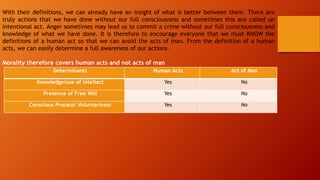
With their definitions, we can already have an insight of what is better between them. There are
truly actions that we have done without our full consciousness and sometimes this are called un
intentional act. Anger sometimes may lead us to commit a crime without our full consciousness and
knowledge of what we have done. It is therefore to encourage everyone that we must KNOW the
definitions of a human act so that we can avoid the acts of man. From the definition of a human
acts, we can easily determine a full awareness of our actions.
Morality therefore covers human acts and not acts of man
Determinants Human Acts Act of Man
Knowledge/use of intellect Yes No
Presence of Free Will Yes No
Conscious Process/ Voluntariness Yes No
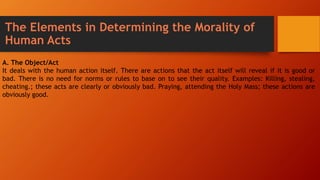
The Elements in Determining the Morality of
Human Acts
A. The Object/Act
It deals with the human action itself. There are actions that the act itself will reveal if it is good or
bad. There is no need for norms or rules to base on to see their quality. Examples: Killing, stealing,
cheating.; these acts are clearly or obviously bad. Praying, attending the Holy Mass; these actions are
obviously good.
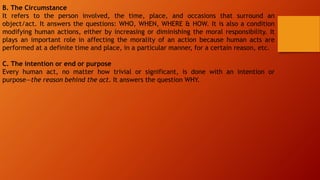
B. The Circumstance
It refers to the person involved, the time, place, and occasions that surround an
object/act. It answers the questions: WHO, WHEN, WHERE & HOW. It is also a condition
modifying human actions, either by increasing or diminishing the moral responsibility. It
plays an important role in affecting the morality of an action because human acts are
performed at a definite time and place, in a particular manner, for a certain reason, etc.
C. The intention or end or purpose
Every human act, no matter how trivial or significant, is done with an intention or
purpose—the reason behind the act. It answers the question WHY.
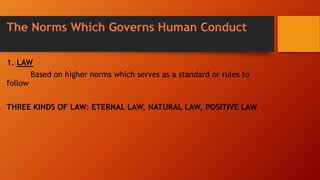
The Norms Which Governs Human Conduct
1. LAW
Based on higher norms which serves as a standard or rules to
follow
THREE KINDS OF LAW: ETERNAL LAW, NATURAL LAW, POSITIVE LAW
A. Eternal Law
God is the Eternal law in which human action must be anchored on the divinity and perfection of
God.
It is the Divine Wisdom of God which oversees the common good and governs everything.
Eternal law is God’s plan to lead all creation towards God’s eternal salvific plan to be holy and
blameless before Him through Jesus Christ (Ephesians 1:4–5) God, as “Being-itself”, is able to
promulgate such a law as God the Creator’s reason is also perfect wisdom.
Everything in nature reflects the Eternal Law in their own natures. Things act according to their
nature, so they derive their proper ends according to the law written into their nature.
B. Natural Law
It is “the rational creature’s participation in the eternal law”
It is “natural” as it consists of Reason given to us by the “higher reason” of the divine Lawgiver.
They are natural as they are objective principles which originate in human nature. The natural law
is universal because it encompasses every person, of every epoch.
It derives from the nature of human. Human beings are capable of reasoning out. Human beings are
rational animal. Thus, human acts must be conformed to the rational nature of man.
C. Positive Law
A law that is promulgated or published.
In its strictest sense, positive law is law that is made by humans. Specifically, Constitutional
Law
Dictionary defines positive law as “Law actually and specifically enacted or adopted by proper
authority for the government of an organized society.” In a more complex sense, the term positive
law refers to a legal philosophy of positivism.
1. The Divine Positive Law-God-given law promulgated to all creature or to a specific community.
2. The Human Positive Law- promulgated by one who is a competent leader for the common good
of all.
i.e.
i. Ordinance
ii. Reasonable
iii. Common good
iv. Competent Authority
The Norms Which Governs Human Conduct
1. LAW
2. CONSCIENCE
_Conscience is the most secret core and sanctuary of man. There he is alone with God
whose voice echoes in his depths.
_It is defined as that part of the human psyche that induces mental anguish and
feelings of guilt when we violate it and feelings of pleasure and well-being when our
actions, thoughts and words are in conformity to our value systems. The Greek word
translated “conscience” in all New Testament references is suneidēsis, meaning “moral
awareness” or “moral consciousness.” The conscience reacts when one’s actions,
thoughts, and words conform to, or are contrary to, a standard of right and wrong.
Antecedent conscience vs Consequent conscience
Note: The difference between antecedent and consequent is that antecedent is anything that
precedes another thing, especially the cause of the second thing while consequence is that which
follows something on which it depends; that which is produced by a cause.
A. Antecedent conscience
_It judges an act before it is done. In other words, one may decide whether to do or not to do.
_The judgment of a person deciding on a moral matter prior to acting on it. Antecedent
conscience either commands or forbids, counsels or permits the performance of an act.
B. Consequent conscience
_Judges an act after its done.
_The judgment of the mind on the morality of an action already performed. The conscience
either approves what has been done, giving peace to the mind and spiritual joy, or disapproves of
what was done, thus causing remorse and a sense of guilt.
1. Correct conscience - tells us when something is a good choice or a bad choice and that this
decision is in agreement with what that thing. The judgment of the mind when it concludes
correctly from true principles that some act is lawful or sinful. Also called true conscience.
2. False conscience - The judgment of the mind when it wrongly decides that something is lawful
but that in fact is unlawful, or vice versa. The error may be due to the false principles used or
because the mind was darkened or confused in its reasoning process.
3. Scrupulous conscience- An erroneous conscience when the mind is unduly swayed by fear and
judges that something is wrong that in fact is lawful.
4. Lax conscience - An erroneous conscience when the mind decides on insufficient grounds that a sinful act is
permissible or that something gravely wrong is not serious.
5. Certain conscience - A state of mind when it has no prudent fear of being wrong about its judgment on some
moral issue and firmly decides that some action is right or wrong.
6. Doubtful conscience - A state of mind when it cannot certainly decide for or against a course of action and
leaves the person unsure about the morality of what one is to do, or what one may have done. One sign of a
doubtful conscience is that it gives rise to a positive judgment with a prudent fear of being wrong, or more
commonly to a negative judgment in which the person does not know whether an act is lawful or not.
7. Guilty Conscience - Disturbed conscience trying to restore good relations with God by means of sorrow and
repentance.

Theo module 1

  • 1.
    Christian Morality inOur Times INSTRUCTOR: ROMNICK AGUSTIN DANAO
  • 2.
    Basic Concepts inMorality A. Definition of Morality There are two definitions of morality namely: descriptive and normative. Let us try to look at their meanings and their applications within the society as a whole. Looking at their meanings and applications, we can recognize their differences as well so as to think what meanings of morality is more valid in our tribes, families, or societies as a whole. A.1. Descriptive morality There is an existing code of conduct being practice by a specific society. That code of conduct becomes their guidelines living within the society where they belong. An example of this code of conduct is the Kalinga bodong system where in every ikalingas has to abide with the pagta/laws in order to maintain peace and orderliness in every tribe.
  • 3.
    However, this descriptivedefinition of morality is contrary to the UNIVERSAL standard of code that applies to all human beings. Why? It is because this code of conduct created by a specific tribe or society is not applicable to other societies like bodong is not applicable in Manila or other places. Thus, descriptive morality is not applicable to all. It is only applicable to a specific place which does have its own laws/practices common to them. This is a descriptive meaning of morality.
  • 4.
    A.2. Normative morality Onthe other hand, normative morality as the second definition of morality adapts the concept of UNIVERSALISM which means there is a universal standard of norms to follow. What is this norm to follow? It is called the natural light of REASON. According to St. Thomas Aquinas, the used of REASON as a norm is that every human has the capacity to think of what is good and bad. In other words, reason is implanted naturally to all of us human beings by God. In this sense, all human has the capacity to decide, to judge, to act on his or her own self for the reason that we all have this natural light of reason given to us by God. Thus, our REASON becomes now the universal standard norms. Why? It is because every human being has the obligation to discern what is good and skip evil in their decisions and actions.
  • 5.
    It is toclaim then that normative morality is the basis of a moral life since we are not to be affected by a specific law that will govern our actions. We are not depending on the basis of descriptive morality which limits to what is commonly practice and set as a guideline in a specific society since not all code of conduct is applicable to everybody. However, reason is a universal standard norm because even there is no law that governs our actions, it is already implied according to our common sense that a certain action is bad or good. Thus, morality studies and judges’ action, intention, and circumstance whether it is right or wrong in the light of REASON.
  • 6.
    The Definition fromthe Perspective of the Christian a. The study of the principles and practices of right and wrong in the light of the Scriptures; b. The application of Christianity to conduct; c. Translating doctrine into deeds, i.e., the study and application of the Christian faith.
  • 7.
    OBJECT OF MORALITY Theobject of morality is the ACTION of man. We are now examining the action of man in terms of his/her decision to know what is proper and improper. There are two bases in determining their differences and their disadvantages to us. Let us study what is more proper, an act of man or human act. Of course, our basis in doing this is to observe our actions.
  • 8.
    Human acts  Properto human – has willful consent and knowledge of the action One freely uses his/her intellect and freewill when acting, behaving and doing  Human acts revealed the value of responsibility and accountability; hence one is fully aware of what she/he is doing i.e., eating healthy foods, review well, no to drugs. Acts of man  Action is not plan  Action is performed without conscious deliberation or knowledge and with the absence of freewill.  Constitute unconscious and involuntary action (ex: breathing, digestion, & others)  Natural processes within the body that continue to function without the use of freewill and reason.
  • 9.
    With their definitions,we can already have an insight of what is better between them. There are truly actions that we have done without our full consciousness and sometimes this are called un intentional act. Anger sometimes may lead us to commit a crime without our full consciousness and knowledge of what we have done. It is therefore to encourage everyone that we must KNOW the definitions of a human act so that we can avoid the acts of man. From the definition of a human acts, we can easily determine a full awareness of our actions. Morality therefore covers human acts and not acts of man Determinants Human Acts Act of Man Knowledge/use of intellect Yes No Presence of Free Will Yes No Conscious Process/ Voluntariness Yes No
  • 10.
    The Elements inDetermining the Morality of Human Acts A. The Object/Act It deals with the human action itself. There are actions that the act itself will reveal if it is good or bad. There is no need for norms or rules to base on to see their quality. Examples: Killing, stealing, cheating.; these acts are clearly or obviously bad. Praying, attending the Holy Mass; these actions are obviously good.
  • 11.
    B. The Circumstance Itrefers to the person involved, the time, place, and occasions that surround an object/act. It answers the questions: WHO, WHEN, WHERE & HOW. It is also a condition modifying human actions, either by increasing or diminishing the moral responsibility. It plays an important role in affecting the morality of an action because human acts are performed at a definite time and place, in a particular manner, for a certain reason, etc. C. The intention or end or purpose Every human act, no matter how trivial or significant, is done with an intention or purpose—the reason behind the act. It answers the question WHY.
  • 12.
    The Norms WhichGoverns Human Conduct 1. LAW Based on higher norms which serves as a standard or rules to follow THREE KINDS OF LAW: ETERNAL LAW, NATURAL LAW, POSITIVE LAW
  • 13.
    A. Eternal Law Godis the Eternal law in which human action must be anchored on the divinity and perfection of God. It is the Divine Wisdom of God which oversees the common good and governs everything. Eternal law is God’s plan to lead all creation towards God’s eternal salvific plan to be holy and blameless before Him through Jesus Christ (Ephesians 1:4–5) God, as “Being-itself”, is able to promulgate such a law as God the Creator’s reason is also perfect wisdom. Everything in nature reflects the Eternal Law in their own natures. Things act according to their nature, so they derive their proper ends according to the law written into their nature. B. Natural Law It is “the rational creature’s participation in the eternal law” It is “natural” as it consists of Reason given to us by the “higher reason” of the divine Lawgiver. They are natural as they are objective principles which originate in human nature. The natural law is universal because it encompasses every person, of every epoch. It derives from the nature of human. Human beings are capable of reasoning out. Human beings are rational animal. Thus, human acts must be conformed to the rational nature of man.
  • 14.
    C. Positive Law Alaw that is promulgated or published. In its strictest sense, positive law is law that is made by humans. Specifically, Constitutional Law Dictionary defines positive law as “Law actually and specifically enacted or adopted by proper authority for the government of an organized society.” In a more complex sense, the term positive law refers to a legal philosophy of positivism. 1. The Divine Positive Law-God-given law promulgated to all creature or to a specific community. 2. The Human Positive Law- promulgated by one who is a competent leader for the common good of all. i.e. i. Ordinance ii. Reasonable iii. Common good iv. Competent Authority
  • 15.
    The Norms WhichGoverns Human Conduct 1. LAW 2. CONSCIENCE _Conscience is the most secret core and sanctuary of man. There he is alone with God whose voice echoes in his depths. _It is defined as that part of the human psyche that induces mental anguish and feelings of guilt when we violate it and feelings of pleasure and well-being when our actions, thoughts and words are in conformity to our value systems. The Greek word translated “conscience” in all New Testament references is suneidēsis, meaning “moral awareness” or “moral consciousness.” The conscience reacts when one’s actions, thoughts, and words conform to, or are contrary to, a standard of right and wrong.
  • 16.
    Antecedent conscience vsConsequent conscience Note: The difference between antecedent and consequent is that antecedent is anything that precedes another thing, especially the cause of the second thing while consequence is that which follows something on which it depends; that which is produced by a cause. A. Antecedent conscience _It judges an act before it is done. In other words, one may decide whether to do or not to do. _The judgment of a person deciding on a moral matter prior to acting on it. Antecedent conscience either commands or forbids, counsels or permits the performance of an act. B. Consequent conscience _Judges an act after its done. _The judgment of the mind on the morality of an action already performed. The conscience either approves what has been done, giving peace to the mind and spiritual joy, or disapproves of what was done, thus causing remorse and a sense of guilt.
  • 17.
    1. Correct conscience- tells us when something is a good choice or a bad choice and that this decision is in agreement with what that thing. The judgment of the mind when it concludes correctly from true principles that some act is lawful or sinful. Also called true conscience. 2. False conscience - The judgment of the mind when it wrongly decides that something is lawful but that in fact is unlawful, or vice versa. The error may be due to the false principles used or because the mind was darkened or confused in its reasoning process. 3. Scrupulous conscience- An erroneous conscience when the mind is unduly swayed by fear and judges that something is wrong that in fact is lawful. 4. Lax conscience - An erroneous conscience when the mind decides on insufficient grounds that a sinful act is permissible or that something gravely wrong is not serious. 5. Certain conscience - A state of mind when it has no prudent fear of being wrong about its judgment on some moral issue and firmly decides that some action is right or wrong. 6. Doubtful conscience - A state of mind when it cannot certainly decide for or against a course of action and leaves the person unsure about the morality of what one is to do, or what one may have done. One sign of a doubtful conscience is that it gives rise to a positive judgment with a prudent fear of being wrong, or more commonly to a negative judgment in which the person does not know whether an act is lawful or not. 7. Guilty Conscience - Disturbed conscience trying to restore good relations with God by means of sorrow and repentance.