Approaches to Childhood learning – Class activity Record Sheet 
After every class Activity write into the record sheet. Add photos throughout the record. 15 records min required for portfolio. Add lots of images to illustrate your understanding. 
Name: J L 
Date: 
11/11/14 
Week number: 
12 
Attended: 
yes 
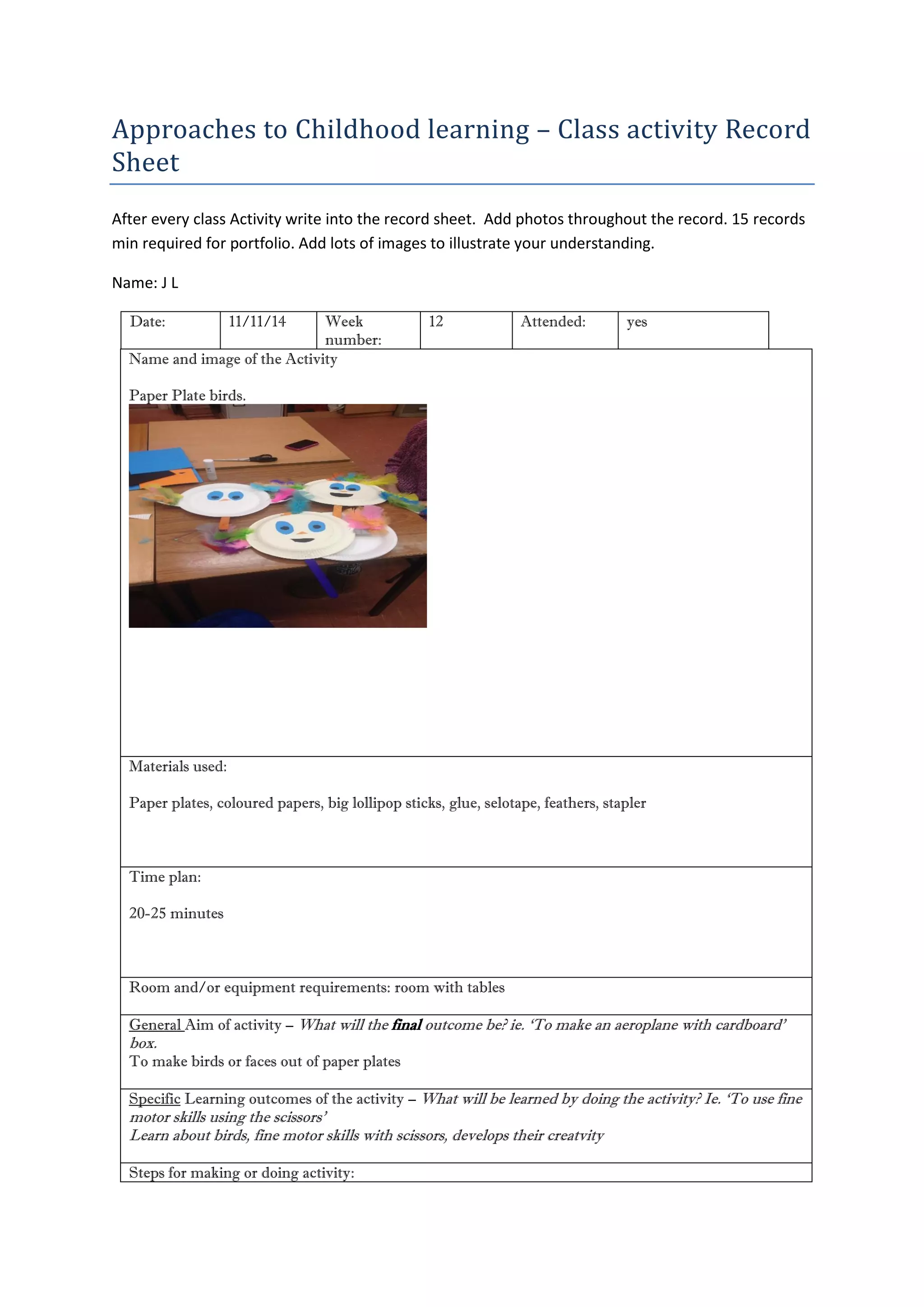
Name and image of the Activity 
Paper Plate birds. 
Materials used: 
Paper plates, coloured papers, big lollipop sticks, glue, selotape, feathers, stapler 
Time plan: 
20-25 minutes 
Room and/or equipment requirements: room with tables 
General Aim of activity – What will the final outcome be? ie. ‘To make an aeroplane with cardboard’ box. 
To make birds or faces out of paper plates 
Specific Learning outcomes of the activity – What will be learned by doing the activity? Ie. ‘To use fine motor skills using the scissors’ 
Learn about birds, fine motor skills with scissors, develops their creatvity 
Steps for making or doing activity:
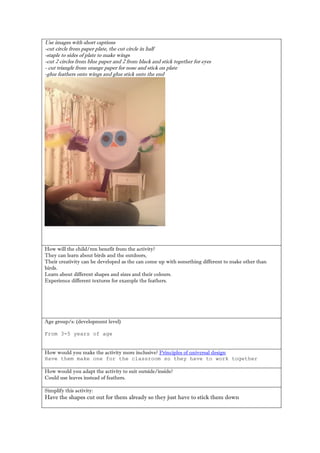
Use images with short captions 
-cut circle from paper plate, the cut circle in half 
-staple to sides of plate to make wings 
-cut 2 circles from blue paper and 2 from black and stick together for eyes 
- cut triangle from orange paper for nose and stick on plate 
-glue feathers onto wings and glue stick onto the end 
How will the child/ren benefit from the activity? 
They can learn about birds and the outdoors, 
Their creativity can be developed as the can come up with something different to make other than birds. 
Learn about different shapes and sizes and their colours. 
Experience different textures for example the feathers. 
Age group/s: (development level) 
From 3-5 years of age 
How would you make the activity more inclusive? Principles of universal design 
Have them make one for the classroom so they have to work together 
How would you adapt the activity to suit outside/inside? 
Could use leaves instead of feathers. 
Simplify this activity: 
Have the shapes cut out for them already so they just have to stick them down
Variations for the activity: How could you vary the activity? ‘Marbling using foam or egg whites instead 
They could use natural materials like the leaves 
The Learning outcomes linked to Aistear 
Exploring and thinking Identity and Belonging Well-being Communicating 
Eg: Aim 1;4,5,6 
Aim 1: 5, 6 
Aim 1: 6 
Aim 1: 5, 6 
Aim 2: 3,4, 6 
Aim 2: 1, 
Aim 2: 1, 3 
Aim 2: 1,3,4 
Aim 3: 1, 2, 6 
Aim 3: 1, 2, 3, 4 
Aim: 1, 3, 5, 6 
Aim 3: 1,2,4,5 
Aim 4: 1, 4, 5, 6 
Aim 4: 1, 3, 4, 6 
Aim 4: 1,3 
Aim 4: 1, 2, 6 
Other curriculums: Montessori, HiScope.. 
 
Safety concerns? If any 
Need to be careful with the children using the scissors 
Could the activity link to an external activity/group/ outing? ‘Visit to a farm/forest to see/do….’ 
The general outdoors or you could change it to suit the occasion for example make a snowman or an elf 
for Christmas or a pumpkin or a bat for halloween 
Extensions for the activity: Could science, geography, history, culture, literacy, maths etc, be incorporated into to the activity? How? What changes would you make? 
Could link in with animals and different seasons or occasions 
Interactions with children: talk about…. Talk with your child about what they are doing. This will help them understand the physical and mental processes they are going through as well as giving them the vocabulary to describe it. "Look at how the paint splatters like that" 
Bring in a book of birds and discuss the different types they could make 
They could paint the plates and discuss the different colours they could use. 
Problem solving element? Make your child aware of the problem solving involved and ask them questions as needed to help them work out problems themselves, eg. "Why isn't the paint coming out now?", "Is the straw reaching the paint when the bottle is tipped like that?", "How could you fix that?" 
I could say things such as why isn’t the selotape sticking the stick to the plate? They would learn that it is too heavy and might need to think of other option to help it stick like glue but I would ask the children what else could we use?
Evaluation of activity: What did think of the activity? 
I felt that it was a fun activity to do. It is quick as it doesn’t take long to do and it is easy for the children to understand. It is very colourful and they can pick what colours they would like to use. 
Additional information: (images, books, articles, video links, websites etc.) 
Summary of your personal learning in points (at least 4) from doing the activity; 
 . birds 
 . how to be creative 
 . different materials 
 . fine motor skills

Paper Plate Birds

  • 1.
    Approaches to Childhoodlearning – Class activity Record Sheet After every class Activity write into the record sheet. Add photos throughout the record. 15 records min required for portfolio. Add lots of images to illustrate your understanding. Name: J L Date: 11/11/14 Week number: 12 Attended: yes Name and image of the Activity Paper Plate birds. Materials used: Paper plates, coloured papers, big lollipop sticks, glue, selotape, feathers, stapler Time plan: 20-25 minutes Room and/or equipment requirements: room with tables General Aim of activity – What will the final outcome be? ie. ‘To make an aeroplane with cardboard’ box. To make birds or faces out of paper plates Specific Learning outcomes of the activity – What will be learned by doing the activity? Ie. ‘To use fine motor skills using the scissors’ Learn about birds, fine motor skills with scissors, develops their creatvity Steps for making or doing activity:
  • 2.
    Use images withshort captions -cut circle from paper plate, the cut circle in half -staple to sides of plate to make wings -cut 2 circles from blue paper and 2 from black and stick together for eyes - cut triangle from orange paper for nose and stick on plate -glue feathers onto wings and glue stick onto the end How will the child/ren benefit from the activity? They can learn about birds and the outdoors, Their creativity can be developed as the can come up with something different to make other than birds. Learn about different shapes and sizes and their colours. Experience different textures for example the feathers. Age group/s: (development level) From 3-5 years of age How would you make the activity more inclusive? Principles of universal design Have them make one for the classroom so they have to work together How would you adapt the activity to suit outside/inside? Could use leaves instead of feathers. Simplify this activity: Have the shapes cut out for them already so they just have to stick them down
  • 3.
    Variations for theactivity: How could you vary the activity? ‘Marbling using foam or egg whites instead They could use natural materials like the leaves The Learning outcomes linked to Aistear Exploring and thinking Identity and Belonging Well-being Communicating Eg: Aim 1;4,5,6 Aim 1: 5, 6 Aim 1: 6 Aim 1: 5, 6 Aim 2: 3,4, 6 Aim 2: 1, Aim 2: 1, 3 Aim 2: 1,3,4 Aim 3: 1, 2, 6 Aim 3: 1, 2, 3, 4 Aim: 1, 3, 5, 6 Aim 3: 1,2,4,5 Aim 4: 1, 4, 5, 6 Aim 4: 1, 3, 4, 6 Aim 4: 1,3 Aim 4: 1, 2, 6 Other curriculums: Montessori, HiScope..  Safety concerns? If any Need to be careful with the children using the scissors Could the activity link to an external activity/group/ outing? ‘Visit to a farm/forest to see/do….’ The general outdoors or you could change it to suit the occasion for example make a snowman or an elf for Christmas or a pumpkin or a bat for halloween Extensions for the activity: Could science, geography, history, culture, literacy, maths etc, be incorporated into to the activity? How? What changes would you make? Could link in with animals and different seasons or occasions Interactions with children: talk about…. Talk with your child about what they are doing. This will help them understand the physical and mental processes they are going through as well as giving them the vocabulary to describe it. "Look at how the paint splatters like that" Bring in a book of birds and discuss the different types they could make They could paint the plates and discuss the different colours they could use. Problem solving element? Make your child aware of the problem solving involved and ask them questions as needed to help them work out problems themselves, eg. "Why isn't the paint coming out now?", "Is the straw reaching the paint when the bottle is tipped like that?", "How could you fix that?" I could say things such as why isn’t the selotape sticking the stick to the plate? They would learn that it is too heavy and might need to think of other option to help it stick like glue but I would ask the children what else could we use?
  • 4.
    Evaluation of activity:What did think of the activity? I felt that it was a fun activity to do. It is quick as it doesn’t take long to do and it is easy for the children to understand. It is very colourful and they can pick what colours they would like to use. Additional information: (images, books, articles, video links, websites etc.) Summary of your personal learning in points (at least 4) from doing the activity;  . birds  . how to be creative  . different materials  . fine motor skills