(1) Activity title: Salt tray writing
Learning objectives:
1. Students can practice writing letters/words in a sensory (salt) tray.
2. Students can demonstrate developing fine motor skills by using a pencil to write
their letters/words.
Materials:
Flat tray
Salt
Letter cards
Unsharpened pencil(s)
Procedure:
 Set tray on a flat surface such as a table or floor (ask child where they prefer to
work).
 Pour salt into the tray- salt should cover the tray ¾ to completely full.
 Place letter cards in front of salt tray (standing upright on a holder may work
best).
 With the unsharpened pencil (or their finger) they can trace the letter into the salt.
 For more advanced practice, child can use word cards to trace words they are
familiar with (such as their name) into the salt tray.
Activity importance:
This activity is included in the literacy kit to allow children to practice their handwriting
using a sensory tray. This activity benefits parents and children by using household items
as an educational resource, as well as allowing parents to observe their child’s progress
and areas of handwriting they may still need to improve on. This activity benefits
teacher-family partnerships by continuing to develop handwriting skills at school and at
home. This activity benefits learning by differentiating the handwriting process.
(2) Activity title: Name/word puzzles
Learning objectives:
1. Students can reorder a puzzle to put together a name/word.
2. Students can demonstrate their knowledge of letter sounds by saying each sound
as they put their puzzle together.
Materials:
Name card or cardstock paper
Permanent marker
Scissors
Procedure:
 Write child’s name or a word they are familiar with on a name card or cardstock
paper.
 Cut the name card or paper using different patterns and jagged edges (so the
pieces will fit together like a puzzle).
 Mix up the pieces and have the child put the letters back together in the correct
order.
 Sound out each letter as they are put in their place.
Activity importance:
This activity is included in the literacy kit to allow children to practice spelling their
names and identification of letter sounds. This activity benefits parents and children by
working together on a difficult early childhood skill. This activity benefits teacher-
family partnerships by continuing to develop knowledge of letter sounds at school and at
home. This activity benefits learning by encouraging students to have the knowledge to
spell their names, as well as continuing to practice letter sound identification.
(3) Activity title: Picture walk
Learning objectives:
1. Students can predict what will happen in the story by previewing the illustrations.
2. Students can describe what is happening in the story by looking at the
illustrations.
3. Students can compare his/her predictions with what events actually occurred in
the story.
Materials:
Children’s book (with pictures)
Procedure:
 Have the child choose a book from home or a place you can read to them, such as
a library.
 Before reading the story, take the child through the illustrations of the book to
make predictions on what they believe the story is about and what is happening on
each page.
 Encourage the child to point out the significance of pictures, such as feelings a
character may be portraying or an action that is taking place.
 Go back through and read the story to see if the predictions were right!
 Compare and contrast predictions and the storyline.
Activity importance:
This activity is included in the literacy kit to encourage families to read at home and
practice making predictions. This activity benefits parents and children by using an
educational tool to encourage enhancement of literacy skills and to spend quality time
together at home. This activity benefits teacher-family partnerships by promoting the
idea of reading to and spending time with children as positive growth and development.
This activity benefits learning by allowing children to read and share stories with their
teachers and families that appeal to their interests.
(4) Activity title: Story in a bag
Learning objectives:
1. Students can identify each item in the bag.
2. Students can create a sentence or story from the item they pull out of the bag.
Materials:
Paper bag
At home items (ex. baby doll, Legos, blocks, utensils, crayons, etc.)
Procedure:
 Find “fun” items throughout the house and place them in a paper bag.
 Sit down with the child and have them pull out one item at a time without
peeking.
 For each item, the child can come up with a sentence about the item or tie all the
items in together to create a story. (ex. first item: Barbie doll. “Barbie wants to go
out with her friends today!”).
 Can repeat the activity with the same items in a different order, or place all new
items in the bag.
Activity importance:
This activity is included in the literacy kit to allow children to use their imaginations in
creating stories. This activity benefits parents and children by using household items as
an educational resource to create and share unique stories. This activity benefits teacher-
family partnerships by encouraging the idea of reading, storytelling, and imagination at
home. This activity benefits learning by differentiating reading and storytelling, as well
as continuing to develop identification and sequencing skills.
(5) Activity title: Clapping syllables
Learning objectives:
1. Students can listen to the sounds in each presented word.
2. Students can break down each word into syllables by clapping
3. Students can demonstrate developing gross motor skills by clapping.
Materials:
(Optional) Picture cards
Procedure:
 Choose a series of words that the child is familiar with to clap out syllables to.
These words may include: the child’s name, mom(my), dad(dy), grandma,
grandpa, etc.
 Encourage the child to listen very closely to the sounds they hear in each word.
 With the child, choose the first word to say out loud (normally), and then break
the word down (slowly).
 As you break the word down, demonstrate clapping each sound and encourage the
child to do it with you.
 Repeat claps with the same word a few times until it becomes a flowing
movement between sounds and claps.
 Repeat the same steps with the remaining words that were chosen to work with.
Activity importance:
This activity is included in the literacy kit to allow children to practice breaking down
syllables in words. This activity benefits parents and children by encouraging a fun,
unique way to practice hearing sounds in words at home. This activity benefits teacher-
family partnerships by furthering the development of a skill learned at school, at home.
This activity benefits learning by using gross motor skills to develop a cognitive skill.
(6) Activity title: Chalkboard water tracing
Learning objectives:
1. Students can demonstrate developing fine motor skills by using a paintbrush to
trace their letters/words.
2. Students can name and write each letter/word they trace.
Materials:
Chalkboard and chalk
Paintbrush
Water
Procedure:
 Choose a letter or word of the day to write on a chalkboard. Beginning with a
letter of the day may be easiest when first introducing the activity.
 Write the letter or word big on the chalkboard, and repeat it two to three times.
With letters, you may choose to write in uppercase and lowercase.
 With a paintbrush and water, the child may trace over the chalk on the
whiteboard.
 As they trace, the chalk becomes “invisible” and they can see their tracing “come
to life” on the chalkboard.
Activity importance:
This activity is included in the literacy kit to allow children to practice their handwriting
skills in a fun and unique way. This activity benefits parents and children by promoting
creativity, as well as allowing parents to observe their child’s progress and areas of
handwriting they may still need to improve on. This activity benefits teacher-family
partnerships by continuing to develop handwriting skills at school and at home. This
activity benefits learning by differentiating the handwriting process.
(7) Activity title: Read aloud books (CD, DVD, Audible app.)
Learning objectives:
1. Students can listen to the story via CD, DVD, or computer/ipad.
2. Students can follow along with the story as it reads aloud.
Materials:
Children’s book that includes CD or DVD
CD player or Computer
Ipad for audible app.
(Optional) headphones
Procedure:
 Choose an age appropriate children’s book that includes an audio component,
such as a CD or DVD. (Stories may also be found on the audible app provided by
amazon. For this listening app, you will need an ipad).
 Set up a listening center for your child where they can listen to the story
independently, with a peer, or with you.
 Some children may prefer to listen with headphones and some may prefer to listen
without- this is optional.
 Place the CD or DVD in the CD player or computer for your child to follow along
with in the story. (For the audible app, choose the story you wish to read/hear and
push “play” on the screen).
 Encourage your child to listen carefully to the story while following along with
the words or pictures. There will also be a specific sound to tell them when to turn
to the next page.
 Allow your child to listen to the whole story and follow along/turn pages
independently.
 Talk to them about the story when it is finished.
Activity importance:
This activity is included in the literacy kit to allow children to be able to listen to a story
from a different resource, integrating technology. This activity benefits parents and
children by promoting educational ways to encourage reading and the use of technology
at home. This activity benefits teacher-family partnerships by continuing to encourage
families to read with children at home in a variety of ways. This activity benefits
learning by including technology as a way to differentiate listening, reading, and
comprehension.
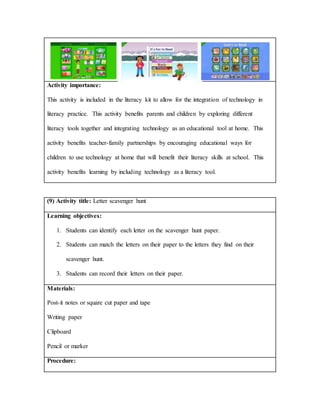
(8) Activity title: Starfall Literacy
Learning objectives:
1. Students can discover new literacy activities using technology.
2. Students can demonstrate their prior literacy knowledge throughout activities.
3. Students can demonstrate new knowledge by practicing new literacy activities.
Materials:
Computer, ipad, or smart phone (ex. iphone)
Procedure:
 Log onto starfall.com
 Allow your child to choose from any of the literacy activities available
(1 through 4).
 Supervise your child by the computer, ipad, or smart phone to monitor their
progress and help with directions.
 Talk to your child about literacy activities they like and encourage him/her to
explore more activities for continued learning.
Activity importance:
This activity is included in the literacy kit to allow for the integration of technology in
literacy practice. This activity benefits parents and children by exploring different
literacy tools together and integrating technology as an educational tool at home. This
activity benefits teacher-family partnerships by encouraging educational ways for
children to use technology at home that will benefit their literacy skills at school. This
activity benefits learning by including technology as a literacy tool.
(9) Activity title: Letter scavenger hunt
Learning objectives:
1. Students can identify each letter on the scavenger hunt paper.
2. Students can match the letters on their paper to the letters they find on their
scavenger hunt.
3. Students can record their letters on their paper.
Materials:
Post-it notes or square cut paper and tape
Writing paper
Clipboard
Pencil or marker
Procedure:
 Pre-type and print (or write) letters on a piece of paper for a letter scavenger hunt.
Letters should be big enough and spaced out far enough on the paper for children
to trace, check off, or cross off.
 Place individual sticky notes (or square pieces of paper) around the house with the
same letters that are on the scavenger hunt paper. Sticky notes or squares can be
placed high, low, or at eye level for children to search for.
 Give the child a pencil or marker and a clipboard with the scavenger hunt paper
attached to it.
 Allow the child to search around the house for the letters, and trace, check off, or
cross off each letter as they find them.
 If they would like to do the activity again, you can use the same scavenger hunt
paper and place the sticky notes or letter squares in different places around the
house. You may also create a new letter scavenger hunt with different letters.
Activity importance:
This activity is included in the literacy kit to allow children to practice identifying letters
by recording their findings. This activity benefits parents and children by using a family
activity to integrate learning. This activity benefits teacher-family partnerships by
continuing to develop letter identification and recording skills at home. This activity
benefits learning by allowing children and families to use creativity in the learning
process.
(10) Activity title: Little writer tracing practice
Learning objectives:
1. Students can trace each letter/word on the screen.
2. Students can identify each letter/word on the screen.
Materials:
Ipad or smart phone (ex. iphone)
Procedure:
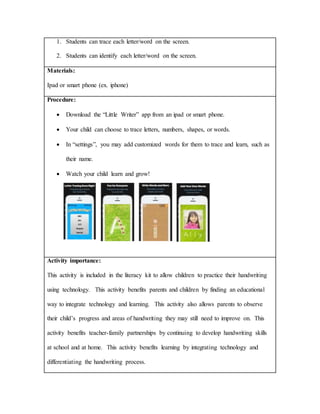
 Download the “Little Writer” app from an ipad or smart phone.
 Your child can choose to trace letters, numbers, shapes, or words.
 In “settings”, you may add customized words for them to trace and learn, such as
their name.
 Watch your child learn and grow!
Activity importance:
This activity is included in the literacy kit to allow children to practice their handwriting
using technology. This activity benefits parents and children by finding an educational
way to integrate technology and learning. This activity also allows parents to observe
their child’s progress and areas of handwriting they may still need to improve on. This
activity benefits teacher-family partnerships by continuing to develop handwriting skills
at school and at home. This activity benefits learning by integrating technology and
differentiating the handwriting process.
Literacy Kit Packaging
When I imagine sending a literacy kit home with my preschool families, I picture
a square cardboard or plastic box with a lid that can flip backwards to reveal the literacy
activities inside. In the front of the literacy kit, there would be labeled resources for each
of the literacy activities I am able to provide families with. These resources may include
name cards, picture cards, post-it notes, extra pencils, extra paper, chalk, etc. Directly
behind the resources would be files of each of the literacy activities in alphabetical order.
Each activity would be labeled under a category, for example: reading, writing,
technology, etc. Families can browse through the activities to find one they desired and
match the activity with the provided resources to set up the activity. When finished with
the activity, families can place the activity back in the file and the resources back in their
individually labeled packaging. Everything can go back into the literacy kit box and be
stored away for next time!

Module4 literacy kit_course5

  • 1.
    (1) Activity title:Salt tray writing Learning objectives: 1. Students can practice writing letters/words in a sensory (salt) tray. 2. Students can demonstrate developing fine motor skills by using a pencil to write their letters/words. Materials: Flat tray Salt Letter cards Unsharpened pencil(s) Procedure:  Set tray on a flat surface such as a table or floor (ask child where they prefer to work).  Pour salt into the tray- salt should cover the tray ¾ to completely full.  Place letter cards in front of salt tray (standing upright on a holder may work best).  With the unsharpened pencil (or their finger) they can trace the letter into the salt.  For more advanced practice, child can use word cards to trace words they are familiar with (such as their name) into the salt tray. Activity importance: This activity is included in the literacy kit to allow children to practice their handwriting using a sensory tray. This activity benefits parents and children by using household items as an educational resource, as well as allowing parents to observe their child’s progress
  • 2.
    and areas ofhandwriting they may still need to improve on. This activity benefits teacher-family partnerships by continuing to develop handwriting skills at school and at home. This activity benefits learning by differentiating the handwriting process. (2) Activity title: Name/word puzzles Learning objectives: 1. Students can reorder a puzzle to put together a name/word. 2. Students can demonstrate their knowledge of letter sounds by saying each sound as they put their puzzle together. Materials: Name card or cardstock paper Permanent marker Scissors Procedure:  Write child’s name or a word they are familiar with on a name card or cardstock paper.  Cut the name card or paper using different patterns and jagged edges (so the pieces will fit together like a puzzle).  Mix up the pieces and have the child put the letters back together in the correct order.  Sound out each letter as they are put in their place. Activity importance: This activity is included in the literacy kit to allow children to practice spelling their
  • 3.
    names and identificationof letter sounds. This activity benefits parents and children by working together on a difficult early childhood skill. This activity benefits teacher- family partnerships by continuing to develop knowledge of letter sounds at school and at home. This activity benefits learning by encouraging students to have the knowledge to spell their names, as well as continuing to practice letter sound identification. (3) Activity title: Picture walk Learning objectives: 1. Students can predict what will happen in the story by previewing the illustrations. 2. Students can describe what is happening in the story by looking at the illustrations. 3. Students can compare his/her predictions with what events actually occurred in the story. Materials: Children’s book (with pictures) Procedure:  Have the child choose a book from home or a place you can read to them, such as a library.  Before reading the story, take the child through the illustrations of the book to make predictions on what they believe the story is about and what is happening on each page.  Encourage the child to point out the significance of pictures, such as feelings a character may be portraying or an action that is taking place.
  • 4.
     Go backthrough and read the story to see if the predictions were right!  Compare and contrast predictions and the storyline. Activity importance: This activity is included in the literacy kit to encourage families to read at home and practice making predictions. This activity benefits parents and children by using an educational tool to encourage enhancement of literacy skills and to spend quality time together at home. This activity benefits teacher-family partnerships by promoting the idea of reading to and spending time with children as positive growth and development. This activity benefits learning by allowing children to read and share stories with their teachers and families that appeal to their interests. (4) Activity title: Story in a bag Learning objectives: 1. Students can identify each item in the bag. 2. Students can create a sentence or story from the item they pull out of the bag. Materials: Paper bag At home items (ex. baby doll, Legos, blocks, utensils, crayons, etc.) Procedure:  Find “fun” items throughout the house and place them in a paper bag.  Sit down with the child and have them pull out one item at a time without peeking.  For each item, the child can come up with a sentence about the item or tie all the
  • 5.
    items in togetherto create a story. (ex. first item: Barbie doll. “Barbie wants to go out with her friends today!”).  Can repeat the activity with the same items in a different order, or place all new items in the bag. Activity importance: This activity is included in the literacy kit to allow children to use their imaginations in creating stories. This activity benefits parents and children by using household items as an educational resource to create and share unique stories. This activity benefits teacher- family partnerships by encouraging the idea of reading, storytelling, and imagination at home. This activity benefits learning by differentiating reading and storytelling, as well as continuing to develop identification and sequencing skills. (5) Activity title: Clapping syllables Learning objectives: 1. Students can listen to the sounds in each presented word. 2. Students can break down each word into syllables by clapping 3. Students can demonstrate developing gross motor skills by clapping. Materials: (Optional) Picture cards Procedure:  Choose a series of words that the child is familiar with to clap out syllables to. These words may include: the child’s name, mom(my), dad(dy), grandma, grandpa, etc.
  • 6.
     Encourage thechild to listen very closely to the sounds they hear in each word.  With the child, choose the first word to say out loud (normally), and then break the word down (slowly).  As you break the word down, demonstrate clapping each sound and encourage the child to do it with you.  Repeat claps with the same word a few times until it becomes a flowing movement between sounds and claps.  Repeat the same steps with the remaining words that were chosen to work with. Activity importance: This activity is included in the literacy kit to allow children to practice breaking down syllables in words. This activity benefits parents and children by encouraging a fun, unique way to practice hearing sounds in words at home. This activity benefits teacher- family partnerships by furthering the development of a skill learned at school, at home. This activity benefits learning by using gross motor skills to develop a cognitive skill. (6) Activity title: Chalkboard water tracing Learning objectives: 1. Students can demonstrate developing fine motor skills by using a paintbrush to trace their letters/words. 2. Students can name and write each letter/word they trace. Materials: Chalkboard and chalk Paintbrush
  • 7.
    Water Procedure:  Choose aletter or word of the day to write on a chalkboard. Beginning with a letter of the day may be easiest when first introducing the activity.  Write the letter or word big on the chalkboard, and repeat it two to three times. With letters, you may choose to write in uppercase and lowercase.  With a paintbrush and water, the child may trace over the chalk on the whiteboard.  As they trace, the chalk becomes “invisible” and they can see their tracing “come to life” on the chalkboard. Activity importance: This activity is included in the literacy kit to allow children to practice their handwriting skills in a fun and unique way. This activity benefits parents and children by promoting creativity, as well as allowing parents to observe their child’s progress and areas of handwriting they may still need to improve on. This activity benefits teacher-family partnerships by continuing to develop handwriting skills at school and at home. This activity benefits learning by differentiating the handwriting process. (7) Activity title: Read aloud books (CD, DVD, Audible app.) Learning objectives: 1. Students can listen to the story via CD, DVD, or computer/ipad. 2. Students can follow along with the story as it reads aloud. Materials:
  • 8.
    Children’s book thatincludes CD or DVD CD player or Computer Ipad for audible app. (Optional) headphones Procedure:  Choose an age appropriate children’s book that includes an audio component, such as a CD or DVD. (Stories may also be found on the audible app provided by amazon. For this listening app, you will need an ipad).  Set up a listening center for your child where they can listen to the story independently, with a peer, or with you.  Some children may prefer to listen with headphones and some may prefer to listen without- this is optional.  Place the CD or DVD in the CD player or computer for your child to follow along with in the story. (For the audible app, choose the story you wish to read/hear and push “play” on the screen).  Encourage your child to listen carefully to the story while following along with the words or pictures. There will also be a specific sound to tell them when to turn to the next page.  Allow your child to listen to the whole story and follow along/turn pages independently.  Talk to them about the story when it is finished. Activity importance: This activity is included in the literacy kit to allow children to be able to listen to a story
  • 9.
    from a differentresource, integrating technology. This activity benefits parents and children by promoting educational ways to encourage reading and the use of technology at home. This activity benefits teacher-family partnerships by continuing to encourage families to read with children at home in a variety of ways. This activity benefits learning by including technology as a way to differentiate listening, reading, and comprehension. (8) Activity title: Starfall Literacy Learning objectives: 1. Students can discover new literacy activities using technology. 2. Students can demonstrate their prior literacy knowledge throughout activities. 3. Students can demonstrate new knowledge by practicing new literacy activities. Materials: Computer, ipad, or smart phone (ex. iphone) Procedure:  Log onto starfall.com  Allow your child to choose from any of the literacy activities available (1 through 4).  Supervise your child by the computer, ipad, or smart phone to monitor their progress and help with directions.  Talk to your child about literacy activities they like and encourage him/her to explore more activities for continued learning.
  • 10.
    Activity importance: This activityis included in the literacy kit to allow for the integration of technology in literacy practice. This activity benefits parents and children by exploring different literacy tools together and integrating technology as an educational tool at home. This activity benefits teacher-family partnerships by encouraging educational ways for children to use technology at home that will benefit their literacy skills at school. This activity benefits learning by including technology as a literacy tool. (9) Activity title: Letter scavenger hunt Learning objectives: 1. Students can identify each letter on the scavenger hunt paper. 2. Students can match the letters on their paper to the letters they find on their scavenger hunt. 3. Students can record their letters on their paper. Materials: Post-it notes or square cut paper and tape Writing paper Clipboard Pencil or marker Procedure:
  • 11.
     Pre-type andprint (or write) letters on a piece of paper for a letter scavenger hunt. Letters should be big enough and spaced out far enough on the paper for children to trace, check off, or cross off.  Place individual sticky notes (or square pieces of paper) around the house with the same letters that are on the scavenger hunt paper. Sticky notes or squares can be placed high, low, or at eye level for children to search for.  Give the child a pencil or marker and a clipboard with the scavenger hunt paper attached to it.  Allow the child to search around the house for the letters, and trace, check off, or cross off each letter as they find them.  If they would like to do the activity again, you can use the same scavenger hunt paper and place the sticky notes or letter squares in different places around the house. You may also create a new letter scavenger hunt with different letters. Activity importance: This activity is included in the literacy kit to allow children to practice identifying letters by recording their findings. This activity benefits parents and children by using a family activity to integrate learning. This activity benefits teacher-family partnerships by continuing to develop letter identification and recording skills at home. This activity benefits learning by allowing children and families to use creativity in the learning process. (10) Activity title: Little writer tracing practice Learning objectives:
  • 12.
    1. Students cantrace each letter/word on the screen. 2. Students can identify each letter/word on the screen. Materials: Ipad or smart phone (ex. iphone) Procedure:  Download the “Little Writer” app from an ipad or smart phone.  Your child can choose to trace letters, numbers, shapes, or words.  In “settings”, you may add customized words for them to trace and learn, such as their name.  Watch your child learn and grow! Activity importance: This activity is included in the literacy kit to allow children to practice their handwriting using technology. This activity benefits parents and children by finding an educational way to integrate technology and learning. This activity also allows parents to observe their child’s progress and areas of handwriting they may still need to improve on. This activity benefits teacher-family partnerships by continuing to develop handwriting skills at school and at home. This activity benefits learning by integrating technology and differentiating the handwriting process.
  • 13.
    Literacy Kit Packaging WhenI imagine sending a literacy kit home with my preschool families, I picture a square cardboard or plastic box with a lid that can flip backwards to reveal the literacy activities inside. In the front of the literacy kit, there would be labeled resources for each of the literacy activities I am able to provide families with. These resources may include name cards, picture cards, post-it notes, extra pencils, extra paper, chalk, etc. Directly behind the resources would be files of each of the literacy activities in alphabetical order. Each activity would be labeled under a category, for example: reading, writing, technology, etc. Families can browse through the activities to find one they desired and match the activity with the provided resources to set up the activity. When finished with the activity, families can place the activity back in the file and the resources back in their individually labeled packaging. Everything can go back into the literacy kit box and be stored away for next time!