Approaches to Childhood learning – Class activity Record Sheet 
After every class Activity write into the record sheet. Add photos throughout record. 15 records min required for portfolio. Add lots of images to illustrate your understanding. 
Name____M M_____________________________________ 
Date: 
12th November 
Week number: 
10 
Attended: 
Yes 
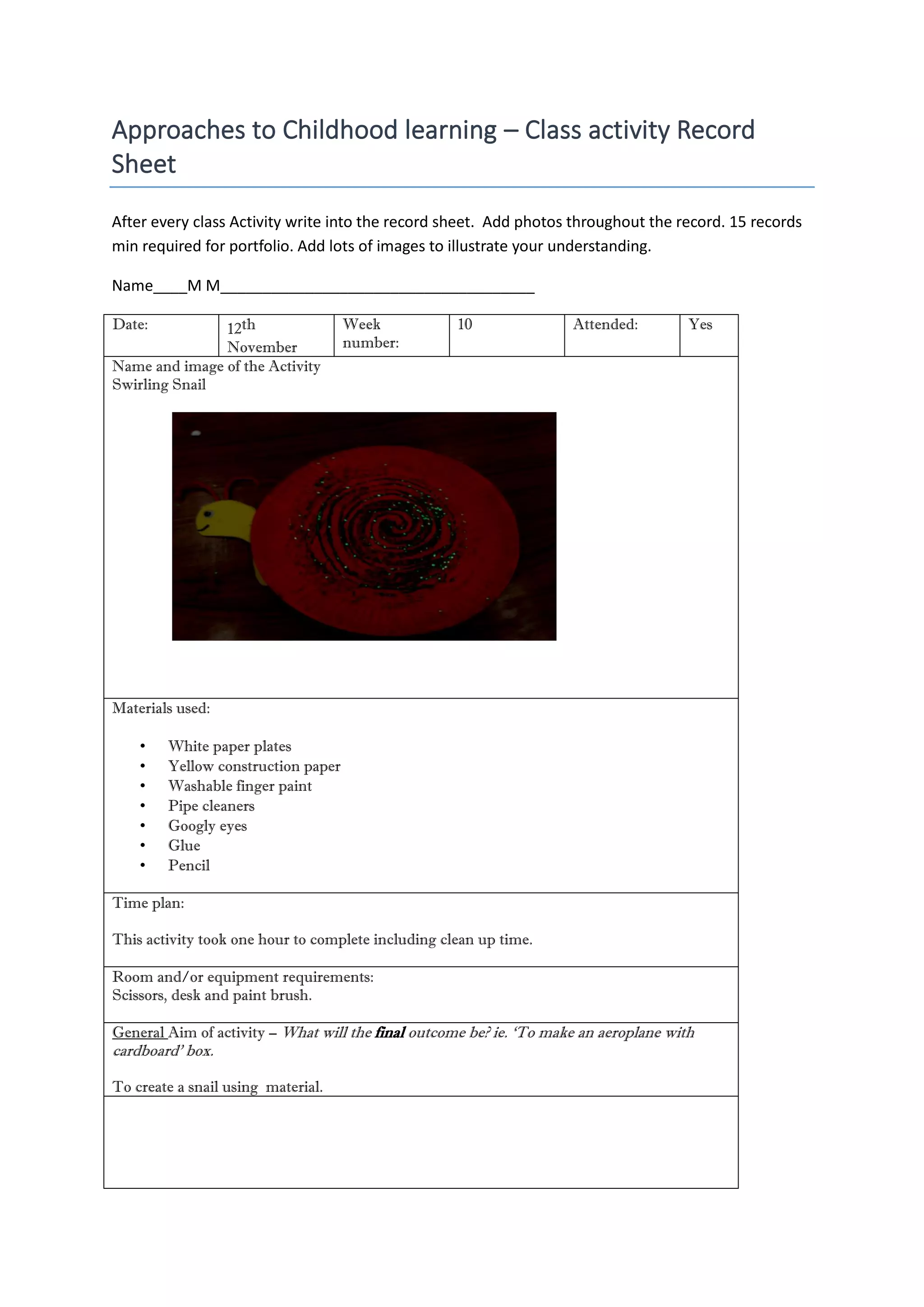
Name and image of the Activity 
Swirling Snail 
Materials used: 
• White paper plates 
• Yellow construction paper 
• Washable finger paint 
• Pipe cleaners 
• Googly eyes 
• Glue 
• Pencil 
Time plan: 
This activity took one hour to complete including clean up time. 
Room and/or equipment requirements: 
Scissors, desk and paint brush. 
General Aim of activity – What will the final outcome be? ie. ‘To make an aeroplane with cardboard’ box. 
To create a snail using material.
Specific Learning outcomes of the activity – What will be learned by doing the activity? Ie. ‘To use fine motor skills using the scissors’ 
• How to trace shapes with a pencil 
• Learn about mixing colours 
• Use fine motor skills using scissors to cut around the snails body 
• Learn what materials to use for parts of the body. Example pipe cleaners ears 
Steps for making or doing activity: 
Use images with short captions 
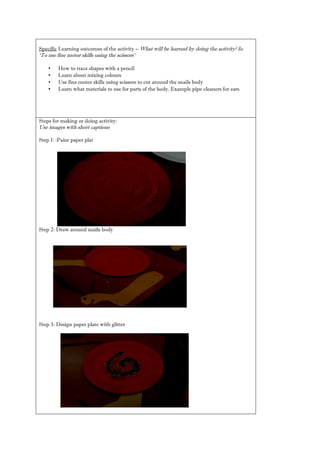
Step 1: :Paint paper plat 
Step 2: Draw around snails body 
Step 3: Design paper plate with glitter
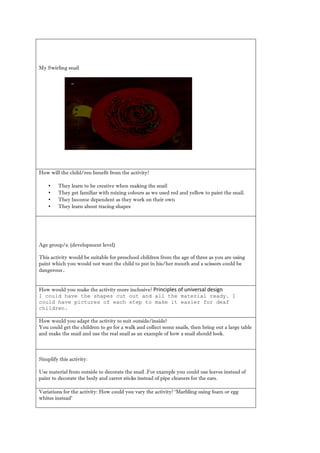
My Swirling snail 
How will the child/ren benefit from activity? 
• They learn to be creative when making the snail 
• They get familiar with mixing colours as we used red and yellow to paint the snail. 
• They become dependent as they work on their own 
• They learn about tracing shapes 
Age group/s: (development level) 
This activity would be suitable for preschool children from the age of three as you are using paint which you would not want the child to put in his/her mouth and a scissors could be dangerous. 
How would you make the activity more inclusive? Principles of universal design 
I could have the shapes cut out and all material ready. could have pictures of each step to make it easier for deaf children. 
How would you adapt the activity to suit outside/inside? 
You could get the children to go for a walk and collect some snails, then bring out large table and make the snail use real as an example of how a should look. 
Simplify this activity: 
Use material from outside to decorate the snail .For example you could use leaves instead of paint to decorate the body and carrot sticks instead of pipe cleaners for ears. 
Variations for the activity: How could you vary activity? ‘Marbling using foam or egg whites instead’
• Use cardboard instead of paper plate 
• Make a snail out of banana and use other food products for eyes ears 
• Use chocolate spread instead of paint 
• Use tissue paper instead of paint to decorate the snail and any other material available 
The Learning outcomes linked to Aistear Exploring and thinking Identity and Belonging Well-being Communicating 
Aim 1;1,4 
Aim 1:1,3 
Aim 1:1,4,6 
Aim 1:1,2,5,6 
Aim2:1,6 
Aim 2:1,4 
Aim 2:3,1 
Aim 2:1,3,4 
Aim 3:4 
Aim 3:2,3 
Aim 3:1,5,2 
Aim 3:1, 
Aim 4:1,3 
Aim 4:1,2,4 
Aim 4:1,2,5 
Aim 4:1,2,4 
Other curriculums: Montessori, HiScope.. 
 
Safety concerns? If any 
A child could cut herself using scissors. Also children need to be careful when paint and glue not to put their fingers in mouth. 
Could the activity link to an external activity/group/ outing? ‘Visit to a farm/forest see/do….’ 
You could bring the children on a nature walk where you show them snails and collect materials that are suitable to decorate the snails body. 
Extensions for the activity: Could science, geography, history, culture, literacy, maths etc, be incorporated into to the activity? How? What changes would you make? 
They learned about numeracy by counting the googly eyes and pipe cleaners how many to put on a snail. They learned literacy by naming the colours of pipe cleaners and paints and they learned about nature by taking part in the walk. 
Interactions with children: talk about…. Talk with your child about what they are doing. This will help them understand the physical and mental processes they are going through as well giving them the vocabulary to describe it. "Look at how paint splatters like that" 
• Look at how the two colours are mixing together 
• Can anyone tell me what colour is this 
• Does anyone know how the googly eyes are sticking and I have not used glue 
• Does anyone know what we will use the pipe cleaners for 
Problem solving element? Make your child aware of the problem solving involved and ask them questions as needed to help them work out problems themselves, eg. "Why isn't the paint coming now?", "Is the straw reaching paint when bottle is tipped like that?", How could you fix that?" 
• Where will we put the smile on snail 
• I’m mixing the two colours together. What will happen next 
• Does anyone know where we put the paper plate 
• Why is it not sticking. Can we fix this
Evaluation of activity: What did think the activity? 
I think this activity would be extremely enjoyable and interesting for children as they learn about mixing colours, how to use different materials and foods be creative learn nature. 
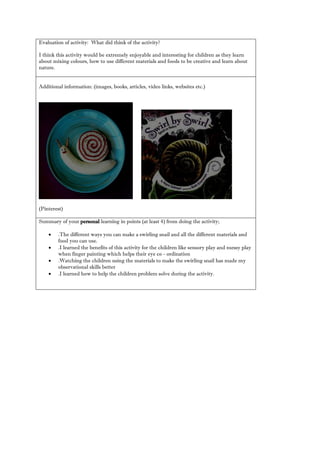
Additional information: (images, books, articles, video links, websites etc.) 
(Pinterest) 
Summary of your personal learning in points (at least 4) from doing the activity; 
 .The different ways you can make a swirling snail and all the materials food you can use. 
 .I learned the benefits of this activity for children like sensory play and messy when finger painting which helps their eye co - ordination 
 .Watching the children using materials to make swirling snail has made my observational skills better 
 .I learned how to help the children problem solve during activity.

Swirling Snail

  • 1.
    Approaches to Childhoodlearning – Class activity Record Sheet After every class Activity write into the record sheet. Add photos throughout record. 15 records min required for portfolio. Add lots of images to illustrate your understanding. Name____M M_____________________________________ Date: 12th November Week number: 10 Attended: Yes Name and image of the Activity Swirling Snail Materials used: • White paper plates • Yellow construction paper • Washable finger paint • Pipe cleaners • Googly eyes • Glue • Pencil Time plan: This activity took one hour to complete including clean up time. Room and/or equipment requirements: Scissors, desk and paint brush. General Aim of activity – What will the final outcome be? ie. ‘To make an aeroplane with cardboard’ box. To create a snail using material.
  • 2.
    Specific Learning outcomesof the activity – What will be learned by doing the activity? Ie. ‘To use fine motor skills using the scissors’ • How to trace shapes with a pencil • Learn about mixing colours • Use fine motor skills using scissors to cut around the snails body • Learn what materials to use for parts of the body. Example pipe cleaners ears Steps for making or doing activity: Use images with short captions Step 1: :Paint paper plat Step 2: Draw around snails body Step 3: Design paper plate with glitter
  • 3.
    My Swirling snail How will the child/ren benefit from activity? • They learn to be creative when making the snail • They get familiar with mixing colours as we used red and yellow to paint the snail. • They become dependent as they work on their own • They learn about tracing shapes Age group/s: (development level) This activity would be suitable for preschool children from the age of three as you are using paint which you would not want the child to put in his/her mouth and a scissors could be dangerous. How would you make the activity more inclusive? Principles of universal design I could have the shapes cut out and all material ready. could have pictures of each step to make it easier for deaf children. How would you adapt the activity to suit outside/inside? You could get the children to go for a walk and collect some snails, then bring out large table and make the snail use real as an example of how a should look. Simplify this activity: Use material from outside to decorate the snail .For example you could use leaves instead of paint to decorate the body and carrot sticks instead of pipe cleaners for ears. Variations for the activity: How could you vary activity? ‘Marbling using foam or egg whites instead’
  • 4.
    • Use cardboardinstead of paper plate • Make a snail out of banana and use other food products for eyes ears • Use chocolate spread instead of paint • Use tissue paper instead of paint to decorate the snail and any other material available The Learning outcomes linked to Aistear Exploring and thinking Identity and Belonging Well-being Communicating Aim 1;1,4 Aim 1:1,3 Aim 1:1,4,6 Aim 1:1,2,5,6 Aim2:1,6 Aim 2:1,4 Aim 2:3,1 Aim 2:1,3,4 Aim 3:4 Aim 3:2,3 Aim 3:1,5,2 Aim 3:1, Aim 4:1,3 Aim 4:1,2,4 Aim 4:1,2,5 Aim 4:1,2,4 Other curriculums: Montessori, HiScope..  Safety concerns? If any A child could cut herself using scissors. Also children need to be careful when paint and glue not to put their fingers in mouth. Could the activity link to an external activity/group/ outing? ‘Visit to a farm/forest see/do….’ You could bring the children on a nature walk where you show them snails and collect materials that are suitable to decorate the snails body. Extensions for the activity: Could science, geography, history, culture, literacy, maths etc, be incorporated into to the activity? How? What changes would you make? They learned about numeracy by counting the googly eyes and pipe cleaners how many to put on a snail. They learned literacy by naming the colours of pipe cleaners and paints and they learned about nature by taking part in the walk. Interactions with children: talk about…. Talk with your child about what they are doing. This will help them understand the physical and mental processes they are going through as well giving them the vocabulary to describe it. "Look at how paint splatters like that" • Look at how the two colours are mixing together • Can anyone tell me what colour is this • Does anyone know how the googly eyes are sticking and I have not used glue • Does anyone know what we will use the pipe cleaners for Problem solving element? Make your child aware of the problem solving involved and ask them questions as needed to help them work out problems themselves, eg. "Why isn't the paint coming now?", "Is the straw reaching paint when bottle is tipped like that?", How could you fix that?" • Where will we put the smile on snail • I’m mixing the two colours together. What will happen next • Does anyone know where we put the paper plate • Why is it not sticking. Can we fix this
  • 5.
    Evaluation of activity:What did think the activity? I think this activity would be extremely enjoyable and interesting for children as they learn about mixing colours, how to use different materials and foods be creative learn nature. Additional information: (images, books, articles, video links, websites etc.) (Pinterest) Summary of your personal learning in points (at least 4) from doing the activity;  .The different ways you can make a swirling snail and all the materials food you can use.  .I learned the benefits of this activity for children like sensory play and messy when finger painting which helps their eye co - ordination  .Watching the children using materials to make swirling snail has made my observational skills better  .I learned how to help the children problem solve during activity.