SHIFTING LEVELS
Different levels operating in groups
GROUPS OPERATE ON MANY
LEVELS
• As a facilitator you will operate between many levels
• Awareness of these levels is built up over time and experience
THE PHYSICAL LEVEL
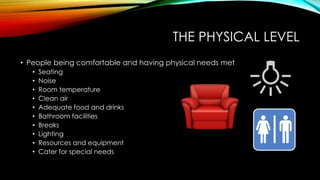
• People being comfortable and having physical needs met
• Seating
• Noise
• Room temperature
• Clean air
• Adequate food and drinks
• Bathroom facilities
• Breaks
• Lighting
• Resources and equipment
• Cater for special needs
THE THINKING LEVEL
• The sharing of ideas
• The exploration of issues
• Brainstorming
• Creative thinking
• Inspiration
• Analysis
• Critical thinking
• Phrases used – I think…I’ve noticed. I understand…My vision is…Can you
imagine…We need to consider
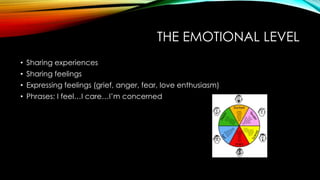
THE EMOTIONAL LEVEL
• Sharing experiences
• Sharing feelings
• Expressing feelings (grief, anger, fear, love enthusiasm)
• Phrases: I feel…I care…I’m concerned
THE INTUITIVE LEVEL
• Working from the intuitive part of the self
• Phrases: I sense that…There is something not quite right here…There is
something off here...We are onto something – I’ve almost got it
THE ENERGY LEVEL
• How awake the participants are
• Observing behaviour/posture/tone and animation of
voices/attentiveness/’vibes’.
• Develop awareness
THE SPIRITUAL LEVEL
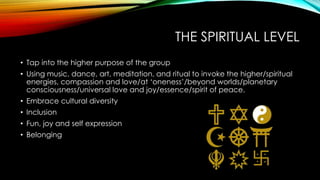
• Tap into the higher purpose of the group
• Using music, dance, art, meditation, and ritual to invoke the higher/spiritual
energies, compassion and love/at ‘oneness’/beyond worlds/planetary
consciousness/universal love and joy/essence/spirit of peace.
• Embrace cultural diversity
• Inclusion
• Fun, joy and self expression
• Belonging
THE SYNERGISTIC LEVEL
• Connectedness in the group
• True cohesiveness
• Group speaks as one voice
• Tuned into each other
• Non-judgemental
NOTICING THE LEVELS
• Listening
• Watching and making observations
• Sensing
WORKING WITH THE LEVELS
• Sharing observations with the group
• Modelling behaviour of the levels
• Inviting the group to share observations
•
REFERENCE
• Hunter, D. (2009) The art of facilitation : the essentials for leading great
meetings and creating group synergy. [Rev. ed.]. ed. San Francisco, Calif.:
Jossey-Bass ; Chichester : John Wiley [distributor]

Shifting levels in groups

  • 1.
  • 2.
    GROUPS OPERATE ONMANY LEVELS • As a facilitator you will operate between many levels • Awareness of these levels is built up over time and experience
  • 3.
    THE PHYSICAL LEVEL •People being comfortable and having physical needs met • Seating • Noise • Room temperature • Clean air • Adequate food and drinks • Bathroom facilities • Breaks • Lighting • Resources and equipment • Cater for special needs
  • 4.
    THE THINKING LEVEL •The sharing of ideas • The exploration of issues • Brainstorming • Creative thinking • Inspiration • Analysis • Critical thinking • Phrases used – I think…I’ve noticed. I understand…My vision is…Can you imagine…We need to consider
  • 5.
    THE EMOTIONAL LEVEL •Sharing experiences • Sharing feelings • Expressing feelings (grief, anger, fear, love enthusiasm) • Phrases: I feel…I care…I’m concerned
  • 6.
    THE INTUITIVE LEVEL •Working from the intuitive part of the self • Phrases: I sense that…There is something not quite right here…There is something off here...We are onto something – I’ve almost got it
  • 7.
    THE ENERGY LEVEL •How awake the participants are • Observing behaviour/posture/tone and animation of voices/attentiveness/’vibes’. • Develop awareness
  • 8.
    THE SPIRITUAL LEVEL •Tap into the higher purpose of the group • Using music, dance, art, meditation, and ritual to invoke the higher/spiritual energies, compassion and love/at ‘oneness’/beyond worlds/planetary consciousness/universal love and joy/essence/spirit of peace. • Embrace cultural diversity • Inclusion • Fun, joy and self expression • Belonging
  • 9.
    THE SYNERGISTIC LEVEL •Connectedness in the group • True cohesiveness • Group speaks as one voice • Tuned into each other • Non-judgemental
  • 10.
    NOTICING THE LEVELS •Listening • Watching and making observations • Sensing
  • 11.
    WORKING WITH THELEVELS • Sharing observations with the group • Modelling behaviour of the levels • Inviting the group to share observations •
  • 12.
    REFERENCE • Hunter, D.(2009) The art of facilitation : the essentials for leading great meetings and creating group synergy. [Rev. ed.]. ed. San Francisco, Calif.: Jossey-Bass ; Chichester : John Wiley [distributor]