Training Effective EFL Tutors
Practical Techniques for
Teaching English as a
Foreign Language (EFL):
Lessons Learned from ESL
CARLOS F. CAMARGO, PhD
Superintendent & Executive Director
INSTITUTE OF COMPUTER TECHNOLOGY (ICT)
&
Research Fellow
OHANA FOUNDATION FOR TECHNICAL DEVELOPMENT, INC.
• Introduction
• Getting to Know the EFL Student
• Vocabulary Development
• Conversation Skills
• Pronunciation
Getting to Know the EFL Student
Training Effective EFL Tutors
Introduction
• Tutors will understand the principles of second language
acquisition and the implications for teaching.
Getting to Know the EFL Student
Training Effective EFL Tutors
Overhead 1: EFL - Mastering the Subject Matter
The
Purpose
o f
Language
Is
Communication!
Getting to Know the EFL Student
Training Effective EFL Tutors
Overhead 2: EFL - Mastering the Subject Matter
PRIMARY SECONDARY
SYSTEM SYSTEM
Getting to Know the EFL Student
Training Effective EFL Tutors
Overhead 3: EFL - Mastering the Subject Matter
Principles of Second Language Acquisition
1. The second language learner is concerned with communication, not
correctness.
2. There is a natural series of language development stages that the second
language learner must and will follow.
3. A person learns a language better if he feels a low level of anxiety and a
high level of success.
4. There is often a feeling of social and psychological distance between the
language learner and the people who speak the "target"-language.
Getting to Know the EFL Student
Training Effective EFL Tutors
Overhead 4: EFL - Mastering the Subject Matter
Implications for Teaching
Teachers and tutors need to:
1. Ensure carry over between what is being taught and the student's
everyday communication needs.
2. Provide for learning in a context of meaning for the student, anchoring
what is learned to real life situations.
3. Provide a relaxed atmosphere in which it is safe to make mistakes and
practice.
4. Work toward the goal of communicating at whatever level—and reward
sincere effort.
5. Involve the student's goals in learning a language and build lessons around
meeting those goals encouraging involvement and motivation.
Getting to Know the EFL Student
Training Effective EFL Tutors
Handout 1: EFL - Mastering the Subject Matter
G l o s s a r y
acquisition: (in reference to language) an unconscious process of gaining language as I opposed
to language learning which is a conscious process
comprehend: to understand thoroughly
consonant: a speech sound produced by obstructing the flow of air from the lungs
context: the circumstances which surround an event or occurrence I curriculum: a course of
study
grammar: the study of the formal features of a language such as the way words are I used in
sentences
idiom: an expression whose meaning cannot be derived from its individual parts or I words
language experience approach: the use of text generated by the student and written down
by the teacher or tutor
minimal pair: two words which have only one sound difference between them I (example:
bit/bat)
phonics: an approach to the teaching of reading that stresses correspondence between I speech
sounds and the letters that represent the sounds
preliterate: (of a culture) not having written records
pronunciation: the sound or sounds of words in a language
sight word: a word which is recognized as a whole without sounding out the parts
stress: the relative loudness in pronunciation of a part of a word or phrase
survival skills: the skills needed to function in everyday life
syllable: a unit of speech consisting of a single pulse of breath and forming a word or a part
of a word
vocabulary: the words of a language
vowel: a speech sound produced without obstructing the flow of air from the lungs, represented
in English by the letters a, e, i, o, u
Getting to Know the EFL Student
Training Effective EFL Tutors
Getting To Know
The EFL Student
• Tutors will gain an awareness of what the EFL student brings
to the learning setting.
• Tutors will learn how to assess the learner’s needs.
Getting to Know the EFL Student
Training Effective EFL Tutors
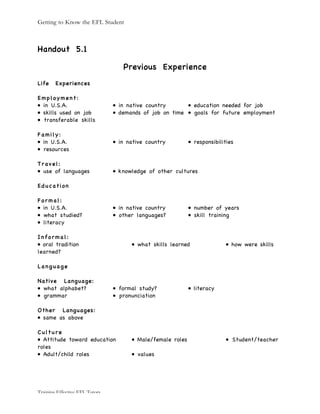
Handout 5.1
Previous Experience
Life Experiences
Employment:
• in U.S.A. • in native country • education needed for job
• skills used on job • demands of job on time • goals for future employment
• transferable skills
Family:
• in U.S.A. • in native country • responsibilities
• resources
Travel:
• use of languages • knowledge of other cultures
Education
Formal:
• in U.S.A. • in native country • number of years
• what studied? • other languages? • skill training
• literacy
Informal:
• oral tradition • what skills learned • how were skills
learned?
Language
Native Language:
• what alphabet? • formal study? • literacy
• grammar • pronunciation
Other Languages:
• same as above
Culture
• Attitude toward education • Male/female roles • Student/teacher
roles
• Adult/child roles • values
Getting to Know the EFL Student
Training Effective EFL Tutors
Where Can You Get Information about Your Student’s Language
and Culture?
• the student him/herself • family members • the library
• National Geographic • Encyclopedia
• Center for Applied Linguistic, P.O. Box 37422, Washington, D.C. 20013
• U.S. Dept. of Education: Refugee Materials Center, 324 E. 11th Street, 9th
floor, Kansas City
Missouri 64106
Getting to Know the EFL Student
Training Effective EFL Tutors
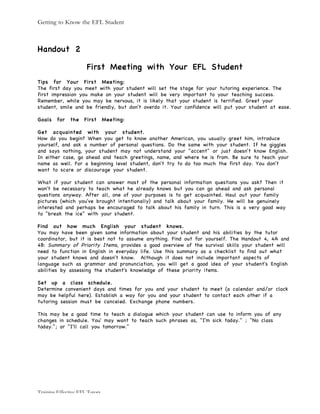
Handout 2
First Meeting with Your EFL Student
Tips for Your First Meeting:
The first day you meet with your student will set the stage for your tutoring experience. The
first impression you make on your student will be very important to your teaching success.
Remember, while you may be nervous, it is likely that your student is terrified. Greet your
student, smile and be friendly, but don't overdo it. Your confidence will put your student at ease.
Goals for the First Meeting:
Get acquainted with your student.
How do you begin? When you get to know another American, you usually greet him, introduce
yourself, and ask a number of personal questions. Do the same with your student. If he giggles
and says nothing, your student may not understand your "accent" or just doesn't know English.
In either case, go ahead and teach greetings, name, and where he is from. Be sure to teach your
name as well. For a beginning level student, don't try to do too much the first day. You don't
want to scare or discourage your student.
What if your student can answer most of the personal information questions you ask? Then it
won't be necessary to teach what he already knows but you can go ahead and ask personal
questions anyway. After all, one of your purposes is to get acquainted. Haul out your family
pictures (which you've brought intentionally) and talk about your family. He will be genuinely
interested and perhaps be encouraged to talk about his family in turn. This is a very good way
to "break the ice" with your student.
Find out how much English your student knows.
You may have been given some information about your student and his abilities by the tutor
coordinator, but it is best not to assume anything. Find out for yourself. The Handout 4, 4A and
4B: Summary of Priority Items, provides a good overview of the survival skills your student will
need to function in English in everyday life. Use this summary as a checklist to find out what
your student knows and doesn't know. Although it does not include important aspects of
language such as grammar and pronunciation, you will get a good idea of your student's English
abilities by assessing the student's knowledge of these priority items.
Set up a class schedule.
Determine convenient days and times for you and your student to meet (a calendar and/or clock
may be helpful here). Establish a way for you and your student to contact each other if a
tutoring session must be canceled. Exchange phone numbers.
This may be a good time to teach a dialogue which your student can use to inform you of any
changes in schedule. You' may want to teach such phrases as, "I'm sick today." ; "No class
today."; or "I'll call you tomorrow."
Getting to Know the EFL Student
Training Effective EFL Tutors
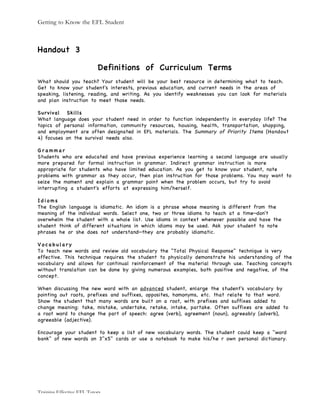
Handout 3
Definitions of Curriculum Terms
What should you teach? Your student will be your best resource in determining what to teach.
Get to know your student's interests, previous education, and current needs in the areas of
speaking, listening, reading, and writing. As you identify weaknesses you can look for materials
and plan instruction to meet those needs.
Survival Skills
What language does your student need in order to function independently in everyday life? The
topics of personal information, community resources, housing, health, transportation, shopping,
and employment are often designated in EFL materials. The Summary of Priority Items (Handout
4) focuses on the survival needs also.
G r a m m a r
Students who are educated and have previous experience learning a second language are usually
more prepared for formal instruction in grammar. Indirect grammar instruction is more
appropriate for students who have limited education. As you get to know your student, note
problems with grammar as they occur, then plan instruction for those problems. You may want to
seize the moment and explain a grammar point when the problem occurs, but try to avoid
interrupting a student's efforts at expressing him/herself.
I d i o m s
The English language is idiomatic. An idiom is a phrase whose meaning is different from the
meaning of the individual words. Select one, two or three idioms to teach at a time—don't
overwhelm the student with a whole list. Use idioms in context whenever possible and have the
student think of different situations in which idioms may be used. Ask your student to note
phrases he or she does not understand—they are probably idiomatic.
V o c a b u l a r y
To teach new words and review old vocabulary the "Total Physical Response" technique is very
effective. This technique requires the student to physically demonstrate his understanding of the
vocabulary and allows for continual reinforcement of the material through use. Teaching concepts
without translation can be done by giving numerous examples, both positive and negative, of the
concept.
When discussing the new word with an advanced student, enlarge the student's vocabulary by
pointing out roots, prefixes and suffixes, opposites, homonyms, etc. that relate to that word.
Show the student that many words are built on a root, with prefixes and suffixes added to
change meaning: take, mistake, undertake, retake, intake, partake. Often suffixes are added to
a root word to change the part of speech: agree (verb), agreement (noun), agreeably (adverb),
agreeable (adjective).
Encourage your student to keep a list of new vocabulary words. The student could keep a "word
bank" of new words on 3"x5" cards or use a notebook to make his/he r own personal dictionary.
Getting to Know the EFL Student
Training Effective EFL Tutors
Handout 3A
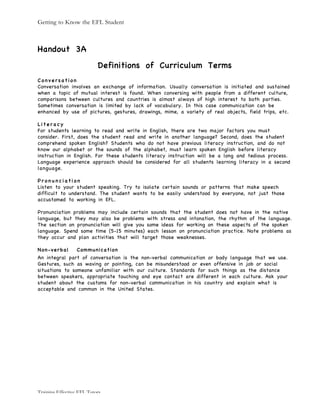
Definitions of Curriculum Terms
C o n v e r s a t i o n
Conversation involves an exchange of information. Usually conversation is initiated and sustained
when a topic of mutual interest is found. When conversing with people from a different culture,
comparisons between cultures and countries is almost always of high interest to both parties.
Sometimes conversation is limited by lack of vocabulary. In this case communication can be
enhanced by use of pictures, gestures, drawings, mime, a variety of real objects, field trips, etc.
L i t e r a c y
For students learning to read and write in English, there are two major factors you must
consider. First, does the student read and write in another language? Second, does the student
comprehend spoken English? Students who do not have previous literacy instruction, and do not
know our alphabet or the sounds of the alphabet, must learn spoken English before literacy
instruction in English. For these students literacy instruction will be a long and tedious process.
Language experience approach should be considered for all students learning literacy in a second
language.
P r o n u n c i a t i o n
Listen to your student speaking. Try to isolate certain sounds or patterns that make speech
difficult to understand. The student wants to be easily understood by everyone, not just those
accustomed to working in EFL.
Pronunciation problems may include certain sounds that the student does not have in the native
language, but they may also be problems with stress and intonation, the rhythm of the language.
The section on pronunciation will give you some ideas for working on these aspects of the spoken
language. Spend some time (5-15 minutes) each lesson on pronunciation practice. Note problems as
they occur and plan activities that will target those weaknesses.
Non-verbal Communication
An integral part of conversation is the non-verbal communication or body language that we use.
Gestures, such as waving or pointing, can be misunderstood or even offensive in job or social
situations to someone unfamiliar with our culture. Standards for such things as the distance
between speakers, appropriate touching and eye contact are different in each culture. Ask your
student about the customs for non-verbal communication in his country and explain what is
acceptable and common in the United States.
Getting to Know the EFL Student
Training Effective EFL Tutors
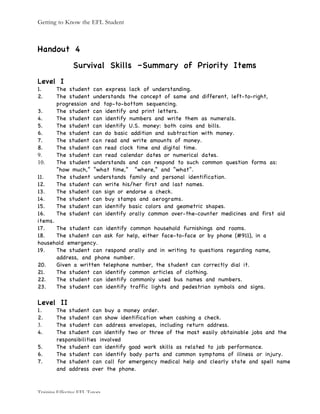
Handout 4
Survival Skills –Summary of Priority Items
Level I
1. The student can express lack of understanding.
2. The student understands the concept of same and different, left-to-right,
progression and top-to-bottom sequencing.
3. The student can identify and print letters.
4. The student can identify numbers and write them as numerals.
5. The student can identify U.S. money: both coins and bills.
6. The student can do basic addition and subtraction with money.
7. The student can read and write amounts of money.
8. The student can read clock time and digital time.
9. The student can read calendar dates or numerical dates.
10. The student understands and can respond to such common question forms as:
“how much,” “what time,” “where,” and “what”.
11. The student understands family and personal identification.
12. The student can write his/her first and last names.
13. The student can sign or endorse a check.
14. The student can buy stamps and aerograms.
15. The student can identify basic colors and geometric shapes.
16. The student can identify orally common over-the-counter medicines and first aid
items.
17. The student can identify common household furnishings and rooms.
18. The student can ask for help, either face-to-face or by phone (#911), in a
household emergency.
19. The student can respond orally and in writing to questions regarding name,
address, and phone number.
20. Given a written telephone number, the student can correctly dial it.
21. The student can identify common articles of clothing.
22. The student can identify commonly used bus names and numbers.
23. The student can identify traffic lights and pedestrian symbols and signs.
Level II
1. The student can buy a money order.
2. The student can show identification when cashing a check.
3. The student can address envelopes, including return address.
4. The student can identify two or three of the most easily obtainable jobs and the
responsibilities involved
5. The student can identify good work skills as related to job performance.
6. The student can identify body parts and common symptoms of illness or injury.
7. The student can call for emergency medical help and clearly state and spell name
and address over the phone.
Getting to Know the EFL Student
Training Effective EFL Tutors
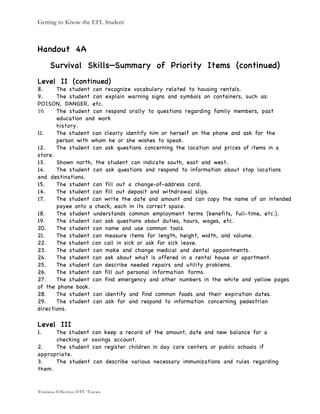
Handout 4A
Survival Skills—Summary of Priority Items (continued)
Level II (continued)
8. The student can recognize vocabulary related to housing rentals.
9. The student can explain warning signs and symbols on containers, such as:
POISON, DANGER, etc.
10. The student can respond orally to questions regarding family members, past
education and work
history.
11. The student can clearly identify him or herself on the phone and ask for the
person with whom he or she wishes to speak.
12. The student can ask questions concerning the location and prices of items in a
store.
13. Shown north, the student can indicate south, east and west.
14. The student can ask questions and respond to information about stop locations
and destinations.
15. The student can fill out a change-of-address card.
16. The student can fill out deposit and withdrawal slips.
17. The student can write the date and amount and can copy the name of an intended
payee onto a check, each in its correct space.
18. The student understands common employment terms (benefits, full-time, etc.).
19. The student can ask questions about duties, hours, wages, etc.
20. The student can name and use common tools.
21. The student can measure items for length, height, width, and volume.
22. The student can call in sick or ask for sick leave.
23. The student can make and change medical and dental appointments.
24. The student can ask about what is offered in a rental house or apartment.
25. The student can describe needed repairs and utility problems.
26. The student can fill out personal information forms.
27. The student can find emergency and other numbers in the white and yellow pages
of the phone book.
28. The student can identify and find common foods and their expiration dates.
29. The student can ask for and respond to information concerning pedestrian
directions.
Level III
1. The student can keep a record of the amount, date and new balance for a
checking or savings account.
2. The student can register children in day care centers or public schools if
appropriate.
3. The student can describe various necessary immunizations and rules regarding
them.
Getting to Know the EFL Student
Training Effective EFL Tutors
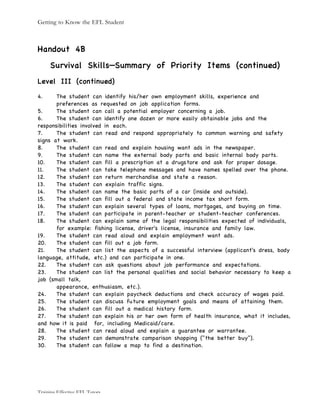
Handout 4B
Survival Skills—Summary of Priority Items (continued)
Level III (continued)
4. The student can identify his/her own employment skills, experience and
preferences as requested on job application forms.
5. The student can call a potential employer concerning a job.
6. The student can identify one dozen or more easily obtainable jobs and the
responsibilities involved in each.
7. The student can read and respond appropriately to common warning and safety
signs at work.
8. The student can read and explain housing want ads in the newspaper.
9. The student can name the external body parts and basic internal body parts.
10. The student can fill a prescription at a drugstore and ask for proper dosage.
11. The student can take telephone messages and have names spelled over the phone.
12. The student can return merchandise and state a reason.
13. The student can explain traffic signs.
14. The student can name the basic parts of a car (inside and outside).
15. The student can fill out a federal and state income tax short form.
16. The student can explain several types of loans, mortgages, and buying on time.
17. The student can participate in parent-teacher or student-teacher conferences.
18. The student can explain some of the legal responsibilities expected of individuals,
for example: fishing license, driver's license, insurance and family law.
19. The student can read aloud and explain employment want ads.
20. The student can fill out a job form.
21. The student can list the aspects of a successful interview (applicant's dress, body
language, attitude, etc.) and can participate in one.
22. The student can ask questions about job performance and expectations.
23. The student can list the personal qualities and social behavior necessary to keep a
job (small talk,
appearance, enthusiasm, etc.).
24. The student can explain paycheck deductions and check accuracy of wages paid.
25. The student can discuss future employment goals and means of attaining them.
26. The student can fill out a medical history form.
27. The student can explain his or her own form of health insurance, what it includes,
and how it is paid for, including Medicaid/care.
28. The student can read aloud and explain a guarantee or warrantee.
29. The student can demonstrate comparison shopping ("the better buy").
30. The student can follow a map to find a destination.
Getting to Know the EFL Student
Training Effective EFL Tutors
Handout 5
Suggested Level 1 Questions for Your First Meeting
Don't just ask a series of questions, share information about yourself as you ask these
questions.
How are you?
What's your name?
What’s your last name?
Please spell your name.
How old are you?
Where are you from?
Did you work in _________?
What did you do there?
Do you have any children?
How many children do you have?
How old are they?
Where do you live?
Show me your I.D. card.
For these questions you will need to have coins, a check, a calendar, a list of numbers, the
alphabet and pencil and paper.
Show me a nickel.
Where is 25 cents?
Please give me 42 cents.
How much is this? (Give the student 44 cents).
Give me a quarter. What is this? (Show the student a check).
What is a check used for?
What time is it? (Show the student 7:00 on the clock).
Show me 8:30. (Have student turn the hands of the clock).
What time do you get up in the morning?
Show me on the clock what time you get up.
When is your birthday?
Show me your birthday on the calendar.
Show me Friday, Monday, January, etc.
Show me the number 1, 5, 12, etc.
Show me the letter A, C, F, etc.
Write the number 7, 32, etc.
Write the letter B, G, K, etc.
Use concrete objects around you to assess the student's general knowledge of vocabulary. If your
student doesn't know these items, you've got your work cut out for you.
Vocabulary Development
Training Effective EFL Tutors
18
Vocabulary
Development
• Tutor will become familiar with Total Physical Response (TPR)
as a method of language instruction.
• Tutors will become familiar with vocabulary building techniques
through TPR actions.
• Tutors will develop a TPR lesson using an activity in sequence
and learn how to follow up a TPR lesson.
Vocabulary Development
Training Effective EFL Tutors
19
Handout 5.1
Total Physical Response -- TSR
Total Physical Response is a widely accepted and popular approach to beginning
language instruction. It is based on observations of how children acquire their first
language which is characterized by a period of listening only, followed by a period of
physical responses to the language before speaking occurs. Frequently the physical
responses are to commands, the imperative form of language, such as "Come to Mommy",
"Give me the ball", etc. Therefore, in the beginning stages the TPR method requires the
student only to watch and listen, then only to respond through physical actions. The
student's physical action demonstrates the student's comprehension. In this way the
tutor always knows if the student is "with" him/her.
In the beginning stages TPR is only a listening and doing activity, not a speaking
activity. After only a short time students will be able to reverse the role of uttering
commands in spontaneous and comprehensible manner and the teacher becomes the
follower of directions given by the student.
The basic principles are:
1. Listening comprehension precedes speaking ability (i.e. speaking with
understanding, not just
"parroting").
2. A physical response reinforces learning; physical involvement promotes memory.
3. Three is the ideal number of new items to introduce—2 items not being enough for
discrimination, more than 3 is too many.
4. Command forms of the verb should be introduced first to eliminate the confusion
of person and tense variations.
5. Infinite repetition is not necessary. If a student doesn't learn in a few trials,
drop it and try again at a later time.
The sequence of introducing a new item is:
1. Tutor says command and demonstrates action while students observe.
2. Tutor gives command, teacher and students act.
3. Tutor gives command, students act.
The objective is:
1. Exchanging roles, student gives command, tutor acts.
Vocabulary Development
Training Effective EFL Tutors
20
Handout 5.1A
Total Physical Response -- TPR
TPR is an easy method to use. Here are some points to remember:
1. First, decide on a focus you want to work on (i.e. an activity from life at
home, a school activity, a work related activity, etc.).
2. Gather in advance any props or visuals you'll need.
3. Be sure you have your student's full attention. Remember that TPR is
primarily a listening
activity.
4. Demonstrate as you utter the command before you can expect an
appropriate response.
5. Continually review and integrate material you have used in previous
sessions.
6. For lower level students, keep the commands simple and short. For higher
level students,
commands can become more complex and require more actions.
7. Keep the pace moving. Watch the student closely. If he/she becomes
confused, demonstrate again as you speak.
8. Keep the tone light and be sure that everyone involved is having a good
time.
Vocabulary Development
Training Effective EFL Tutors
21
Overhead 1
Washing Your Hands
[image series: washing hands]
ACTION ENGLISH PICTURES. Alemany Press, Inc., Hayward, CA 1985
Permission granted to reproduce for classroom use.
Vocabulary Development
Training Effective EFL Tutors
22
Overhead 2
Individual Pictures
[individual pictures- washing hands]
Vocabulary Development
Training Effective EFL Tutors
23
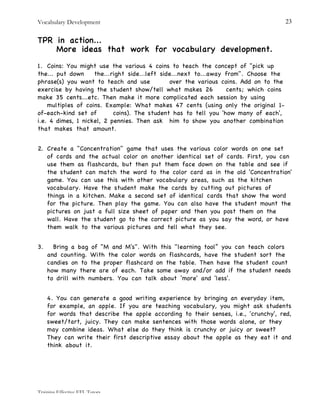
TPR in action...
More ideas that work for vocabulary development.
1. Coins: You might use the various 4 coins to teach the concept of "pick up
the... put down the...right side...left side...next to...away from". Choose the
phrase(s) you want to teach and use over the various coins. Add on to the
exercise by having the student show/tell what makes 26 cents; which coins
make 35 cents...etc. Then make it more complicated each session by using
multiples of coins. Example: What makes 47 cents (using only the original 1-
of-each-kind set of coins). The student has to tell you 'how many of each',
i.e. 4 dimes, 1 nickel, 2 pennies. Then ask him to show you another combination
that makes that amount.
2. Create a "Concentration" game that uses the various color words on one set
of cards and the actual color on another identical set of cards. First, you can
use them as flashcards, but then put them face down on the table and see if
the student can match the word to the color card as in the old 'Concentration'
game. You can use this with other vocabulary areas, such as the kitchen
vocabulary. Have the student make the cards by cutting out pictures of
things in a kitchen. Make a second set of identical cards that show the word
for the picture. Then play the game. You can also have the student mount the
pictures on just a full size sheet of paper and then you post them on the
wall. Have the student go to the correct picture as you say the word, or have
them walk to the various pictures and tell what they see.
3. Bring a bag of "M and M's". With this "learning tool” you can teach colors
and counting. With the color words on flashcards, have the student sort the
candies on to the proper flashcard on the table. Then have the student count
how many there are of each. Take some away and/or add if the student needs
to drill with numbers. You can talk about ‘more' and 'less'.
4. You can generate a good writing experience by bringing an everyday item,
for example, an apple. If you are teaching vocabulary, you might ask students
for words that describe the apple according to their senses, i.e., 'crunchy', red,
sweet/tart, juicy. They can make sentences with those words alone, or they
may combine ideas. What else do they think is crunchy or juicy or sweet?
They can write their first descriptive essay about the apple as they eat it and
think about it.
Conversation Skills
Training Effective EFL Tutors
24
Conversation
Skills
• Tutors will practice techniques for developing listening skills in
themselves and in their students.
• Tutors will practice effective questioning techniques for
development of conversation.
• Tutors will review information on aspects of conversation
management.
Conversation Skills
Training Effective EFL Tutors
25
Handout 1
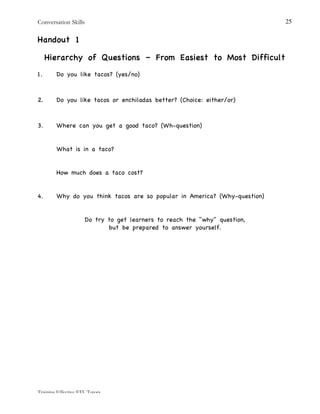
Hierarchy of Questions – From Easiest to Most Difficult
1. Do you like tacos? (yes/no)
2. Do you like tacos or enchiladas better? (Choice: either/or)
3. Where can you get a good taco? (Wh-question)
What is in a taco?
How much does a taco cost?
4. Why do you think tacos are so popular in America? (Why-question)
Do try to get learners to reach the "why" question,
but be prepared to answer yourself.
Conversation Skills
Training Effective EFL Tutors
26
Overhead 1
Riding on the Bus
[image: riding on the bus]
Conversation Skills
Training Effective EFL Tutors
27
Handout 2
“Freire” Discussion Technique
Part One
[image - riding on the bus]
Content
Where are these people?
Who are they?
What are they doing?
What is happening in the picture?
What time is it?
Feeling Questions
How does the old lady feel? Why?
How does the man carrying groceries feel? Why?
How does the bus driver feel? Why?
How does the man getting elbowed feel? Why?
Relate to Personal Experiences
Have you ever ridden a bus? Where? What happened?
Did you carry your groceries on the bus?
Has anyone ever bumped into you on the bus? What happened?
Conversation Skills
Training Effective EFL Tutors
28
Handout 2A
“Friere” Discussion Technique
Part One (continued)
Larger Perspective: Global/Societal
Why do people take the bus?
Why are buses crowded?
Who rides the bus?
Why?
What are other means of transportation?
Solutions
What can be done to relieve overcrowding on the bus?
How can we meet the transportation needs of elderly and handicapped people?
How can our transportation system be improved?
Conversation Skills
Training Effective EFL Tutors
29
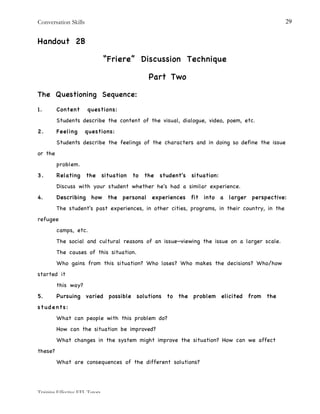
Handout 2B
“Friere” Discussion Technique
Part Two
The Questioning Sequence:
1. Content questions:
Students describe the content of the visual, dialogue, video, poem, etc.
2. Feeling questions:
Students describe the feelings of the characters and in doing so define the issue
or the
problem.
3. Relating the situation to the student's situation:
Discuss with your student whether he's had a similar experience.
4. Describing how the personal experiences fit into a larger perspective:
The student's past experiences, in other cities, programs, in their country, in the
refugee
camps, etc.
The social and cultural reasons of an issue—viewing the issue on a larger scale.
The causes of this situation.
Who gains from this situation? Who loses? Who makes the decisions? Who/how
started it
this way?
5. Pursuing varied possible solutions to the problem elicited from the
students:
What can people with this problem do?
How can the situation be improved?
What changes in the system might improve the situation? How can we affect
these?
What are consequences of the different solutions?
Conversation Skills
Training Effective EFL Tutors
30
Handout 3
Tips for Talking with EFL Students
Don’t Focus on the Language
Instead, focus on the meaning of what is being said. If communication is your goal, have
activities planned that get your student talking about something that is important to
her/him.
Anything That Helps Communication "Goes"
Pictures, games, field trips, food...this is your chance to be creative.
Don’t Worry About Errors
Focus on communicating—not error-free speech.
Laugh a Lot!!
Humor eases a tense situation and makes language learning much more fun.
Try To Be Quiet. Wait At Least 5 Seconds After Asking a
Question.
This is tough because in our culture we are uncomfortable with silence. Don't do all the
talking.
Teach Your Student To Ask Questions
Let the student control the conversation.
Don/t Speak More Loudly
Try to speak more distinctly and slowly.
Try Rephrasing
If a student doesn't seem to understand, rephrase and repeat.
Ask Students What They Have Understood
Use what was understood as a base for rephrasing what was not understood.
Don’t Be Afraid To Tell Students You Don’t Understand
Tell what you have understood and where you got lost. Ask clarification questions.
Go From Known To Unknown/Simple To Complex
Focus on Interests the Student Has
Students are encouraged when you take an interest in their country and culture.
Cultural comparisons are fascinating and instructional.
Conversation Skills
Training Effective EFL Tutors
31
Handout 4
Selection of Visual Aids
1. Pictures
• Look for photographic quality, color, and good size
• Look for pictures which show people in a variety of circumstances
• Look for pictures that tell a story—the answers to questions WHO, WHAT,
WHEN, WHERE, HOW should be obvious in the picture.
2. Photographs
• Look for good quality, color, good size, people and a story.
3. Newspaper Articles
• Look for illustrations such as photos, graphs, charts, etc. which accompany
articles or tell a story by themselves.
4. M a p s
• Look for the maps of the world, the U.S., Oregon, your community and your
student's country. Maps are best in color and of good size.
5. C a r t o o n s
• Look for quality of image, color, and size. Most important is to avoid racist,
sexist stereotypes often found in cartoons. Also avoid idiomatic expressions
unless you are teaching idioms.
6. Children's Books
• Look for classic stories with high quality pictures.
Where To Find Visual Aids
1. Magazines
• National Geographic, Life, Refugees, etc. Look at second hand stores, ask
friends, go to the library.
2. Newspapers
• USA Today has good graphics.
3. Photographs
• Your own, your student's photos
4. C a r t o o n s
• Newspapers, cartoon books, magazines
5. Children's Books
• Your children, your friend's children, library
Conversation Skills
Training Effective EFL Tutors
32
Handout 4A
Activities Which Promote Communication
1. Games
• Card games – Teach American games like “Old Maid,” “Gin Rummy” or
“Cribbage.” Have your student teach you a card game.
• Bingo – Make up bingo game with different vocabulary, draw a grid on
paper for the game.
• Simon Says – Give students instructions (i.e., “Touch your toes.”) and
when student responds correctly, comprehension is ensured. Reverse
roles.
• Password, Scrabble, Backgammon, Pictionary
2. Guided Imagery
• You lead the imagery, which can be as simple or difficult as your
student can handle. After imaging, both of you can draw a picture of
what you envisioned and talk about it.
3. Field Trips
• Take your student to the library, museums, downtown, grocery store,
hardware store, pet shop, zoo, concert, gardens, etc.
4. Sorting
• Give your student objects or pictures of objects which they must sort
into categories. Talk about the categories and how they were selected.
5. Box of Stuff
• Bring a box of everyday or culturally interesting items. Student selects
item and must describe it or talk about it for one minute or make 3 to
5 sentences about the object chosen. Someone describes an object and the
other person has to pick it up based on the description. Have students
bring object box.
Conversation Skills
Training Effective EFL Tutors
33
Questioning Strategy Design
Eliciting Questions Thinking Category
Common
Experience
Experience Get student and good
audiovisual aid face to face
or
Get student and reference
face to face
Inductive
Questions
Discuss
What...?
What happened?
What do you know about?
What did you see?
How did it make you feel?
Why do you think...?
What conclusions can you
draw...?
What does it mean?
Apply
If... then...?
Suppose that...
Recall
Affective
Identification
Drawing Inferences
About Relationships
M a k i n g
Generalizations
(Conceptualizations)
Application
Deductive
Questions
Evaluate
Did it work?
How successful was...?
Were the results as
predicted?
Evaluation
(Application of criteria of
validity and quality to
products or processes)
Conversation Skills
Training Effective EFL Tutors
34
Talk Time
Objectives
Talk time provides a special language learning activity not often practiced in the
classroom setting. It is a "student-centered" activity. In the Talk Time setting no one
assumes the "teacher" role. Instead, the emphasis is on friendship roles where
knowledge, cultural information and opinions can be shared on a basis of social equals.
Talk Time provides a non-critical, low risk, supportive environment for limited English
language speakers to:
• practice the English language skills they have learned
• exchange cultural information and experience
• gain an awareness of their immediate community
Talk Time offers volunteers the opportunity to:
• support a non-native speaker's use of the English language in a social setting
• exchange information and experiences with people of other cultures
• help newcomers connect with the community
• help newcomers feel more comfortable around Americans
• meet other Americans with similar interests
Each language learner will have limits as to how effectively he or she can express ideas.
The objective of Talk Time is to generate as much conversation as the newcomer can
manage using the English s/he has already acquired. Further communication is achieved
by pictures, gestures, drawings, mime, smiles and great intuitive leaps!
F o r m a t
The format shouldn't limit the learners' efforts to communicate or make the volunteers
feel they are responsible for their partners' learning process. Rather, it is designed to
foster free flowing conversation.
Theme: To provide a starting point and support to keep the talk coming, the coordinator
chooses a theme and provides related materials and activities. Group identity is
developed gradually. Supplying a comfortable structure for both limited English
speakers and volunteers and providing a sense of purpose help assure the continuing
existence of the Talk Time program.
Check for Comprehension: Don't ask, "Do you understand?" Provide a means for
your student to demonstrate understanding. For example, to check if your student
understands the meaning of "tall", you can use a picture with people of varying heights
and ask “Is she tall?” “Is he tall?”, etc. If your student answers correctly, she
understands the vocabulary.
Conversation Skills
Training Effective EFL Tutors
35
Tips for Talk Time
Here are some considerations for talk-time tutors to make:
1. Always start with introductions and greetings. (“How are you today?”, “My
name is _________.”, etc.)
2. Never assume your students will be able to understand everything you say.
3. Encourage your students to do 50% or more of the talking. Do so by asking
them simple and
leading questions about themselves. Don't be uncomfortable with silent
pauses (they happen in all social situations). Encourage students to ask you
questions.
4. Focus conversation on material at hand or else on topics that have arisen in
context within your group.
5. Ask questions often which will enable you to determine if your students are
"with you." These comprehension check questions can be yes/no questions
(Are you married? You're married, right?) or short answer questions (Are
you married, single, or widowed?) Avoid asking "Do you understand?"
because students tend to answer "Yes" even if they don't understand.
6. Don't teach. However, do be aware of your speech and limit use of
unfamiliar words and abstract concepts (ones that aren't easily
demonstrated). lf students don't seem to be following you, repeat and/or
rephrase your question or statement.
7. Be comfortable telling students about yourself – you’ll find they are
interested in knowing you.
Pronunciation
Training Effective EFL Tutors
36
Pronunciation
• Tutors will be introduced to pronunciation. They will identify
strategies to help students improve their pronunciation based
on specific problems the student has with individual sounds.
Pronunciation
Training Effective EFL Tutors
37
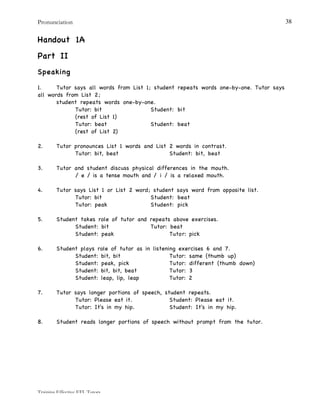
Handout 1
Part I
Listening
1. Make a list of words that differ by one sound.
List 1 List2
/¢i/ /e/
bit beat
Complete these lists with your own words.
2. Pronounce all the words in List 1.
3. Pronounce all the words in List 2.
4. Pronounce List 1 word, then List 2 word.
bit-beat
pick - peak
lip - leap
5. Tutor says a word, student tells what sound it is.
Tutor: bit Student: hold up one finger
Tutor: peak Student: hold up two fingers
6. Tutor says two words from the lists, student tells if they are the same or
different – thumb up or thumb down.
Tutor: bit, bit Student: thumb up
Tutor: pick, peak Student thumb down
7. Tutor says three words, two of which are the same, student tells which
word is different—1, 2, or 3.
Tutor: pick, pick, peak Student: 3
Tutor: bit, beat, bit Student: 2
Pronunciation
Training Effective EFL Tutors
38
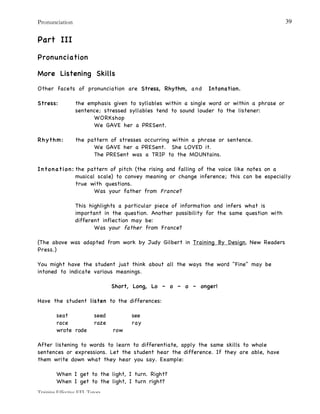
Handout 1A
Part II
Speaking
1. Tutor says all words from List 1; student repeats words one-by-one. Tutor says
all words from List 2;
student repeats words one-by-one.
Tutor: bit Student: bit
(rest of List 1)
Tutor: beat Student: beat
(rest of List 2)
2. Tutor pronounces List 1 words and List 2 words in contrast.
Tutor: bit, beat Student: bit, beat
3. Tutor and student discuss physical differences in the mouth.
/ e / is a tense mouth and / i / is a relaxed mouth.
4. Tutor says List 1 or List 2 word; student says word from opposite list.
Tutor: bit Student: beat
Tutor: peak Student: pick
5. Student takes role of tutor and repeats above exercises.
Student: bit Tutor: beat
Student: peak Tutor: pick
6. Student plays role of tutor as in listening exercises 6 and 7.
Student: bit, bit Tutor: same (thumb up)
Student: peak, pick Tutor: different (thumb down)
Student: bit, bit, beat Tutor: 3
Student: leap, lip, leap Tutor: 2
7. Tutor says longer portions of speech, student repeats.
Tutor: Please eat it. Student: Please eat it.
Tutor: It's in my hip. Student: It's in my hip.
8. Student reads longer portions of speech without prompt from the tutor.
Pronunciation
Training Effective EFL Tutors
39
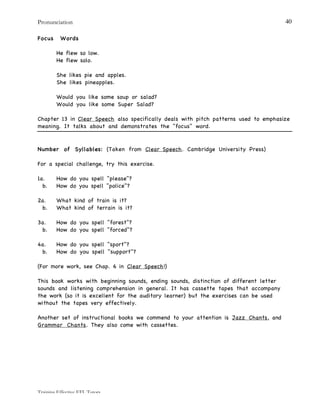
Part III
Pronunciation
More Listening Skills
Other facets of pronunciation are Stress, Rhythm, and Intonation.
Stress: the emphasis given to syllables within a single word or within a phrase or
sentence; stressed syllables tend to sound louder to the listener:
WORKshop
We GAVE her a PRESent.
Rhythm: the pattern of stresses occurring within a phrase or sentence.
We GAVE her a PRESent. She LOVED it.
The PRESent was a TRIP to the MOUNtains.
Intonation: the pattern of pitch (the rising and falling of the voice like notes on a
musical scale) to convey meaning or change inference; this can be especially
true with questions.
Was your father from France?
This highlights a particular piece of information and infers what is
important in the question. Another possibility for the same question with
different inflection may be:
Was your father from France?
(The above was adapted from work by Judy Gilbert in Training By Design, New Readers
Press.)
You might have the student just think about all the ways the word "Fine" may be
intoned to indicate various meanings.
Short, Long, Lo – o – o – onger!
Have the student listen to the differences:
seat seed see
race raze ray
wrote rode row
After listening to words to learn to differentiate, apply the same skills to whole
sentences or expressions. Let the student hear the difference. If they are able, have
them write down what they hear you say. Example:
When I get to the light, I turn. Right?
When I get to the light, I turn right?
Pronunciation
Training Effective EFL Tutors
40
Focus Words
He flew so low.
He flew solo.
She likes pie and apples.
She likes pineapples.
Would you like some soup or salad?
Would you like some Super Salad?
Chapter 13 in Clear Speech also specifically deals with pitch patterns used to emphasize
meaning. It talks about and demonstrates the "focus" word.
Number of Syllables: (Taken from Clear Speech. Cambridge University Press)
For a special challenge, try this exercise.
1a. How do you spell "please"?
b. How do you spell "police"?
2a. What kind of train is it?
b. What kind of terrain is it?
3a. How do you spell "forest"?
b. How do you spell "forced"?
4a. How do you spell "sport"?
b. How do you spell "support"?
(For more work, see Chap. 6 in Clear Speech!)
This book works with beginning sounds, ending sounds, distinction of different letter
sounds and listening comprehension in general. It has cassette tapes that accompany
the work (so it is excellent for the auditory learner) but the exercises can be used
without the tapes very effectively.
Another set of instructional books we commend to your attention is Jazz Chants, and
Grammar Chants. They also come with cassettes.

TutorHandbook-EFL

  • 1.
    Training Effective EFLTutors Practical Techniques for Teaching English as a Foreign Language (EFL): Lessons Learned from ESL CARLOS F. CAMARGO, PhD Superintendent & Executive Director INSTITUTE OF COMPUTER TECHNOLOGY (ICT) & Research Fellow OHANA FOUNDATION FOR TECHNICAL DEVELOPMENT, INC. • Introduction • Getting to Know the EFL Student • Vocabulary Development • Conversation Skills • Pronunciation
  • 2.
    Getting to Knowthe EFL Student Training Effective EFL Tutors Introduction • Tutors will understand the principles of second language acquisition and the implications for teaching.
  • 3.
    Getting to Knowthe EFL Student Training Effective EFL Tutors Overhead 1: EFL - Mastering the Subject Matter The Purpose o f Language Is Communication!
  • 4.
    Getting to Knowthe EFL Student Training Effective EFL Tutors Overhead 2: EFL - Mastering the Subject Matter PRIMARY SECONDARY SYSTEM SYSTEM
  • 5.
    Getting to Knowthe EFL Student Training Effective EFL Tutors Overhead 3: EFL - Mastering the Subject Matter Principles of Second Language Acquisition 1. The second language learner is concerned with communication, not correctness. 2. There is a natural series of language development stages that the second language learner must and will follow. 3. A person learns a language better if he feels a low level of anxiety and a high level of success. 4. There is often a feeling of social and psychological distance between the language learner and the people who speak the "target"-language.
  • 6.
    Getting to Knowthe EFL Student Training Effective EFL Tutors Overhead 4: EFL - Mastering the Subject Matter Implications for Teaching Teachers and tutors need to: 1. Ensure carry over between what is being taught and the student's everyday communication needs. 2. Provide for learning in a context of meaning for the student, anchoring what is learned to real life situations. 3. Provide a relaxed atmosphere in which it is safe to make mistakes and practice. 4. Work toward the goal of communicating at whatever level—and reward sincere effort. 5. Involve the student's goals in learning a language and build lessons around meeting those goals encouraging involvement and motivation.
  • 7.
    Getting to Knowthe EFL Student Training Effective EFL Tutors Handout 1: EFL - Mastering the Subject Matter G l o s s a r y acquisition: (in reference to language) an unconscious process of gaining language as I opposed to language learning which is a conscious process comprehend: to understand thoroughly consonant: a speech sound produced by obstructing the flow of air from the lungs context: the circumstances which surround an event or occurrence I curriculum: a course of study grammar: the study of the formal features of a language such as the way words are I used in sentences idiom: an expression whose meaning cannot be derived from its individual parts or I words language experience approach: the use of text generated by the student and written down by the teacher or tutor minimal pair: two words which have only one sound difference between them I (example: bit/bat) phonics: an approach to the teaching of reading that stresses correspondence between I speech sounds and the letters that represent the sounds preliterate: (of a culture) not having written records pronunciation: the sound or sounds of words in a language sight word: a word which is recognized as a whole without sounding out the parts stress: the relative loudness in pronunciation of a part of a word or phrase survival skills: the skills needed to function in everyday life syllable: a unit of speech consisting of a single pulse of breath and forming a word or a part of a word vocabulary: the words of a language vowel: a speech sound produced without obstructing the flow of air from the lungs, represented in English by the letters a, e, i, o, u
  • 8.
    Getting to Knowthe EFL Student Training Effective EFL Tutors Getting To Know The EFL Student • Tutors will gain an awareness of what the EFL student brings to the learning setting. • Tutors will learn how to assess the learner’s needs.
  • 9.
    Getting to Knowthe EFL Student Training Effective EFL Tutors Handout 5.1 Previous Experience Life Experiences Employment: • in U.S.A. • in native country • education needed for job • skills used on job • demands of job on time • goals for future employment • transferable skills Family: • in U.S.A. • in native country • responsibilities • resources Travel: • use of languages • knowledge of other cultures Education Formal: • in U.S.A. • in native country • number of years • what studied? • other languages? • skill training • literacy Informal: • oral tradition • what skills learned • how were skills learned? Language Native Language: • what alphabet? • formal study? • literacy • grammar • pronunciation Other Languages: • same as above Culture • Attitude toward education • Male/female roles • Student/teacher roles • Adult/child roles • values
  • 10.
    Getting to Knowthe EFL Student Training Effective EFL Tutors Where Can You Get Information about Your Student’s Language and Culture? • the student him/herself • family members • the library • National Geographic • Encyclopedia • Center for Applied Linguistic, P.O. Box 37422, Washington, D.C. 20013 • U.S. Dept. of Education: Refugee Materials Center, 324 E. 11th Street, 9th floor, Kansas City Missouri 64106
  • 11.
    Getting to Knowthe EFL Student Training Effective EFL Tutors Handout 2 First Meeting with Your EFL Student Tips for Your First Meeting: The first day you meet with your student will set the stage for your tutoring experience. The first impression you make on your student will be very important to your teaching success. Remember, while you may be nervous, it is likely that your student is terrified. Greet your student, smile and be friendly, but don't overdo it. Your confidence will put your student at ease. Goals for the First Meeting: Get acquainted with your student. How do you begin? When you get to know another American, you usually greet him, introduce yourself, and ask a number of personal questions. Do the same with your student. If he giggles and says nothing, your student may not understand your "accent" or just doesn't know English. In either case, go ahead and teach greetings, name, and where he is from. Be sure to teach your name as well. For a beginning level student, don't try to do too much the first day. You don't want to scare or discourage your student. What if your student can answer most of the personal information questions you ask? Then it won't be necessary to teach what he already knows but you can go ahead and ask personal questions anyway. After all, one of your purposes is to get acquainted. Haul out your family pictures (which you've brought intentionally) and talk about your family. He will be genuinely interested and perhaps be encouraged to talk about his family in turn. This is a very good way to "break the ice" with your student. Find out how much English your student knows. You may have been given some information about your student and his abilities by the tutor coordinator, but it is best not to assume anything. Find out for yourself. The Handout 4, 4A and 4B: Summary of Priority Items, provides a good overview of the survival skills your student will need to function in English in everyday life. Use this summary as a checklist to find out what your student knows and doesn't know. Although it does not include important aspects of language such as grammar and pronunciation, you will get a good idea of your student's English abilities by assessing the student's knowledge of these priority items. Set up a class schedule. Determine convenient days and times for you and your student to meet (a calendar and/or clock may be helpful here). Establish a way for you and your student to contact each other if a tutoring session must be canceled. Exchange phone numbers. This may be a good time to teach a dialogue which your student can use to inform you of any changes in schedule. You' may want to teach such phrases as, "I'm sick today." ; "No class today."; or "I'll call you tomorrow."
  • 12.
    Getting to Knowthe EFL Student Training Effective EFL Tutors Handout 3 Definitions of Curriculum Terms What should you teach? Your student will be your best resource in determining what to teach. Get to know your student's interests, previous education, and current needs in the areas of speaking, listening, reading, and writing. As you identify weaknesses you can look for materials and plan instruction to meet those needs. Survival Skills What language does your student need in order to function independently in everyday life? The topics of personal information, community resources, housing, health, transportation, shopping, and employment are often designated in EFL materials. The Summary of Priority Items (Handout 4) focuses on the survival needs also. G r a m m a r Students who are educated and have previous experience learning a second language are usually more prepared for formal instruction in grammar. Indirect grammar instruction is more appropriate for students who have limited education. As you get to know your student, note problems with grammar as they occur, then plan instruction for those problems. You may want to seize the moment and explain a grammar point when the problem occurs, but try to avoid interrupting a student's efforts at expressing him/herself. I d i o m s The English language is idiomatic. An idiom is a phrase whose meaning is different from the meaning of the individual words. Select one, two or three idioms to teach at a time—don't overwhelm the student with a whole list. Use idioms in context whenever possible and have the student think of different situations in which idioms may be used. Ask your student to note phrases he or she does not understand—they are probably idiomatic. V o c a b u l a r y To teach new words and review old vocabulary the "Total Physical Response" technique is very effective. This technique requires the student to physically demonstrate his understanding of the vocabulary and allows for continual reinforcement of the material through use. Teaching concepts without translation can be done by giving numerous examples, both positive and negative, of the concept. When discussing the new word with an advanced student, enlarge the student's vocabulary by pointing out roots, prefixes and suffixes, opposites, homonyms, etc. that relate to that word. Show the student that many words are built on a root, with prefixes and suffixes added to change meaning: take, mistake, undertake, retake, intake, partake. Often suffixes are added to a root word to change the part of speech: agree (verb), agreement (noun), agreeably (adverb), agreeable (adjective). Encourage your student to keep a list of new vocabulary words. The student could keep a "word bank" of new words on 3"x5" cards or use a notebook to make his/he r own personal dictionary.
  • 13.
    Getting to Knowthe EFL Student Training Effective EFL Tutors Handout 3A Definitions of Curriculum Terms C o n v e r s a t i o n Conversation involves an exchange of information. Usually conversation is initiated and sustained when a topic of mutual interest is found. When conversing with people from a different culture, comparisons between cultures and countries is almost always of high interest to both parties. Sometimes conversation is limited by lack of vocabulary. In this case communication can be enhanced by use of pictures, gestures, drawings, mime, a variety of real objects, field trips, etc. L i t e r a c y For students learning to read and write in English, there are two major factors you must consider. First, does the student read and write in another language? Second, does the student comprehend spoken English? Students who do not have previous literacy instruction, and do not know our alphabet or the sounds of the alphabet, must learn spoken English before literacy instruction in English. For these students literacy instruction will be a long and tedious process. Language experience approach should be considered for all students learning literacy in a second language. P r o n u n c i a t i o n Listen to your student speaking. Try to isolate certain sounds or patterns that make speech difficult to understand. The student wants to be easily understood by everyone, not just those accustomed to working in EFL. Pronunciation problems may include certain sounds that the student does not have in the native language, but they may also be problems with stress and intonation, the rhythm of the language. The section on pronunciation will give you some ideas for working on these aspects of the spoken language. Spend some time (5-15 minutes) each lesson on pronunciation practice. Note problems as they occur and plan activities that will target those weaknesses. Non-verbal Communication An integral part of conversation is the non-verbal communication or body language that we use. Gestures, such as waving or pointing, can be misunderstood or even offensive in job or social situations to someone unfamiliar with our culture. Standards for such things as the distance between speakers, appropriate touching and eye contact are different in each culture. Ask your student about the customs for non-verbal communication in his country and explain what is acceptable and common in the United States.
  • 14.
    Getting to Knowthe EFL Student Training Effective EFL Tutors Handout 4 Survival Skills –Summary of Priority Items Level I 1. The student can express lack of understanding. 2. The student understands the concept of same and different, left-to-right, progression and top-to-bottom sequencing. 3. The student can identify and print letters. 4. The student can identify numbers and write them as numerals. 5. The student can identify U.S. money: both coins and bills. 6. The student can do basic addition and subtraction with money. 7. The student can read and write amounts of money. 8. The student can read clock time and digital time. 9. The student can read calendar dates or numerical dates. 10. The student understands and can respond to such common question forms as: “how much,” “what time,” “where,” and “what”. 11. The student understands family and personal identification. 12. The student can write his/her first and last names. 13. The student can sign or endorse a check. 14. The student can buy stamps and aerograms. 15. The student can identify basic colors and geometric shapes. 16. The student can identify orally common over-the-counter medicines and first aid items. 17. The student can identify common household furnishings and rooms. 18. The student can ask for help, either face-to-face or by phone (#911), in a household emergency. 19. The student can respond orally and in writing to questions regarding name, address, and phone number. 20. Given a written telephone number, the student can correctly dial it. 21. The student can identify common articles of clothing. 22. The student can identify commonly used bus names and numbers. 23. The student can identify traffic lights and pedestrian symbols and signs. Level II 1. The student can buy a money order. 2. The student can show identification when cashing a check. 3. The student can address envelopes, including return address. 4. The student can identify two or three of the most easily obtainable jobs and the responsibilities involved 5. The student can identify good work skills as related to job performance. 6. The student can identify body parts and common symptoms of illness or injury. 7. The student can call for emergency medical help and clearly state and spell name and address over the phone.
  • 15.
    Getting to Knowthe EFL Student Training Effective EFL Tutors Handout 4A Survival Skills—Summary of Priority Items (continued) Level II (continued) 8. The student can recognize vocabulary related to housing rentals. 9. The student can explain warning signs and symbols on containers, such as: POISON, DANGER, etc. 10. The student can respond orally to questions regarding family members, past education and work history. 11. The student can clearly identify him or herself on the phone and ask for the person with whom he or she wishes to speak. 12. The student can ask questions concerning the location and prices of items in a store. 13. Shown north, the student can indicate south, east and west. 14. The student can ask questions and respond to information about stop locations and destinations. 15. The student can fill out a change-of-address card. 16. The student can fill out deposit and withdrawal slips. 17. The student can write the date and amount and can copy the name of an intended payee onto a check, each in its correct space. 18. The student understands common employment terms (benefits, full-time, etc.). 19. The student can ask questions about duties, hours, wages, etc. 20. The student can name and use common tools. 21. The student can measure items for length, height, width, and volume. 22. The student can call in sick or ask for sick leave. 23. The student can make and change medical and dental appointments. 24. The student can ask about what is offered in a rental house or apartment. 25. The student can describe needed repairs and utility problems. 26. The student can fill out personal information forms. 27. The student can find emergency and other numbers in the white and yellow pages of the phone book. 28. The student can identify and find common foods and their expiration dates. 29. The student can ask for and respond to information concerning pedestrian directions. Level III 1. The student can keep a record of the amount, date and new balance for a checking or savings account. 2. The student can register children in day care centers or public schools if appropriate. 3. The student can describe various necessary immunizations and rules regarding them.
  • 16.
    Getting to Knowthe EFL Student Training Effective EFL Tutors Handout 4B Survival Skills—Summary of Priority Items (continued) Level III (continued) 4. The student can identify his/her own employment skills, experience and preferences as requested on job application forms. 5. The student can call a potential employer concerning a job. 6. The student can identify one dozen or more easily obtainable jobs and the responsibilities involved in each. 7. The student can read and respond appropriately to common warning and safety signs at work. 8. The student can read and explain housing want ads in the newspaper. 9. The student can name the external body parts and basic internal body parts. 10. The student can fill a prescription at a drugstore and ask for proper dosage. 11. The student can take telephone messages and have names spelled over the phone. 12. The student can return merchandise and state a reason. 13. The student can explain traffic signs. 14. The student can name the basic parts of a car (inside and outside). 15. The student can fill out a federal and state income tax short form. 16. The student can explain several types of loans, mortgages, and buying on time. 17. The student can participate in parent-teacher or student-teacher conferences. 18. The student can explain some of the legal responsibilities expected of individuals, for example: fishing license, driver's license, insurance and family law. 19. The student can read aloud and explain employment want ads. 20. The student can fill out a job form. 21. The student can list the aspects of a successful interview (applicant's dress, body language, attitude, etc.) and can participate in one. 22. The student can ask questions about job performance and expectations. 23. The student can list the personal qualities and social behavior necessary to keep a job (small talk, appearance, enthusiasm, etc.). 24. The student can explain paycheck deductions and check accuracy of wages paid. 25. The student can discuss future employment goals and means of attaining them. 26. The student can fill out a medical history form. 27. The student can explain his or her own form of health insurance, what it includes, and how it is paid for, including Medicaid/care. 28. The student can read aloud and explain a guarantee or warrantee. 29. The student can demonstrate comparison shopping ("the better buy"). 30. The student can follow a map to find a destination.
  • 17.
    Getting to Knowthe EFL Student Training Effective EFL Tutors Handout 5 Suggested Level 1 Questions for Your First Meeting Don't just ask a series of questions, share information about yourself as you ask these questions. How are you? What's your name? What’s your last name? Please spell your name. How old are you? Where are you from? Did you work in _________? What did you do there? Do you have any children? How many children do you have? How old are they? Where do you live? Show me your I.D. card. For these questions you will need to have coins, a check, a calendar, a list of numbers, the alphabet and pencil and paper. Show me a nickel. Where is 25 cents? Please give me 42 cents. How much is this? (Give the student 44 cents). Give me a quarter. What is this? (Show the student a check). What is a check used for? What time is it? (Show the student 7:00 on the clock). Show me 8:30. (Have student turn the hands of the clock). What time do you get up in the morning? Show me on the clock what time you get up. When is your birthday? Show me your birthday on the calendar. Show me Friday, Monday, January, etc. Show me the number 1, 5, 12, etc. Show me the letter A, C, F, etc. Write the number 7, 32, etc. Write the letter B, G, K, etc. Use concrete objects around you to assess the student's general knowledge of vocabulary. If your student doesn't know these items, you've got your work cut out for you.
  • 18.
    Vocabulary Development Training EffectiveEFL Tutors 18 Vocabulary Development • Tutor will become familiar with Total Physical Response (TPR) as a method of language instruction. • Tutors will become familiar with vocabulary building techniques through TPR actions. • Tutors will develop a TPR lesson using an activity in sequence and learn how to follow up a TPR lesson.
  • 19.
    Vocabulary Development Training EffectiveEFL Tutors 19 Handout 5.1 Total Physical Response -- TSR Total Physical Response is a widely accepted and popular approach to beginning language instruction. It is based on observations of how children acquire their first language which is characterized by a period of listening only, followed by a period of physical responses to the language before speaking occurs. Frequently the physical responses are to commands, the imperative form of language, such as "Come to Mommy", "Give me the ball", etc. Therefore, in the beginning stages the TPR method requires the student only to watch and listen, then only to respond through physical actions. The student's physical action demonstrates the student's comprehension. In this way the tutor always knows if the student is "with" him/her. In the beginning stages TPR is only a listening and doing activity, not a speaking activity. After only a short time students will be able to reverse the role of uttering commands in spontaneous and comprehensible manner and the teacher becomes the follower of directions given by the student. The basic principles are: 1. Listening comprehension precedes speaking ability (i.e. speaking with understanding, not just "parroting"). 2. A physical response reinforces learning; physical involvement promotes memory. 3. Three is the ideal number of new items to introduce—2 items not being enough for discrimination, more than 3 is too many. 4. Command forms of the verb should be introduced first to eliminate the confusion of person and tense variations. 5. Infinite repetition is not necessary. If a student doesn't learn in a few trials, drop it and try again at a later time. The sequence of introducing a new item is: 1. Tutor says command and demonstrates action while students observe. 2. Tutor gives command, teacher and students act. 3. Tutor gives command, students act. The objective is: 1. Exchanging roles, student gives command, tutor acts.
  • 20.
    Vocabulary Development Training EffectiveEFL Tutors 20 Handout 5.1A Total Physical Response -- TPR TPR is an easy method to use. Here are some points to remember: 1. First, decide on a focus you want to work on (i.e. an activity from life at home, a school activity, a work related activity, etc.). 2. Gather in advance any props or visuals you'll need. 3. Be sure you have your student's full attention. Remember that TPR is primarily a listening activity. 4. Demonstrate as you utter the command before you can expect an appropriate response. 5. Continually review and integrate material you have used in previous sessions. 6. For lower level students, keep the commands simple and short. For higher level students, commands can become more complex and require more actions. 7. Keep the pace moving. Watch the student closely. If he/she becomes confused, demonstrate again as you speak. 8. Keep the tone light and be sure that everyone involved is having a good time.
  • 21.
    Vocabulary Development Training EffectiveEFL Tutors 21 Overhead 1 Washing Your Hands [image series: washing hands] ACTION ENGLISH PICTURES. Alemany Press, Inc., Hayward, CA 1985 Permission granted to reproduce for classroom use.
  • 22.
    Vocabulary Development Training EffectiveEFL Tutors 22 Overhead 2 Individual Pictures [individual pictures- washing hands]
  • 23.
    Vocabulary Development Training EffectiveEFL Tutors 23 TPR in action... More ideas that work for vocabulary development. 1. Coins: You might use the various 4 coins to teach the concept of "pick up the... put down the...right side...left side...next to...away from". Choose the phrase(s) you want to teach and use over the various coins. Add on to the exercise by having the student show/tell what makes 26 cents; which coins make 35 cents...etc. Then make it more complicated each session by using multiples of coins. Example: What makes 47 cents (using only the original 1- of-each-kind set of coins). The student has to tell you 'how many of each', i.e. 4 dimes, 1 nickel, 2 pennies. Then ask him to show you another combination that makes that amount. 2. Create a "Concentration" game that uses the various color words on one set of cards and the actual color on another identical set of cards. First, you can use them as flashcards, but then put them face down on the table and see if the student can match the word to the color card as in the old 'Concentration' game. You can use this with other vocabulary areas, such as the kitchen vocabulary. Have the student make the cards by cutting out pictures of things in a kitchen. Make a second set of identical cards that show the word for the picture. Then play the game. You can also have the student mount the pictures on just a full size sheet of paper and then you post them on the wall. Have the student go to the correct picture as you say the word, or have them walk to the various pictures and tell what they see. 3. Bring a bag of "M and M's". With this "learning tool” you can teach colors and counting. With the color words on flashcards, have the student sort the candies on to the proper flashcard on the table. Then have the student count how many there are of each. Take some away and/or add if the student needs to drill with numbers. You can talk about ‘more' and 'less'. 4. You can generate a good writing experience by bringing an everyday item, for example, an apple. If you are teaching vocabulary, you might ask students for words that describe the apple according to their senses, i.e., 'crunchy', red, sweet/tart, juicy. They can make sentences with those words alone, or they may combine ideas. What else do they think is crunchy or juicy or sweet? They can write their first descriptive essay about the apple as they eat it and think about it.
  • 24.
    Conversation Skills Training EffectiveEFL Tutors 24 Conversation Skills • Tutors will practice techniques for developing listening skills in themselves and in their students. • Tutors will practice effective questioning techniques for development of conversation. • Tutors will review information on aspects of conversation management.
  • 25.
    Conversation Skills Training EffectiveEFL Tutors 25 Handout 1 Hierarchy of Questions – From Easiest to Most Difficult 1. Do you like tacos? (yes/no) 2. Do you like tacos or enchiladas better? (Choice: either/or) 3. Where can you get a good taco? (Wh-question) What is in a taco? How much does a taco cost? 4. Why do you think tacos are so popular in America? (Why-question) Do try to get learners to reach the "why" question, but be prepared to answer yourself.
  • 26.
    Conversation Skills Training EffectiveEFL Tutors 26 Overhead 1 Riding on the Bus [image: riding on the bus]
  • 27.
    Conversation Skills Training EffectiveEFL Tutors 27 Handout 2 “Freire” Discussion Technique Part One [image - riding on the bus] Content Where are these people? Who are they? What are they doing? What is happening in the picture? What time is it? Feeling Questions How does the old lady feel? Why? How does the man carrying groceries feel? Why? How does the bus driver feel? Why? How does the man getting elbowed feel? Why? Relate to Personal Experiences Have you ever ridden a bus? Where? What happened? Did you carry your groceries on the bus? Has anyone ever bumped into you on the bus? What happened?
  • 28.
    Conversation Skills Training EffectiveEFL Tutors 28 Handout 2A “Friere” Discussion Technique Part One (continued) Larger Perspective: Global/Societal Why do people take the bus? Why are buses crowded? Who rides the bus? Why? What are other means of transportation? Solutions What can be done to relieve overcrowding on the bus? How can we meet the transportation needs of elderly and handicapped people? How can our transportation system be improved?
  • 29.
    Conversation Skills Training EffectiveEFL Tutors 29 Handout 2B “Friere” Discussion Technique Part Two The Questioning Sequence: 1. Content questions: Students describe the content of the visual, dialogue, video, poem, etc. 2. Feeling questions: Students describe the feelings of the characters and in doing so define the issue or the problem. 3. Relating the situation to the student's situation: Discuss with your student whether he's had a similar experience. 4. Describing how the personal experiences fit into a larger perspective: The student's past experiences, in other cities, programs, in their country, in the refugee camps, etc. The social and cultural reasons of an issue—viewing the issue on a larger scale. The causes of this situation. Who gains from this situation? Who loses? Who makes the decisions? Who/how started it this way? 5. Pursuing varied possible solutions to the problem elicited from the students: What can people with this problem do? How can the situation be improved? What changes in the system might improve the situation? How can we affect these? What are consequences of the different solutions?
  • 30.
    Conversation Skills Training EffectiveEFL Tutors 30 Handout 3 Tips for Talking with EFL Students Don’t Focus on the Language Instead, focus on the meaning of what is being said. If communication is your goal, have activities planned that get your student talking about something that is important to her/him. Anything That Helps Communication "Goes" Pictures, games, field trips, food...this is your chance to be creative. Don’t Worry About Errors Focus on communicating—not error-free speech. Laugh a Lot!! Humor eases a tense situation and makes language learning much more fun. Try To Be Quiet. Wait At Least 5 Seconds After Asking a Question. This is tough because in our culture we are uncomfortable with silence. Don't do all the talking. Teach Your Student To Ask Questions Let the student control the conversation. Don/t Speak More Loudly Try to speak more distinctly and slowly. Try Rephrasing If a student doesn't seem to understand, rephrase and repeat. Ask Students What They Have Understood Use what was understood as a base for rephrasing what was not understood. Don’t Be Afraid To Tell Students You Don’t Understand Tell what you have understood and where you got lost. Ask clarification questions. Go From Known To Unknown/Simple To Complex Focus on Interests the Student Has Students are encouraged when you take an interest in their country and culture. Cultural comparisons are fascinating and instructional.
  • 31.
    Conversation Skills Training EffectiveEFL Tutors 31 Handout 4 Selection of Visual Aids 1. Pictures • Look for photographic quality, color, and good size • Look for pictures which show people in a variety of circumstances • Look for pictures that tell a story—the answers to questions WHO, WHAT, WHEN, WHERE, HOW should be obvious in the picture. 2. Photographs • Look for good quality, color, good size, people and a story. 3. Newspaper Articles • Look for illustrations such as photos, graphs, charts, etc. which accompany articles or tell a story by themselves. 4. M a p s • Look for the maps of the world, the U.S., Oregon, your community and your student's country. Maps are best in color and of good size. 5. C a r t o o n s • Look for quality of image, color, and size. Most important is to avoid racist, sexist stereotypes often found in cartoons. Also avoid idiomatic expressions unless you are teaching idioms. 6. Children's Books • Look for classic stories with high quality pictures. Where To Find Visual Aids 1. Magazines • National Geographic, Life, Refugees, etc. Look at second hand stores, ask friends, go to the library. 2. Newspapers • USA Today has good graphics. 3. Photographs • Your own, your student's photos 4. C a r t o o n s • Newspapers, cartoon books, magazines 5. Children's Books • Your children, your friend's children, library
  • 32.
    Conversation Skills Training EffectiveEFL Tutors 32 Handout 4A Activities Which Promote Communication 1. Games • Card games – Teach American games like “Old Maid,” “Gin Rummy” or “Cribbage.” Have your student teach you a card game. • Bingo – Make up bingo game with different vocabulary, draw a grid on paper for the game. • Simon Says – Give students instructions (i.e., “Touch your toes.”) and when student responds correctly, comprehension is ensured. Reverse roles. • Password, Scrabble, Backgammon, Pictionary 2. Guided Imagery • You lead the imagery, which can be as simple or difficult as your student can handle. After imaging, both of you can draw a picture of what you envisioned and talk about it. 3. Field Trips • Take your student to the library, museums, downtown, grocery store, hardware store, pet shop, zoo, concert, gardens, etc. 4. Sorting • Give your student objects or pictures of objects which they must sort into categories. Talk about the categories and how they were selected. 5. Box of Stuff • Bring a box of everyday or culturally interesting items. Student selects item and must describe it or talk about it for one minute or make 3 to 5 sentences about the object chosen. Someone describes an object and the other person has to pick it up based on the description. Have students bring object box.
  • 33.
    Conversation Skills Training EffectiveEFL Tutors 33 Questioning Strategy Design Eliciting Questions Thinking Category Common Experience Experience Get student and good audiovisual aid face to face or Get student and reference face to face Inductive Questions Discuss What...? What happened? What do you know about? What did you see? How did it make you feel? Why do you think...? What conclusions can you draw...? What does it mean? Apply If... then...? Suppose that... Recall Affective Identification Drawing Inferences About Relationships M a k i n g Generalizations (Conceptualizations) Application Deductive Questions Evaluate Did it work? How successful was...? Were the results as predicted? Evaluation (Application of criteria of validity and quality to products or processes)
  • 34.
    Conversation Skills Training EffectiveEFL Tutors 34 Talk Time Objectives Talk time provides a special language learning activity not often practiced in the classroom setting. It is a "student-centered" activity. In the Talk Time setting no one assumes the "teacher" role. Instead, the emphasis is on friendship roles where knowledge, cultural information and opinions can be shared on a basis of social equals. Talk Time provides a non-critical, low risk, supportive environment for limited English language speakers to: • practice the English language skills they have learned • exchange cultural information and experience • gain an awareness of their immediate community Talk Time offers volunteers the opportunity to: • support a non-native speaker's use of the English language in a social setting • exchange information and experiences with people of other cultures • help newcomers connect with the community • help newcomers feel more comfortable around Americans • meet other Americans with similar interests Each language learner will have limits as to how effectively he or she can express ideas. The objective of Talk Time is to generate as much conversation as the newcomer can manage using the English s/he has already acquired. Further communication is achieved by pictures, gestures, drawings, mime, smiles and great intuitive leaps! F o r m a t The format shouldn't limit the learners' efforts to communicate or make the volunteers feel they are responsible for their partners' learning process. Rather, it is designed to foster free flowing conversation. Theme: To provide a starting point and support to keep the talk coming, the coordinator chooses a theme and provides related materials and activities. Group identity is developed gradually. Supplying a comfortable structure for both limited English speakers and volunteers and providing a sense of purpose help assure the continuing existence of the Talk Time program. Check for Comprehension: Don't ask, "Do you understand?" Provide a means for your student to demonstrate understanding. For example, to check if your student understands the meaning of "tall", you can use a picture with people of varying heights and ask “Is she tall?” “Is he tall?”, etc. If your student answers correctly, she understands the vocabulary.
  • 35.
    Conversation Skills Training EffectiveEFL Tutors 35 Tips for Talk Time Here are some considerations for talk-time tutors to make: 1. Always start with introductions and greetings. (“How are you today?”, “My name is _________.”, etc.) 2. Never assume your students will be able to understand everything you say. 3. Encourage your students to do 50% or more of the talking. Do so by asking them simple and leading questions about themselves. Don't be uncomfortable with silent pauses (they happen in all social situations). Encourage students to ask you questions. 4. Focus conversation on material at hand or else on topics that have arisen in context within your group. 5. Ask questions often which will enable you to determine if your students are "with you." These comprehension check questions can be yes/no questions (Are you married? You're married, right?) or short answer questions (Are you married, single, or widowed?) Avoid asking "Do you understand?" because students tend to answer "Yes" even if they don't understand. 6. Don't teach. However, do be aware of your speech and limit use of unfamiliar words and abstract concepts (ones that aren't easily demonstrated). lf students don't seem to be following you, repeat and/or rephrase your question or statement. 7. Be comfortable telling students about yourself – you’ll find they are interested in knowing you.
  • 36.
    Pronunciation Training Effective EFLTutors 36 Pronunciation • Tutors will be introduced to pronunciation. They will identify strategies to help students improve their pronunciation based on specific problems the student has with individual sounds.
  • 37.
    Pronunciation Training Effective EFLTutors 37 Handout 1 Part I Listening 1. Make a list of words that differ by one sound. List 1 List2 /¢i/ /e/ bit beat Complete these lists with your own words. 2. Pronounce all the words in List 1. 3. Pronounce all the words in List 2. 4. Pronounce List 1 word, then List 2 word. bit-beat pick - peak lip - leap 5. Tutor says a word, student tells what sound it is. Tutor: bit Student: hold up one finger Tutor: peak Student: hold up two fingers 6. Tutor says two words from the lists, student tells if they are the same or different – thumb up or thumb down. Tutor: bit, bit Student: thumb up Tutor: pick, peak Student thumb down 7. Tutor says three words, two of which are the same, student tells which word is different—1, 2, or 3. Tutor: pick, pick, peak Student: 3 Tutor: bit, beat, bit Student: 2
  • 38.
    Pronunciation Training Effective EFLTutors 38 Handout 1A Part II Speaking 1. Tutor says all words from List 1; student repeats words one-by-one. Tutor says all words from List 2; student repeats words one-by-one. Tutor: bit Student: bit (rest of List 1) Tutor: beat Student: beat (rest of List 2) 2. Tutor pronounces List 1 words and List 2 words in contrast. Tutor: bit, beat Student: bit, beat 3. Tutor and student discuss physical differences in the mouth. / e / is a tense mouth and / i / is a relaxed mouth. 4. Tutor says List 1 or List 2 word; student says word from opposite list. Tutor: bit Student: beat Tutor: peak Student: pick 5. Student takes role of tutor and repeats above exercises. Student: bit Tutor: beat Student: peak Tutor: pick 6. Student plays role of tutor as in listening exercises 6 and 7. Student: bit, bit Tutor: same (thumb up) Student: peak, pick Tutor: different (thumb down) Student: bit, bit, beat Tutor: 3 Student: leap, lip, leap Tutor: 2 7. Tutor says longer portions of speech, student repeats. Tutor: Please eat it. Student: Please eat it. Tutor: It's in my hip. Student: It's in my hip. 8. Student reads longer portions of speech without prompt from the tutor.
  • 39.
    Pronunciation Training Effective EFLTutors 39 Part III Pronunciation More Listening Skills Other facets of pronunciation are Stress, Rhythm, and Intonation. Stress: the emphasis given to syllables within a single word or within a phrase or sentence; stressed syllables tend to sound louder to the listener: WORKshop We GAVE her a PRESent. Rhythm: the pattern of stresses occurring within a phrase or sentence. We GAVE her a PRESent. She LOVED it. The PRESent was a TRIP to the MOUNtains. Intonation: the pattern of pitch (the rising and falling of the voice like notes on a musical scale) to convey meaning or change inference; this can be especially true with questions. Was your father from France? This highlights a particular piece of information and infers what is important in the question. Another possibility for the same question with different inflection may be: Was your father from France? (The above was adapted from work by Judy Gilbert in Training By Design, New Readers Press.) You might have the student just think about all the ways the word "Fine" may be intoned to indicate various meanings. Short, Long, Lo – o – o – onger! Have the student listen to the differences: seat seed see race raze ray wrote rode row After listening to words to learn to differentiate, apply the same skills to whole sentences or expressions. Let the student hear the difference. If they are able, have them write down what they hear you say. Example: When I get to the light, I turn. Right? When I get to the light, I turn right?
  • 40.
    Pronunciation Training Effective EFLTutors 40 Focus Words He flew so low. He flew solo. She likes pie and apples. She likes pineapples. Would you like some soup or salad? Would you like some Super Salad? Chapter 13 in Clear Speech also specifically deals with pitch patterns used to emphasize meaning. It talks about and demonstrates the "focus" word. Number of Syllables: (Taken from Clear Speech. Cambridge University Press) For a special challenge, try this exercise. 1a. How do you spell "please"? b. How do you spell "police"? 2a. What kind of train is it? b. What kind of terrain is it? 3a. How do you spell "forest"? b. How do you spell "forced"? 4a. How do you spell "sport"? b. How do you spell "support"? (For more work, see Chap. 6 in Clear Speech!) This book works with beginning sounds, ending sounds, distinction of different letter sounds and listening comprehension in general. It has cassette tapes that accompany the work (so it is excellent for the auditory learner) but the exercises can be used without the tapes very effectively. Another set of instructional books we commend to your attention is Jazz Chants, and Grammar Chants. They also come with cassettes.