





What if …..
Teacher:
Silviana Maricela Madrid González
Student:
Carmen Judith Bazurto Palma
TEACHING PRACTICUM I
What if students are all at
different levels
Teachers can divide and apply different activities
focused on their levels if the classroom has the
facilities.
Teachers use the same material with different
activities and difficulty based on knowledge.
Teachers can work homogeneously, but learners
with more knowledge can get bored quickly; so it is
necessary to have additional material or make
them to help others in work group.
Teachers must walk around in order that each
member work and avoid anxiety without inferior
or superior attitude to create an inspiring
environment to learn.
What if the class is very
big?
 Teachers must be in front in the class to be
accessible for learners.
 Using active and recreation activities as:
 Worksheet
Pair and group work
Drill or repetition
Class division for question and answer
Name a leader in each group.
Provide an enjoyable environment.
Using the technology to communicate, post
information, evaluate , and leave assignments.
What if students keep using
their own language?
Teachers must explain which are the benefit to
practice the English in class and disadvantage to
improve the learning skills.
Establish norms about the mother tongue and
encourage to avoid especially when students are
speaking; because student lose opportunity to
feedback and rehearsal.
Teachers should only respond when students
speak English.
Teachers must speak English most of the time and
use material in order to expose students with the
real language.
Motivate students to speak and acquire the
second language.
What if students don't do
homework?
Make agreements with students about
homework and leave assignments accorder their
interesting and lesson objectives.
Using diverse type and unexpected task to
motivate students to do something new, fun,
creative which active their knowledge
Teacher must stimulate, score and make
feedback from students´ homework with
respect.
It is important encouraged students to correct
their mistakes and learn from them and give
opportunities to express; even students should
correct each other’s homework by support and
cooperative knowledge.
What if students are
uncooperative?
 Teacher must calm down and be professionally and
avoid to react emotionally.
 It is important to find out what cause the problem and
act as friend instead of authorities to try to help students;
also explain sanction for bad behaviour as the last
resources.
 Explain for the whole class the norms at the beginning
of the year to do something according that when the
problem happens and remind the language-learning
contract.
 Motivate students to change their behaviour in the
future.
 Use individual dialogue to have an approach with
students by email, letter or set meeting.
 Talk to colleges and the higher authority about
discipline policy.
What if students don't want
to talk?
 It is not a good idea to force students, but it is better to
use different techniques as:
o Use pair work and group work to make students to
feel comfortable with small among students.
o Create activity where the progress is slowly by steps
in order to make student to gain self-assured.
o Teacher must encourage students to act out dialogues
by rise and fall their voice to speak more naturally.
o Use role play make student to speak more freely
when they pretend to be someone else.
o Use recording as homework by students where
teachers have to listen with the objective to give
advice, recommendation and feedback. This help to
avoid the embarrassment (for them) of making
mistakes.
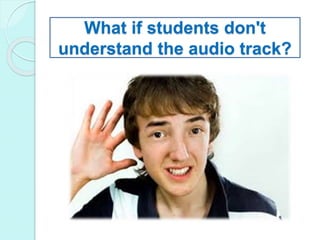
What if students don't
understand the audio track?
 Teachers can use:
◦ Preview interview questions about what students will listen that
help them to have predictive power.
◦ Jigsaw listening by dividing the listening in different groups and
provide an audio scripts them listen the whole class and guess the
correct order.
◦ Apply an easy task which does not require comprehension
excessively.
◦ Play the first segment or play the listening into different parts to
make students predict what is going to happen next
◦ Use audio script for help student with weak listening skills. Another
use is divide the script and to put it together. Beside, read audio script
before, during and after they listen; also complete the space
◦ Provide a vocabulary based on the audio to help students to
understand as a clue.
◦ Persuade students to listen as much as possible the target language
to acquire the language and improve their understanding.
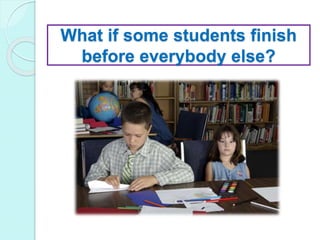
What if some students finish
before everybody else?
When students or group finish first teachers can
give worksheet or have a plan extension to the
original task.
Teachers must be creative to solve this situation
by different spare activities that include:
Worksheets,
Puzzles,
Jeopardy
Readings
Games
Writing
E-books and so on…

What if students are all at

  • 1.
    What if ….. Teacher: SilvianaMaricela Madrid González Student: Carmen Judith Bazurto Palma TEACHING PRACTICUM I
  • 2.
    What if studentsare all at different levels
  • 3.
    Teachers can divideand apply different activities focused on their levels if the classroom has the facilities. Teachers use the same material with different activities and difficulty based on knowledge. Teachers can work homogeneously, but learners with more knowledge can get bored quickly; so it is necessary to have additional material or make them to help others in work group. Teachers must walk around in order that each member work and avoid anxiety without inferior or superior attitude to create an inspiring environment to learn.
  • 4.
    What if theclass is very big?
  • 5.
     Teachers mustbe in front in the class to be accessible for learners.  Using active and recreation activities as:  Worksheet Pair and group work Drill or repetition Class division for question and answer Name a leader in each group. Provide an enjoyable environment. Using the technology to communicate, post information, evaluate , and leave assignments.
  • 6.
    What if studentskeep using their own language?
  • 7.
    Teachers must explainwhich are the benefit to practice the English in class and disadvantage to improve the learning skills. Establish norms about the mother tongue and encourage to avoid especially when students are speaking; because student lose opportunity to feedback and rehearsal. Teachers should only respond when students speak English. Teachers must speak English most of the time and use material in order to expose students with the real language. Motivate students to speak and acquire the second language.
  • 8.
    What if studentsdon't do homework?
  • 9.
    Make agreements withstudents about homework and leave assignments accorder their interesting and lesson objectives. Using diverse type and unexpected task to motivate students to do something new, fun, creative which active their knowledge Teacher must stimulate, score and make feedback from students´ homework with respect. It is important encouraged students to correct their mistakes and learn from them and give opportunities to express; even students should correct each other’s homework by support and cooperative knowledge.
  • 10.
    What if studentsare uncooperative?
  • 11.
     Teacher mustcalm down and be professionally and avoid to react emotionally.  It is important to find out what cause the problem and act as friend instead of authorities to try to help students; also explain sanction for bad behaviour as the last resources.  Explain for the whole class the norms at the beginning of the year to do something according that when the problem happens and remind the language-learning contract.  Motivate students to change their behaviour in the future.  Use individual dialogue to have an approach with students by email, letter or set meeting.  Talk to colleges and the higher authority about discipline policy.
  • 12.
    What if studentsdon't want to talk?
  • 13.
     It isnot a good idea to force students, but it is better to use different techniques as: o Use pair work and group work to make students to feel comfortable with small among students. o Create activity where the progress is slowly by steps in order to make student to gain self-assured. o Teacher must encourage students to act out dialogues by rise and fall their voice to speak more naturally. o Use role play make student to speak more freely when they pretend to be someone else. o Use recording as homework by students where teachers have to listen with the objective to give advice, recommendation and feedback. This help to avoid the embarrassment (for them) of making mistakes.
  • 14.
    What if studentsdon't understand the audio track?
  • 15.
     Teachers canuse: ◦ Preview interview questions about what students will listen that help them to have predictive power. ◦ Jigsaw listening by dividing the listening in different groups and provide an audio scripts them listen the whole class and guess the correct order. ◦ Apply an easy task which does not require comprehension excessively. ◦ Play the first segment or play the listening into different parts to make students predict what is going to happen next ◦ Use audio script for help student with weak listening skills. Another use is divide the script and to put it together. Beside, read audio script before, during and after they listen; also complete the space ◦ Provide a vocabulary based on the audio to help students to understand as a clue. ◦ Persuade students to listen as much as possible the target language to acquire the language and improve their understanding.
  • 16.
    What if somestudents finish before everybody else?
  • 17.
    When students orgroup finish first teachers can give worksheet or have a plan extension to the original task. Teachers must be creative to solve this situation by different spare activities that include: Worksheets, Puzzles, Jeopardy Readings Games Writing E-books and so on…