An automated workflow to screen alkene reductases
using high-throughput thin layer chromatography
Background
• Synthetic biology efforts often require high-throughput screening
tools for enzyme engineering campaigns.
• Chromatographic and mass spectrometry-based approaches can
require cost-intensive instrumentation and technical expertise not
broadly available, and complex workflows and analysis time can
significantly impact throughput.
Approach
• To this end, we develop an automated, 96-well screening
platform based on thin layer chromatography (TLC) and use it to
monitor in vitro activity of a geranylgeranyl reductase from
Sulfolobus acidocaldarius (SaGGR).
• Unreduced SaGGR products are oxidized to their corresponding
epoxide and applied to thin layer silica plates by acoustic
printing. These derivatives are chromatographically separated
based on the number of epoxides they possess and are
covalently ligated to a chromophore, allowing detection of
enzyme variants with unique product distributions or enhanced
reductase activity.
Outcomes and Impacts
• We employ this workflow to examine farnesol reduction using a
codon-saturation mutagenesis library at site Leu377 of SaGGR.
We show this TLC-based screen can distinguish between 4-fold
differences in enzyme activity for select mutants and validated
those results by GC-MS.
• With appropriate quantitation methods, this workflow can be used
to screen polyprenyl reductase activity and can be readily
adapted to analyze broader catalyst libraries whose products are
amenable to TLC analysis
Garabedian, Meadows, Mingardon, et al. (2020) Biotechnology for Biofuels, (doi: 10.1186/s13068-020-01821-w)
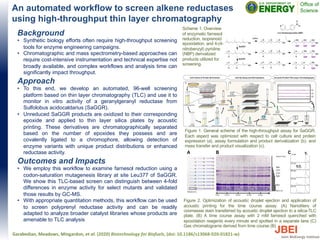
Scheme 1. Overview
of enzymatic farnesol
reduction, isoprenoid
epoxidation, and 4-(4-
nitrobenzyl) pyridine
(NBP) derivatized
products utilized for
screening.
Figure 2. Optimization of acoustic droplet ejection and application of
acoustic printing for the time course assay. (A) Nanoliters of
coomassie stain transferred by acoustic droplet ejection to a silica-TLC
plate. (B) A time course assay with 2 mM farnesol quenched with
epoxidation reagents every minute and spotted in a separate lane (C)
Gas chromatograms derived from time course (B)
Figure 1. General scheme of the high-throughput assay for SaGGR.
Each aspect was optimized with respect to cell culture and protein
expression (a), assay formulation and product derivatization (b), and
mass transfer and product visualization (c).
Repurposing a microfluidic formulation device for
automated DNA construction
Background
• Microfluidic chips are used to precisely control the
behavior and movement of very, very small amounts of
fluids
• Computer-controlled microfluidics chips are time
consuming and costly to develop, and they are typically
designed to perform one specific task for one specific type
of system.
Approach
• Scientists at JBEI, in collaboration with researchers from
TeselaGen, have tested the ability to repurpose a chip for
a different use than the one for which it had been originally
designed.
Outcomes and Impacts
• JBEI researchers were able to adapt the microfluidics chip
by writing a computer program to control the valves and
the pumps of the chip to construct DNA, even though the
chip had been originally made to do something different
• This accomplishment suggests that in the other
microfluidics chips could also be repurposed to perform
several different programmable functions for use in diverse
research settings
• To make a single gene manually can take one researcher
several weeks and a lot of expensive supplies. Using an
automated microfluidics chip, the same researcher can
produce multiple genes at the same time while significantly
reducing the amounts, and therefore the costs, of supplies.
Goyal et al (2020) PLoS ONE, doi: 10.1371/journal.pone.0242157
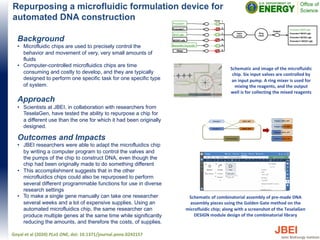
Schematic and image of the microfluidic
chip. Six input valves are controlled by
an input pump. A ring mixer is used for
mixing the reagents, and the output
well is for collecting the mixed reagents
Schematic of combinatorial assembly of pre-made DNA
assembly pieces using the Golden Gate method on the
microfluidic chip; along with a screenshot of the TeselaGen
DESIGN module design of the combinatorial library
Editorial: Proceedings of ICPSBBB 2018 - 2nd International
Conference on Plant Synthetic Biology, Bioengineering and
Biotechnology
Outcomes and Impacts
• The proceedings of the conference were published as a Research Topic in
Frontiers in Plant Science https://www.frontiersin.org/research-
topics/9259/proceedings-of-icpsbbb-2018---2nd-international-conference-
on-plant-synthetic-biology-bioengineering. The special issue consists of 8
peer-reviewed publications, including four reviews and four original research
articles.
• The editorial is a summary of the eight papers, which fall into general topics
as described below.
• Quantitative and genetic parts: A primary goal of plant synthetic biology is to
produce predictable and programmable genetic circuits from simple
regulatory elements and well-characterized genetic components. Synthetic
biology approaches in complex organisms like plants composed of
differentiated cells and tissues, with unique regulatory or developmental
contexts present unique challenges.
• Evolution, expression of transgenes and epigenetic changes after gene
editing: Many new tools, Including CRISPR/Cas9 have revolutionized plant
genetic engineering and enabled much better precision. A surprising result
of systematic analysis of transgenic plants is that position effects are almost
negligible in plants. This means that researchers can analyze much fewer
independent transformant lines than has been generally thought in the plant
science community.
• Engineering of stress tolerance and bioproduction: Engineering stress
tolerance in plants has huge potential to accelerate and keep pace with the
effects of climate change. Analysis of multi-omics data has given new
insights into network cross-talk to unravel the underlying complexity
required for stress sensing and signaling.
Scheller HV, Patron N, Jensen PE (2020) Frontiers in Plant Science 11:614933, doi: 10.3389/fpls.2020.614933
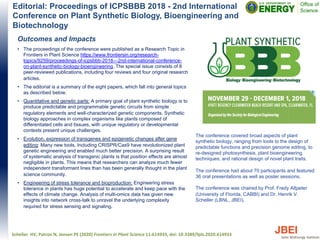
The conference covered broad aspects of plant
synthetic biology, ranging from tools to the design of
predictable functions and precision genome editing, to
re-designed photosynthesis, plant bioengineering
techniques, and rational design of novel plant traits.
The conference had about 70 participants and featured
36 oral presentations as well as poster sessions.
The conference was chaired by Prof. Fredy Altpeter
(University of Florida, CABBI) and Dr. Henrik V.
Scheller (LBNL, JBEI).
Conversion of Poplar Biomass into High-Energy
Density Tricyclic Sesquiterpene Jet Fuel Blendstocks
Background
• Bio-derived jet fuel is of particular interest as aviation is less
amenable to electrification compared to other modes of
transportation and synthetic biology provides the ability to tailor fuel
properties to enhance performance
• Energy-dense sesquiterpenes have been identified as potential
next-generation jet fuels that can be renewably produced from
lignocellulosic biomass
Approach
• We developed a biomass deconstruction and conversion
process that enabled the production of two tricyclic
sesquiterpenes, epi-isozizaene and prespatane, from the woody
biomass poplar using the versatile basidiomycete
Rhodosporidium toruloides
• We demonstrated terpene production at both bench and
bioreactor scales, with prespatane titers reaching 1173.6 mg/L
when grown in poplar hydrolysate in a 2 L bioreactor
• We examined the theoretical fuel properties of prespatane and
epi-isozizaene in their hydrogenated states as blending options
for jet fuel, and compared them to aviation fuel, Jet A
Outcomes and Impacts
• Our findings indicate that prespatane and epi-isozizaene in their
hydrogenated states would be attractive blending options in Jet A
or other lower density renewable jet fuels as they would improve
viscosity and increase their energy density. Saturated epi-
isozizaene and saturated prespatane have energy densities that
are 16.6 and 18.8% higher than Jet A, respectively. These results
highlight the potential of R. toruloides as a production host for the
sustainable and scalable production of bio-derived jet fuel blends,
and this is the first report of prespatane as an alternative jet fuel.
Geiselman et al. (2020) Microbial cell factories, doi: 10.1186/s12934-020-01456-4
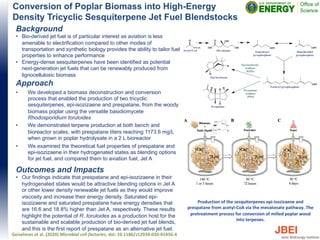
Production of the sesquiterpenes epi-isozizaene and
prespatane from acetyl-CoA via the mevalonate pathway. The
pretreatment process for conversion of milled poplar wood
into terpenes.
Whole-Genome Sequence of Brevibacillus
borstelensis SDM, Isolated from a Sorghum-Adapted
Microbial Community
Background
• Soil contains an untapped diversity of microbial communities with
equally diverse metabolic capacities
• In the present study, a new strain of Brevibacillus borstelensis was
isolated from a compost-derived microbial community enriched on
untreated sorghum biomass.
Approach
• B. borstelensis SDM was isolated by spreading an enrichment
culture of green waste compost obtained from the city of Berkeley,
California, incubated with sorghum in M9TE (7) on Luria Bertani
(LB) solid medium and incubating it overnight at 50ºC.
Outcomes and Impacts
• Six colonies were randomly picked and identified through 16S
rRNA-encoding gene sequencing as Brevibacillus
borstelensis (99% identical).
• Genome assembly and annotation was performed with Kbase tools
• The best genome assembly was obtained using MEGAHIT and
comprised 128 contigs, all of them with ≥1,000 bp, with a total
length of 5,246,051 bp, an N50 value of 82,015 bp, and an average
GC content of 51.62%
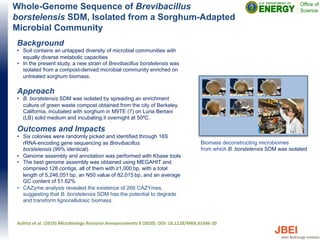
• CAZyme analysis revealed the existence of 266 CAZYmes,
suggesting that B. borstelensis SDM has the potential to degrade
and transform lignocellulosic biomass.
Aulitto et al. (2019) Microbiology Resource Announcements 9 (2020). DOI: 10.1128/MRA.01046-20
Passage 1
(Day 14)
Enrichment
Passage 3
(Day 42)
Passage 4
(Day 56)
Day 371
Passage 2 (Day 28)
Biomass deconstructing microbiomes
from which B. borstelensis SDM was isolated
A grass-specific cellulose–xylan interaction dominates
in sorghum secondary cell walls
Background
• Sorghum (Sorghum bicolor L. Moench) is a promising source of
lignocellulosic biomass for the production of renewable fuels and
chemicals, as well as for forage.
• Understanding secondary cell wall architecture is key to
understanding recalcitrance i.e. identifying features which
prevent the efficient conversion of complex biomass to simple
carbon units.
• The interaction between the cell wall components that form the
three-dimensional network remains poorly understood for
grasses.
Approach
• We employ multi-dimensional ssNMR analysis on sorghum to
reveal the native architecture of its secondary cell wall and
explore xylan-cellulose interactions in grasses.
Outcomes and Impacts
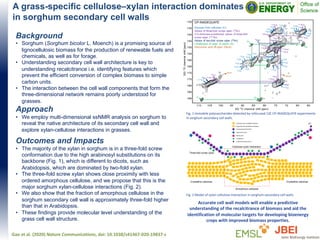
• The majority of the xylan in sorghum is in a three-fold screw
conformation due to the high arabinosyl substitutions on its
backbone (Fig. 1), which is different to dicots, such as
Arabidopsis, which are dominated by two-fold xylan.
• The three-fold screw xylan shows close proximity with less
ordered amorphous cellulose, and we propose that this is the
major sorghum xylan-cellulose interactions (Fig. 2).
• We also show that the fraction of amorphous cellulose in the
sorghum secondary cell wall is approximately three-fold higher
than that in Arabidopsis.
• These findings provide molecular level understanding of the
grass cell wall structure.
Gao et al. (2020) Nature Communications, doi: 10.1038/s41467-020-19837-z
Accurate cell wall models will enable a predictive
understanding of the recalcitrance of biomass and aid the
identification of molecular targets for developing bioenergy
crops with improved biomass properties.
Fig. 1 Immobile polysaccharides detected by refocused 13C CP-INADEQUATE experiments
in sorghum secondary cell walls.
Fig. 2 Model of xylan-cellulose interaction in sorghum secondary cell walls.
Machine learning for metabolic engineering: A review
Background
• Machine learning provides researchers a unique opportunity to make
metabolic engineering more predictable.
Approach
• In this review, we offer an introduction to Machine learning in terms that
are relatable to metabolic engineers.
• We include practical advice for the practitioner in terms of data
management, algorithm libraries, and computational resources.
• A variety of applications ranging from pathway construction and
optimization, to scale-up are discussed.
• Finally, the future perspectives and most promising directions for this
combination of disciplines are examined.
Outcomes and Impacts
• By enabling a predictive metabolic engineering, machine learning can
have a disruptive impact on this field, facilitating much more ambitious
goals.
• The fundamental challenges involve enabling streams of high-quality
data, developing new algorithms to integrate the advantages of data-
driven and mechanistic approaches, and fully leveraging novel tools in
machine learning and synthetic biology.
Lawson et al. (2020) Metabolic Engineering, doi: 10.1016/j.ymben.2020.10.005
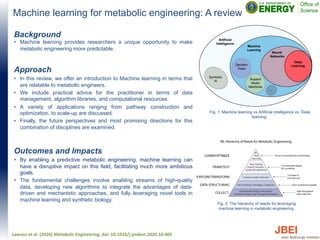
Fig. 2. The hierarchy of needs for leveraging
machine learning in metabolic engineering.
Fig. 1. Machine learning vs Artificial intelligence vs. Deep
learning.

JBEI Publications November 2020

  • 1.
    An automated workflowto screen alkene reductases using high-throughput thin layer chromatography Background • Synthetic biology efforts often require high-throughput screening tools for enzyme engineering campaigns. • Chromatographic and mass spectrometry-based approaches can require cost-intensive instrumentation and technical expertise not broadly available, and complex workflows and analysis time can significantly impact throughput. Approach • To this end, we develop an automated, 96-well screening platform based on thin layer chromatography (TLC) and use it to monitor in vitro activity of a geranylgeranyl reductase from Sulfolobus acidocaldarius (SaGGR). • Unreduced SaGGR products are oxidized to their corresponding epoxide and applied to thin layer silica plates by acoustic printing. These derivatives are chromatographically separated based on the number of epoxides they possess and are covalently ligated to a chromophore, allowing detection of enzyme variants with unique product distributions or enhanced reductase activity. Outcomes and Impacts • We employ this workflow to examine farnesol reduction using a codon-saturation mutagenesis library at site Leu377 of SaGGR. We show this TLC-based screen can distinguish between 4-fold differences in enzyme activity for select mutants and validated those results by GC-MS. • With appropriate quantitation methods, this workflow can be used to screen polyprenyl reductase activity and can be readily adapted to analyze broader catalyst libraries whose products are amenable to TLC analysis Garabedian, Meadows, Mingardon, et al. (2020) Biotechnology for Biofuels, (doi: 10.1186/s13068-020-01821-w) Scheme 1. Overview of enzymatic farnesol reduction, isoprenoid epoxidation, and 4-(4- nitrobenzyl) pyridine (NBP) derivatized products utilized for screening. Figure 2. Optimization of acoustic droplet ejection and application of acoustic printing for the time course assay. (A) Nanoliters of coomassie stain transferred by acoustic droplet ejection to a silica-TLC plate. (B) A time course assay with 2 mM farnesol quenched with epoxidation reagents every minute and spotted in a separate lane (C) Gas chromatograms derived from time course (B) Figure 1. General scheme of the high-throughput assay for SaGGR. Each aspect was optimized with respect to cell culture and protein expression (a), assay formulation and product derivatization (b), and mass transfer and product visualization (c).
  • 2.
    Repurposing a microfluidicformulation device for automated DNA construction Background • Microfluidic chips are used to precisely control the behavior and movement of very, very small amounts of fluids • Computer-controlled microfluidics chips are time consuming and costly to develop, and they are typically designed to perform one specific task for one specific type of system. Approach • Scientists at JBEI, in collaboration with researchers from TeselaGen, have tested the ability to repurpose a chip for a different use than the one for which it had been originally designed. Outcomes and Impacts • JBEI researchers were able to adapt the microfluidics chip by writing a computer program to control the valves and the pumps of the chip to construct DNA, even though the chip had been originally made to do something different • This accomplishment suggests that in the other microfluidics chips could also be repurposed to perform several different programmable functions for use in diverse research settings • To make a single gene manually can take one researcher several weeks and a lot of expensive supplies. Using an automated microfluidics chip, the same researcher can produce multiple genes at the same time while significantly reducing the amounts, and therefore the costs, of supplies. Goyal et al (2020) PLoS ONE, doi: 10.1371/journal.pone.0242157 Schematic and image of the microfluidic chip. Six input valves are controlled by an input pump. A ring mixer is used for mixing the reagents, and the output well is for collecting the mixed reagents Schematic of combinatorial assembly of pre-made DNA assembly pieces using the Golden Gate method on the microfluidic chip; along with a screenshot of the TeselaGen DESIGN module design of the combinatorial library
  • 3.
    Editorial: Proceedings ofICPSBBB 2018 - 2nd International Conference on Plant Synthetic Biology, Bioengineering and Biotechnology Outcomes and Impacts • The proceedings of the conference were published as a Research Topic in Frontiers in Plant Science https://www.frontiersin.org/research- topics/9259/proceedings-of-icpsbbb-2018---2nd-international-conference- on-plant-synthetic-biology-bioengineering. The special issue consists of 8 peer-reviewed publications, including four reviews and four original research articles. • The editorial is a summary of the eight papers, which fall into general topics as described below. • Quantitative and genetic parts: A primary goal of plant synthetic biology is to produce predictable and programmable genetic circuits from simple regulatory elements and well-characterized genetic components. Synthetic biology approaches in complex organisms like plants composed of differentiated cells and tissues, with unique regulatory or developmental contexts present unique challenges. • Evolution, expression of transgenes and epigenetic changes after gene editing: Many new tools, Including CRISPR/Cas9 have revolutionized plant genetic engineering and enabled much better precision. A surprising result of systematic analysis of transgenic plants is that position effects are almost negligible in plants. This means that researchers can analyze much fewer independent transformant lines than has been generally thought in the plant science community. • Engineering of stress tolerance and bioproduction: Engineering stress tolerance in plants has huge potential to accelerate and keep pace with the effects of climate change. Analysis of multi-omics data has given new insights into network cross-talk to unravel the underlying complexity required for stress sensing and signaling. Scheller HV, Patron N, Jensen PE (2020) Frontiers in Plant Science 11:614933, doi: 10.3389/fpls.2020.614933 The conference covered broad aspects of plant synthetic biology, ranging from tools to the design of predictable functions and precision genome editing, to re-designed photosynthesis, plant bioengineering techniques, and rational design of novel plant traits. The conference had about 70 participants and featured 36 oral presentations as well as poster sessions. The conference was chaired by Prof. Fredy Altpeter (University of Florida, CABBI) and Dr. Henrik V. Scheller (LBNL, JBEI).
  • 4.
    Conversion of PoplarBiomass into High-Energy Density Tricyclic Sesquiterpene Jet Fuel Blendstocks Background • Bio-derived jet fuel is of particular interest as aviation is less amenable to electrification compared to other modes of transportation and synthetic biology provides the ability to tailor fuel properties to enhance performance • Energy-dense sesquiterpenes have been identified as potential next-generation jet fuels that can be renewably produced from lignocellulosic biomass Approach • We developed a biomass deconstruction and conversion process that enabled the production of two tricyclic sesquiterpenes, epi-isozizaene and prespatane, from the woody biomass poplar using the versatile basidiomycete Rhodosporidium toruloides • We demonstrated terpene production at both bench and bioreactor scales, with prespatane titers reaching 1173.6 mg/L when grown in poplar hydrolysate in a 2 L bioreactor • We examined the theoretical fuel properties of prespatane and epi-isozizaene in their hydrogenated states as blending options for jet fuel, and compared them to aviation fuel, Jet A Outcomes and Impacts • Our findings indicate that prespatane and epi-isozizaene in their hydrogenated states would be attractive blending options in Jet A or other lower density renewable jet fuels as they would improve viscosity and increase their energy density. Saturated epi- isozizaene and saturated prespatane have energy densities that are 16.6 and 18.8% higher than Jet A, respectively. These results highlight the potential of R. toruloides as a production host for the sustainable and scalable production of bio-derived jet fuel blends, and this is the first report of prespatane as an alternative jet fuel. Geiselman et al. (2020) Microbial cell factories, doi: 10.1186/s12934-020-01456-4 Production of the sesquiterpenes epi-isozizaene and prespatane from acetyl-CoA via the mevalonate pathway. The pretreatment process for conversion of milled poplar wood into terpenes.
  • 5.
    Whole-Genome Sequence ofBrevibacillus borstelensis SDM, Isolated from a Sorghum-Adapted Microbial Community Background • Soil contains an untapped diversity of microbial communities with equally diverse metabolic capacities • In the present study, a new strain of Brevibacillus borstelensis was isolated from a compost-derived microbial community enriched on untreated sorghum biomass. Approach • B. borstelensis SDM was isolated by spreading an enrichment culture of green waste compost obtained from the city of Berkeley, California, incubated with sorghum in M9TE (7) on Luria Bertani (LB) solid medium and incubating it overnight at 50ºC. Outcomes and Impacts • Six colonies were randomly picked and identified through 16S rRNA-encoding gene sequencing as Brevibacillus borstelensis (99% identical). • Genome assembly and annotation was performed with Kbase tools • The best genome assembly was obtained using MEGAHIT and comprised 128 contigs, all of them with ≥1,000 bp, with a total length of 5,246,051 bp, an N50 value of 82,015 bp, and an average GC content of 51.62% • CAZyme analysis revealed the existence of 266 CAZYmes, suggesting that B. borstelensis SDM has the potential to degrade and transform lignocellulosic biomass. Aulitto et al. (2019) Microbiology Resource Announcements 9 (2020). DOI: 10.1128/MRA.01046-20 Passage 1 (Day 14) Enrichment Passage 3 (Day 42) Passage 4 (Day 56) Day 371 Passage 2 (Day 28) Biomass deconstructing microbiomes from which B. borstelensis SDM was isolated
  • 6.
    A grass-specific cellulose–xylaninteraction dominates in sorghum secondary cell walls Background • Sorghum (Sorghum bicolor L. Moench) is a promising source of lignocellulosic biomass for the production of renewable fuels and chemicals, as well as for forage. • Understanding secondary cell wall architecture is key to understanding recalcitrance i.e. identifying features which prevent the efficient conversion of complex biomass to simple carbon units. • The interaction between the cell wall components that form the three-dimensional network remains poorly understood for grasses. Approach • We employ multi-dimensional ssNMR analysis on sorghum to reveal the native architecture of its secondary cell wall and explore xylan-cellulose interactions in grasses. Outcomes and Impacts • The majority of the xylan in sorghum is in a three-fold screw conformation due to the high arabinosyl substitutions on its backbone (Fig. 1), which is different to dicots, such as Arabidopsis, which are dominated by two-fold xylan. • The three-fold screw xylan shows close proximity with less ordered amorphous cellulose, and we propose that this is the major sorghum xylan-cellulose interactions (Fig. 2). • We also show that the fraction of amorphous cellulose in the sorghum secondary cell wall is approximately three-fold higher than that in Arabidopsis. • These findings provide molecular level understanding of the grass cell wall structure. Gao et al. (2020) Nature Communications, doi: 10.1038/s41467-020-19837-z Accurate cell wall models will enable a predictive understanding of the recalcitrance of biomass and aid the identification of molecular targets for developing bioenergy crops with improved biomass properties. Fig. 1 Immobile polysaccharides detected by refocused 13C CP-INADEQUATE experiments in sorghum secondary cell walls. Fig. 2 Model of xylan-cellulose interaction in sorghum secondary cell walls.
  • 7.
    Machine learning formetabolic engineering: A review Background • Machine learning provides researchers a unique opportunity to make metabolic engineering more predictable. Approach • In this review, we offer an introduction to Machine learning in terms that are relatable to metabolic engineers. • We include practical advice for the practitioner in terms of data management, algorithm libraries, and computational resources. • A variety of applications ranging from pathway construction and optimization, to scale-up are discussed. • Finally, the future perspectives and most promising directions for this combination of disciplines are examined. Outcomes and Impacts • By enabling a predictive metabolic engineering, machine learning can have a disruptive impact on this field, facilitating much more ambitious goals. • The fundamental challenges involve enabling streams of high-quality data, developing new algorithms to integrate the advantages of data- driven and mechanistic approaches, and fully leveraging novel tools in machine learning and synthetic biology. Lawson et al. (2020) Metabolic Engineering, doi: 10.1016/j.ymben.2020.10.005 Fig. 2. The hierarchy of needs for leveraging machine learning in metabolic engineering. Fig. 1. Machine learning vs Artificial intelligence vs. Deep learning.