Genomic and functional analyses of fungal and bacterial
consortia that enable lignocellulose breakdown in goat
gut microbiomes
Background
• Herbivore digestive tracts harbor complex communities of
anaerobic microbes that cooperate to break down lignocellulose.
• Gut microbiomes are untapped sources of strains, pathways, and
enzymes useful for converting plant biomass to valuable
chemicals.
Approach
• We performed more than 400 parallel enrichments from goat
feces to determine how substrate and antibiotic selection
influence microbial membership, activity, stability, and chemical
productivity of consortia sourced from herbivore guts.
Outcomes and Impacts
• We assembled 719 high-quality metagenome-assembled
genomes (MAGs) that are unique at the species level.
• Anaerobic fungi dominated the most active consortia we
enriched, and these outperformed bacterially dominated consortia
in terms of both methane production and cellulose degradation.
• Metabolic pathway reconstructions from MAGs of bacteria,
archaea, and fungi suggested that cross-domain partnerships
between fungi and methanogens enabled acetate, formate, and
methane production. In contrast, bacterially dominated consortia
mainly produced propionate and butyrate. Metabolite
measurements confirmed these suspected interdomain
partnerships.
• Our findings ultimately indicate that division of labor by anaerobes
degrading plant biomass is useful for industrial bioprocessing.
Peng et al. (2021) Nature Microbiology, doi: 10.1038/s41564-020-00861-0
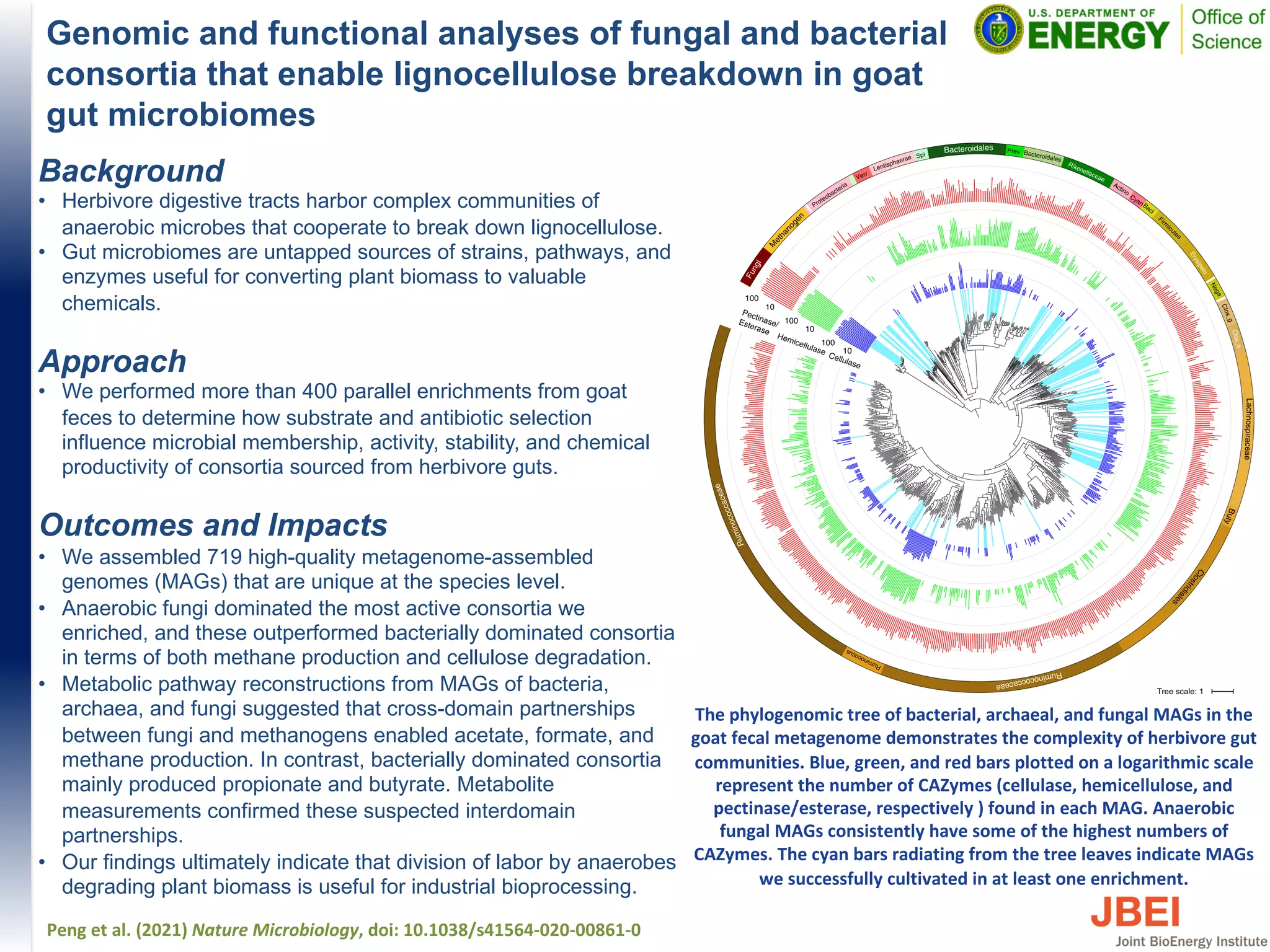
The phylogenomic tree of bacterial, archaeal, and fungal MAGs in the
goat fecal metagenome demonstrates the complexity of herbivore gut
communities. Blue, green, and red bars plotted on a logarithmic scale
represent the number of CAZymes (cellulase, hemicellulose, and
pectinase/esterase, respectively ) found in each MAG. Anaerobic
fungal MAGs consistently have some of the highest numbers of
CAZymes. The cyan bars radiating from the tree leaves indicate MAGs
we successfully cultivated in at least one enrichment.
Liquid nanostructure of choline lysinate with
water and a model lignin residue
Jiang et al (2021) Green Chemistry DOI: 10.1039/D0GC03664A
(Top) 3D spatial distribution functions of selected
[Ch][Lys] atoms, showing 20% probability surfaces.
(Bottom) H-Bond angle distributions in neat [Ch][Lys] and
the [Ch][Lys]–water.
Background
• Certain ionic liquids (ILs) are attractive candidates for effecting
dissolution and fractionation of lignin
• Bio-based solvents, such as choline amino acid ILs, are non-
toxic, renewable and inexpensive
• How these bio-based ILs solubilize the complex structures within
lignin, including polar, aromatic, and non-polar moieties, and how
water influences the lignin extraction process are not understood
at the nanoscale
Approach
• We investigated the structure of liquid [Ch][Lys], the effect of
added water, and the relationship between structure and the
solubility of a model lignin residue to identify key intermolecular
interactions through neutron diffraction experiments at ISIS
• We compared the nanostructure of [Ch][Lys] to previously studied
primary and secondary ammonium protic ILs to identify the
unique characteristics key for biomass processing
Outcomes and Impacts
• Guaiacol is found to H-bond through its phenol group to both the
anion and water, destabilizing the lysinate cyclic conformer and
altering the liquid nanostructure
• The addition of water, which extends the H-bonding network while
largely preserving its bicontinuous nanostructure, makes the ionic
liquid–water mixture an effective solvent
• This molecular understanding of how additional water molecules
affect solvent–solute interactions enables design of novel ILs for
biomass pretreatment
Experimentally Validated Reconstruction and Analysis of
a Genome-Scale Metabolic Model of an Anaerobic
Neocallimastigomycota Fungus
Background
• Genome-scale metabolic models are important tools used to
understand and engineer microorganisms.
• These models are reconstructed from sequence data and have
largely been restricted to model organisms.
• Non-model fungi are increasingly used in biotechnology, however
tools to engineer their metabolism are underdeveloped.
• This study introduces both the genome of Neocallimastix lanati and
the first genome-scale metabolic model an anaerobic gut fungus.
Approach
• Long read sequencing technology was used to sequence the
genome of N. lanati.
• A metabolic model encompassing the primary metabolism of N.
lanati was reconstructed from sequence data, literature and
experiments.
Outcomes and Impacts
• N. lanati’s 200 Mbp genome encodes for 1788 CAZymes, of which
585 are associated with the fungal cellulosome.
• The model, iNlan20, is composed of 1018 genes, 1023 reactions
and 816 metabolites.
• The gut fungal hydrogenosome was modeled, and key metabolic
enzymes identified.
• Model predictions were compared to experimental data (13C MFA,
substrate utilization, transcriptomic expression levels) and found to
be accurate.
• Conflicts between model predictions and experiments suggest the
presence of a bifurcating hydrogenase and/or a potential proton
pumping module. Further work is necessary to elucidate these
questions.
Wilken et al. (2021) mSystems, doi: 10.1128/mSystems.00002-21
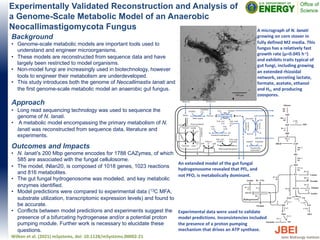
A micrograph of N. lanati
growing on corn stover in
fully defined M2 media. This
fungus has a relatively fast
growth rate (μ=0.045 h-1)
and exhibits traits typical of
gut fungi, including growing
an extended rhizoidal
network, secreting lactate,
formate, acetate, ethanol
and H2, and producing
zoospores.
An extended model of the gut fungal
hydrogenosome revealed that PFL, and
not PFO, is metabolically dominant.
Experimental data were used to validate
model predictions. Inconsistencies included
the presence of a proton pumping
mechanism that drives an ATP synthase.
Evolutionary gain of oligosaccharide hydrolysis and
sugar transport enhanced carbohydrate partitioning in
sweet watermelon fruits
Background
• How raffinose (Raf) family oligosaccharides, the major translocated
sugars in cucurbits, are hydrolyzed and subsequently partitioned
has not been fully elucidated.
• By performing reciprocal grafting of watermelon (Citrullus lanatus)
fruits to branch stems, we observed that Raf was hydrolyzed in the
fruit of cultivated watermelons but was backlogged in the fruit of
wild ancestor species.
Approach
• Through a genome-wide association study, the alkaline alpha-
galactosidase ClAGA2 was identified as the key factor controlling
stachyose and Raf hydrolysis.
• Plant transformation confirmed that ClAGA2 controls fruit Raf
hydrolysis and reduces Raf content in fruits.
• Two single-nucleotide polymorphisms (SNPs) within the
ClAGA2 promoter results in recruitment of the transcription factor
ClNF-YC2 and high ClAGA2 expression in cultivated watermelon.
Outcomes and Impacts
• Sugar Transporter 3 (ClSWEET3) and Tonoplast Sugar Transporter
(ClTST2) participate in plasma membrane sugar transport and
sugar storage in fruit cell vacuoles, respectively.
• High expression of ClSWEET3 is important for sugar accumulation
in cultivated watermelon.
• Genomic signatures indicate that the selection
of ClAGA2, ClSWEET3, and ClTST2 for carbohydrate partitioning
led to the derivation of modern sweet watermelon from non-sweet
ancestors during domestication.
• This study provides targets for engineering crops, including
bioenergy crops, with altered carbohydrate partitioning.
Ren et al. (2019) Plant Cell, doi: 10.1093/plcell/koab055
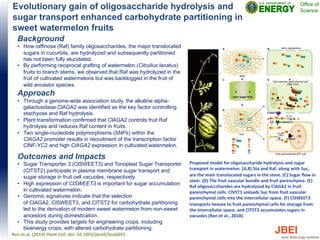
Proposed model for oligosaccharide hydrolysis and sugar
transport in watermelon. (A,B) Sta and Raf, along with Suc,
are the main translocated sugars in the stem. (C) Sugar flow in
stem. (D) The fruit vascular bundle and fruit parenchyma. (E)
Raf oligosacccharides are hydrolyzed by ClAGA2 in fruit
parenchymal cells. ClVST1 unloads Suc from fruit vascular
parenchymal cells into the intercellular space. (F) ClSWEET3
transports hexose to fruit parenchymal cells for storage from
the intercellular space, and ClTST2 accumulates sugars in
vacuoles (Ren et al., 2018).
Engineering Saccharomyces cerevisiae for isoprenol
production
Background
• Recently, the isoprenol has gained interest as advanced biofuels
and a promising, strategic bio-derived precursor for jet fuel blend-
stocks.
• Saccharomyces cerevisiae has been widely used in the
biotechnology industry due to robustness and ease of genetic
manipulation, and it is generally regarded as safe (GRAS) for
large-scale operation.
• Isoprenol production has not been reported in S. cerevisiae.
Approach
• The original mevalonate (MVA) pathway and IPP-bypass pathway
(IBP) were engineered in S. cerevisiae.
• To improve isoprenol production via the IBP, we engineered the
strains by deleting a promiscuous endogenous kinase and
screened a promiscuous phosphatase that improves isoprenol
production significantly.
Outcomes and Impacts
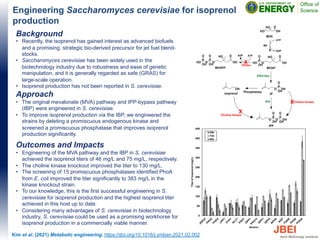
• Engineering of the MVA pathway and the IBP in S. cerevisiae
achieved the isoprenol titers of 46 mg/L and 75 mg/L, respectively.
• The choline kinase knockout improved the titer to 130 mg/L.
• The screening of 15 promiscuous phosphatases identified PhoA
from E. coli improved the titer significantly to 383 mg/L in the
kinase knockout strain.
• To our knowledge, this is the first successful engineering in S.
cerevisiae for isoprenol production and the highest isoprenol titer
achieved in this host up to date.
• Considering many advantages of S. cerevisiae in biotechnology
industry, S. cerevisiae could be used as a promising workhorse for
isoprenol production in a commercially viable manner.
Kim et al. (2021) Metabolic engineering, https://doi.org/10.1016/j.ymben.2021.02.002
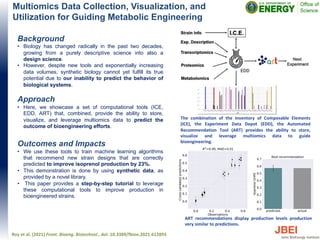
Multiomics Data Collection, Visualization, and
Utilization for Guiding Metabolic Engineering
Background
• Biology has changed radically in the past two decades,
growing from a purely descriptive science into also a
design science.
• However, despite new tools and exponentially increasing
data volumes, synthetic biology cannot yet fulfill its true
potential due to our inability to predict the behavior of
biological systems.
Approach
• Here, we showcase a set of computational tools (ICE,
EDD, ART) that, combined, provide the ability to store,
visualize, and leverage multiomics data to predict the
outcome of bioengineering efforts.
Outcomes and Impacts
• We use these tools to train machine learning algorithms
that recommend new strain designs that are correctly
predicted to improve isoprenol production by 23%.
• This demonstration is done by using synthetic data, as
provided by a novel library.
• This paper provides a step-by-step tutorial to leverage
these computational tools to improve production in
bioengineered strains.
Roy et al. (2021) Front. Bioeng. Biotechnol., doi: 10.3389/fbioe.2021.612893
ART recommendations display production levels production
very similar to predictions.
The combination of the Inventory of Composable Elements
(ICE), the Experiment Data Depot (EDD), the Automated
Recommendation Tool (ART) provides the ability to store,
visualize and leverage multiomics data to guide
bioengineering.
Biofuels for a sustainable future
Background
The current needs for energy and human
dependency on fossil have led to the
accumulation of greenhouse gases and
accelerated the pace of climate change.
Major efforts have been taken to develop,
test, and adopt clean and renewable fuel
alternatives
Outcomes and Impacts
In this review article we discuss the potential
of new feedstock and processes for biofuel
production including landfill, plastic waste
and lignocellulose conversion, algal
photosynthesis and electrochemical carbon
fixation. We also revisit the latest advances
in microbial fermentation to increase biofuel
yield and in the rational design and fine-
tuning of biosynthetic pathways for ‘‘designer
fuels’’.
Liu et al (2021) Cell DOI: https://doi.org/10.1016/j.cell.2021.01.052
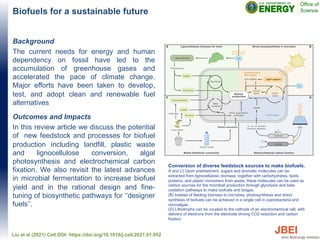
Conversion of diverse feedstock sources to make biofuels.
A and C) Upon pretreatment, sugars and aromatic molecules can be
extracted from lignocellulosic biomass; together with carbohydrates, lipids,
proteins, and plastic monomers from waste, these molecules can be used as
carbon sources for the microbial production through glycolysis and beta
oxidation pathways to make biofuels and biogas.
(B) Instead of feeding biomass to microbes, photosynthesis and direct
synthesis of biofuels can be achieved in a single cell in cyanobacteria and
microalgae.
(D) Lithotrophs can be coupled to the cathode of an electrochemical cell, with
delivery of electrons from the electrode driving CO2 reduction and carbon
fixation
Liquid nanostructure of cholinium argininate
biomass solvents
Brunner et al (2021) ACS Sustainable Chem. Eng. DOI: 10.1021/acssuschemeng.0c08829
Spatial density distribution functions of guanidine carbon
(green), carboxylate oxygen (red), and water (blue) vs
choline charge center in 1:3 [Ch][Arg]/water and 1:10
[Ch][Arg]/water. SDFs plotted as 50% probability surfaces
Background
• The ionic liquid cholinium argininate ([Ch][Arg]) mixed with
water forms biocompatible solvents that are efficient biomass
deconstruction systems
• The exact mechanism by which [Ch][Arg] interacts with and
deconstructs biomass remains unknown
Approach
• We used neutron diffraction experiments @ ISIS and empirical
potential structure refinement fits of the data to reveal the
liquid nanostructure of 1:3 [Ch][Arg]/water, 1:10
[Ch][Arg]/water, and 1:10:0.5 [Ch][Arg]/ water/guaiacol.
Outcomes and Impacts
• Radial distribution functions reveal that cation−anion
electrostatic interactions are complemented by a multitude of
hydrogen bond interactions
• The cation charge group tends to occupy regions of space
around the anion that will polarize any hydrogen bonds
• Guaiacol is solubilized primarily by the argininate carboxylate
and water - so strong polarized hydrogen bonds may be
responsible for biomass breakdown but are not key for
guaiacol dissolution

JBEI Research Highlight Slides - February 2021

  • 1.
    Genomic and functionalanalyses of fungal and bacterial consortia that enable lignocellulose breakdown in goat gut microbiomes Background • Herbivore digestive tracts harbor complex communities of anaerobic microbes that cooperate to break down lignocellulose. • Gut microbiomes are untapped sources of strains, pathways, and enzymes useful for converting plant biomass to valuable chemicals. Approach • We performed more than 400 parallel enrichments from goat feces to determine how substrate and antibiotic selection influence microbial membership, activity, stability, and chemical productivity of consortia sourced from herbivore guts. Outcomes and Impacts • We assembled 719 high-quality metagenome-assembled genomes (MAGs) that are unique at the species level. • Anaerobic fungi dominated the most active consortia we enriched, and these outperformed bacterially dominated consortia in terms of both methane production and cellulose degradation. • Metabolic pathway reconstructions from MAGs of bacteria, archaea, and fungi suggested that cross-domain partnerships between fungi and methanogens enabled acetate, formate, and methane production. In contrast, bacterially dominated consortia mainly produced propionate and butyrate. Metabolite measurements confirmed these suspected interdomain partnerships. • Our findings ultimately indicate that division of labor by anaerobes degrading plant biomass is useful for industrial bioprocessing. Peng et al. (2021) Nature Microbiology, doi: 10.1038/s41564-020-00861-0 The phylogenomic tree of bacterial, archaeal, and fungal MAGs in the goat fecal metagenome demonstrates the complexity of herbivore gut communities. Blue, green, and red bars plotted on a logarithmic scale represent the number of CAZymes (cellulase, hemicellulose, and pectinase/esterase, respectively ) found in each MAG. Anaerobic fungal MAGs consistently have some of the highest numbers of CAZymes. The cyan bars radiating from the tree leaves indicate MAGs we successfully cultivated in at least one enrichment.
  • 2.
    Liquid nanostructure ofcholine lysinate with water and a model lignin residue Jiang et al (2021) Green Chemistry DOI: 10.1039/D0GC03664A (Top) 3D spatial distribution functions of selected [Ch][Lys] atoms, showing 20% probability surfaces. (Bottom) H-Bond angle distributions in neat [Ch][Lys] and the [Ch][Lys]–water. Background • Certain ionic liquids (ILs) are attractive candidates for effecting dissolution and fractionation of lignin • Bio-based solvents, such as choline amino acid ILs, are non- toxic, renewable and inexpensive • How these bio-based ILs solubilize the complex structures within lignin, including polar, aromatic, and non-polar moieties, and how water influences the lignin extraction process are not understood at the nanoscale Approach • We investigated the structure of liquid [Ch][Lys], the effect of added water, and the relationship between structure and the solubility of a model lignin residue to identify key intermolecular interactions through neutron diffraction experiments at ISIS • We compared the nanostructure of [Ch][Lys] to previously studied primary and secondary ammonium protic ILs to identify the unique characteristics key for biomass processing Outcomes and Impacts • Guaiacol is found to H-bond through its phenol group to both the anion and water, destabilizing the lysinate cyclic conformer and altering the liquid nanostructure • The addition of water, which extends the H-bonding network while largely preserving its bicontinuous nanostructure, makes the ionic liquid–water mixture an effective solvent • This molecular understanding of how additional water molecules affect solvent–solute interactions enables design of novel ILs for biomass pretreatment
  • 3.
    Experimentally Validated Reconstructionand Analysis of a Genome-Scale Metabolic Model of an Anaerobic Neocallimastigomycota Fungus Background • Genome-scale metabolic models are important tools used to understand and engineer microorganisms. • These models are reconstructed from sequence data and have largely been restricted to model organisms. • Non-model fungi are increasingly used in biotechnology, however tools to engineer their metabolism are underdeveloped. • This study introduces both the genome of Neocallimastix lanati and the first genome-scale metabolic model an anaerobic gut fungus. Approach • Long read sequencing technology was used to sequence the genome of N. lanati. • A metabolic model encompassing the primary metabolism of N. lanati was reconstructed from sequence data, literature and experiments. Outcomes and Impacts • N. lanati’s 200 Mbp genome encodes for 1788 CAZymes, of which 585 are associated with the fungal cellulosome. • The model, iNlan20, is composed of 1018 genes, 1023 reactions and 816 metabolites. • The gut fungal hydrogenosome was modeled, and key metabolic enzymes identified. • Model predictions were compared to experimental data (13C MFA, substrate utilization, transcriptomic expression levels) and found to be accurate. • Conflicts between model predictions and experiments suggest the presence of a bifurcating hydrogenase and/or a potential proton pumping module. Further work is necessary to elucidate these questions. Wilken et al. (2021) mSystems, doi: 10.1128/mSystems.00002-21 A micrograph of N. lanati growing on corn stover in fully defined M2 media. This fungus has a relatively fast growth rate (μ=0.045 h-1) and exhibits traits typical of gut fungi, including growing an extended rhizoidal network, secreting lactate, formate, acetate, ethanol and H2, and producing zoospores. An extended model of the gut fungal hydrogenosome revealed that PFL, and not PFO, is metabolically dominant. Experimental data were used to validate model predictions. Inconsistencies included the presence of a proton pumping mechanism that drives an ATP synthase.
  • 4.
    Evolutionary gain ofoligosaccharide hydrolysis and sugar transport enhanced carbohydrate partitioning in sweet watermelon fruits Background • How raffinose (Raf) family oligosaccharides, the major translocated sugars in cucurbits, are hydrolyzed and subsequently partitioned has not been fully elucidated. • By performing reciprocal grafting of watermelon (Citrullus lanatus) fruits to branch stems, we observed that Raf was hydrolyzed in the fruit of cultivated watermelons but was backlogged in the fruit of wild ancestor species. Approach • Through a genome-wide association study, the alkaline alpha- galactosidase ClAGA2 was identified as the key factor controlling stachyose and Raf hydrolysis. • Plant transformation confirmed that ClAGA2 controls fruit Raf hydrolysis and reduces Raf content in fruits. • Two single-nucleotide polymorphisms (SNPs) within the ClAGA2 promoter results in recruitment of the transcription factor ClNF-YC2 and high ClAGA2 expression in cultivated watermelon. Outcomes and Impacts • Sugar Transporter 3 (ClSWEET3) and Tonoplast Sugar Transporter (ClTST2) participate in plasma membrane sugar transport and sugar storage in fruit cell vacuoles, respectively. • High expression of ClSWEET3 is important for sugar accumulation in cultivated watermelon. • Genomic signatures indicate that the selection of ClAGA2, ClSWEET3, and ClTST2 for carbohydrate partitioning led to the derivation of modern sweet watermelon from non-sweet ancestors during domestication. • This study provides targets for engineering crops, including bioenergy crops, with altered carbohydrate partitioning. Ren et al. (2019) Plant Cell, doi: 10.1093/plcell/koab055 Proposed model for oligosaccharide hydrolysis and sugar transport in watermelon. (A,B) Sta and Raf, along with Suc, are the main translocated sugars in the stem. (C) Sugar flow in stem. (D) The fruit vascular bundle and fruit parenchyma. (E) Raf oligosacccharides are hydrolyzed by ClAGA2 in fruit parenchymal cells. ClVST1 unloads Suc from fruit vascular parenchymal cells into the intercellular space. (F) ClSWEET3 transports hexose to fruit parenchymal cells for storage from the intercellular space, and ClTST2 accumulates sugars in vacuoles (Ren et al., 2018).
  • 5.
    Engineering Saccharomyces cerevisiaefor isoprenol production Background • Recently, the isoprenol has gained interest as advanced biofuels and a promising, strategic bio-derived precursor for jet fuel blend- stocks. • Saccharomyces cerevisiae has been widely used in the biotechnology industry due to robustness and ease of genetic manipulation, and it is generally regarded as safe (GRAS) for large-scale operation. • Isoprenol production has not been reported in S. cerevisiae. Approach • The original mevalonate (MVA) pathway and IPP-bypass pathway (IBP) were engineered in S. cerevisiae. • To improve isoprenol production via the IBP, we engineered the strains by deleting a promiscuous endogenous kinase and screened a promiscuous phosphatase that improves isoprenol production significantly. Outcomes and Impacts • Engineering of the MVA pathway and the IBP in S. cerevisiae achieved the isoprenol titers of 46 mg/L and 75 mg/L, respectively. • The choline kinase knockout improved the titer to 130 mg/L. • The screening of 15 promiscuous phosphatases identified PhoA from E. coli improved the titer significantly to 383 mg/L in the kinase knockout strain. • To our knowledge, this is the first successful engineering in S. cerevisiae for isoprenol production and the highest isoprenol titer achieved in this host up to date. • Considering many advantages of S. cerevisiae in biotechnology industry, S. cerevisiae could be used as a promising workhorse for isoprenol production in a commercially viable manner. Kim et al. (2021) Metabolic engineering, https://doi.org/10.1016/j.ymben.2021.02.002
  • 6.
    Multiomics Data Collection,Visualization, and Utilization for Guiding Metabolic Engineering Background • Biology has changed radically in the past two decades, growing from a purely descriptive science into also a design science. • However, despite new tools and exponentially increasing data volumes, synthetic biology cannot yet fulfill its true potential due to our inability to predict the behavior of biological systems. Approach • Here, we showcase a set of computational tools (ICE, EDD, ART) that, combined, provide the ability to store, visualize, and leverage multiomics data to predict the outcome of bioengineering efforts. Outcomes and Impacts • We use these tools to train machine learning algorithms that recommend new strain designs that are correctly predicted to improve isoprenol production by 23%. • This demonstration is done by using synthetic data, as provided by a novel library. • This paper provides a step-by-step tutorial to leverage these computational tools to improve production in bioengineered strains. Roy et al. (2021) Front. Bioeng. Biotechnol., doi: 10.3389/fbioe.2021.612893 ART recommendations display production levels production very similar to predictions. The combination of the Inventory of Composable Elements (ICE), the Experiment Data Depot (EDD), the Automated Recommendation Tool (ART) provides the ability to store, visualize and leverage multiomics data to guide bioengineering.
  • 7.
    Biofuels for asustainable future Background The current needs for energy and human dependency on fossil have led to the accumulation of greenhouse gases and accelerated the pace of climate change. Major efforts have been taken to develop, test, and adopt clean and renewable fuel alternatives Outcomes and Impacts In this review article we discuss the potential of new feedstock and processes for biofuel production including landfill, plastic waste and lignocellulose conversion, algal photosynthesis and electrochemical carbon fixation. We also revisit the latest advances in microbial fermentation to increase biofuel yield and in the rational design and fine- tuning of biosynthetic pathways for ‘‘designer fuels’’. Liu et al (2021) Cell DOI: https://doi.org/10.1016/j.cell.2021.01.052 Conversion of diverse feedstock sources to make biofuels. A and C) Upon pretreatment, sugars and aromatic molecules can be extracted from lignocellulosic biomass; together with carbohydrates, lipids, proteins, and plastic monomers from waste, these molecules can be used as carbon sources for the microbial production through glycolysis and beta oxidation pathways to make biofuels and biogas. (B) Instead of feeding biomass to microbes, photosynthesis and direct synthesis of biofuels can be achieved in a single cell in cyanobacteria and microalgae. (D) Lithotrophs can be coupled to the cathode of an electrochemical cell, with delivery of electrons from the electrode driving CO2 reduction and carbon fixation
  • 8.
    Liquid nanostructure ofcholinium argininate biomass solvents Brunner et al (2021) ACS Sustainable Chem. Eng. DOI: 10.1021/acssuschemeng.0c08829 Spatial density distribution functions of guanidine carbon (green), carboxylate oxygen (red), and water (blue) vs choline charge center in 1:3 [Ch][Arg]/water and 1:10 [Ch][Arg]/water. SDFs plotted as 50% probability surfaces Background • The ionic liquid cholinium argininate ([Ch][Arg]) mixed with water forms biocompatible solvents that are efficient biomass deconstruction systems • The exact mechanism by which [Ch][Arg] interacts with and deconstructs biomass remains unknown Approach • We used neutron diffraction experiments @ ISIS and empirical potential structure refinement fits of the data to reveal the liquid nanostructure of 1:3 [Ch][Arg]/water, 1:10 [Ch][Arg]/water, and 1:10:0.5 [Ch][Arg]/ water/guaiacol. Outcomes and Impacts • Radial distribution functions reveal that cation−anion electrostatic interactions are complemented by a multitude of hydrogen bond interactions • The cation charge group tends to occupy regions of space around the anion that will polarize any hydrogen bonds • Guaiacol is solubilized primarily by the argininate carboxylate and water - so strong polarized hydrogen bonds may be responsible for biomass breakdown but are not key for guaiacol dissolution