JAZZ DANCE!!!
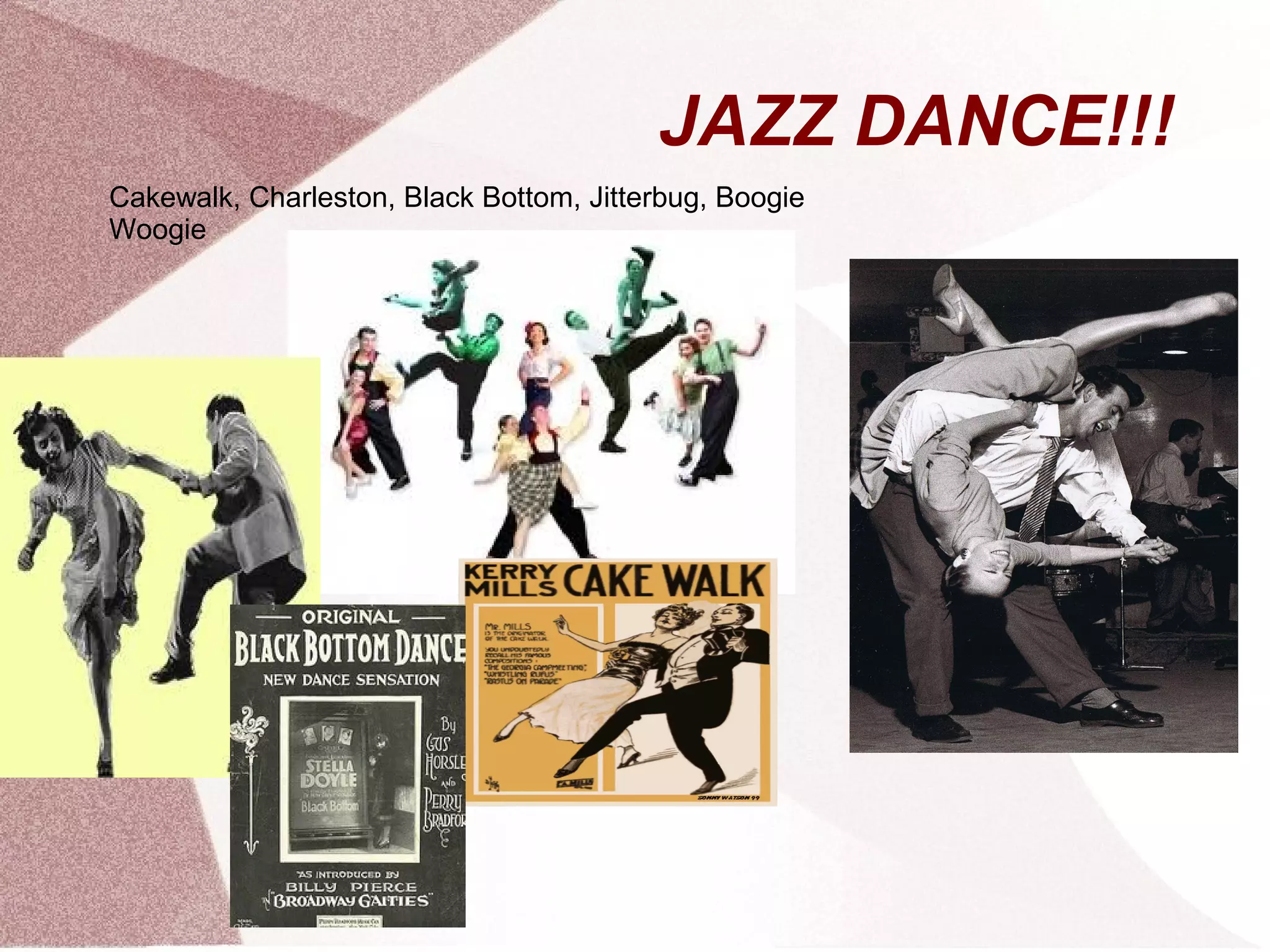
Cakewalk, Charleston, Black Bottom, Jitterbug, Boogie
Woogie
AFRICAN AMERICANS

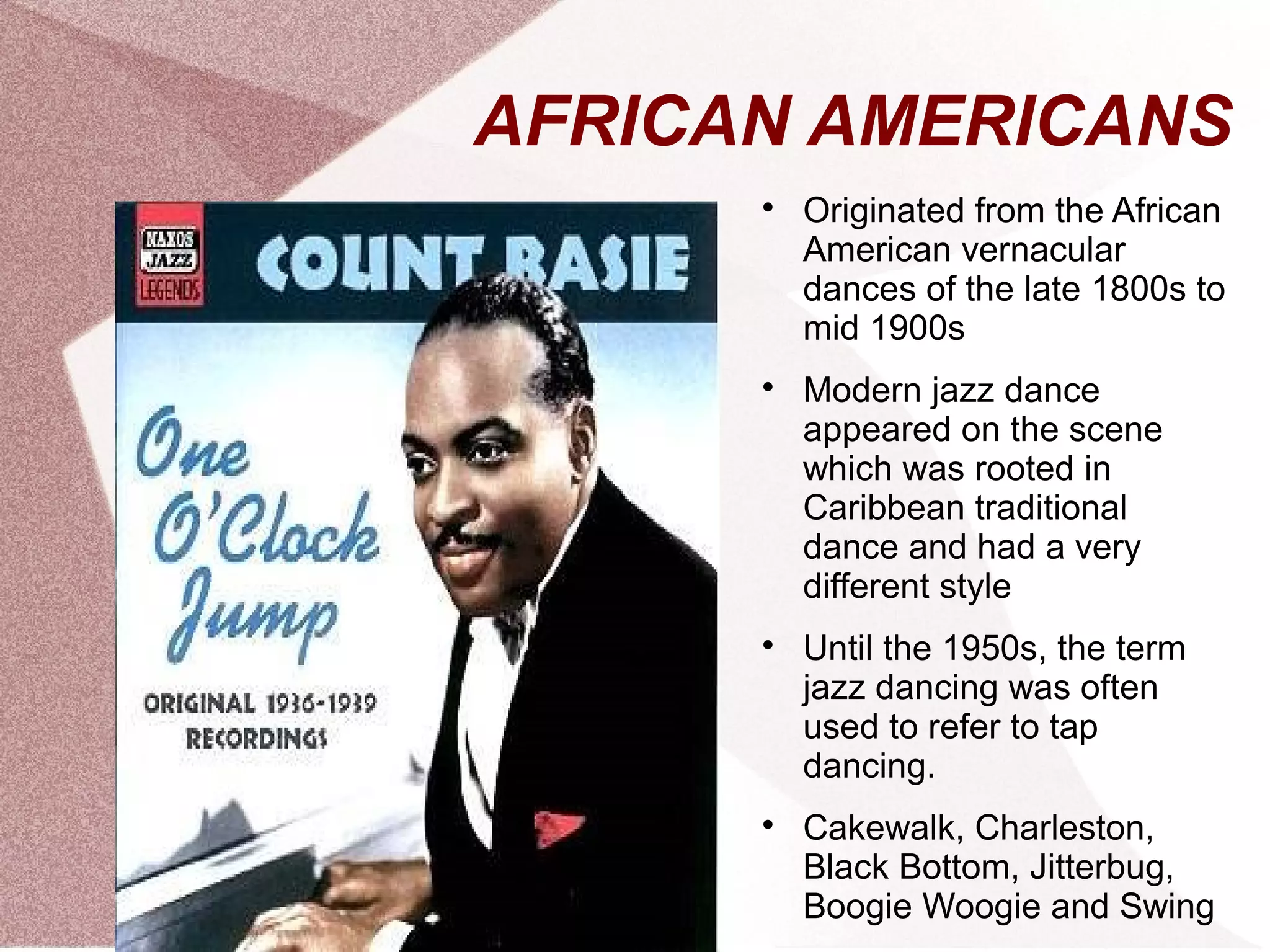
Originated from the African
American vernacular
dances of the late 1800s to
mid 1900s

Modern jazz dance
appeared on the scene
which was rooted in
Caribbean traditional
dance and had a very
different style

Until the 1950s, the term
jazz dancing was often
used to refer to tap
dancing.

Cakewalk, Charleston,
Black Bottom, Jitterbug,
Boogie Woogie and Swing
JACK COLE
PIONEER OF JAZZ DANCE
Row 1 Row 2 Row 3 Row 4
0
2
4
6
8
10
12
Column 1
Column 2
Column 3

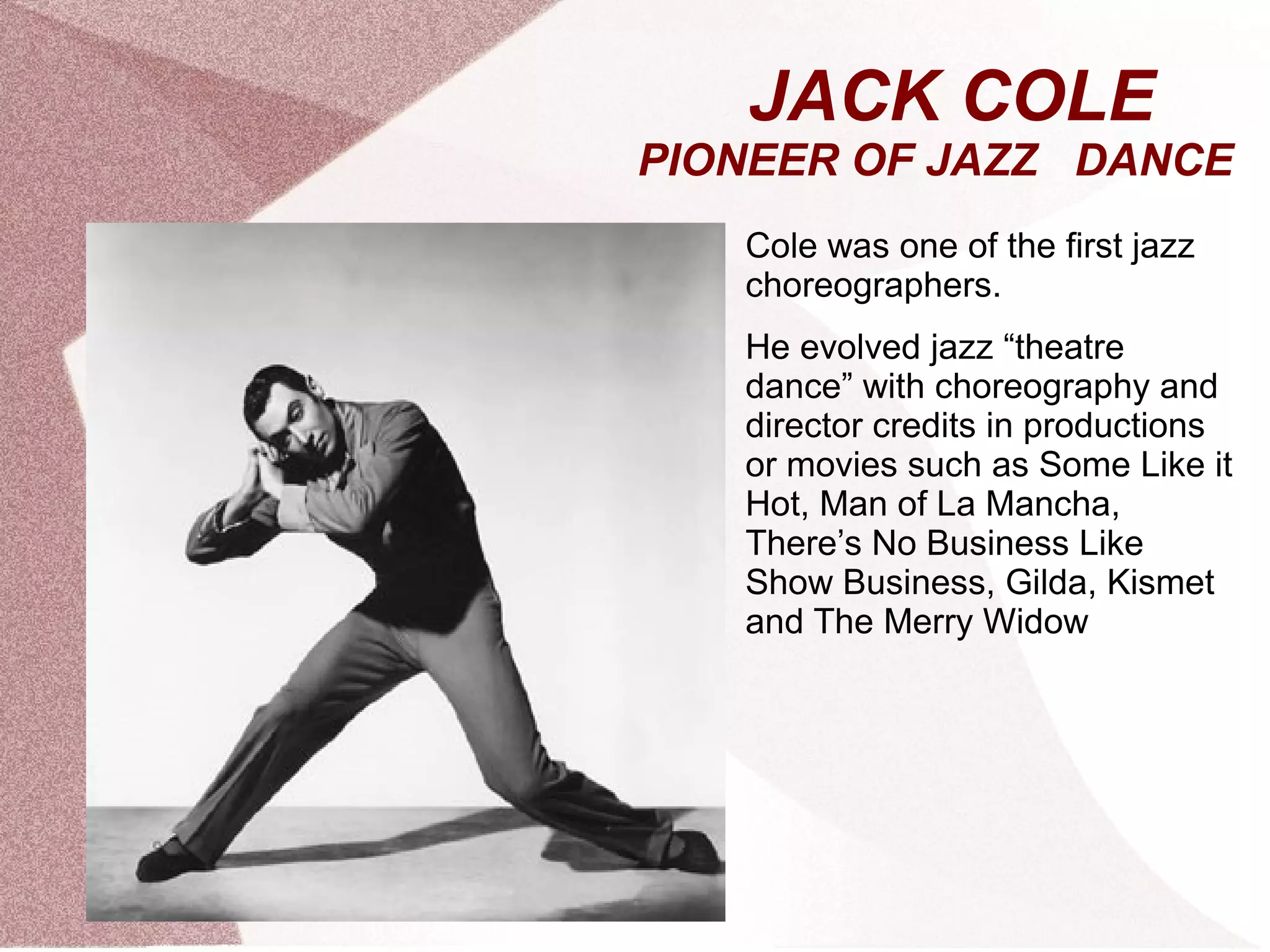
Cole was one of the first jazz
choreographers.

He evolved jazz “theatre
dance” with choreography and
director credits in productions
or movies such as Some Like it
Hot, Man of La Mancha,
There’s No Business Like
Show Business, Gilda, Kismet
and The Merry Widow
JACK COLE
PIONEER OF JAZZ DANCE

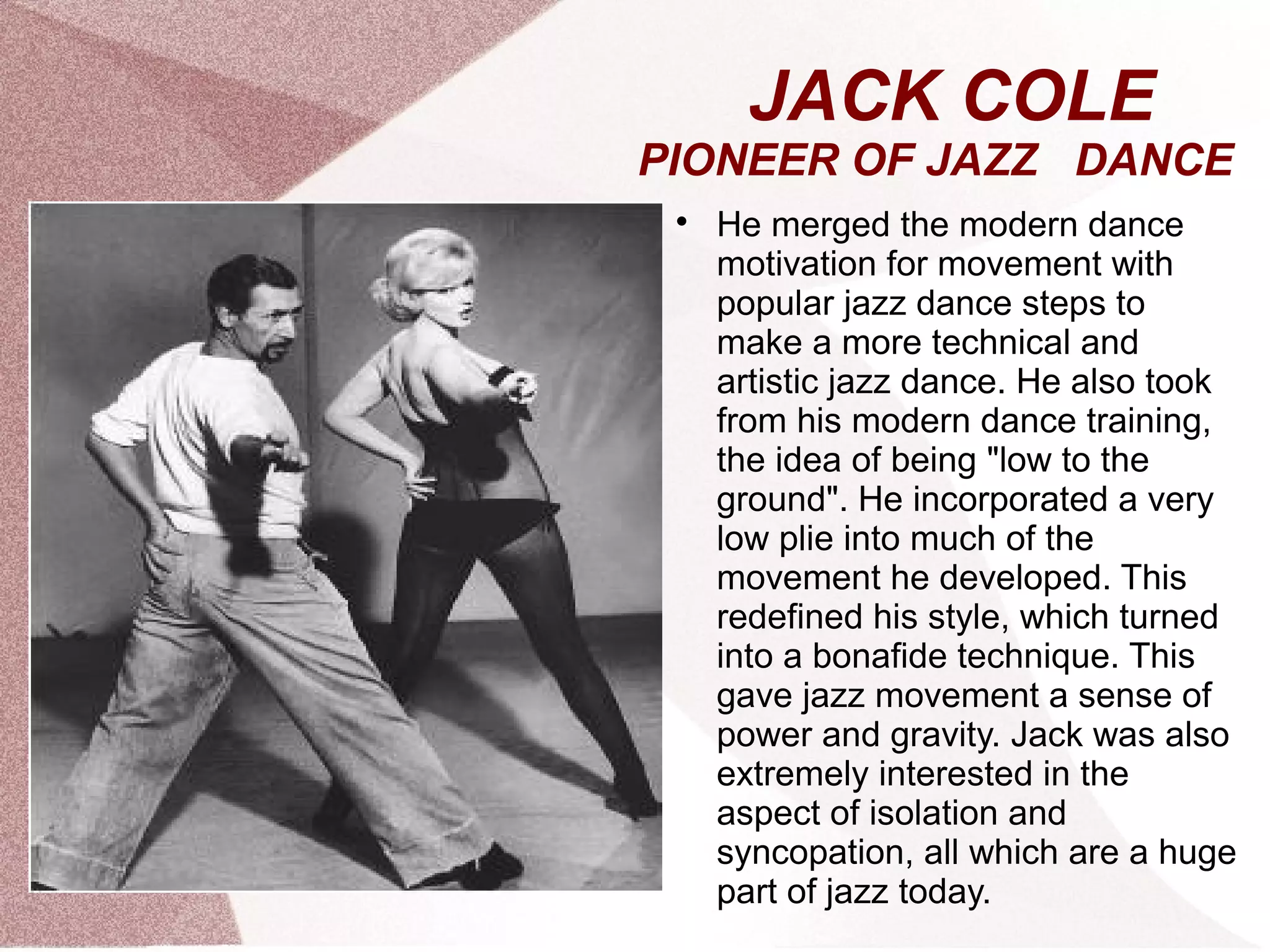
He merged the modern dance
motivation for movement with
popular jazz dance steps to
make a more technical and
artistic jazz dance. He also took
from his modern dance training,
the idea of being "low to the
ground". He incorporated a very
low plie into much of the
movement he developed. This
redefined his style, which turned
into a bonafide technique. This
gave jazz movement a sense of
power and gravity. Jack was also
extremely interested in the
aspect of isolation and
syncopation, all which are a huge
part of jazz today.
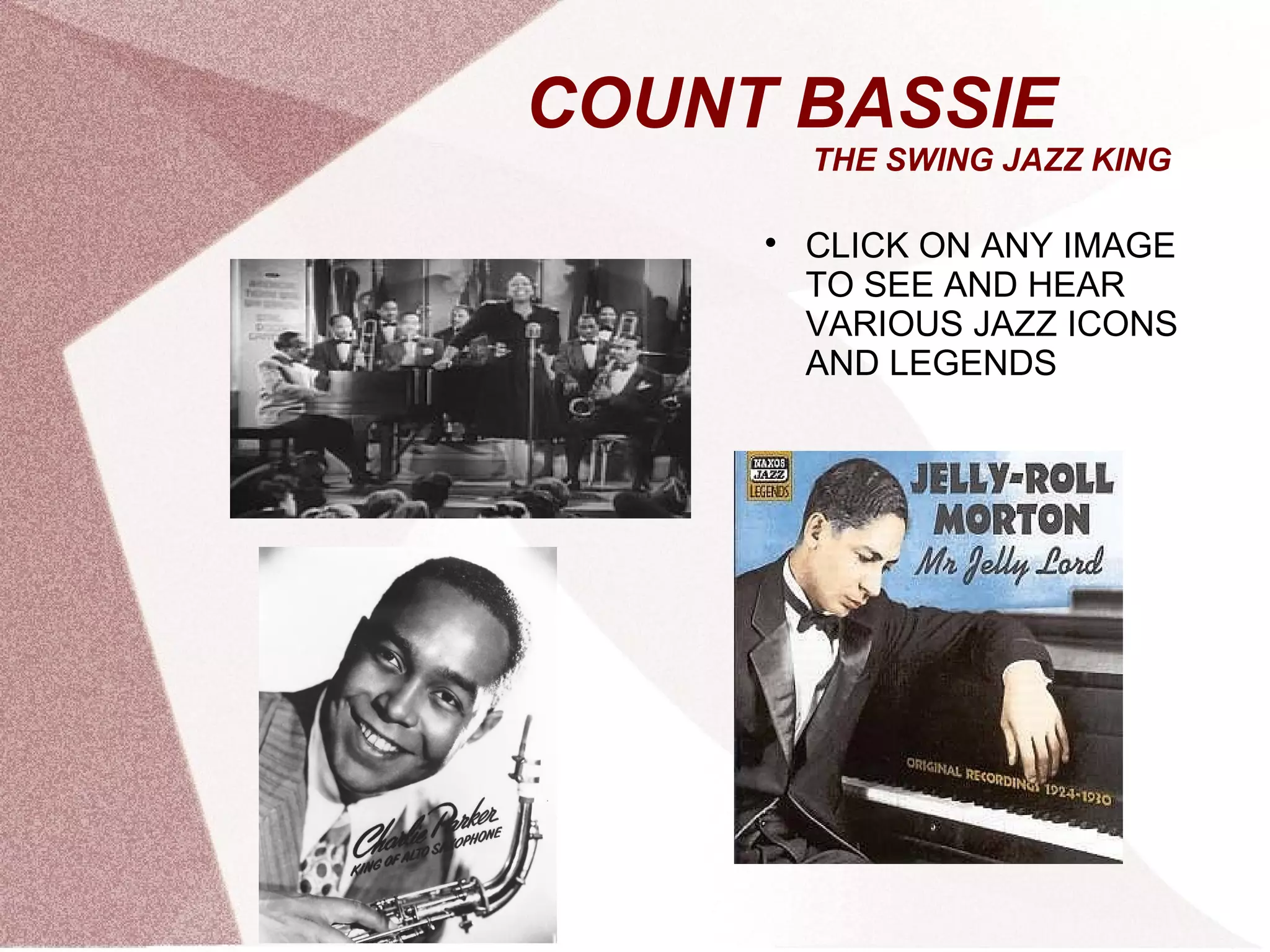
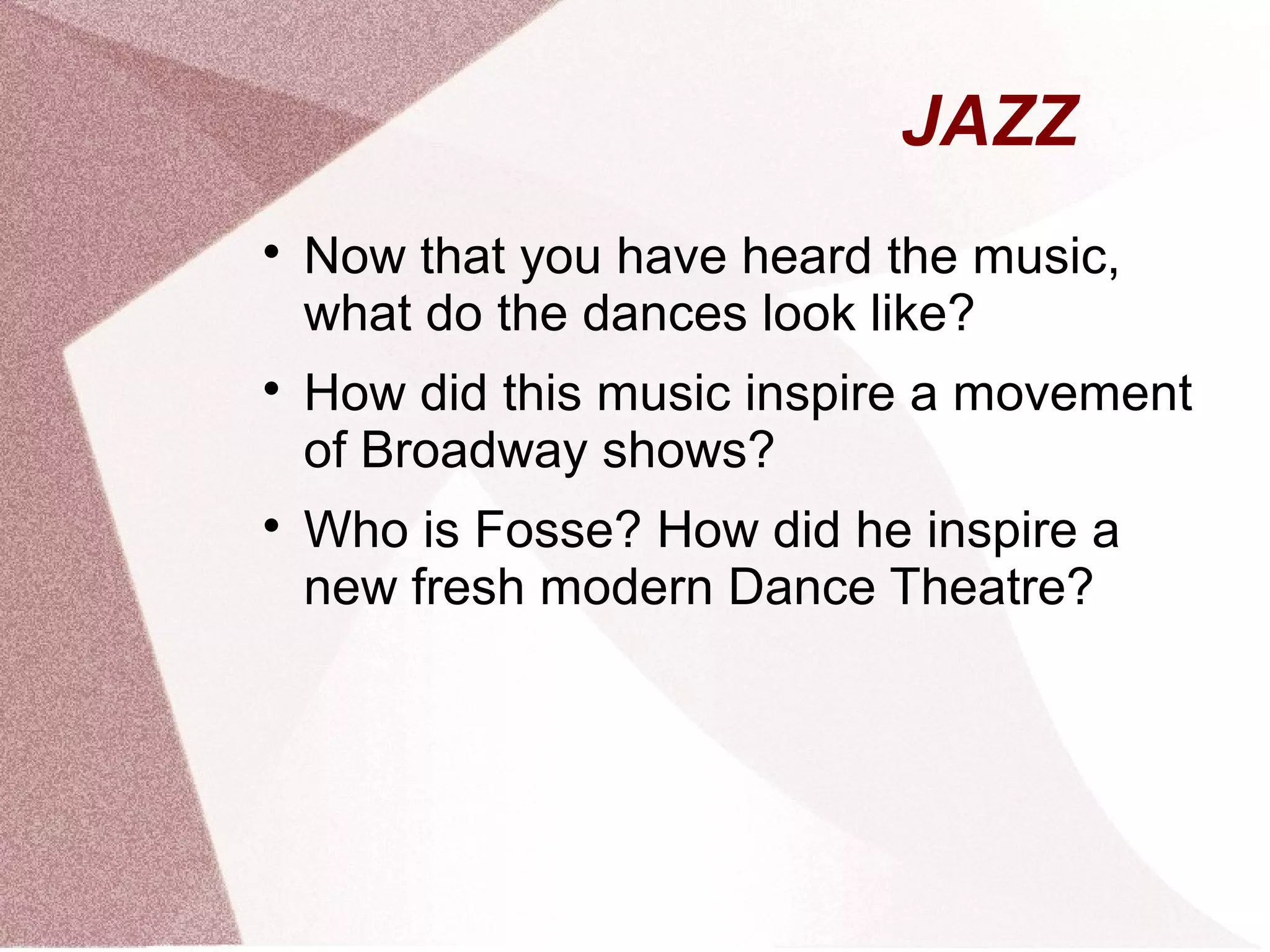
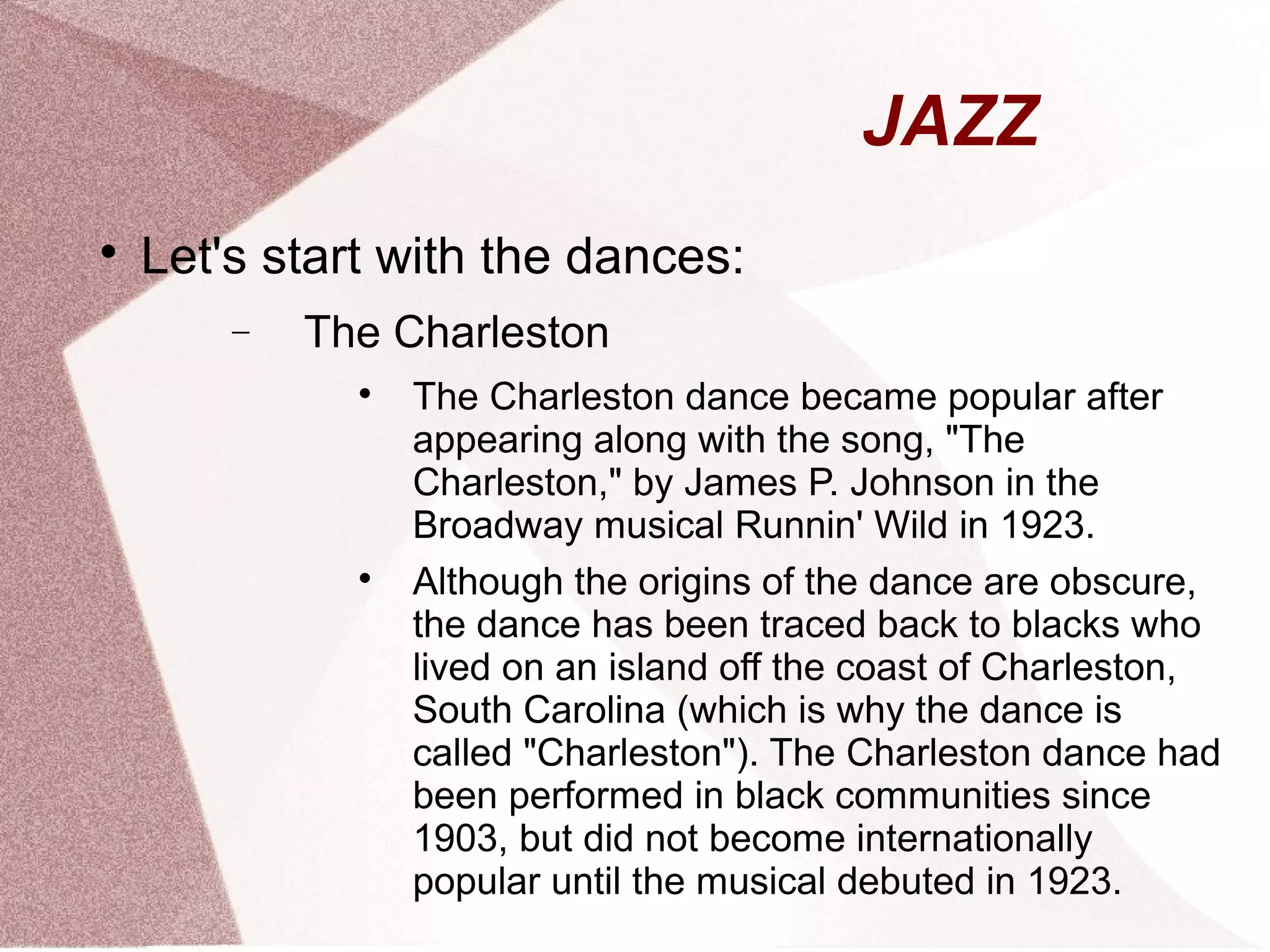
COUNT BASSIE
THE SWING JAZZ KING

CLICK ON ANY IMAGE
TO SEE AND HEAR
VARIOUS JAZZ ICONS
AND LEGENDS
JAZZ

Now that you have heard the music,
what do the dances look like?

How did this music inspire a movement
of Broadway shows?

Who is Fosse? How did he inspire a
new fresh modern Dance Theatre?
JAZZ

Let's start with the dances:
− The Charleston

The Charleston dance became popular after
appearing along with the song, "The
Charleston," by James P. Johnson in the
Broadway musical Runnin' Wild in 1923.

Although the origins of the dance are obscure,
the dance has been traced back to blacks who
lived on an island off the coast of Charleston,
South Carolina (which is why the dance is
called "Charleston"). The Charleston dance had
been performed in black communities since
1903, but did not become internationally
popular until the musical debuted in 1923.
THE CHARLESTON

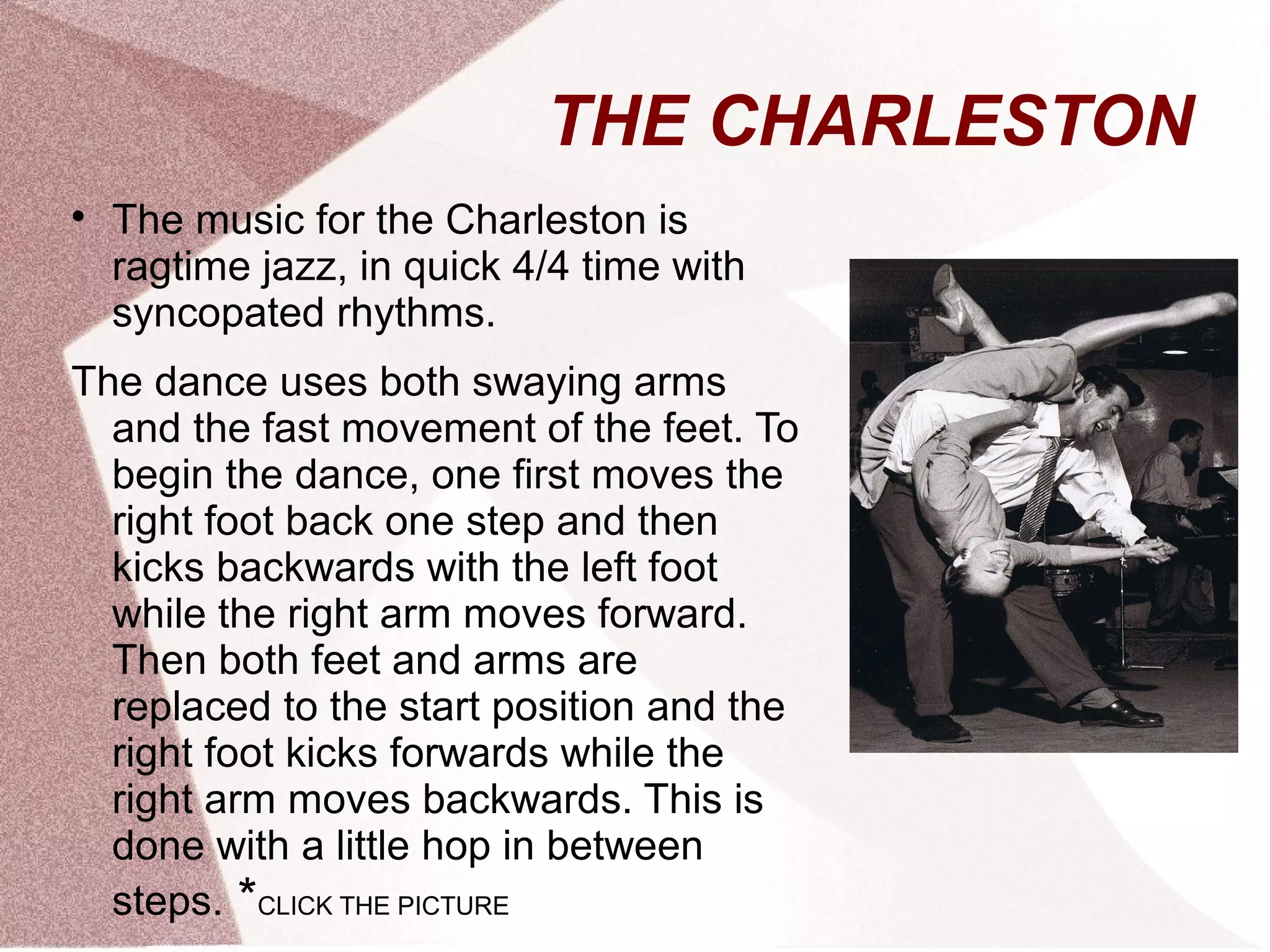
The music for the Charleston is
ragtime jazz, in quick 4/4 time with
syncopated rhythms.
The dance uses both swaying arms
and the fast movement of the feet. To
begin the dance, one first moves the
right foot back one step and then
kicks backwards with the left foot
while the right arm moves forward.
Then both feet and arms are
replaced to the start position and the
right foot kicks forwards while the
right arm moves backwards. This is
done with a little hop in between
steps. *CLICK THE PICTURE
THE BLACK BOTTOM

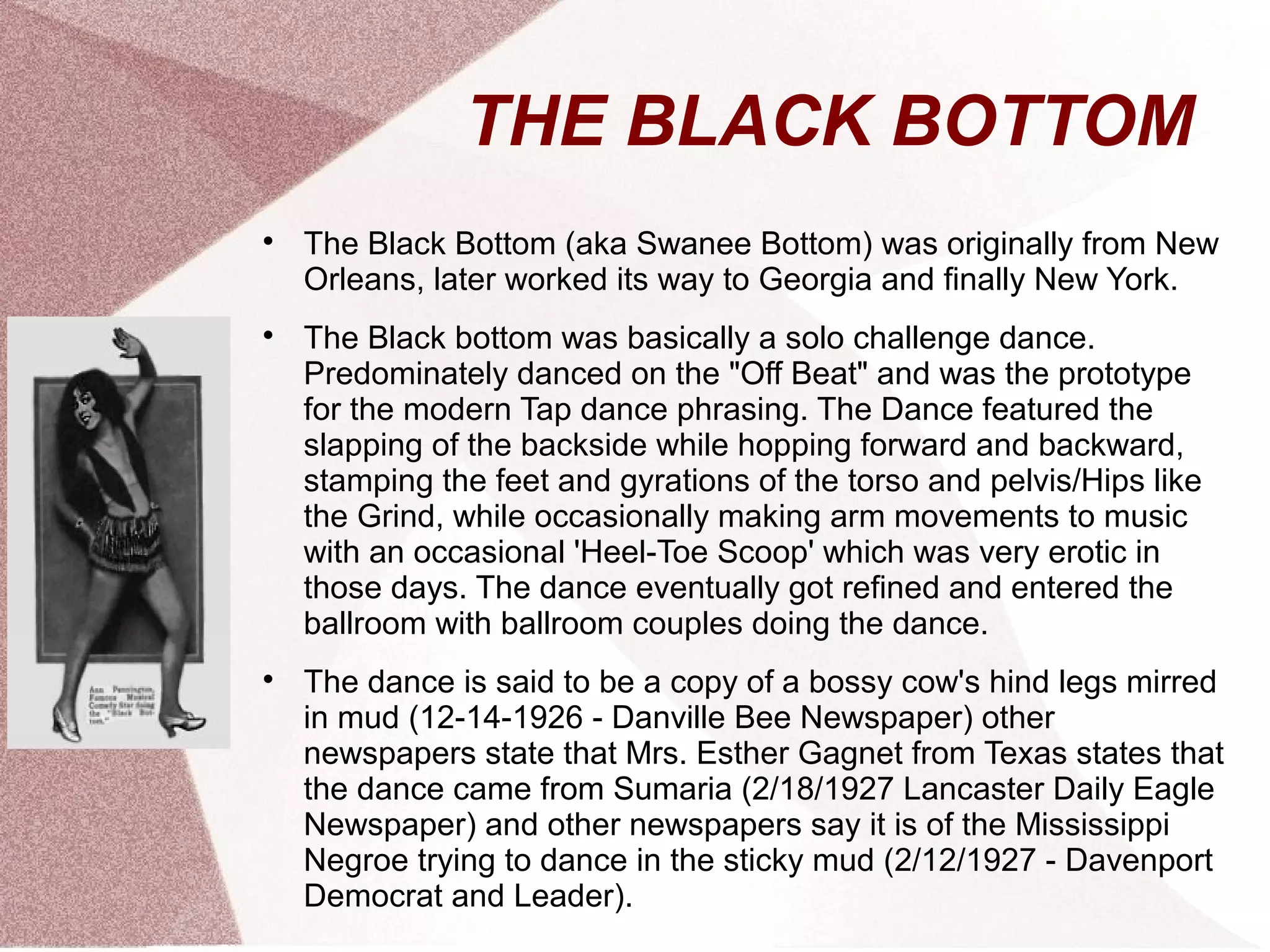
The Black Bottom (aka Swanee Bottom) was originally from New
Orleans, later worked its way to Georgia and finally New York.

The Black bottom was basically a solo challenge dance.
Predominately danced on the "Off Beat" and was the prototype
for the modern Tap dance phrasing. The Dance featured the
slapping of the backside while hopping forward and backward,
stamping the feet and gyrations of the torso and pelvis/Hips like
the Grind, while occasionally making arm movements to music
with an occasional 'Heel-Toe Scoop' which was very erotic in
those days. The dance eventually got refined and entered the
ballroom with ballroom couples doing the dance.

The dance is said to be a copy of a bossy cow's hind legs mirred
in mud (12-14-1926 - Danville Bee Newspaper) other
newspapers state that Mrs. Esther Gagnet from Texas states that
the dance came from Sumaria (2/18/1927 Lancaster Daily Eagle
Newspaper) and other newspapers say it is of the Mississippi
Negroe trying to dance in the sticky mud (2/12/1927 - Davenport
Democrat and Leader).
THE CAKE WALK

The Cakewalk had its origins in slavery. Peering through the windows
at the spectacles hosted by white planters, enslaved blacks would
then prance and preen in imitation of whites at their own dances,
using exaggerated movements, curtsys and bows to and adopting
“high-toned” clothing to mock. In performance, couples would line up
to form an aisle, down which each pair would take a turn at a high-
stepping promenade through the others. The irony was extended
when white planters began to host and judge Cakewalk competitions,
awarding a cake of some kind to the winning couple.

The meaning of the dance was lost on white minstrel performers,
who added the exaggerated, over-the-top dance to their repertoire to
portray the bumbling attempts of poor blacks to mimic the manners
of whites. No longer was the Cakewalk a dance of satire; minstrels
and their audience genuinely thought it signified blacks wanting to be
like whites. By the turn of the century, the Cakewalk was used by
both black and white minstrel performers far from its original
intentions, and when the musical comedy gained prominence in
theatre, the Cakewalk was transferred from the circuit theatre to
Broadway.
MODERN JAZZ
CHOREOGRAPHERS
Katherine Dunham

In 1937, Katherine Dunham, a
former student of ballet and
modern dance, formed the Negro
Dance Group after returning from
academic study in the Caribbean.
The group incorporated African
and Caribbean dance movements
with more traditional dance forms.
Dunham's fusion of modern, ballet
and ethnic dance is an important
component of modern jazz dance.
Jerome Robbins

In the 1950s and 60s, New York
City Ballet associate artistic
director, Jerome Robbins was a
hugely influential and successful
theatrical jazz dance
choreographer as well as a ballet
choreographer. Dance historians
credit Robbins with the refinement
of the jazz gesture--and the
melding of ballet and jazz for a
more lyrical and dramatic form of
jazz dance. In addition to his
ballets for NYCB, Robbins
choreographed Broadway
musicals like "West Side Story,"
"The King and I" and "Fiddler on
the Roof."
MODERN JAZZ
CHOREOGRAPHERS
Bob Fosse

Influenced heavily by choreographers Jack Cole and Jerome Robbins,
Bob Fosse expanded on the use of the isolation and gesture--
sometimes moving only a finger or a hip as part of his choreography.
Fosse's physical limitations--turned in knees and hunched shoulders--
became part of his dance vocabulary. Bowler hats, canes and chairs
became standard props in jazz dance thanks to Fosse. Fosse's original
production of the musical "Chicago" opened in 1975. A new production,
with his choreography, opened in 1996 and, as of 2010, is still running.

Jazz Dance ppt

  • 1.
    JAZZ DANCE!!! Cakewalk, Charleston,Black Bottom, Jitterbug, Boogie Woogie
  • 2.
    AFRICAN AMERICANS  Originated fromthe African American vernacular dances of the late 1800s to mid 1900s  Modern jazz dance appeared on the scene which was rooted in Caribbean traditional dance and had a very different style  Until the 1950s, the term jazz dancing was often used to refer to tap dancing.  Cakewalk, Charleston, Black Bottom, Jitterbug, Boogie Woogie and Swing
  • 3.
    JACK COLE PIONEER OFJAZZ DANCE Row 1 Row 2 Row 3 Row 4 0 2 4 6 8 10 12 Column 1 Column 2 Column 3  Cole was one of the first jazz choreographers.  He evolved jazz “theatre dance” with choreography and director credits in productions or movies such as Some Like it Hot, Man of La Mancha, There’s No Business Like Show Business, Gilda, Kismet and The Merry Widow
  • 4.
    JACK COLE PIONEER OFJAZZ DANCE  He merged the modern dance motivation for movement with popular jazz dance steps to make a more technical and artistic jazz dance. He also took from his modern dance training, the idea of being "low to the ground". He incorporated a very low plie into much of the movement he developed. This redefined his style, which turned into a bonafide technique. This gave jazz movement a sense of power and gravity. Jack was also extremely interested in the aspect of isolation and syncopation, all which are a huge part of jazz today.
  • 5.
    COUNT BASSIE THE SWINGJAZZ KING  CLICK ON ANY IMAGE TO SEE AND HEAR VARIOUS JAZZ ICONS AND LEGENDS
  • 6.
    JAZZ  Now that youhave heard the music, what do the dances look like?  How did this music inspire a movement of Broadway shows?  Who is Fosse? How did he inspire a new fresh modern Dance Theatre?
  • 7.
    JAZZ  Let's start withthe dances: − The Charleston  The Charleston dance became popular after appearing along with the song, "The Charleston," by James P. Johnson in the Broadway musical Runnin' Wild in 1923.  Although the origins of the dance are obscure, the dance has been traced back to blacks who lived on an island off the coast of Charleston, South Carolina (which is why the dance is called "Charleston"). The Charleston dance had been performed in black communities since 1903, but did not become internationally popular until the musical debuted in 1923.
  • 8.
    THE CHARLESTON  The musicfor the Charleston is ragtime jazz, in quick 4/4 time with syncopated rhythms. The dance uses both swaying arms and the fast movement of the feet. To begin the dance, one first moves the right foot back one step and then kicks backwards with the left foot while the right arm moves forward. Then both feet and arms are replaced to the start position and the right foot kicks forwards while the right arm moves backwards. This is done with a little hop in between steps. *CLICK THE PICTURE
  • 9.
    THE BLACK BOTTOM  TheBlack Bottom (aka Swanee Bottom) was originally from New Orleans, later worked its way to Georgia and finally New York.  The Black bottom was basically a solo challenge dance. Predominately danced on the "Off Beat" and was the prototype for the modern Tap dance phrasing. The Dance featured the slapping of the backside while hopping forward and backward, stamping the feet and gyrations of the torso and pelvis/Hips like the Grind, while occasionally making arm movements to music with an occasional 'Heel-Toe Scoop' which was very erotic in those days. The dance eventually got refined and entered the ballroom with ballroom couples doing the dance.  The dance is said to be a copy of a bossy cow's hind legs mirred in mud (12-14-1926 - Danville Bee Newspaper) other newspapers state that Mrs. Esther Gagnet from Texas states that the dance came from Sumaria (2/18/1927 Lancaster Daily Eagle Newspaper) and other newspapers say it is of the Mississippi Negroe trying to dance in the sticky mud (2/12/1927 - Davenport Democrat and Leader).
  • 10.
    THE CAKE WALK  TheCakewalk had its origins in slavery. Peering through the windows at the spectacles hosted by white planters, enslaved blacks would then prance and preen in imitation of whites at their own dances, using exaggerated movements, curtsys and bows to and adopting “high-toned” clothing to mock. In performance, couples would line up to form an aisle, down which each pair would take a turn at a high- stepping promenade through the others. The irony was extended when white planters began to host and judge Cakewalk competitions, awarding a cake of some kind to the winning couple.  The meaning of the dance was lost on white minstrel performers, who added the exaggerated, over-the-top dance to their repertoire to portray the bumbling attempts of poor blacks to mimic the manners of whites. No longer was the Cakewalk a dance of satire; minstrels and their audience genuinely thought it signified blacks wanting to be like whites. By the turn of the century, the Cakewalk was used by both black and white minstrel performers far from its original intentions, and when the musical comedy gained prominence in theatre, the Cakewalk was transferred from the circuit theatre to Broadway.
  • 11.
    MODERN JAZZ CHOREOGRAPHERS Katherine Dunham  In1937, Katherine Dunham, a former student of ballet and modern dance, formed the Negro Dance Group after returning from academic study in the Caribbean. The group incorporated African and Caribbean dance movements with more traditional dance forms. Dunham's fusion of modern, ballet and ethnic dance is an important component of modern jazz dance. Jerome Robbins  In the 1950s and 60s, New York City Ballet associate artistic director, Jerome Robbins was a hugely influential and successful theatrical jazz dance choreographer as well as a ballet choreographer. Dance historians credit Robbins with the refinement of the jazz gesture--and the melding of ballet and jazz for a more lyrical and dramatic form of jazz dance. In addition to his ballets for NYCB, Robbins choreographed Broadway musicals like "West Side Story," "The King and I" and "Fiddler on the Roof."
  • 12.
    MODERN JAZZ CHOREOGRAPHERS Bob Fosse  Influencedheavily by choreographers Jack Cole and Jerome Robbins, Bob Fosse expanded on the use of the isolation and gesture-- sometimes moving only a finger or a hip as part of his choreography. Fosse's physical limitations--turned in knees and hunched shoulders-- became part of his dance vocabulary. Bowler hats, canes and chairs became standard props in jazz dance thanks to Fosse. Fosse's original production of the musical "Chicago" opened in 1975. A new production, with his choreography, opened in 1996 and, as of 2010, is still running.