SOCIAL
DANCES
SOCIAL DANCE
•Intended primarily to get to know
other people in attendance to a
certain social function.
•They are also called ballroom
dances.
•They are usually performed in
pairs, male and female, but many
also performed in groups.
CLASSIFICATIO
N OF
SOCIAL
DANCES
MODERN-STANDARD
DANCES
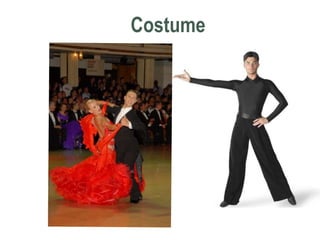
•They wear ankle length gowns for
females and coat-and-tie for males.
•Most of the time, movements in these
are restricted to close ballroom position
with partner.
Costume
Shoes
MODERN-STANDARD
DANCES
NAME OF DANCE ORIGIN
Slow Waltz Austria
Tango Argentina
Foxtrot USA
Quickstep USA
SLOW WALTZ
•Began as a country folk dance in Austria
and Bavarian in the 17th century
•In 19th century, it was introduced to
England.
•It was the first dance where a man held
a woman close to his body
TANGO
•Originated in Argentina in the late 19th
century
•It is danced in both open and closed
embraces which focuses on the lead and
follow moving in harmony of the tango's
passionate charging music
•Utilizes strong and staccato movements
FOXTROT
•It is an American dance and believed to
be of African-American origin.
•Named by a vaudeville Harry Fox in
1914
•It can be danced at slow, medium, or
fast tempos depending on the speed of
the jazz or big band music
QUICKSTEP
•It is an English dance and was invented
in the 1920s as a combination of faster
tempo of foxtrot.
•includes the walks, runs, chasses, and
turns of the original foxtrot dance, with
some other fast figures such as locks,
hops, and skips.
LATIN-AMERICAN DANCES
•Latin Dances distinguish themselves by
the costume worn by performers.
•They are somewhat revealing, tight-
fitting, sexy yet sophisticated in nature.
•They are also distinguished by the
nature of the movements.
•They are freer and can be performed in
close or open hold.
Costumes
Shoes
LATIN-AMERICAN DANCES
NAME OF DANCE ORIGIN
Cha-Cha-Cha Cuba
Samba Brazil
Rhumba Cuba
Paso Doble Spain
Jive USA
CHA-CHA-CHA
•sometimes called cha-cha in the US
•was developed by Enrique Jorrín in the
early 1950s
•It is a flirtatious dance with many hip
rotations and partners synchronizing
their movements
SAMBA
•It is the national dance of Brazil
•In 1905, samba became known to other
countries during an exhibition in Paris
•In the 1940s, samba was introduced in
America
•It is danced with a slight bounce which
is created through the bending and
straightening the knee
RHUMBA
•Rhumba came to the United States from
Cuba in the 1920s and became a
popular cabaret dance during
prohibition. It includes Cuban motions
through knee-strengthening, figure-
eight hip rotation, and swiveling foot
action
•An important characteristic of rhumba is
the powerful and direct lead achieved
through the ball of the foot
PASO DOBLE
•It originated from Spain and its dramatic
bullfights
•The dance is mostly performed only in
competitions and rarely socially because
of its many choreographic rules.
•The lead plays the role of the matador
while the follow takes the role of the
matador's cape, the bull, or even the
matador
JIVE
•is part of the swing dance group and is
a very lively variation of the jitterbug
•originated from African American clubs
in the early 1940s
•In jive, the man leads the dance while
the woman encourages the man to ask
them to dance
DON’TS IN TERMS OF OUTFIT
AND DANCE SHOES
•Do not wear sneaker or any shoe with
rubber or spongy sole
•Avoid sleeveless shirts and strapped
dresses.
•Avoid shaggy, baggy, low armpit upper
shirt.
DON’TS IN TERMS OF OUTFIT
AND DANCE SHOES
•Avoid accessories like big rings,
watches, brooches, loose/long necklace
and big belt buckles
•Long hair should be put up or tied in a
pony tail.
PERSONAL GROOMING
•Before the dance…
•Shower and use deodorant
•Brush your teeth and use
mouthwash/breath mint
•Don’t smoke
NO-FAULT DANCING
•Never blame a partner for missed
execution of figures
•Dance to the level of your partner
•The show must go on
DEMEANOR
•Be personable, smile and make an eye
contact with the partner
•Project a positive image on the dance
floor even if it’s not your personal style.
•No teaching on the dance floor, it may
insult your partner
•Do not cut other dancers off
SOCIAL
DANCES
Prepared by:
ANGELA MAE C. ALBA
Instructor I

Social Dances

  • 1.
  • 2.
    SOCIAL DANCE •Intended primarilyto get to know other people in attendance to a certain social function. •They are also called ballroom dances. •They are usually performed in pairs, male and female, but many also performed in groups.
  • 3.
  • 4.
    MODERN-STANDARD DANCES •They wear anklelength gowns for females and coat-and-tie for males. •Most of the time, movements in these are restricted to close ballroom position with partner.
  • 5.
  • 6.
  • 7.
    MODERN-STANDARD DANCES NAME OF DANCEORIGIN Slow Waltz Austria Tango Argentina Foxtrot USA Quickstep USA
  • 8.
    SLOW WALTZ •Began asa country folk dance in Austria and Bavarian in the 17th century •In 19th century, it was introduced to England. •It was the first dance where a man held a woman close to his body
  • 9.
    TANGO •Originated in Argentinain the late 19th century •It is danced in both open and closed embraces which focuses on the lead and follow moving in harmony of the tango's passionate charging music •Utilizes strong and staccato movements
  • 10.
    FOXTROT •It is anAmerican dance and believed to be of African-American origin. •Named by a vaudeville Harry Fox in 1914 •It can be danced at slow, medium, or fast tempos depending on the speed of the jazz or big band music
  • 11.
    QUICKSTEP •It is anEnglish dance and was invented in the 1920s as a combination of faster tempo of foxtrot. •includes the walks, runs, chasses, and turns of the original foxtrot dance, with some other fast figures such as locks, hops, and skips.
  • 12.
    LATIN-AMERICAN DANCES •Latin Dancesdistinguish themselves by the costume worn by performers. •They are somewhat revealing, tight- fitting, sexy yet sophisticated in nature. •They are also distinguished by the nature of the movements. •They are freer and can be performed in close or open hold.
  • 13.
  • 14.
  • 15.
    LATIN-AMERICAN DANCES NAME OFDANCE ORIGIN Cha-Cha-Cha Cuba Samba Brazil Rhumba Cuba Paso Doble Spain Jive USA
  • 16.
    CHA-CHA-CHA •sometimes called cha-chain the US •was developed by Enrique Jorrín in the early 1950s •It is a flirtatious dance with many hip rotations and partners synchronizing their movements
  • 17.
    SAMBA •It is thenational dance of Brazil •In 1905, samba became known to other countries during an exhibition in Paris •In the 1940s, samba was introduced in America •It is danced with a slight bounce which is created through the bending and straightening the knee
  • 18.
    RHUMBA •Rhumba came tothe United States from Cuba in the 1920s and became a popular cabaret dance during prohibition. It includes Cuban motions through knee-strengthening, figure- eight hip rotation, and swiveling foot action •An important characteristic of rhumba is the powerful and direct lead achieved through the ball of the foot
  • 19.
    PASO DOBLE •It originatedfrom Spain and its dramatic bullfights •The dance is mostly performed only in competitions and rarely socially because of its many choreographic rules. •The lead plays the role of the matador while the follow takes the role of the matador's cape, the bull, or even the matador
  • 20.
    JIVE •is part ofthe swing dance group and is a very lively variation of the jitterbug •originated from African American clubs in the early 1940s •In jive, the man leads the dance while the woman encourages the man to ask them to dance
  • 21.
    DON’TS IN TERMSOF OUTFIT AND DANCE SHOES •Do not wear sneaker or any shoe with rubber or spongy sole •Avoid sleeveless shirts and strapped dresses. •Avoid shaggy, baggy, low armpit upper shirt.
  • 22.
    DON’TS IN TERMSOF OUTFIT AND DANCE SHOES •Avoid accessories like big rings, watches, brooches, loose/long necklace and big belt buckles •Long hair should be put up or tied in a pony tail.
  • 23.
    PERSONAL GROOMING •Before thedance… •Shower and use deodorant •Brush your teeth and use mouthwash/breath mint •Don’t smoke
  • 24.
    NO-FAULT DANCING •Never blamea partner for missed execution of figures •Dance to the level of your partner •The show must go on
  • 25.
    DEMEANOR •Be personable, smileand make an eye contact with the partner •Project a positive image on the dance floor even if it’s not your personal style. •No teaching on the dance floor, it may insult your partner •Do not cut other dancers off
  • 26.

Editor's Notes

  • #9 When performing the dance, the upper body is kept to the left throughout all figures, follow's body leaves the right side of the lead while the head is extended to follow the elbow. Figures with rotation have little rise
  • #10 The tango's technique is like walking to the music while keeping feet grounded and allowing ankles and knees to brush against one another during each step taken. Body weight is kept over the toes and the connection is held between the dancers in the hips.
  • #11 Fox was rapidly trotting step to ragtime music. The dance therefore was originally named as the “Fox’s trot” The partners are facing one another and frame rotates from one side to another, changing direction after a measure. The dance is flat, with no rise and fall like the waltz. The walking steps are taken as slow for the two beats per steps and quick for one beat per step. Foxtrot is performed for both International Standard and American Smooth
  • #12 It is a fast moving dance, so men are allowed to close their feet and the couples move in short syncopated steps
  • #17 The dance includes bending and straightening of the knee
  • #18 The rhythm of samba and its name originated from the language and culture of West African slaves
  • #19 Cabaret – entertainment provided at a such restaurant/where you can buy alcohol and enjoy music show
  • #20 Matador – a person who has the major part in a bullfight and who kills the bull
  • #21 Jitterbug – a very lively type of dance in 1940s During World War II, American soldiers introduced the jive in England where it was adapted to today's competitive jive