DANCE
and
Cheerdancing and cheerleading are physical activities that
involve organized routines that feature a combination of
dance, tumbling, jumps, cheers, yelling, and stunts. Both are
usually performed during sports events such as basketball and
volleyball.
They can also be performed in stand-alone competitions in
which judges evaluate the routine based on a set criteria. An
individual who performs in a cheer dance is called cheer
dancer , while a person who performs in a cheerleading is
referred to as cheerleader.
Cheer Dance vs. Cheerleading
Both share some elements, they are nonetheless different in some aspects.
According to JR David (manager of the Philippine cheerleading team and director
of the National Cheerleading Championship) , cheer dance is more artistic while
cheerleading is more technical. Rhufa Rosario (a respected pep squad coach),
explains that cheer dance is a combination of cheerleading and dance that
focuses more on dance and different kinds of themes and props. She also notes
that cheerleading is more of a sport, with dance just as one of its basic elements:
stunts, pyramids, tumblings, and tosses.
The challenge, therefore, is to balance all these five elements.
History of
Cheerdancing
and
Cheerleading
Beginnings
Cheerleading dates to the 1860s, in Great Britain, and entered the US in
the 1880s. Although women currently dominate the field, cheerleading
was begun by men. Princeton University, in 1884, got the idea that crowd
chanting at football games would boost school spirit so they came up
with a catchy cheer. In 1898, University of Minnesota student Johnny
Campbell directed a crowd in cheering 'Rah, Rah, Rah! Ski-u-mah, Hoo-
Rah! Hoo-Rah! Varsity! Varsity! Varsity, Minn-e-So-Tah!', making Campbell
the very first cheerleader and November 2, 1898 the official birth date of
organized cheerleading. Soon after, the University of Minnesota
organized a 'yell leader' squad of six male students, who still use
Campbell's original cheer."
You can delete this slide when you’re done editing the presentation.
Female Participation
It was only in 1932 when women were finally admitted into
cheerleading. During the late 1920s many published school papers still
referred to cheerleaders as “man” or “chap”. In the early 1940s when
the Second World War, it caused a drastic change in the world of
cheerleading – with collegiate men being drafted into the U.S.
military, women got the opportunity to participate more in sporting
events , including cheerleading. From then on, until today, females
have dominated the sport.
The Father of the Modern Cheer
Cheerleading became a huge part of Lawrence Herkimer’s life. He stepped
onto the scene in 1948, and thus began the modern era of cheerleading.
One of his first innovations was to combine motion and gymnastics to
invigorate the spectators. He also invented one of the most well-known
cheerleading jumps– the herkie. His innovations spread around the world
as different countries begin to adopt American sports into their culture.
Health
Benefits of
Cheer Dance
01
STRENGTH
Routines in a cheer dance include
cheerleaders lifting other cheerleaders.
Vigorous activities provide strength which
can increase the number of burned calories,
can also result healthier and stronger
muscles, and reduce muscle pain. Strong
muscles help support bones which reduces
the probability of bone breakage
CARDIOVASCULAR HEALTH
Engagement in activities
such as jumping, stunts,
leaping and floor routines
can increase the heart rate
and improve cardiovascular
health.
03
FLEXIBILITY
Both require flexibility. With sufficient proper
training, they can perform splits, etc.
Flexibility is correlated woth a decreased risk
of injury. Aches and pains that one may
experience during cheer dance performances
may be reduced if he or she has healthy
muscle development, which is promoted by
muscle flexibility.
02
SUPPORT AND SOCIALIZATION
Both cheer dance and cheerleading
require regular interaction among the
members of a cheering squad. Members
must learn to fully trust one another.
Richard Weissbourd, a psychologist,
points out that participating in group
sports can help developstrong morals
and also can reduce the likelihood of
anxiety and depression.
04
Cheer Dance and Cheerleading in th Philippines
The Universal Cheerleaders Association (UCA) started introducing the
concept of cheerleading to the world in the 1980s.Cheerleading began to
flourisg in the Philippines in the 1990s as a natural outgrowth of the
Filipinos’ love for team sports. Here in the Philippines, the most
recognizable and watched cheer dance/cheerleading competitions are
the annual University Athletic Association of the Philippines (UAAP) Cheer
Dance Competion, the National Collegiate Athletic Association (NCAA)
Cheerleading Competition, and the National Cheerleading Championship
(NCC).
UAAP
The UAAP Cheer Dance
Competition is an annual
one-day event for the
cheer dance teams of the
eight member-universities
of the UAAP– AdU, ADMU,
DLSU, FEU, NU, UE, UP, and
UST.
NCAA
The NCAA Cheerleading
Competition is also an
annual one-day event for
the cheerleading teams of
the ten member-colleges
of the NCAA– AU, CSJL,
DLS-SCB, EAC, JRU, LPU,
MIT, SBC, SSC-R, and
UPHSD.
NCC
The NCC is considered as the first
and only cheerleading competition
in the Philippines that uses
American cheerleading rules and
regulation. Since in conception in
2006, it has become one of the
bggest cheerleading events in the
world, with more than 300
participating teams every season.
All of these competitions are
governed buy different national
cheer dance and cheerleading
associations in the country such as
the Philippine Cheerleading Alliance
and the Cheerleading Philippines
Association, both of which are
affiliated with international
organizations like the International
Cheer Union and International
Federation of Cheerleading.
Cheer Dance Rules
Cheer dance competition here in te Philippines have varying rules and
regulations, meaning, some rules enforced in one competition may not
apply in another competition and vice versa.
Judging criteria for a simple cheer dance or cheerleading competitions
need not be highly technical in nature: instead they must be suitable to
the level of competition.
The Basics of
Cheer Dance
and
Cheerleading
Motions
The most important aspect of both cheer dance and cheerleading are
motions. Motions make a routine or dance unique and uniform among squad
members. They also make the performance look sharp and clean.
TOUCHDOWN
Arms are raised vertical
above the shoulders,
parallel and straight
reaching up.
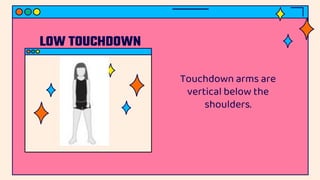
LOW TOUCHDOWN
Touchdown arms are
vertical below the
shoulders.
TABLE TOP
Arms are down at
sides with elbows
bent; hands are in
front of chest.
HIGH V
Shoulders
relaxed; arms in
the shape of a
large V, straight
up reaching
diagonal over the
shoulders.
LOW V
Shoulders
relaxed; arms are
in the shape of a
large V, straight
down reaching
diagonal under
shoulders.
T
Shoulders
relaxed; arms
straight and
horizontal to
shoulders and
parallel to the
ground.
Jumps
Jumps are often need in cheer dance routines and chants. Jumps draw
attention from spectators and a certain appearance of difficulty.
In prep motions, jumps are combined with arm motions. The following are
the steps to do a prep:
1. Start with your arms in a High V.
2. Next, swing both of your arms in a circular motion toward the inside.
Make sure they cross overhead while you bend your knees and
prepare to jump.
3. Leap into the air simultaneously as you continue to circle your arms all
the away around and direct your body to form the jump positions as
shown by the illustrations
Tuck Jump
Knees are kept together
and brought as close as
possible to the chest.
Arms are in a High V
position. Chest is kept
straight up and should
not lean forward.
Spread Eagle
Your legs are put in a
wide motion while your
arms are in a High V. The
body sould look like an X
if done correctly.
Double Hook
In this position, your legs
must be pulled up and
bent or hooked under
the body while your
arms are in a High V.
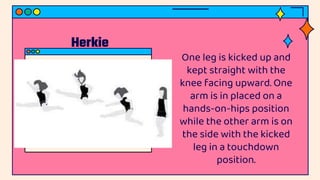
Herkie
One leg is kicked up and
kept straight with the
knee facing upward. One
arm is in placed on a
hands-on-hips position
while the other arm is on
the side with the kicked
leg in a touchdown
position.
Tumbling
Tumbling is one of the core skills in gymnastics. It is one
of the hardest and most dangerous elements of cheer
dance. This should not be tried without a spot or
spotter, a person who ensures the safety of a
cheerleader when he or she performs dangerous
stunts and routines.
Standing Tumbling
A cheerleader simply
stands and uses the
movements of his or her
arms and the muscles in
his or her legs to jump
and tumble
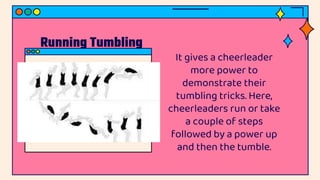
Running Tumbling
It gives a cheerleader
more power to
demonstrate their
tumbling tricks. Here,
cheerleaders run or take
a couple of steps
followed by a power up
and then the tumble.
Stunts
Stunts sequences and pyramids are some of the most
exciting feats to watch in a cheer dance competition. In
stunts sequences, some members of the cheer dance
squad are raised above the ground to catch the
attention of spectators.
Use of Facilities and Equipments
in Practoce and Performances
A spacious facility is
required for conducing
practices and holding
performances. Baskettball
gyms—stadiums or
coliseums for more
prestigious competitons,
for instance, barangay
courts or open-air courst
for smaller competitions.
Gears and Apparel
Male and female usually wear
fitted compression shirts,
shorts, and tights for these
events. Compression garments
improve blood circulation to
support the muscles to prevent
soreness. These garments are
then matched with good pair
flexible, durable, and light
rubber shoes
Personal
Safety
Protocol
01
Knowledge and Awareness
Recognize possible harmful situations and
identify steps to tske lessen the risks of
accidents
Environmental Conditions
One must consider the
environmental hazards that
might cause an accident.
04
Ability
You must always be aware of your own and
your teammates’ condition.
03
“No pain, no gain”
Even if you consider yourself in great
shape, start any new routine at
relatively low intensity and increase
your level of exertion gradually over a
number of weeks.
06
02 05
Recognize possible harmful situations and
identify steps to tske lessen the risks of
accidents
Be realistic in judging your and your
teammates’ abilities
If you feel pain during exercise, you
should stop immediately and reassess
the activity you are doing.
State of mind Do not overdo anything
01
Warm up and cool down
Warming up prepares your body for the
exercise of the activity, while cooling odwn
helps your heart rate and breathing to
return to normal levels.
Fluid Replacement
Prolonged physical activities generates a
large amount of heat. This heat can
increase the internal temperature of the
body.
• Drink at least 16-20 ounces of fluid 2
hours before exercising. Then drink 8
ounces of fluid 15-30 minutes before
you start
• Sip 4-6 ounces of fluid every 15-20
minutes while you exercise.
• After exercising, you must drink enough
water to replace the body fluid you lost.
03
Warming up
It should be performed prior to all
sessions of strenuous exercise as
“cold” muscles are more susceptible to
injury.
A proper warm-up should increase
tissue temperature and raise blood
flow to the muscles.
02
Stretching
Stretching helps improve flexibility. It
can also be part of warm-ups and cool
downs. For stretching, keep the ff. in
mind:
a. Stretch before and after exercise or
physical activity.
b. Stretch gently and slowly.
c. Hold stretches for a minimum of 10
seconds.
d. Breathe slowly andeasily.
04
THANK
YOU!!!!

PE.pptx

  • 1.
  • 2.
    Cheerdancing and cheerleadingare physical activities that involve organized routines that feature a combination of dance, tumbling, jumps, cheers, yelling, and stunts. Both are usually performed during sports events such as basketball and volleyball. They can also be performed in stand-alone competitions in which judges evaluate the routine based on a set criteria. An individual who performs in a cheer dance is called cheer dancer , while a person who performs in a cheerleading is referred to as cheerleader.
  • 3.
    Cheer Dance vs.Cheerleading Both share some elements, they are nonetheless different in some aspects. According to JR David (manager of the Philippine cheerleading team and director of the National Cheerleading Championship) , cheer dance is more artistic while cheerleading is more technical. Rhufa Rosario (a respected pep squad coach), explains that cheer dance is a combination of cheerleading and dance that focuses more on dance and different kinds of themes and props. She also notes that cheerleading is more of a sport, with dance just as one of its basic elements: stunts, pyramids, tumblings, and tosses. The challenge, therefore, is to balance all these five elements.
  • 4.
  • 5.
    Beginnings Cheerleading dates tothe 1860s, in Great Britain, and entered the US in the 1880s. Although women currently dominate the field, cheerleading was begun by men. Princeton University, in 1884, got the idea that crowd chanting at football games would boost school spirit so they came up with a catchy cheer. In 1898, University of Minnesota student Johnny Campbell directed a crowd in cheering 'Rah, Rah, Rah! Ski-u-mah, Hoo- Rah! Hoo-Rah! Varsity! Varsity! Varsity, Minn-e-So-Tah!', making Campbell the very first cheerleader and November 2, 1898 the official birth date of organized cheerleading. Soon after, the University of Minnesota organized a 'yell leader' squad of six male students, who still use Campbell's original cheer." You can delete this slide when you’re done editing the presentation.
  • 6.
    Female Participation It wasonly in 1932 when women were finally admitted into cheerleading. During the late 1920s many published school papers still referred to cheerleaders as “man” or “chap”. In the early 1940s when the Second World War, it caused a drastic change in the world of cheerleading – with collegiate men being drafted into the U.S. military, women got the opportunity to participate more in sporting events , including cheerleading. From then on, until today, females have dominated the sport.
  • 7.
    The Father ofthe Modern Cheer Cheerleading became a huge part of Lawrence Herkimer’s life. He stepped onto the scene in 1948, and thus began the modern era of cheerleading. One of his first innovations was to combine motion and gymnastics to invigorate the spectators. He also invented one of the most well-known cheerleading jumps– the herkie. His innovations spread around the world as different countries begin to adopt American sports into their culture.
  • 8.
  • 9.
    01 STRENGTH Routines in acheer dance include cheerleaders lifting other cheerleaders. Vigorous activities provide strength which can increase the number of burned calories, can also result healthier and stronger muscles, and reduce muscle pain. Strong muscles help support bones which reduces the probability of bone breakage CARDIOVASCULAR HEALTH Engagement in activities such as jumping, stunts, leaping and floor routines can increase the heart rate and improve cardiovascular health. 03 FLEXIBILITY Both require flexibility. With sufficient proper training, they can perform splits, etc. Flexibility is correlated woth a decreased risk of injury. Aches and pains that one may experience during cheer dance performances may be reduced if he or she has healthy muscle development, which is promoted by muscle flexibility. 02 SUPPORT AND SOCIALIZATION Both cheer dance and cheerleading require regular interaction among the members of a cheering squad. Members must learn to fully trust one another. Richard Weissbourd, a psychologist, points out that participating in group sports can help developstrong morals and also can reduce the likelihood of anxiety and depression. 04
  • 10.
    Cheer Dance andCheerleading in th Philippines The Universal Cheerleaders Association (UCA) started introducing the concept of cheerleading to the world in the 1980s.Cheerleading began to flourisg in the Philippines in the 1990s as a natural outgrowth of the Filipinos’ love for team sports. Here in the Philippines, the most recognizable and watched cheer dance/cheerleading competitions are the annual University Athletic Association of the Philippines (UAAP) Cheer Dance Competion, the National Collegiate Athletic Association (NCAA) Cheerleading Competition, and the National Cheerleading Championship (NCC).
  • 11.
    UAAP The UAAP CheerDance Competition is an annual one-day event for the cheer dance teams of the eight member-universities of the UAAP– AdU, ADMU, DLSU, FEU, NU, UE, UP, and UST. NCAA The NCAA Cheerleading Competition is also an annual one-day event for the cheerleading teams of the ten member-colleges of the NCAA– AU, CSJL, DLS-SCB, EAC, JRU, LPU, MIT, SBC, SSC-R, and UPHSD.
  • 12.
    NCC The NCC isconsidered as the first and only cheerleading competition in the Philippines that uses American cheerleading rules and regulation. Since in conception in 2006, it has become one of the bggest cheerleading events in the world, with more than 300 participating teams every season. All of these competitions are governed buy different national cheer dance and cheerleading associations in the country such as the Philippine Cheerleading Alliance and the Cheerleading Philippines Association, both of which are affiliated with international organizations like the International Cheer Union and International Federation of Cheerleading.
  • 13.
    Cheer Dance Rules Cheerdance competition here in te Philippines have varying rules and regulations, meaning, some rules enforced in one competition may not apply in another competition and vice versa. Judging criteria for a simple cheer dance or cheerleading competitions need not be highly technical in nature: instead they must be suitable to the level of competition.
  • 14.
    The Basics of CheerDance and Cheerleading
  • 15.
    Motions The most importantaspect of both cheer dance and cheerleading are motions. Motions make a routine or dance unique and uniform among squad members. They also make the performance look sharp and clean. TOUCHDOWN Arms are raised vertical above the shoulders, parallel and straight reaching up.
  • 16.
    LOW TOUCHDOWN Touchdown armsare vertical below the shoulders.
  • 17.
    TABLE TOP Arms aredown at sides with elbows bent; hands are in front of chest.
  • 18.
    HIGH V Shoulders relaxed; armsin the shape of a large V, straight up reaching diagonal over the shoulders.
  • 19.
    LOW V Shoulders relaxed; armsare in the shape of a large V, straight down reaching diagonal under shoulders.
  • 20.
    T Shoulders relaxed; arms straight and horizontalto shoulders and parallel to the ground.
  • 21.
    Jumps Jumps are oftenneed in cheer dance routines and chants. Jumps draw attention from spectators and a certain appearance of difficulty. In prep motions, jumps are combined with arm motions. The following are the steps to do a prep: 1. Start with your arms in a High V. 2. Next, swing both of your arms in a circular motion toward the inside. Make sure they cross overhead while you bend your knees and prepare to jump. 3. Leap into the air simultaneously as you continue to circle your arms all the away around and direct your body to form the jump positions as shown by the illustrations
  • 22.
    Tuck Jump Knees arekept together and brought as close as possible to the chest. Arms are in a High V position. Chest is kept straight up and should not lean forward.
  • 23.
    Spread Eagle Your legsare put in a wide motion while your arms are in a High V. The body sould look like an X if done correctly.
  • 24.
    Double Hook In thisposition, your legs must be pulled up and bent or hooked under the body while your arms are in a High V.
  • 25.
    Herkie One leg iskicked up and kept straight with the knee facing upward. One arm is in placed on a hands-on-hips position while the other arm is on the side with the kicked leg in a touchdown position.
  • 26.
    Tumbling Tumbling is oneof the core skills in gymnastics. It is one of the hardest and most dangerous elements of cheer dance. This should not be tried without a spot or spotter, a person who ensures the safety of a cheerleader when he or she performs dangerous stunts and routines.
  • 27.
    Standing Tumbling A cheerleadersimply stands and uses the movements of his or her arms and the muscles in his or her legs to jump and tumble
  • 28.
    Running Tumbling It givesa cheerleader more power to demonstrate their tumbling tricks. Here, cheerleaders run or take a couple of steps followed by a power up and then the tumble.
  • 29.
    Stunts Stunts sequences andpyramids are some of the most exciting feats to watch in a cheer dance competition. In stunts sequences, some members of the cheer dance squad are raised above the ground to catch the attention of spectators.
  • 30.
    Use of Facilitiesand Equipments in Practoce and Performances A spacious facility is required for conducing practices and holding performances. Baskettball gyms—stadiums or coliseums for more prestigious competitons, for instance, barangay courts or open-air courst for smaller competitions. Gears and Apparel Male and female usually wear fitted compression shirts, shorts, and tights for these events. Compression garments improve blood circulation to support the muscles to prevent soreness. These garments are then matched with good pair flexible, durable, and light rubber shoes
  • 31.
  • 32.
    01 Knowledge and Awareness Recognizepossible harmful situations and identify steps to tske lessen the risks of accidents Environmental Conditions One must consider the environmental hazards that might cause an accident. 04 Ability You must always be aware of your own and your teammates’ condition. 03 “No pain, no gain” Even if you consider yourself in great shape, start any new routine at relatively low intensity and increase your level of exertion gradually over a number of weeks. 06 02 05 Recognize possible harmful situations and identify steps to tske lessen the risks of accidents Be realistic in judging your and your teammates’ abilities If you feel pain during exercise, you should stop immediately and reassess the activity you are doing. State of mind Do not overdo anything
  • 33.
    01 Warm up andcool down Warming up prepares your body for the exercise of the activity, while cooling odwn helps your heart rate and breathing to return to normal levels. Fluid Replacement Prolonged physical activities generates a large amount of heat. This heat can increase the internal temperature of the body. • Drink at least 16-20 ounces of fluid 2 hours before exercising. Then drink 8 ounces of fluid 15-30 minutes before you start • Sip 4-6 ounces of fluid every 15-20 minutes while you exercise. • After exercising, you must drink enough water to replace the body fluid you lost. 03 Warming up It should be performed prior to all sessions of strenuous exercise as “cold” muscles are more susceptible to injury. A proper warm-up should increase tissue temperature and raise blood flow to the muscles. 02 Stretching Stretching helps improve flexibility. It can also be part of warm-ups and cool downs. For stretching, keep the ff. in mind: a. Stretch before and after exercise or physical activity. b. Stretch gently and slowly. c. Hold stretches for a minimum of 10 seconds. d. Breathe slowly andeasily. 04
  • 34.