Harlem Renaissance: Jazz
Music & Dance
By: Alexus Silverio, Jamie Mendoza, U-
Neisha Logan, and Karen Solano
History of Jazz
•Jazz originated in the early 20th
century in the United States.
•Some say the word, “Jazz” was a slang term related to sex
and romance, while others said it had its origins in the
English writers Geoffrey Chaucer and William Shakespeare.
•Early roots of Jazz dancing originated from the African
American Culture. Natives in Africa danced to celebrate the
cycles of life; birth, puberty, etc.
Major Historical Influences
• In the 1920's African American literature were
music and dance and it began to flourish in
Harlem.
• This African American cultural movement
became known as the "New Negro Movement"
and later as the Harlem Renaissance.
• This was more than a movement, the Harlem
Renaissance was a way for African Americans to
redefine themselves.
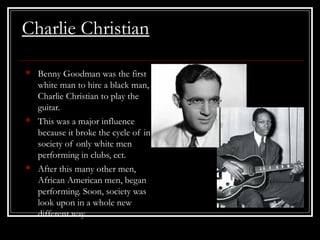
Charlie Christian
• Benny Goodman was the first
white man to hire a black man,
Charlie Christian to play the
guitar.
• This was a major influence
because it broke the cycle of in
society of only white men
performing in clubs, ect.
• After this many other men,
African American men, began
performing. Soon, society was
look upon in a whole new
different way.
Performer's &' Their Contributions
There were many Performers in that era one
of the them was Duke Ellington.
•Moved to NYC to start a band
•Him and his band appeared in many
Nightclubs and theaters, One of them being
Carnegie Hall
•He is considered to be one of the greatest
composers & Musicians
Performer's &'their contributions 2
Louis Armstrong
•Considered to be One of the greatest jazz
players of all time
•His first performance was at the age of 7
•Louis influenced the harlem renaissnance
and played with the Fletcher Henderson By
band
•He is knownto be the True King of Jazz
The cotton Club
• The cottons club location during the harlem
renaissance era was 644 Lenox ave &'
14th street.
• It opened 1920 and it was segregated
where only white patrons can enter the
service and entertainment was by black
entertainment
• In the early years legendary jazz became a
part of the cotton club
The Cotton Club performers
• Many known jazz performers performed
such as :
• Duke Ellington, Cab callowway,
BessieSmith, Billie Holiday, Nat King Cole,
Ella Fitzgerald,
• Today there is a new Cotton Club which
sits under the massive Manhattan Viaduct
Major Cultural Influences
• The African Americans who made their way to
Harlem during and after the First World War found a
political and intellectual leader in W. E. B. Du Bois,
who advocated a forceful, militant approach to the
struggle for black self-determination.
• At the same time as these writers and artists launched
the Harlem Renaissance, Harlem was full of other
important political and cultural activities.
• Marcus Garvey: the leader of a Back to Africa, Black
Nationalist movement centered in Harlem.
• Jazz itself, formerly a music limited to an African
American audience, became the dominant popular
music of the 1920s, reaching a diverse audience that
included a good many urban—and, for that matter,
even rural—white Americans.
Music & Dance in Renaissance
• During the Harlem Renaissance, African Americans loved
music and dance. There were new types of dance and music
that became significant to them, and changed many of their
lives. Music during this time was valuable to them, Jazz most
importantly. African Americans came together at night clubs
like the Savoy and Cotton Club to hear some of the jazz
musicians do their work. At night they went to the clubs,
listened to the performers and danced all night.
References
http://harlemworldmag.com/2010/08/13/harle
m-history-the-cotton-club/
www.ushistory.org/us/46e.asp
www.britannica.com/.../Harlem-Renaissance
www.biography.com
http://www.groundation.com
http://www.columbia.edu

Harlem Renaissance Dance and Music

  • 1.
    Harlem Renaissance: Jazz Music& Dance By: Alexus Silverio, Jamie Mendoza, U- Neisha Logan, and Karen Solano
  • 2.
    History of Jazz •Jazzoriginated in the early 20th century in the United States. •Some say the word, “Jazz” was a slang term related to sex and romance, while others said it had its origins in the English writers Geoffrey Chaucer and William Shakespeare. •Early roots of Jazz dancing originated from the African American Culture. Natives in Africa danced to celebrate the cycles of life; birth, puberty, etc.
  • 3.
    Major Historical Influences •In the 1920's African American literature were music and dance and it began to flourish in Harlem. • This African American cultural movement became known as the "New Negro Movement" and later as the Harlem Renaissance. • This was more than a movement, the Harlem Renaissance was a way for African Americans to redefine themselves.
  • 4.
    Charlie Christian • BennyGoodman was the first white man to hire a black man, Charlie Christian to play the guitar. • This was a major influence because it broke the cycle of in society of only white men performing in clubs, ect. • After this many other men, African American men, began performing. Soon, society was look upon in a whole new different way.
  • 5.
    Performer's &' TheirContributions There were many Performers in that era one of the them was Duke Ellington. •Moved to NYC to start a band •Him and his band appeared in many Nightclubs and theaters, One of them being Carnegie Hall •He is considered to be one of the greatest composers & Musicians
  • 6.
    Performer's &'their contributions2 Louis Armstrong •Considered to be One of the greatest jazz players of all time •His first performance was at the age of 7 •Louis influenced the harlem renaissnance and played with the Fletcher Henderson By band •He is knownto be the True King of Jazz
  • 7.
    The cotton Club •The cottons club location during the harlem renaissance era was 644 Lenox ave &' 14th street. • It opened 1920 and it was segregated where only white patrons can enter the service and entertainment was by black entertainment • In the early years legendary jazz became a part of the cotton club
  • 8.
    The Cotton Clubperformers • Many known jazz performers performed such as : • Duke Ellington, Cab callowway, BessieSmith, Billie Holiday, Nat King Cole, Ella Fitzgerald, • Today there is a new Cotton Club which sits under the massive Manhattan Viaduct
  • 9.
    Major Cultural Influences •The African Americans who made their way to Harlem during and after the First World War found a political and intellectual leader in W. E. B. Du Bois, who advocated a forceful, militant approach to the struggle for black self-determination. • At the same time as these writers and artists launched the Harlem Renaissance, Harlem was full of other important political and cultural activities. • Marcus Garvey: the leader of a Back to Africa, Black Nationalist movement centered in Harlem. • Jazz itself, formerly a music limited to an African American audience, became the dominant popular music of the 1920s, reaching a diverse audience that included a good many urban—and, for that matter, even rural—white Americans.
  • 10.
    Music & Dancein Renaissance • During the Harlem Renaissance, African Americans loved music and dance. There were new types of dance and music that became significant to them, and changed many of their lives. Music during this time was valuable to them, Jazz most importantly. African Americans came together at night clubs like the Savoy and Cotton Club to hear some of the jazz musicians do their work. At night they went to the clubs, listened to the performers and danced all night.
  • 11.