By: Christine Purefoy, tisha Park,
nataliah Brown and armani hinnant
 The Harlem Renaissance started around the 1920’s
during the reconstruction of the country after the civil
war. The Harlem Renaissance brought life to people,
and mostly African Americans that were going through
oppression at the time.
 African American dance began to flourish in the
Harlem section of New York City. African Americans
were encouraged to embrace their culture and
heritage. It gave them a new way to express
themselves. This new era was called the “New Negro
Movement.”
 During the “New Negro Movement” a lot of unique
music came about that really inspired the people to
live their life despite all the struggles they were facing.
 Jazz and Blues were the main structure of all music
for the Harlem Renaissance. Famous jazz musicians
like; Billie Holiday, Duke Ellington, and Louis
Armstrong paved the way for all future jazz musicians.
 Jazz is composed primarily of brass instruments and
was considered the symbol of the South.
 Instruments had different meaning and could only
be in position of certain people. For instance the
piano it was considered a wealthy instrument.
 Instruments that African Americans were allowed
to use consisted of the basic instrument like;
trumpets, saxophones, trombone, and double
bass.
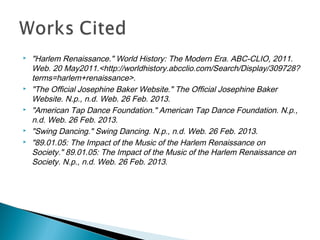
 There were different types of dances like the
shimmy, the jitterbug, the Charleston, the lindy
hop, and the cakewalk.
http://www.youtube.com/watch?v=90TzDXjWTdo
http://www.youtube.com/watch?v=ahoJReiCaPk
 Famous dancers from the Harlem Renaissance like
Josephine Baker and Bill “Bojangles” Robinsons made
dancing very unique and creative.
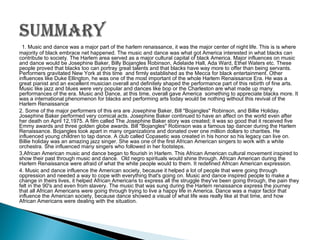
 Josephine Baker started dancing around the 1920’s.
Her type of style of dancing made way for the different
types of dances of today.
 Bill “Bojangles” Robinsons was known for how fast his
feet moved, thus audiences giving him the nick name.
His most popular dance he did was the jitterbug.
1. Music and dance was a major part of the harlem renaissance, it was the major center of night life. This is is where
majority of black embrace net happened. The music and dance was what got America interested in what blacks can
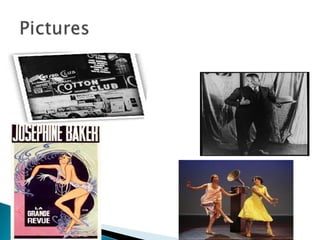
contribute to society. The Harlem area served as a major cultural capital of black America. Major influences on music
and dance would be Josephine Baker, Billy Bojangles Robinson, Adelaide Hall, Ada Ward, Ethel Waters etc. These
people proved that blacks too can portray great talents and that blacks have way more to offer than being servants.
Performers gravitated New York at this time  and firmly established as the Mecca for black entertainment. Other
influences like Duke Ellington, he was one of the most important of the whole Harlem Renaissance Era. He was a
great pianist and an excellent musician overall and definitely shaped the performance part of this rebirth of fine arts.
Music like jazz and blues were very popular and dances like bop or the Charleston are what made up many
performances of the era. Music and Dance, at this time, overall gave America  something to appreciate blacks more. It
was a international phenomenon for blacks and performing arts today would be nothing without this revival of the
Harlem Renaissance 
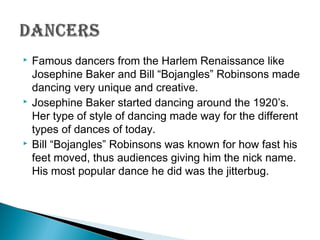
2. Some of the major performers of this era are Josephine Baker, Bill "Bojangles" Robinson, and Billie Holiday.
Josephine Baker performed very comical acts. Josephine Baker continued to have an affect on the world even after
her death on April 12,1975. A film called The Josephine Baker story was created; it was so good that it received five
Emmy awards and three golden globe awards. Bill "Bojangles" Robinson was a famous tap dancer during the Harlem
Renaissance. Bojangles took apart in many organizations and donated over one million dollars to charities. He
influenced young children to tap dance. A club called Copasetic was created in his honor so his legacy can live on.
Billie holiday was an amazing jazz singer. She was one of the first African American singers to work with a white
orchestra. She influenced many singers who followed in her footsteps.
3.African American music and dance began to flourish in Harlem. This African American cultural movement inspired to
show their past through music and dance. Old negro spirituals would shine through. African American during the
Harlem Renaissance were afraid of what the white people would to them. It redefined African American expression.
4. Music and dance influence the American society, because it helped a lot of people that were going through
oppression and needed a way to cope with everything that's going on. Music and dance inspired people to make a
change in theirs lives, it helped African Americans to express all the struggle they've been going through, the pain they
felt in the 90's and even from slavery. The music that was sung during the Harlem renaissance express the journey
that all African Americans were going through trying to live a happy life in America. Dance was a major factor that
influence the American society, because dance showed a visual of what life was really like at that time, and how
African Americans were dealing with the situation.
 "Harlem Renaissance." World History: The Modern Era. ABC-CLIO, 2011.
Web. 20 May2011.<http://worldhistory.abcclio.com/Search/Display/309728?
terms=harlem+renaissance>. 
 "The Official Josephine Baker Website." The Official Josephine Baker
Website. N.p., n.d. Web. 26 Feb. 2013.
 "American Tap Dance Foundation." American Tap Dance Foundation. N.p.,
n.d. Web. 26 Feb. 2013.
 "Swing Dancing." Swing Dancing. N.p., n.d. Web. 26 Feb. 2013.
 "89.01.05: The Impact of the Music of the Harlem Renaissance on
Society." 89.01.05: The Impact of the Music of the Harlem Renaissance on
Society. N.p., n.d. Web. 26 Feb. 2013.
 "Harlem Renaissance." World History: The Modern Era. ABC-CLIO, 2011.
Web. 20 May2011.<http://worldhistory.abcclio.com/Search/Display/309728?
terms=harlem+renaissance>. 
 "The Official Josephine Baker Website." The Official Josephine Baker
Website. N.p., n.d. Web. 26 Feb. 2013.
 "American Tap Dance Foundation." American Tap Dance Foundation. N.p.,
n.d. Web. 26 Feb. 2013.
 "Swing Dancing." Swing Dancing. N.p., n.d. Web. 26 Feb. 2013.
 "89.01.05: The Impact of the Music of the Harlem Renaissance on
Society." 89.01.05: The Impact of the Music of the Harlem Renaissance on
Society. N.p., n.d. Web. 26 Feb. 2013.

The Harlem Renaissance Dance

  • 1.
    By: Christine Purefoy,tisha Park, nataliah Brown and armani hinnant
  • 2.
     The HarlemRenaissance started around the 1920’s during the reconstruction of the country after the civil war. The Harlem Renaissance brought life to people, and mostly African Americans that were going through oppression at the time.  African American dance began to flourish in the Harlem section of New York City. African Americans were encouraged to embrace their culture and heritage. It gave them a new way to express themselves. This new era was called the “New Negro Movement.”
  • 3.
     During the“New Negro Movement” a lot of unique music came about that really inspired the people to live their life despite all the struggles they were facing.  Jazz and Blues were the main structure of all music for the Harlem Renaissance. Famous jazz musicians like; Billie Holiday, Duke Ellington, and Louis Armstrong paved the way for all future jazz musicians.  Jazz is composed primarily of brass instruments and was considered the symbol of the South.
  • 4.
     Instruments haddifferent meaning and could only be in position of certain people. For instance the piano it was considered a wealthy instrument.  Instruments that African Americans were allowed to use consisted of the basic instrument like; trumpets, saxophones, trombone, and double bass.
  • 5.
     There weredifferent types of dances like the shimmy, the jitterbug, the Charleston, the lindy hop, and the cakewalk. http://www.youtube.com/watch?v=90TzDXjWTdo http://www.youtube.com/watch?v=ahoJReiCaPk
  • 7.
     Famous dancersfrom the Harlem Renaissance like Josephine Baker and Bill “Bojangles” Robinsons made dancing very unique and creative.  Josephine Baker started dancing around the 1920’s. Her type of style of dancing made way for the different types of dances of today.  Bill “Bojangles” Robinsons was known for how fast his feet moved, thus audiences giving him the nick name. His most popular dance he did was the jitterbug.
  • 8.
    1. Music anddance was a major part of the harlem renaissance, it was the major center of night life. This is is where majority of black embrace net happened. The music and dance was what got America interested in what blacks can contribute to society. The Harlem area served as a major cultural capital of black America. Major influences on music and dance would be Josephine Baker, Billy Bojangles Robinson, Adelaide Hall, Ada Ward, Ethel Waters etc. These people proved that blacks too can portray great talents and that blacks have way more to offer than being servants. Performers gravitated New York at this time  and firmly established as the Mecca for black entertainment. Other influences like Duke Ellington, he was one of the most important of the whole Harlem Renaissance Era. He was a great pianist and an excellent musician overall and definitely shaped the performance part of this rebirth of fine arts. Music like jazz and blues were very popular and dances like bop or the Charleston are what made up many performances of the era. Music and Dance, at this time, overall gave America  something to appreciate blacks more. It was a international phenomenon for blacks and performing arts today would be nothing without this revival of the Harlem Renaissance  2. Some of the major performers of this era are Josephine Baker, Bill "Bojangles" Robinson, and Billie Holiday. Josephine Baker performed very comical acts. Josephine Baker continued to have an affect on the world even after her death on April 12,1975. A film called The Josephine Baker story was created; it was so good that it received five Emmy awards and three golden globe awards. Bill "Bojangles" Robinson was a famous tap dancer during the Harlem Renaissance. Bojangles took apart in many organizations and donated over one million dollars to charities. He influenced young children to tap dance. A club called Copasetic was created in his honor so his legacy can live on. Billie holiday was an amazing jazz singer. She was one of the first African American singers to work with a white orchestra. She influenced many singers who followed in her footsteps. 3.African American music and dance began to flourish in Harlem. This African American cultural movement inspired to show their past through music and dance. Old negro spirituals would shine through. African American during the Harlem Renaissance were afraid of what the white people would to them. It redefined African American expression. 4. Music and dance influence the American society, because it helped a lot of people that were going through oppression and needed a way to cope with everything that's going on. Music and dance inspired people to make a change in theirs lives, it helped African Americans to express all the struggle they've been going through, the pain they felt in the 90's and even from slavery. The music that was sung during the Harlem renaissance express the journey that all African Americans were going through trying to live a happy life in America. Dance was a major factor that influence the American society, because dance showed a visual of what life was really like at that time, and how African Americans were dealing with the situation.
  • 9.
     "Harlem Renaissance." WorldHistory: The Modern Era. ABC-CLIO, 2011. Web. 20 May2011.<http://worldhistory.abcclio.com/Search/Display/309728? terms=harlem+renaissance>.   "The Official Josephine Baker Website." The Official Josephine Baker Website. N.p., n.d. Web. 26 Feb. 2013.  "American Tap Dance Foundation." American Tap Dance Foundation. N.p., n.d. Web. 26 Feb. 2013.  "Swing Dancing." Swing Dancing. N.p., n.d. Web. 26 Feb. 2013.  "89.01.05: The Impact of the Music of the Harlem Renaissance on Society." 89.01.05: The Impact of the Music of the Harlem Renaissance on Society. N.p., n.d. Web. 26 Feb. 2013.
  • 10.
     "Harlem Renaissance." WorldHistory: The Modern Era. ABC-CLIO, 2011. Web. 20 May2011.<http://worldhistory.abcclio.com/Search/Display/309728? terms=harlem+renaissance>.   "The Official Josephine Baker Website." The Official Josephine Baker Website. N.p., n.d. Web. 26 Feb. 2013.  "American Tap Dance Foundation." American Tap Dance Foundation. N.p., n.d. Web. 26 Feb. 2013.  "Swing Dancing." Swing Dancing. N.p., n.d. Web. 26 Feb. 2013.  "89.01.05: The Impact of the Music of the Harlem Renaissance on Society." 89.01.05: The Impact of the Music of the Harlem Renaissance on Society. N.p., n.d. Web. 26 Feb. 2013.