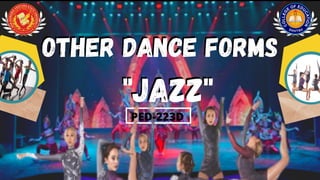
Other Dance Forms
"JAZZ"
PED-223D
Other Dance Forms
"JAZZ"
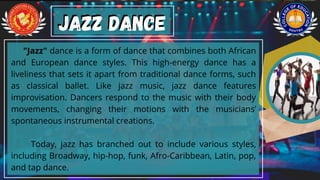
"Jazz" dance is a form of dance that combines both African
and European dance styles. This high-energy dance has a
liveliness that sets it apart from traditional dance forms, such
as classical ballet. Like jazz music, jazz dance features
improvisation. Dancers respond to the music with their body
movements, changing their motions with the musicians’
spontaneous instrumental creations.
Today, jazz has branched out to include various styles,
including Broadway, hip-hop, funk, Afro-Caribbean, Latin, pop,
and tap dance.
JAZZ DANCE
JAZZ DANCE
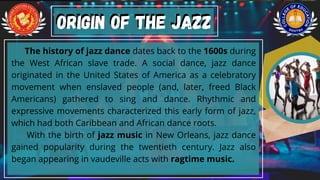
The history of jazz dance dates back to the 1600s during
the West African slave trade. A social dance, jazz dance
originated in the United States of America as a celebratory
movement when enslaved people (and, later, freed Black
Americans) gathered to sing and dance. Rhythmic and
expressive movements characterized this early form of jazz,
which had both Caribbean and African dance roots.
With the birth of jazz music in New Orleans, jazz dance
gained popularity during the twentieth century. Jazz also
began appearing in vaudeville acts with ragtime music.
ORIGIN OF THE JAZZ
ORIGIN OF THE JAZZ
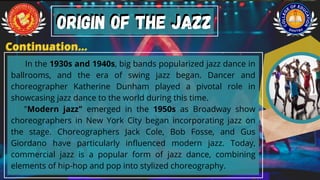
In the 1930s and 1940s, big bands popularized jazz dance in
ballrooms, and the era of swing jazz began. Dancer and
choreographer Katherine Dunham played a pivotal role in
showcasing jazz dance to the world during this time.
"Modern jazz" emerged in the 1950s as Broadway show
choreographers in New York City began incorporating jazz on
the stage. Choreographers Jack Cole, Bob Fosse, and Gus
Giordano have particularly influenced modern jazz. Today,
commercial jazz is a popular form of jazz dance, combining
elements of hip-hop and pop into stylized choreography.
ORIGIN OF THE JAZZ
ORIGIN OF THE JAZZ
Continuation...
Continuation...
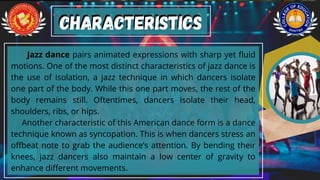
Jazz dance pairs animated expressions with sharp yet fluid
motions. One of the most distinct characteristics of jazz dance is
the use of isolation, a jazz technique in which dancers isolate
one part of the body. While this one part moves, the rest of the
body remains still. Oftentimes, dancers isolate their head,
shoulders, ribs, or hips.
Another characteristic of this American dance form is a dance
technique known as syncopation. This is when dancers stress an
offbeat note to grab the audience’s attention. By bending their
knees, jazz dancers also maintain a low center of gravity to
enhance different movements.
Characteristics
Characteristics
6 Jazz
Dance Moves
6 Jazz
Dance Moves
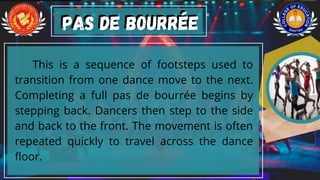
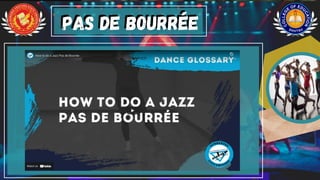
This is a sequence of footsteps used to
transition from one dance move to the next.
Completing a full pas de bourrée begins by
stepping back. Dancers then step to the side
and back to the front. The movement is often
repeated quickly to travel across the dance
floor.
Pas de bourrée
Pas de bourrée
Pas de bourrée
Pas de bourrée
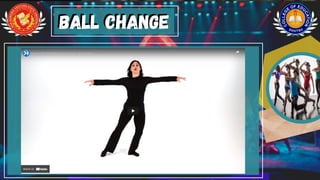
A ball change uses the balls of the feet to
shift the dancer’s weight from one foot to the
next. Like the pas de bourrée, you can use a
ball change to transition between dance
moves. Dancers transfer their weight to the
ball of one foot, and then step forward with
the other foot.
Ball change
Ball change
Ball change
Ball change
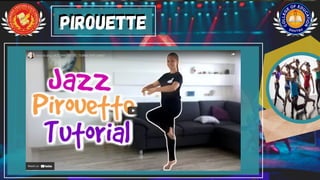
A pirouette is when a dancer turns on one
foot. While one leg remains planted on the
ground, the other leg spins, turning the
dancer’s body.
Pirouette
Pirouette
Pirouette
Pirouette
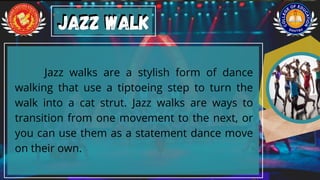
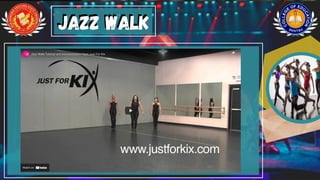
Jazz walks are a stylish form of dance
walking that use a tiptoeing step to turn the
walk into a cat strut. Jazz walks are ways to
transition from one movement to the next, or
you can use them as a statement dance move
on their own.
Jazz walk
Jazz walk
Jazz walk
Jazz walk
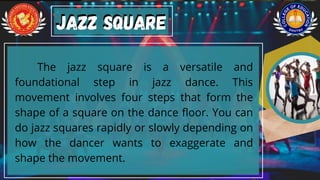
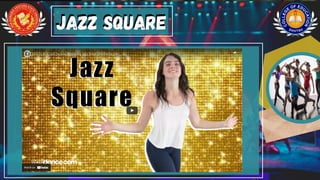
The jazz square is a versatile and
foundational step in jazz dance. This
movement involves four steps that form the
shape of a square on the dance floor. You can
do jazz squares rapidly or slowly depending on
how the dancer wants to exaggerate and
shape the movement.
Jazz square
Jazz square
Jazz square
Jazz square
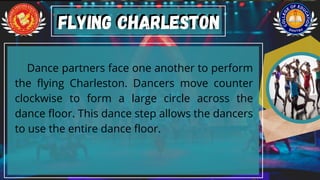
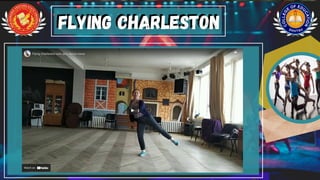
Dance partners face one another to perform
the flying Charleston. Dancers move counter
clockwise to form a large circle across the
dance floor. This dance step allows the dancers
to use the entire dance floor.
Flying Charleston
Flying Charleston
Flying Charleston
Flying Charleston
Street Jazz
Street Jazz
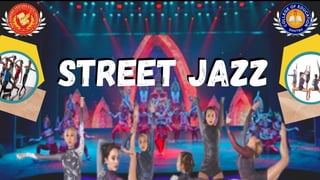
- "Street jazz dance" combines jazz dance, hip-hop
dance and funk.
- Street jazz dance is a term used to describe dance
styles that evolved outside dance studios in - everyday
spaces such as streets, dance parties, block parties,
parks, school yards, raves and nightclubs.
- Often improvisational and social in nature, street jazz
dance encourages the interaction and contact with
other dancers and spectators from different countries.
Street Jazz
Street Jazz
The history about street jazz, it’s all about
being informal dancing but it did once changed
to an informal settings in nightclubs schools
and as it says, the streets. It all started in
1970s, when you would put together Jazz
Dance, Modern Hip-Hop and Funk.
Origin
Origin
The elements are break dancing and the
fluid moments of Hip-Hop that are found in
the cultural dance of Street Jazz. Also would
be having Jazz Dance, Broadway Dance,
Tectonics, and Contemporary Dance. Jazz was
identified by fast foot work, spins, acrobatic
flips and moves. Mostly inspired by modern
Hip-Hop.
Elements
Elements
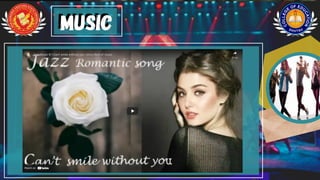
- The music used is normally influenced by
the concept and the story the choreographer
wants to tell to an audience.
- Pop music or jazz music sung by a famous
artist are usually chosen to fit the idea of the
dance story.
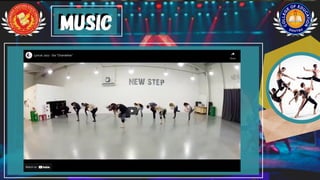
music
music
music
music
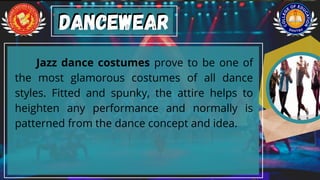
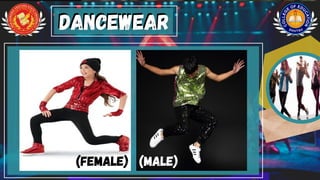
Jazz dance costumes prove to be one of
the most glamorous costumes of all dance
styles. Fitted and spunky, the attire helps to
heighten any performance and normally is
patterned from the dance concept and idea.
Dancewear
Dancewear
Dancewear
Dancewear
(Female) (male)
Lyrical Jazz
Lyrical Jazz
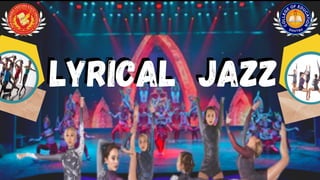
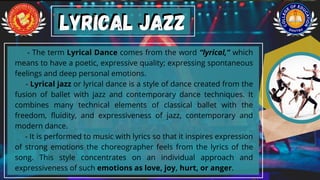
- The term Lyrical Dance comes from the word “lyrical,” which
means to have a poetic, expressive quality; expressing spontaneous
feelings and deep personal emotions.
- Lyrical jazz or lyrical dance is a style of dance created from the
fusion of ballet with jazz and contemporary dance techniques. It
combines many technical elements of classical ballet with the
freedom, fluidity, and expressiveness of jazz, contemporary and
modern dance.
- It is performed to music with lyrics so that it inspires expression
of strong emotions the choreographer feels from the lyrics of the
song. This style concentrates on an individual approach and
expressiveness of such emotions as love, joy, hurt, or anger.
Lyrical Jazz
Lyrical Jazz
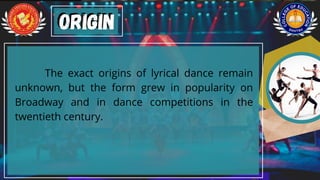
The exact origins of lyrical dance remain
unknown, but the form grew in popularity on
Broadway and in dance competitions in the
twentieth century.
Origin
Origin
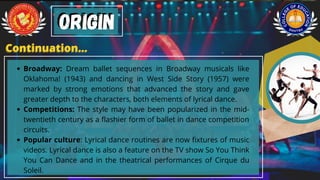
Broadway: Dream ballet sequences in Broadway musicals like
Oklahoma! (1943) and dancing in West Side Story (1957) were
marked by strong emotions that advanced the story and gave
greater depth to the characters, both elements of lyrical dance.
Competitions: The style may have been popularized in the mid-
twentieth century as a flashier form of ballet in dance competition
circuits.
Popular culture: Lyrical dance routines are now fixtures of music
videos. Lyrical dance is also a feature on the TV show So You Think
You Can Dance and in the theatrical performances of Cirque du
Soleil.
Origin
Origin
Continuation...
Continuation...
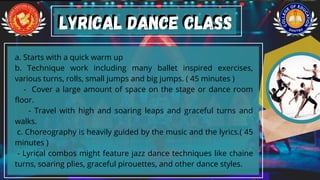
a. Starts with a quick warm up
b. Technique work including many ballet inspired exercises,
various turns, rolls, small jumps and big jumps. ( 45 minutes )
- Cover a large amount of space on the stage or dance room
floor.
- Travel with high and soaring leaps and graceful turns and
walks.
c. Choreography is heavily guided by the music and the lyrics.( 45
minutes )
- Lyrical combos might feature jazz dance techniques like chaine
turns, soaring plies, graceful pirouettes, and other dance styles.
Lyrical Dance Class
Lyrical Dance Class
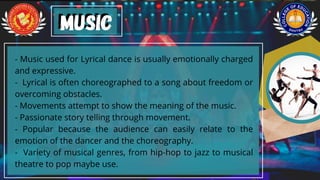
- Music used for Lyrical dance is usually emotionally charged
and expressive.
- Lyrical is often choreographed to a song about freedom or
overcoming obstacles.
- Movements attempt to show the meaning of the music.
- Passionate story telling through movement.
- Popular because the audience can easily relate to the
emotion of the dancer and the choreography.
- Variety of musical genres, from hip-hop to jazz to musical
theatre to pop maybe use.
music
music
music
music
- Leotards dotted with rhinestones or other
dance costumes that, along with the
choreography.
- The colour of lyrical costumes can be
anything from solid black to a colourful palette.
Dancewear
Dancewear
Dancewear
Dancewear
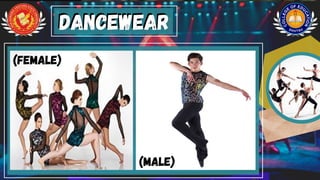
(Female)
(male)
Even though you may like to dance, you may
not be very good at it. All it takes is a little time
and practice. The main question is: are you
doing this to impress others, or is your heart in
this? Only when you know the answer for sure,
will you be great.
Dance to Lyrical Music
1. Understand that when you dance lyrical, your movements
show the words of the song.
- This means that if the words were, "She falls like the petal drifting
from its rose," you would gracefully sink to the floor and pretend to
be the petal.
2. Try to come up with lots of different feelings and moves.
- It would get very boring to watch someone do the same movement
over, and over, and over again.
3. Find a stage, an open place, such as a basement, or even
outside in your front lawn.
- The best places are the ones with a large lengthy mirror on the wall.
4. Pick a song with deep meaning and flowing music.
Dance to Lyrical Music
5. Listen to the song.
- You should listen to it maybe 2-3 time to get the feel of the
words, instruments, and the tempo.
6. Do your body a favor; before you dance, make sure
you stretch.
- This is a key part in getting better. You don't want to pull a
muscle and not be able to practice, so be sure to stretch
your arms, legs, neck, and maybe do some push-ups.
- If you plan on doing tricks, be sure to stretch extra well, so
you won't get injured
Dance to Lyrical Music
7. Just let your body flow.
- When you dance fluently, like the water in a stream, you let your
body pretend you are trapped under the ocean. (Pretend you can still
breathe)
- You would get bored just standing there with nothing to do, so you
start to flow.
8. Learn tricks.
- To make your dance stand out, you may want to add tricks.
- There are hundreds of dance tutorials online. Chose a tutorial from
an actual known dancer (so you can guarantee it's safe) and follow the
teacher.
- Some examples of tricks are pirouettes, splits, barrel rolls, jumps,
and leaps.
Dance to Lyrical Music
thank you!
thank you!

JAZZ.pdf

  • 1.
  • 2.
    "Jazz" dance isa form of dance that combines both African and European dance styles. This high-energy dance has a liveliness that sets it apart from traditional dance forms, such as classical ballet. Like jazz music, jazz dance features improvisation. Dancers respond to the music with their body movements, changing their motions with the musicians’ spontaneous instrumental creations. Today, jazz has branched out to include various styles, including Broadway, hip-hop, funk, Afro-Caribbean, Latin, pop, and tap dance. JAZZ DANCE JAZZ DANCE
  • 3.
    The history ofjazz dance dates back to the 1600s during the West African slave trade. A social dance, jazz dance originated in the United States of America as a celebratory movement when enslaved people (and, later, freed Black Americans) gathered to sing and dance. Rhythmic and expressive movements characterized this early form of jazz, which had both Caribbean and African dance roots. With the birth of jazz music in New Orleans, jazz dance gained popularity during the twentieth century. Jazz also began appearing in vaudeville acts with ragtime music. ORIGIN OF THE JAZZ ORIGIN OF THE JAZZ
  • 4.
    In the 1930sand 1940s, big bands popularized jazz dance in ballrooms, and the era of swing jazz began. Dancer and choreographer Katherine Dunham played a pivotal role in showcasing jazz dance to the world during this time. "Modern jazz" emerged in the 1950s as Broadway show choreographers in New York City began incorporating jazz on the stage. Choreographers Jack Cole, Bob Fosse, and Gus Giordano have particularly influenced modern jazz. Today, commercial jazz is a popular form of jazz dance, combining elements of hip-hop and pop into stylized choreography. ORIGIN OF THE JAZZ ORIGIN OF THE JAZZ Continuation... Continuation...
  • 5.
    Jazz dance pairsanimated expressions with sharp yet fluid motions. One of the most distinct characteristics of jazz dance is the use of isolation, a jazz technique in which dancers isolate one part of the body. While this one part moves, the rest of the body remains still. Oftentimes, dancers isolate their head, shoulders, ribs, or hips. Another characteristic of this American dance form is a dance technique known as syncopation. This is when dancers stress an offbeat note to grab the audience’s attention. By bending their knees, jazz dancers also maintain a low center of gravity to enhance different movements. Characteristics Characteristics
  • 6.
    6 Jazz Dance Moves 6Jazz Dance Moves
  • 7.
    This is asequence of footsteps used to transition from one dance move to the next. Completing a full pas de bourrée begins by stepping back. Dancers then step to the side and back to the front. The movement is often repeated quickly to travel across the dance floor. Pas de bourrée Pas de bourrée
  • 8.
  • 9.
    A ball changeuses the balls of the feet to shift the dancer’s weight from one foot to the next. Like the pas de bourrée, you can use a ball change to transition between dance moves. Dancers transfer their weight to the ball of one foot, and then step forward with the other foot. Ball change Ball change
  • 10.
  • 11.
    A pirouette iswhen a dancer turns on one foot. While one leg remains planted on the ground, the other leg spins, turning the dancer’s body. Pirouette Pirouette
  • 12.
  • 13.
    Jazz walks area stylish form of dance walking that use a tiptoeing step to turn the walk into a cat strut. Jazz walks are ways to transition from one movement to the next, or you can use them as a statement dance move on their own. Jazz walk Jazz walk
  • 14.
  • 16.
    The jazz squareis a versatile and foundational step in jazz dance. This movement involves four steps that form the shape of a square on the dance floor. You can do jazz squares rapidly or slowly depending on how the dancer wants to exaggerate and shape the movement. Jazz square Jazz square
  • 17.
  • 18.
    Dance partners faceone another to perform the flying Charleston. Dancers move counter clockwise to form a large circle across the dance floor. This dance step allows the dancers to use the entire dance floor. Flying Charleston Flying Charleston
  • 19.
  • 20.
  • 21.
    - "Street jazzdance" combines jazz dance, hip-hop dance and funk. - Street jazz dance is a term used to describe dance styles that evolved outside dance studios in - everyday spaces such as streets, dance parties, block parties, parks, school yards, raves and nightclubs. - Often improvisational and social in nature, street jazz dance encourages the interaction and contact with other dancers and spectators from different countries. Street Jazz Street Jazz
  • 22.
    The history aboutstreet jazz, it’s all about being informal dancing but it did once changed to an informal settings in nightclubs schools and as it says, the streets. It all started in 1970s, when you would put together Jazz Dance, Modern Hip-Hop and Funk. Origin Origin
  • 23.
    The elements arebreak dancing and the fluid moments of Hip-Hop that are found in the cultural dance of Street Jazz. Also would be having Jazz Dance, Broadway Dance, Tectonics, and Contemporary Dance. Jazz was identified by fast foot work, spins, acrobatic flips and moves. Mostly inspired by modern Hip-Hop. Elements Elements
  • 24.
    - The musicused is normally influenced by the concept and the story the choreographer wants to tell to an audience. - Pop music or jazz music sung by a famous artist are usually chosen to fit the idea of the dance story. music music
  • 25.
  • 26.
    Jazz dance costumesprove to be one of the most glamorous costumes of all dance styles. Fitted and spunky, the attire helps to heighten any performance and normally is patterned from the dance concept and idea. Dancewear Dancewear
  • 27.
  • 28.
  • 29.
    - The termLyrical Dance comes from the word “lyrical,” which means to have a poetic, expressive quality; expressing spontaneous feelings and deep personal emotions. - Lyrical jazz or lyrical dance is a style of dance created from the fusion of ballet with jazz and contemporary dance techniques. It combines many technical elements of classical ballet with the freedom, fluidity, and expressiveness of jazz, contemporary and modern dance. - It is performed to music with lyrics so that it inspires expression of strong emotions the choreographer feels from the lyrics of the song. This style concentrates on an individual approach and expressiveness of such emotions as love, joy, hurt, or anger. Lyrical Jazz Lyrical Jazz
  • 30.
    The exact originsof lyrical dance remain unknown, but the form grew in popularity on Broadway and in dance competitions in the twentieth century. Origin Origin
  • 31.
    Broadway: Dream balletsequences in Broadway musicals like Oklahoma! (1943) and dancing in West Side Story (1957) were marked by strong emotions that advanced the story and gave greater depth to the characters, both elements of lyrical dance. Competitions: The style may have been popularized in the mid- twentieth century as a flashier form of ballet in dance competition circuits. Popular culture: Lyrical dance routines are now fixtures of music videos. Lyrical dance is also a feature on the TV show So You Think You Can Dance and in the theatrical performances of Cirque du Soleil. Origin Origin Continuation... Continuation...
  • 32.
    a. Starts witha quick warm up b. Technique work including many ballet inspired exercises, various turns, rolls, small jumps and big jumps. ( 45 minutes ) - Cover a large amount of space on the stage or dance room floor. - Travel with high and soaring leaps and graceful turns and walks. c. Choreography is heavily guided by the music and the lyrics.( 45 minutes ) - Lyrical combos might feature jazz dance techniques like chaine turns, soaring plies, graceful pirouettes, and other dance styles. Lyrical Dance Class Lyrical Dance Class
  • 33.
    - Music usedfor Lyrical dance is usually emotionally charged and expressive. - Lyrical is often choreographed to a song about freedom or overcoming obstacles. - Movements attempt to show the meaning of the music. - Passionate story telling through movement. - Popular because the audience can easily relate to the emotion of the dancer and the choreography. - Variety of musical genres, from hip-hop to jazz to musical theatre to pop maybe use. music music
  • 34.
  • 35.
    - Leotards dottedwith rhinestones or other dance costumes that, along with the choreography. - The colour of lyrical costumes can be anything from solid black to a colourful palette. Dancewear Dancewear
  • 36.
  • 37.
    Even though youmay like to dance, you may not be very good at it. All it takes is a little time and practice. The main question is: are you doing this to impress others, or is your heart in this? Only when you know the answer for sure, will you be great. Dance to Lyrical Music Dance to Lyrical Music
  • 38.
    1. Understand thatwhen you dance lyrical, your movements show the words of the song. - This means that if the words were, "She falls like the petal drifting from its rose," you would gracefully sink to the floor and pretend to be the petal. 2. Try to come up with lots of different feelings and moves. - It would get very boring to watch someone do the same movement over, and over, and over again. 3. Find a stage, an open place, such as a basement, or even outside in your front lawn. - The best places are the ones with a large lengthy mirror on the wall. 4. Pick a song with deep meaning and flowing music. Dance to Lyrical Music Dance to Lyrical Music
  • 39.
    5. Listen tothe song. - You should listen to it maybe 2-3 time to get the feel of the words, instruments, and the tempo. 6. Do your body a favor; before you dance, make sure you stretch. - This is a key part in getting better. You don't want to pull a muscle and not be able to practice, so be sure to stretch your arms, legs, neck, and maybe do some push-ups. - If you plan on doing tricks, be sure to stretch extra well, so you won't get injured Dance to Lyrical Music Dance to Lyrical Music
  • 40.
    7. Just letyour body flow. - When you dance fluently, like the water in a stream, you let your body pretend you are trapped under the ocean. (Pretend you can still breathe) - You would get bored just standing there with nothing to do, so you start to flow. 8. Learn tricks. - To make your dance stand out, you may want to add tricks. - There are hundreds of dance tutorials online. Chose a tutorial from an actual known dancer (so you can guarantee it's safe) and follow the teacher. - Some examples of tricks are pirouettes, splits, barrel rolls, jumps, and leaps. Dance to Lyrical Music Dance to Lyrical Music
  • 41.