Metro: JAX-WS, WSIT  and REST Carol McDonald Java Architect Sun Microsystems
About the Speaker Carol  cDonald:  Java Architect at Sun Microsystems Before Sun, worked on software development of:  Application to  manage car Loans  for  Toyota  (>10 million loans)  Pharmaceutical  Intranet apps  ( Roche  Switzerland)  Telecom  Network Mgmt  ( Digital  France)  X.400  Email Server  ( IBM  Germany)
Agenda Metro  JAX-WS  WSIT REST:  JAX-RS
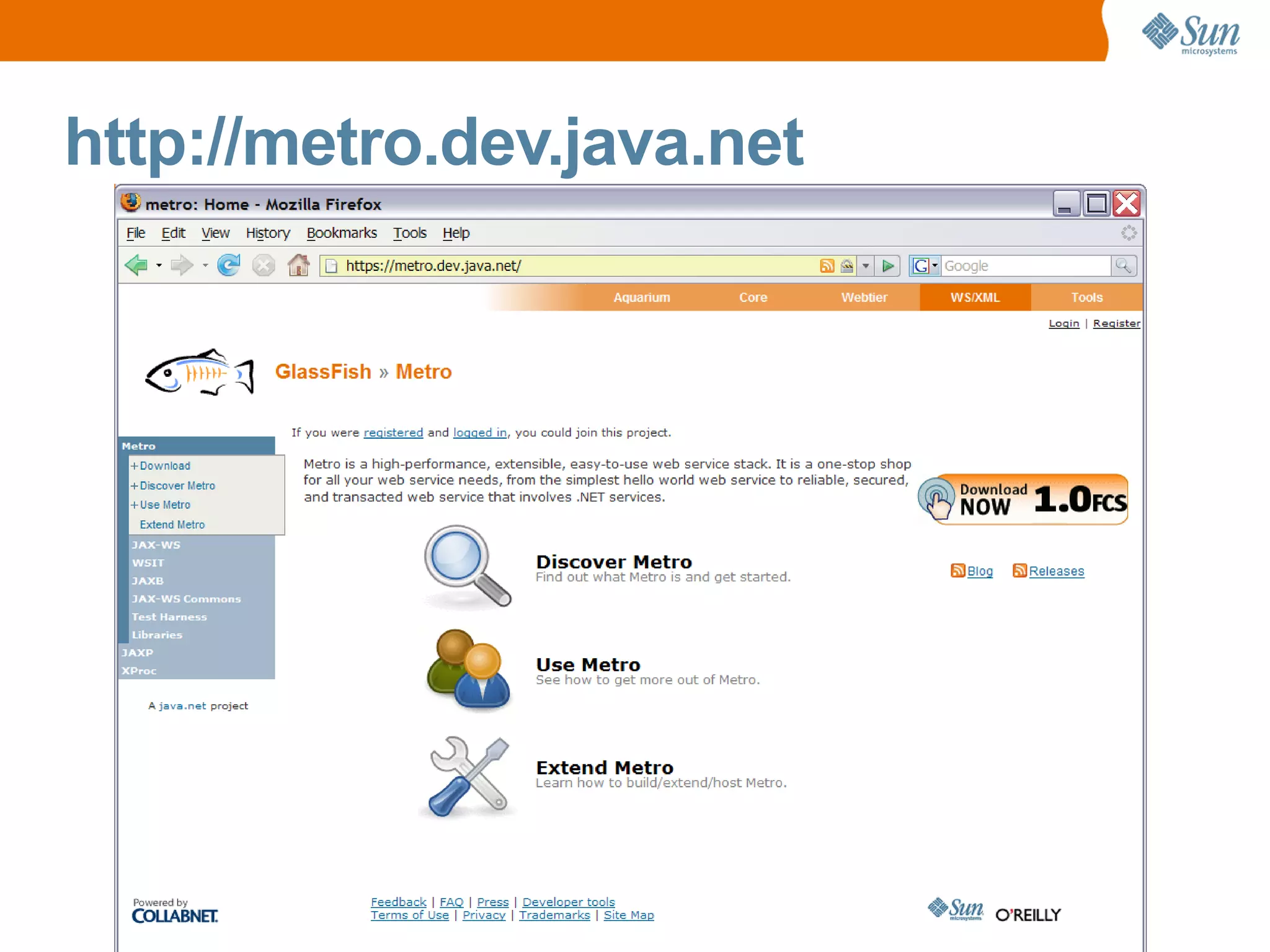
Project Metro  Project Metro =  Java.net  project for  GlassFish Web Services stack   http://metro.dev.java.net  Can also be used outside of Glassfish key components of Metro: JAX-WS  and  WSIT
http://metro.dev.java.net
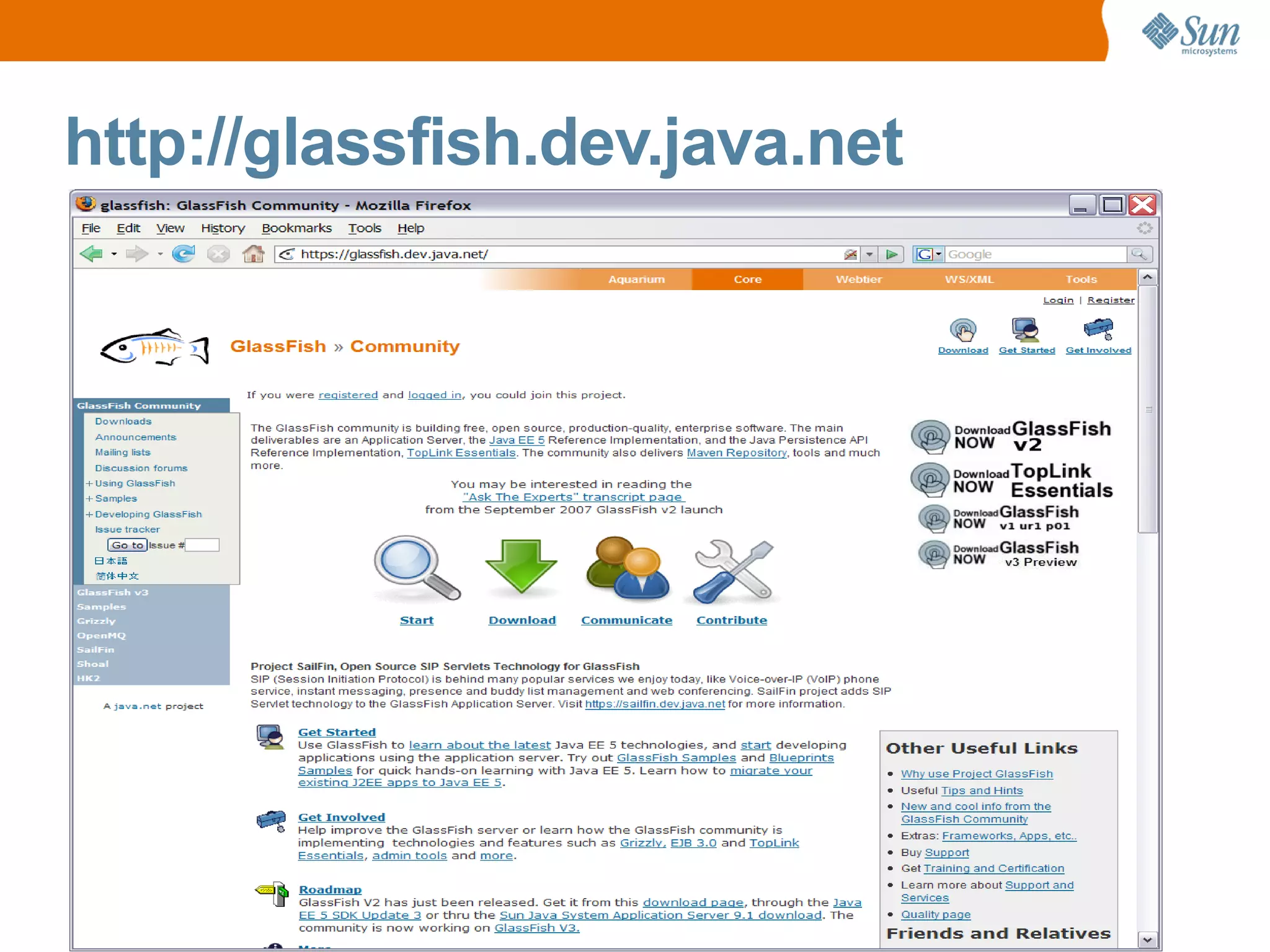
http://glassfish.dev.java.net
JAX-WS  In addition to Glassfish,  JAX_WS can be used as WS stack with   JBoss,   WebLogic  Server 10,  Apache  Tomcat ,  Jetty , and  Java SE ,  TmaxSoft  JEUS 6,  Spring
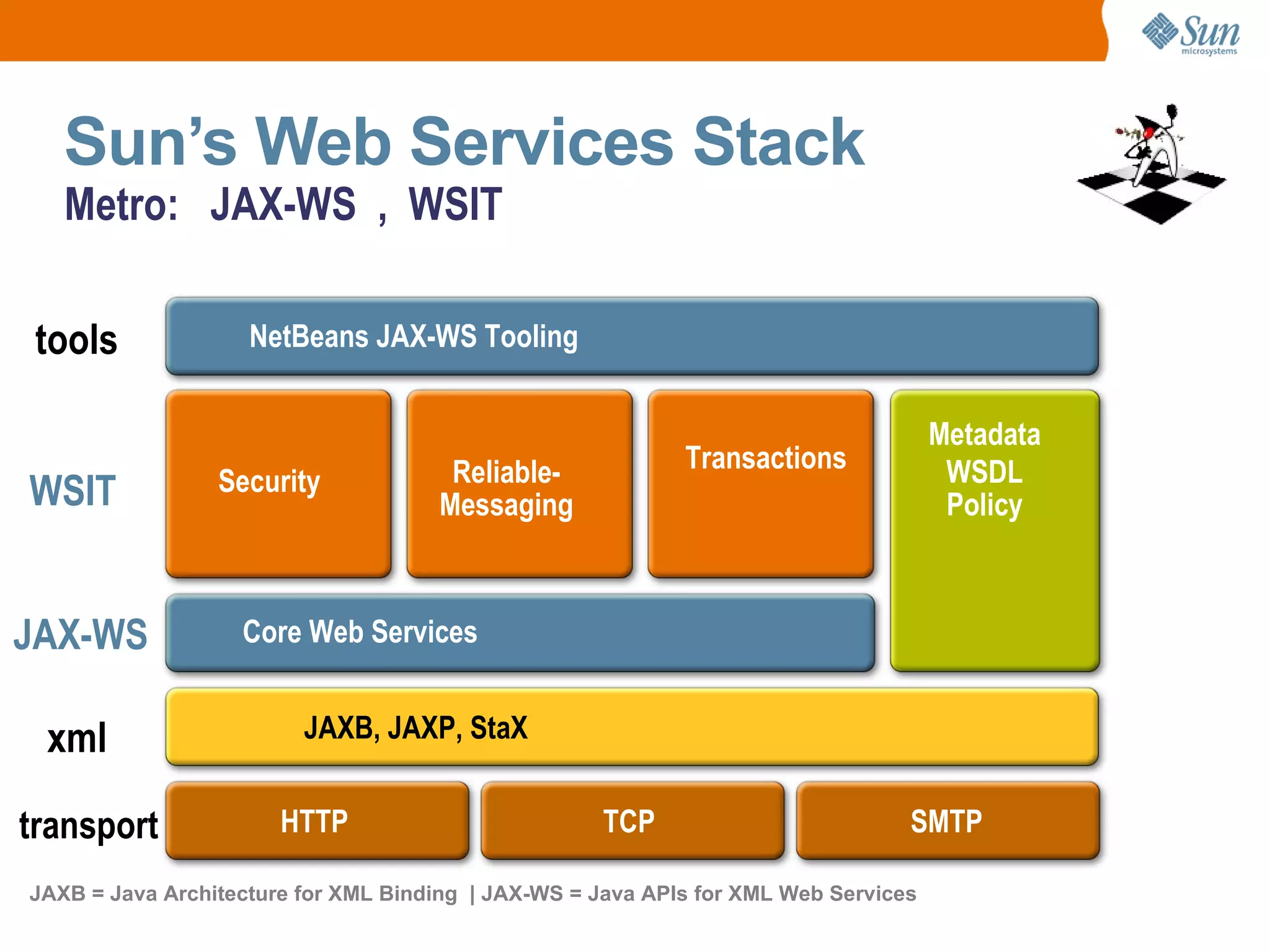
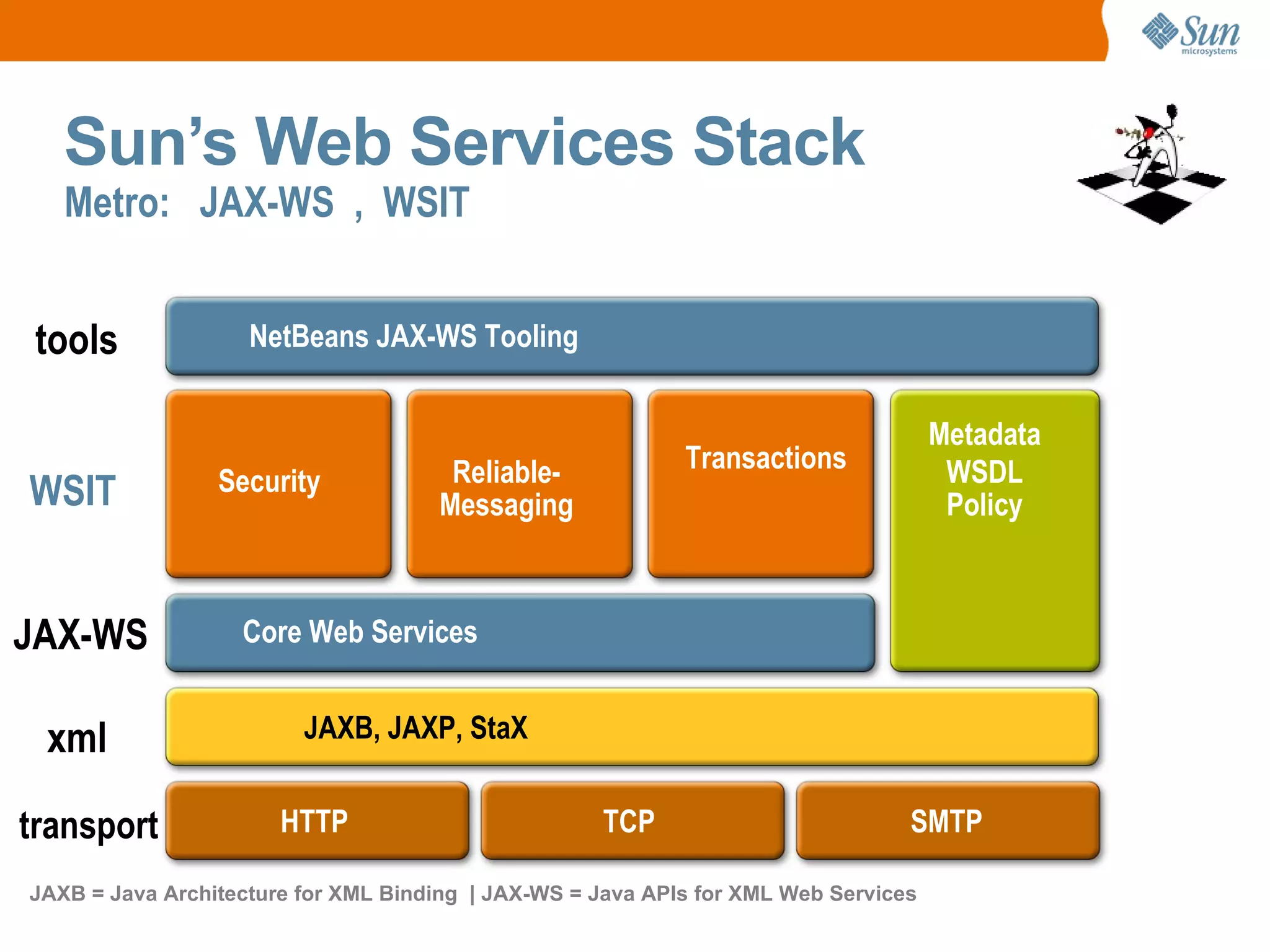
Sun’s Web Services Stack Metro:  JAX-WS  ,  WSIT   JAXB = Java Architecture for XML Binding  | JAX-WS = Java APIs for XML Web Services NetBeans JAX-WS Tooling Transactions Reliable- Messaging Security Metadata WSDL Policy Core Web Services  HTTP TCP SMTP JAXB, JAXP, StaX  JAX-WS WSIT tools transport xml
Agenda Metro  JAX-WS  WSIT REST
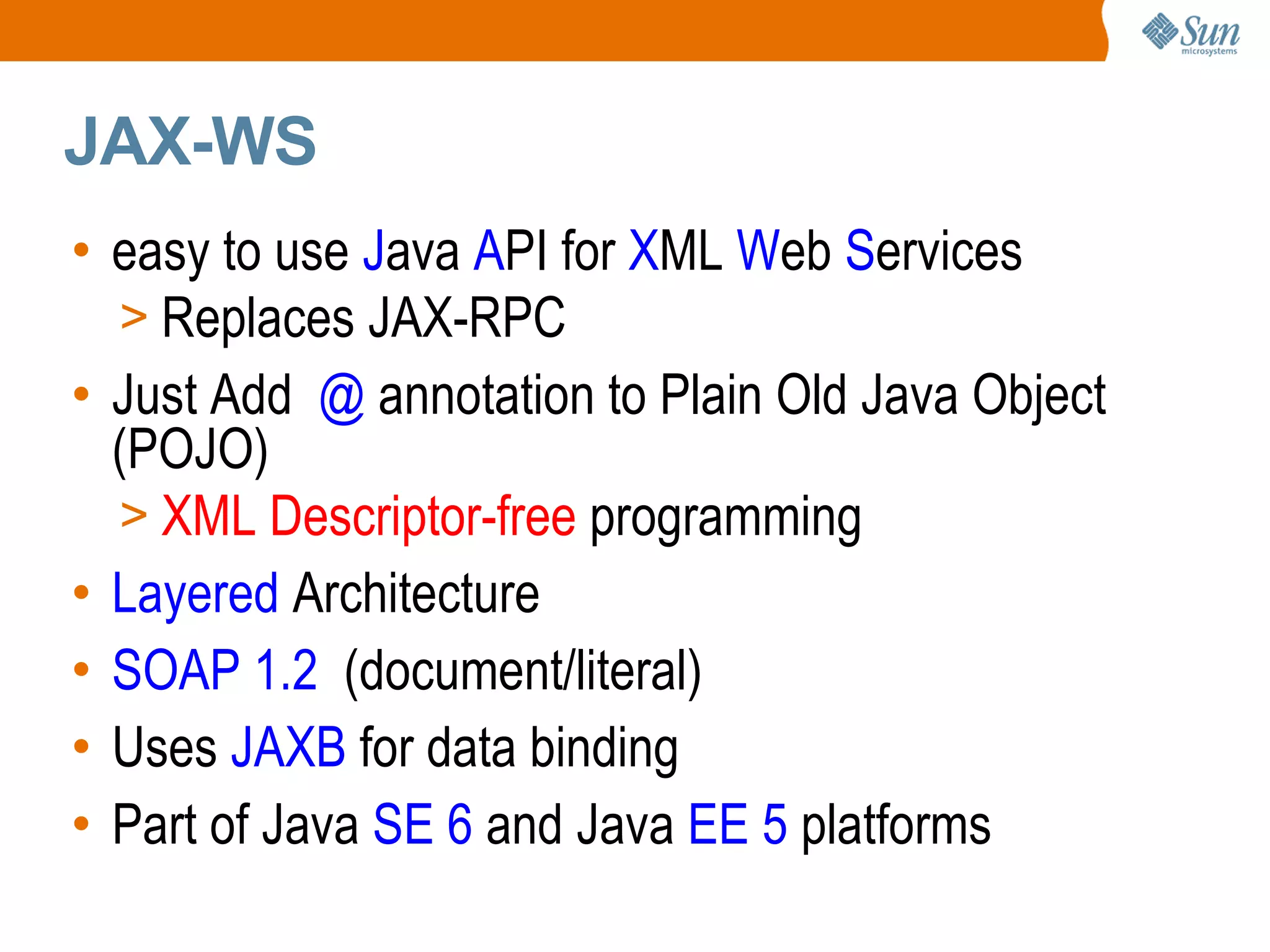
JAX-WS  easy to use  J ava  A PI for  X ML  W eb  S ervices Replaces JAX-RPC Just Add  @  annotation to Plain Old Java Object (POJO)  XML   Descriptor-free  programming Layered  Architecture SOAP 1.2   (document/literal) Uses  JAXB  for data binding Part of Java  SE 6  and Java  EE 5  platforms
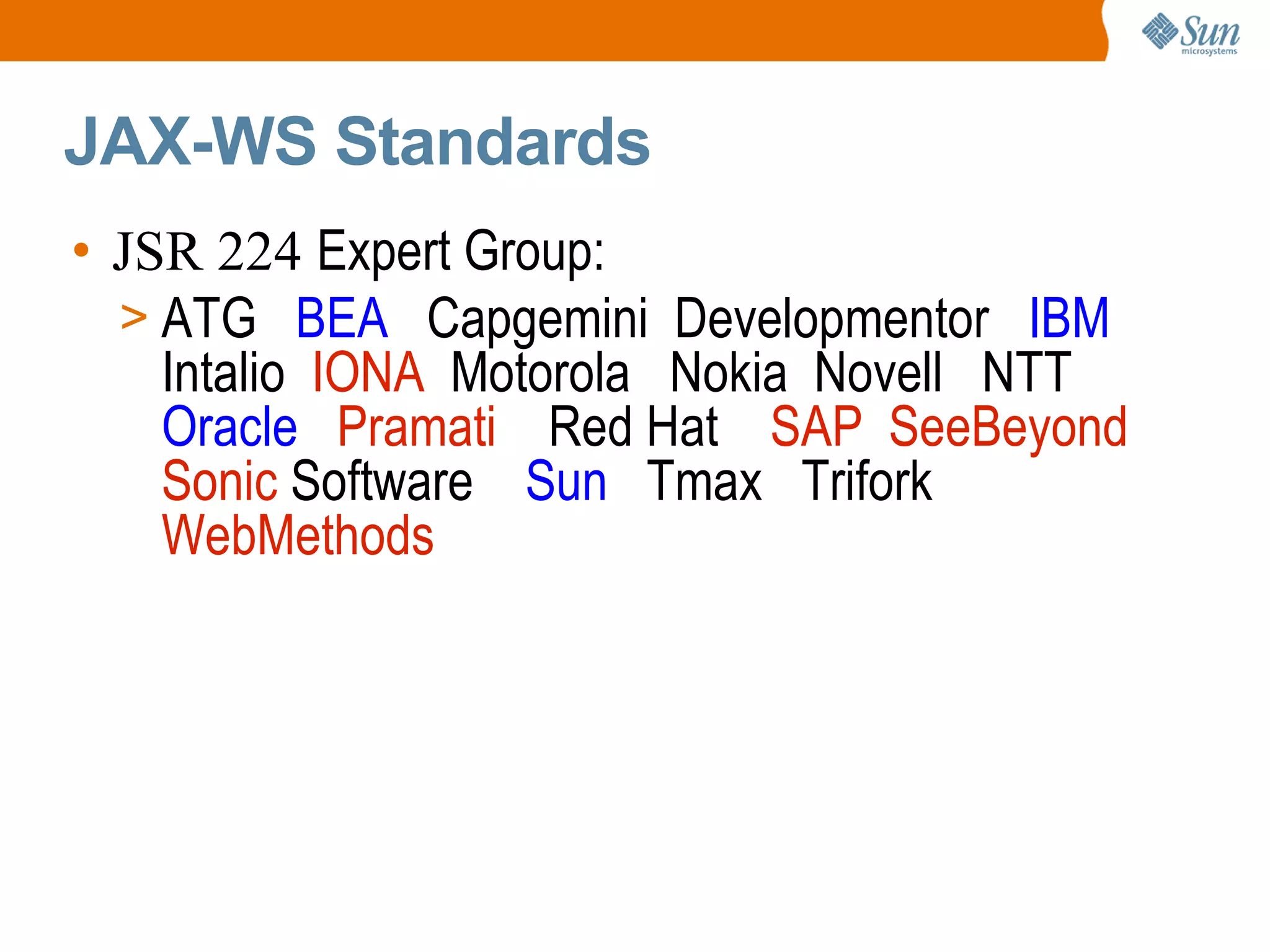
JAX-WS Standards  JSR 224  Expert Group: ATG  BEA   Capgemini  Developmentor  IBM   Intalio  IONA   Motorola  Nokia  Novell  NTT  Oracle   Pramati   Red Hat  SAP   SeeBeyond   Sonic  Software  Sun   Tmax  Trifork  WebMethods
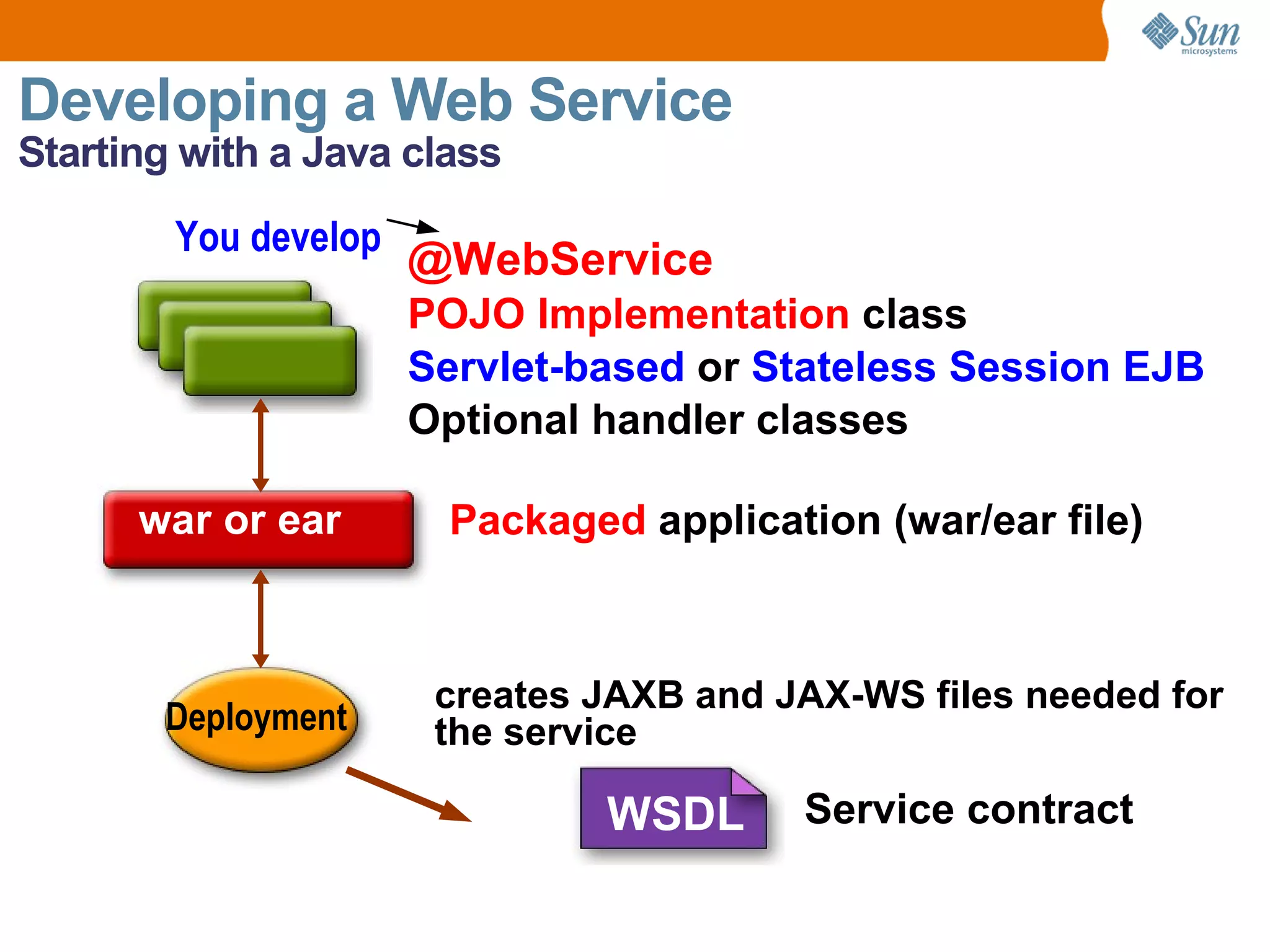
Developing a Web Service  Starting with a Java class   war or ear @WebService POJO Implementation  class Servlet-based  or  Stateless Session EJB Optional handler classes Packaged  application  (war/ear file) You develop Service contract WSDL Deployment creates JAXB and JAX-WS files needed for the service
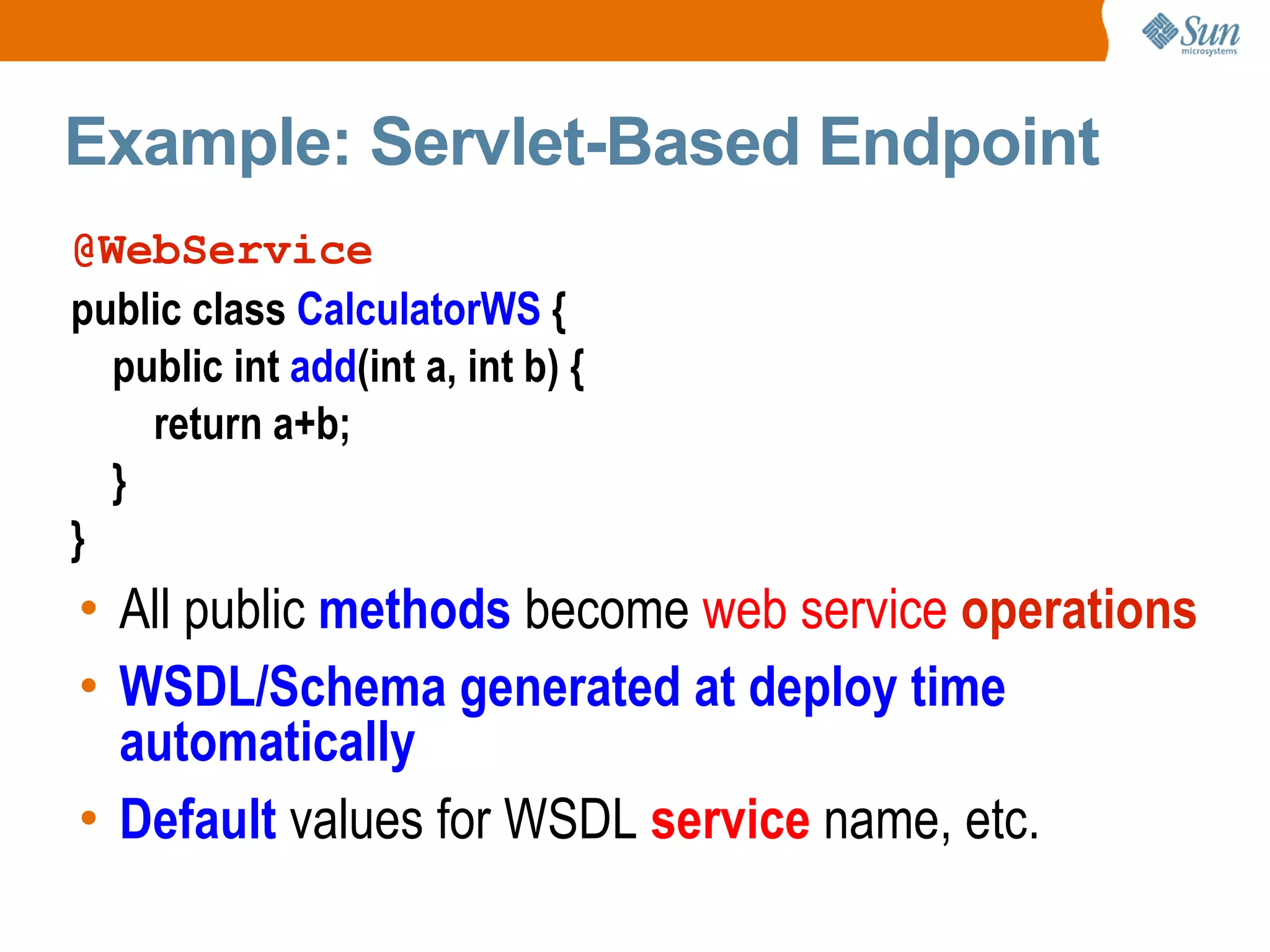
Example: Servlet-Based Endpoint @WebService public class  CalculatorWS  { public int  add (int a, int b) { return a+b; } } All public  methods  become  web service   operations WSDL/Schema generated at deploy time automatically Default   values for WSDL  service   name, etc.
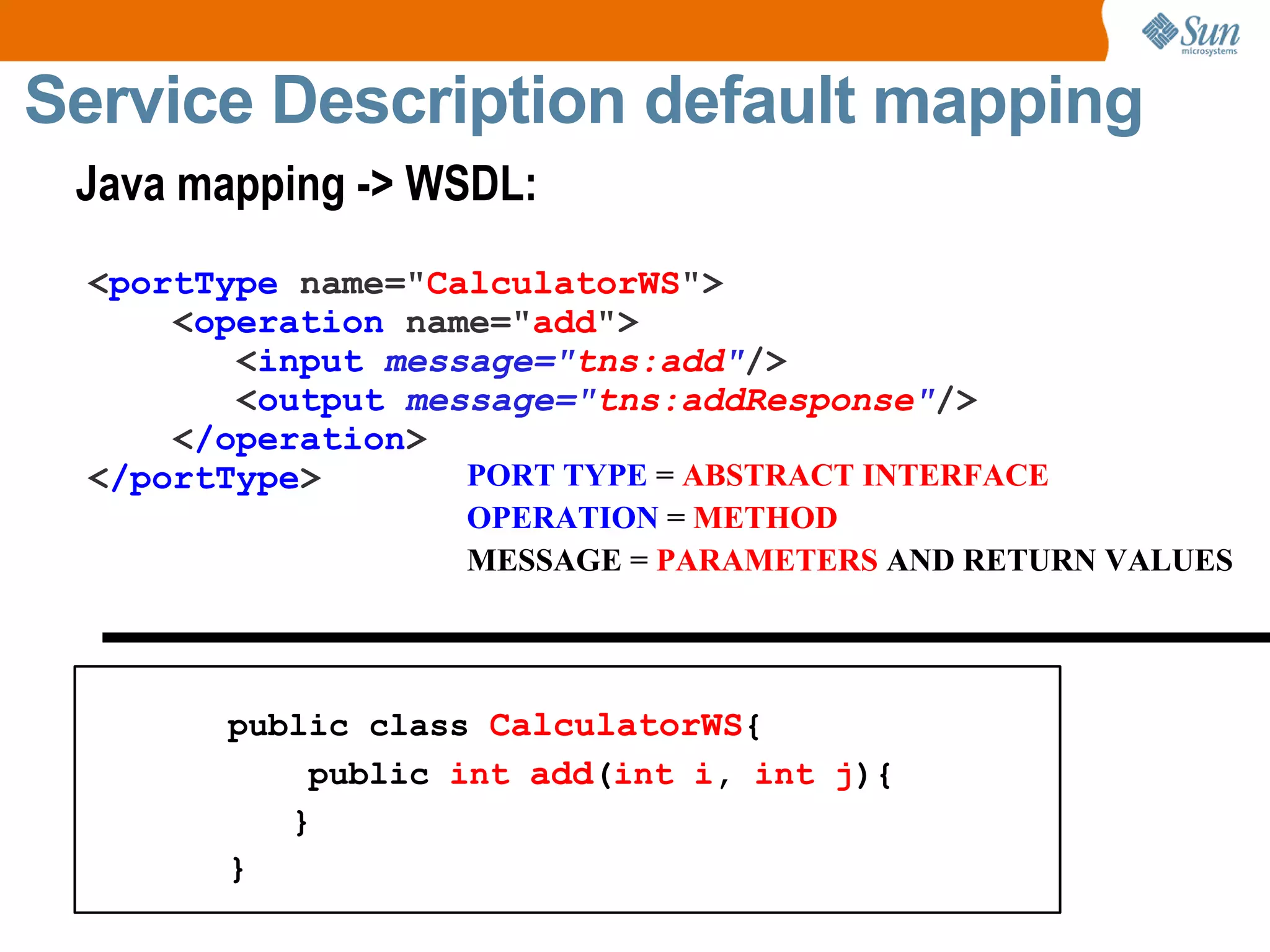
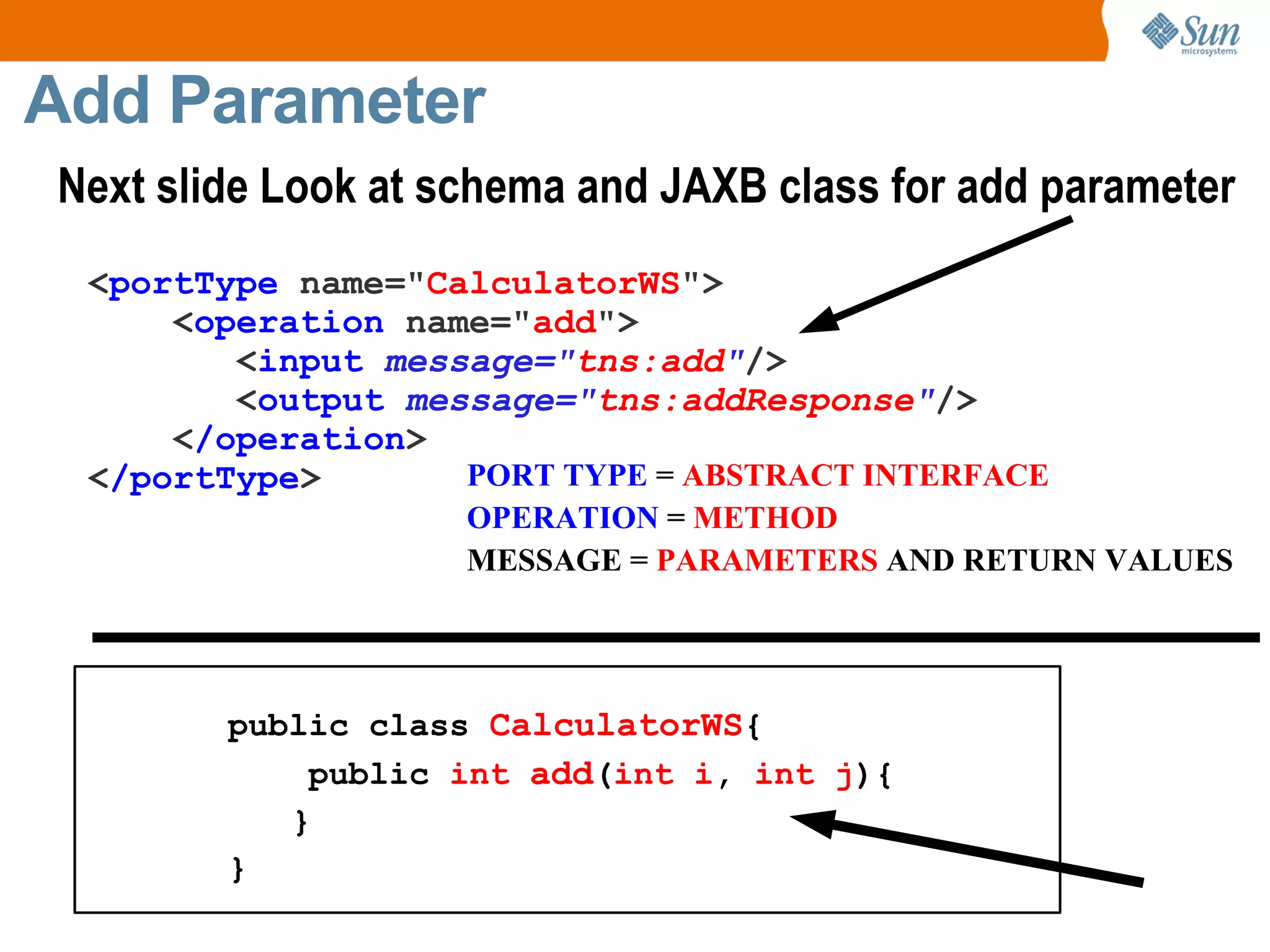
Service Description default mapping  Java mapping -> WSDL: public class   CalculatorWS { public  int   add ( int i ,  int j ){  } } < portType  name=&quot; CalculatorWS &quot;> < operation  name=&quot; add &quot;> < input   message=&quot; tns:add &quot; /> < output   message=&quot; tns:addResponse &quot; /> < /operation > < /portType > PORT TYPE  =  ABSTRACT INTERFACE  OPERATION  =  METHOD  MESSAGE =  PARAMETERS  AND RETURN VALUES
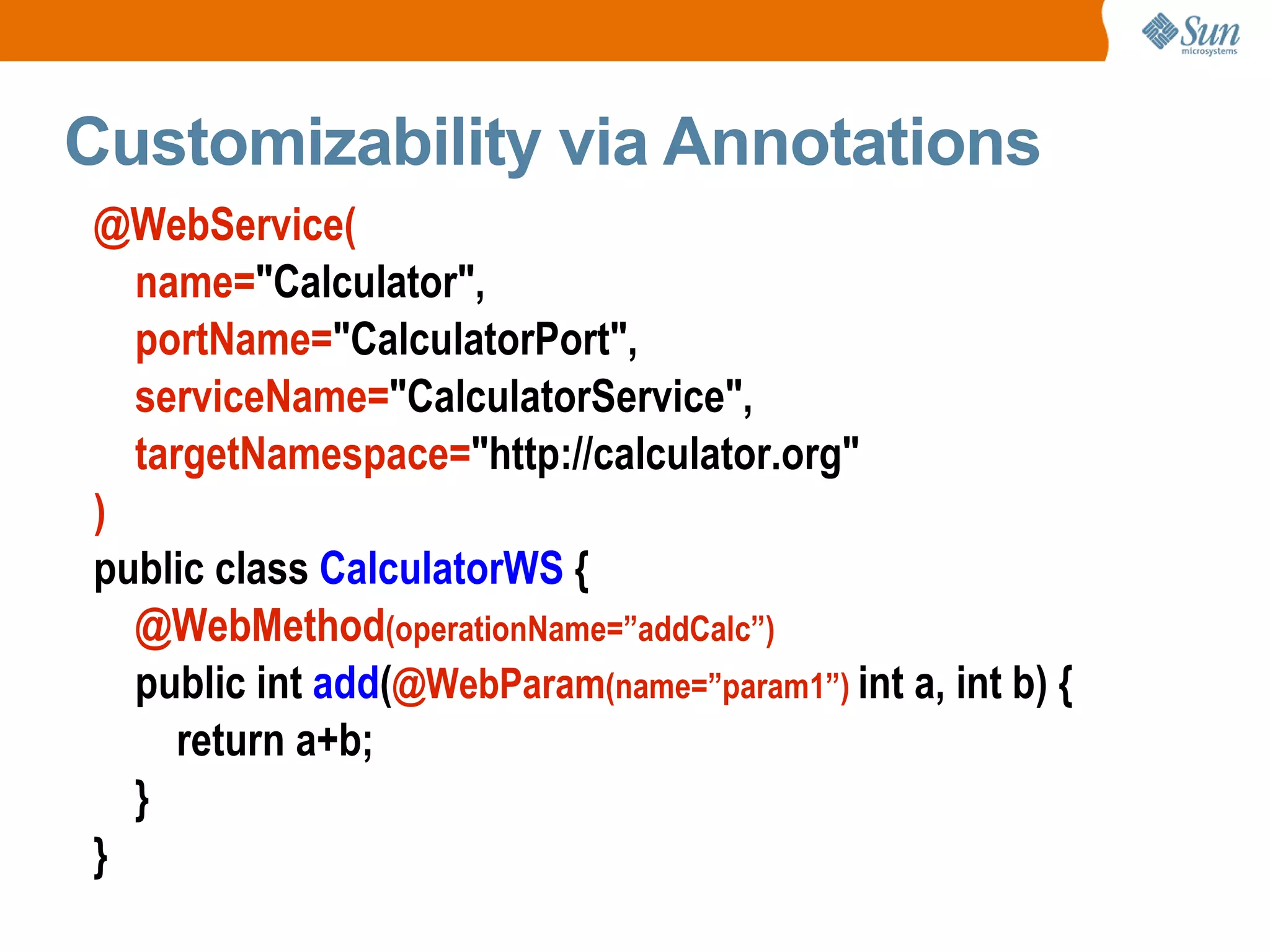
Customizability via Annotations @WebService( name= &quot;Calculator&quot;, portName= &quot;CalculatorPort&quot;, serviceName= &quot;CalculatorService&quot;, targetNamespace= &quot;http://calculator.org&quot; ) public class  CalculatorWS  { @WebMethod (operationName=”addCalc”) public int  add ( @WebParam (name=”param1”)  int a, int b) { return a+b; } }
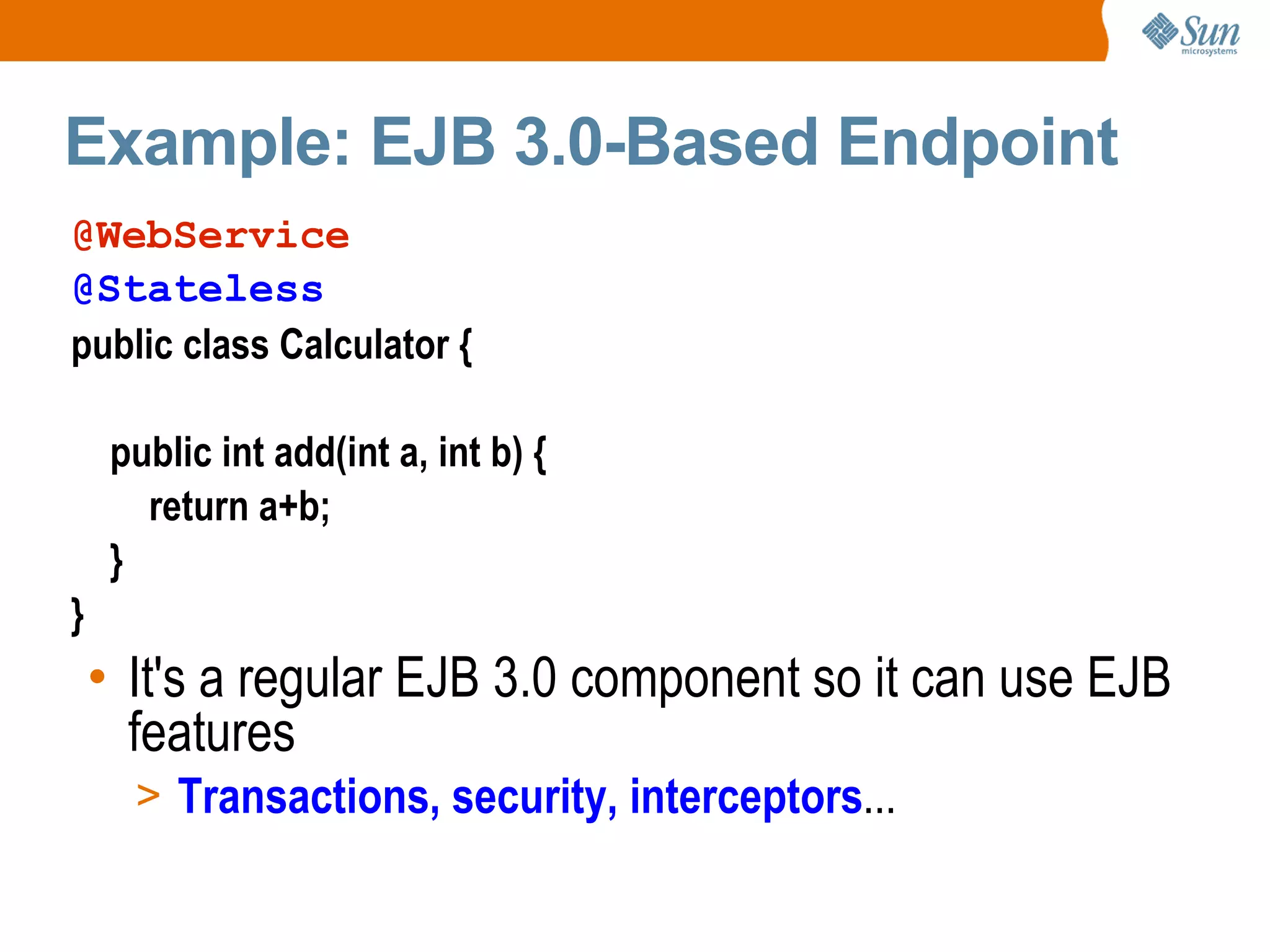
Example: EJB 3.0-Based Endpoint It's a regular EJB 3.0 component so it can use EJB features Transactions, security, interceptors ... @WebService @Stateless public class Calculator {   public int add(int a, int b) { return a+b; } }
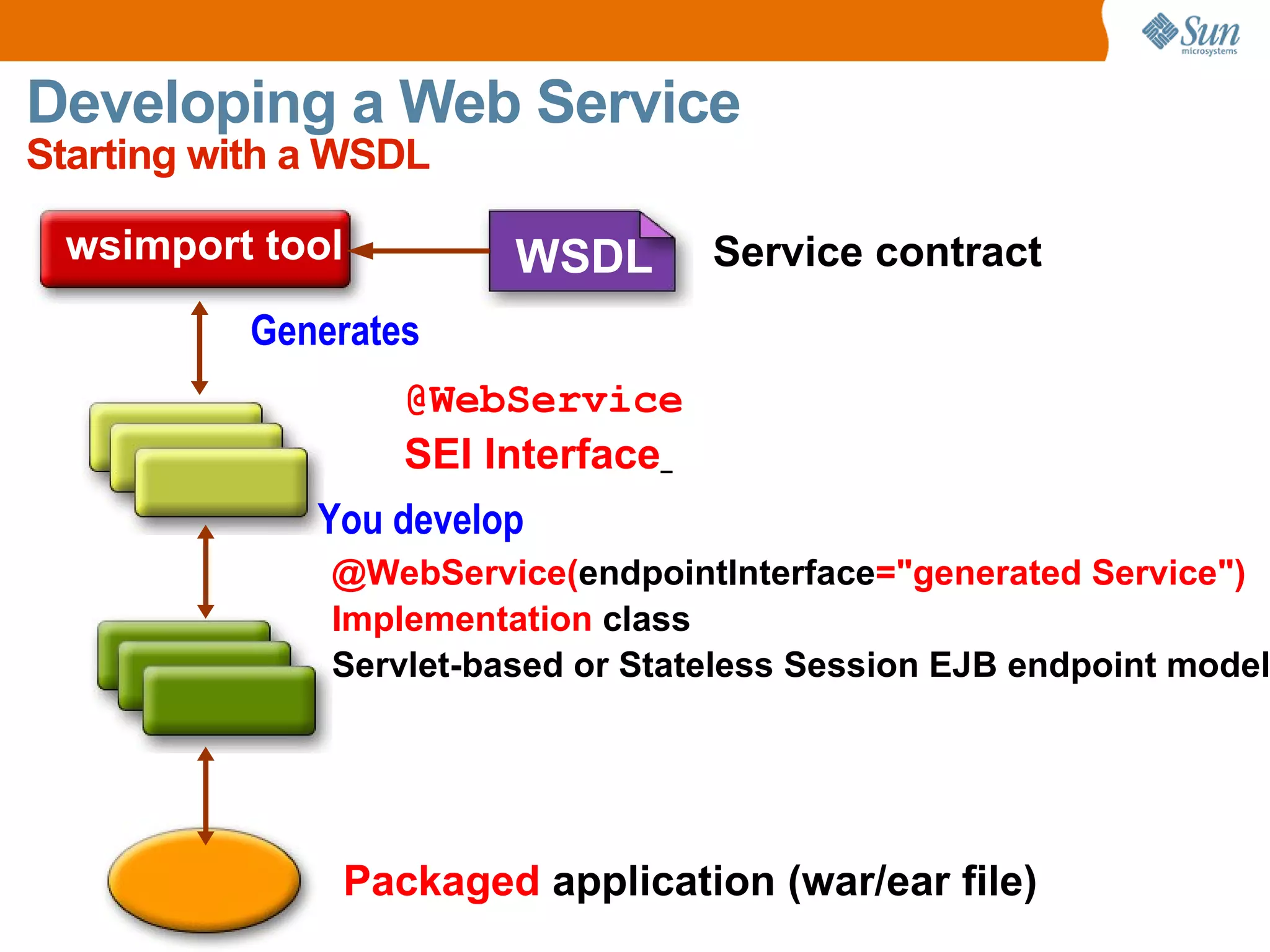
Developing a Web Service Starting with a WSDL wsimport  tool @WebService  SEI Interface   @WebService( endpointInterface =&quot;generated Service&quot;)  Implementation  class Servlet-based or Stateless Session EJB endpoint model Packaged  application  (war/ear file) Service contract WSDL Generates You develop
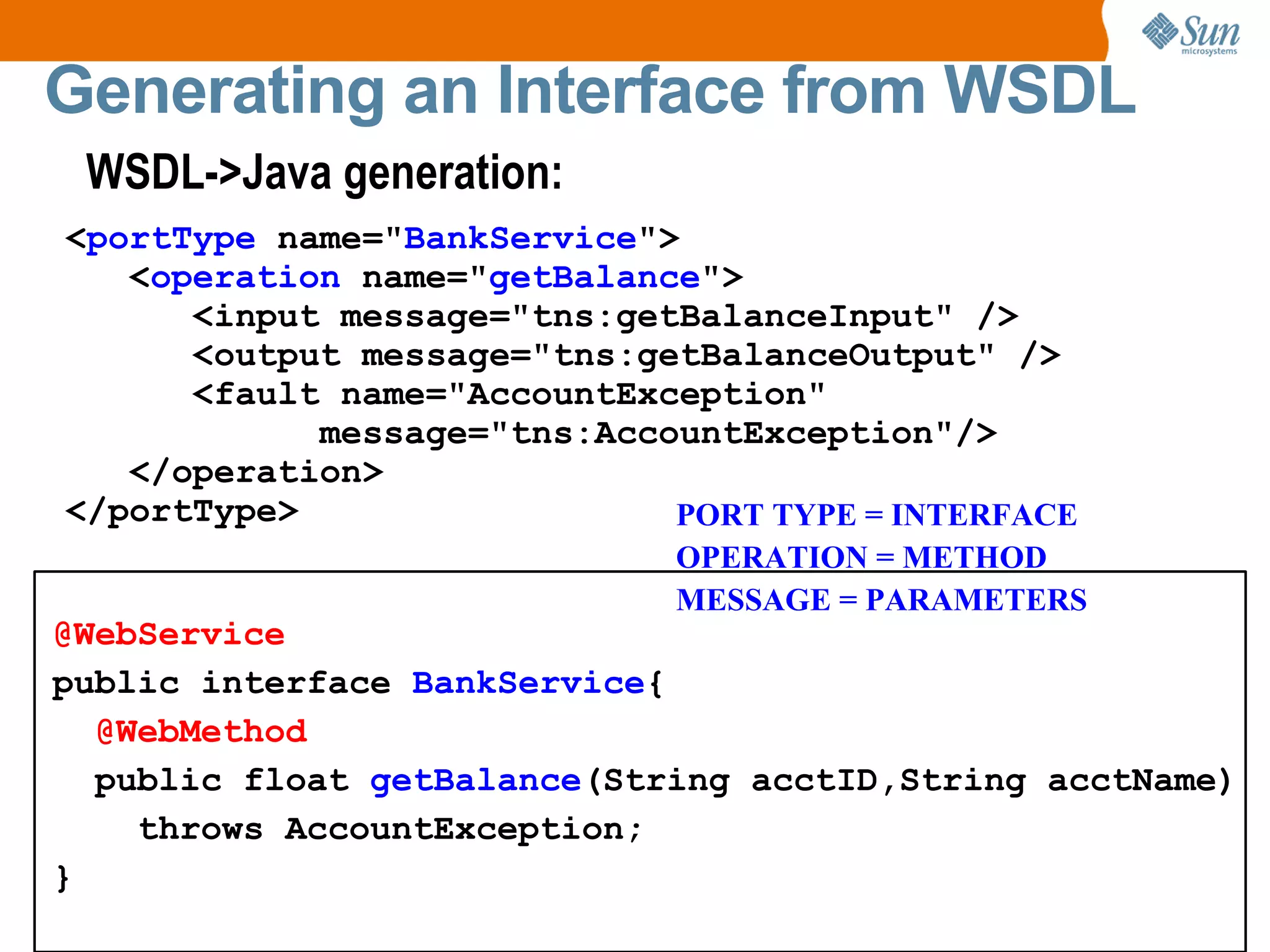
Generating an Interface from WSDL   WSDL->Java generation: @WebService public interface  BankService { @WebMethod public float  getBalance (String acctID,String acctName) throws AccountException; } < portType  name=&quot; BankService &quot;> < operation  name=&quot; getBalance &quot;> <input message=&quot;tns:getBalanceInput&quot; /> <output message=&quot;tns:getBalanceOutput&quot; /> <fault name=&quot;AccountException&quot; message=&quot;tns:AccountException&quot;/> </operation> </portType> PORT TYPE = INTERFACE  OPERATION = METHOD  MESSAGE = PARAMETERS
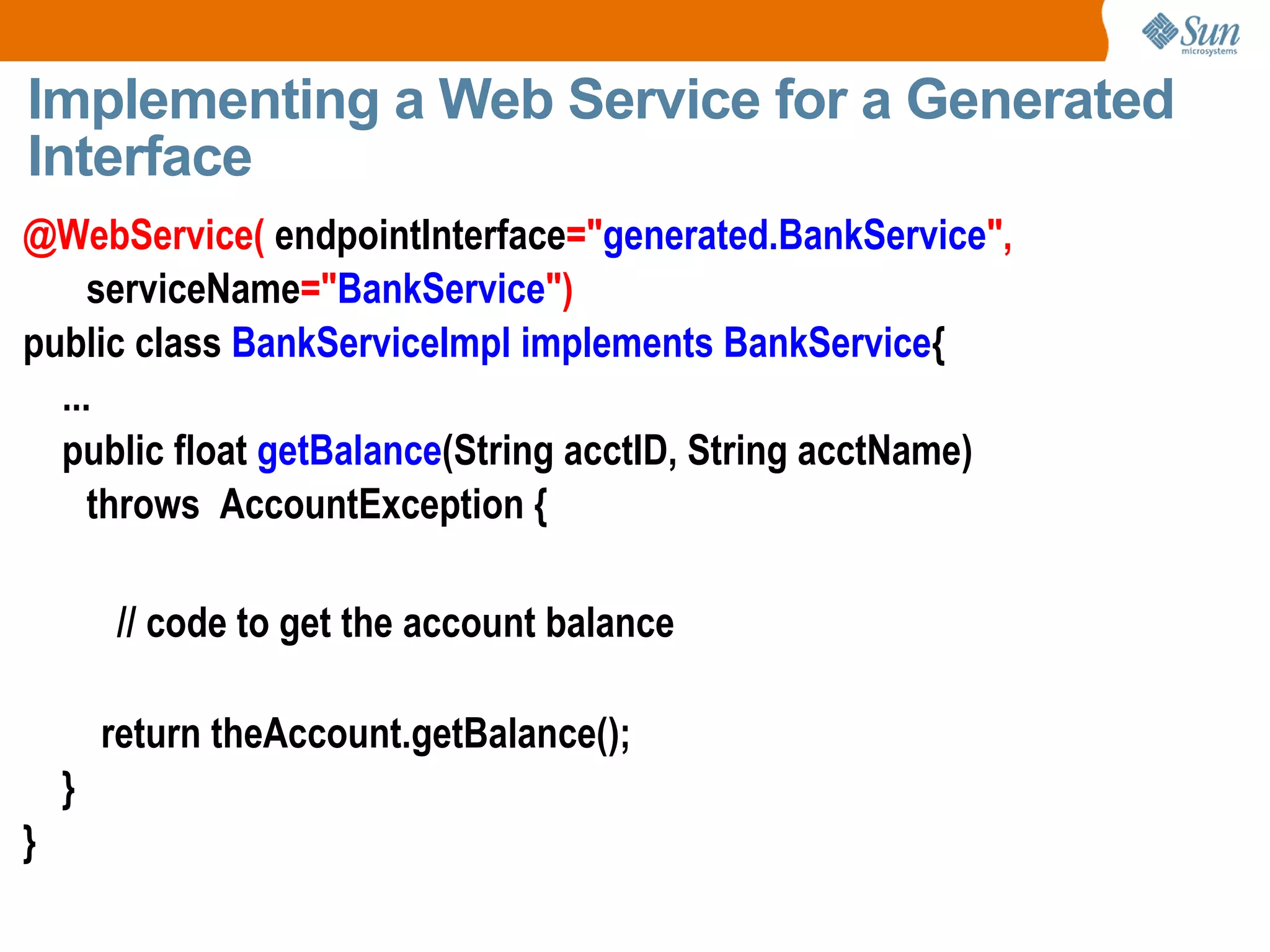
Implementing a Web Service for a Generated Interface @WebService(  endpointInterface =&quot; generated.BankService &quot;,  serviceName =&quot; BankService &quot;) public class  BankServiceImpl implements BankService { ... public float  getBalance (String acctID, String acctName)  throws  AccountException { // code to get the account balance return theAccount.getBalance(); } }
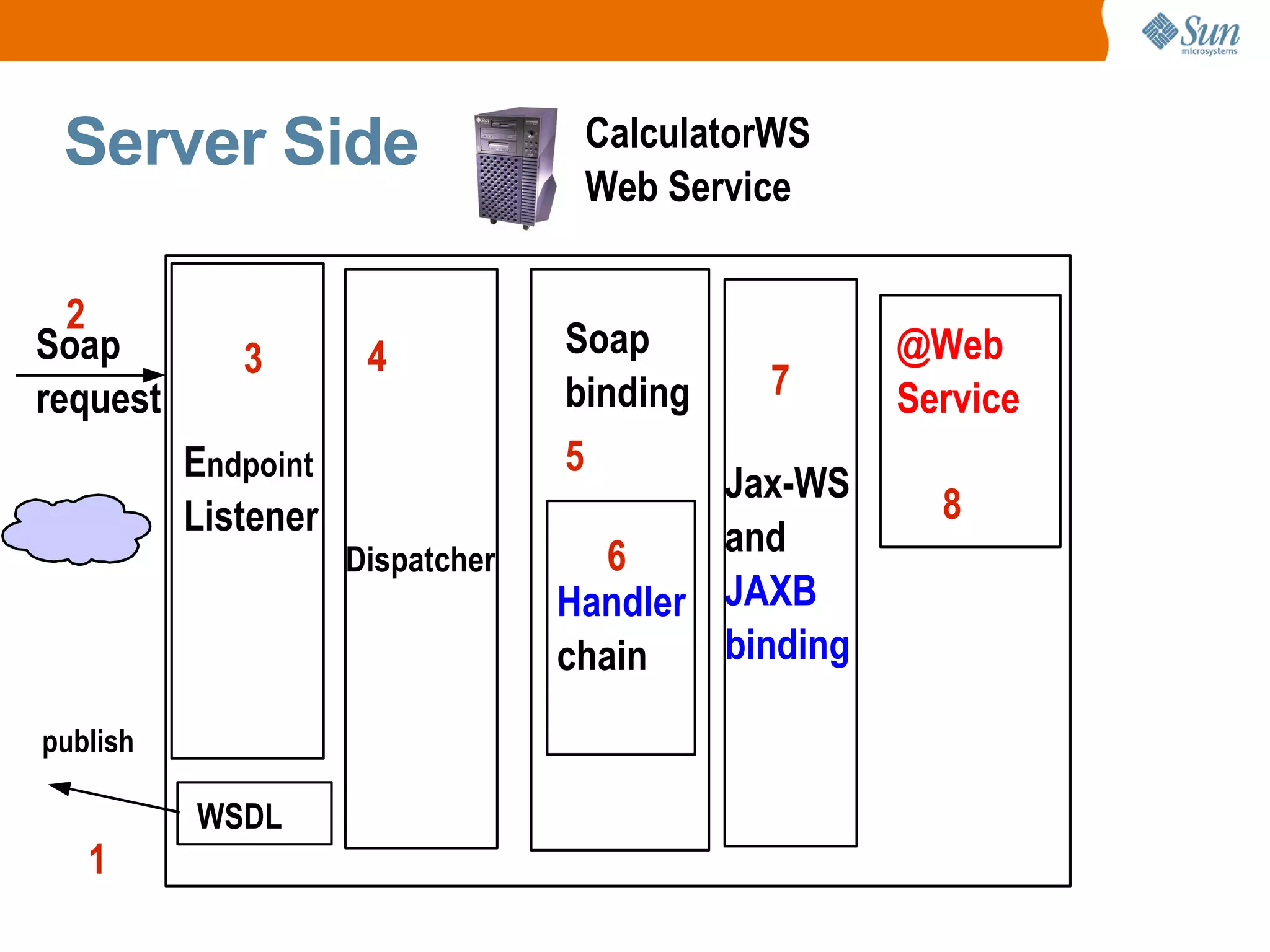
Server Side CalculatorWS Web Service E ndpoint Listener Soap binding @Web Service Soap request publish 1 2 3 4 5 6 7 8
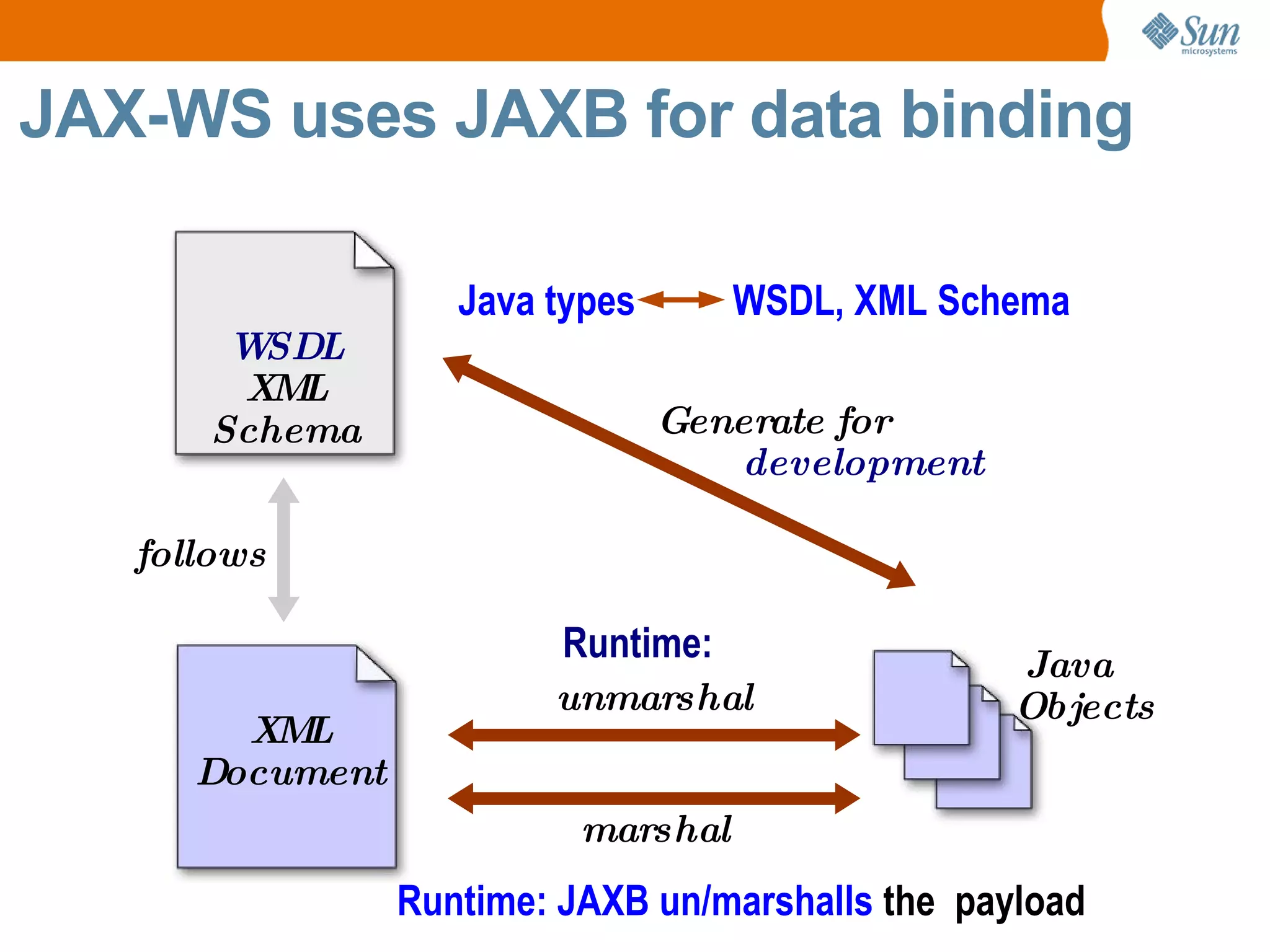
Runtime:  Java types   WSDL, XML Schema JAX-WS uses JAXB for data binding  Runtime: JAXB un/marshalls  the  payload WSDL  XML Schema XML Document unmarshal marshal Generate for  development  Java  Objects follows
Add Parameter  Next slide Look at schema and JAXB class for add parameter  public class   CalculatorWS { public  int   add ( int i ,  int j ){  } } < portType  name=&quot; CalculatorWS &quot;> < operation  name=&quot; add &quot;> < input   message=&quot; tns:add &quot; /> < output   message=&quot; tns:addResponse &quot; /> < /operation > < /portType > PORT TYPE  =  ABSTRACT INTERFACE  OPERATION  =  METHOD  MESSAGE =  PARAMETERS  AND RETURN VALUES
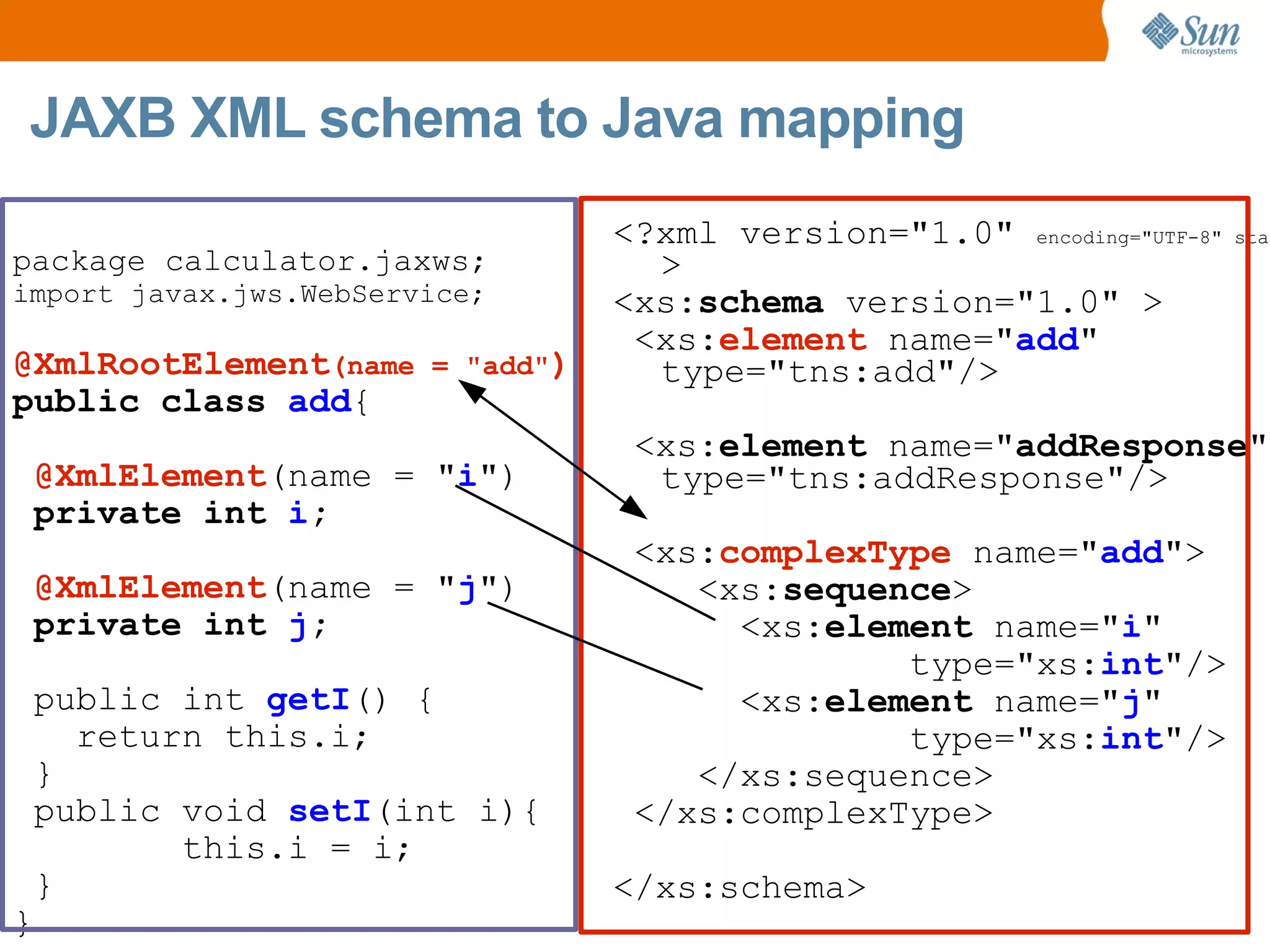
JAXB XML schema to Java mapping package calculator.jaxws; import javax.jws.WebService; @XmlRootElement (name = &quot;add&quot; ) public class   add { @XmlElement (name = &quot; i &quot;) private int  i ; @XmlElement (name = &quot; j &quot;) private int  j ; public int  getI () { return this.i; } public void  setI (int i){ this.i = i; } } <?xml version=&quot;1.0&quot;  encoding=&quot;UTF-8&quot; standalone=&quot;yes&quot;? > <xs: schema  version=&quot;1.0&quot; > <xs: element  name=&quot; add &quot;  type=&quot;tns:add&quot;/> <xs: element  name=&quot; addResponse &quot; type=&quot;tns:addResponse&quot;/> <xs: complexType  name=&quot; add &quot;> <xs: sequence > <xs: element  name=&quot; i &quot; type=&quot;xs: int &quot;/> <xs: element  name=&quot; j &quot;  type=&quot;xs: int &quot;/> </xs:sequence> </xs:complexType> </xs:schema>
demo
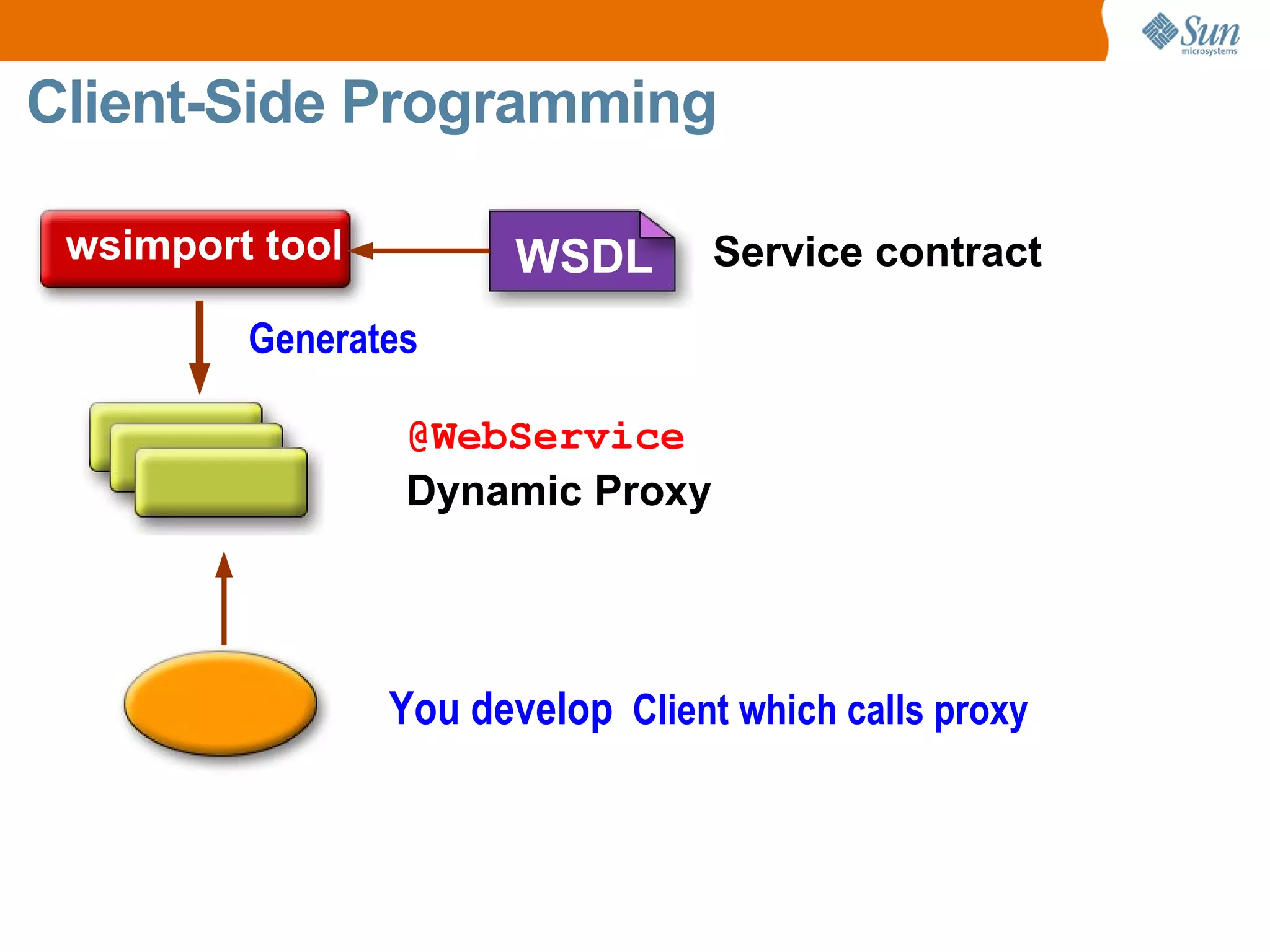
Client-Side Programming  wsimport tool @WebService  Dynamic Proxy Service contract WSDL Generates You develop   Client which calls proxy
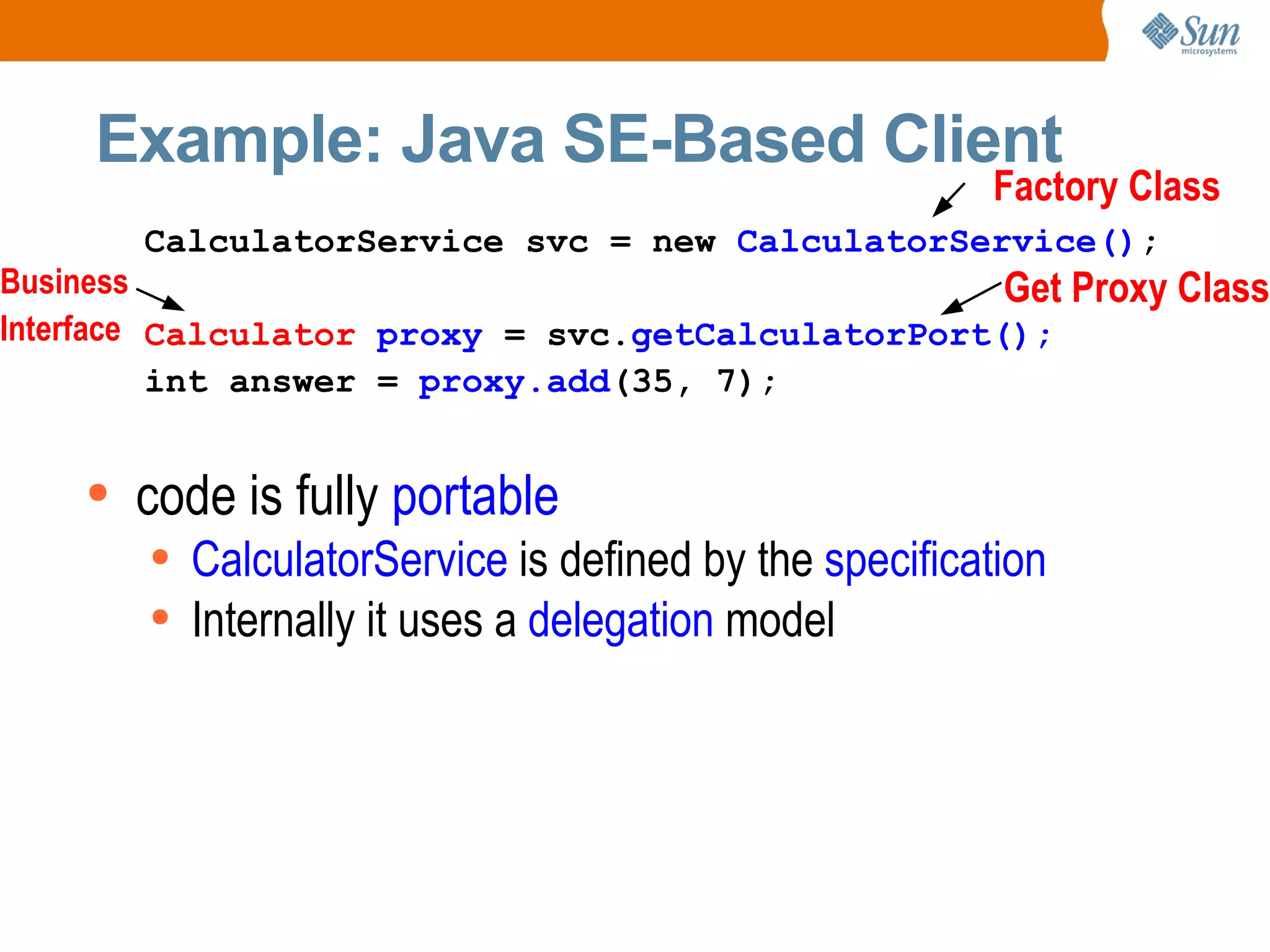
Example: Java SE-Based Client code is fully  portable CalculatorService  is defined by the  specification Internally it uses a  delegation  model CalculatorService svc = new  CalculatorService() ; Calculator   proxy  = svc. getCalculatorPort(); int answer =  proxy.add (35, 7); Factory Class Get Proxy Class Business  Interface
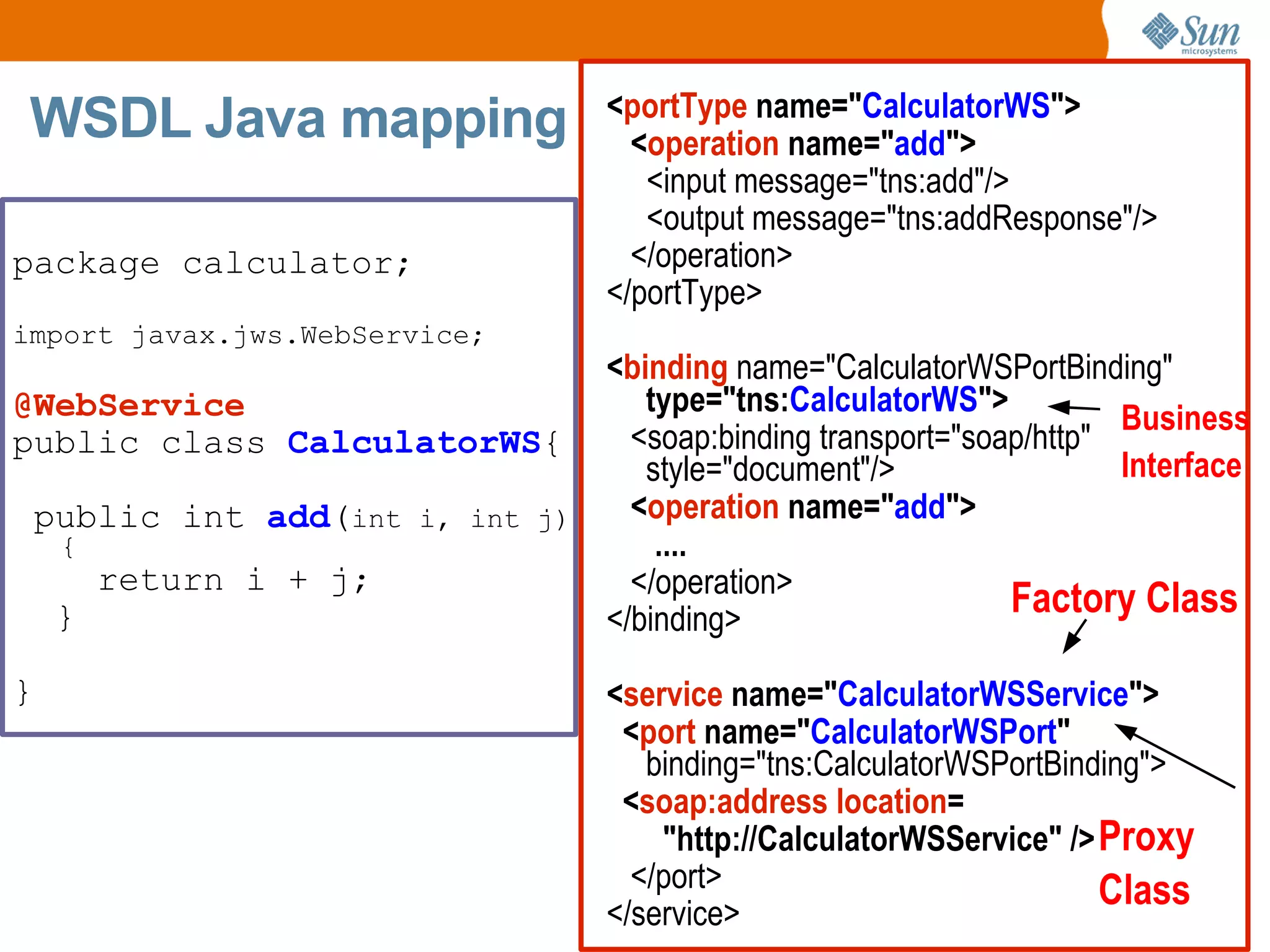
WSDL Java mapping package calculator; import javax.jws.WebService; @WebService public class  CalculatorWS { public int  add ( int i, int j) { return i + j; } } < portType  name=&quot; CalculatorWS &quot;> < operation  name=&quot; add &quot;> <input message=&quot;tns:add&quot;/> <output message=&quot;tns:addResponse&quot;/> </operation> </portType> < binding  name=&quot;CalculatorWSPortBinding&quot;  type=&quot;tns: CalculatorWS &quot;> <soap:binding transport=&quot;soap/http&quot;  style=&quot;document&quot;/> < operation  name=&quot; add &quot;> .... </operation> </binding> < service  name=&quot; CalculatorWSService &quot;> < port  name=&quot; CalculatorWSPort &quot;  binding=&quot;tns:CalculatorWSPortBinding&quot;>  < soap:address   location = &quot;http://CalculatorWSService&quot; /> </port> </service> Factory Class Proxy  Class Business  Interface
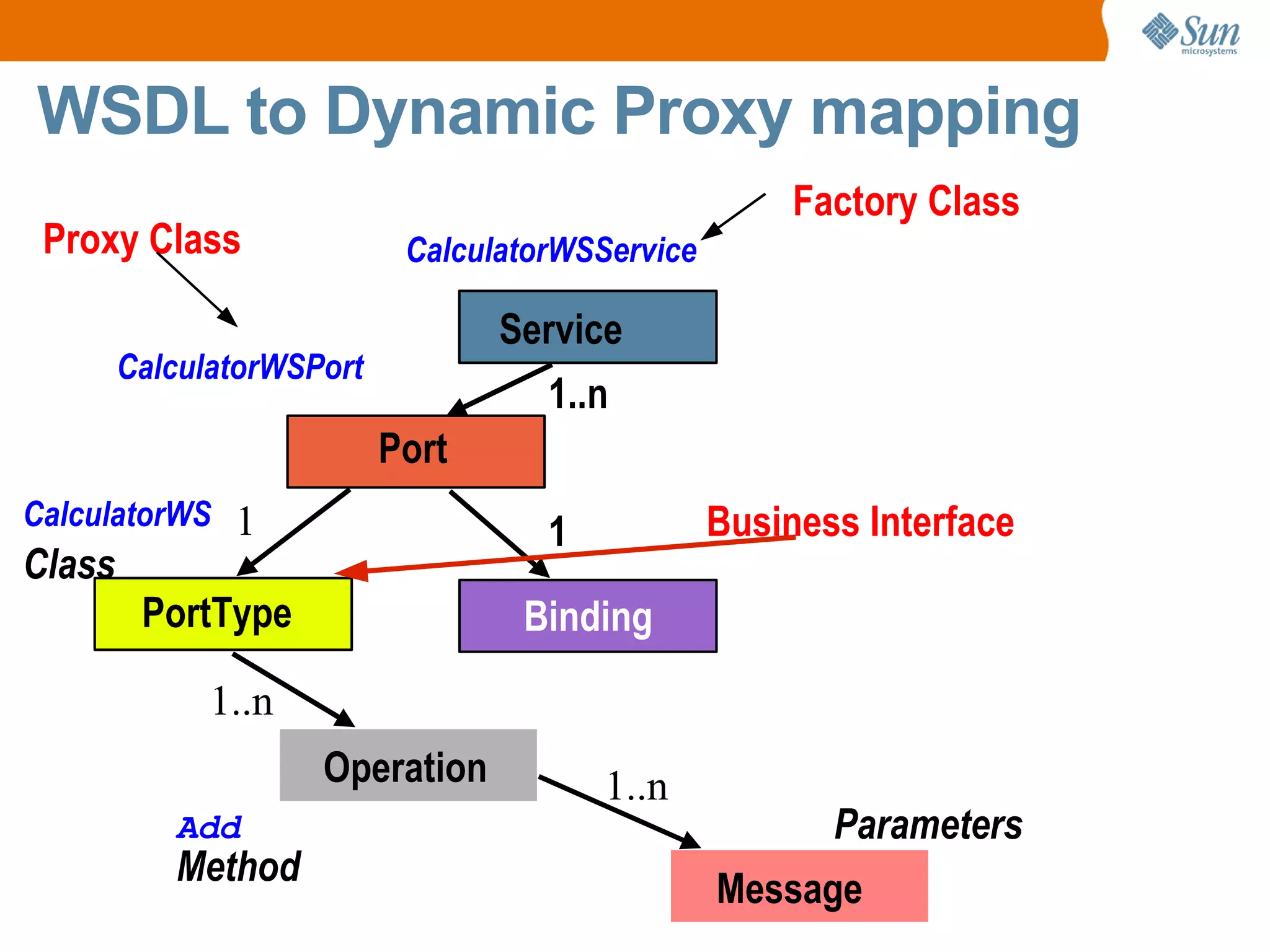
WSDL to Dynamic Proxy mapping  Service Port PortType Binding 1..n 1 1 1..n 1..n CalculatorWSPort CalculatorWS Class CalculatorWSService Add  Method Parameters Business Interface Factory Class Proxy Class Operation Message
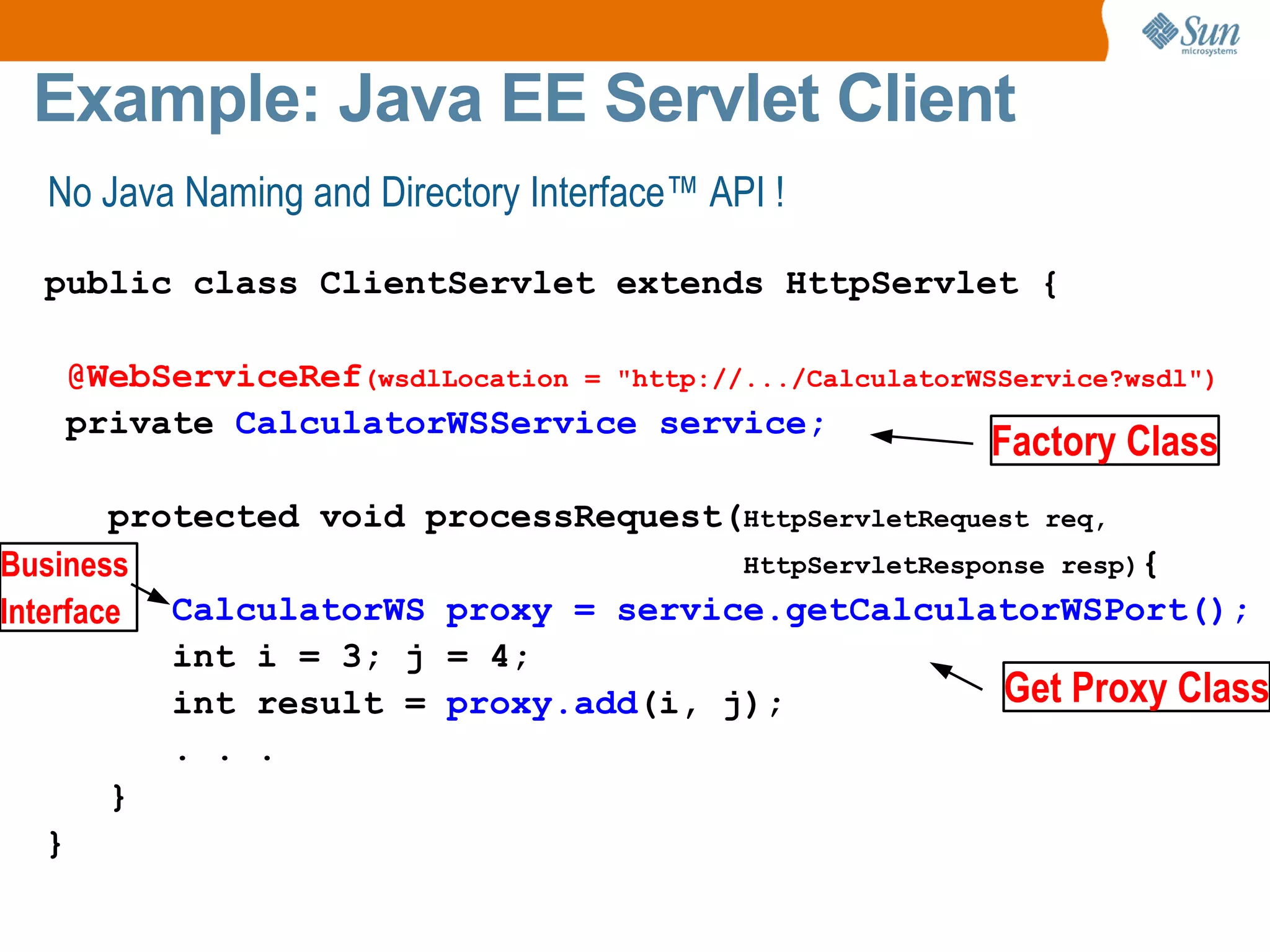
Example: Java EE Servlet Client No Java Naming and Directory Interface™ API ! public class ClientServlet extends HttpServlet { @WebServiceRef (wsdlLocation = &quot;http://.../CalculatorWSService?wsdl&quot;) private  CalculatorWSService service; protected void processRequest( HttpServletRequest req, HttpServletResponse resp) { CalculatorWS proxy = service.getCalculatorWSPort(); int i = 3; j = 4; int result =  proxy.add (i, j); . . . } } Get Proxy Class Business  Interface Factory Class
demo
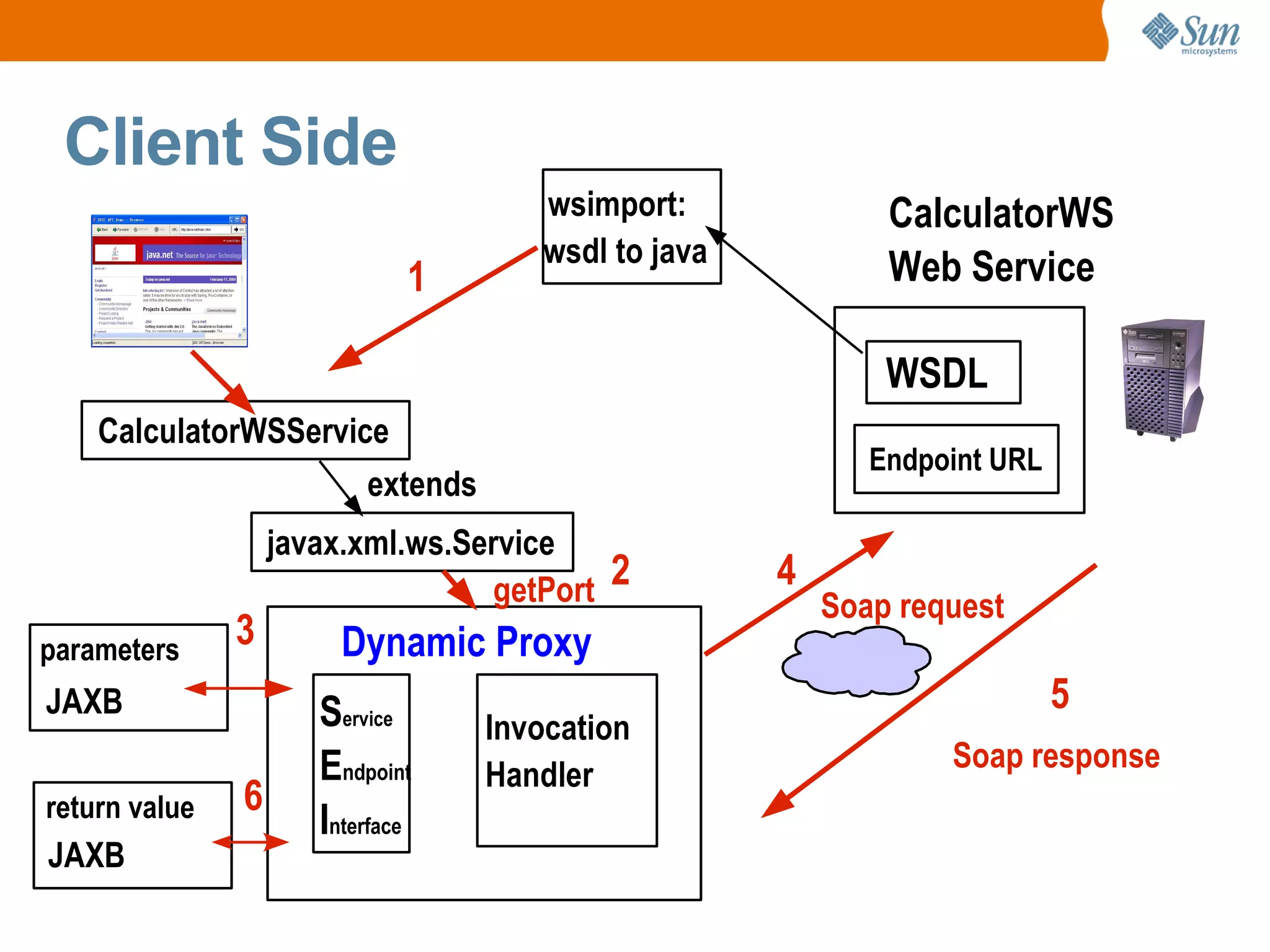
Client Side CalculatorWS Web Service extends Dynamic Proxy S ervice E ndpoint I nterface Invocation Handler JAXB JAXB return value parameters getPort 1 2 3 6 Soap request Soap response 4 5
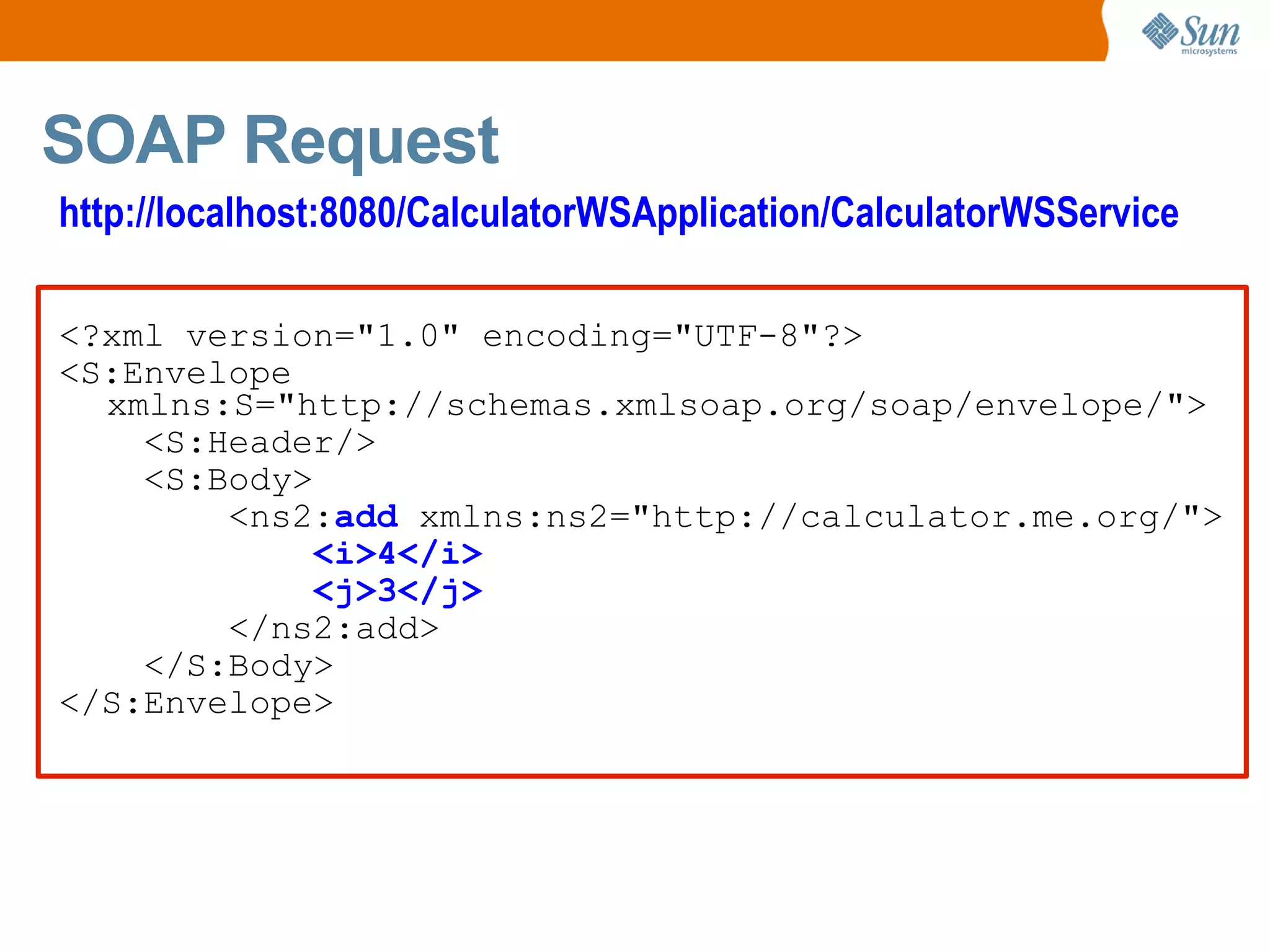
SOAP Request <?xml version=&quot;1.0&quot; encoding=&quot;UTF-8&quot;?> <S:Envelope xmlns:S=&quot;http://schemas.xmlsoap.org/soap/envelope/&quot;> <S:Header/> <S:Body> <ns2: add  xmlns:ns2=&quot;http://calculator.me.org/&quot;> <i>4</i> <j>3</j> </ns2:add> </S:Body> </S:Envelope> http://localhost:8080/CalculatorWSApplication/CalculatorWSService
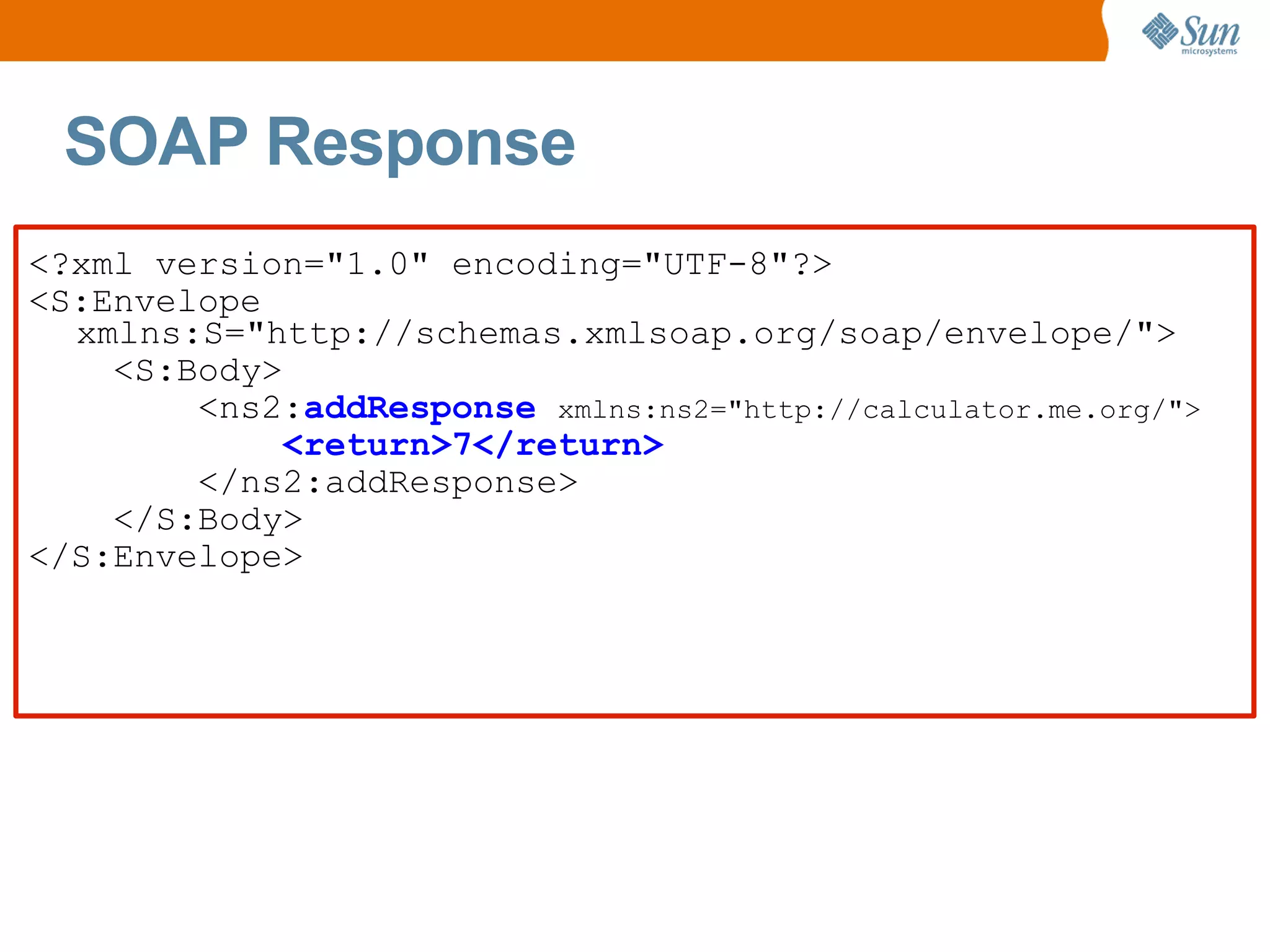
SOAP Response <?xml version=&quot;1.0&quot; encoding=&quot;UTF-8&quot;?> <S:Envelope xmlns:S=&quot;http://schemas.xmlsoap.org/soap/envelope/&quot;> <S:Body> <ns2: addResponse   xmlns:ns2=&quot;http://calculator.me.org/&quot;> <return>7</return> </ns2:addResponse> </S:Body> </S:Envelope>
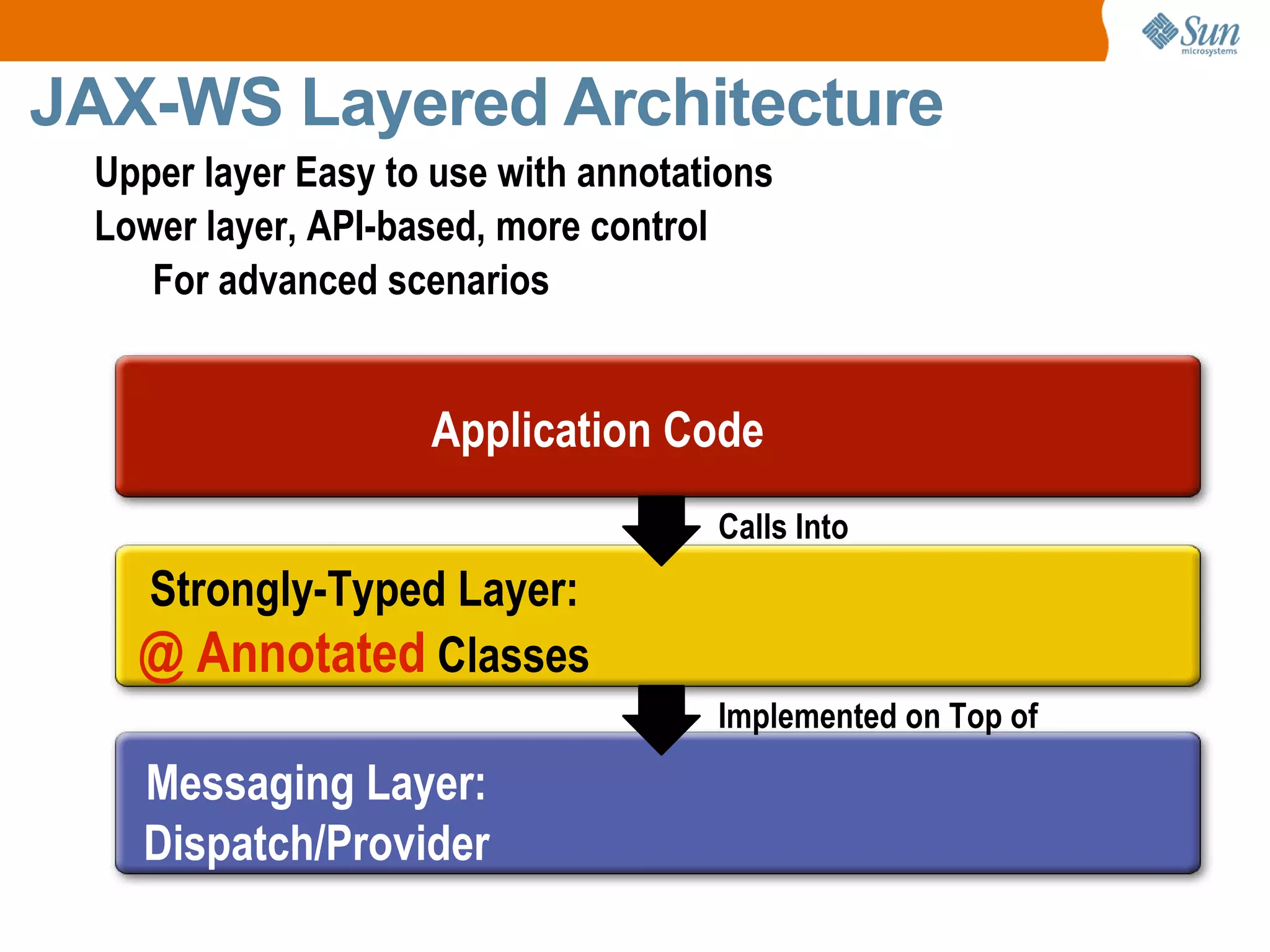
JAX-WS Layered Architecture Calls Into Implemented on Top of Messaging Layer: Dispatch/Provider Application Code Strongly-Typed Layer: @ Annotated  Classes Upper layer Easy to use with annotations  Lower layer, API-based, more control For advanced scenarios
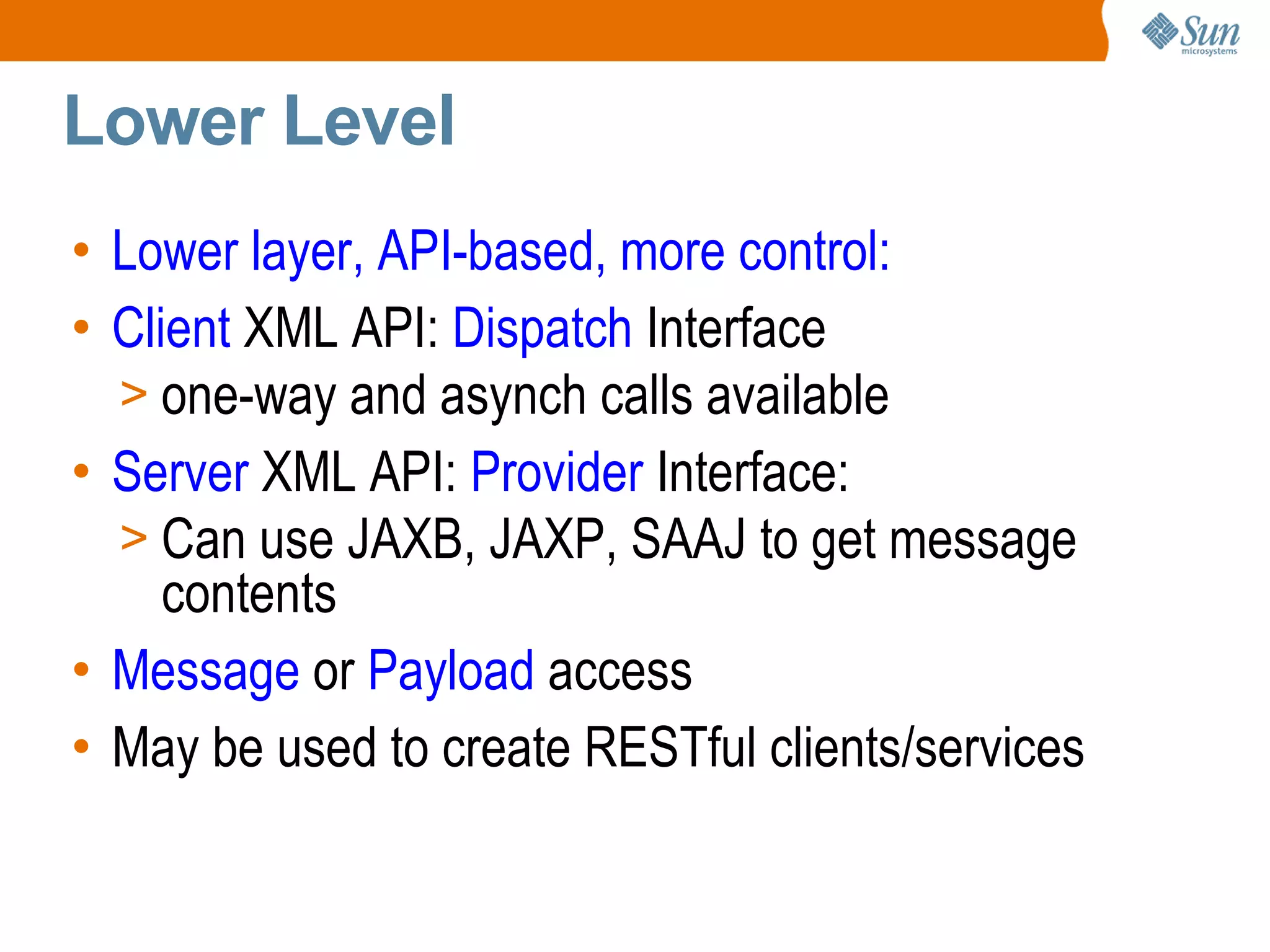
Lower Level Lower layer, API-based, more control: Client  XML API:  Dispatch  Interface one-way and asynch calls available Server  XML API:  Provider  Interface: Can use JAXB, JAXP, SAAJ to get message contents Message  or  Payload  access May be used to create RESTful clients/services
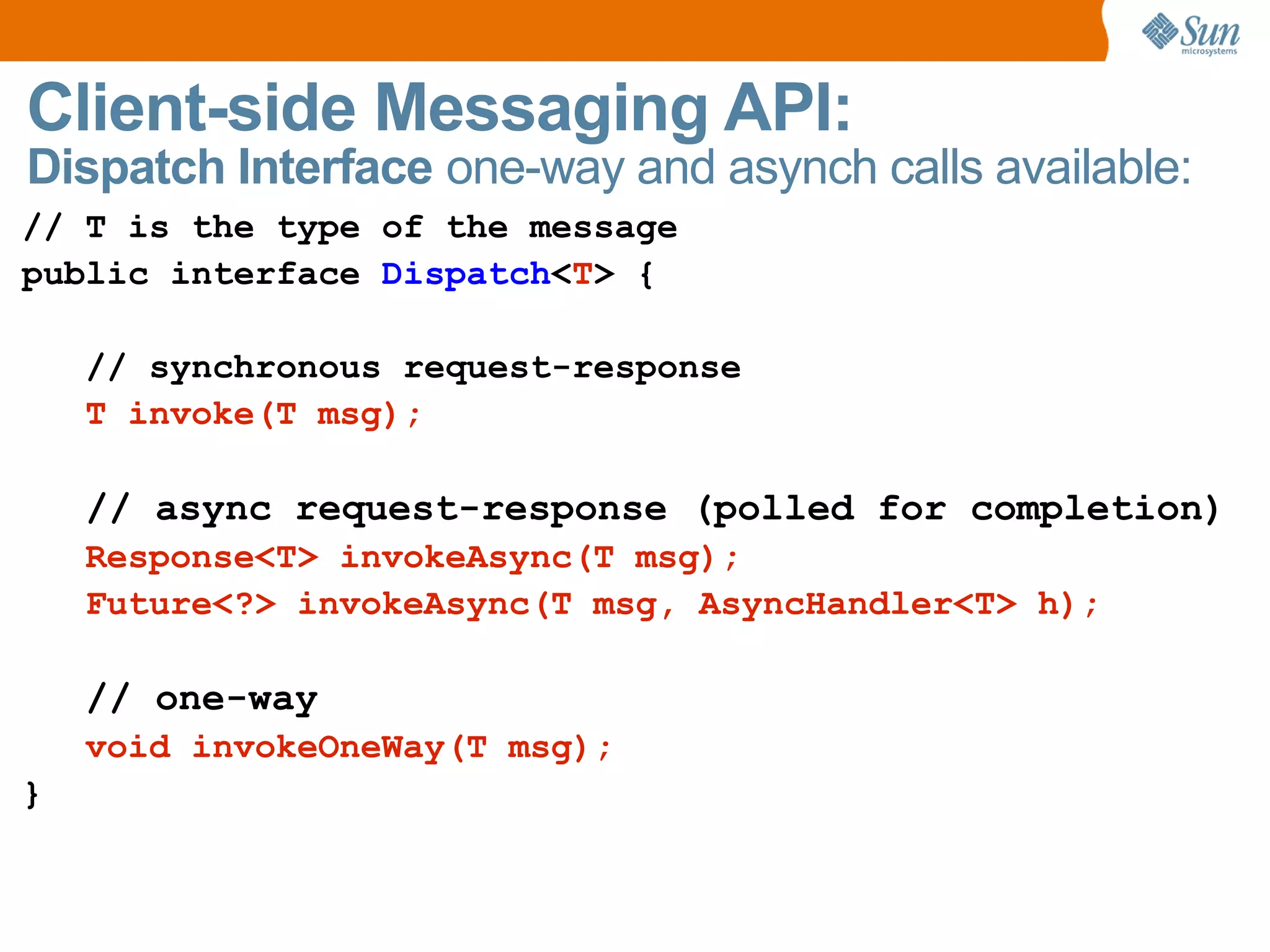
Client-side Messaging API:  Dispatch Interface  one-way and asynch calls available: // T is the type of the message public interface  Dispatch < T >  { // synchronous request-response T invoke(T msg); // async request-response ( polled for completion) Response<T> invokeAsync(T msg); Future<?> invokeAsync(T msg, AsyncHandler<T> h); // one-way void invokeOneWay(T msg); }
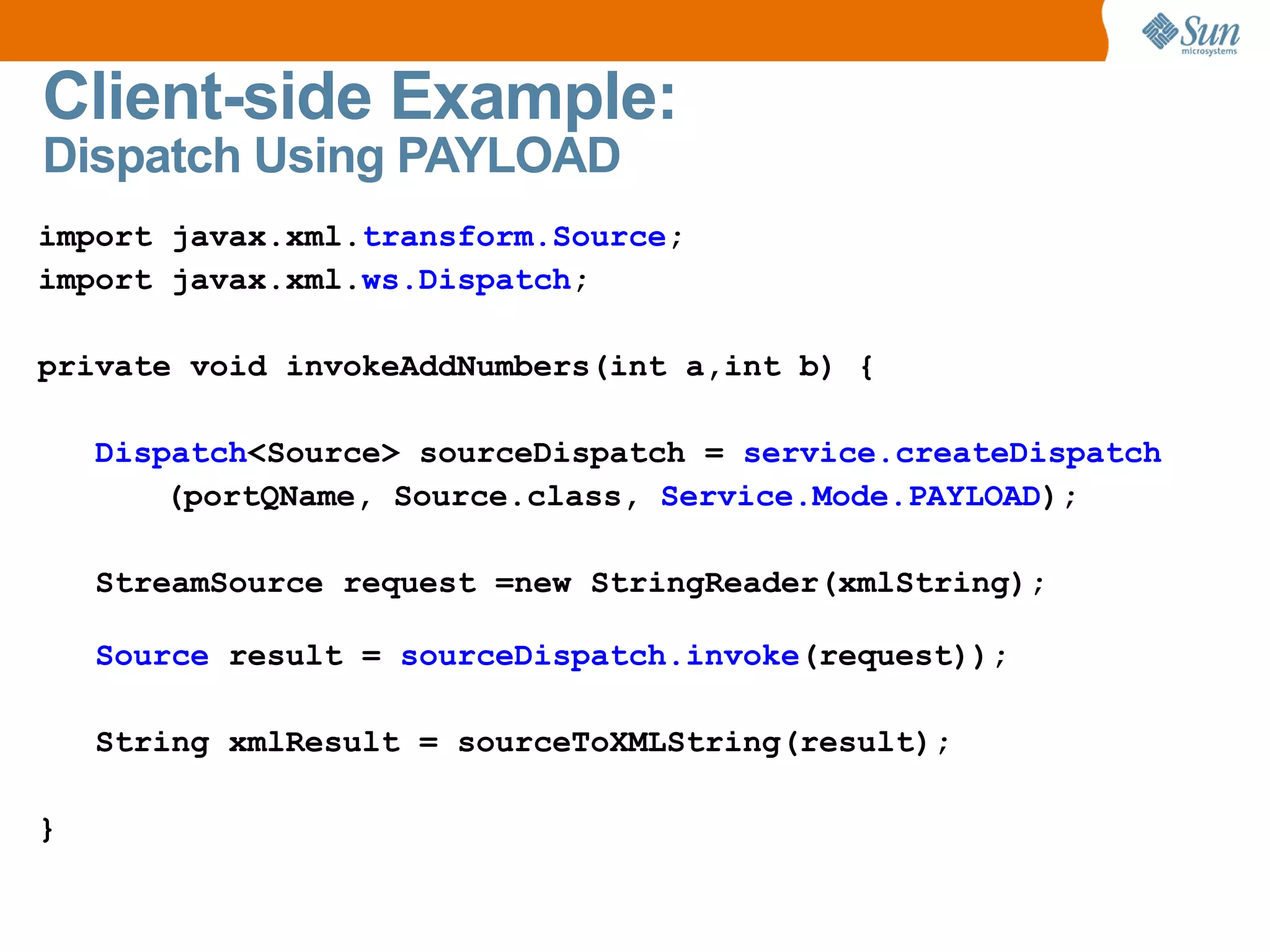
Client-side Example: Dispatch Using PAYLOAD import javax.xml. transform.Source ; import javax.xml. ws.Dispatch ; private void invokeAddNumbers(int a,int b) { Dispatch <Source> sourceDispatch =  service.createDispatch (portQName, Source.class,  Service.Mode.PAYLOAD ); StreamSource request =new StringReader(xmlString); Source  result =  sourceDispatch.invoke (request)); String xmlResult = sourceToXMLString(result); }
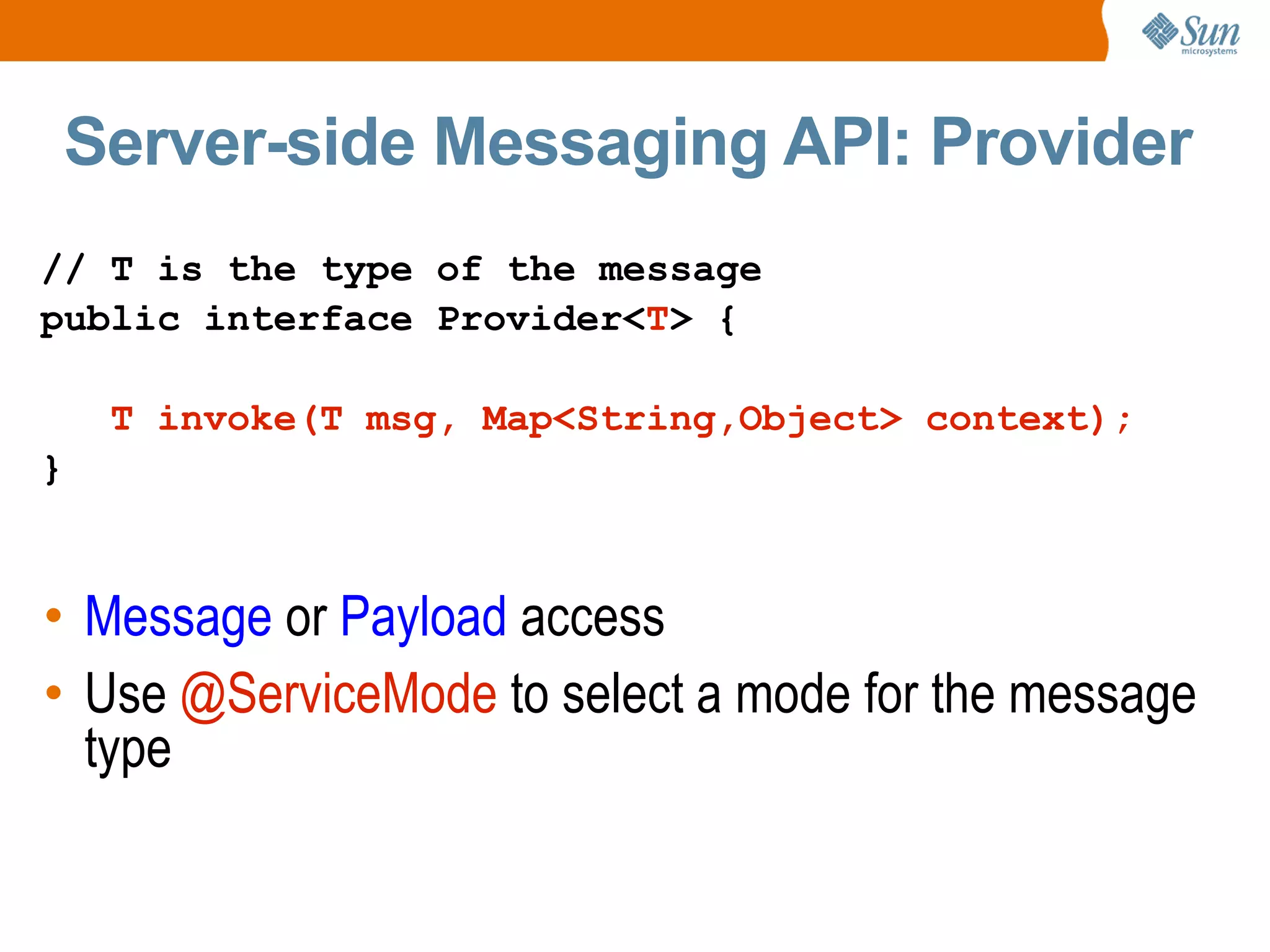
Server-side Messaging API: Provider // T is the type of the message public interface Provider< T >  { T invoke(T msg, Map<String,Object> context); } Message  or  Payload  access Use  @ServiceMode  to select a mode for the message type
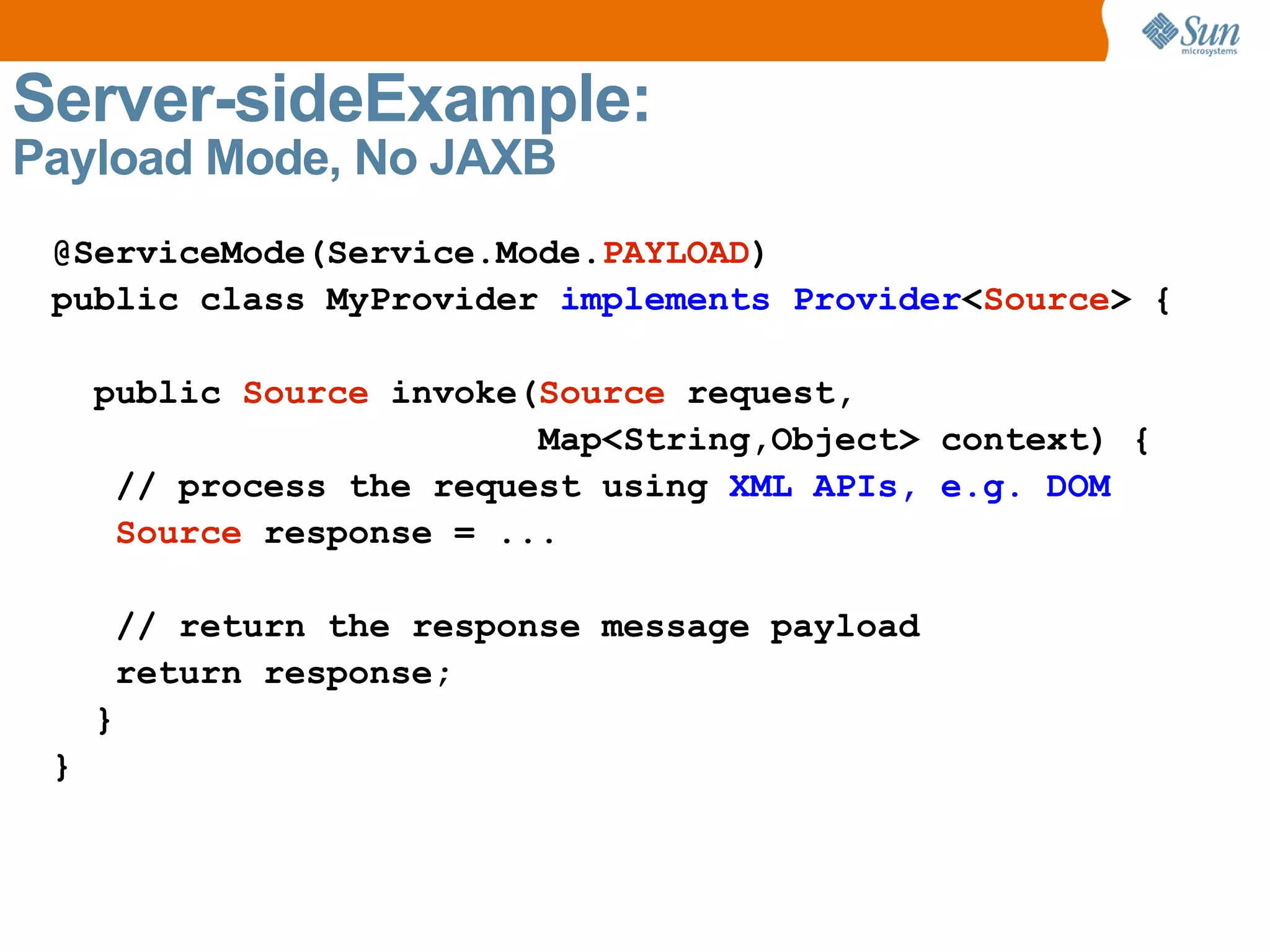
Server-sideExample:  Payload Mode, No JAXB @ServiceMode(Service.Mode. PAYLOAD ) public class MyProvider  implements Provider < Source > { public  Source   invoke( Source  request, Map<String,Object> context) { // process the request using  XML APIs, e.g. DOM Source  response = ... // return the response message payload return response; } }
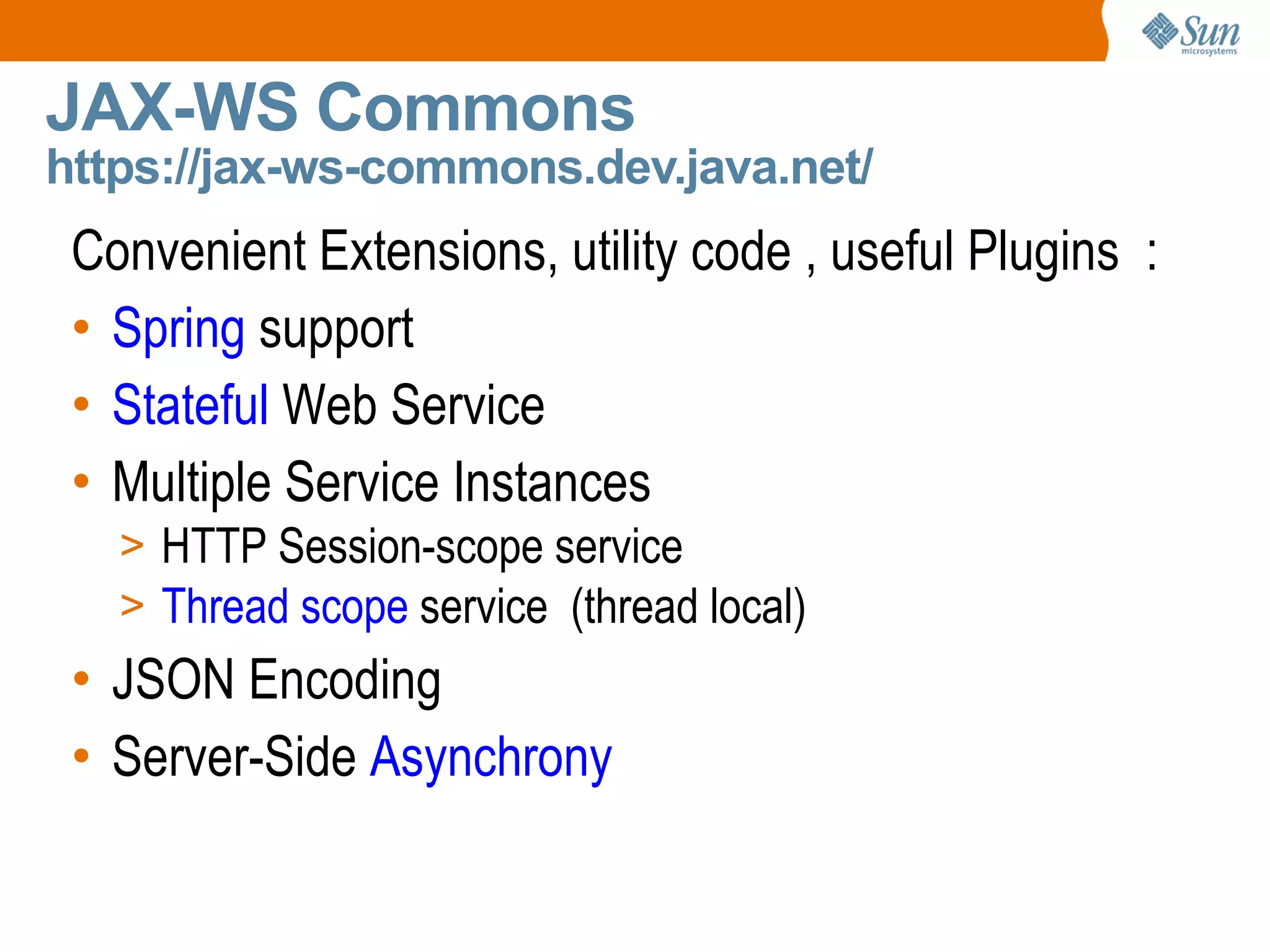
JAX-WS Commons https://jax-ws-commons.dev.java.net/ Convenient Extensions, utility code , useful Plugins  : Spring  support Stateful  Web Service  Multiple Service Instances HTTP Session-scope service  Thread scope  service  (thread local) JSON Encoding  Server-Side  Asynchrony
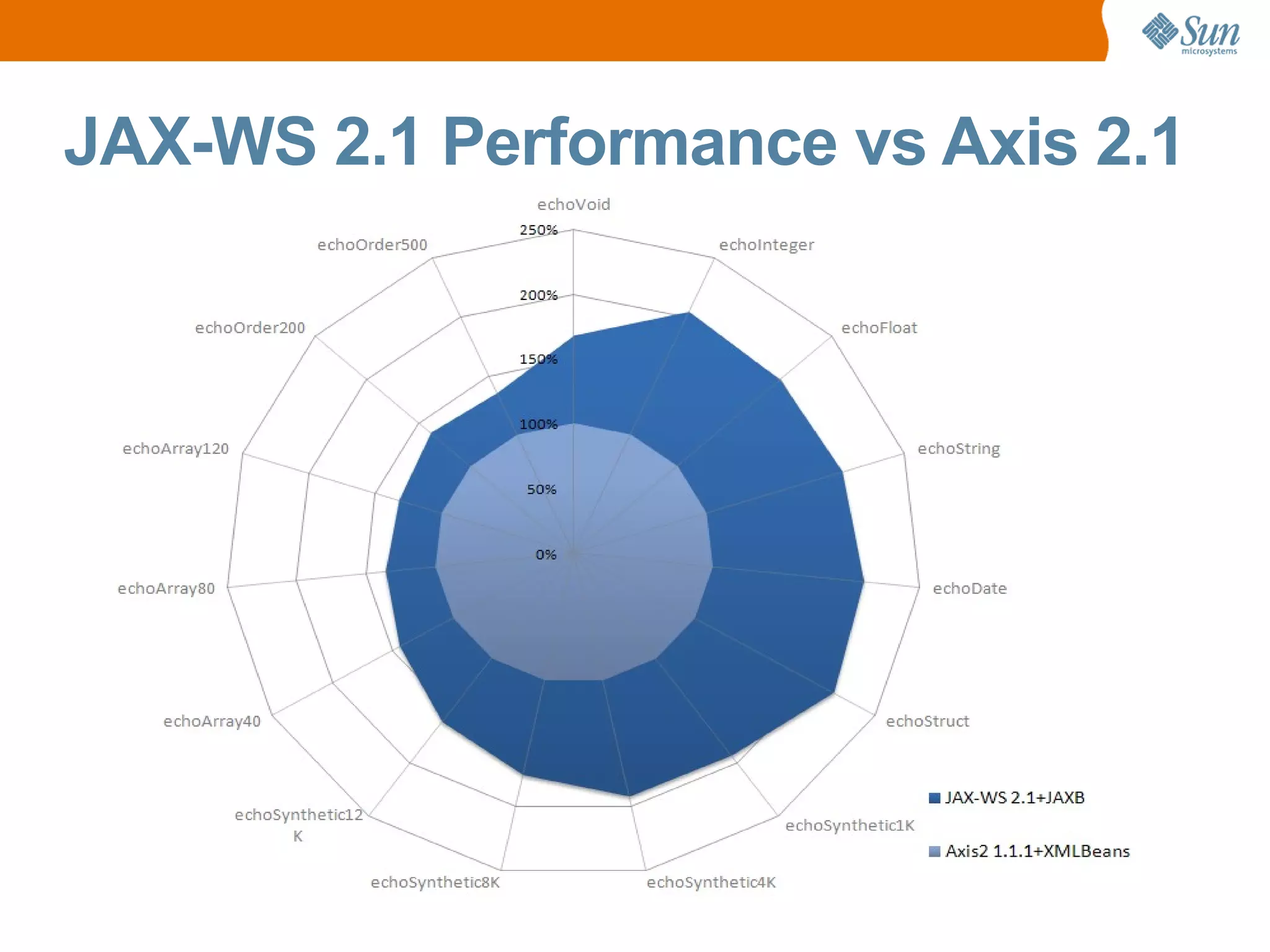
JAX-WS 2.1 Performance vs Axis 2.1
Agenda Metro  JAX-WS Standards WSIT REST
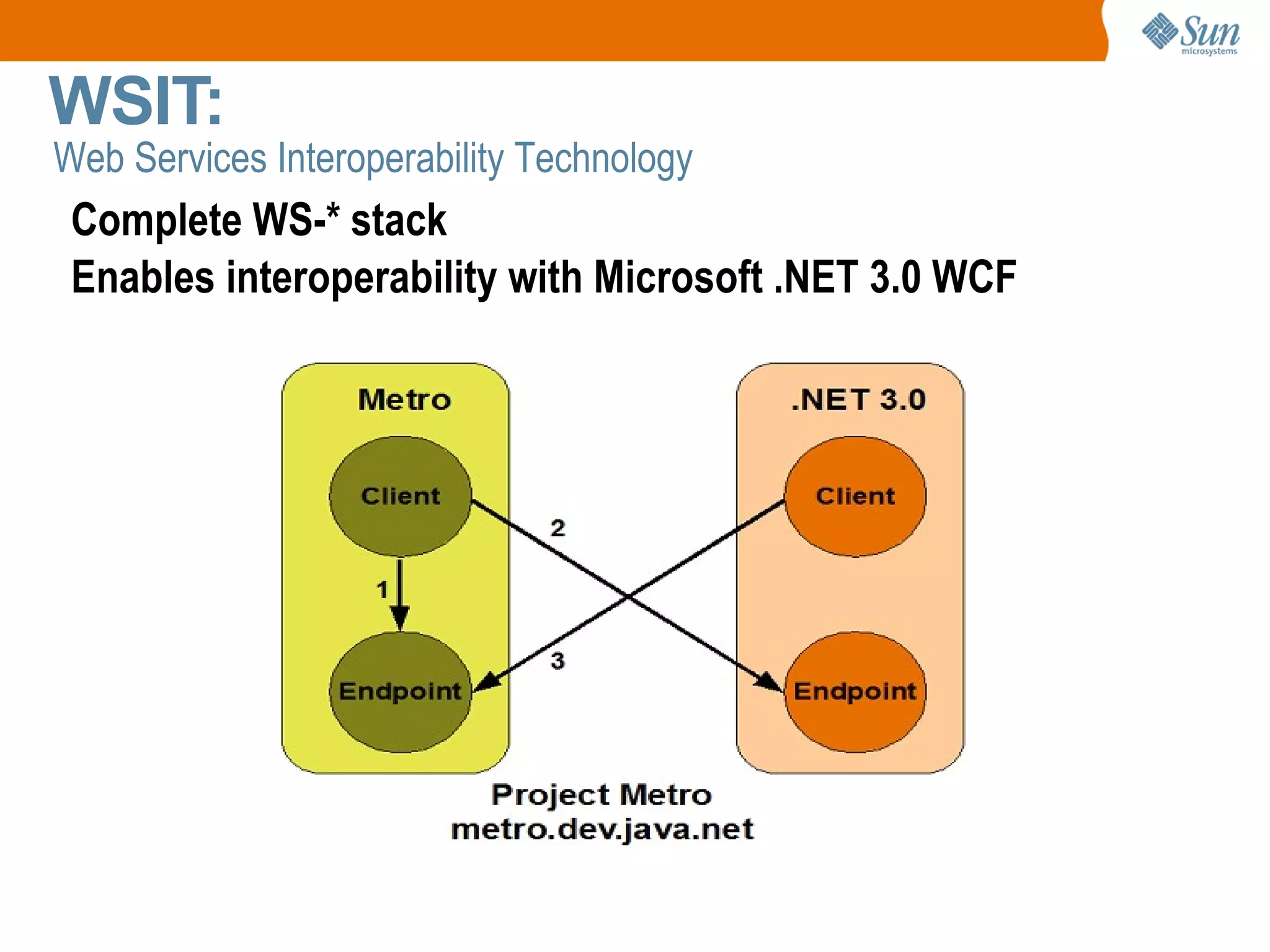
WSIT: Web Services Interoperability Technology Complete WS-* stack  Enables interoperability with Microsoft .NET 3.0 WCF
Sun’s Web Services Stack Metro:  JAX-WS  ,  WSIT   JAXB = Java Architecture for XML Binding  | JAX-WS = Java APIs for XML Web Services NetBeans JAX-WS Tooling Transactions Reliable- Messaging Security Metadata WSDL Policy Core Web Services  HTTP TCP SMTP JAXB, JAXP, StaX  JAX-WS WSIT tools transport xml
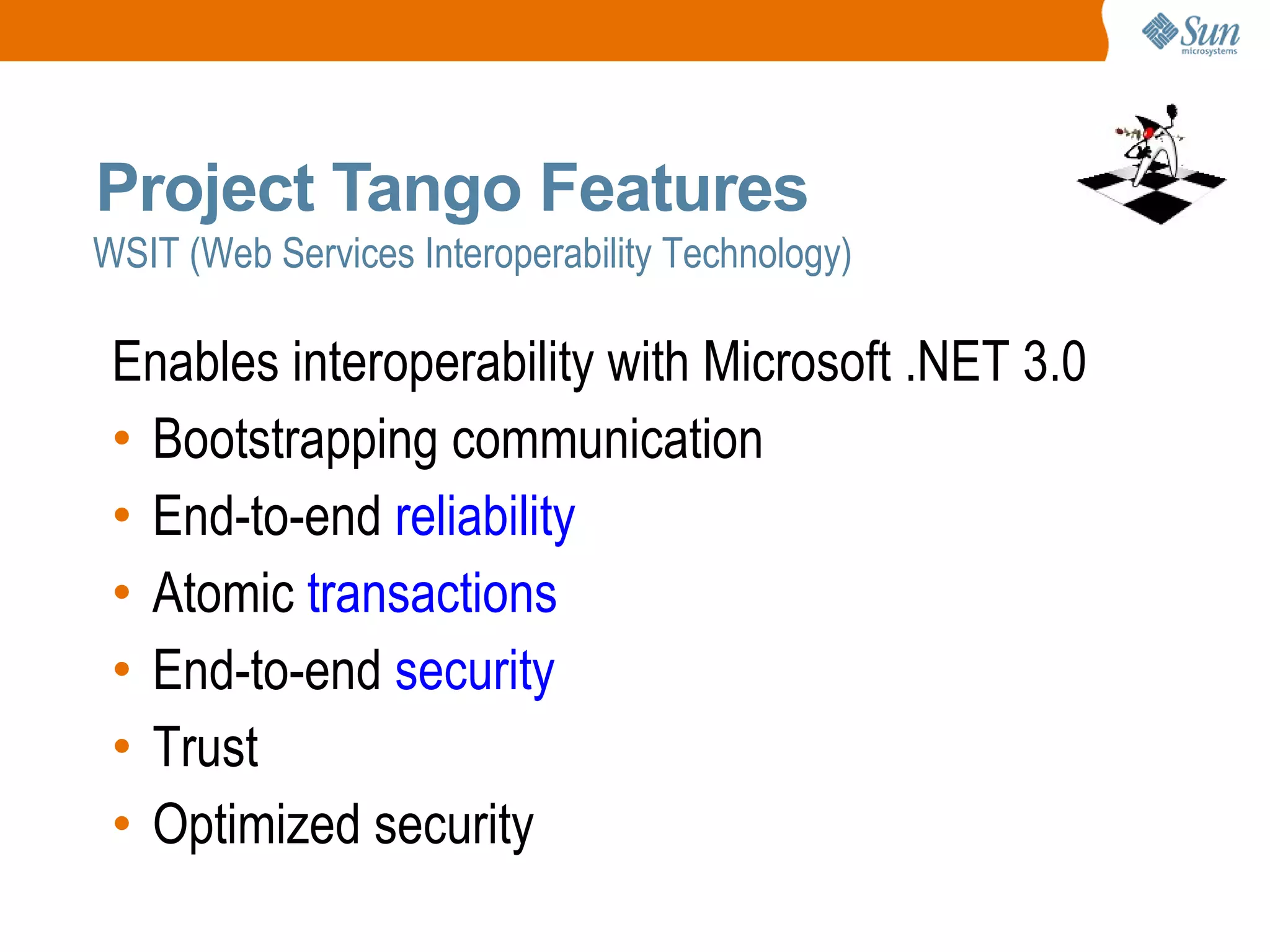
WSIT (Web Services Interoperability Technology) Project Tango Features Enables interoperability with Microsoft .NET 3.0  Bootstrapping communication End-to-end  reliability Atomic  transactions End-to-end  security Trust Optimized security
Metro WSIT Reliable Messaging
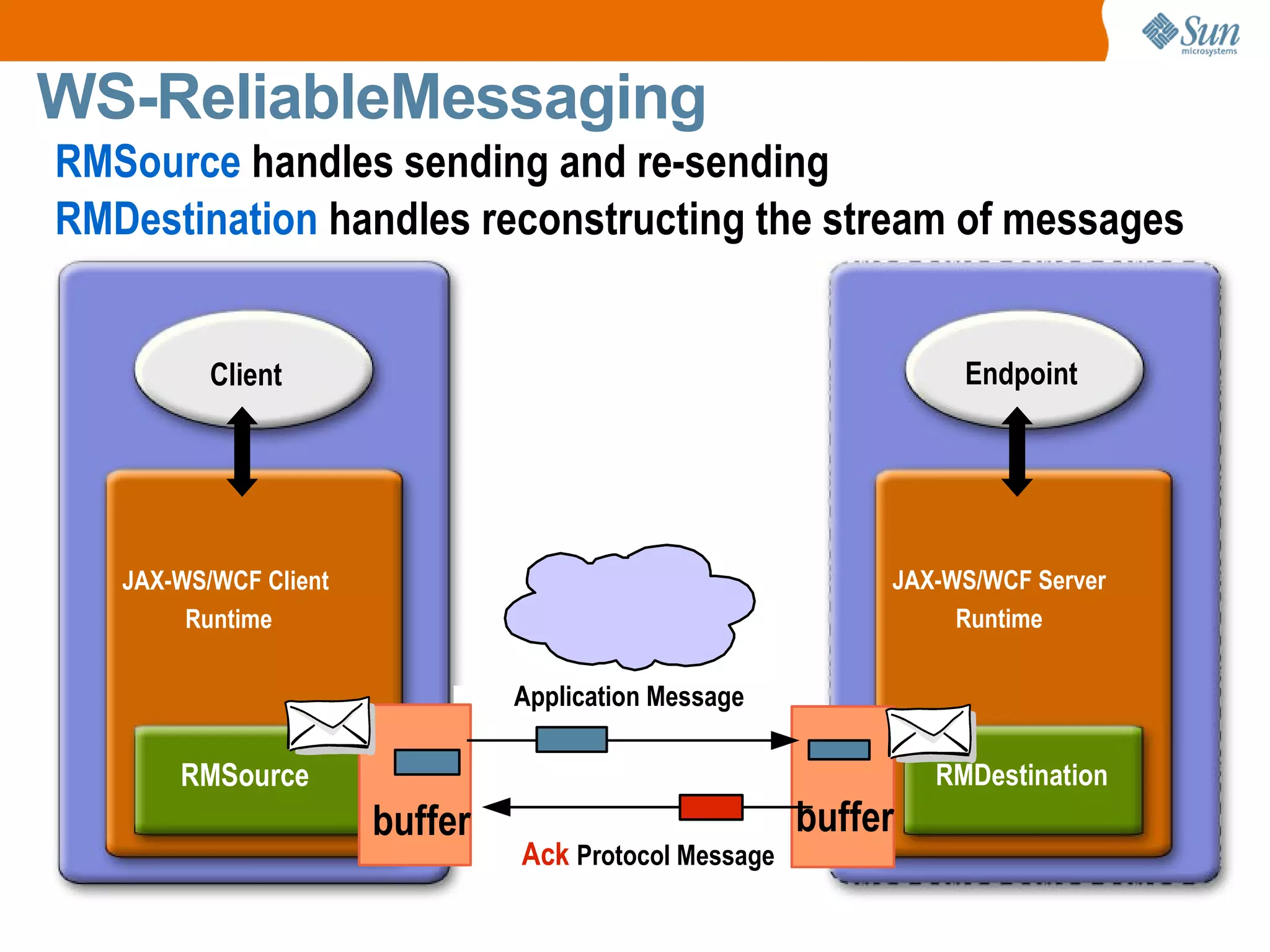
WS-ReliableMessaging JAX-WS/WCF Server Runtime JAX-WS/WCF Client  Runtime Application Message Ack   Protocol Message buffer buffer RMSource  handles sending and re-sending RMDestination  handles reconstructing the stream of messages
Brings reliability to SOAP (protocol) layer Transparent to application Delivery assurance At least once At most once In order End-to-End Reliability WS-ReliableMessaging
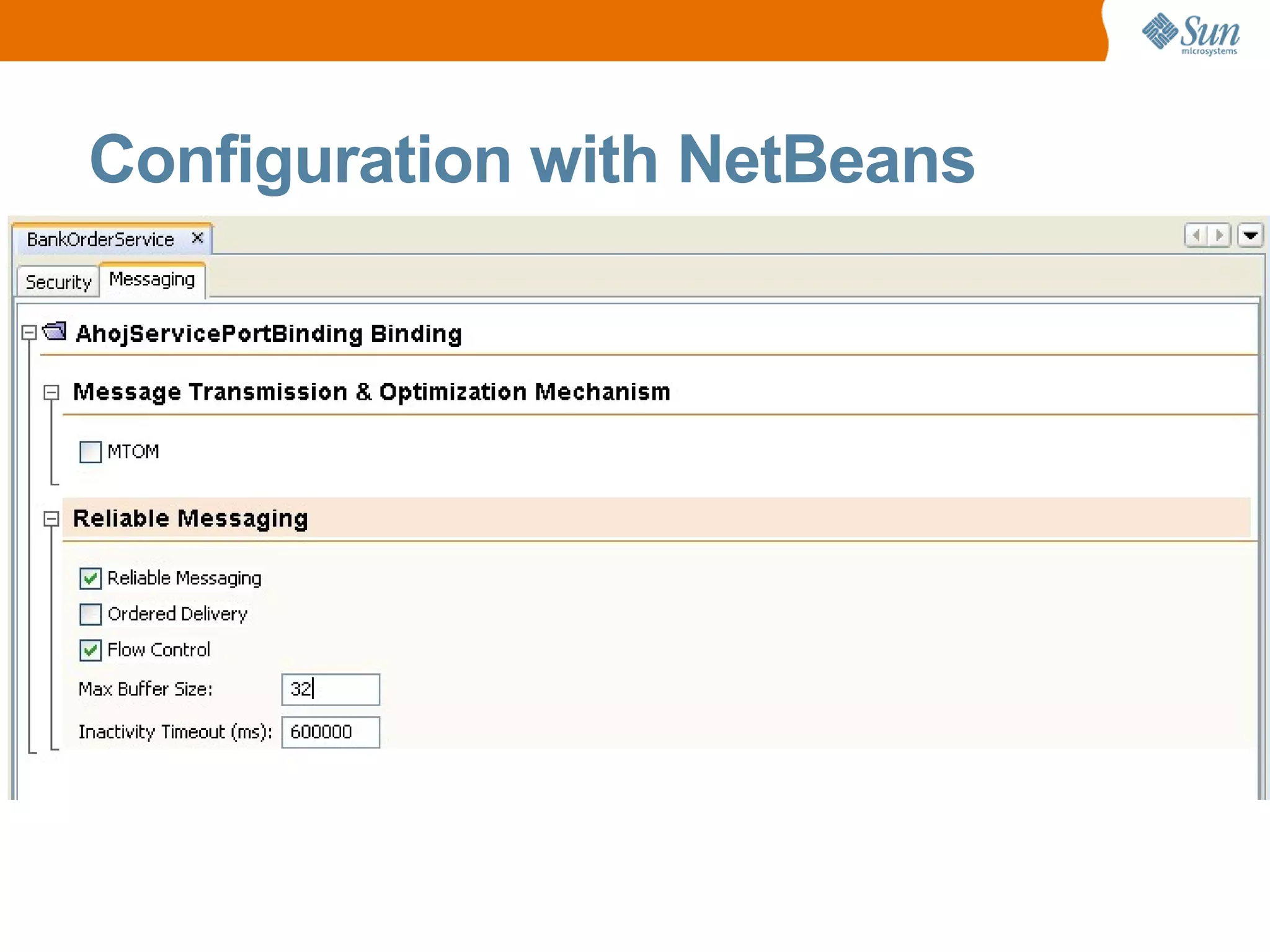
Configuration with NetBeans
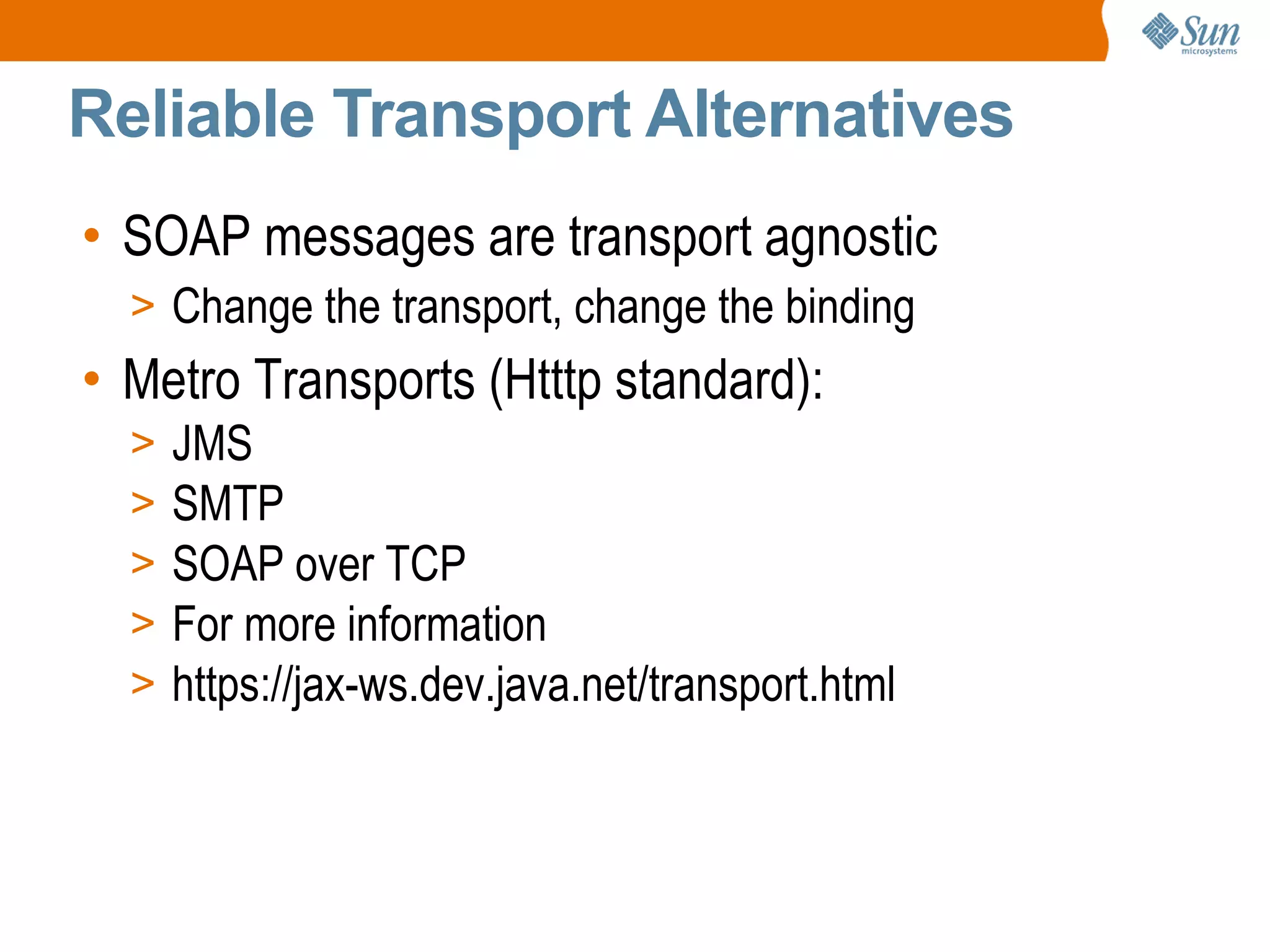
Reliable Transport Alternatives SOAP messages are transport agnostic Change the transport, change the binding Metro Transports (Htttp standard):  JMS SMTP SOAP over TCP For more information  https://jax-ws.dev.java.net/transport.html
Metro  WSIT Transactions
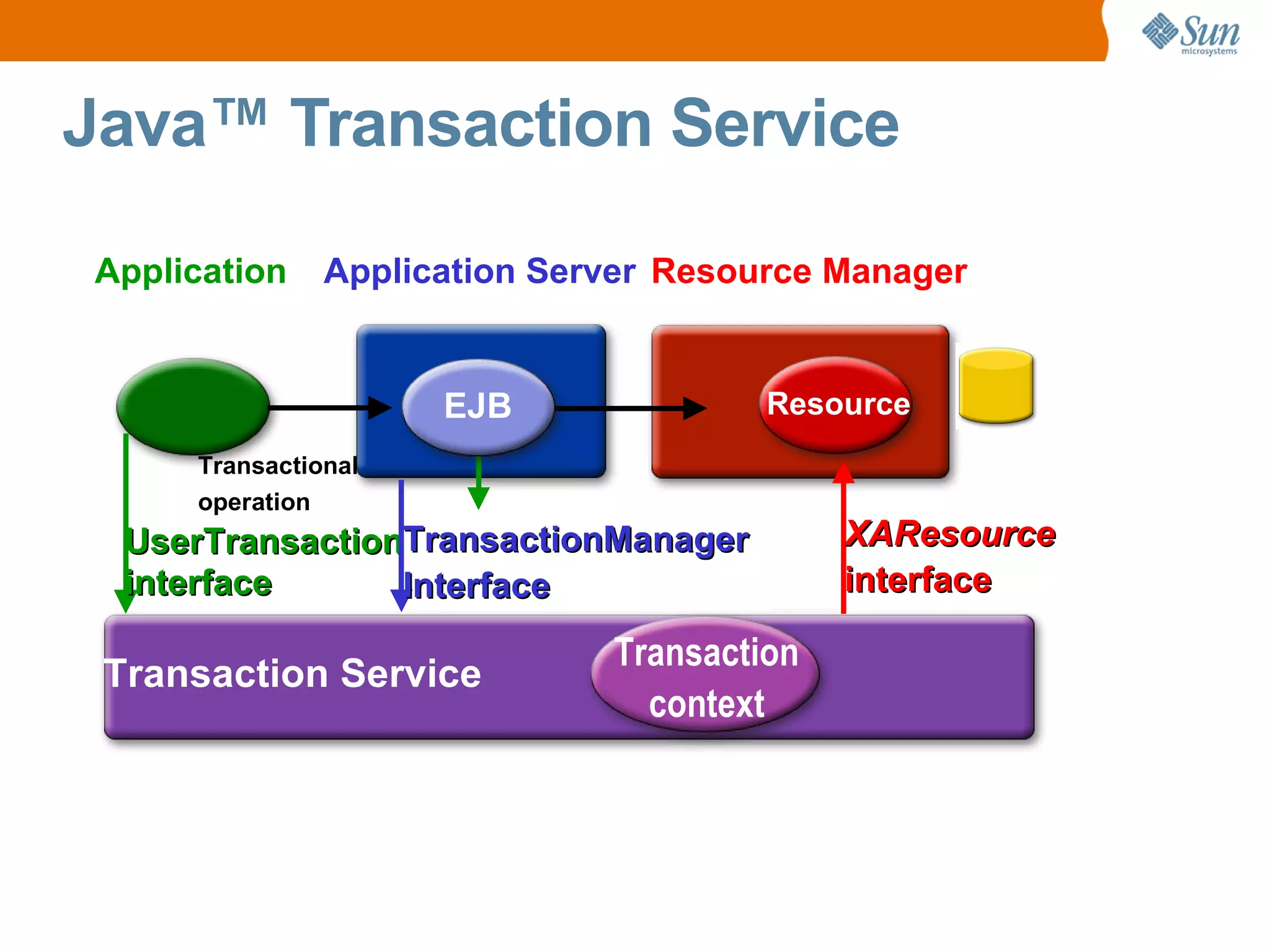
Java™ Transaction Service Application Server Transaction Service Application UserTransaction  interface Resource Manager XAResource   interface Transactional operation TransactionManager Interface Resource EJB Transaction context
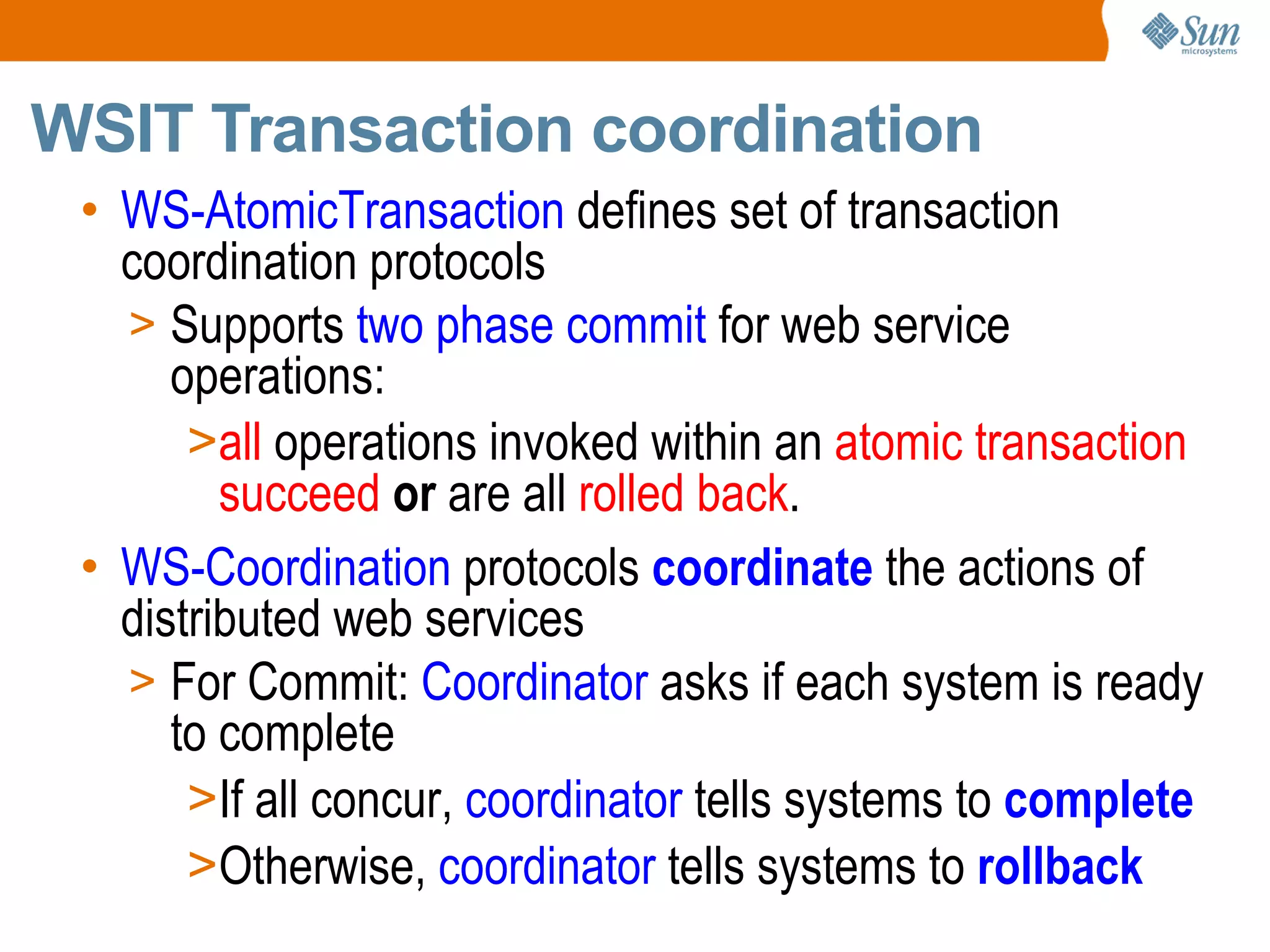
WS-AtomicTransaction  defines set of transaction coordination protocols Supports  two phase commit  for web service operations: all  operations invoked within an  atomic transaction   succeed   or  are all  rolled back . WS-Coordination  protocols  coordinate  the actions of distributed web services  For Commit:  Coordinator  asks if each system is ready to complete If all concur,  coordinator  tells systems to  complete Otherwise,  coordinator  tells systems to  rollback WSIT Transaction coordination
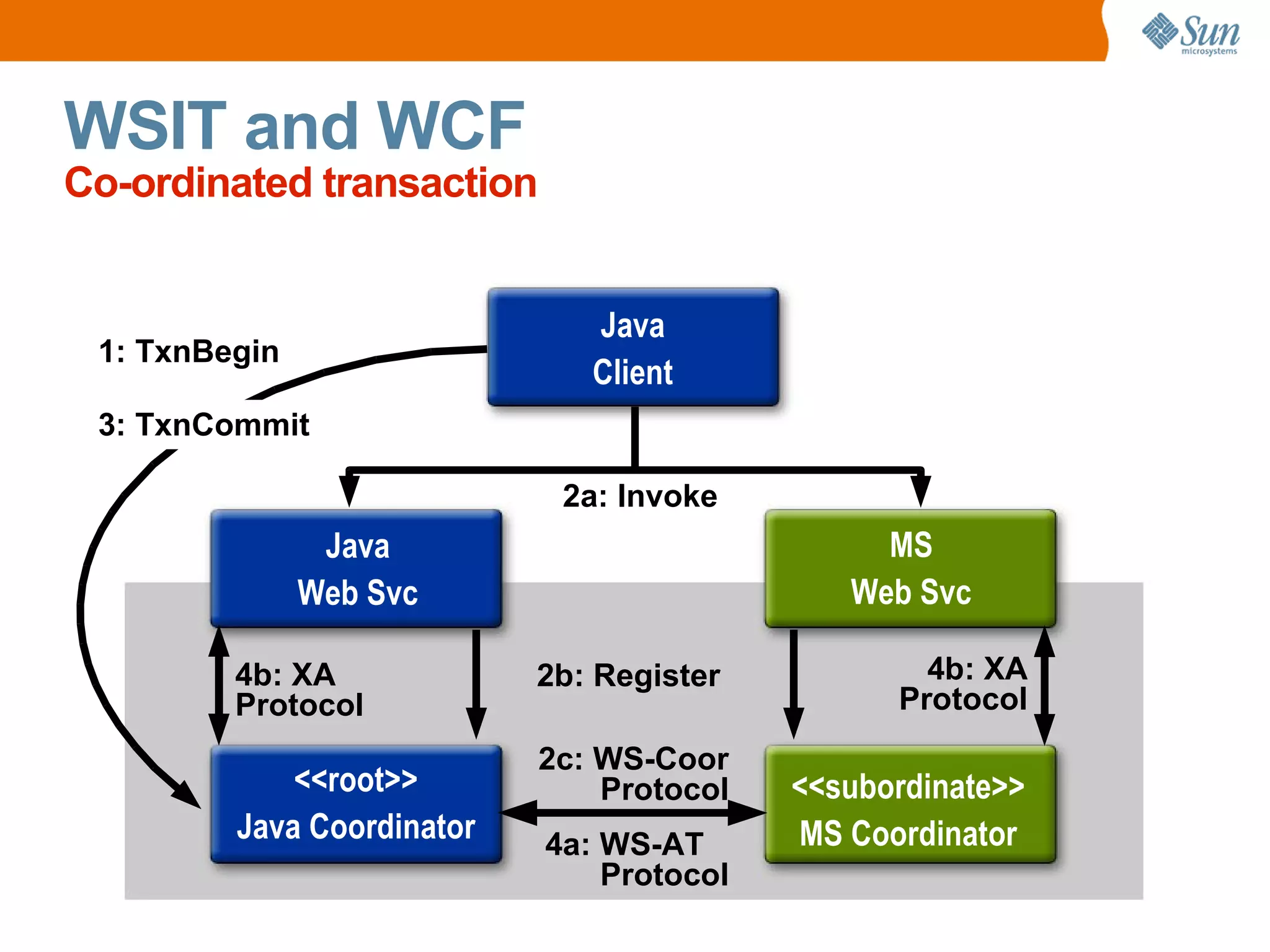
WSIT and WCF  Co-ordinated transaction  4a: WS-AT  Protocol 3: TxnCommit 2c: WS-Coor  Protocol 2b: Register 4b: XA   Protocol 4b: XA Protocol  2a: Invoke 1: TxnBegin
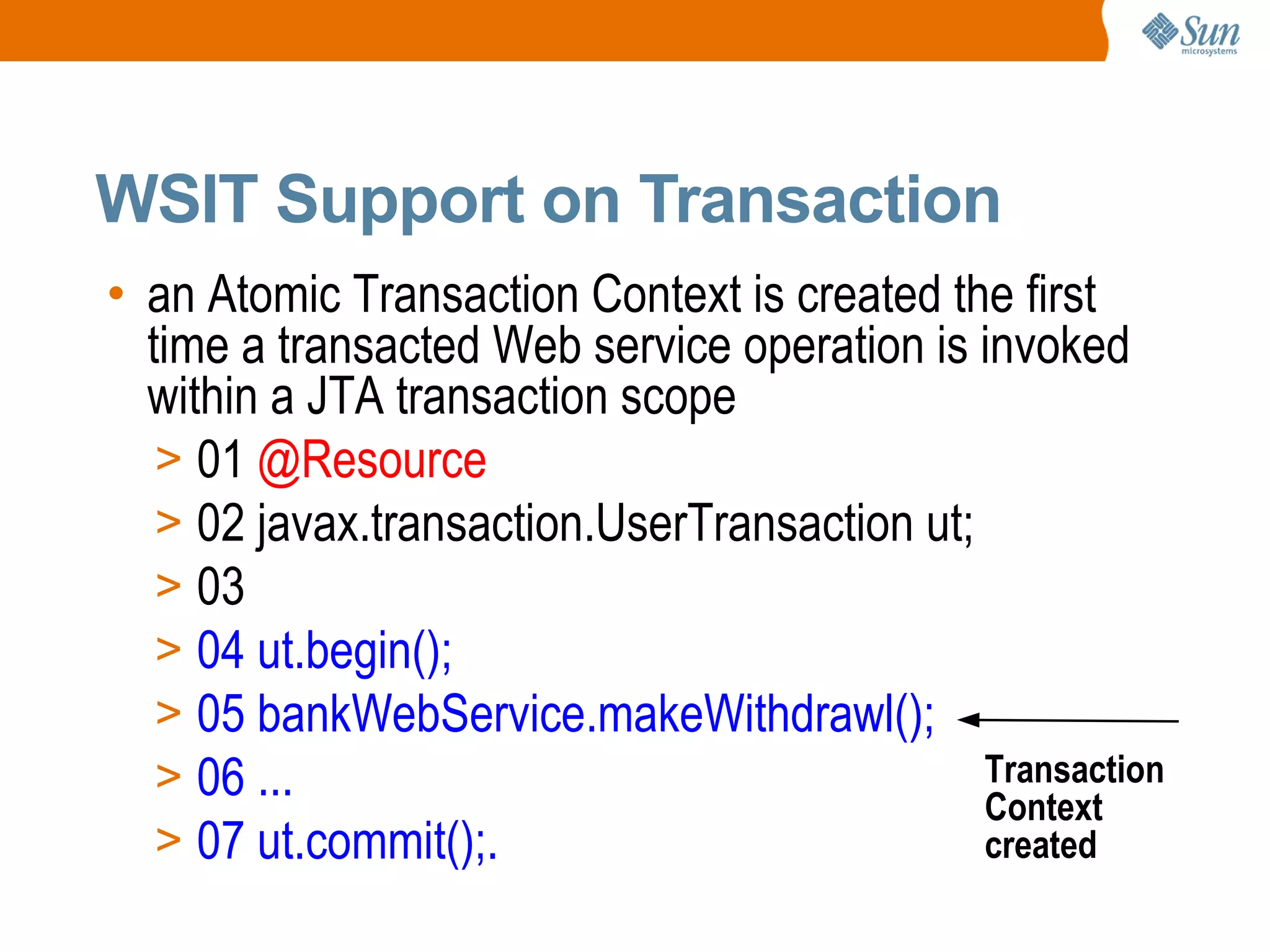
an Atomic Transaction Context is created the first time a transacted Web service operation is invoked within a JTA transaction scope 01  @Resource  02 javax.transaction.UserTransaction ut;  03  04 ut.begin();  05 bankWebService.makeWithdrawl();  06 ...  07 ut.commit();. WSIT Support on Transaction Transaction  Context created
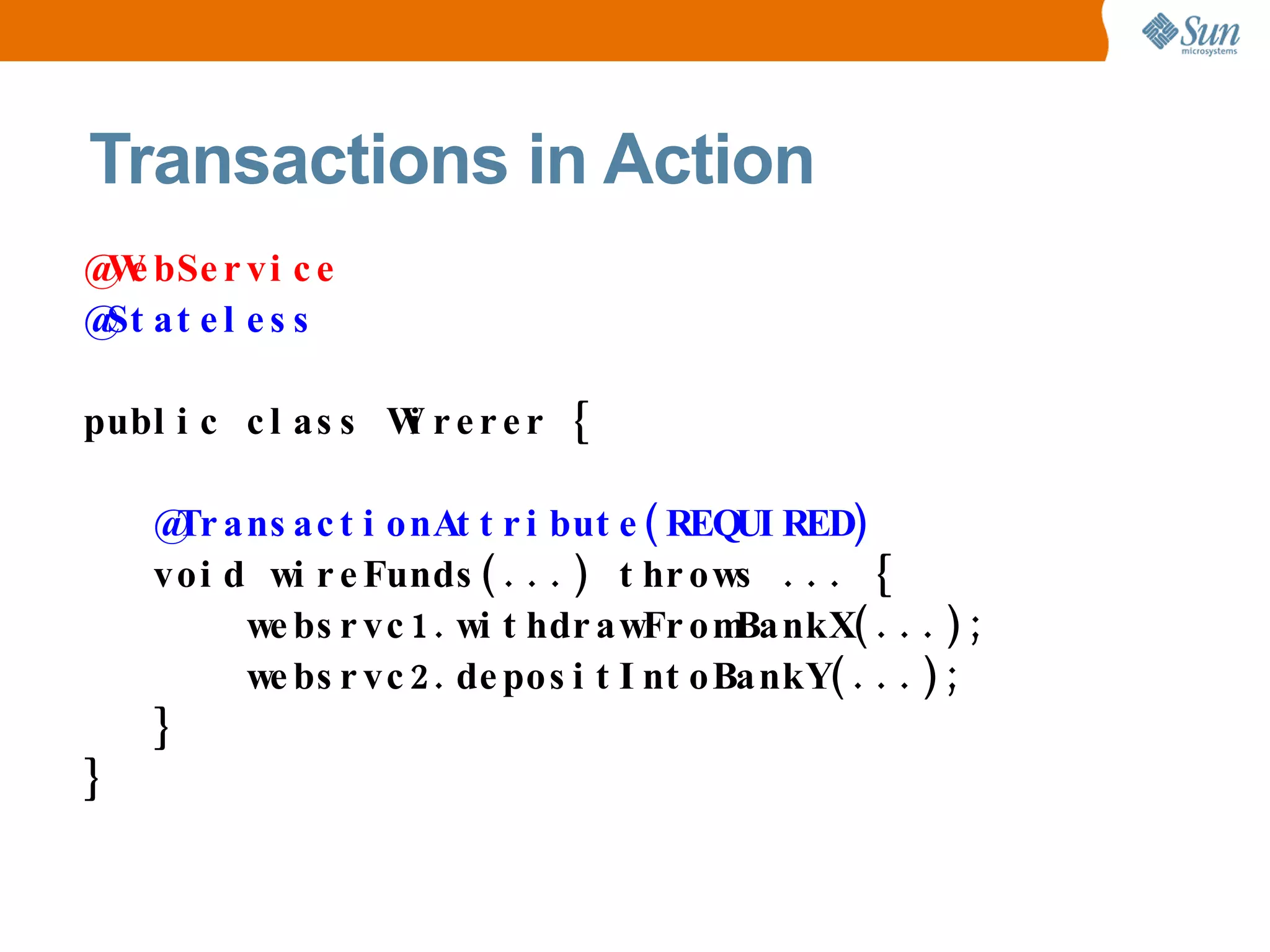
Transactions in Action @WebService   @Stateless   public class Wirerer {  @TransactionAttribute(REQUIRED)   void wireFunds(...) throws ... { websrvc1.withdrawFromBankX(...); websrvc2.depositIntoBankY(...); }  }
Metro  WSIT Security
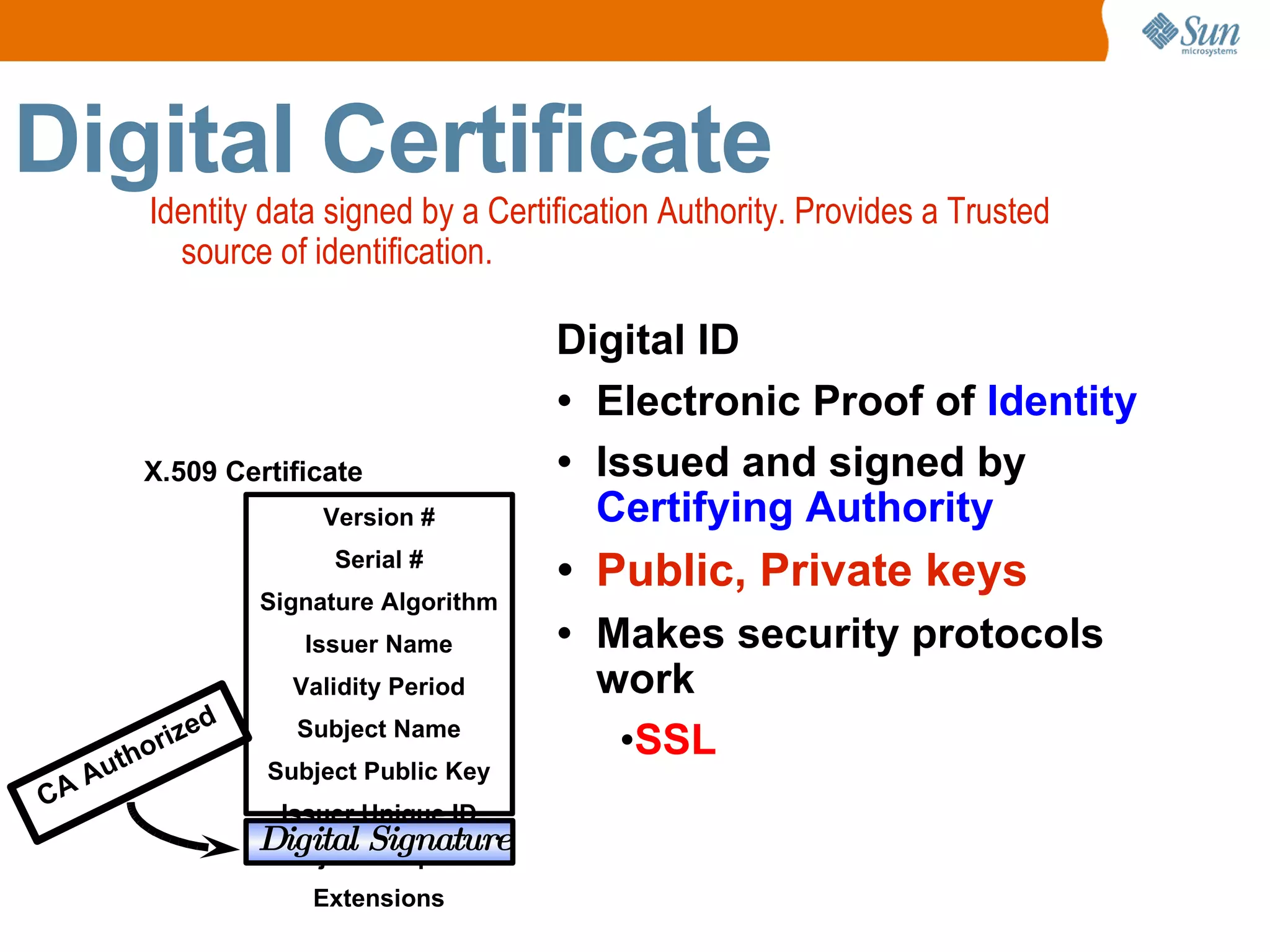
Digital Certificate Identity data signed by a Certification Authority. Provides a Trusted source of identification.  Version # Serial # Signature Algorithm Issuer Name Validity Period Subject Name Subject Public Key Issuer Unique ID Subject Unique ID Extensions Digital Signature X.509 Certificate Digital ID Electronic Proof of  Identity Issued and signed by  Certifying Authority   Public, Private keys Makes security protocols work SSL CA Authorized
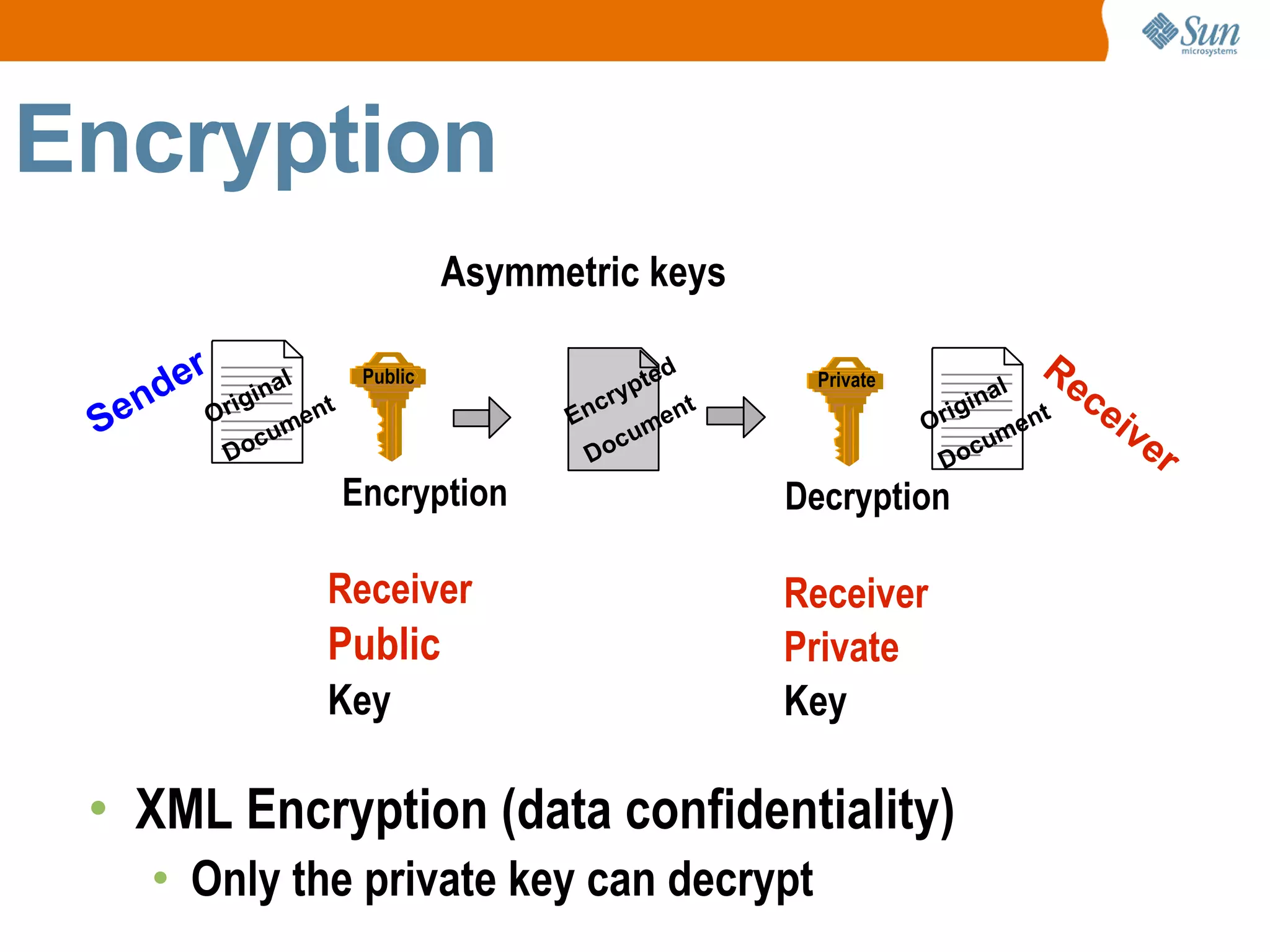
Encryption Receiver Public Key Receiver Private Key XML Encryption (data confidentiality) Only the private key can decrypt Asymmetric keys Public Encryption Original Document Encrypted Document Private Decryption Original Document Sender Receiver
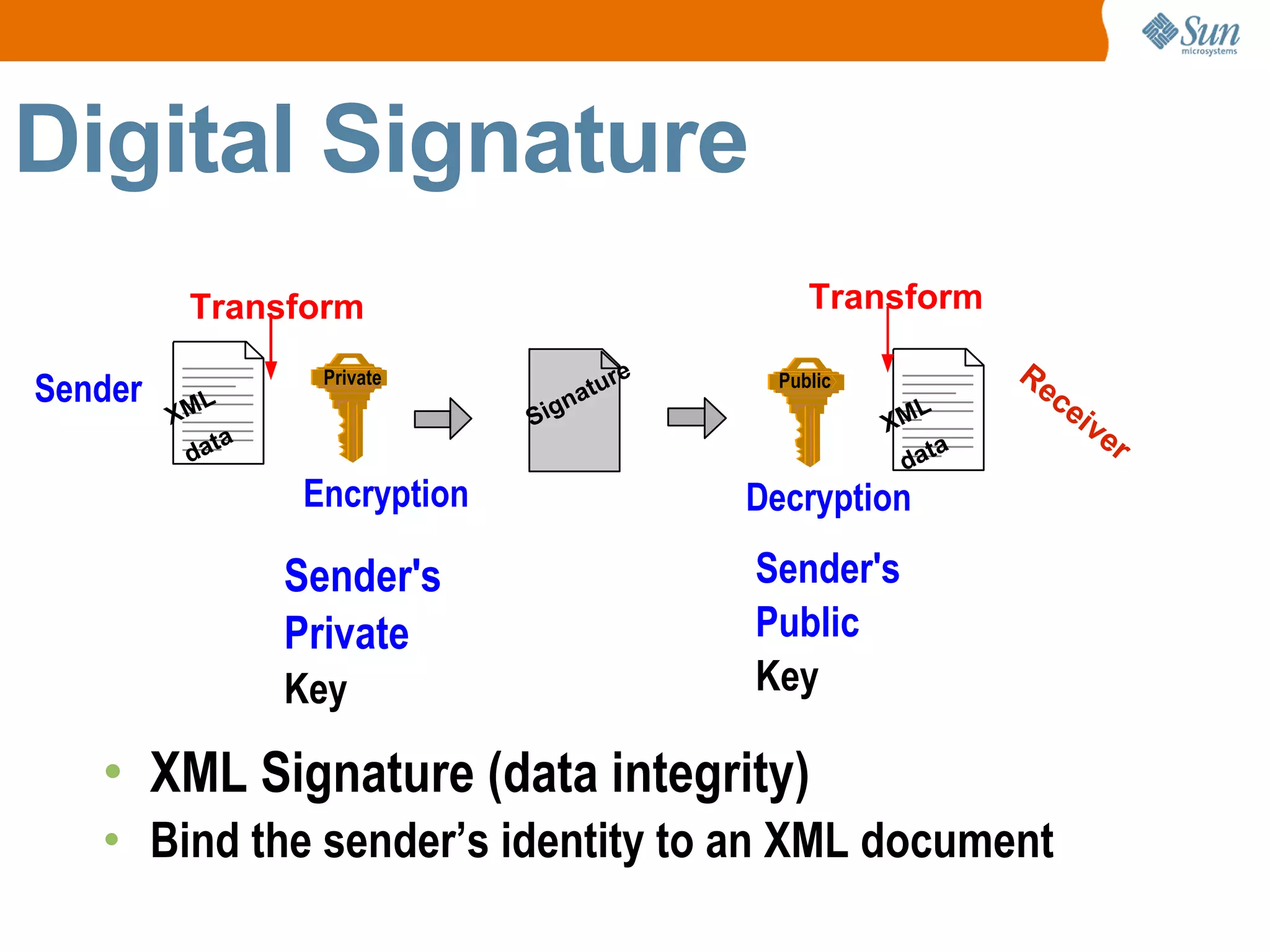
Digital Signature Transform Transform Sender Sender's  Private Key Sender's   Public Key XML Signature (data integrity) Bind the sender’s identity to an XML document  Private Encryption XML data Signature Public Decryption XML data Receiver
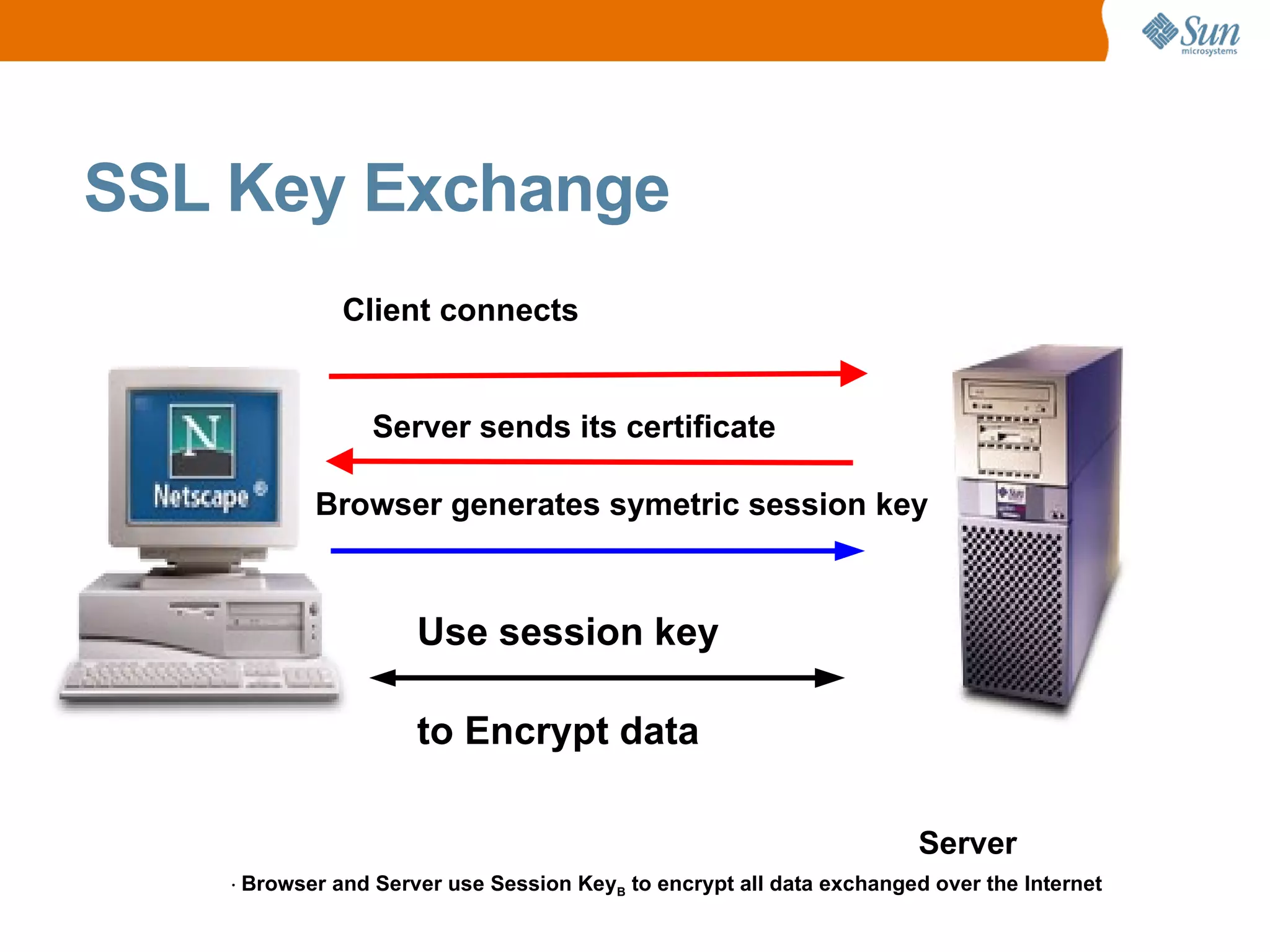
SSL Key Exchange Server Client connects Browser generates symetric session key Use session key to Encrypt data Browser and Server use Session Key B  to encrypt all data exchanged over the Internet
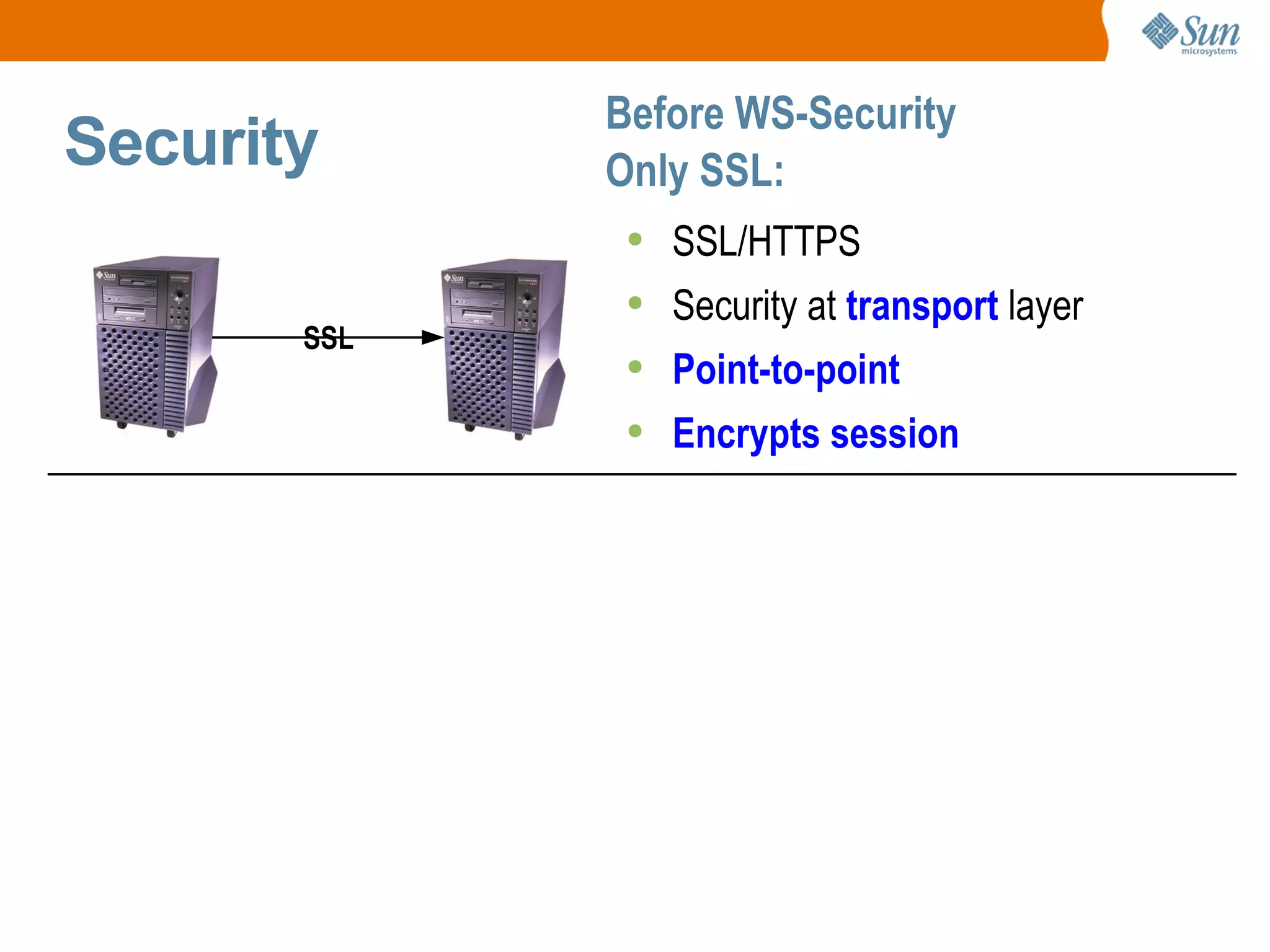
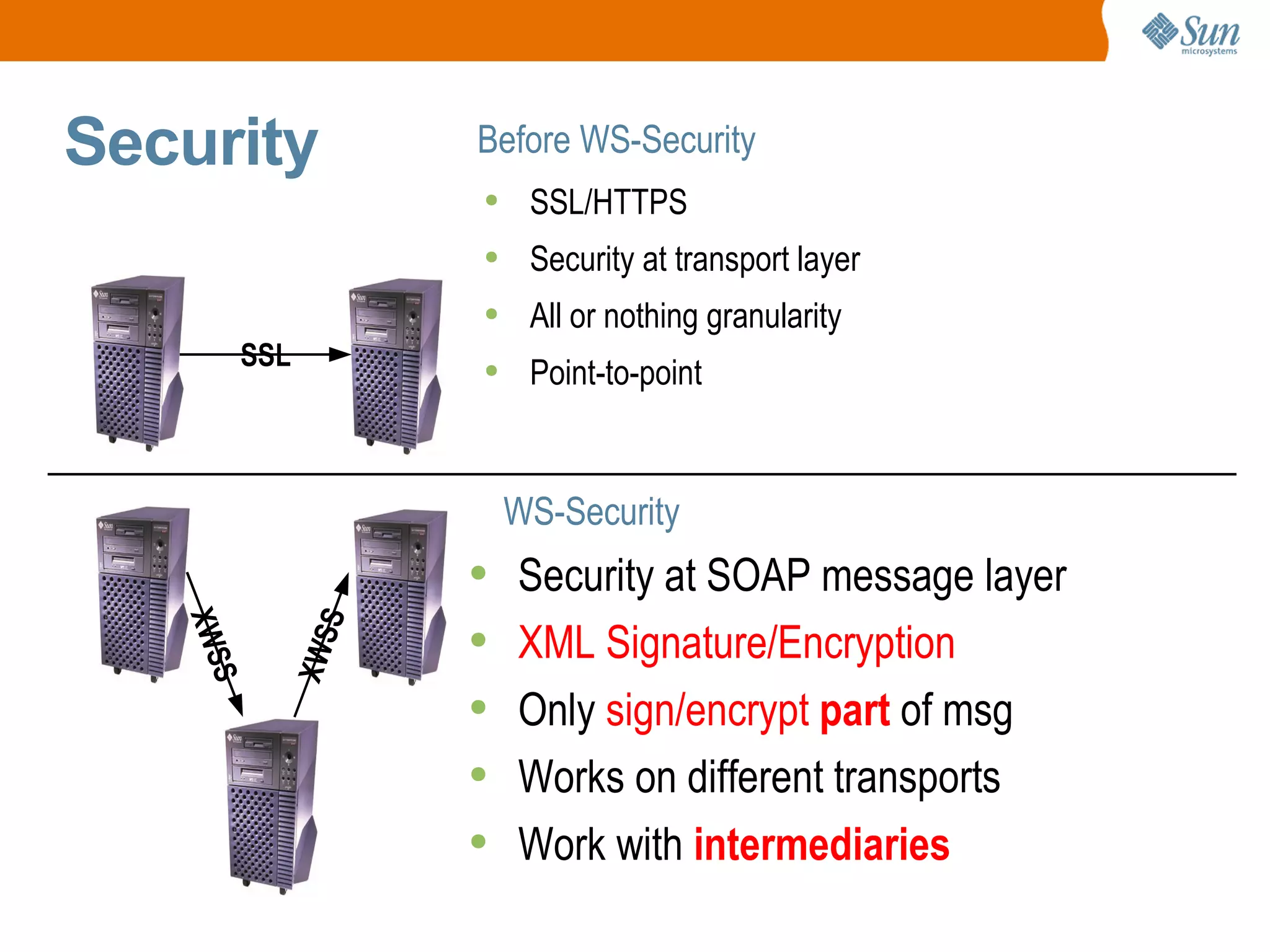
Security Before WS-Security Only SSL: WS-Security Security at SOAP (protocol) layer Fine granularity possible Only sign/encrypt credit card #  (e.g., XML subtree) Works on non-TCP/IP transports Integrity, Confidentiality, Auth W3C XML Signature/Encryption SSL/HTTPS Security at  transport  layer Point-to-point Encrypts session
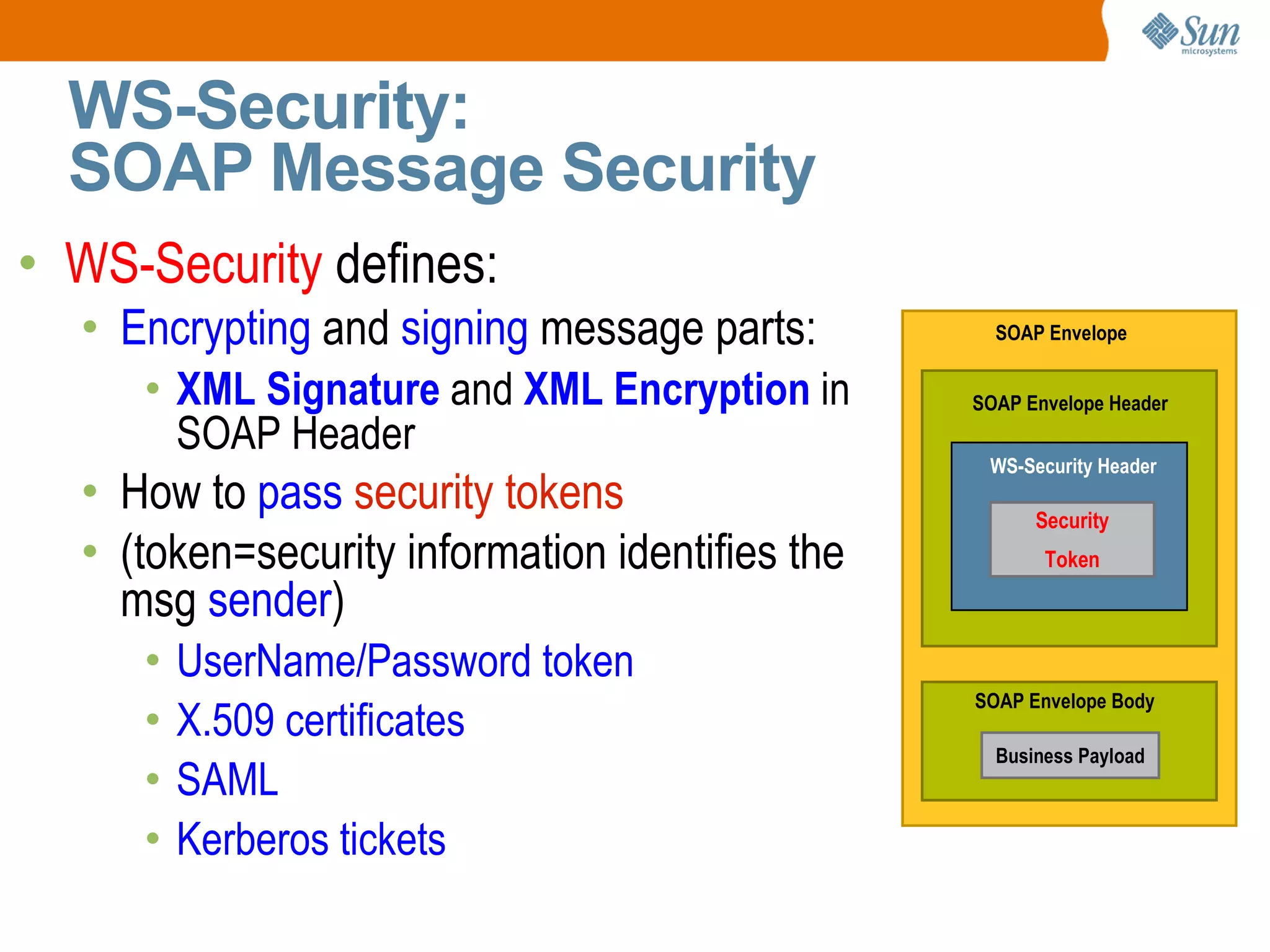
WS-Security: SOAP Message Security WS-Security  defines: Encrypting  and  signing  message parts:  XML Signature  and   XML Encryption   in SOAP Header How to  pass  security tokens (token=security information identifies the msg  sender ) UserName/Password token X.509 certificates SAML Kerberos tickets SOAP Envelope SOAP Envelope Header SOAP Envelope Body WS-Security Header Security Token Business Payload
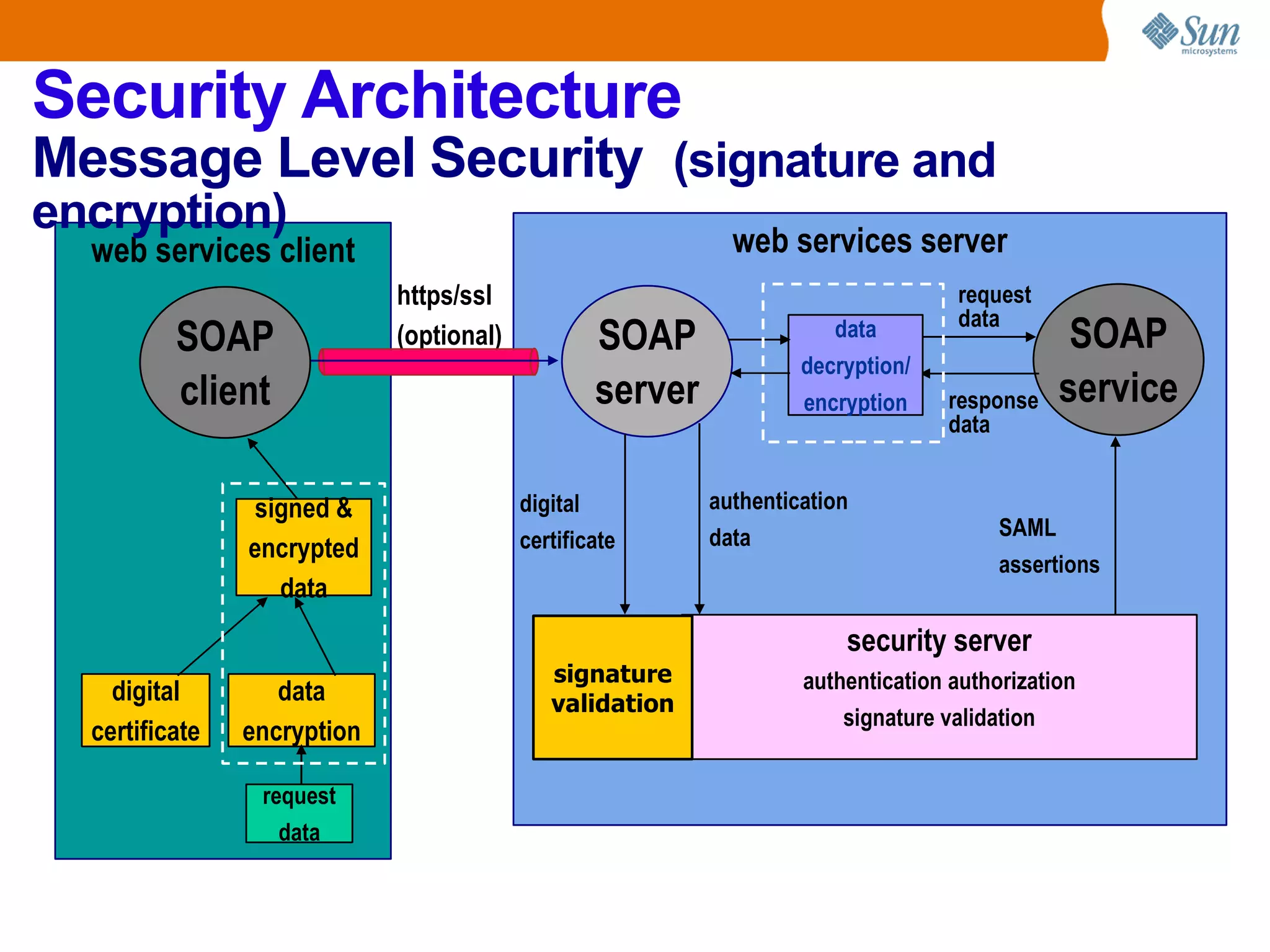
request data response data authentication data SAML assertions https/ssl (optional) digital certificate Security Architecture Message Level Security  (signature and encryption) web services client SOAP client signed & encrypted data web services server SOAP server SOAP service security server authentication authorization signature validation data encryption digital certificate request data data decryption/ encryption signature validation
Security Before WS-Security WS-Security Security at SOAP message layer XML Signature/Encryption Only  sign/encrypt   part  of msg Works on different transports Work with  intermediaries SSL/HTTPS Security at transport layer All or nothing granularity Point-to-point
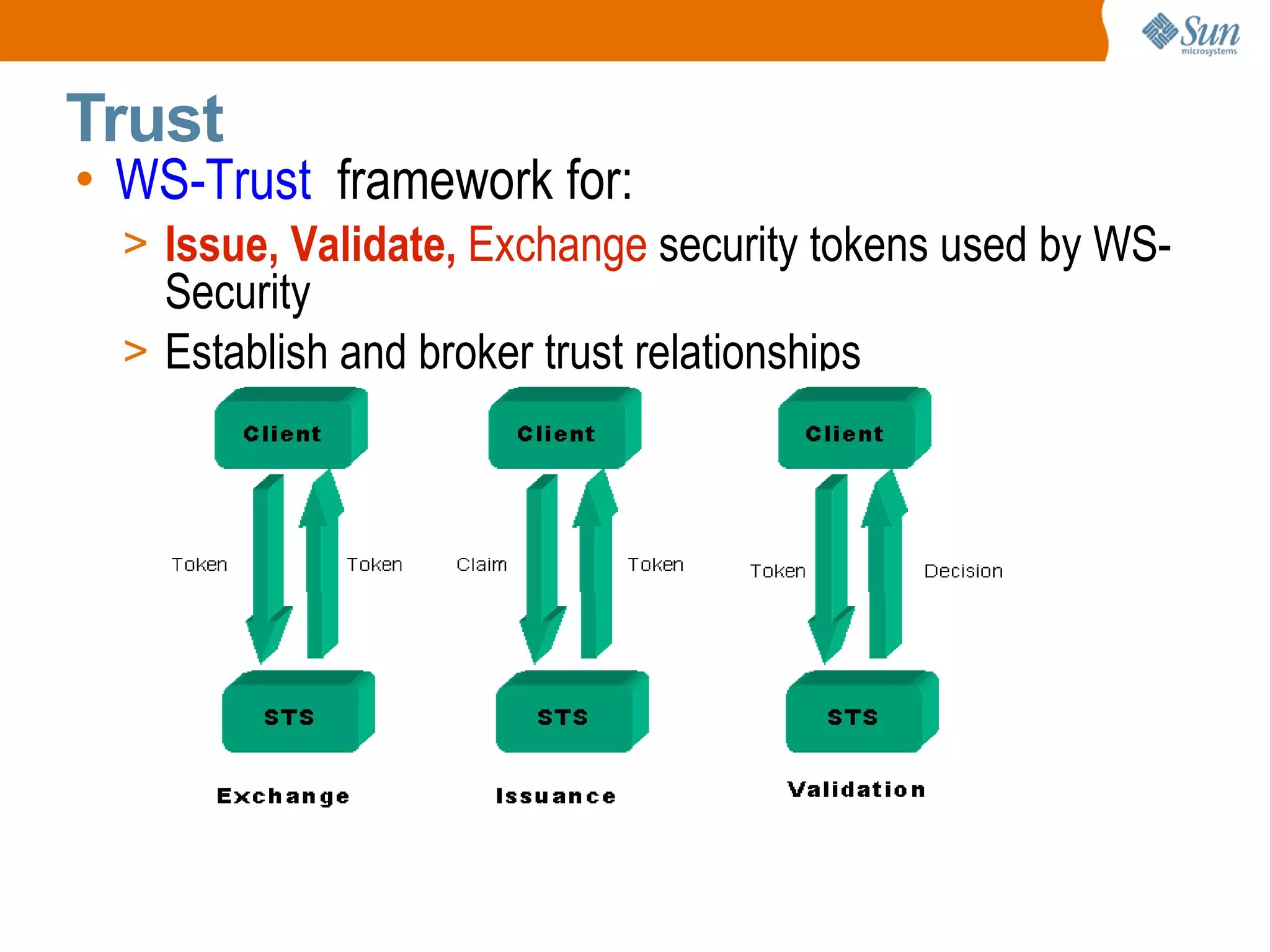
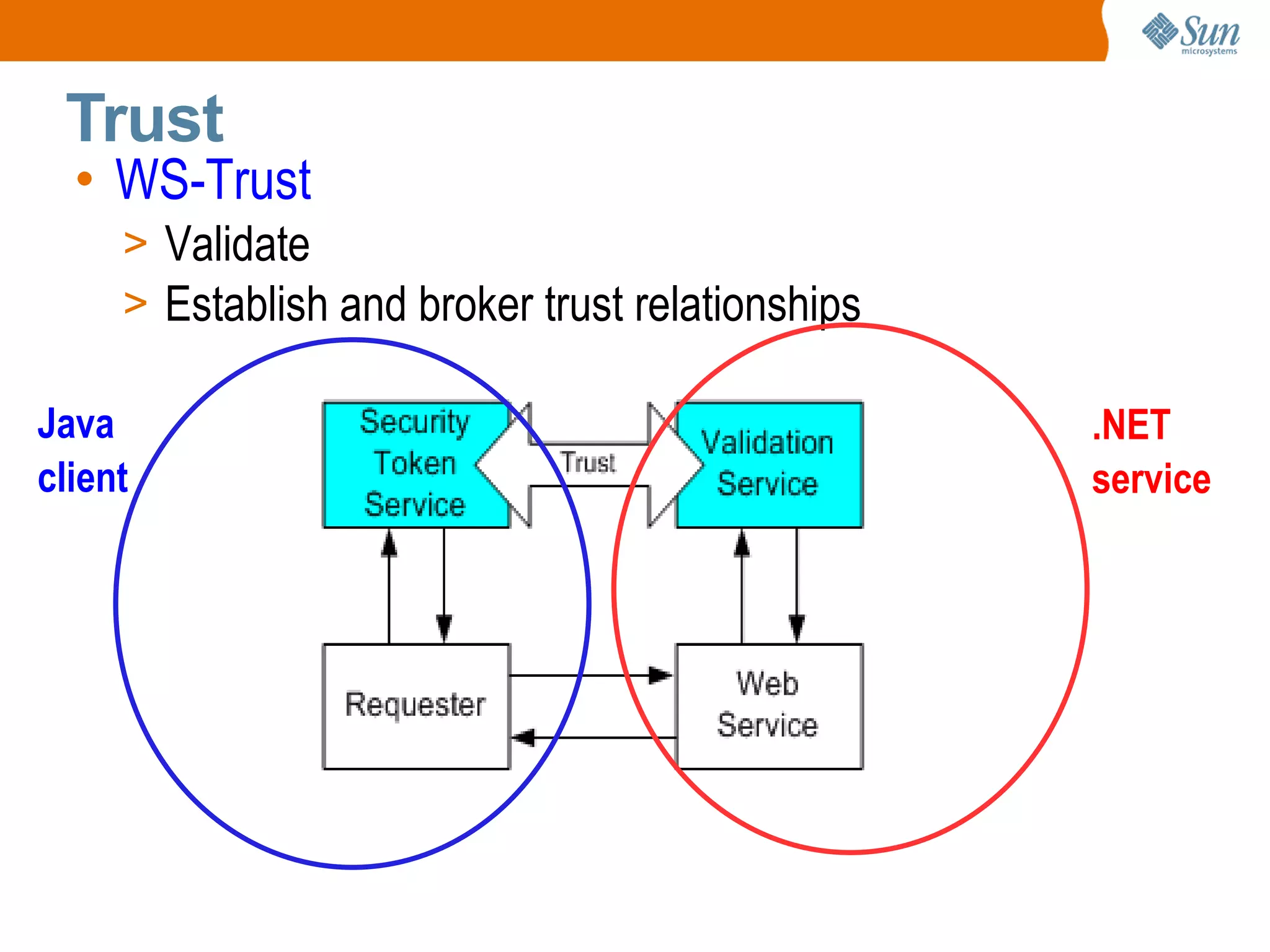
WS-Trust   framework for: Issue, Validate,   Exchange   security tokens used by WS-Security Establish and broker trust relationships Trust
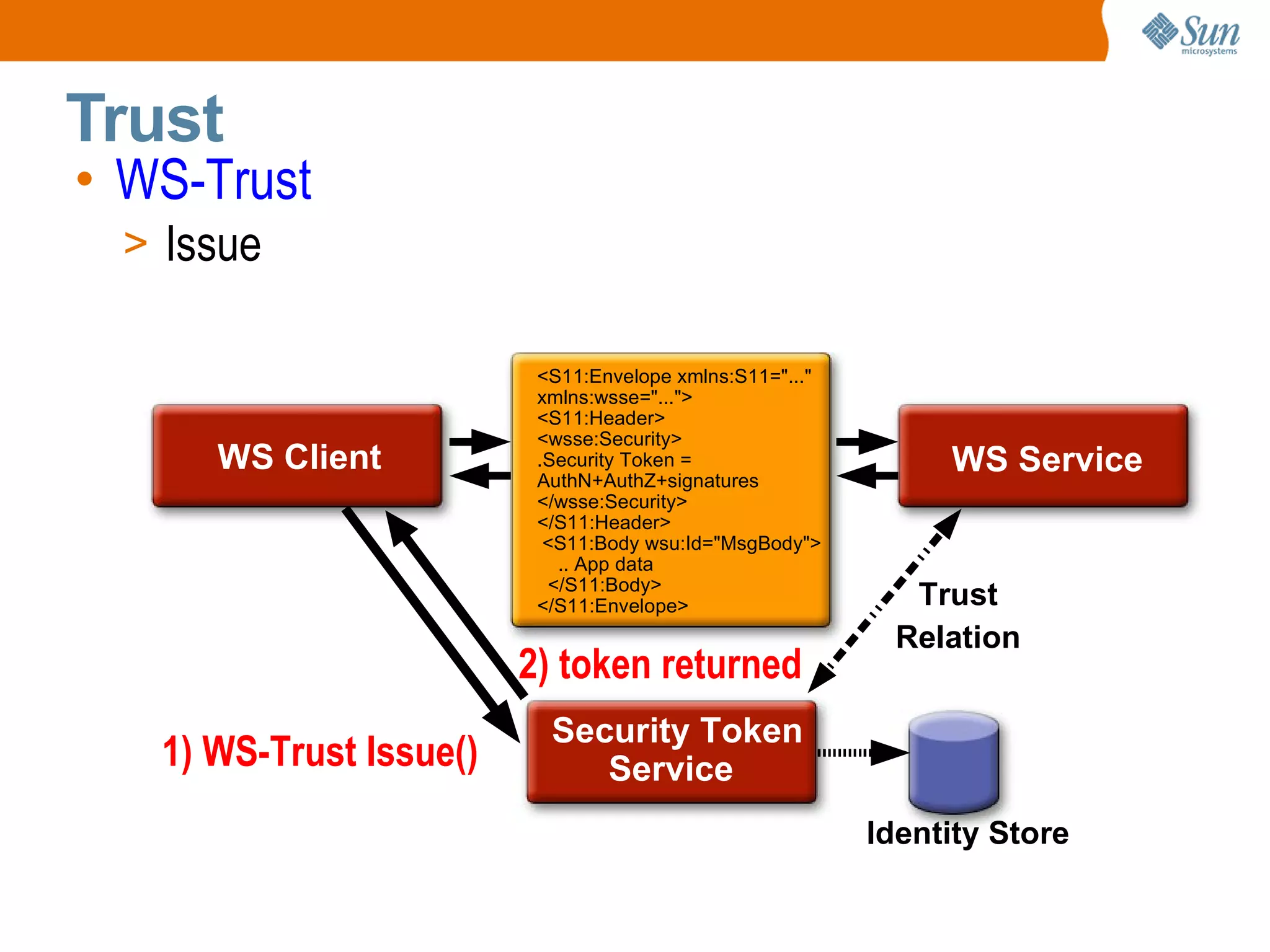
WS-Trust   Issue Trust Trust Relation Identity Store WS Client WS Service Security Token Service 1) WS-Trust Issue() 2) token returned <S11:Envelope xmlns:S11=&quot;...&quot;  xmlns:wsse=&quot;...&quot;> <S11:Header> <wsse:Security> .Security Token =  AuthN+AuthZ+signatures </wsse:Security>  </S11:Header> <S11:Body wsu:Id=&quot;MsgBody&quot;> .. App data </S11:Body> </S11:Envelope>
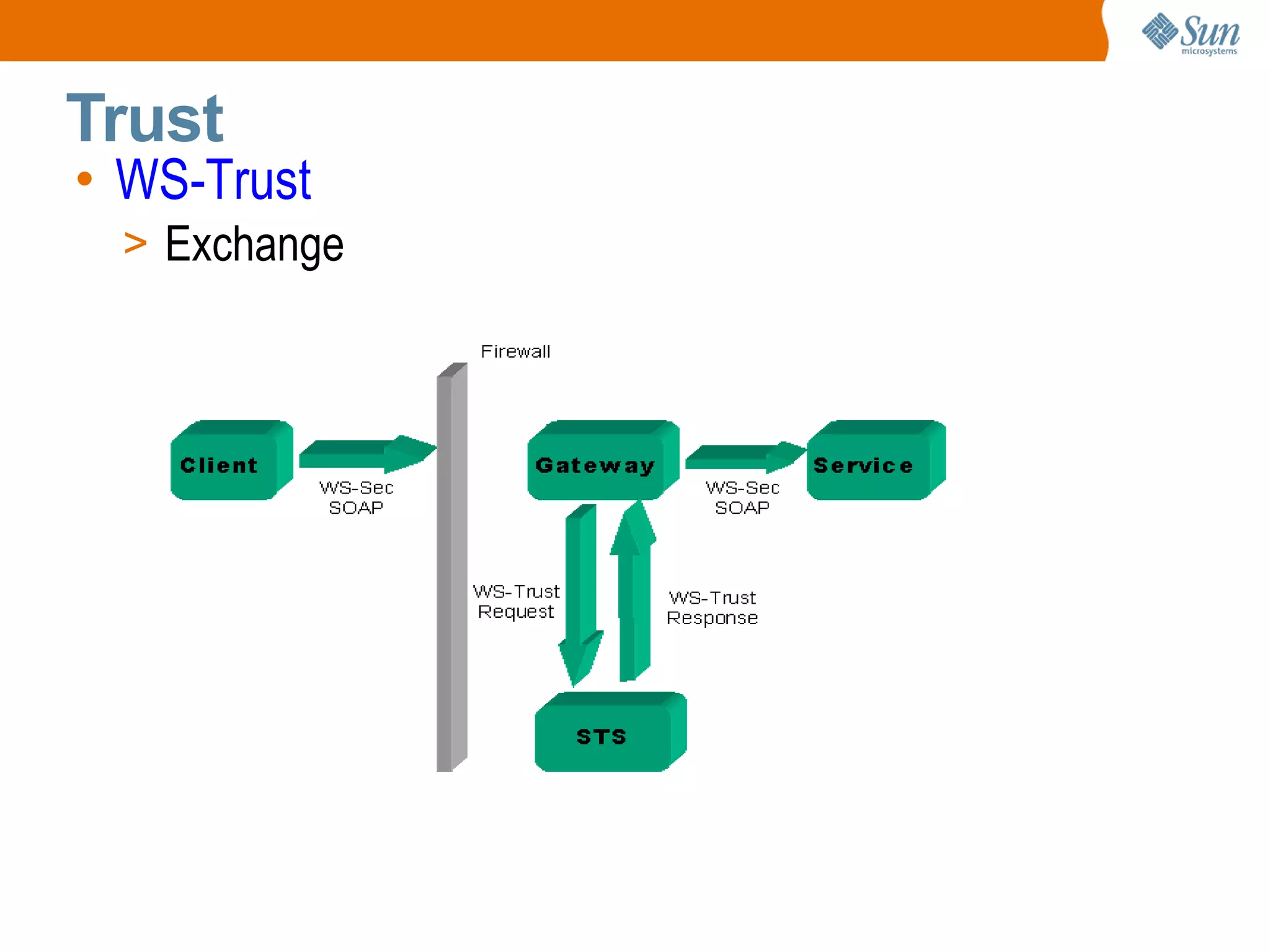
WS-Trust   Exchange Trust
WS-Trust   Validate Establish and broker trust relationships Trust .NET service Java client
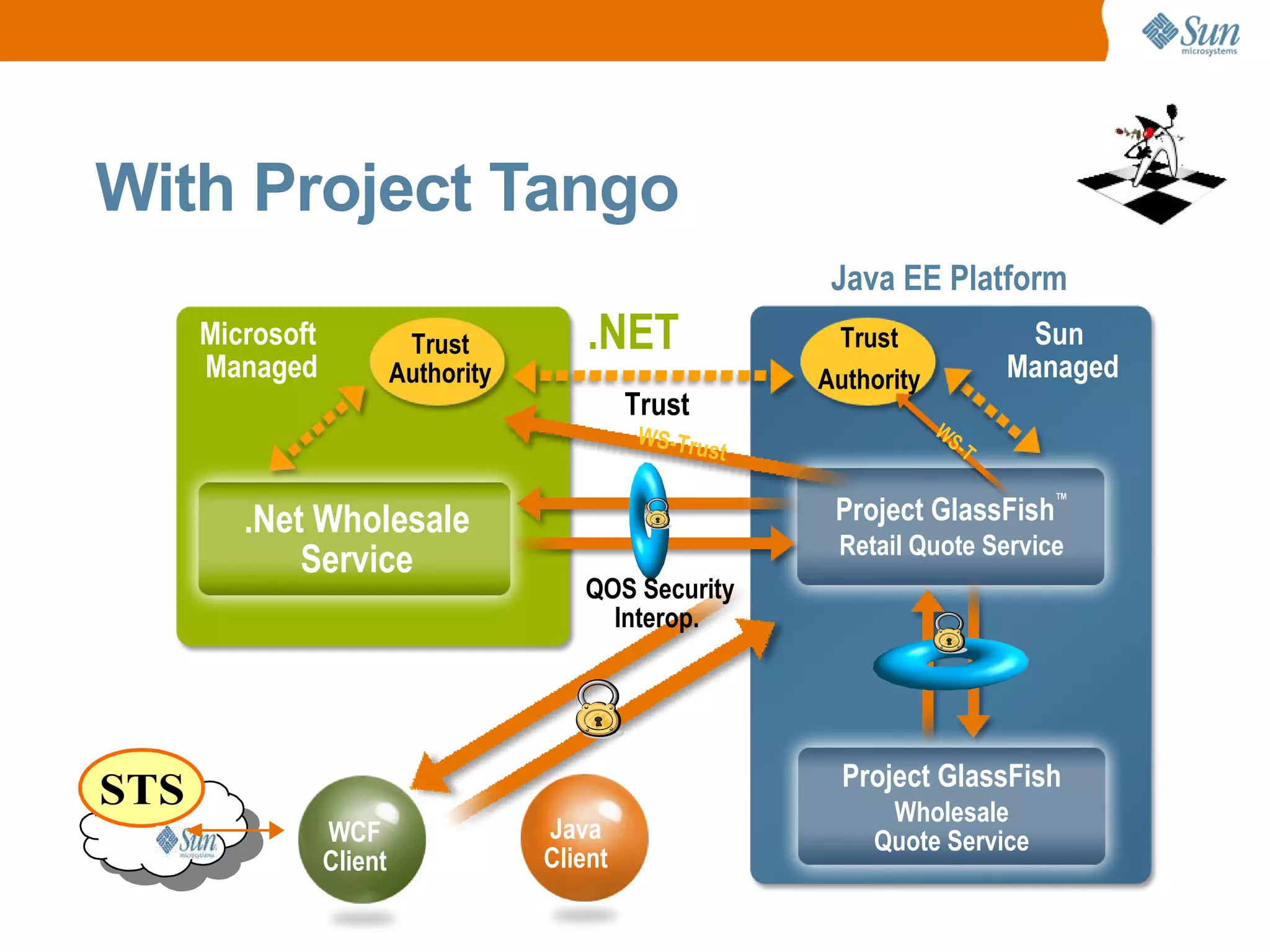
.NET Trust Authority Trust Authority Sun  Managed Microsoft  Managed Project GlassFish ™ Retail Quote Service Project GlassFish Wholesale Quote Service .Net Wholesale Service Java EE Platform  With Project Tango WCF Client Java Client WS-Trust WS-T Trust QOS Security Interop.
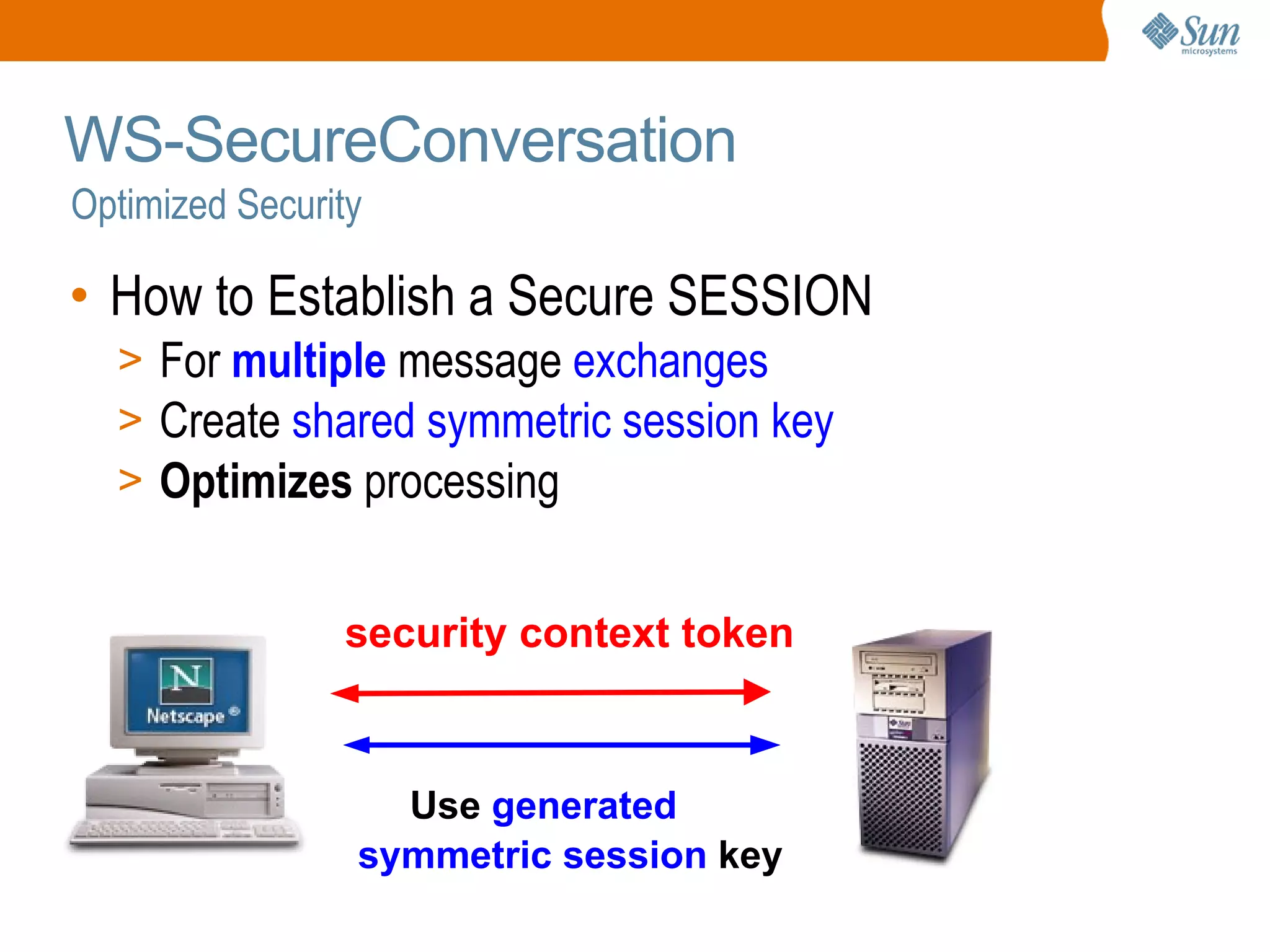
How to Establish a Secure SESSION For  multiple  message  exchanges Create  shared symmetric session key   Optimizes  processing  WS-SecureConversation Optimized Security security context token Use  generated  symmetric session  key
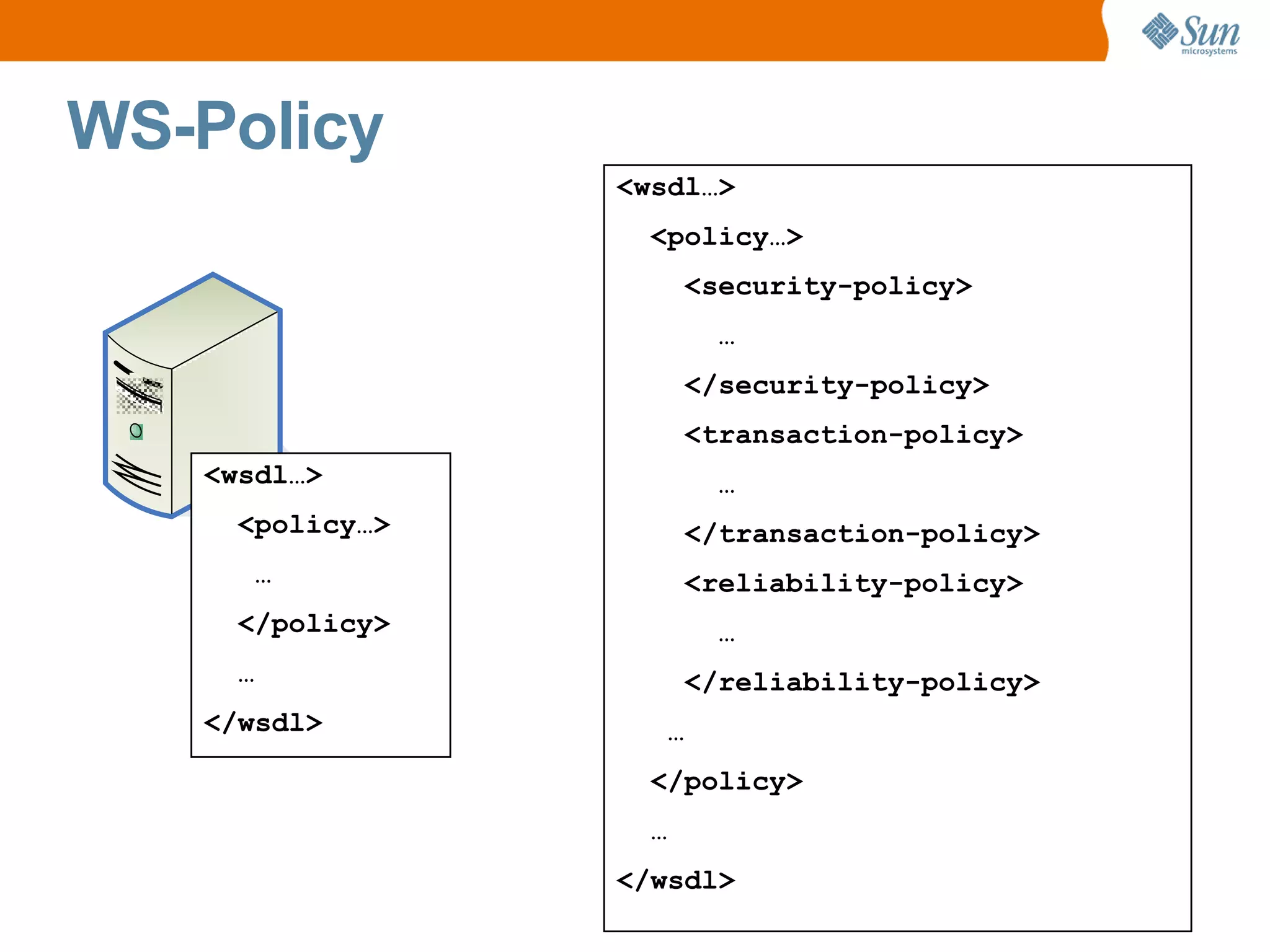
WS-Policy <wsdl…> <policy…> … </policy> … </wsdl> <wsdl…> <policy…> <security-policy> … </security-policy> <transaction-policy> … </transaction-policy> <reliability-policy> … </reliability-policy> … </policy> … </wsdl>
Metro: Bootstrapping
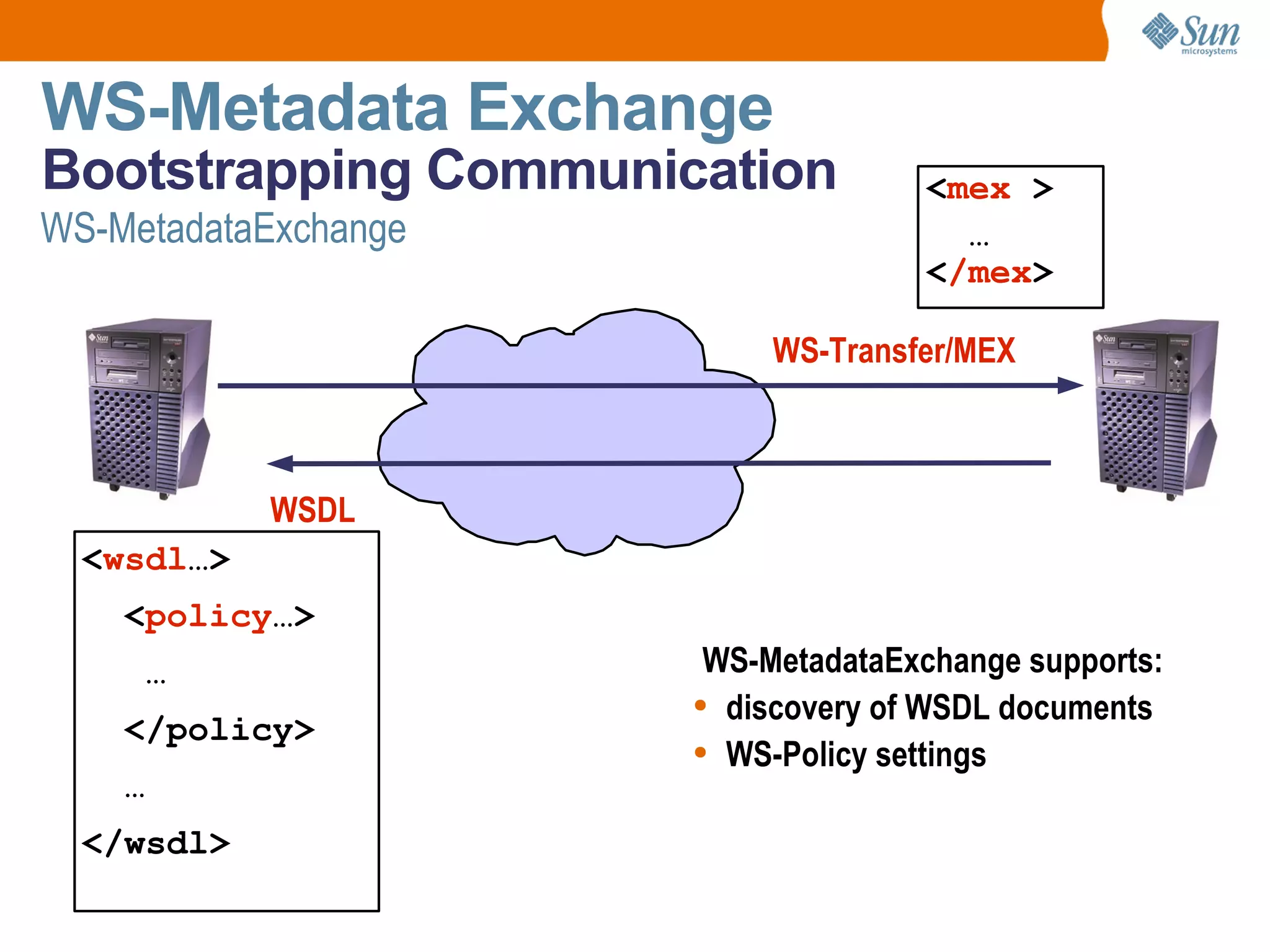
WS-Metadata Exchange Bootstrapping Communication < mex  >   …   < /mex > < wsdl …> < policy …> … </policy> … </wsdl> WS-MetadataExchange supports: discovery of WSDL documents WS-Policy settings  WS-MetadataExchange WS-Transfer/MEX WSDL
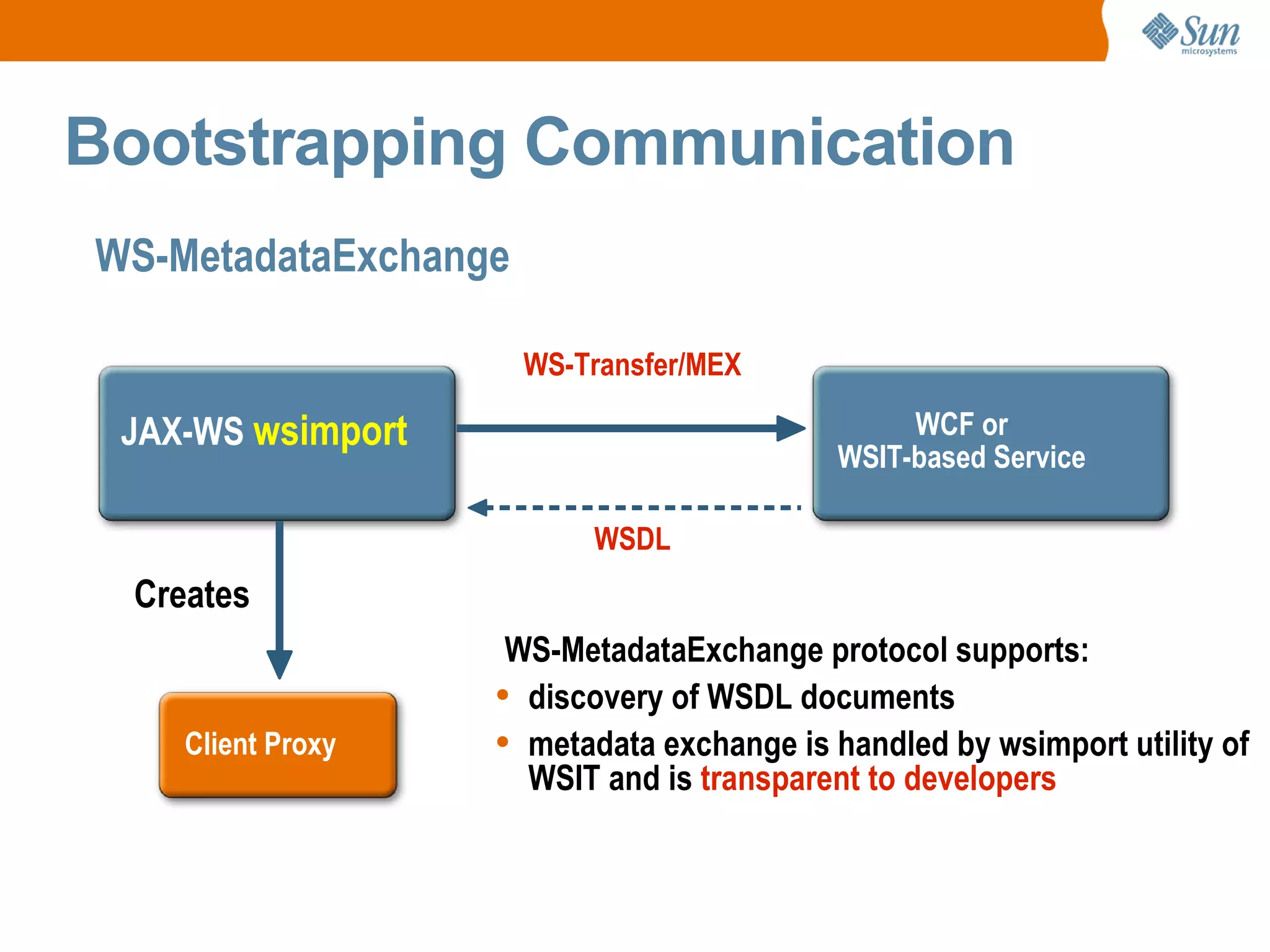
Bootstrapping Communication JAX-WS  wsimport WCF or WSIT-based Service Creates Client Proxy WS-Transfer/MEX WSDL WS-MetadataExchange WS-MetadataExchange protocol supports: discovery of WSDL documents metadata exchange is handled by wsimport utility of WSIT and is  transparent to developers
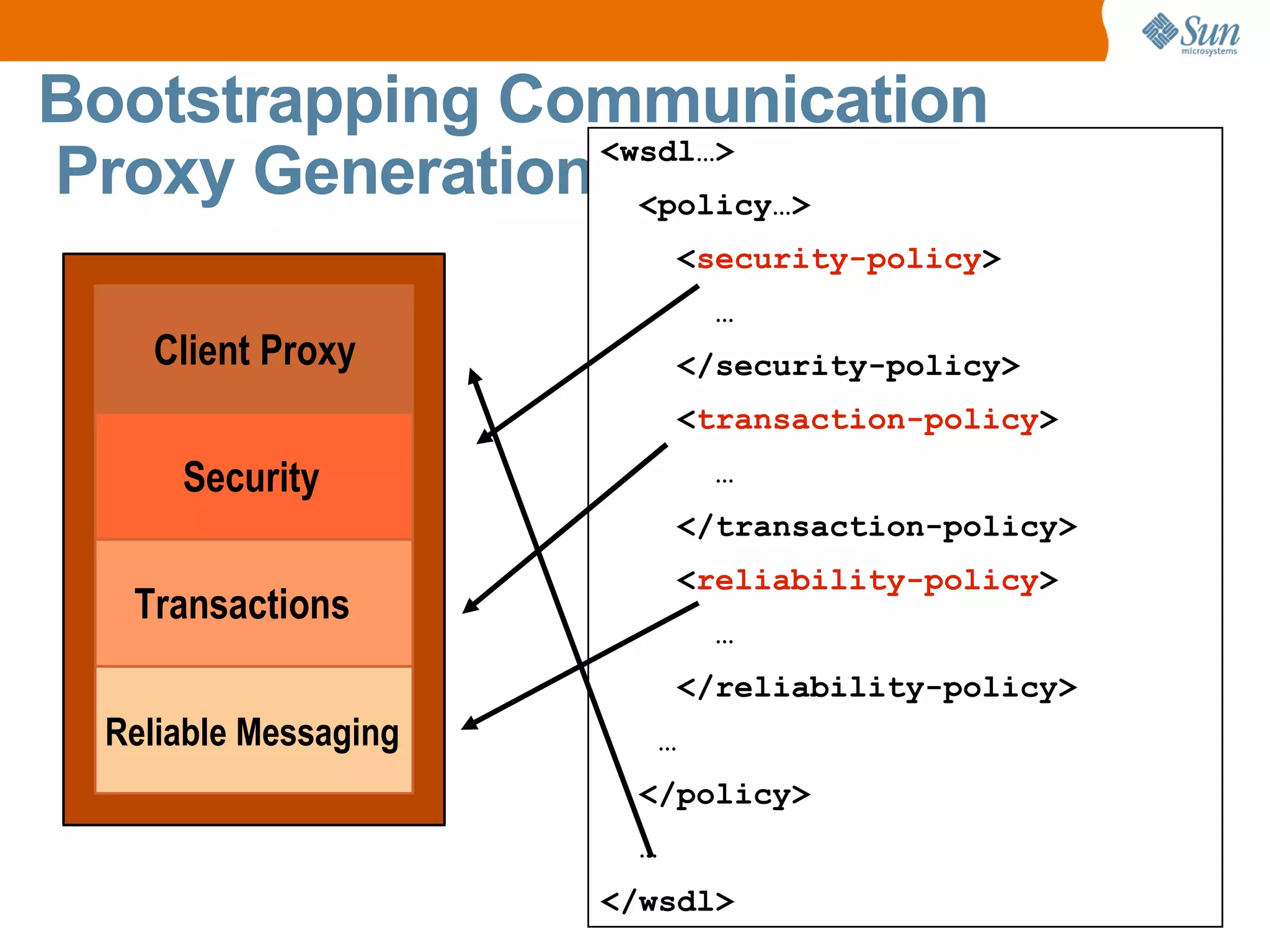
Proxy Generation Bootstrapping Communication <wsdl…> <policy…> < security-policy > … </security-policy> < transaction-policy > … </transaction-policy> < reliability-policy > … </reliability-policy> … </policy> … </wsdl>
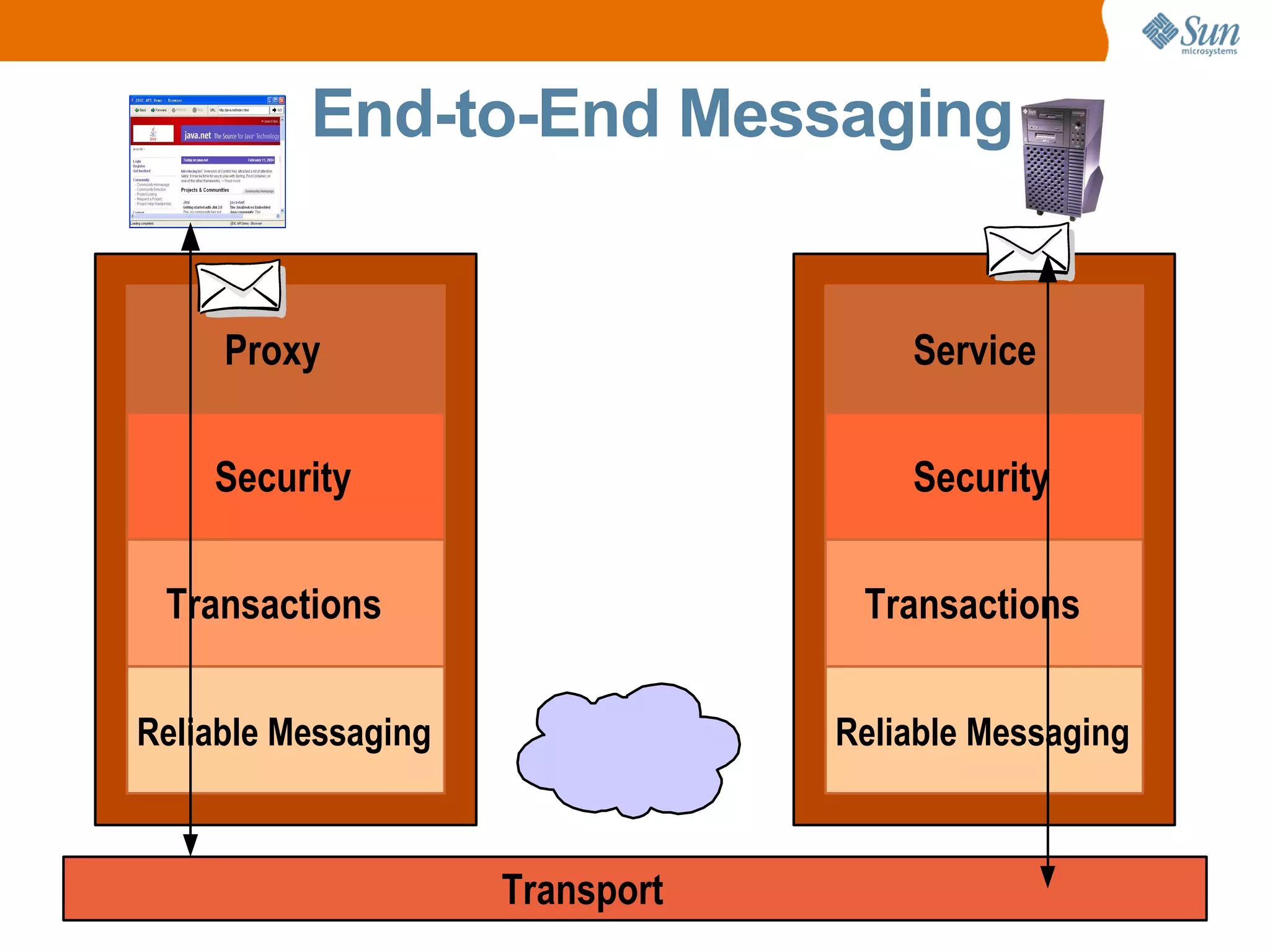
End-to-End Messaging
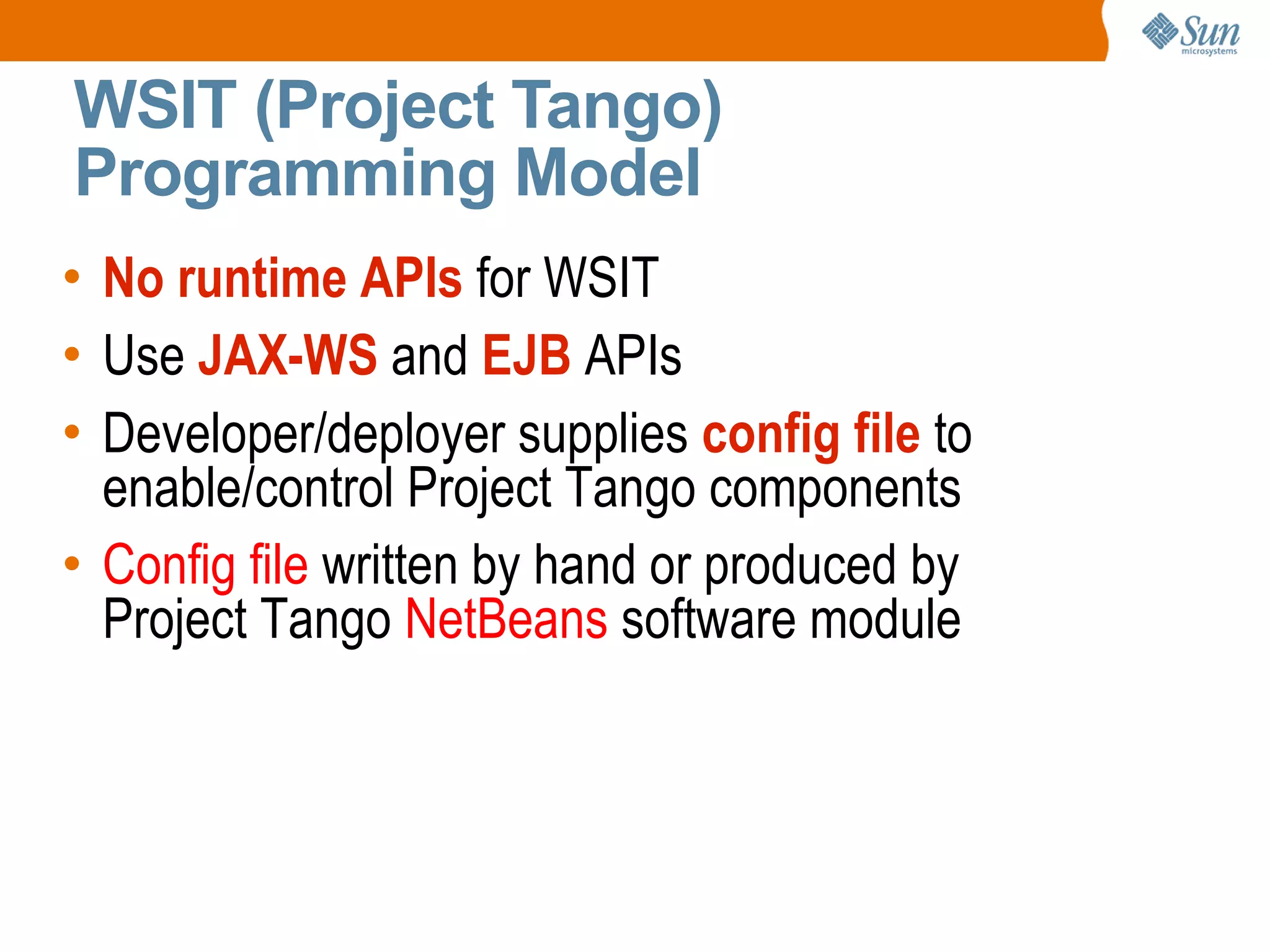
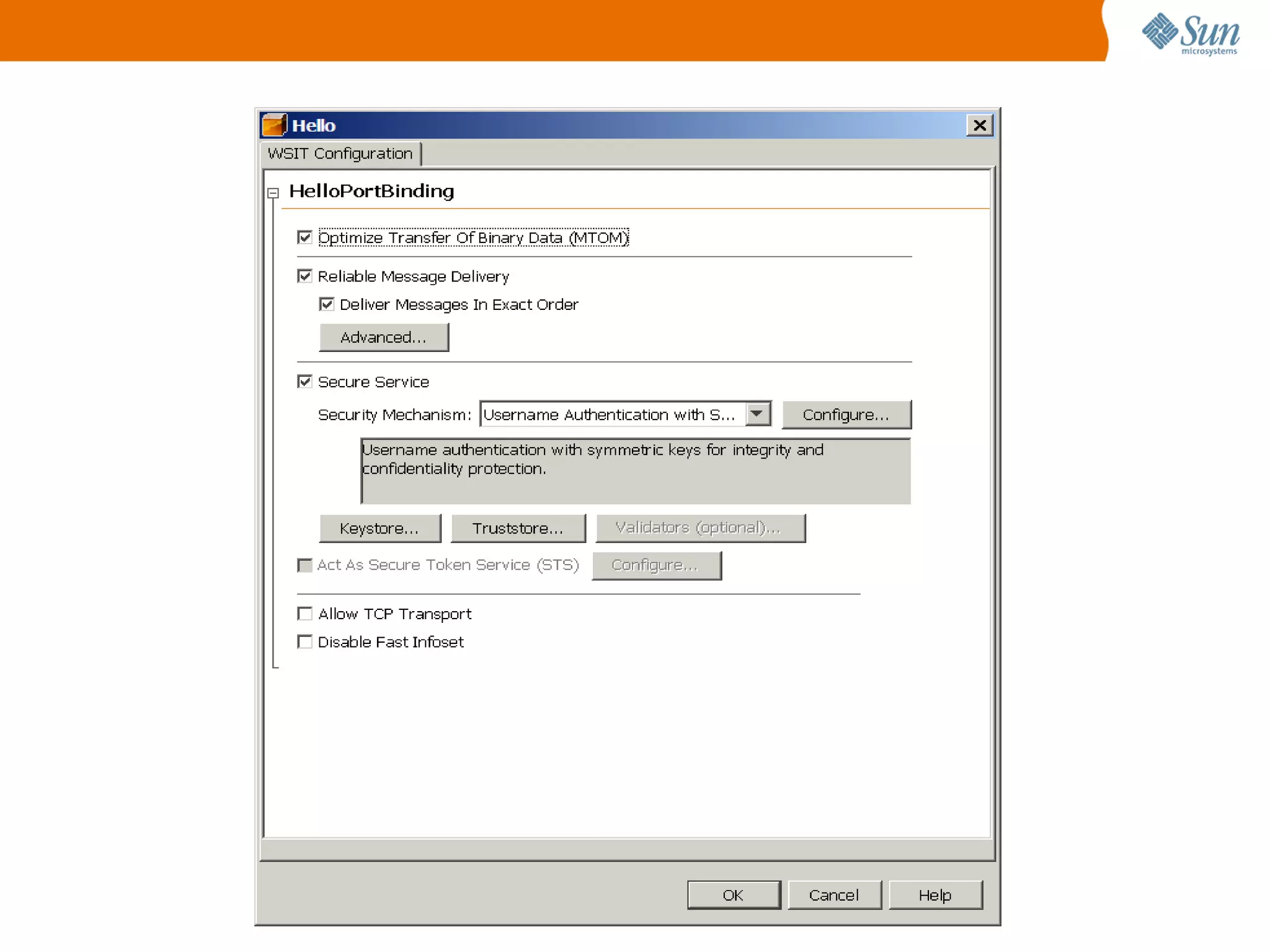
No runtime APIs   for WSIT Use  JAX-WS   and  EJB   APIs Developer/deployer supplies  config file   to enable/control Project Tango components Config file  written by hand or produced by  Project Tango  NetBeans  software module WSIT (Project Tango) Programming Model
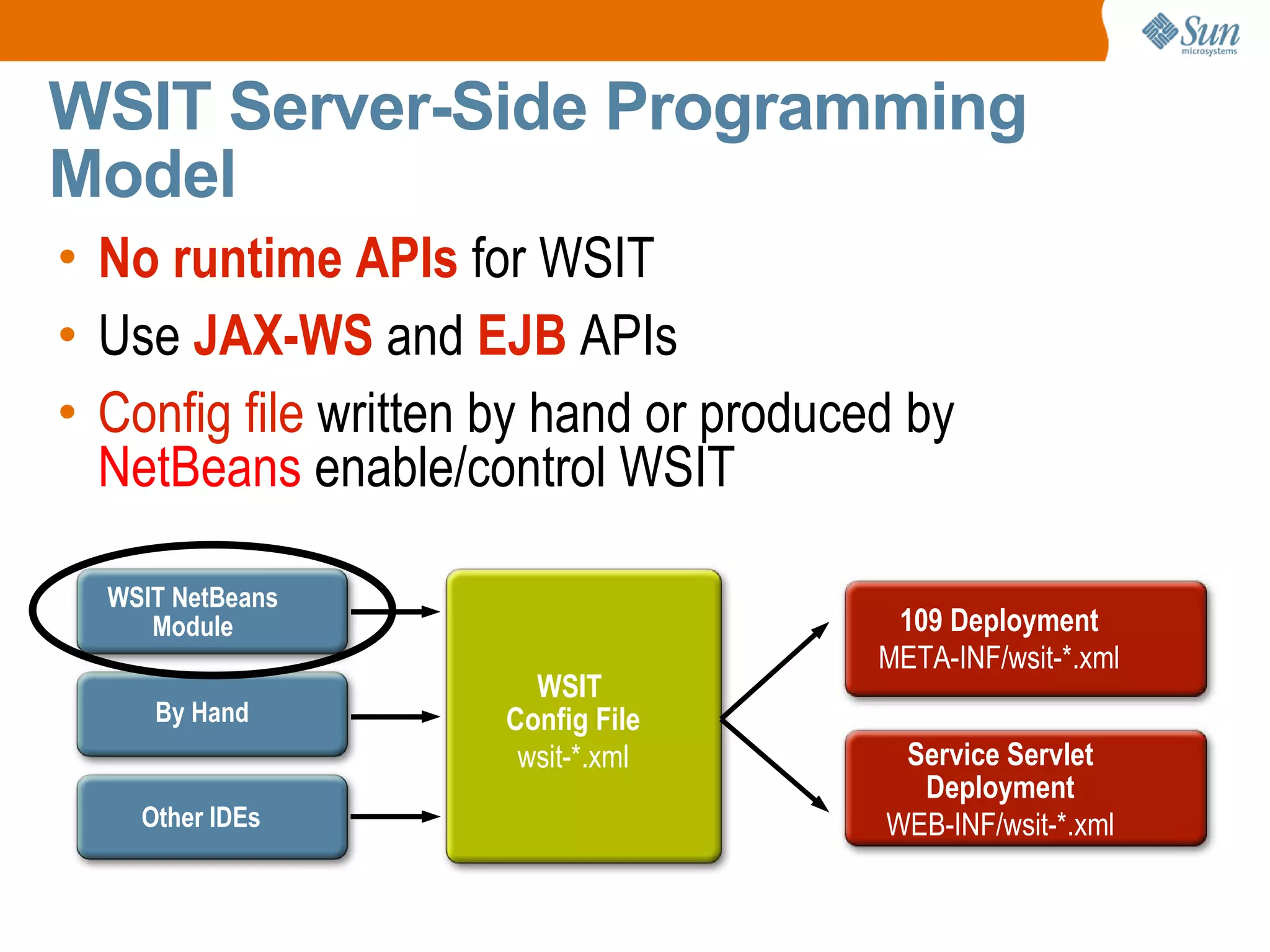
WSIT NetBeans Module By Hand Other IDEs 109 Deployment META-INF/wsit-*.xml Service Servlet Deployment WEB-INF/wsit-*.xml WSIT Server-Side Programming Model WSIT  Config File wsit-*.xml No runtime APIs   for WSIT Use  JAX-WS   and  EJB   APIs Config file  written by hand or produced by  NetBeans  enable/control WSIT
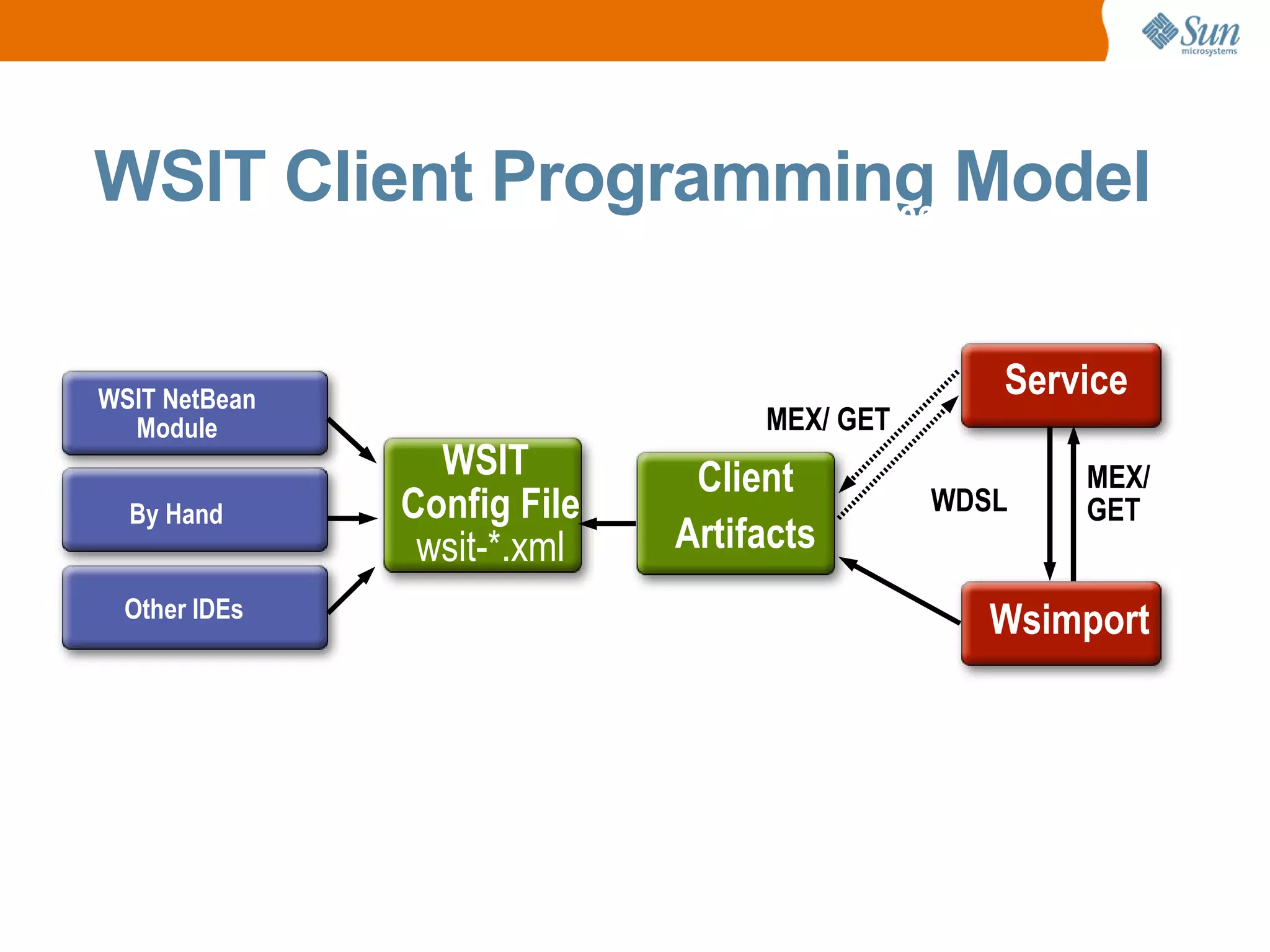
WSIT Client Programming Model 109  Service Wsimport Client Artifacts WSIT  Config File wsit-*.xml WSIT NetBean Module By Hand Other IDEs MEX/ GET WDSL MEX/ GET
 
Agenda Metro  JAX-WS Standards WSIT REST  with JAX-RS
API: JAX-RS Standardized in the JSR 311 Will be included in Java EE 6 EG members Alcatel-Lucent, BEA, Day Software, Fujitsu, innoQ, Nortel, Red Hat Experts in Atom, AtomPub, WebDAV, HTTP, REST, Restlet  Group started in April 2007
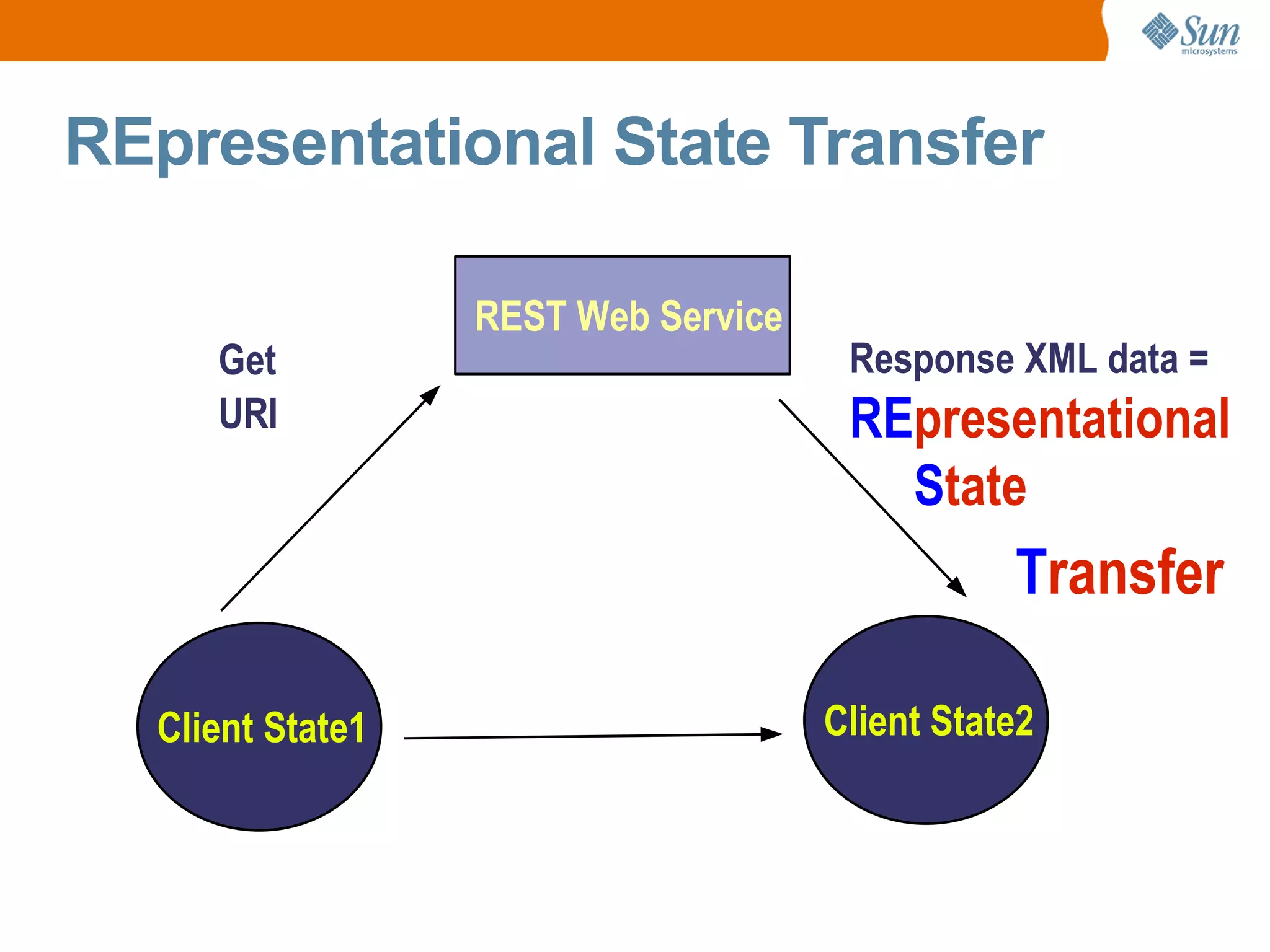
REpresentational State Transfer Get URI Response XML data = RE presentational  S tate T ransfer
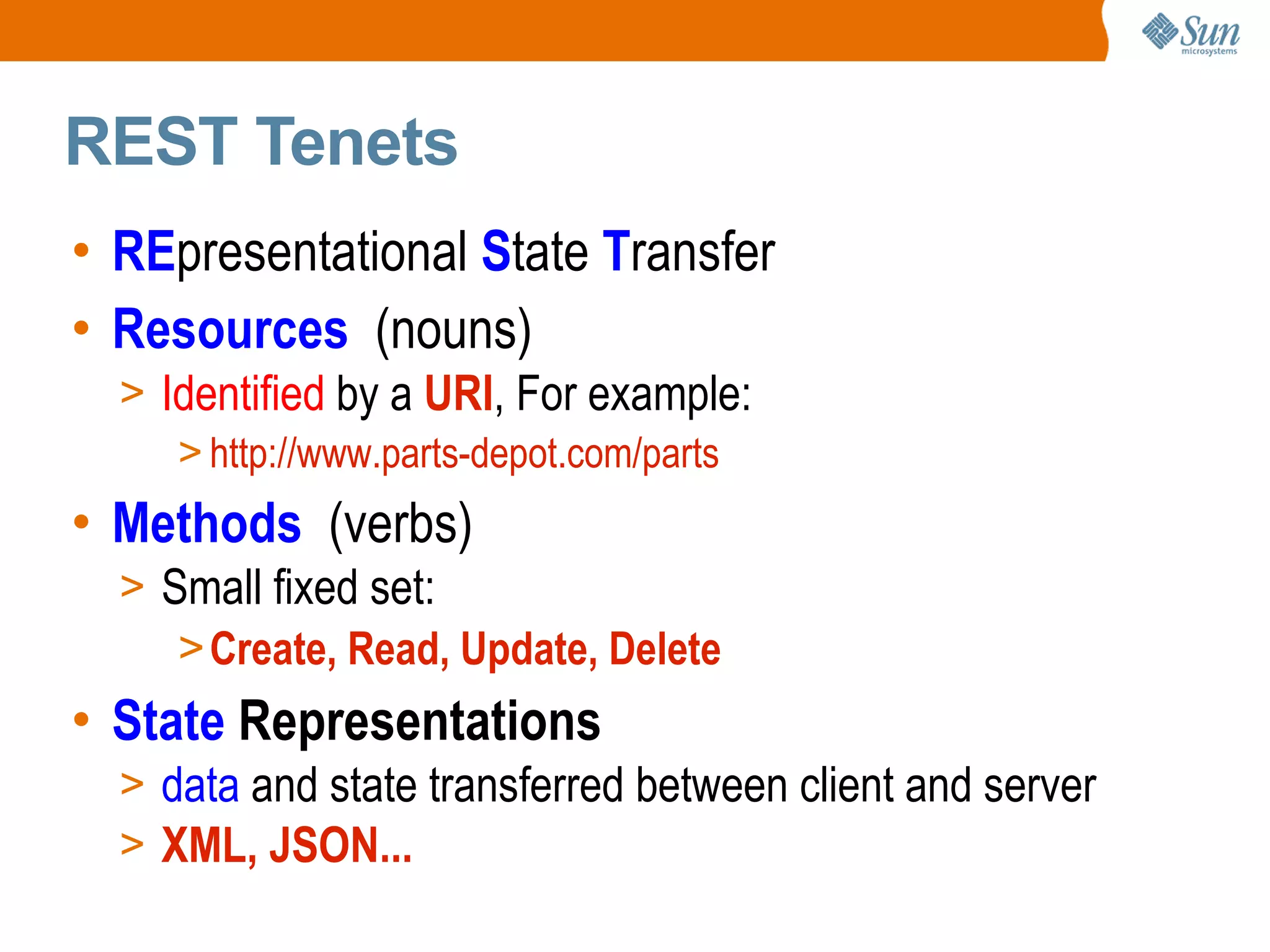
REST Tenets RE presentational  S tate  T ransfer Resources   (nouns) Identified  by a  URI , For example: http://www.parts-depot.com/parts Methods   (verbs) Small fixed set: Create, Read, Update, Delete State  Representations   data  and state transferred between client and server XML, JSON...
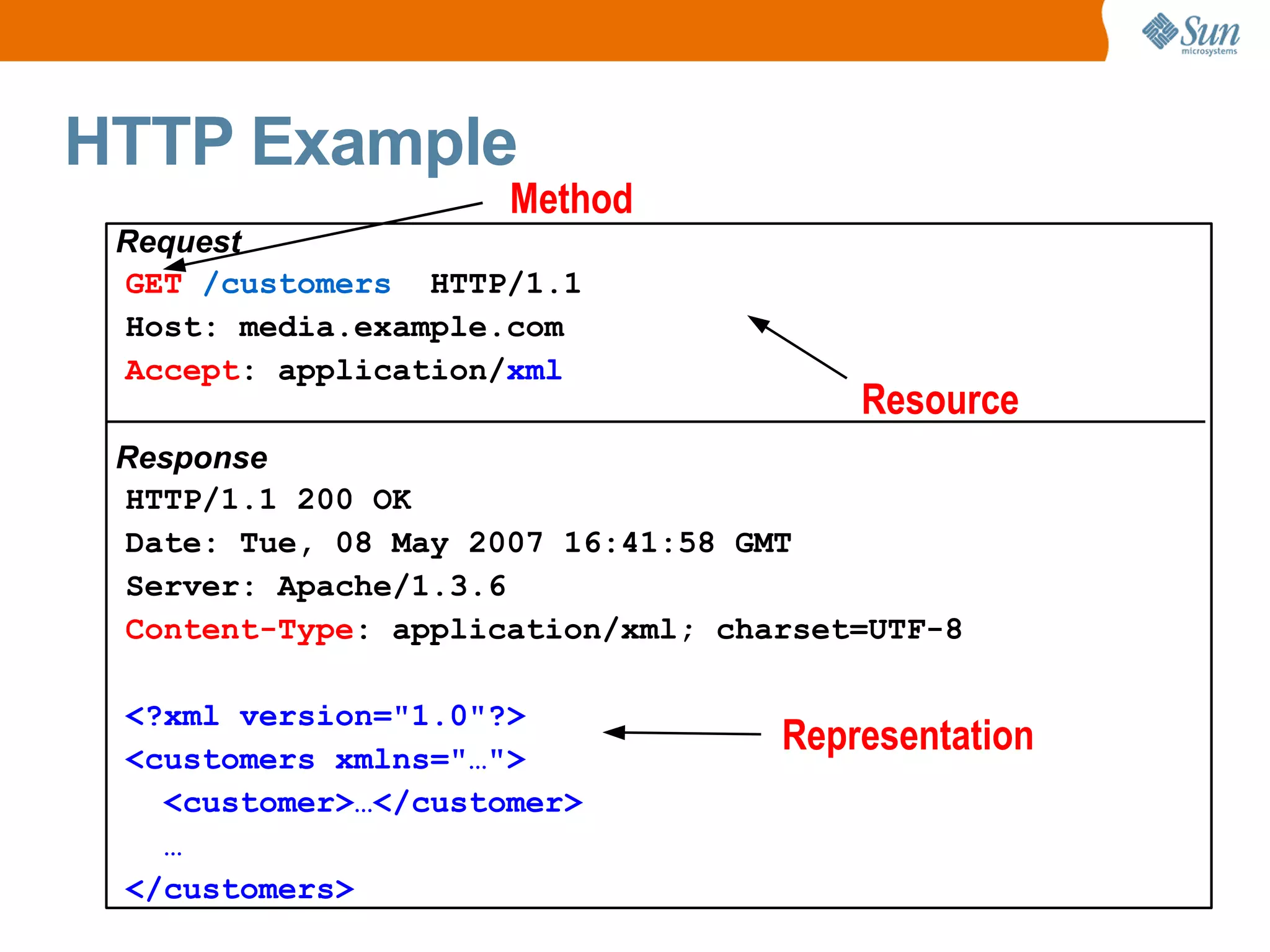
HTTP Example Request GET   /customers  HTTP/1.1 Host: media.example.com Accept : application/ xml Response HTTP/1.1 200 OK Date: Tue, 08 May 2007 16:41:58 GMT Server: Apache/1.3.6 Content-Type : application/xml; charset=UTF-8 <?xml version=&quot;1.0&quot;?> <customers xmlns=&quot;…&quot;> <customer>…</customer> … </customers> Resource Method Representation
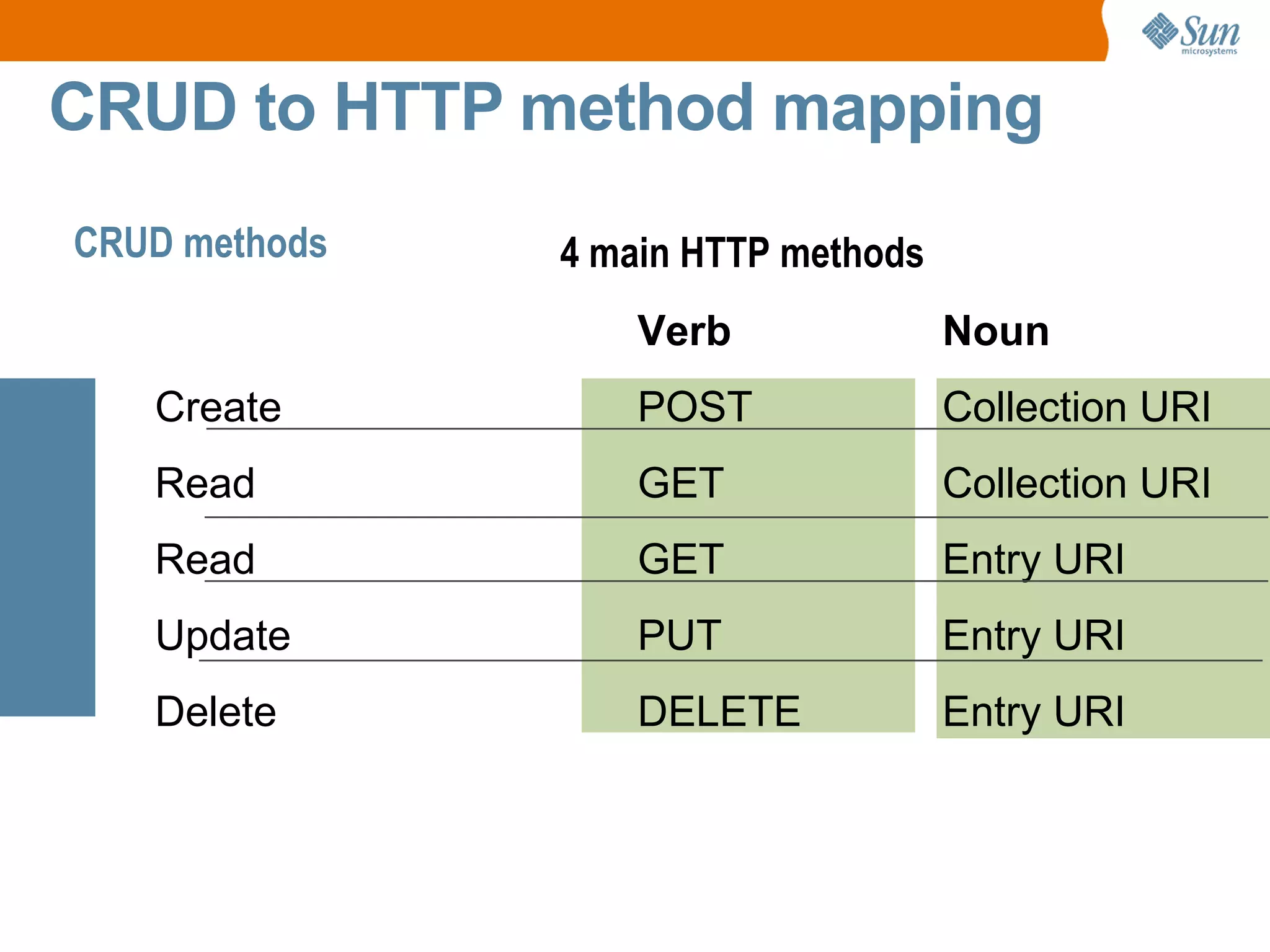
Verb Noun Create POST Collection URI  Read GET Collection URI Read GET Entry URI Update PUT Entry URI Delete DELETE Entry URI CRUD to HTTP method mapping 4 main HTTP methods CRUD methods
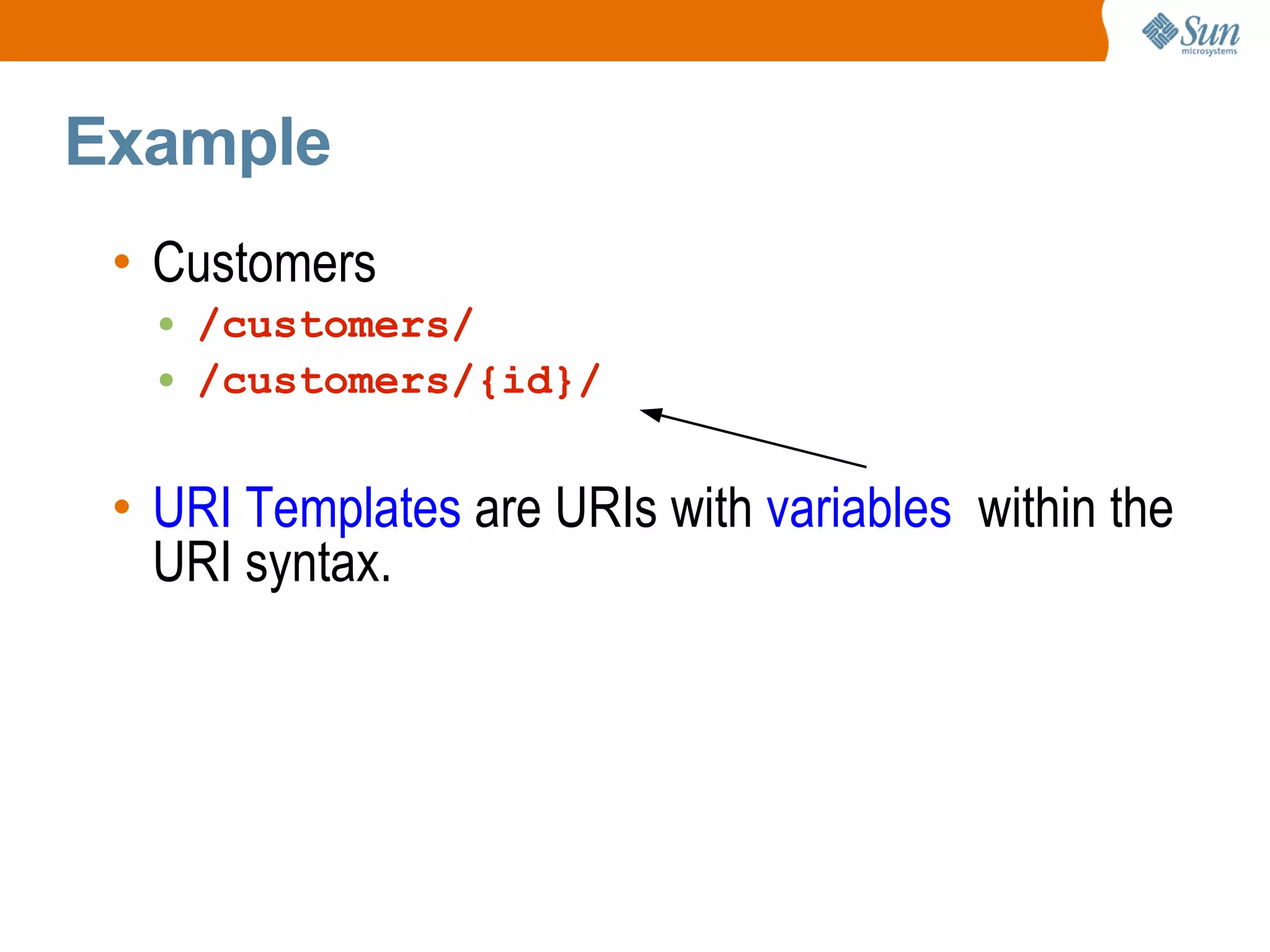
Example Customers /customers/ /customers/{id}/ URI Templates  are URIs with  variables   within the URI syntax.
Customer Resource Using Servlet API public class Artist extends HttpServlet { public enum SupportedOutputFormat {XML, JSON}; protected void doGet(HttpServletRequest request, HttpServletResponse response) throws ServletException, IOException { String accept = request.getHeader(&quot;accept&quot;).toLowerCase(); String acceptableTypes[] = accept.split(&quot;,&quot;); SupportedOutputFormat outputType = null; for (String acceptableType: acceptableTypes) { if (acceptableType.contains(&quot;*/*&quot;) || acceptableType.contains(&quot;application/*&quot;) || acceptableType.contains(&quot;application/xml&quot;)) { outputType=SupportedOutputFormat.XML; break; } else if (acceptableType.contains(&quot;application/json&quot;)) { outputType=SupportedOutputFormat.JSON; break; } } if (outputType==null) response.sendError(415); String path = request.getPathInfo(); String pathSegments[] = path.split(&quot;/&quot;); String artist = pathSegments[1]; if (pathSegments.length < 2 && pathSegments.length > 3) response.sendError(404); else if (pathSegments.length == 3 && pathSegments[2].equals(&quot;recordings&quot;)) { if (outputType == SupportedOutputFormat.XML) writeRecordingsForArtistAsXml(response, artist); else writeRecordingsForArtistAsJson(response, artist); } else { if (outputType == SupportedOutputFormat.XML) writeArtistAsXml(response, artist); else writeArtistAsJson(response, artist); } } private void writeRecordingsForArtistAsXml(HttpServletResponse response, String artist) { ... } private void writeRecordingsForArtistAsJson(HttpServletResponse response, String artist) { ... } private void writeArtistAsXml(HttpServletResponse response, String artist) { ... } private void writeArtistAsJson(HttpServletResponse response, String artist) { ... } } Don't try to read this,  this is just to show the complexity :)
Server-side API Wish List JAX-RS = Easier REST Way High level, Declarative Uses @ annotation in POJOs
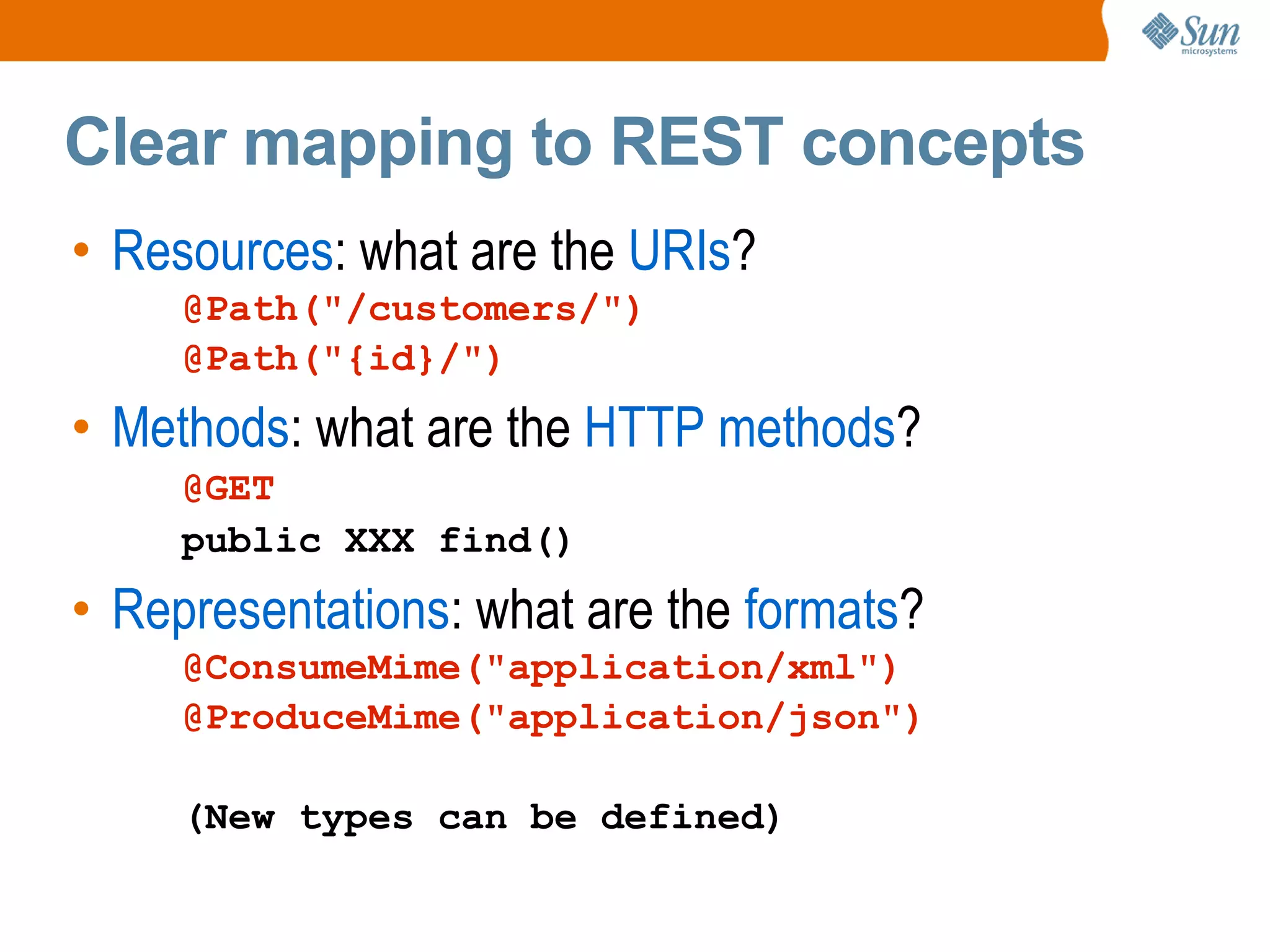
Clear mapping to REST concepts Resources : what are the  URIs ? @Path(&quot;/customers/&quot;) @Path(&quot;{id}/&quot;) Methods : what are the  HTTP methods ? @GET public XXX find() Representations : what are the  formats ? @ConsumeMime(&quot;application/xml&quot;) @ProduceMime(&quot;application/json&quot;) (New types can be defined)
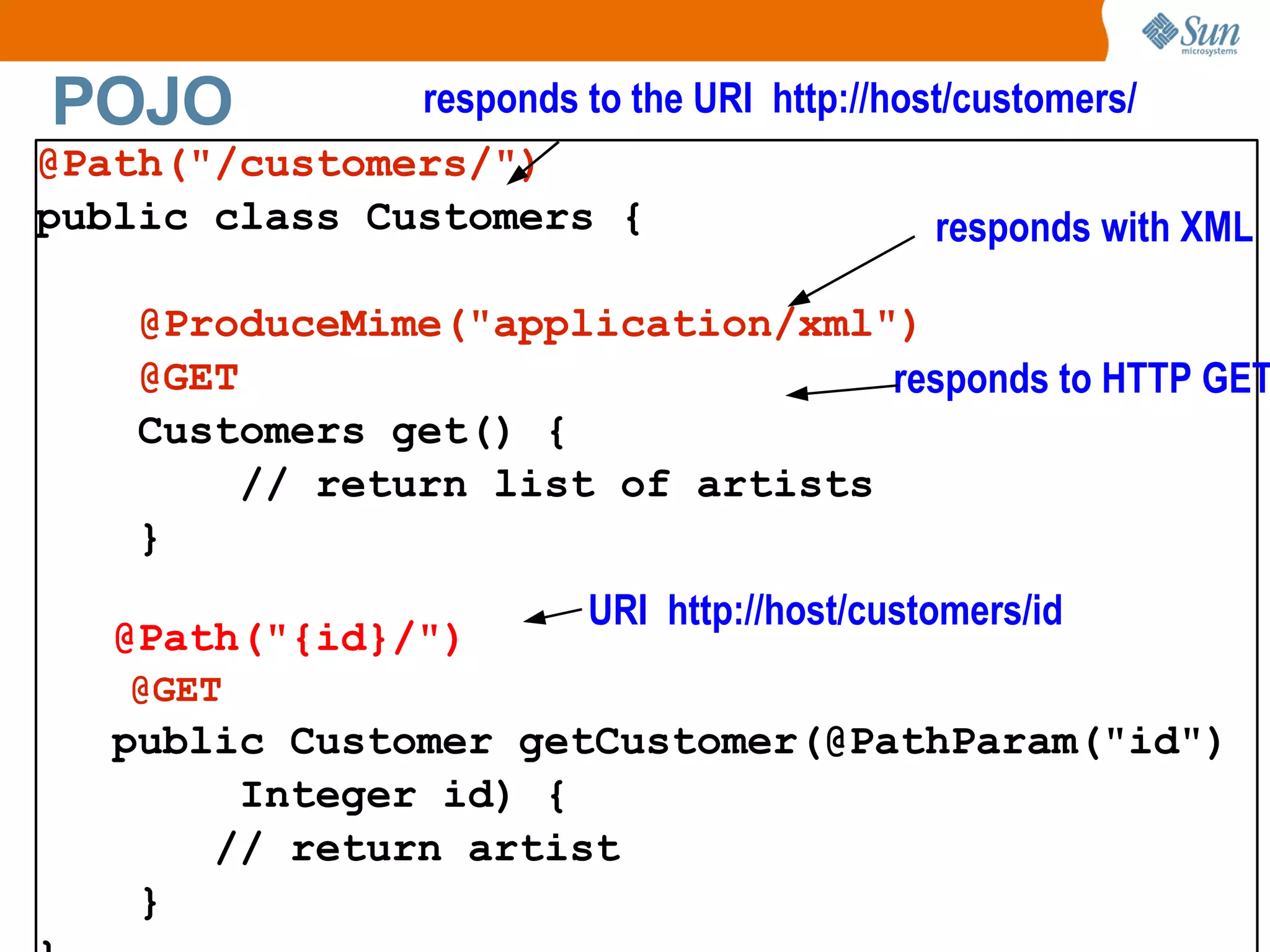
POJO @Path(&quot;/customers/&quot;) public class Customers { @ProduceMime(&quot;application/xml&quot;) @GET Customers get() { // return list of artists } @Path(&quot;{id}/&quot;) @GET public Customer getCustomer(@PathParam(&quot;id&quot;) Integer id) { // return artist } } responds to the URI  http://host/customers/ responds with XML responds to HTTP GET  URI  http://host/customers/id
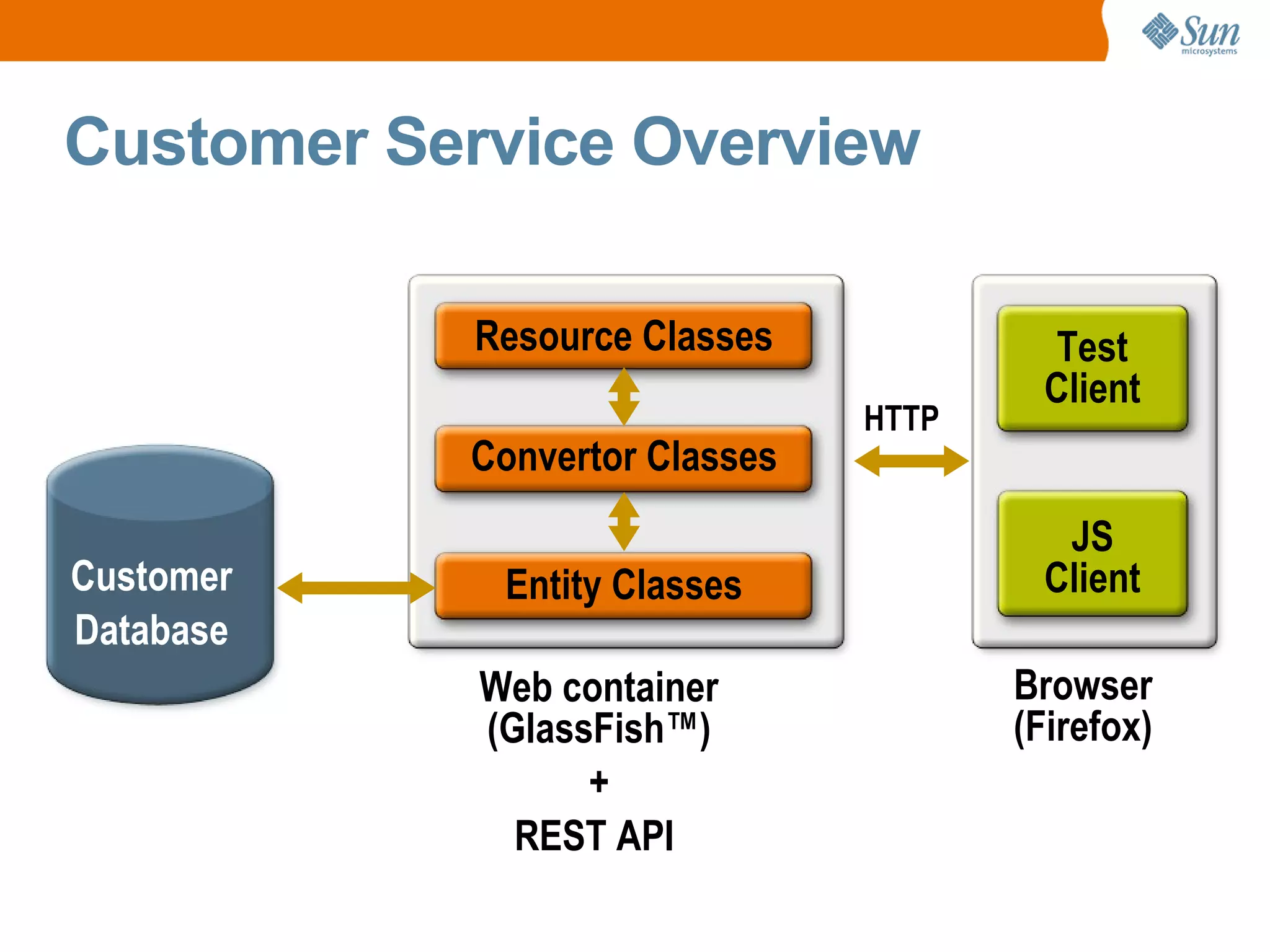
Customer Service Overview Customer Database Web container (GlassFish™) + REST API  Browser (Firefox) HTTP
Summary Metro  Integrated with  GlassFish  Application Server JAX-WS  easier  to use and more powerful than JAX-RPC part of the  Java EE 5  and  Java SE 6  platforms Layered design hides the complexity Extensible  at the protocol and transport level WSIT Makes Metro  interoperable  with other WS-* stacks No new APIs , easy with NetBeans plugin JAX-RS   High-level declarative programming model for  REST
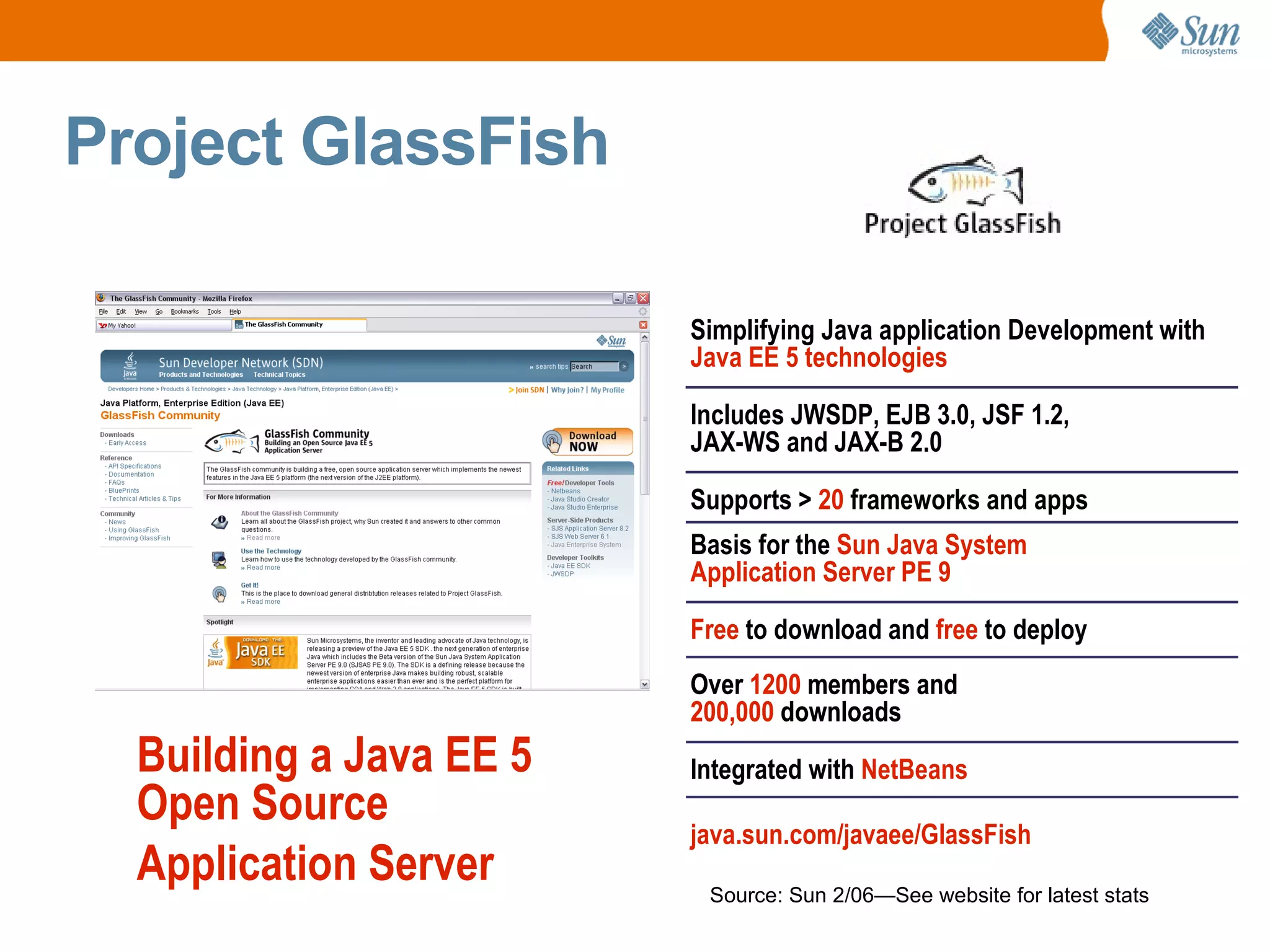
Building a Java EE 5  Open Source Application Server  Source: Sun 2/06—See website for latest stats Project GlassFish Simplifying Java application Development with  Java EE 5 technologies Includes JWSDP, EJB 3.0, JSF 1.2,  JAX-WS and JAX-B 2.0 Supports >  20  frameworks and apps Basis for the  Sun Java System  Application Server PE 9 Free  to download and  free  to deploy Over  1200  members and  200,000  downloads Over  1200  members and  200,000  downloads Integrated with  NetBeans java.sun.com/javaee/GlassFish
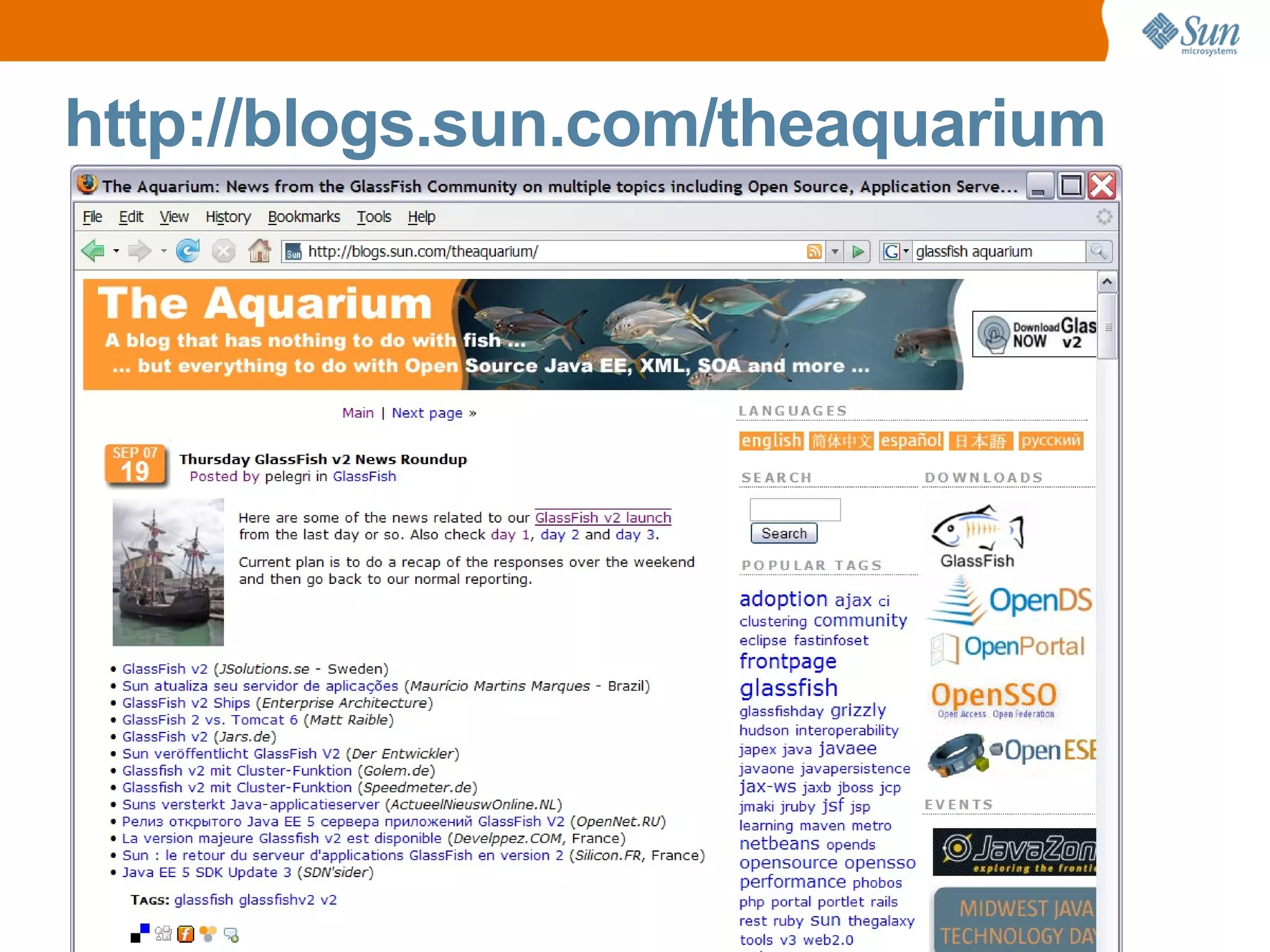
http://blogs.sun.com/theaquarium
For More Information METRO http://metro.dev.java.net JAX-WS http://jax-ws.dev.java.net WSIT http://wsit.dev.java.net REST http://jersey.dev.java.net Glassfish http://glassfish.dev.java.net
Carol McDonald [email_address] Metro: JAX-WS, WSIT  and REST

Interoperable Web Services with JAX-WS

  • 1.
    Metro: JAX-WS, WSIT and REST Carol McDonald Java Architect Sun Microsystems
  • 2.
    About the SpeakerCarol cDonald: Java Architect at Sun Microsystems Before Sun, worked on software development of: Application to manage car Loans for Toyota (>10 million loans) Pharmaceutical Intranet apps ( Roche Switzerland) Telecom Network Mgmt ( Digital France) X.400 Email Server ( IBM Germany)
  • 3.
    Agenda Metro JAX-WS WSIT REST: JAX-RS
  • 4.
    Project Metro Project Metro = Java.net project for GlassFish Web Services stack http://metro.dev.java.net Can also be used outside of Glassfish key components of Metro: JAX-WS and WSIT
  • 5.
  • 6.
  • 7.
    JAX-WS Inaddition to Glassfish, JAX_WS can be used as WS stack with JBoss, WebLogic Server 10, Apache Tomcat , Jetty , and Java SE , TmaxSoft JEUS 6, Spring
  • 8.
    Sun’s Web ServicesStack Metro: JAX-WS , WSIT JAXB = Java Architecture for XML Binding | JAX-WS = Java APIs for XML Web Services NetBeans JAX-WS Tooling Transactions Reliable- Messaging Security Metadata WSDL Policy Core Web Services HTTP TCP SMTP JAXB, JAXP, StaX JAX-WS WSIT tools transport xml
  • 9.
    Agenda Metro JAX-WS WSIT REST
  • 10.
    JAX-WS easyto use J ava A PI for X ML W eb S ervices Replaces JAX-RPC Just Add @ annotation to Plain Old Java Object (POJO) XML Descriptor-free programming Layered Architecture SOAP 1.2 (document/literal) Uses JAXB for data binding Part of Java SE 6 and Java EE 5 platforms
  • 11.
    JAX-WS Standards JSR 224 Expert Group: ATG BEA Capgemini Developmentor IBM Intalio IONA Motorola Nokia Novell NTT Oracle Pramati Red Hat SAP SeeBeyond Sonic Software Sun Tmax Trifork WebMethods
  • 12.
    Developing a WebService Starting with a Java class war or ear @WebService POJO Implementation class Servlet-based or Stateless Session EJB Optional handler classes Packaged application (war/ear file) You develop Service contract WSDL Deployment creates JAXB and JAX-WS files needed for the service
  • 13.
    Example: Servlet-Based Endpoint@WebService public class CalculatorWS { public int add (int a, int b) { return a+b; } } All public methods become web service operations WSDL/Schema generated at deploy time automatically Default values for WSDL service name, etc.
  • 14.
    Service Description defaultmapping Java mapping -> WSDL: public class CalculatorWS { public int add ( int i , int j ){ } } < portType name=&quot; CalculatorWS &quot;> < operation name=&quot; add &quot;> < input message=&quot; tns:add &quot; /> < output message=&quot; tns:addResponse &quot; /> < /operation > < /portType > PORT TYPE = ABSTRACT INTERFACE OPERATION = METHOD MESSAGE = PARAMETERS AND RETURN VALUES
  • 15.
    Customizability via Annotations@WebService( name= &quot;Calculator&quot;, portName= &quot;CalculatorPort&quot;, serviceName= &quot;CalculatorService&quot;, targetNamespace= &quot;http://calculator.org&quot; ) public class CalculatorWS { @WebMethod (operationName=”addCalc”) public int add ( @WebParam (name=”param1”) int a, int b) { return a+b; } }
  • 16.
    Example: EJB 3.0-BasedEndpoint It's a regular EJB 3.0 component so it can use EJB features Transactions, security, interceptors ... @WebService @Stateless public class Calculator { public int add(int a, int b) { return a+b; } }
  • 17.
    Developing a WebService Starting with a WSDL wsimport tool @WebService SEI Interface @WebService( endpointInterface =&quot;generated Service&quot;) Implementation class Servlet-based or Stateless Session EJB endpoint model Packaged application (war/ear file) Service contract WSDL Generates You develop
  • 18.
    Generating an Interfacefrom WSDL WSDL->Java generation: @WebService public interface BankService { @WebMethod public float getBalance (String acctID,String acctName) throws AccountException; } < portType name=&quot; BankService &quot;> < operation name=&quot; getBalance &quot;> <input message=&quot;tns:getBalanceInput&quot; /> <output message=&quot;tns:getBalanceOutput&quot; /> <fault name=&quot;AccountException&quot; message=&quot;tns:AccountException&quot;/> </operation> </portType> PORT TYPE = INTERFACE OPERATION = METHOD MESSAGE = PARAMETERS
  • 19.
    Implementing a WebService for a Generated Interface @WebService( endpointInterface =&quot; generated.BankService &quot;, serviceName =&quot; BankService &quot;) public class BankServiceImpl implements BankService { ... public float getBalance (String acctID, String acctName) throws AccountException { // code to get the account balance return theAccount.getBalance(); } }
  • 20.
    Server Side CalculatorWSWeb Service E ndpoint Listener Soap binding @Web Service Soap request publish 1 2 3 4 5 6 7 8
  • 21.
    Runtime: Javatypes WSDL, XML Schema JAX-WS uses JAXB for data binding Runtime: JAXB un/marshalls the payload WSDL XML Schema XML Document unmarshal marshal Generate for development Java Objects follows
  • 22.
    Add Parameter Next slide Look at schema and JAXB class for add parameter public class CalculatorWS { public int add ( int i , int j ){ } } < portType name=&quot; CalculatorWS &quot;> < operation name=&quot; add &quot;> < input message=&quot; tns:add &quot; /> < output message=&quot; tns:addResponse &quot; /> < /operation > < /portType > PORT TYPE = ABSTRACT INTERFACE OPERATION = METHOD MESSAGE = PARAMETERS AND RETURN VALUES
  • 23.
    JAXB XML schemato Java mapping package calculator.jaxws; import javax.jws.WebService; @XmlRootElement (name = &quot;add&quot; ) public class add { @XmlElement (name = &quot; i &quot;) private int i ; @XmlElement (name = &quot; j &quot;) private int j ; public int getI () { return this.i; } public void setI (int i){ this.i = i; } } <?xml version=&quot;1.0&quot; encoding=&quot;UTF-8&quot; standalone=&quot;yes&quot;? > <xs: schema version=&quot;1.0&quot; > <xs: element name=&quot; add &quot; type=&quot;tns:add&quot;/> <xs: element name=&quot; addResponse &quot; type=&quot;tns:addResponse&quot;/> <xs: complexType name=&quot; add &quot;> <xs: sequence > <xs: element name=&quot; i &quot; type=&quot;xs: int &quot;/> <xs: element name=&quot; j &quot; type=&quot;xs: int &quot;/> </xs:sequence> </xs:complexType> </xs:schema>
  • 24.
  • 25.
    Client-Side Programming wsimport tool @WebService Dynamic Proxy Service contract WSDL Generates You develop Client which calls proxy
  • 26.
    Example: Java SE-BasedClient code is fully portable CalculatorService is defined by the specification Internally it uses a delegation model CalculatorService svc = new CalculatorService() ; Calculator proxy = svc. getCalculatorPort(); int answer = proxy.add (35, 7); Factory Class Get Proxy Class Business Interface
  • 27.
    WSDL Java mappingpackage calculator; import javax.jws.WebService; @WebService public class CalculatorWS { public int add ( int i, int j) { return i + j; } } < portType name=&quot; CalculatorWS &quot;> < operation name=&quot; add &quot;> <input message=&quot;tns:add&quot;/> <output message=&quot;tns:addResponse&quot;/> </operation> </portType> < binding name=&quot;CalculatorWSPortBinding&quot; type=&quot;tns: CalculatorWS &quot;> <soap:binding transport=&quot;soap/http&quot; style=&quot;document&quot;/> < operation name=&quot; add &quot;> .... </operation> </binding> < service name=&quot; CalculatorWSService &quot;> < port name=&quot; CalculatorWSPort &quot; binding=&quot;tns:CalculatorWSPortBinding&quot;> < soap:address location = &quot;http://CalculatorWSService&quot; /> </port> </service> Factory Class Proxy Class Business Interface
  • 28.
    WSDL to DynamicProxy mapping Service Port PortType Binding 1..n 1 1 1..n 1..n CalculatorWSPort CalculatorWS Class CalculatorWSService Add Method Parameters Business Interface Factory Class Proxy Class Operation Message
  • 29.
    Example: Java EEServlet Client No Java Naming and Directory Interface™ API ! public class ClientServlet extends HttpServlet { @WebServiceRef (wsdlLocation = &quot;http://.../CalculatorWSService?wsdl&quot;) private CalculatorWSService service; protected void processRequest( HttpServletRequest req, HttpServletResponse resp) { CalculatorWS proxy = service.getCalculatorWSPort(); int i = 3; j = 4; int result = proxy.add (i, j); . . . } } Get Proxy Class Business Interface Factory Class
  • 30.
  • 31.
    Client Side CalculatorWSWeb Service extends Dynamic Proxy S ervice E ndpoint I nterface Invocation Handler JAXB JAXB return value parameters getPort 1 2 3 6 Soap request Soap response 4 5
  • 32.
    SOAP Request <?xmlversion=&quot;1.0&quot; encoding=&quot;UTF-8&quot;?> <S:Envelope xmlns:S=&quot;http://schemas.xmlsoap.org/soap/envelope/&quot;> <S:Header/> <S:Body> <ns2: add xmlns:ns2=&quot;http://calculator.me.org/&quot;> <i>4</i> <j>3</j> </ns2:add> </S:Body> </S:Envelope> http://localhost:8080/CalculatorWSApplication/CalculatorWSService
  • 33.
    SOAP Response <?xmlversion=&quot;1.0&quot; encoding=&quot;UTF-8&quot;?> <S:Envelope xmlns:S=&quot;http://schemas.xmlsoap.org/soap/envelope/&quot;> <S:Body> <ns2: addResponse xmlns:ns2=&quot;http://calculator.me.org/&quot;> <return>7</return> </ns2:addResponse> </S:Body> </S:Envelope>
  • 34.
    JAX-WS Layered ArchitectureCalls Into Implemented on Top of Messaging Layer: Dispatch/Provider Application Code Strongly-Typed Layer: @ Annotated Classes Upper layer Easy to use with annotations Lower layer, API-based, more control For advanced scenarios
  • 35.
    Lower Level Lowerlayer, API-based, more control: Client XML API: Dispatch Interface one-way and asynch calls available Server XML API: Provider Interface: Can use JAXB, JAXP, SAAJ to get message contents Message or Payload access May be used to create RESTful clients/services
  • 36.
    Client-side Messaging API: Dispatch Interface one-way and asynch calls available: // T is the type of the message public interface Dispatch < T > { // synchronous request-response T invoke(T msg); // async request-response ( polled for completion) Response<T> invokeAsync(T msg); Future<?> invokeAsync(T msg, AsyncHandler<T> h); // one-way void invokeOneWay(T msg); }
  • 37.
    Client-side Example: DispatchUsing PAYLOAD import javax.xml. transform.Source ; import javax.xml. ws.Dispatch ; private void invokeAddNumbers(int a,int b) { Dispatch <Source> sourceDispatch = service.createDispatch (portQName, Source.class, Service.Mode.PAYLOAD ); StreamSource request =new StringReader(xmlString); Source result = sourceDispatch.invoke (request)); String xmlResult = sourceToXMLString(result); }
  • 38.
    Server-side Messaging API:Provider // T is the type of the message public interface Provider< T > { T invoke(T msg, Map<String,Object> context); } Message or Payload access Use @ServiceMode to select a mode for the message type
  • 39.
    Server-sideExample: PayloadMode, No JAXB @ServiceMode(Service.Mode. PAYLOAD ) public class MyProvider implements Provider < Source > { public Source invoke( Source request, Map<String,Object> context) { // process the request using XML APIs, e.g. DOM Source response = ... // return the response message payload return response; } }
  • 40.
    JAX-WS Commons https://jax-ws-commons.dev.java.net/Convenient Extensions, utility code , useful Plugins : Spring support Stateful Web Service Multiple Service Instances HTTP Session-scope service Thread scope service (thread local) JSON Encoding Server-Side Asynchrony
  • 41.
  • 42.
    Agenda Metro JAX-WS Standards WSIT REST
  • 43.
    WSIT: Web ServicesInteroperability Technology Complete WS-* stack Enables interoperability with Microsoft .NET 3.0 WCF
  • 44.
    Sun’s Web ServicesStack Metro: JAX-WS , WSIT JAXB = Java Architecture for XML Binding | JAX-WS = Java APIs for XML Web Services NetBeans JAX-WS Tooling Transactions Reliable- Messaging Security Metadata WSDL Policy Core Web Services HTTP TCP SMTP JAXB, JAXP, StaX JAX-WS WSIT tools transport xml
  • 45.
    WSIT (Web ServicesInteroperability Technology) Project Tango Features Enables interoperability with Microsoft .NET 3.0 Bootstrapping communication End-to-end reliability Atomic transactions End-to-end security Trust Optimized security
  • 46.
  • 47.
    WS-ReliableMessaging JAX-WS/WCF ServerRuntime JAX-WS/WCF Client Runtime Application Message Ack Protocol Message buffer buffer RMSource handles sending and re-sending RMDestination handles reconstructing the stream of messages
  • 48.
    Brings reliability toSOAP (protocol) layer Transparent to application Delivery assurance At least once At most once In order End-to-End Reliability WS-ReliableMessaging
  • 49.
  • 50.
    Reliable Transport AlternativesSOAP messages are transport agnostic Change the transport, change the binding Metro Transports (Htttp standard): JMS SMTP SOAP over TCP For more information https://jax-ws.dev.java.net/transport.html
  • 51.
    Metro WSITTransactions
  • 52.
    Java™ Transaction ServiceApplication Server Transaction Service Application UserTransaction interface Resource Manager XAResource interface Transactional operation TransactionManager Interface Resource EJB Transaction context
  • 53.
    WS-AtomicTransaction definesset of transaction coordination protocols Supports two phase commit for web service operations: all operations invoked within an atomic transaction succeed or are all rolled back . WS-Coordination protocols coordinate the actions of distributed web services For Commit: Coordinator asks if each system is ready to complete If all concur, coordinator tells systems to complete Otherwise, coordinator tells systems to rollback WSIT Transaction coordination
  • 54.
    WSIT and WCF Co-ordinated transaction 4a: WS-AT Protocol 3: TxnCommit 2c: WS-Coor Protocol 2b: Register 4b: XA Protocol 4b: XA Protocol 2a: Invoke 1: TxnBegin
  • 55.
    an Atomic TransactionContext is created the first time a transacted Web service operation is invoked within a JTA transaction scope 01 @Resource 02 javax.transaction.UserTransaction ut; 03 04 ut.begin(); 05 bankWebService.makeWithdrawl(); 06 ... 07 ut.commit();. WSIT Support on Transaction Transaction Context created
  • 56.
    Transactions in Action@WebService @Stateless public class Wirerer { @TransactionAttribute(REQUIRED) void wireFunds(...) throws ... { websrvc1.withdrawFromBankX(...); websrvc2.depositIntoBankY(...); } }
  • 57.
    Metro WSITSecurity
  • 58.
    Digital Certificate Identitydata signed by a Certification Authority. Provides a Trusted source of identification. Version # Serial # Signature Algorithm Issuer Name Validity Period Subject Name Subject Public Key Issuer Unique ID Subject Unique ID Extensions Digital Signature X.509 Certificate Digital ID Electronic Proof of Identity Issued and signed by Certifying Authority Public, Private keys Makes security protocols work SSL CA Authorized
  • 59.
    Encryption Receiver PublicKey Receiver Private Key XML Encryption (data confidentiality) Only the private key can decrypt Asymmetric keys Public Encryption Original Document Encrypted Document Private Decryption Original Document Sender Receiver
  • 60.
    Digital Signature TransformTransform Sender Sender's Private Key Sender's Public Key XML Signature (data integrity) Bind the sender’s identity to an XML document Private Encryption XML data Signature Public Decryption XML data Receiver
  • 61.
    SSL Key ExchangeServer Client connects Browser generates symetric session key Use session key to Encrypt data Browser and Server use Session Key B to encrypt all data exchanged over the Internet
  • 62.
    Security Before WS-SecurityOnly SSL: WS-Security Security at SOAP (protocol) layer Fine granularity possible Only sign/encrypt credit card # (e.g., XML subtree) Works on non-TCP/IP transports Integrity, Confidentiality, Auth W3C XML Signature/Encryption SSL/HTTPS Security at transport layer Point-to-point Encrypts session
  • 63.
    WS-Security: SOAP MessageSecurity WS-Security defines: Encrypting and signing message parts: XML Signature and XML Encryption in SOAP Header How to pass security tokens (token=security information identifies the msg sender ) UserName/Password token X.509 certificates SAML Kerberos tickets SOAP Envelope SOAP Envelope Header SOAP Envelope Body WS-Security Header Security Token Business Payload
  • 64.
    request data responsedata authentication data SAML assertions https/ssl (optional) digital certificate Security Architecture Message Level Security (signature and encryption) web services client SOAP client signed & encrypted data web services server SOAP server SOAP service security server authentication authorization signature validation data encryption digital certificate request data data decryption/ encryption signature validation
  • 65.
    Security Before WS-SecurityWS-Security Security at SOAP message layer XML Signature/Encryption Only sign/encrypt part of msg Works on different transports Work with intermediaries SSL/HTTPS Security at transport layer All or nothing granularity Point-to-point
  • 66.
    WS-Trust framework for: Issue, Validate, Exchange security tokens used by WS-Security Establish and broker trust relationships Trust
  • 67.
    WS-Trust Issue Trust Trust Relation Identity Store WS Client WS Service Security Token Service 1) WS-Trust Issue() 2) token returned <S11:Envelope xmlns:S11=&quot;...&quot; xmlns:wsse=&quot;...&quot;> <S11:Header> <wsse:Security> .Security Token = AuthN+AuthZ+signatures </wsse:Security> </S11:Header> <S11:Body wsu:Id=&quot;MsgBody&quot;> .. App data </S11:Body> </S11:Envelope>
  • 68.
    WS-Trust Exchange Trust
  • 69.
    WS-Trust Validate Establish and broker trust relationships Trust .NET service Java client
  • 70.
    .NET Trust AuthorityTrust Authority Sun Managed Microsoft Managed Project GlassFish ™ Retail Quote Service Project GlassFish Wholesale Quote Service .Net Wholesale Service Java EE Platform With Project Tango WCF Client Java Client WS-Trust WS-T Trust QOS Security Interop.
  • 71.
    How to Establisha Secure SESSION For multiple message exchanges Create shared symmetric session key Optimizes processing WS-SecureConversation Optimized Security security context token Use generated symmetric session key
  • 72.
    WS-Policy <wsdl…> <policy…>… </policy> … </wsdl> <wsdl…> <policy…> <security-policy> … </security-policy> <transaction-policy> … </transaction-policy> <reliability-policy> … </reliability-policy> … </policy> … </wsdl>
  • 73.
  • 74.
    WS-Metadata Exchange BootstrappingCommunication < mex > … < /mex > < wsdl …> < policy …> … </policy> … </wsdl> WS-MetadataExchange supports: discovery of WSDL documents WS-Policy settings WS-MetadataExchange WS-Transfer/MEX WSDL
  • 75.
    Bootstrapping Communication JAX-WS wsimport WCF or WSIT-based Service Creates Client Proxy WS-Transfer/MEX WSDL WS-MetadataExchange WS-MetadataExchange protocol supports: discovery of WSDL documents metadata exchange is handled by wsimport utility of WSIT and is transparent to developers
  • 76.
    Proxy Generation BootstrappingCommunication <wsdl…> <policy…> < security-policy > … </security-policy> < transaction-policy > … </transaction-policy> < reliability-policy > … </reliability-policy> … </policy> … </wsdl>
  • 77.
  • 78.
    No runtime APIs for WSIT Use JAX-WS and EJB APIs Developer/deployer supplies config file to enable/control Project Tango components Config file written by hand or produced by Project Tango NetBeans software module WSIT (Project Tango) Programming Model
  • 79.
    WSIT NetBeans ModuleBy Hand Other IDEs 109 Deployment META-INF/wsit-*.xml Service Servlet Deployment WEB-INF/wsit-*.xml WSIT Server-Side Programming Model WSIT Config File wsit-*.xml No runtime APIs for WSIT Use JAX-WS and EJB APIs Config file written by hand or produced by NetBeans enable/control WSIT
  • 80.
    WSIT Client ProgrammingModel 109 Service Wsimport Client Artifacts WSIT Config File wsit-*.xml WSIT NetBean Module By Hand Other IDEs MEX/ GET WDSL MEX/ GET
  • 81.
  • 82.
    Agenda Metro JAX-WS Standards WSIT REST with JAX-RS
  • 83.
    API: JAX-RS Standardizedin the JSR 311 Will be included in Java EE 6 EG members Alcatel-Lucent, BEA, Day Software, Fujitsu, innoQ, Nortel, Red Hat Experts in Atom, AtomPub, WebDAV, HTTP, REST, Restlet Group started in April 2007
  • 84.
    REpresentational State TransferGet URI Response XML data = RE presentational S tate T ransfer
  • 85.
    REST Tenets REpresentational S tate T ransfer Resources (nouns) Identified by a URI , For example: http://www.parts-depot.com/parts Methods (verbs) Small fixed set: Create, Read, Update, Delete State Representations data and state transferred between client and server XML, JSON...
  • 86.
    HTTP Example RequestGET /customers HTTP/1.1 Host: media.example.com Accept : application/ xml Response HTTP/1.1 200 OK Date: Tue, 08 May 2007 16:41:58 GMT Server: Apache/1.3.6 Content-Type : application/xml; charset=UTF-8 <?xml version=&quot;1.0&quot;?> <customers xmlns=&quot;…&quot;> <customer>…</customer> … </customers> Resource Method Representation
  • 87.
    Verb Noun CreatePOST Collection URI Read GET Collection URI Read GET Entry URI Update PUT Entry URI Delete DELETE Entry URI CRUD to HTTP method mapping 4 main HTTP methods CRUD methods
  • 88.
    Example Customers /customers//customers/{id}/ URI Templates are URIs with variables within the URI syntax.
  • 89.
    Customer Resource UsingServlet API public class Artist extends HttpServlet { public enum SupportedOutputFormat {XML, JSON}; protected void doGet(HttpServletRequest request, HttpServletResponse response) throws ServletException, IOException { String accept = request.getHeader(&quot;accept&quot;).toLowerCase(); String acceptableTypes[] = accept.split(&quot;,&quot;); SupportedOutputFormat outputType = null; for (String acceptableType: acceptableTypes) { if (acceptableType.contains(&quot;*/*&quot;) || acceptableType.contains(&quot;application/*&quot;) || acceptableType.contains(&quot;application/xml&quot;)) { outputType=SupportedOutputFormat.XML; break; } else if (acceptableType.contains(&quot;application/json&quot;)) { outputType=SupportedOutputFormat.JSON; break; } } if (outputType==null) response.sendError(415); String path = request.getPathInfo(); String pathSegments[] = path.split(&quot;/&quot;); String artist = pathSegments[1]; if (pathSegments.length < 2 && pathSegments.length > 3) response.sendError(404); else if (pathSegments.length == 3 && pathSegments[2].equals(&quot;recordings&quot;)) { if (outputType == SupportedOutputFormat.XML) writeRecordingsForArtistAsXml(response, artist); else writeRecordingsForArtistAsJson(response, artist); } else { if (outputType == SupportedOutputFormat.XML) writeArtistAsXml(response, artist); else writeArtistAsJson(response, artist); } } private void writeRecordingsForArtistAsXml(HttpServletResponse response, String artist) { ... } private void writeRecordingsForArtistAsJson(HttpServletResponse response, String artist) { ... } private void writeArtistAsXml(HttpServletResponse response, String artist) { ... } private void writeArtistAsJson(HttpServletResponse response, String artist) { ... } } Don't try to read this, this is just to show the complexity :)
  • 90.
    Server-side API WishList JAX-RS = Easier REST Way High level, Declarative Uses @ annotation in POJOs
  • 91.
    Clear mapping toREST concepts Resources : what are the URIs ? @Path(&quot;/customers/&quot;) @Path(&quot;{id}/&quot;) Methods : what are the HTTP methods ? @GET public XXX find() Representations : what are the formats ? @ConsumeMime(&quot;application/xml&quot;) @ProduceMime(&quot;application/json&quot;) (New types can be defined)
  • 92.
    POJO @Path(&quot;/customers/&quot;) publicclass Customers { @ProduceMime(&quot;application/xml&quot;) @GET Customers get() { // return list of artists } @Path(&quot;{id}/&quot;) @GET public Customer getCustomer(@PathParam(&quot;id&quot;) Integer id) { // return artist } } responds to the URI http://host/customers/ responds with XML responds to HTTP GET URI http://host/customers/id
  • 93.
    Customer Service OverviewCustomer Database Web container (GlassFish™) + REST API Browser (Firefox) HTTP
  • 94.
    Summary Metro Integrated with GlassFish Application Server JAX-WS easier to use and more powerful than JAX-RPC part of the Java EE 5 and Java SE 6 platforms Layered design hides the complexity Extensible at the protocol and transport level WSIT Makes Metro interoperable with other WS-* stacks No new APIs , easy with NetBeans plugin JAX-RS High-level declarative programming model for REST
  • 95.
    Building a JavaEE 5 Open Source Application Server Source: Sun 2/06—See website for latest stats Project GlassFish Simplifying Java application Development with Java EE 5 technologies Includes JWSDP, EJB 3.0, JSF 1.2, JAX-WS and JAX-B 2.0 Supports > 20 frameworks and apps Basis for the Sun Java System Application Server PE 9 Free to download and free to deploy Over 1200 members and 200,000 downloads Over 1200 members and 200,000 downloads Integrated with NetBeans java.sun.com/javaee/GlassFish
  • 96.
  • 97.
    For More InformationMETRO http://metro.dev.java.net JAX-WS http://jax-ws.dev.java.net WSIT http://wsit.dev.java.net REST http://jersey.dev.java.net Glassfish http://glassfish.dev.java.net
  • 98.
    Carol McDonald [email_address]Metro: JAX-WS, WSIT and REST