Java/J2ee Programming Training
Inner Classes
Page 1Classification: Restricted
Agenda
• Inner Classes
Page 2Classification: Restricted
Objective
• Write code to construct instances of any concrete class including normal
top level classes, inner classes, static inner classes, and anonymous inner
classes.
Page 3Classification: Restricted
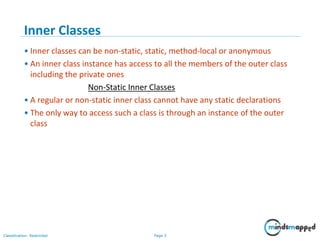
Inner Classes
• Inner classes can be non-static, static, method-local or anonymous
• An inner class instance has access to all the members of the outer class
including the private ones
Non-Static Inner Classes
• A regular or non-static inner class cannot have any static declarations
• The only way to access such a class is through an instance of the outer
class
Page 4Classification: Restricted
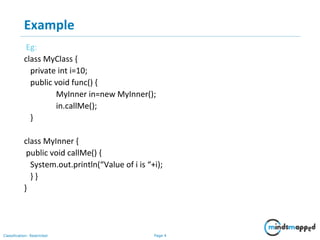
Example
Eg:
class MyClass {
private int i=10;
public void func() {
MyInner in=new MyInner();
in.callMe();
}
class MyInner {
public void callMe() {
System.out.println(“Value of i is “+i);
} }
}
Page 5Classification: Restricted
Instantiating an Inner Class
• To instantiate an inner class, you need an instance of the outer class
• From inside the outer class instance code, use the inner class name alone
to instantiate
Eg: MyInner myInner=new MyInner();
• From outside the outer class instance code, the inner class name must
include the outer class name
Eg: MyClass myClass=new MyClass();
MyClass.MyInner inner=myClass.new MyInner();
Page 6Classification: Restricted
Method local Inner Classes
• A method local inner class can be instantiated only within the method
where it is defined
• It cannot access the local variables of the enclosing method unless they
are final
Eg: class MyOuter {
private int i=2;
void callMe() {
class MyInner {
void callInner() {
System.out.println(“i is “+i);
}
}
} }
Page 7Classification: Restricted
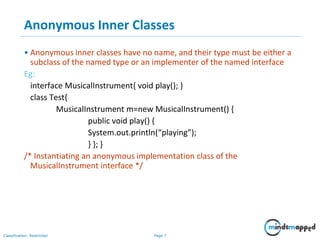
Anonymous Inner Classes
• Anonymous inner classes have no name, and their type must be either a
subclass of the named type or an implementer of the named interface
Eg:
interface MusicalInstrument{ void play(); }
class Test{
MusicalInstrument m=new MusicalInstrument() {
public void play() {
System.out.println(“playing”);
} }; }
/* Instantiating an anonymous implementation class of the
MusicalInstrument interface */
Page 8Classification: Restricted
Static Nested Classes
• A static nested class is a static member of the enclosing class
• A static nested class does not have access to the instance variables and
methods of the class.
Eg:
class Outer{
static class MyNested{}
}
class Test{
public static void main(String args[]){
Outer.MyNested n=new Outer.MyNested();
}
}
Page 9Classification: Restricted
Extra Points to Remember…
• To refer to the inner class instance, use the keyword this from code
within the inner class. To reference the outer this, precede the keyword
this with the outer class name.
Eg: MyOuter.this
• The only modifiers that can be applied to a method local inner class are
abstract and final
• An anonymous subclass can extend a class or implement one interface,
not both.
• You don’t need an instance of the outer class to instantiate a static
nested class.
Page 10Classification: Restricted
Thank You

Java Inner Class

  • 1.
  • 2.
  • 3.
    Page 2Classification: Restricted Objective •Write code to construct instances of any concrete class including normal top level classes, inner classes, static inner classes, and anonymous inner classes.
  • 4.
    Page 3Classification: Restricted InnerClasses • Inner classes can be non-static, static, method-local or anonymous • An inner class instance has access to all the members of the outer class including the private ones Non-Static Inner Classes • A regular or non-static inner class cannot have any static declarations • The only way to access such a class is through an instance of the outer class
  • 5.
    Page 4Classification: Restricted Example Eg: classMyClass { private int i=10; public void func() { MyInner in=new MyInner(); in.callMe(); } class MyInner { public void callMe() { System.out.println(“Value of i is “+i); } } }
  • 6.
    Page 5Classification: Restricted Instantiatingan Inner Class • To instantiate an inner class, you need an instance of the outer class • From inside the outer class instance code, use the inner class name alone to instantiate Eg: MyInner myInner=new MyInner(); • From outside the outer class instance code, the inner class name must include the outer class name Eg: MyClass myClass=new MyClass(); MyClass.MyInner inner=myClass.new MyInner();
  • 7.
    Page 6Classification: Restricted Methodlocal Inner Classes • A method local inner class can be instantiated only within the method where it is defined • It cannot access the local variables of the enclosing method unless they are final Eg: class MyOuter { private int i=2; void callMe() { class MyInner { void callInner() { System.out.println(“i is “+i); } } } }
  • 8.
    Page 7Classification: Restricted AnonymousInner Classes • Anonymous inner classes have no name, and their type must be either a subclass of the named type or an implementer of the named interface Eg: interface MusicalInstrument{ void play(); } class Test{ MusicalInstrument m=new MusicalInstrument() { public void play() { System.out.println(“playing”); } }; } /* Instantiating an anonymous implementation class of the MusicalInstrument interface */
  • 9.
    Page 8Classification: Restricted StaticNested Classes • A static nested class is a static member of the enclosing class • A static nested class does not have access to the instance variables and methods of the class. Eg: class Outer{ static class MyNested{} } class Test{ public static void main(String args[]){ Outer.MyNested n=new Outer.MyNested(); } }
  • 10.
    Page 9Classification: Restricted ExtraPoints to Remember… • To refer to the inner class instance, use the keyword this from code within the inner class. To reference the outer this, precede the keyword this with the outer class name. Eg: MyOuter.this • The only modifiers that can be applied to a method local inner class are abstract and final • An anonymous subclass can extend a class or implement one interface, not both. • You don’t need an instance of the outer class to instantiate a static nested class.
  • 11.