Java/J2EE Programming Training
Java Generics
Page 1Classification: Restricted
Agenda
• background and goals of generic programming
• basics of generic classes = parameterized types
• generic methods for general algorithms
• inheritance rules for generic types
• bounded type parameters
• generic code and the Java Virtual Machine
• restrictions and limitations
• wildcard types and wildcard type capture
Page 2Classification: Restricted
2
Why generic programming
Background
• old version 1.4 Java collections were Object-based and required the use of
ugly casts
• cannot specify the exact type of elements
• must cast to specific classes when accessing
Java generics
• lets you write code that is safer and easier to read
• is especially useful for general data structures, such as ArrayList
• generic programming = programming with classes and methods
parameterized with types
Page 3Classification: Restricted
3
Why generic programming (cont.)
• generic types are a powerful tool to write reusable object-oriented
components and libraries
• however, the generic language features are not easy to master and can be
misused
• their full understanding requires the knowledge of the type theory of
programming languages
• especially covariant and contravariant typing
• the following introduces the main aspects of Java generics and their use and
limitations
• we mostly inspect illustrative samples of what is and what is not allowed, with
some short glimpses inside the JVM implementation
Page 4Classification: Restricted
4
Why generic programming (cont.)
Java generics
• in principle, supports statically-typed data structures
• early detection of type violations
• cannot insert a string into ArrayList <Number>
• also, hides automatically generated casts
• superficially resembles C++ templates
• C++ templates are factories for ordinary classes and functions
• a new class is always instantiated for given distinct generic parameters
(type or other)
• in Java, generic types are factories for compile-time entities related to types
and methods
Page 5Classification: Restricted
5
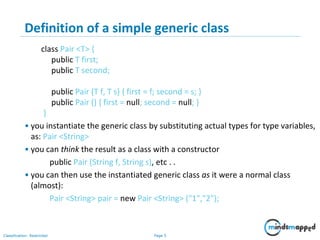
Definition of a simple generic class
class Pair <T> {
public T first;
public T second;
public Pair (T f, T s) { first = f; second = s; }
public Pair () { first = null; second = null; }
}
• you instantiate the generic class by substituting actual types for type variables,
as: Pair <String>
• you can think the result as a class with a constructor
public Pair (String f, String s), etc . .
• you can then use the instantiated generic class as it were a normal class
(almost):
Pair <String> pair = new Pair <String> ("1","2");
Page 6Classification: Restricted
6
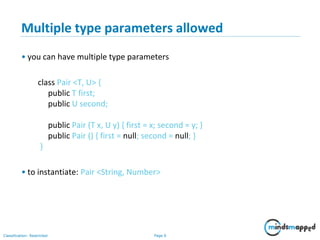
Multiple type parameters allowed
• you can have multiple type parameters
class Pair <T, U> {
public T first;
public U second;
public Pair (T x, U y) { first = x; second = y; }
public Pair () { first = null; second = null; }
}
• to instantiate: Pair <String, Number>
Page 7Classification: Restricted
7
Generic static algorithms
• you can define generic methods both inside ordinary classes and inside
generic classes
class Algorithms { // some utility class
public static <T> T getMiddle (T [ ] a) {
return a [ a.length / 2 ];
}
. . .
}
• when calling a generic method, you can specify type
String s = Algorithms.<String>getMiddle (names);
• but in most cases, the compiler infers the type:
String s = Algorithms. getMiddle (names);
Page 8Classification: Restricted
8
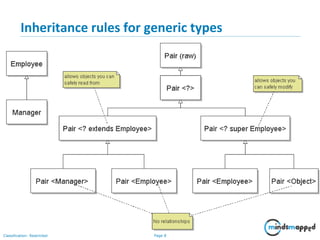
Inheritance rules for generic types
Page 9Classification: Restricted
9
Comments on inheritance relations
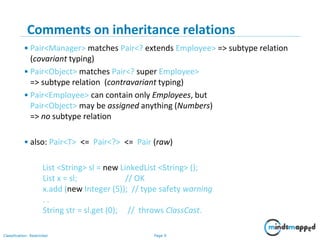
• Pair<Manager> matches Pair<? extends Employee> => subtype relation
(covariant typing)
• Pair<Object> matches Pair<? super Employee>
=> subtype relation (contravariant typing)
• Pair<Employee> can contain only Employees, but
Pair<Object> may be assigned anything (Numbers)
=> no subtype relation
• also: Pair<T> <= Pair<?> <= Pair (raw)
List <String> sl = new LinkedList <String> ();
List x = sl; // OK
x.add (new Integer (5)); // type safety warning
. .
String str = sl.get (0); // throws ClassCast.
Page 10Classification: Restricted
10
Bounds for type variables
• consider the min algorithm: find the smallest item in a given array of elements
• to compile this, must restrict T to implement the Comparable interface that
provides compareTo
public static <T extends Comparable>
T min (T [ ] a) { // this is almost correct
if (a.length == 0) throw new InvalidArg.. (..);
T smallest = a [0];
for (int i = 1; i < a.length; i++)
if (smallest.compareTo (a [i]) > 0) // T constraint
smallest = a [i];
return smallest;
}
Page 11Classification: Restricted
11
Bounds for type variables (cont.)
• however, Comparable is itself a generic interface
• moreover, any supertype of T may have extended it
public static <T extends Object & // bounding class
Comparable <? super T>>
T min (T [ ] a) { . . . // the more general form
T smallest = a [0];
for (int i = 1; i < a.length; i++)
if (smallest.compareTo (a [i]) > 0) // T constraint
smallest = a [i];
return smallest;
}
• cannot inherit multiple different instantiations of the same generic type (class
or interface)
• an inherited generic type is fixed for subtypes, too
Page 12Classification: Restricted
12
Generic code and the JVM
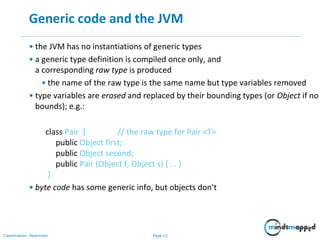
• the JVM has no instantiations of generic types
• a generic type definition is compiled once only, and
a corresponding raw type is produced
• the name of the raw type is the same name but type variables removed
• type variables are erased and replaced by their bounding types (or Object if no
bounds); e.g.:
class Pair { // the raw type for Pair <T>
public Object first;
public Object second;
public Pair (Object f, Object s) { . . }
}
• byte code has some generic info, but objects don't
Page 13Classification: Restricted
13
Generic code and the JVM (cont.)
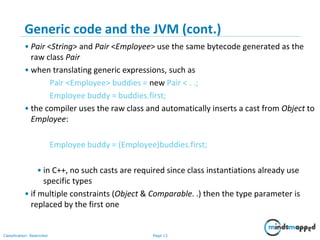
• Pair <String> and Pair <Employee> use the same bytecode generated as the
raw class Pair
• when translating generic expressions, such as
Pair <Employee> buddies = new Pair < . .;
Employee buddy = buddies.first;
• the compiler uses the raw class and automatically inserts a cast from Object to
Employee:
Employee buddy = (Employee)buddies.first;
• in C++, no such casts are required since class instantiations already use
specific types
• if multiple constraints (Object & Comparable. .) then the type parameter is
replaced by the first one
Page 14Classification: Restricted
14
Overriding of methods of generic type
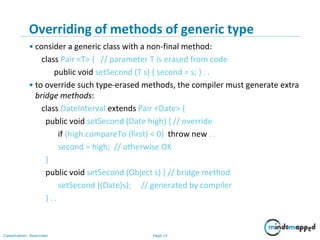
• consider a generic class with a non-final method:
class Pair <T> { // parameter T is erased from code
public void setSecond (T s) { second = s; } . .
• to override such type-erased methods, the compiler must generate extra
bridge methods:
class DateInterval extends Pair <Date> {
public void setSecond (Date high) { // override
if (high.compareTo (first) < 0) throw new . .
second = high; // otherwise OK
}
public void setSecond (Object s) { // bridge method
setSecond ((Date)s); // generated by compiler
} . .
Page 15Classification: Restricted
15
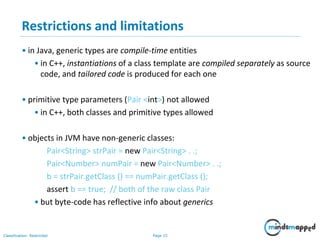
Restrictions and limitations
• in Java, generic types are compile-time entities
• in C++, instantiations of a class template are compiled separately as source
code, and tailored code is produced for each one
• primitive type parameters (Pair <int>) not allowed
• in C++, both classes and primitive types allowed
• objects in JVM have non-generic classes:
Pair<String> strPair = new Pair<String> . .;
Pair<Number> numPair = new Pair<Number> . .;
b = strPair.getClass () == numPair.getClass ();
assert b == true; // both of the raw class Pair
• but byte-code has reflective info about generics
Page 16Classification: Restricted
16
Restrictions and limitations (cont.)
• instantiations of generic parameter T are not allowed
new T () // ERROR: whatever T to produce?
new T [10]
• arrays of parameterized types are not allowed
new Pair <String> [10]; // ERROR
• since type erasure removes type information needed for checks of array
assignments
• static fields and static methods with type parameters are not allowed
class Singleton <T> {
private static T singleOne; // ERROR
• since after type erasure, one class and one shared static field for all
instantiations and their objects
Page 17Classification: Restricted
17
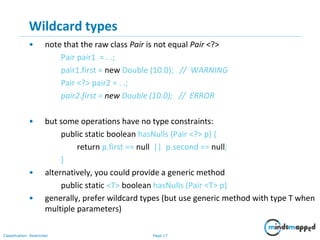
Wildcard types
• note that the raw class Pair is not equal Pair <?>
Pair pair1 = . .;
pair1.first = new Double (10.0); // WARNING
Pair <?> pair2 = . .;
pair2.first = new Double (10.0); // ERROR
• but some operations have no type constraints:
public static boolean hasNulls (Pair <?> p) {
return p.first == null || p.second == null;
}
• alternatively, you could provide a generic method
public static <T> boolean hasNulls (Pair <T> p)
• generally, prefer wildcard types (but use generic method with type T when
multiple parameters)
Page 18Classification: Restricted
18
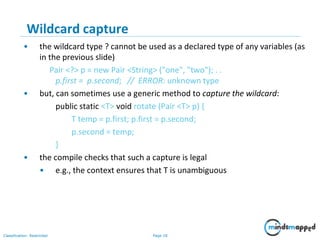
Wildcard capture
• the wildcard type ? cannot be used as a declared type of any variables (as
in the previous slide)
Pair <?> p = new Pair <String> ("one", "two"); . .
p.first = p.second; // ERROR: unknown type
• but, can sometimes use a generic method to capture the wildcard:
public static <T> void rotate (Pair <T> p) {
T temp = p.first; p.first = p.second;
p.second = temp;
}
• the compile checks that such a capture is legal
• e.g., the context ensures that T is unambiguous
Page 19Classification: Restricted
19
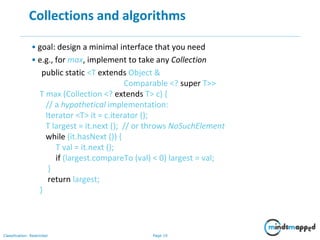
Collections and algorithms
• goal: design a minimal interface that you need
• e.g., for max, implement to take any Collection
public static <T extends Object &
Comparable <? super T>>
T max (Collection <? extends T> c) {
// a hypothetical implementation:
Iterator <T> it = c.iterator ();
T largest = it.next (); // or throws NoSuchElement
while (it.hasNext ()) {
T val = it.next ();
if (largest.compareTo (val) < 0) largest = val;
}
return largest;
}
Page 20Classification: Restricted
Thank You

Java Generics

  • 1.
  • 2.
    Page 1Classification: Restricted Agenda •background and goals of generic programming • basics of generic classes = parameterized types • generic methods for general algorithms • inheritance rules for generic types • bounded type parameters • generic code and the Java Virtual Machine • restrictions and limitations • wildcard types and wildcard type capture
  • 3.
    Page 2Classification: Restricted 2 Whygeneric programming Background • old version 1.4 Java collections were Object-based and required the use of ugly casts • cannot specify the exact type of elements • must cast to specific classes when accessing Java generics • lets you write code that is safer and easier to read • is especially useful for general data structures, such as ArrayList • generic programming = programming with classes and methods parameterized with types
  • 4.
    Page 3Classification: Restricted 3 Whygeneric programming (cont.) • generic types are a powerful tool to write reusable object-oriented components and libraries • however, the generic language features are not easy to master and can be misused • their full understanding requires the knowledge of the type theory of programming languages • especially covariant and contravariant typing • the following introduces the main aspects of Java generics and their use and limitations • we mostly inspect illustrative samples of what is and what is not allowed, with some short glimpses inside the JVM implementation
  • 5.
    Page 4Classification: Restricted 4 Whygeneric programming (cont.) Java generics • in principle, supports statically-typed data structures • early detection of type violations • cannot insert a string into ArrayList <Number> • also, hides automatically generated casts • superficially resembles C++ templates • C++ templates are factories for ordinary classes and functions • a new class is always instantiated for given distinct generic parameters (type or other) • in Java, generic types are factories for compile-time entities related to types and methods
  • 6.
    Page 5Classification: Restricted 5 Definitionof a simple generic class class Pair <T> { public T first; public T second; public Pair (T f, T s) { first = f; second = s; } public Pair () { first = null; second = null; } } • you instantiate the generic class by substituting actual types for type variables, as: Pair <String> • you can think the result as a class with a constructor public Pair (String f, String s), etc . . • you can then use the instantiated generic class as it were a normal class (almost): Pair <String> pair = new Pair <String> ("1","2");
  • 7.
    Page 6Classification: Restricted 6 Multipletype parameters allowed • you can have multiple type parameters class Pair <T, U> { public T first; public U second; public Pair (T x, U y) { first = x; second = y; } public Pair () { first = null; second = null; } } • to instantiate: Pair <String, Number>
  • 8.
    Page 7Classification: Restricted 7 Genericstatic algorithms • you can define generic methods both inside ordinary classes and inside generic classes class Algorithms { // some utility class public static <T> T getMiddle (T [ ] a) { return a [ a.length / 2 ]; } . . . } • when calling a generic method, you can specify type String s = Algorithms.<String>getMiddle (names); • but in most cases, the compiler infers the type: String s = Algorithms. getMiddle (names);
  • 9.
  • 10.
    Page 9Classification: Restricted 9 Commentson inheritance relations • Pair<Manager> matches Pair<? extends Employee> => subtype relation (covariant typing) • Pair<Object> matches Pair<? super Employee> => subtype relation (contravariant typing) • Pair<Employee> can contain only Employees, but Pair<Object> may be assigned anything (Numbers) => no subtype relation • also: Pair<T> <= Pair<?> <= Pair (raw) List <String> sl = new LinkedList <String> (); List x = sl; // OK x.add (new Integer (5)); // type safety warning . . String str = sl.get (0); // throws ClassCast.
  • 11.
    Page 10Classification: Restricted 10 Boundsfor type variables • consider the min algorithm: find the smallest item in a given array of elements • to compile this, must restrict T to implement the Comparable interface that provides compareTo public static <T extends Comparable> T min (T [ ] a) { // this is almost correct if (a.length == 0) throw new InvalidArg.. (..); T smallest = a [0]; for (int i = 1; i < a.length; i++) if (smallest.compareTo (a [i]) > 0) // T constraint smallest = a [i]; return smallest; }
  • 12.
    Page 11Classification: Restricted 11 Boundsfor type variables (cont.) • however, Comparable is itself a generic interface • moreover, any supertype of T may have extended it public static <T extends Object & // bounding class Comparable <? super T>> T min (T [ ] a) { . . . // the more general form T smallest = a [0]; for (int i = 1; i < a.length; i++) if (smallest.compareTo (a [i]) > 0) // T constraint smallest = a [i]; return smallest; } • cannot inherit multiple different instantiations of the same generic type (class or interface) • an inherited generic type is fixed for subtypes, too
  • 13.
    Page 12Classification: Restricted 12 Genericcode and the JVM • the JVM has no instantiations of generic types • a generic type definition is compiled once only, and a corresponding raw type is produced • the name of the raw type is the same name but type variables removed • type variables are erased and replaced by their bounding types (or Object if no bounds); e.g.: class Pair { // the raw type for Pair <T> public Object first; public Object second; public Pair (Object f, Object s) { . . } } • byte code has some generic info, but objects don't
  • 14.
    Page 13Classification: Restricted 13 Genericcode and the JVM (cont.) • Pair <String> and Pair <Employee> use the same bytecode generated as the raw class Pair • when translating generic expressions, such as Pair <Employee> buddies = new Pair < . .; Employee buddy = buddies.first; • the compiler uses the raw class and automatically inserts a cast from Object to Employee: Employee buddy = (Employee)buddies.first; • in C++, no such casts are required since class instantiations already use specific types • if multiple constraints (Object & Comparable. .) then the type parameter is replaced by the first one
  • 15.
    Page 14Classification: Restricted 14 Overridingof methods of generic type • consider a generic class with a non-final method: class Pair <T> { // parameter T is erased from code public void setSecond (T s) { second = s; } . . • to override such type-erased methods, the compiler must generate extra bridge methods: class DateInterval extends Pair <Date> { public void setSecond (Date high) { // override if (high.compareTo (first) < 0) throw new . . second = high; // otherwise OK } public void setSecond (Object s) { // bridge method setSecond ((Date)s); // generated by compiler } . .
  • 16.
    Page 15Classification: Restricted 15 Restrictionsand limitations • in Java, generic types are compile-time entities • in C++, instantiations of a class template are compiled separately as source code, and tailored code is produced for each one • primitive type parameters (Pair <int>) not allowed • in C++, both classes and primitive types allowed • objects in JVM have non-generic classes: Pair<String> strPair = new Pair<String> . .; Pair<Number> numPair = new Pair<Number> . .; b = strPair.getClass () == numPair.getClass (); assert b == true; // both of the raw class Pair • but byte-code has reflective info about generics
  • 17.
    Page 16Classification: Restricted 16 Restrictionsand limitations (cont.) • instantiations of generic parameter T are not allowed new T () // ERROR: whatever T to produce? new T [10] • arrays of parameterized types are not allowed new Pair <String> [10]; // ERROR • since type erasure removes type information needed for checks of array assignments • static fields and static methods with type parameters are not allowed class Singleton <T> { private static T singleOne; // ERROR • since after type erasure, one class and one shared static field for all instantiations and their objects
  • 18.
    Page 17Classification: Restricted 17 Wildcardtypes • note that the raw class Pair is not equal Pair <?> Pair pair1 = . .; pair1.first = new Double (10.0); // WARNING Pair <?> pair2 = . .; pair2.first = new Double (10.0); // ERROR • but some operations have no type constraints: public static boolean hasNulls (Pair <?> p) { return p.first == null || p.second == null; } • alternatively, you could provide a generic method public static <T> boolean hasNulls (Pair <T> p) • generally, prefer wildcard types (but use generic method with type T when multiple parameters)
  • 19.
    Page 18Classification: Restricted 18 Wildcardcapture • the wildcard type ? cannot be used as a declared type of any variables (as in the previous slide) Pair <?> p = new Pair <String> ("one", "two"); . . p.first = p.second; // ERROR: unknown type • but, can sometimes use a generic method to capture the wildcard: public static <T> void rotate (Pair <T> p) { T temp = p.first; p.first = p.second; p.second = temp; } • the compile checks that such a capture is legal • e.g., the context ensures that T is unambiguous
  • 20.
    Page 19Classification: Restricted 19 Collectionsand algorithms • goal: design a minimal interface that you need • e.g., for max, implement to take any Collection public static <T extends Object & Comparable <? super T>> T max (Collection <? extends T> c) { // a hypothetical implementation: Iterator <T> it = c.iterator (); T largest = it.next (); // or throws NoSuchElement while (it.hasNext ()) { T val = it.next (); if (largest.compareTo (val) < 0) largest = val; } return largest; }
  • 21.