Nested Classes
 Writing a class within another is allowed
in Java. The class written within is called
the nested class, and the class that
holds the inner class is called the outer
class.
Nested Classes
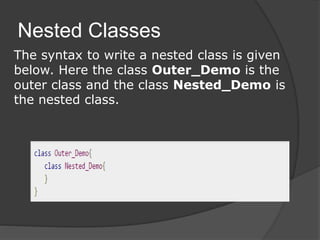
The syntax to write a nested class is given
below. Here the class Outer_Demo is the
outer class and the class Nested_Demo is
the nested class.
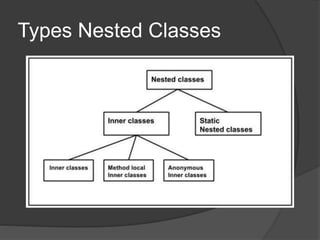
Types Nested Classes
 Non-static nested classes:
 These are the non-static members of a
class.
 Static nested classes:
 These are the static members of a class.
Types Nested Classes
Inner Classes
 Inner classes are of three types
depending on how and where you define
them. They are:
 Inner Class
 Method-local Inner Classlass
 Anonymous Inner Class
Inner Classes
 Creating an inner class is quite simple. You
just need to write a class within a class
Inner Classes
Inner Classes
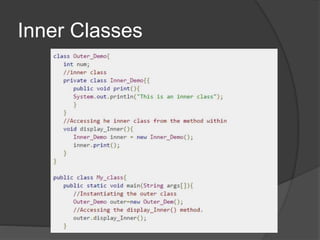
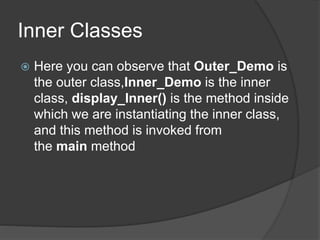
 Here you can observe that Outer_Demo is
the outer class,Inner_Demo is the inner
class, display_Inner() is the method inside
which we are instantiating the inner class,
and this method is invoked from
the main method
Accessing private Members of
class
 Inner classes are also used to access the
private members of a class.
 To instantiate the inner class, initially you
have to instantiate the outer class.
Thereafter, using the object of the outer
class, you can instantiate the inner class as
shown below.
Accessing private Members of
class
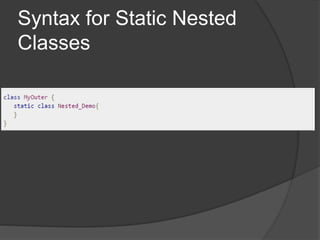
Static Nested Classes
 A static inner class is a nested class
which is a static member of the outer
class. It can be accessed without
instantiating the outer class, using
other static members. Just like static
members, a static nested class does not
have access to the instance variables
and methods of the outer class. The
syntax of static nested class is as
follows:
Syntax for Static Nested
Classes
Static Nested Classes
 Instantiating a static nested class is a bit
different from instantiating an inner
class. The following program shows how
to use a static nested class.
Static Nested Classes

types of classes in java

  • 2.
    Nested Classes  Writinga class within another is allowed in Java. The class written within is called the nested class, and the class that holds the inner class is called the outer class.
  • 3.
    Nested Classes The syntaxto write a nested class is given below. Here the class Outer_Demo is the outer class and the class Nested_Demo is the nested class.
  • 4.
    Types Nested Classes Non-static nested classes:  These are the non-static members of a class.  Static nested classes:  These are the static members of a class.
  • 5.
  • 6.
    Inner Classes  Innerclasses are of three types depending on how and where you define them. They are:  Inner Class  Method-local Inner Classlass  Anonymous Inner Class
  • 7.
    Inner Classes  Creatingan inner class is quite simple. You just need to write a class within a class
  • 8.
  • 9.
    Inner Classes  Hereyou can observe that Outer_Demo is the outer class,Inner_Demo is the inner class, display_Inner() is the method inside which we are instantiating the inner class, and this method is invoked from the main method
  • 10.
    Accessing private Membersof class  Inner classes are also used to access the private members of a class.  To instantiate the inner class, initially you have to instantiate the outer class. Thereafter, using the object of the outer class, you can instantiate the inner class as shown below.
  • 11.
  • 12.
    Static Nested Classes A static inner class is a nested class which is a static member of the outer class. It can be accessed without instantiating the outer class, using other static members. Just like static members, a static nested class does not have access to the instance variables and methods of the outer class. The syntax of static nested class is as follows:
  • 13.
    Syntax for StaticNested Classes
  • 14.
    Static Nested Classes Instantiating a static nested class is a bit different from instantiating an inner class. The following program shows how to use a static nested class.
  • 15.

Editor's Notes

  • #7 NOTE: We know a class cannot be associated with the access modifier private, but if we have the class as a member of other class, then the inner class can be made private. 
  • #8 NOTE: We know a class cannot be associated with the access modifier private, but if we have the class as a member of other class, then the inner class can be made private.