
LANDSCAPE DESIGN
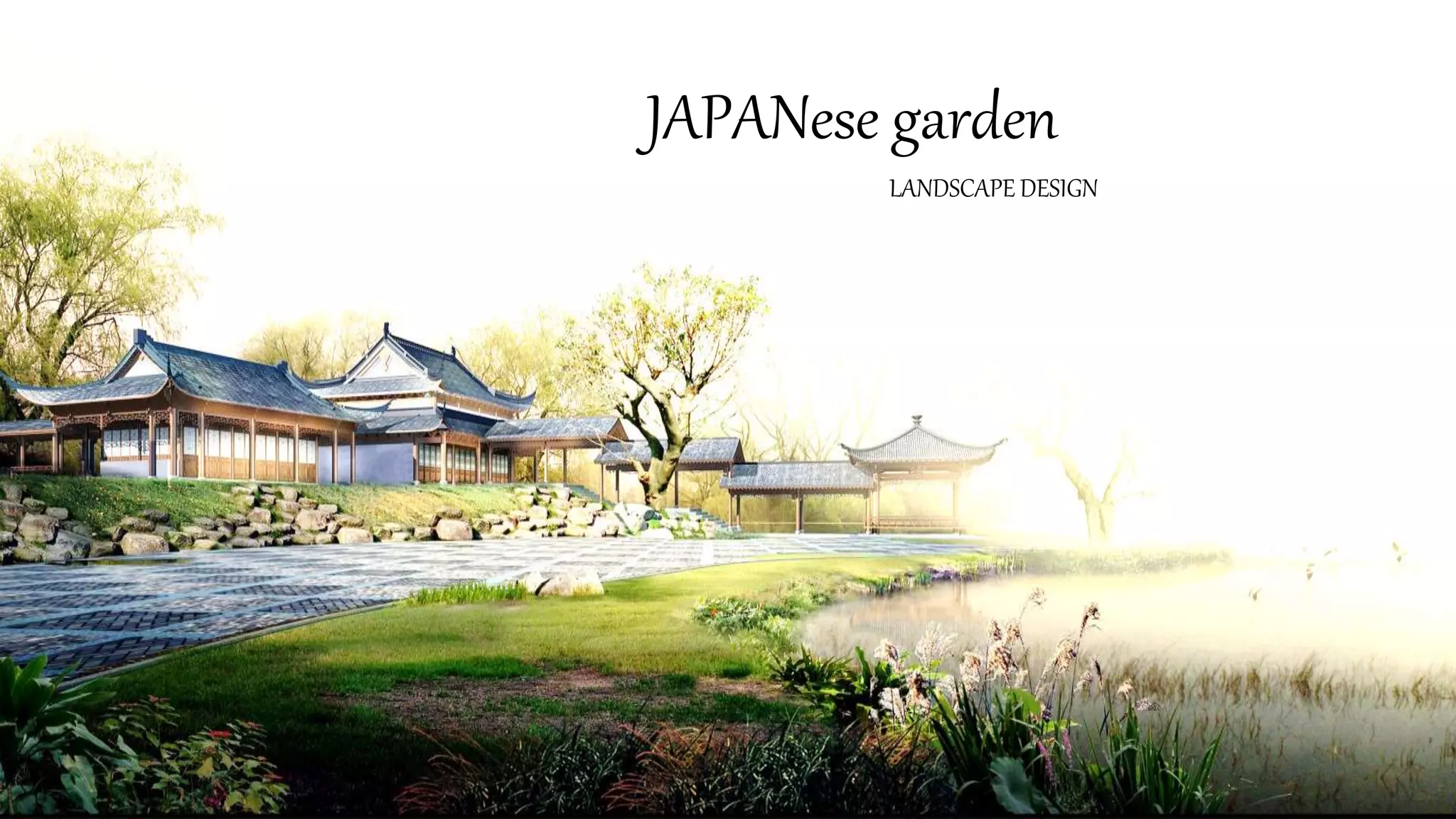
JAPANese garden
JAPAN
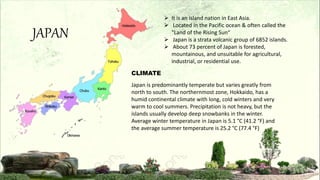
 It is an island nation in East Asia.
 Located in the Pacific ocean & often called the
"Land of the Rising Sun“
 Japan is a strata volcanic group of 6852 islands.
 About 73 percent of Japan is forested,
mountainous, and unsuitable for agricultural,
industrial, or residential use.
Japan is predominantly temperate but varies greatly from
north to south. The northernmost zone, Hokkaido, has a
humid continental climate with long, cold winters and very
warm to cool summers. Precipitation is not heavy, but the
islands usually develop deep snowbanks in the winter.
Average winter temperature in Japan is 5.1 °C (41.2 °F) and
the average summer temperature is 25.2 °C (77.4 °F)
CLIMATE
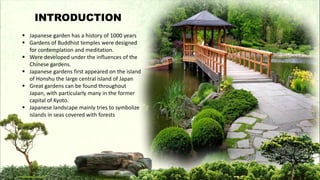
 Japanese garden has a history of 1000 years
 Gardens of Buddhist temples were designed
for contemplation and meditation.
 Were developed under the influences of the
Chinese gardens.
 Japanese gardens first appeared on the island
of Honshu the large central island of Japan
 Great gardens can be found throughout
Japan, with particularly many in the former
capital of Kyoto.
 Japanese landscape mainly tries to symbolize
islands in seas covered with forests
INTRODUCTION
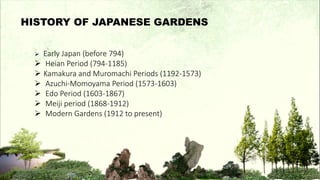
 Early Japan (before 794)
 Heian Period (794-1185)
 Kamakura and Muromachi Periods (1192-1573)
 Azuchi-Momoyama Period (1573-1603)
 Edo Period (1603-1867)
 Meiji period (1868-1912)
 Modern Gardens (1912 to present)
HISTORY OF JAPANESE GARDENS
 Early Japan (before 794)
 Heian Period (794-1185)
 Kamakura and Muromachi Periods (1192-1573)
 Azuchi-Momoyama Period (1573-1603)
 Edo Period (1603-1867)
 Meiji period (1868-1912)
 Modern Gardens (1912 to present)
HISTORY OF JAPANESE GARDENS
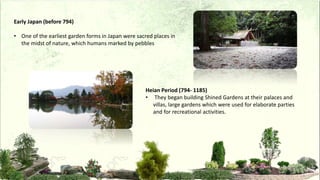
Early Japan (before 794)
• One of the earliest garden forms in Japan were sacred places in
the midst of nature, which humans marked by pebbles
Heian Period (794- 1185)
• They began building Shined Gardens at their palaces and
villas, large gardens which were used for elaborate parties
and for recreational activities.
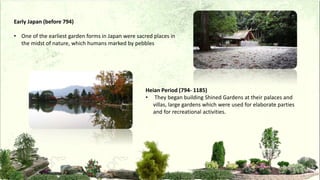
Early Japan (before 794)
• One of the earliest garden forms in Japan were sacred places in
the midst of nature, which humans marked by pebbles
Heian Period (794- 1185)
• They began building Shined Gardens at their palaces and
villas, large gardens which were used for elaborate parties
and for recreational activities.
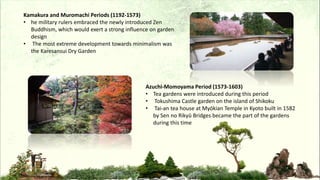
Kamakura and Muromachi Periods (1192-1573)
• he military rulers embraced the newly introduced Zen
Buddhism, which would exert a strong influence on garden
design
• The most extreme development towards minimalism was
the Karesansui Dry Garden
Azuchi-Momoyama Period (1573-1603)
• Tea gardens were introduced during this period
• Tokushima Castle garden on the island of Shikoku
• Tai-an tea house at Myōkian Temple in Kyoto built in 1582
by Sen no Rikyū Bridges became the part of the gardens
during this time
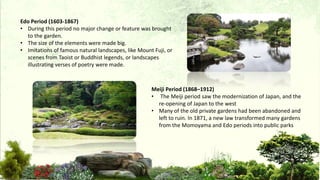
Edo Period (1603-1867)
• During this period no major change or feature was brought
to the garden.
• The size of the elements were made big.
• Imitations of famous natural landscapes, like Mount Fuji, or
scenes from Taoist or Buddhist legends, or landscapes
illustrating verses of poetry were made.
Meiji Period (1868–1912)
• The Meiji period saw the modernization of Japan, and the
re-opening of Japan to the west
• Many of the old private gardens had been abandoned and
left to ruin. In 1871, a new law transformed many gardens
from the Momoyama and Edo periods into public parks
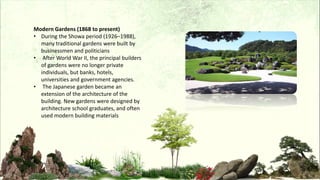
Modern Gardens (1868 to present)
• During the Showa period (1926–1988),
many traditional gardens were built by
businessmen and politicians
• After World War II, the principal builders
of gardens were no longer private
individuals, but banks, hotels,
universities and government agencies.
• The Japanese garden became an
extension of the architecture of the
building. New gardens were designed by
architecture school graduates, and often
used modern building materials
Water
Rock and sand
Garden bridges
Stone lanterns and water basins
Garden fences and gates
Trees and flowers
 Fish
ELEMENTS
WATER
• Water is used not just for its visual quality, but
also for its sound.
• The Japanese have learnt to exploit the sound
of water in all its various form. it varies from
powerful waterfall to water falling into a water
basin, creating different emotions.
• It represents the sea, lake, pond or river in
nature.
• Non geometrical in appearance; in order to
preserve the natural shapes, man- made ponds
are asymmetrical. The bank of the pond is
usually bordered by stones
• A fountain is sometimes found at the bottom of
a hill or hillside or forest.
There are number of ways in which water can
be used in Japanese gardens:
• As a pond or lake setting, in a stream and
as a waterfall.
• If the objective is to create an expensive
atmosphere then a pond or lake is the
answer.
• If the aim is dynamic effect, which will
stimulate both visual and acoustic senses
then waterfall is more suitable Wells are
also used in japanese gardens..
• A hermitage garden is a small garden usually built by a
samurai or government official who wanted to retire from
public life and devote himself to study or meditation.
• Elements of these gardens –
•Garden –traditional garden features
•Rustic house
•Winding path
• Features –
The garden is attached to a rustic house, and
approached by a winding path, which suggests it is deep in a
forest. It may have a small pond, a Japanese rock garden, and
the other features of traditional gardens, in miniature,
designed to create tranquility and inspiration.
HERMITAGE GARDEN
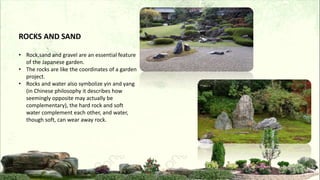
ROCKS AND SAND
• Rock,sand and gravel are an essential feature
of the Japanese garden.
• The rocks are like the coordinates of a garden
project.
• Rocks and water also symbolize yin and yang
(in Chinese philosophy it describes how
seemingly opposite may actually be
complementary), the hard rock and soft
water complement each other, and water,
though soft, can wear away rock.
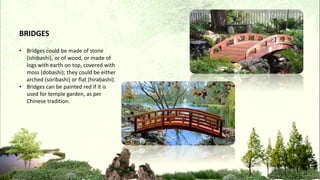
• Bridges could be made of stone
(ishibashi), or of wood, or made of
logs with earth on top, covered with
moss (dobashi); they could be either
arched (soribashi) or flat (hirabashi).
• Bridges can be painted red if it is
used for temple garden, as per
Chinese tradition.
BRIDGES
STONE LANTERNS & WATER BASINS
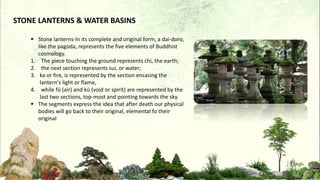
 Stone lanterns-In its complete and original form, a dai-doro,
like the pagoda, represents the five elements of Buddhist
cosmology.
1. The piece touching the ground represents chi, the earth;
2. the next section represents sui, or water;
3. ka or fire, is represented by the section encasing the
lantern's light or flame,
4. while fū (air) and kū (void or spirit) are represented by the
last two sections, top-most and pointing towards the sky.
 The segments express the idea that after death our physical
bodies will go back to their original, elemental fo their
original
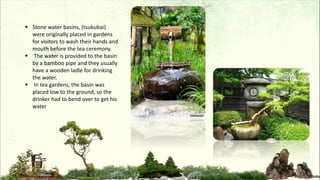
 Stone water basins, (tsukubai)
were originally placed in gardens
for visitors to wash their hands and
mouth before the tea ceremony.
 The water is provided to the basin
by a bamboo pipe and they usually
have a wooden ladle for drinking
the water.
 In tea gardens, the basin was
placed low to the ground, so the
drinker had to bend over to get his
water
GARDEN FENCES & GATES
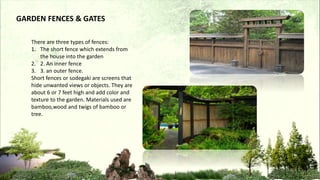
There are three types of fences:
1. The short fence which extends from
the house into the garden
2. 2. An inner fence
3. 3. an outer fence.
Short fences or sodegaki are screens that
hide unwanted views or objects. They are
about 6 or 7 feet high and add color and
texture to the garden. Materials used are
bamboo,wood and twigs of bamboo or
tree.
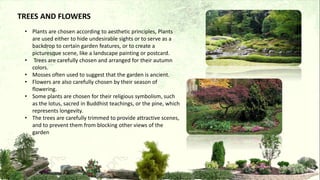
• Plants are chosen according to aesthetic principles, Plants
are used either to hide undesirable sights or to serve as a
backdrop to certain garden features, or to create a
picturesque scene, like a landscape painting or postcard.
• Trees are carefully chosen and arranged for their autumn
colors.
• Mosses often used to suggest that the garden is ancient.
• Flowers are also carefully chosen by their season of
flowering.
• Some plants are chosen for their religious symbolism, such
as the lotus, sacred in Buddhist teachings, or the pine, which
represents longevity.
• The trees are carefully trimmed to provide attractive scenes,
and to prevent them from blocking other views of the
garden
TREES AND FLOWERS
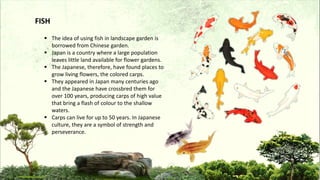
 The idea of using fish in landscape garden is
borrowed from Chinese garden.
 Japan is a country where a large population
leaves little land available for flower gardens.
 The Japanese, therefore, have found places to
grow living flowers, the colored carps.
 They appeared in Japan many centuries ago
and the Japanese have crossbred them for
over 100 years, producing carps of high value
that bring a flash of colour to the shallow
waters.
 Carps can live for up to 50 years. In Japanese
culture, they are a symbol of strength and
perseverance.
FISH
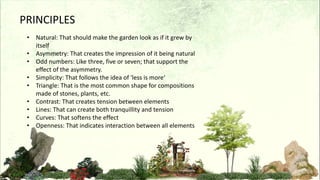
PRINCIPLES
• Natural: That should make the garden look as if it grew by
itself
• Asymmetry: That creates the impression of it being natural
• Odd numbers: Like three, five or seven; that support the
effect of the asymmetry.
• Simplicity: That follows the idea of 'less is more‘
• Triangle: That is the most common shape for compositions
made of stones, plants, etc.
• Contrast: That creates tension between elements
• Lines: That can create both tranquillity and tension
• Curves: That softens the effect
• Openness: That indicates interaction between all elements
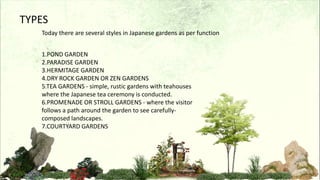
TYPES
Today there are several styles in Japanese gardens as per function
1.POND GARDEN
2.PARADISE GARDEN
3.HERMITAGE GARDEN
4.DRY ROCK GARDEN OR ZEN GARDENS
5.TEA GARDENS - simple, rustic gardens with teahouses
where the Japanese tea ceremony is conducted.
6.PROMENADE OR STROLL GARDENS - where the visitor
follows a path around the garden to see carefully-
composed landscapes.
7.COURTYARD GARDENS
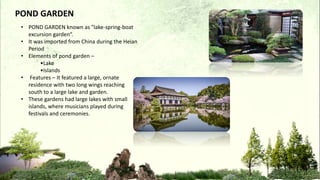
POND GARDEN
• POND GARDEN known as "lake-spring-boat
excursion garden“.
• It was imported from China during the Heian
Period
• Elements of pond garden –
•Lake
•Islands
• Features – It featured a large, ornate
residence with two long wings reaching
south to a large lake and garden.
• These gardens had large lakes with small
islands, where musicians played during
festivals and ceremonies.
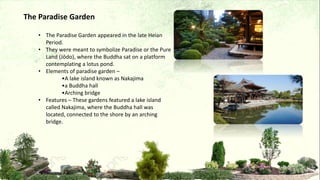
• The Paradise Garden appeared in the late Heian
Period.
• They were meant to symbolize Paradise or the Pure
Land (Jōdo), where the Buddha sat on a platform
contemplating a lotus pond.
• Elements of paradise garden –
•A lake island known as Nakajima
•a Buddha hall
•Arching bridge
• Features – These gardens featured a lake island
called Nakajima, where the Buddha hall was
located, connected to the shore by an arching
bridge.
The Paradise Garden
• These are meant for meditation and in
these gardens.
• Elements of rock/ zen gardens –
•White sand
•Raked gravel
• Features –
These gardens have white sand
or raked gravel in place of water, carefully-
arranged rocks, and sometimes rocks and sand
covered with moss.
DRY ROCK GARDENS/ ZEN GARDENS
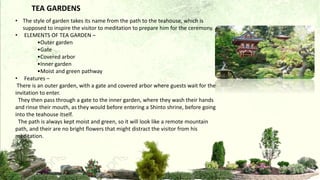
• The style of garden takes its name from the path to the teahouse, which is
supposed to inspire the visitor to meditation to prepare him for the ceremony.
• ELEMENTS OF TEA GARDEN –
•Outer garden
•Gate
•Covered arbor
•Inner garden
•Moist and green pathway
• Features –
There is an outer garden, with a gate and covered arbor where guests wait for the
invitation to enter.
They then pass through a gate to the inner garden, where they wash their hands
and rinse their mouth, as they would before entering a Shinto shrine, before going
into the teahouse itself.
The path is always kept moist and green, so it will look like a remote mountain
path, and their are no bright flowers that might distract the visitor from his
meditation.
TEA GARDENS
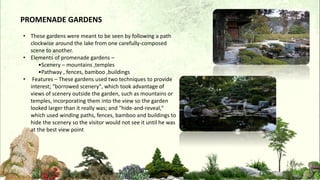
• These gardens were meant to be seen by following a path
clockwise around the lake from one carefully-composed
scene to another.
• Elements of promenade gardens –
•Scenery – mountains ,temples
•Pathway , fences, bamboo ,buildings
• Features – These gardens used two techniques to provide
interest; "borrowed scenery", which took advantage of
views of scenery outside the garden, such as mountains or
temples, incorporating them into the view so the garden
looked larger than it really was; and "hide-and-reveal,"
which used winding paths, fences, bamboo and buildings to
hide the scenery so the visitor would not see it until he was
at the best view point
PROMENADE GARDENS
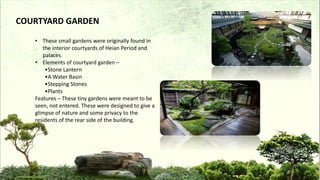
COURTYARD GARDEN
• These small gardens were originally found in
the interior courtyards of Heian Period and
palaces.
• Elements of courtyard garden –
•Stone Lantern
•A Water Basin
•Stepping Stones
•Plants
Features – These tiny gardens were meant to be
seen, not entered. These were designed to give a
glimpse of nature and some privacy to the
residents of the rear side of the building.
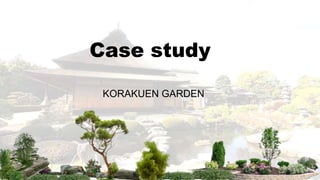
Case study
KORAKUEN GARDEN
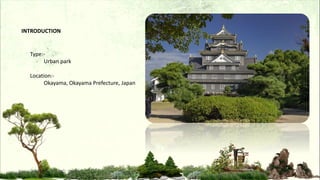
Type:-
Urban park
Location:-
Okayama, Okayama Prefecture, Japan
INTRODUCTION
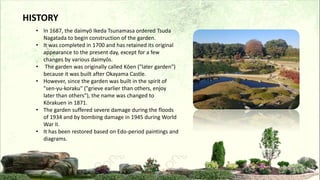
• In 1687, the daimyō Ikeda Tsunamasa ordered Tsuda
Nagatada to begin construction of the garden.
• It was completed in 1700 and has retained its original
appearance to the present day, except for a few
changes by various daimyōs.
• The garden was originally called Kōen ("later garden")
because it was built after Okayama Castle.
• However, since the garden was built in the spirit of
"sen-yu-koraku" ("grieve earlier than others, enjoy
later than others"), the name was changed to
Kōrakuen in 1871.
• The garden suffered severe damage during the floods
of 1934 and by bombing damage in 1945 during World
War II.
• It has been restored based on Edo-period paintings and
diagrams.
HISTORY
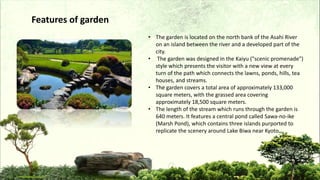
• The garden is located on the north bank of the Asahi River
on an island between the river and a developed part of the
city.
• The garden was designed in the Kaiyu ("scenic promenade")
style which presents the visitor with a new view at every
turn of the path which connects the lawns, ponds, hills, tea
houses, and streams.
• The garden covers a total area of approximately 133,000
square meters, with the grassed area covering
approximately 18,500 square meters.
• The length of the stream which runs through the garden is
640 meters. It features a central pond called Sawa-no-ike
(Marsh Pond), which contains three islands purported to
replicate the scenery around Lake Biwa near Kyoto.
Features of garden
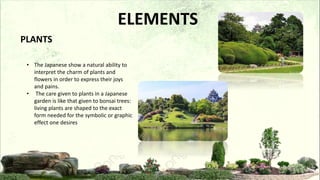
• The Japanese show a natural ability to
interpret the charm of plants and
flowers in order to express their joys
and pains.
• The care given to plants in a Japanese
garden is like that given to bonsai trees:
living plants are shaped to the exact
form needed for the symbolic or graphic
effect one desires
PLANTS
ELEMENTS
WATER
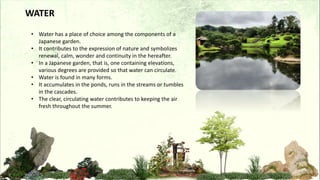
• Water has a place of choice among the components of a
Japanese garden.
• It contributes to the expression of nature and symbolizes
renewal, calm, wonder and continuity in the hereafter.
• In a Japanese garden, that is, one containing elevations,
various degrees are provided so that water can circulate.
• Water is found in many forms.
• It accumulates in the ponds, runs in the streams or tumbles
in the cascades.
• The clear, circulating water contributes to keeping the air
fresh throughout the summer.
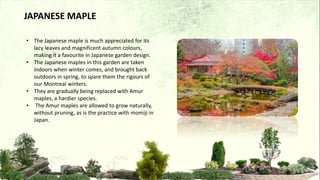
• The Japanese maple is much appreciated for its
lacy leaves and magnificent autumn colours,
making it a favourite in Japanese garden design.
• The Japanese maples in this garden are taken
indoors when winter comes, and brought back
outdoors in spring, to spare them the rigours of
our Montreal winters.
• They are gradually being replaced with Amur
maples, a hardier species.
• The Amur maples are allowed to grow naturally,
without pruning, as is the practice with momiji in
Japan.
JAPANESE MAPLE
• Bridges are privileged sites in a Japanese
garden, where one will linger and take in
the beauty of the landscape, watch the
carps swimming in their watery elements,
and enjoy the softness of the breeze.
• Bridges may be built of wood, bamboo,
earth or stone. Whether they are rounded,
arc-shaped or in zigzags, they always
remain in harmony with the surrounding
nature.
BRIDGES
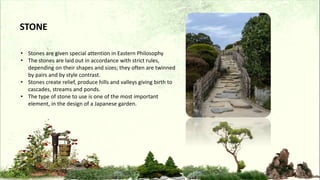
• Stones are given special attention in Eastern Philosophy
• The stones are laid out in accordance with strict rules,
depending on their shapes and sizes; they often are twinned
by pairs and by style contrast.
• Stones create relief, produce hills and valleys giving birth to
cascades, streams and ponds.
• The type of stone to use is one of the most important
element, in the design of a Japanese garden.
STONE
PHILOSOPHY
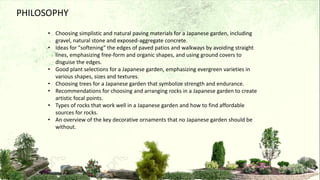
• Choosing simplistic and natural paving materials for a Japanese garden, including
gravel, natural stone and exposed-aggregate concrete.
• Ideas for "softening" the edges of paved patios and walkways by avoiding straight
lines, emphasizing free-form and organic shapes, and using ground covers to
disguise the edges.
• Good plant selections for a Japanese garden, emphasizing evergreen varieties in
various shapes, sizes and textures.
• Choosing trees for a Japanese garden that symbolize strength and endurance.
• Recommendations for choosing and arranging rocks in a Japanese garden to create
artistic focal points.
• Types of rocks that work well in a Japanese garden and how to find affordable
sources for rocks.
• An overview of the key decorative ornaments that no Japanese garden should be
without.
THANK YOU
BY:- SAMRUDDHI PATIL
SUNIL JAMBHULKAR
KARTIK VIKARI
madhukant singh

Japanese garden

  • 1.
  • 2.
    JAPAN  It isan island nation in East Asia.  Located in the Pacific ocean & often called the "Land of the Rising Sun“  Japan is a strata volcanic group of 6852 islands.  About 73 percent of Japan is forested, mountainous, and unsuitable for agricultural, industrial, or residential use. Japan is predominantly temperate but varies greatly from north to south. The northernmost zone, Hokkaido, has a humid continental climate with long, cold winters and very warm to cool summers. Precipitation is not heavy, but the islands usually develop deep snowbanks in the winter. Average winter temperature in Japan is 5.1 °C (41.2 °F) and the average summer temperature is 25.2 °C (77.4 °F) CLIMATE
  • 3.
     Japanese gardenhas a history of 1000 years  Gardens of Buddhist temples were designed for contemplation and meditation.  Were developed under the influences of the Chinese gardens.  Japanese gardens first appeared on the island of Honshu the large central island of Japan  Great gardens can be found throughout Japan, with particularly many in the former capital of Kyoto.  Japanese landscape mainly tries to symbolize islands in seas covered with forests INTRODUCTION
  • 4.
     Early Japan(before 794)  Heian Period (794-1185)  Kamakura and Muromachi Periods (1192-1573)  Azuchi-Momoyama Period (1573-1603)  Edo Period (1603-1867)  Meiji period (1868-1912)  Modern Gardens (1912 to present) HISTORY OF JAPANESE GARDENS
  • 5.
     Early Japan(before 794)  Heian Period (794-1185)  Kamakura and Muromachi Periods (1192-1573)  Azuchi-Momoyama Period (1573-1603)  Edo Period (1603-1867)  Meiji period (1868-1912)  Modern Gardens (1912 to present) HISTORY OF JAPANESE GARDENS
  • 6.
    Early Japan (before794) • One of the earliest garden forms in Japan were sacred places in the midst of nature, which humans marked by pebbles Heian Period (794- 1185) • They began building Shined Gardens at their palaces and villas, large gardens which were used for elaborate parties and for recreational activities.
  • 7.
    Early Japan (before794) • One of the earliest garden forms in Japan were sacred places in the midst of nature, which humans marked by pebbles Heian Period (794- 1185) • They began building Shined Gardens at their palaces and villas, large gardens which were used for elaborate parties and for recreational activities.
  • 8.
    Kamakura and MuromachiPeriods (1192-1573) • he military rulers embraced the newly introduced Zen Buddhism, which would exert a strong influence on garden design • The most extreme development towards minimalism was the Karesansui Dry Garden Azuchi-Momoyama Period (1573-1603) • Tea gardens were introduced during this period • Tokushima Castle garden on the island of Shikoku • Tai-an tea house at Myōkian Temple in Kyoto built in 1582 by Sen no Rikyū Bridges became the part of the gardens during this time
  • 9.
    Edo Period (1603-1867) •During this period no major change or feature was brought to the garden. • The size of the elements were made big. • Imitations of famous natural landscapes, like Mount Fuji, or scenes from Taoist or Buddhist legends, or landscapes illustrating verses of poetry were made. Meiji Period (1868–1912) • The Meiji period saw the modernization of Japan, and the re-opening of Japan to the west • Many of the old private gardens had been abandoned and left to ruin. In 1871, a new law transformed many gardens from the Momoyama and Edo periods into public parks
  • 10.
    Modern Gardens (1868to present) • During the Showa period (1926–1988), many traditional gardens were built by businessmen and politicians • After World War II, the principal builders of gardens were no longer private individuals, but banks, hotels, universities and government agencies. • The Japanese garden became an extension of the architecture of the building. New gardens were designed by architecture school graduates, and often used modern building materials
  • 11.
    Water Rock and sand Gardenbridges Stone lanterns and water basins Garden fences and gates Trees and flowers  Fish ELEMENTS
  • 12.
    WATER • Water isused not just for its visual quality, but also for its sound. • The Japanese have learnt to exploit the sound of water in all its various form. it varies from powerful waterfall to water falling into a water basin, creating different emotions. • It represents the sea, lake, pond or river in nature. • Non geometrical in appearance; in order to preserve the natural shapes, man- made ponds are asymmetrical. The bank of the pond is usually bordered by stones • A fountain is sometimes found at the bottom of a hill or hillside or forest.
  • 13.
    There are numberof ways in which water can be used in Japanese gardens: • As a pond or lake setting, in a stream and as a waterfall. • If the objective is to create an expensive atmosphere then a pond or lake is the answer. • If the aim is dynamic effect, which will stimulate both visual and acoustic senses then waterfall is more suitable Wells are also used in japanese gardens..
  • 14.
    • A hermitagegarden is a small garden usually built by a samurai or government official who wanted to retire from public life and devote himself to study or meditation. • Elements of these gardens – •Garden –traditional garden features •Rustic house •Winding path • Features – The garden is attached to a rustic house, and approached by a winding path, which suggests it is deep in a forest. It may have a small pond, a Japanese rock garden, and the other features of traditional gardens, in miniature, designed to create tranquility and inspiration. HERMITAGE GARDEN
  • 15.
    ROCKS AND SAND •Rock,sand and gravel are an essential feature of the Japanese garden. • The rocks are like the coordinates of a garden project. • Rocks and water also symbolize yin and yang (in Chinese philosophy it describes how seemingly opposite may actually be complementary), the hard rock and soft water complement each other, and water, though soft, can wear away rock.
  • 16.
    • Bridges couldbe made of stone (ishibashi), or of wood, or made of logs with earth on top, covered with moss (dobashi); they could be either arched (soribashi) or flat (hirabashi). • Bridges can be painted red if it is used for temple garden, as per Chinese tradition. BRIDGES
  • 17.
    STONE LANTERNS &WATER BASINS  Stone lanterns-In its complete and original form, a dai-doro, like the pagoda, represents the five elements of Buddhist cosmology. 1. The piece touching the ground represents chi, the earth; 2. the next section represents sui, or water; 3. ka or fire, is represented by the section encasing the lantern's light or flame, 4. while fū (air) and kū (void or spirit) are represented by the last two sections, top-most and pointing towards the sky.  The segments express the idea that after death our physical bodies will go back to their original, elemental fo their original
  • 18.
     Stone waterbasins, (tsukubai) were originally placed in gardens for visitors to wash their hands and mouth before the tea ceremony.  The water is provided to the basin by a bamboo pipe and they usually have a wooden ladle for drinking the water.  In tea gardens, the basin was placed low to the ground, so the drinker had to bend over to get his water
  • 19.
    GARDEN FENCES &GATES There are three types of fences: 1. The short fence which extends from the house into the garden 2. 2. An inner fence 3. 3. an outer fence. Short fences or sodegaki are screens that hide unwanted views or objects. They are about 6 or 7 feet high and add color and texture to the garden. Materials used are bamboo,wood and twigs of bamboo or tree.
  • 20.
    • Plants arechosen according to aesthetic principles, Plants are used either to hide undesirable sights or to serve as a backdrop to certain garden features, or to create a picturesque scene, like a landscape painting or postcard. • Trees are carefully chosen and arranged for their autumn colors. • Mosses often used to suggest that the garden is ancient. • Flowers are also carefully chosen by their season of flowering. • Some plants are chosen for their religious symbolism, such as the lotus, sacred in Buddhist teachings, or the pine, which represents longevity. • The trees are carefully trimmed to provide attractive scenes, and to prevent them from blocking other views of the garden TREES AND FLOWERS
  • 21.
     The ideaof using fish in landscape garden is borrowed from Chinese garden.  Japan is a country where a large population leaves little land available for flower gardens.  The Japanese, therefore, have found places to grow living flowers, the colored carps.  They appeared in Japan many centuries ago and the Japanese have crossbred them for over 100 years, producing carps of high value that bring a flash of colour to the shallow waters.  Carps can live for up to 50 years. In Japanese culture, they are a symbol of strength and perseverance. FISH
  • 22.
    PRINCIPLES • Natural: Thatshould make the garden look as if it grew by itself • Asymmetry: That creates the impression of it being natural • Odd numbers: Like three, five or seven; that support the effect of the asymmetry. • Simplicity: That follows the idea of 'less is more‘ • Triangle: That is the most common shape for compositions made of stones, plants, etc. • Contrast: That creates tension between elements • Lines: That can create both tranquillity and tension • Curves: That softens the effect • Openness: That indicates interaction between all elements
  • 23.
    TYPES Today there areseveral styles in Japanese gardens as per function 1.POND GARDEN 2.PARADISE GARDEN 3.HERMITAGE GARDEN 4.DRY ROCK GARDEN OR ZEN GARDENS 5.TEA GARDENS - simple, rustic gardens with teahouses where the Japanese tea ceremony is conducted. 6.PROMENADE OR STROLL GARDENS - where the visitor follows a path around the garden to see carefully- composed landscapes. 7.COURTYARD GARDENS
  • 24.
    POND GARDEN • PONDGARDEN known as "lake-spring-boat excursion garden“. • It was imported from China during the Heian Period • Elements of pond garden – •Lake •Islands • Features – It featured a large, ornate residence with two long wings reaching south to a large lake and garden. • These gardens had large lakes with small islands, where musicians played during festivals and ceremonies.
  • 25.
    • The ParadiseGarden appeared in the late Heian Period. • They were meant to symbolize Paradise or the Pure Land (Jōdo), where the Buddha sat on a platform contemplating a lotus pond. • Elements of paradise garden – •A lake island known as Nakajima •a Buddha hall •Arching bridge • Features – These gardens featured a lake island called Nakajima, where the Buddha hall was located, connected to the shore by an arching bridge. The Paradise Garden
  • 26.
    • These aremeant for meditation and in these gardens. • Elements of rock/ zen gardens – •White sand •Raked gravel • Features – These gardens have white sand or raked gravel in place of water, carefully- arranged rocks, and sometimes rocks and sand covered with moss. DRY ROCK GARDENS/ ZEN GARDENS
  • 27.
    • The styleof garden takes its name from the path to the teahouse, which is supposed to inspire the visitor to meditation to prepare him for the ceremony. • ELEMENTS OF TEA GARDEN – •Outer garden •Gate •Covered arbor •Inner garden •Moist and green pathway • Features – There is an outer garden, with a gate and covered arbor where guests wait for the invitation to enter. They then pass through a gate to the inner garden, where they wash their hands and rinse their mouth, as they would before entering a Shinto shrine, before going into the teahouse itself. The path is always kept moist and green, so it will look like a remote mountain path, and their are no bright flowers that might distract the visitor from his meditation. TEA GARDENS
  • 28.
    • These gardenswere meant to be seen by following a path clockwise around the lake from one carefully-composed scene to another. • Elements of promenade gardens – •Scenery – mountains ,temples •Pathway , fences, bamboo ,buildings • Features – These gardens used two techniques to provide interest; "borrowed scenery", which took advantage of views of scenery outside the garden, such as mountains or temples, incorporating them into the view so the garden looked larger than it really was; and "hide-and-reveal," which used winding paths, fences, bamboo and buildings to hide the scenery so the visitor would not see it until he was at the best view point PROMENADE GARDENS
  • 29.
    COURTYARD GARDEN • Thesesmall gardens were originally found in the interior courtyards of Heian Period and palaces. • Elements of courtyard garden – •Stone Lantern •A Water Basin •Stepping Stones •Plants Features – These tiny gardens were meant to be seen, not entered. These were designed to give a glimpse of nature and some privacy to the residents of the rear side of the building.
  • 30.
  • 31.
    Type:- Urban park Location:- Okayama, OkayamaPrefecture, Japan INTRODUCTION
  • 32.
    • In 1687,the daimyō Ikeda Tsunamasa ordered Tsuda Nagatada to begin construction of the garden. • It was completed in 1700 and has retained its original appearance to the present day, except for a few changes by various daimyōs. • The garden was originally called Kōen ("later garden") because it was built after Okayama Castle. • However, since the garden was built in the spirit of "sen-yu-koraku" ("grieve earlier than others, enjoy later than others"), the name was changed to Kōrakuen in 1871. • The garden suffered severe damage during the floods of 1934 and by bombing damage in 1945 during World War II. • It has been restored based on Edo-period paintings and diagrams. HISTORY
  • 33.
    • The gardenis located on the north bank of the Asahi River on an island between the river and a developed part of the city. • The garden was designed in the Kaiyu ("scenic promenade") style which presents the visitor with a new view at every turn of the path which connects the lawns, ponds, hills, tea houses, and streams. • The garden covers a total area of approximately 133,000 square meters, with the grassed area covering approximately 18,500 square meters. • The length of the stream which runs through the garden is 640 meters. It features a central pond called Sawa-no-ike (Marsh Pond), which contains three islands purported to replicate the scenery around Lake Biwa near Kyoto. Features of garden
  • 34.
    • The Japaneseshow a natural ability to interpret the charm of plants and flowers in order to express their joys and pains. • The care given to plants in a Japanese garden is like that given to bonsai trees: living plants are shaped to the exact form needed for the symbolic or graphic effect one desires PLANTS ELEMENTS
  • 35.
    WATER • Water hasa place of choice among the components of a Japanese garden. • It contributes to the expression of nature and symbolizes renewal, calm, wonder and continuity in the hereafter. • In a Japanese garden, that is, one containing elevations, various degrees are provided so that water can circulate. • Water is found in many forms. • It accumulates in the ponds, runs in the streams or tumbles in the cascades. • The clear, circulating water contributes to keeping the air fresh throughout the summer.
  • 36.
    • The Japanesemaple is much appreciated for its lacy leaves and magnificent autumn colours, making it a favourite in Japanese garden design. • The Japanese maples in this garden are taken indoors when winter comes, and brought back outdoors in spring, to spare them the rigours of our Montreal winters. • They are gradually being replaced with Amur maples, a hardier species. • The Amur maples are allowed to grow naturally, without pruning, as is the practice with momiji in Japan. JAPANESE MAPLE
  • 37.
    • Bridges areprivileged sites in a Japanese garden, where one will linger and take in the beauty of the landscape, watch the carps swimming in their watery elements, and enjoy the softness of the breeze. • Bridges may be built of wood, bamboo, earth or stone. Whether they are rounded, arc-shaped or in zigzags, they always remain in harmony with the surrounding nature. BRIDGES
  • 38.
    • Stones aregiven special attention in Eastern Philosophy • The stones are laid out in accordance with strict rules, depending on their shapes and sizes; they often are twinned by pairs and by style contrast. • Stones create relief, produce hills and valleys giving birth to cascades, streams and ponds. • The type of stone to use is one of the most important element, in the design of a Japanese garden. STONE
  • 39.
    PHILOSOPHY • Choosing simplisticand natural paving materials for a Japanese garden, including gravel, natural stone and exposed-aggregate concrete. • Ideas for "softening" the edges of paved patios and walkways by avoiding straight lines, emphasizing free-form and organic shapes, and using ground covers to disguise the edges. • Good plant selections for a Japanese garden, emphasizing evergreen varieties in various shapes, sizes and textures. • Choosing trees for a Japanese garden that symbolize strength and endurance. • Recommendations for choosing and arranging rocks in a Japanese garden to create artistic focal points. • Types of rocks that work well in a Japanese garden and how to find affordable sources for rocks. • An overview of the key decorative ornaments that no Japanese garden should be without.
  • 40.
    THANK YOU BY:- SAMRUDDHIPATIL SUNIL JAMBHULKAR KARTIK VIKARI madhukant singh