Japanese
gardens
NAR-604
LANDSCAPE
DESIGN
B.ARCH 6TH SEMESTER
SECTION –A
SESSION -2015-16
SUBMITTED
TO-
AR. UMESH
GOVIL SIR
SUBMITTED
BY-
ISHITA
ISHU
JAYA
JITENDRA
JUHI
JUNAID
KAMAL
 The art of gardening is believed to be an important part of Japanese
culture for many centuries.
 Shinto, Buddhism and Taoism were used in the creation of different
garden styles in order to bring a spiritual sense to the gardens and make
them places where people could spend their time in a peaceful way and
meditate.
 Core values of Japanese gardening have been largely shaped by Chinese
culture and tradition.
 Religion, in particular Buddhism, also had a major influence on Japanese
gardening.
 According to Shintoism ,the native religion of Japan “everything in nature
is sacred”; trees, plants, and rocks.
 They used white gravel in temples as to keep areas clean and white as a
means of enticing the spirits and gods to visit these places.
 Shintoism is not much the worship of rocks ,but the veneration of the
spirit that created those objects.
INTRODUCTION
 The history of the Japanese gardens goes back to around the 7th
century. The first Japanese gardens, that expressed Shinto, Buddhism
and Taoism visions can be traced back to the Asuka Period. They were
designed to capture the landscape in its natural form. From this
period the basic rules of designing gardens was established.
 Heian Period is the second very important chapter in the
development of Japanese garden art. Aristocratic style of gardens
where created in front of the mansion with artificial ponds and islands.
 During the Kamakura Period and Muromachi Period garden-making
techniques improved considerably because of the rise of the Zen
style. Many gardens designed in that time were properties of
successive shoguns and daimios, who belong to the highest class in
Japanese society. Famous gardens created after Meiji Period were
frequented by business people and politicians. Most of them are
opened to the public now and play a role in city parks.
HISTORY
 Natural: That should make the garden look as if it grew by itself
 Asymmetry: That creates the impression of it being natural
 Odd numbers: Like three, five or seven; that support the effect of the
asymmetry.
 Simplicity: That follows the idea of 'less is more'
 Triangle: That is the most common shape for compositions made of
stones, plants, etc.
 Contrast: That creates tension between
elements
 Lines: That can create both tranquillity
and tension
 Curves: That softens the effect
 Openness: That indicates interaction
between all elements
BASIC RULES IN THE DESIGN OF
JAPANESE GARDENS
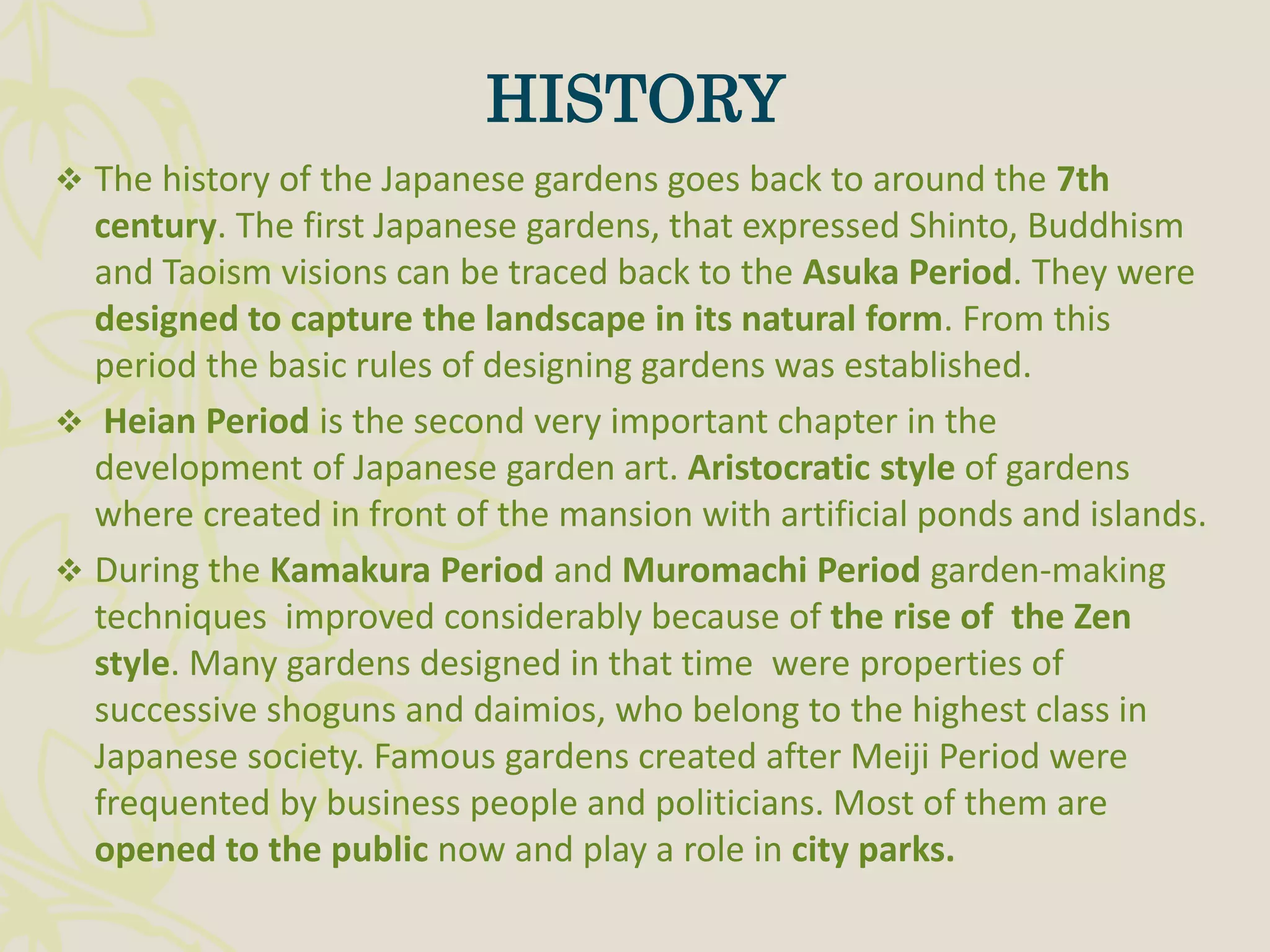
 The line between garden and its surrounding landscape is not distinct.
 In the Japanese garden, the viewer should consider nature as a picture
frame into which the garden, or the man- made work of art, is inserted.
PRINCIPLES OF JAPANESE GARDENS
 A common design principle found in most Japanese garden is the use of
asymmetry.
 Plants and trees are often arranged in an asymmetric fashion, as are
fences and hedges.
 The clever use of space is unique where empty spaces are deliberately left
unfiled to create feeling of spaciousness and uncluttered calm.
 Balance, the proportions and spaces are an essential design principle.
 Plants are represented by moss that
surrounds the rock.
 Water is represented by raked gravel.
 In spring one revels in the bright green
of new buds and the blossoms of the
azaleas.
 In summer , the contrasts of the lush
foliage painted against the cool shadows.
 Fall wrests the brilliant colors from dying
leaves as they slip into the deathly hush
of winter, the garden buried under a
shroud of snow.
 Winters is as much a garden season in
Japan as spring. The Japanese refer to
snow piled on the branches of trees a
sekku, or snow blossoms, and there is a
lantern known as yukimi that is named
the snow viewing lantern.
ELEMENTS OF JAPANESE GARDENS
There are three key elements without which a Japanese garden cannot be
made, that are:
Plants
Rocks
Water
Other subsidiary elements:
Paths
Lanterns
Fences
 A stone lantern representing four natural elements: earth, water, fire and
wind.
 Statues of male and female lions, placed at the entrance of the garden in
order to protect the garden from intruders.
 Water basin known as a deer chaser, which keep deer away by making a
special sound when filled up.
 Typical Japanese bridge, called a moon bridge, whose purpose is to reflect
artistic feelings.
 Japanese garden is predominately green with its use of evergreen trees.
 The trees and plants are chosen not just for their beauty and gracefulness
but also for their symbolism.
 The deep greens of pines symbolize timeless and longevity, while the
colors of the maples and cherries reflect the changing seasons.
PLANTS
 Cherry (Prunus serrulata) and plum trees are extensively used in
Japanese gardens. Both flowers in early April.
Moss:
 It is a simple plant and there are
many different varieties in existence.
 Moss needs damp shady conditions
in order to flourish.
 In constantly dry, sunny aspect, it
will not grow.
 Moss is most often found in
woodland area under the shade of
trees where nothing else will grow.
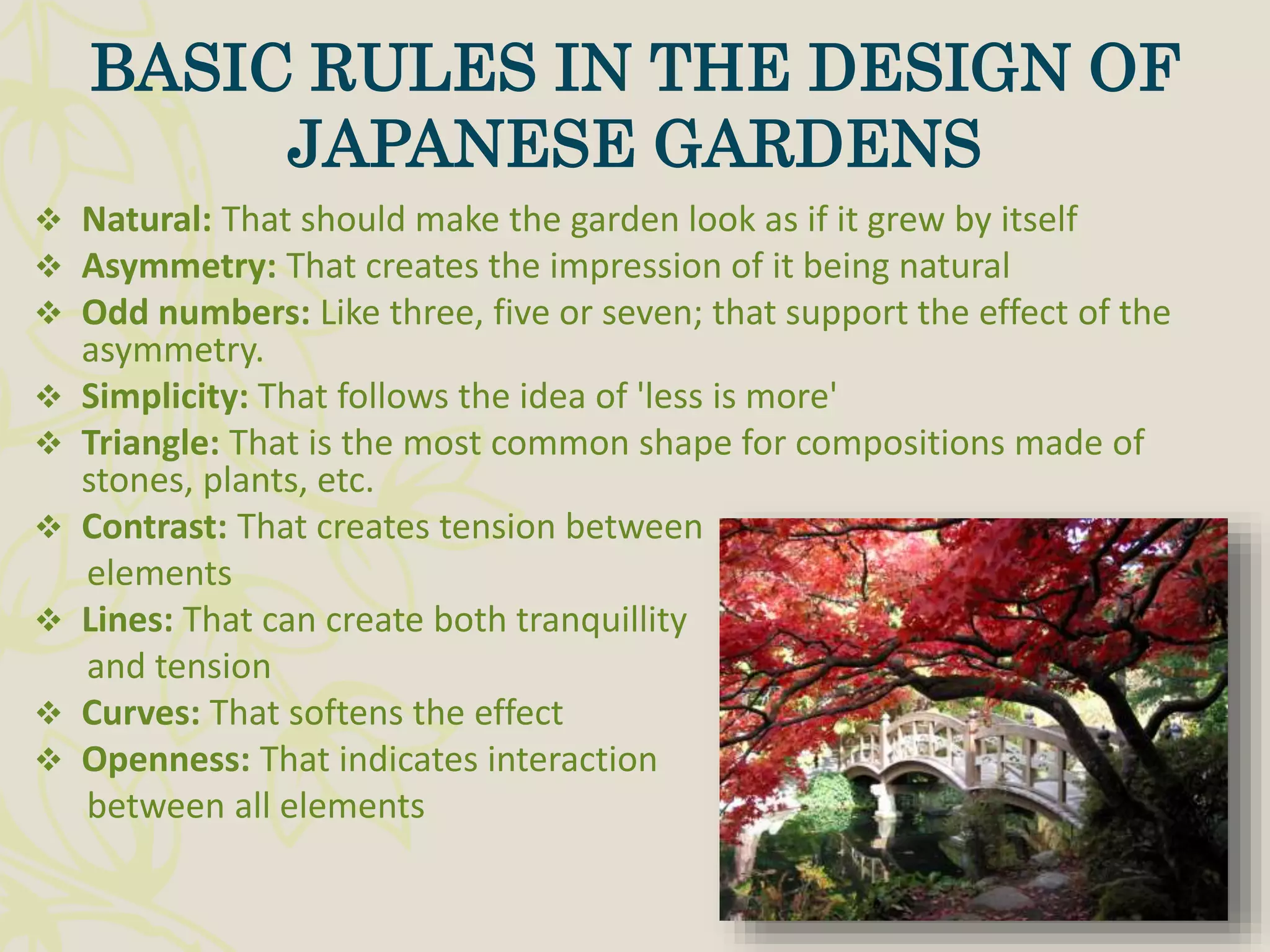
 Scientific Name: Abies Firma
 Habitat: Evergreen
 Texture: Coarse
 Height: 40’ to 70’
 Leaf: 1.5" dark green needles are notched at base; sharp prickly
point
 Flower/Fruit: 3.5 to 5" brown cones
JAPANESE FIR
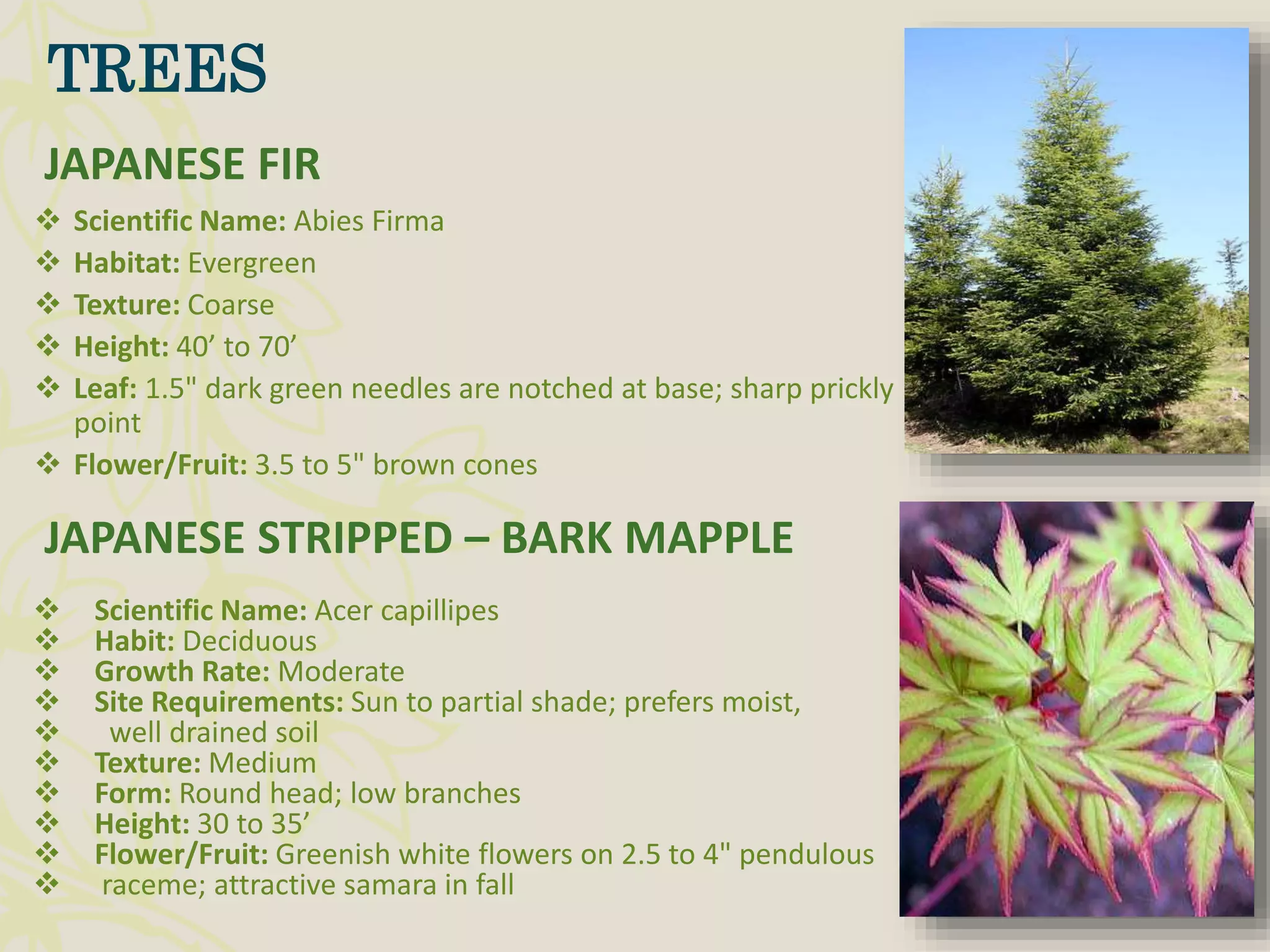
JAPANESE STRIPPED – BARK MAPPLE
 Scientific Name: Acer capillipes
 Habit: Deciduous
 Growth Rate: Moderate
 Site Requirements: Sun to partial shade; prefers moist,
 well drained soil
 Texture: Medium
 Form: Round head; low branches
 Height: 30 to 35’
 Flower/Fruit: Greenish white flowers on 2.5 to 4" pendulous
 raceme; attractive samara in fall
TREES
 Scientific Name: Acer palmatum
 Growth Rate: Slow to moderate
 Site Requirements: Light dappled shade; evenly moist,
well drained soil; protect from drying winds
 Texture: Medium to fine
 Form: Low; dense rounded top; spreading
branches; assumes a layered look
 Height: 15 to 25'
 Flower/Fruit: Small red to purple
 flowers; attractive if viewed closely but
 insignificant from a distance.
JAPANESE MAPLE
 Scientific Name
Betula grossa
 Growth Rate: Moderate
 Site Requirements: Sun; moist well drained soil
 Texture: Medium
 Form: Pyramidal
 Height: 20 to 25'
 Leaf: 2 to 4" alternate, simple leaves; yellow fall
color
 Flower/Fruit: Nonshowy flowers
JAPANESE CHERRY BIRCH
 The rocks are like the coordinates of a garden project.
 Choosing the right type of rock and positioning them on right place.
 Size is meaningful only when viewed in the context of the scale of the
garden & its relationship with the neighboring rocks and other artifacts.
 Variation in rock sizes offer greater contrast & interest resulting in the
more dynamic arrangement of rocks.
ROCKS
 Rocks are often used to represent islands and mountains, so conical or
dome shape would be the obvious choice.
 Colors, generally bright colors are avoided.
 Color of rocks generally varies from grey to black, and from yellow to
brick red on other hand.
 Texture, one of the vital characteristics of any rock.
 A jagged textured rock gives feeling of timelessness and dignity.
 Smooth rocks like water worn stones or glacial boulders convey the
feeling of antiquity especially when combined in an interesting shape.
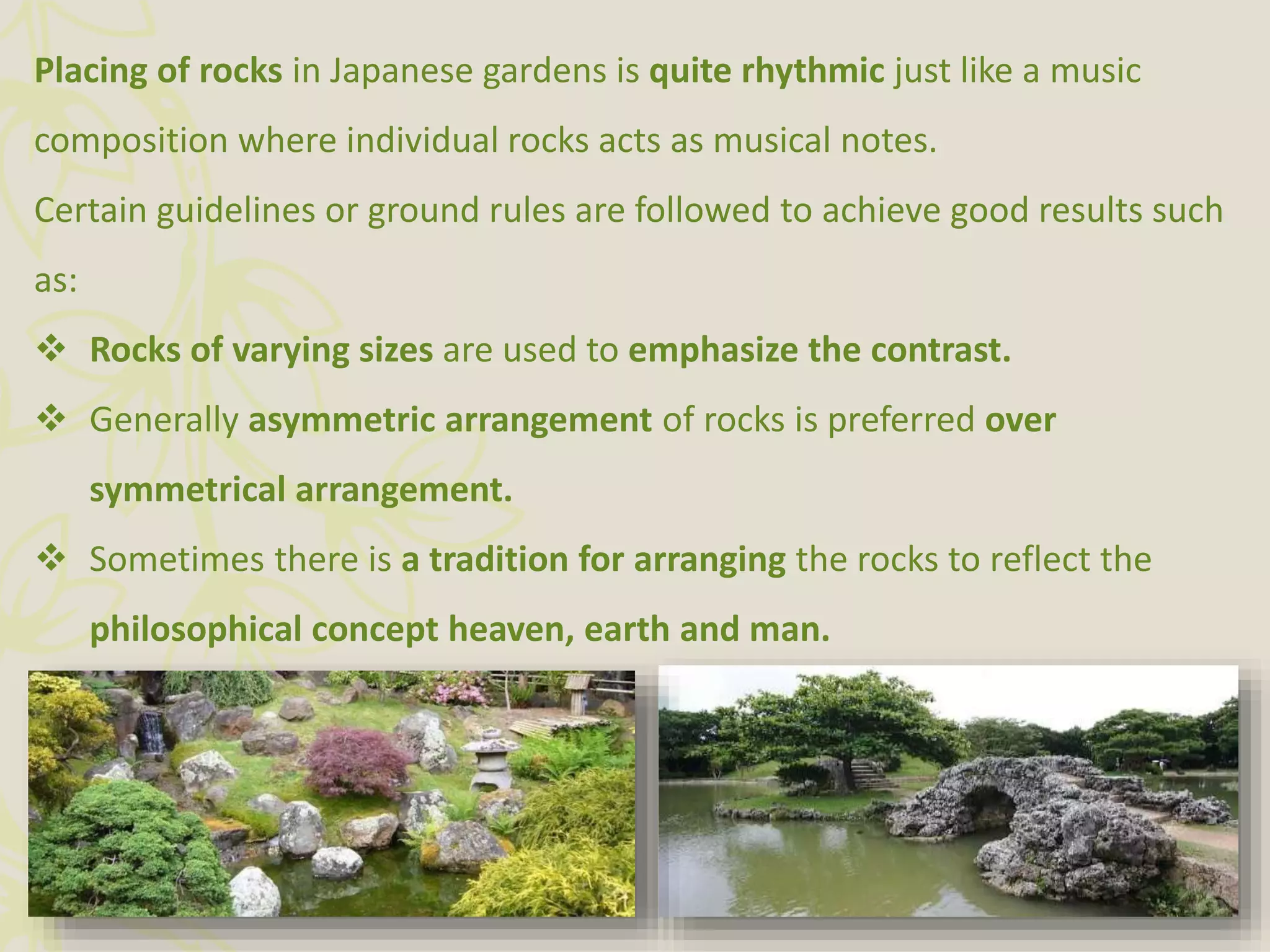
Placing of rocks in Japanese gardens is quite rhythmic just like a music
composition where individual rocks acts as musical notes.
Certain guidelines or ground rules are followed to achieve good results such
as:
 Rocks of varying sizes are used to emphasize the contrast.
 Generally asymmetric arrangement of rocks is preferred over
symmetrical arrangement.
 Sometimes there is a tradition for arranging the rocks to reflect the
philosophical concept heaven, earth and man.
 Water is used not just for its visual quality, but also for its sound.
 The Japanese have learnt to exploit the sound of water in all its various
form. it varies from powerful waterfall to water falling into a water
basin, creating different emotions.
 It represents the sea, lake, pond or river in nature. Non geometrical in
appearance; in order to preserve the natural shapes, man-made ponds
are asymmetrical.
 The bank of the pond is usually bordered by stones. A fountain is
sometimes found at the bottom of a hill or hillside or secluded forest.
 Wells are sometimes found in a Japanese garden.
WATER OR IKE
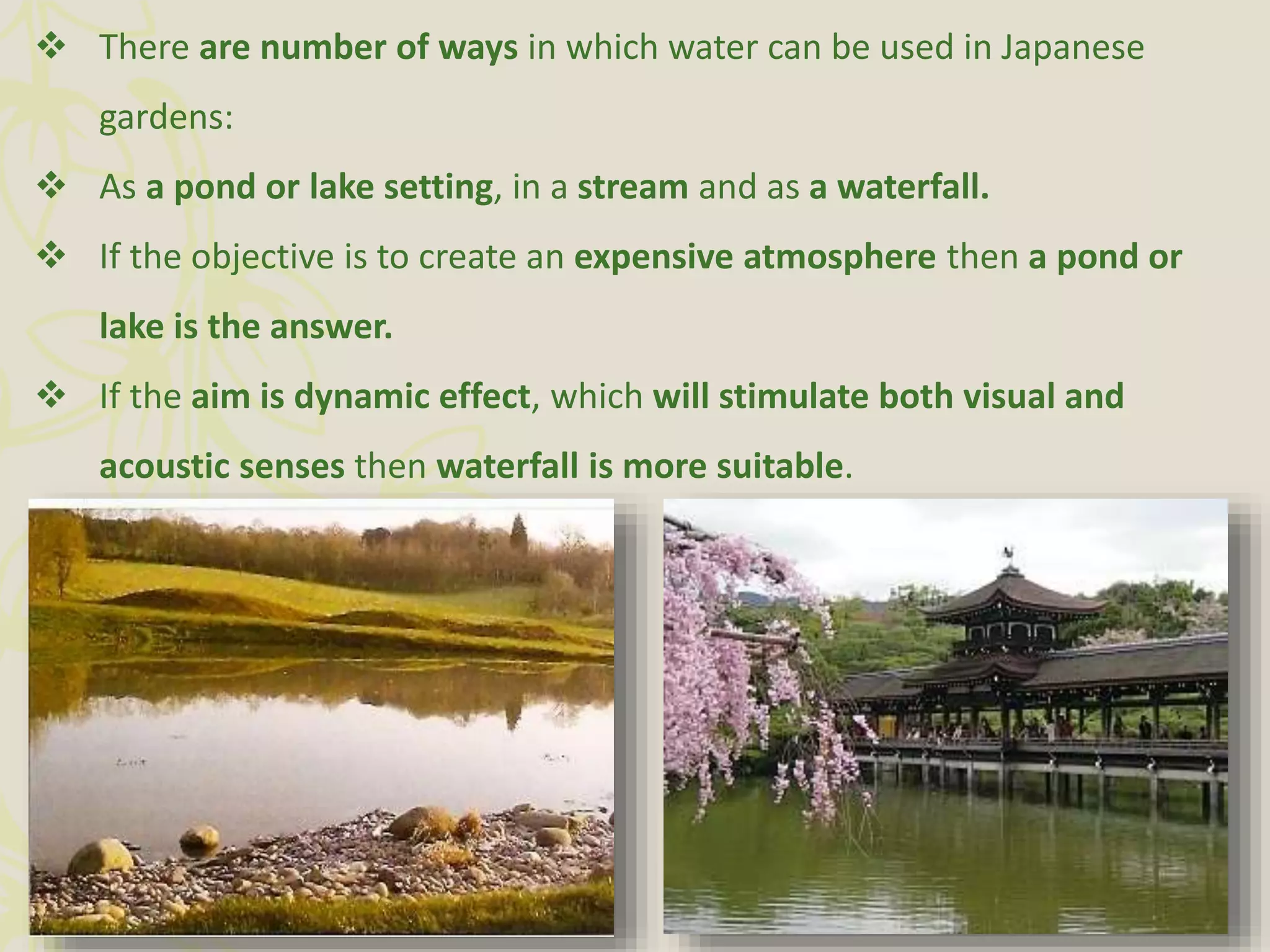
 There are number of ways in which water can be used in Japanese
gardens:
 As a pond or lake setting, in a stream and as a waterfall.
 If the objective is to create an expensive atmosphere then a pond or
lake is the answer.
 If the aim is dynamic effect, which will stimulate both visual and
acoustic senses then waterfall is more suitable.
 Usually used in tea gardens.
 Flat stepping stones served to preserve the grass as well as orient the
viewer to a specific visual experience.
 Step- stones are found near the veranda or entrance of the house or tea
room. The visitor of the house or room is expected to place his shoes on
the step- stone before entering.
PATHS OR TOBI ISHI
 The basins vary from simple depressions in uncut stone to elaborate
carved stone creations, and are usually provided with a bamboo dipper
for scooping up water. Two kinds of stone water basins-
 Kazari- chozubachi, which is kept near the verandah
 Tsukubai for tea garden
 Stone lanterns are placed besides prominent water basins whose
luminance underscored the unfinished beauty of the tea aesthetic.
WATER BASINS AND LANTERNS
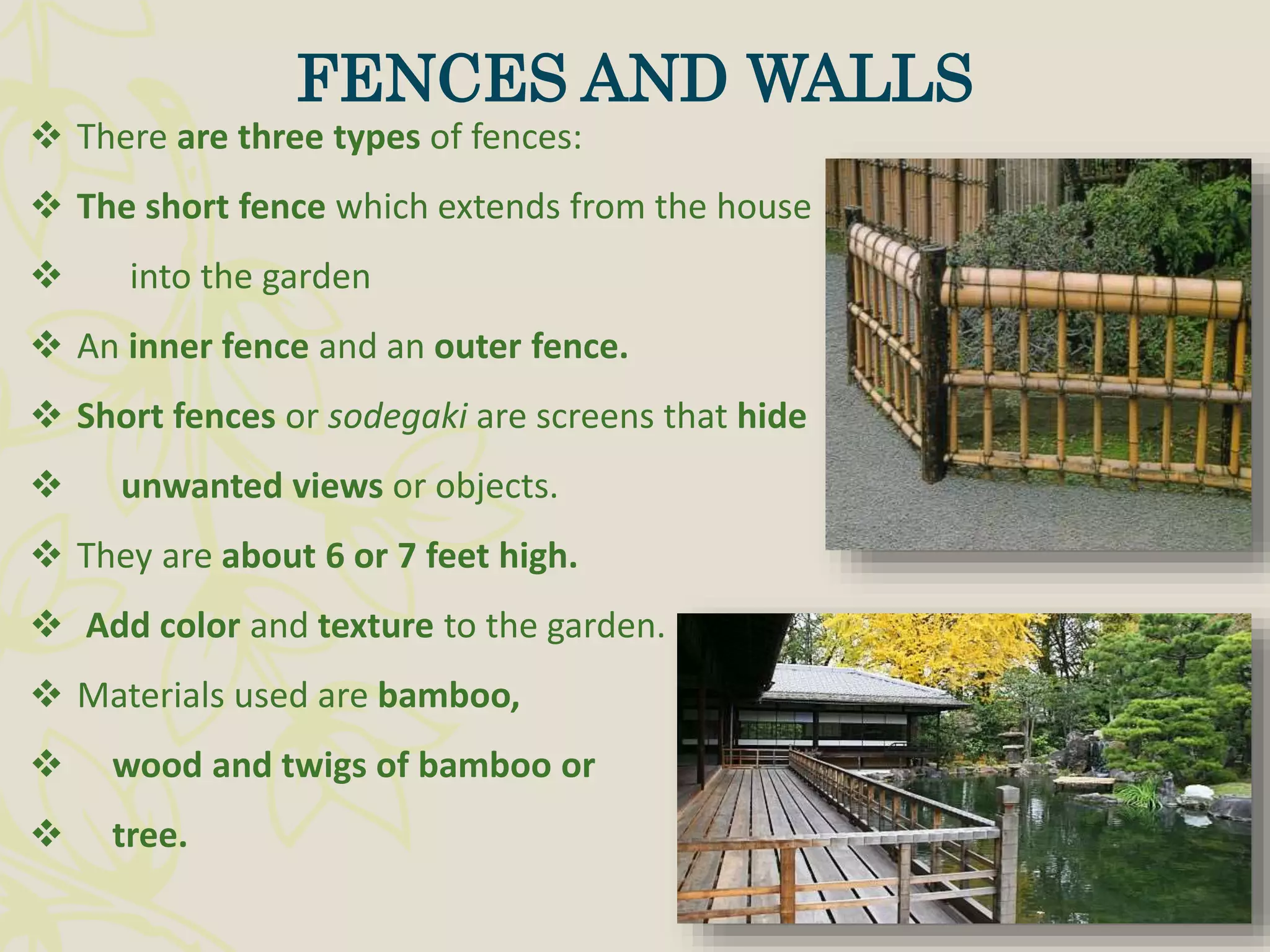
 There are three types of fences:
 The short fence which extends from the house
 into the garden
 An inner fence and an outer fence.
 Short fences or sodegaki are screens that hide
 unwanted views or objects.
 They are about 6 or 7 feet high.
 Add color and texture to the garden.
 Materials used are bamboo,
 wood and twigs of bamboo or
 tree.
FENCES AND WALLS
TYPES OF JAPANESE GARDENS
 Legacy of ancient Chinese imperial park tradition.
 The imperial hunting parks complete with vast man-made lakes and
miniature mountains and islands.
 The imperial gardens were created on a massive scale and filled with all
manner of choice indigenous plants, shrubs, and trees.
 Stroll gardens are by definition gardens for walking in. Here visitors can
enjoy a leisurely stroll taking in all beautiful scenery. All the ingredients
that make a Japanese garden are here- rocks, plants, and water.
THE STROLL GARDENS
 Also described as “gardens of emptiness”.
 Generally, a garden that has nothing but a few bare rocks in patch of
sand.
 These gardens were uncluttered and reduced to the bare minimum.
 Some refer to them as mini-malsit gardens also.
 Also called “Kare-sansui” which means empty landscape.
 Zen warriors(highly educated) developed a very sophisticated and
refined sense of artistic taste and that combined with their very simple
and frugal life style evolved into the characteristic Zen style that we
know today.
THE ZEN TEMPLE GARDENS
 On first impression tea garden appears to be simply a small Japanese
garden consisting of a few stepping stones plus a lantern, water basin
and tiny hut.
 The traditional tea garden is in fact two garden in one.
 There is the simple outer garden, where guest gather in a waiting area,
and the inner garden that contains the tea house.
 The outer garden is approached by a stepping stone path, lit by a rough
stone lantern.
 The tea garden is essentially a small garden no bigger than the passage
way of a normal suburban house
including the backyard.
 The stepping stone path leads to the
waiting area which has a simple hut
like structure with a bench often
referred to as the waiting pavilion.
 The entrance area, which
incorporates the stepping stone
path is the outer garden.
TEA GARDENS
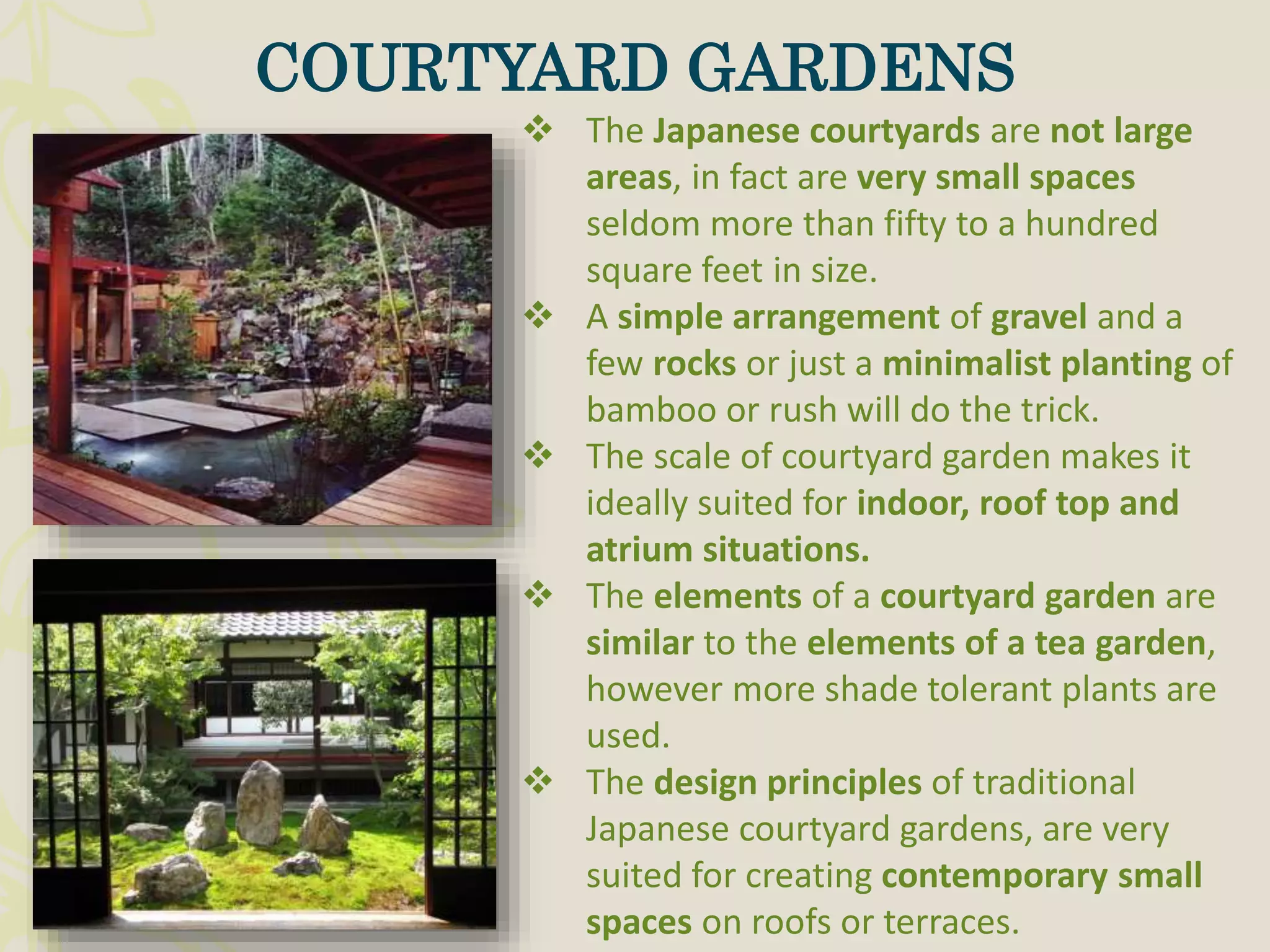
 The Japanese courtyards are not large
areas, in fact are very small spaces
seldom more than fifty to a hundred
square feet in size.
 A simple arrangement of gravel and a
few rocks or just a minimalist planting of
bamboo or rush will do the trick.
 The scale of courtyard garden makes it
ideally suited for indoor, roof top and
atrium situations.
 The elements of a courtyard garden are
similar to the elements of a tea garden,
however more shade tolerant plants are
used.
 The design principles of traditional
Japanese courtyard gardens, are very
suited for creating contemporary small
spaces on roofs or terraces.
COURTYARD GARDENS
REFERENCES
http://www.japan-guide.com/e/e2099_types.html
http://web-japan.org/factsheet/en/pdf/26Gardens.pdf
http://www.japan-guide.com/e/e2099_elements.html
http://www.japan-guide.com/e/e2099_list.html
http://www.japanorbit.com/japanese-culture/japanese-
garden.html
http://en.wikipedia.org/wiki/Japanese_garden
http://digitaljournal.com/article/353493
http://www.zen-garden.org/html/page_Overview.htm
http://jh2403a.wordpress.com/2010/01/31/japanese-
influences-on-modern-
THANKYOU

Japanese garden

  • 1.
    Japanese gardens NAR-604 LANDSCAPE DESIGN B.ARCH 6TH SEMESTER SECTION–A SESSION -2015-16 SUBMITTED TO- AR. UMESH GOVIL SIR SUBMITTED BY- ISHITA ISHU JAYA JITENDRA JUHI JUNAID KAMAL
  • 2.
     The artof gardening is believed to be an important part of Japanese culture for many centuries.  Shinto, Buddhism and Taoism were used in the creation of different garden styles in order to bring a spiritual sense to the gardens and make them places where people could spend their time in a peaceful way and meditate.  Core values of Japanese gardening have been largely shaped by Chinese culture and tradition.  Religion, in particular Buddhism, also had a major influence on Japanese gardening.  According to Shintoism ,the native religion of Japan “everything in nature is sacred”; trees, plants, and rocks.  They used white gravel in temples as to keep areas clean and white as a means of enticing the spirits and gods to visit these places.  Shintoism is not much the worship of rocks ,but the veneration of the spirit that created those objects. INTRODUCTION
  • 3.
     The historyof the Japanese gardens goes back to around the 7th century. The first Japanese gardens, that expressed Shinto, Buddhism and Taoism visions can be traced back to the Asuka Period. They were designed to capture the landscape in its natural form. From this period the basic rules of designing gardens was established.  Heian Period is the second very important chapter in the development of Japanese garden art. Aristocratic style of gardens where created in front of the mansion with artificial ponds and islands.  During the Kamakura Period and Muromachi Period garden-making techniques improved considerably because of the rise of the Zen style. Many gardens designed in that time were properties of successive shoguns and daimios, who belong to the highest class in Japanese society. Famous gardens created after Meiji Period were frequented by business people and politicians. Most of them are opened to the public now and play a role in city parks. HISTORY
  • 4.
     Natural: Thatshould make the garden look as if it grew by itself  Asymmetry: That creates the impression of it being natural  Odd numbers: Like three, five or seven; that support the effect of the asymmetry.  Simplicity: That follows the idea of 'less is more'  Triangle: That is the most common shape for compositions made of stones, plants, etc.  Contrast: That creates tension between elements  Lines: That can create both tranquillity and tension  Curves: That softens the effect  Openness: That indicates interaction between all elements BASIC RULES IN THE DESIGN OF JAPANESE GARDENS
  • 5.
     The linebetween garden and its surrounding landscape is not distinct.  In the Japanese garden, the viewer should consider nature as a picture frame into which the garden, or the man- made work of art, is inserted.
  • 6.
  • 7.
     A commondesign principle found in most Japanese garden is the use of asymmetry.  Plants and trees are often arranged in an asymmetric fashion, as are fences and hedges.  The clever use of space is unique where empty spaces are deliberately left unfiled to create feeling of spaciousness and uncluttered calm.  Balance, the proportions and spaces are an essential design principle.
  • 8.
     Plants arerepresented by moss that surrounds the rock.  Water is represented by raked gravel.  In spring one revels in the bright green of new buds and the blossoms of the azaleas.  In summer , the contrasts of the lush foliage painted against the cool shadows.  Fall wrests the brilliant colors from dying leaves as they slip into the deathly hush of winter, the garden buried under a shroud of snow.  Winters is as much a garden season in Japan as spring. The Japanese refer to snow piled on the branches of trees a sekku, or snow blossoms, and there is a lantern known as yukimi that is named the snow viewing lantern.
  • 9.
  • 10.
    There are threekey elements without which a Japanese garden cannot be made, that are: Plants Rocks Water Other subsidiary elements: Paths Lanterns Fences  A stone lantern representing four natural elements: earth, water, fire and wind.  Statues of male and female lions, placed at the entrance of the garden in order to protect the garden from intruders.  Water basin known as a deer chaser, which keep deer away by making a special sound when filled up.  Typical Japanese bridge, called a moon bridge, whose purpose is to reflect artistic feelings.
  • 12.
     Japanese gardenis predominately green with its use of evergreen trees.  The trees and plants are chosen not just for their beauty and gracefulness but also for their symbolism.  The deep greens of pines symbolize timeless and longevity, while the colors of the maples and cherries reflect the changing seasons. PLANTS
  • 13.
     Cherry (Prunusserrulata) and plum trees are extensively used in Japanese gardens. Both flowers in early April. Moss:  It is a simple plant and there are many different varieties in existence.  Moss needs damp shady conditions in order to flourish.  In constantly dry, sunny aspect, it will not grow.  Moss is most often found in woodland area under the shade of trees where nothing else will grow.
  • 14.
     Scientific Name:Abies Firma  Habitat: Evergreen  Texture: Coarse  Height: 40’ to 70’  Leaf: 1.5" dark green needles are notched at base; sharp prickly point  Flower/Fruit: 3.5 to 5" brown cones JAPANESE FIR JAPANESE STRIPPED – BARK MAPPLE  Scientific Name: Acer capillipes  Habit: Deciduous  Growth Rate: Moderate  Site Requirements: Sun to partial shade; prefers moist,  well drained soil  Texture: Medium  Form: Round head; low branches  Height: 30 to 35’  Flower/Fruit: Greenish white flowers on 2.5 to 4" pendulous  raceme; attractive samara in fall TREES
  • 15.
     Scientific Name:Acer palmatum  Growth Rate: Slow to moderate  Site Requirements: Light dappled shade; evenly moist, well drained soil; protect from drying winds  Texture: Medium to fine  Form: Low; dense rounded top; spreading branches; assumes a layered look  Height: 15 to 25'  Flower/Fruit: Small red to purple  flowers; attractive if viewed closely but  insignificant from a distance. JAPANESE MAPLE
  • 16.
     Scientific Name Betulagrossa  Growth Rate: Moderate  Site Requirements: Sun; moist well drained soil  Texture: Medium  Form: Pyramidal  Height: 20 to 25'  Leaf: 2 to 4" alternate, simple leaves; yellow fall color  Flower/Fruit: Nonshowy flowers JAPANESE CHERRY BIRCH
  • 17.
     The rocksare like the coordinates of a garden project.  Choosing the right type of rock and positioning them on right place.  Size is meaningful only when viewed in the context of the scale of the garden & its relationship with the neighboring rocks and other artifacts.  Variation in rock sizes offer greater contrast & interest resulting in the more dynamic arrangement of rocks. ROCKS
  • 18.
     Rocks areoften used to represent islands and mountains, so conical or dome shape would be the obvious choice.  Colors, generally bright colors are avoided.  Color of rocks generally varies from grey to black, and from yellow to brick red on other hand.  Texture, one of the vital characteristics of any rock.  A jagged textured rock gives feeling of timelessness and dignity.  Smooth rocks like water worn stones or glacial boulders convey the feeling of antiquity especially when combined in an interesting shape.
  • 19.
    Placing of rocksin Japanese gardens is quite rhythmic just like a music composition where individual rocks acts as musical notes. Certain guidelines or ground rules are followed to achieve good results such as:  Rocks of varying sizes are used to emphasize the contrast.  Generally asymmetric arrangement of rocks is preferred over symmetrical arrangement.  Sometimes there is a tradition for arranging the rocks to reflect the philosophical concept heaven, earth and man.
  • 20.
     Water isused not just for its visual quality, but also for its sound.  The Japanese have learnt to exploit the sound of water in all its various form. it varies from powerful waterfall to water falling into a water basin, creating different emotions.  It represents the sea, lake, pond or river in nature. Non geometrical in appearance; in order to preserve the natural shapes, man-made ponds are asymmetrical.  The bank of the pond is usually bordered by stones. A fountain is sometimes found at the bottom of a hill or hillside or secluded forest.  Wells are sometimes found in a Japanese garden. WATER OR IKE
  • 21.
     There arenumber of ways in which water can be used in Japanese gardens:  As a pond or lake setting, in a stream and as a waterfall.  If the objective is to create an expensive atmosphere then a pond or lake is the answer.  If the aim is dynamic effect, which will stimulate both visual and acoustic senses then waterfall is more suitable.
  • 22.
     Usually usedin tea gardens.  Flat stepping stones served to preserve the grass as well as orient the viewer to a specific visual experience.  Step- stones are found near the veranda or entrance of the house or tea room. The visitor of the house or room is expected to place his shoes on the step- stone before entering. PATHS OR TOBI ISHI
  • 23.
     The basinsvary from simple depressions in uncut stone to elaborate carved stone creations, and are usually provided with a bamboo dipper for scooping up water. Two kinds of stone water basins-  Kazari- chozubachi, which is kept near the verandah  Tsukubai for tea garden  Stone lanterns are placed besides prominent water basins whose luminance underscored the unfinished beauty of the tea aesthetic. WATER BASINS AND LANTERNS
  • 24.
     There arethree types of fences:  The short fence which extends from the house  into the garden  An inner fence and an outer fence.  Short fences or sodegaki are screens that hide  unwanted views or objects.  They are about 6 or 7 feet high.  Add color and texture to the garden.  Materials used are bamboo,  wood and twigs of bamboo or  tree. FENCES AND WALLS
  • 25.
  • 26.
     Legacy ofancient Chinese imperial park tradition.  The imperial hunting parks complete with vast man-made lakes and miniature mountains and islands.  The imperial gardens were created on a massive scale and filled with all manner of choice indigenous plants, shrubs, and trees.  Stroll gardens are by definition gardens for walking in. Here visitors can enjoy a leisurely stroll taking in all beautiful scenery. All the ingredients that make a Japanese garden are here- rocks, plants, and water. THE STROLL GARDENS
  • 27.
     Also describedas “gardens of emptiness”.  Generally, a garden that has nothing but a few bare rocks in patch of sand.  These gardens were uncluttered and reduced to the bare minimum.  Some refer to them as mini-malsit gardens also.  Also called “Kare-sansui” which means empty landscape.  Zen warriors(highly educated) developed a very sophisticated and refined sense of artistic taste and that combined with their very simple and frugal life style evolved into the characteristic Zen style that we know today. THE ZEN TEMPLE GARDENS
  • 28.
     On firstimpression tea garden appears to be simply a small Japanese garden consisting of a few stepping stones plus a lantern, water basin and tiny hut.  The traditional tea garden is in fact two garden in one.  There is the simple outer garden, where guest gather in a waiting area, and the inner garden that contains the tea house.  The outer garden is approached by a stepping stone path, lit by a rough stone lantern.  The tea garden is essentially a small garden no bigger than the passage way of a normal suburban house including the backyard.  The stepping stone path leads to the waiting area which has a simple hut like structure with a bench often referred to as the waiting pavilion.  The entrance area, which incorporates the stepping stone path is the outer garden. TEA GARDENS
  • 29.
     The Japanesecourtyards are not large areas, in fact are very small spaces seldom more than fifty to a hundred square feet in size.  A simple arrangement of gravel and a few rocks or just a minimalist planting of bamboo or rush will do the trick.  The scale of courtyard garden makes it ideally suited for indoor, roof top and atrium situations.  The elements of a courtyard garden are similar to the elements of a tea garden, however more shade tolerant plants are used.  The design principles of traditional Japanese courtyard gardens, are very suited for creating contemporary small spaces on roofs or terraces. COURTYARD GARDENS
  • 30.
  • 31.